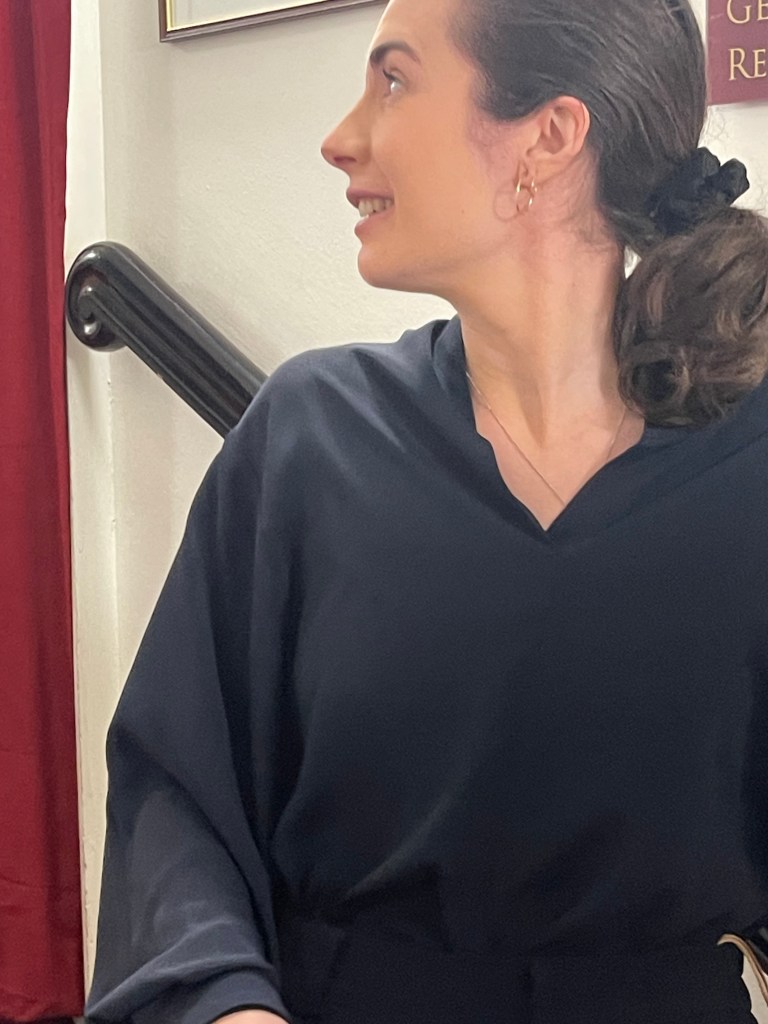

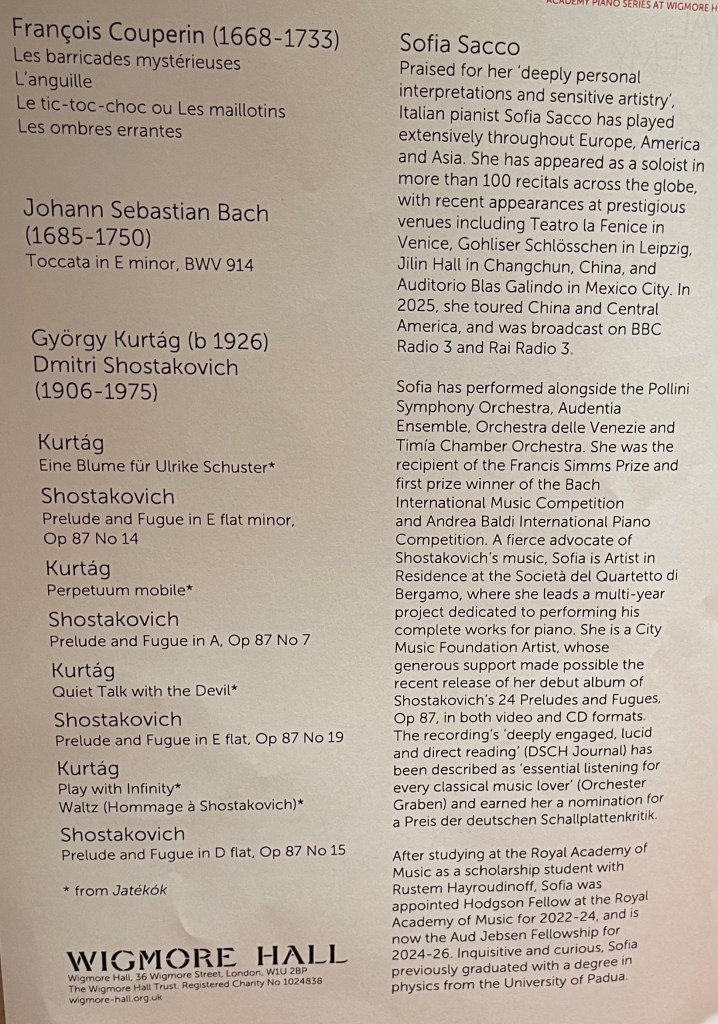

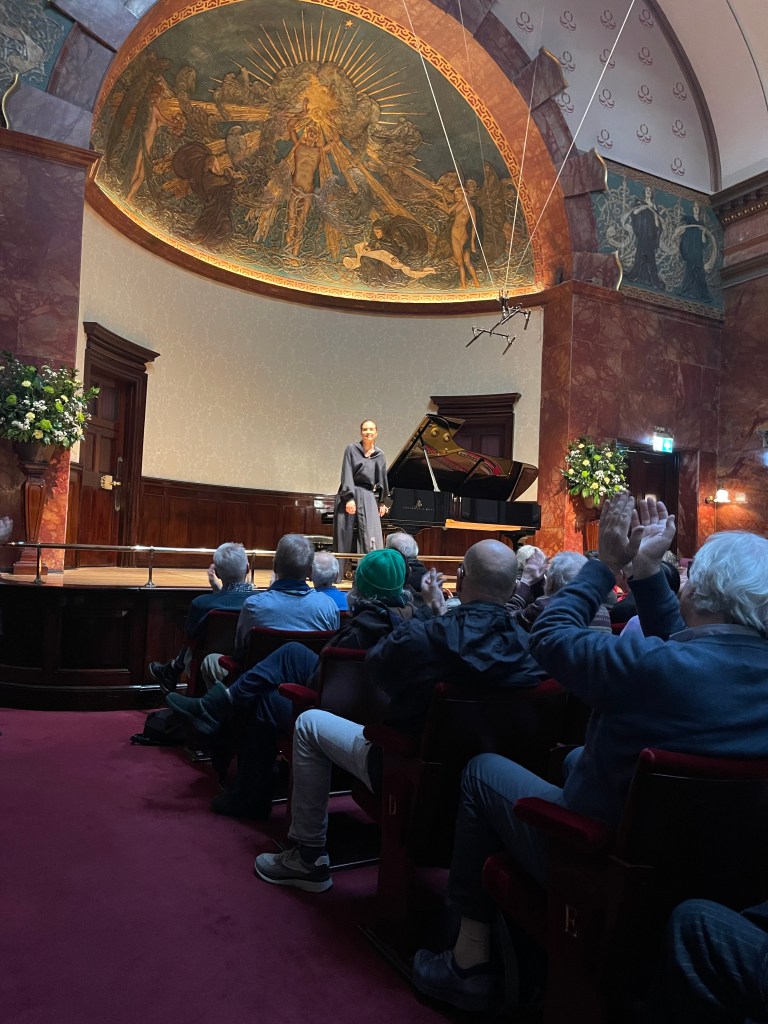
Sofia Sacco swimming in sounds of radiance and questioning beauty. From the fluidity of Couperin through the improvisations of Bach to the magical world of Kurtág and surprisingly Shostakovich.
There was a beautiful fluidity to the first of the pieces by Couperin with the whispered sounds that she brought to ‘Les barricades’ before the Scarlattian clarity and brilliance of ‘L’anguille’. Brilliance too with ‘Le tic -toc-choc’ but also a beguiling rhythmic energy. Finishing this group with the refined delicacy and beauty of the whispered asides of ecstatic radiance of ‘Les ombres errantes’.
An opening that immediately showed the beauty of sound and refined musicianship that she was to bring to the entire recital. Her loose flowing gown allowed her to swim in musical waters with florid horizontal movements that could caress the keys with great sensitivity giving access to a kaleidoscopic sound world of chameleonic beauty.
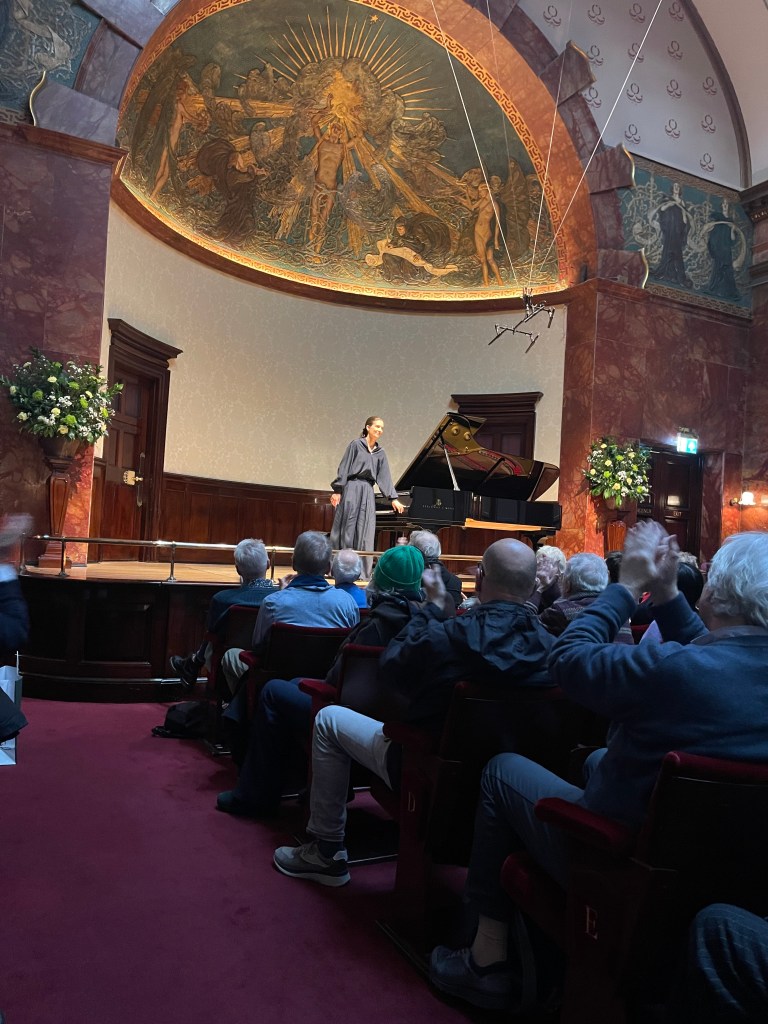

A timeless improvisatory world opened up with Bach’s E minor Toccata. An opening declaration was followed by a whispered fugato of radiant beauty and a moment of silence before a searching recitativo of extraordinary sensitivity. Another long pause and silence before the complete change of character with the Toccata that at first seemed at breakneck speed but which she keep under complete control and also sotto voce with an exhilarating rhythmic impetus as it built up into joyous almost outrageous Busonian glory. A very original interpretation of sensitivity, imagination and scholarship showing the technical command that were the very raison d’être of Bach’s seven Toccatas.


It was now that Sofia’s fantasy world of colour and imagination could be revealed with a beguiling mix of Kurtág and Shostakovich. An extraordinary multitude of sounds with Kurtág’s ‘Eine Blume’ barely whispered but then bursting into burning intensity with notes ‘pummelled’ with fists, not with violence but with reverberations of vibrating urgency. Shostakovich was to enter sharing the same sound world so naturally with the fugue n. 14, full of mystery and pastoral calm. Little did we suspect that Kurtág’s ‘Perpetuum mobile’ would be streams of glissandi played with varying intensity and great fantasy but finishing like Beethoven with a final definitive ‘clout’ ! Waves of sound were continued with Shostakovich n. 7 as Kurtág’s ‘Quiet talk with the Devil’ entered with whispered bass notes full of mystery and questioning energy only to finish with an astonishing moment of silence. Shostakovich was now ready to make his presence felt with the magisterial outpouring of n. 19 with his dynamic almost punched out fugue. Kurtág playing with infinity as a left hand scale crawled from the top to the bottom of the keyboard with strange reverberations imposed on its infinite journey. This was transformed into the waltz that was Kurtág’s ‘Hommage à Shostakovich’ with fists full of notes bouncing like a ‘kitten on the keys’ in vague waltz time. No one can doubt the impish sense of humour of a musician who could terrify his colleagues with his burgeoning insistence. Now Shostakovich had the field with his spiky almost Prokofiev style fugue. A brilliant mix that made me want to hear more and explore the sound world of Shostakovich and Kurtág.
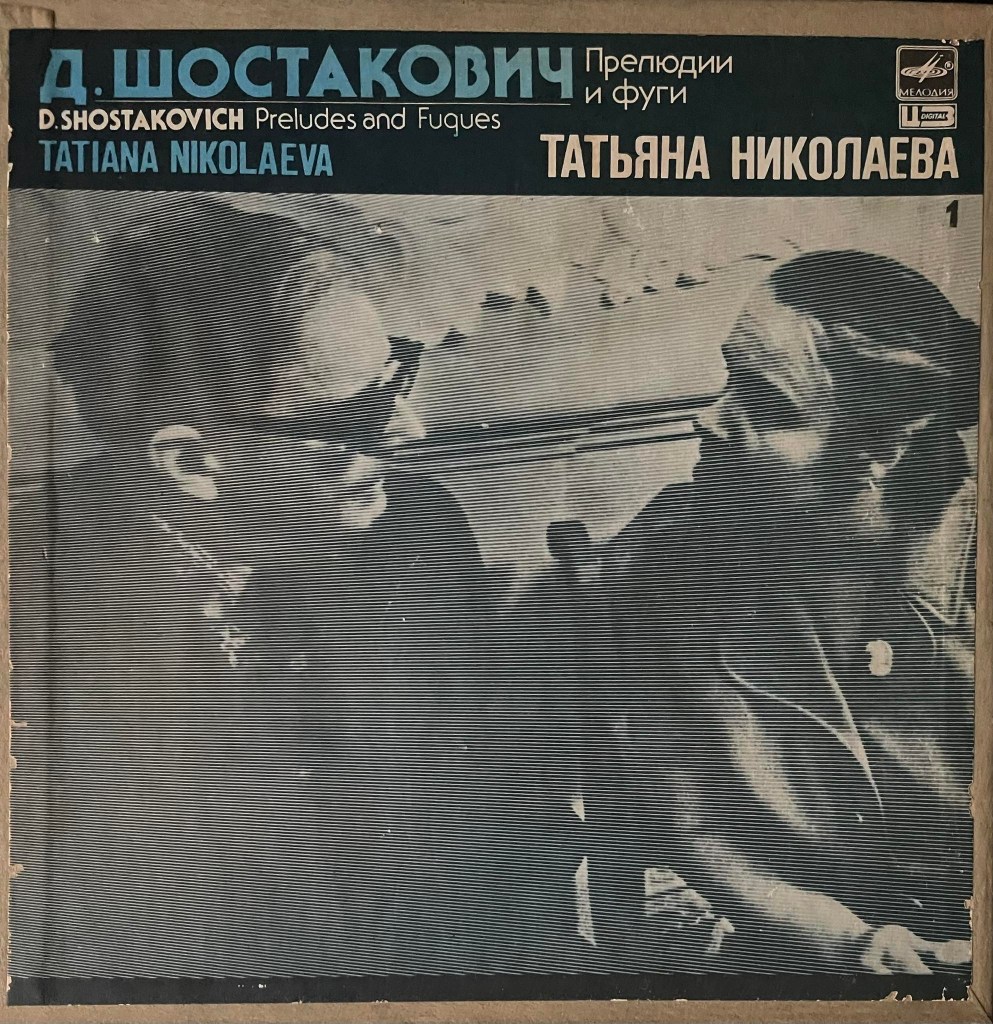
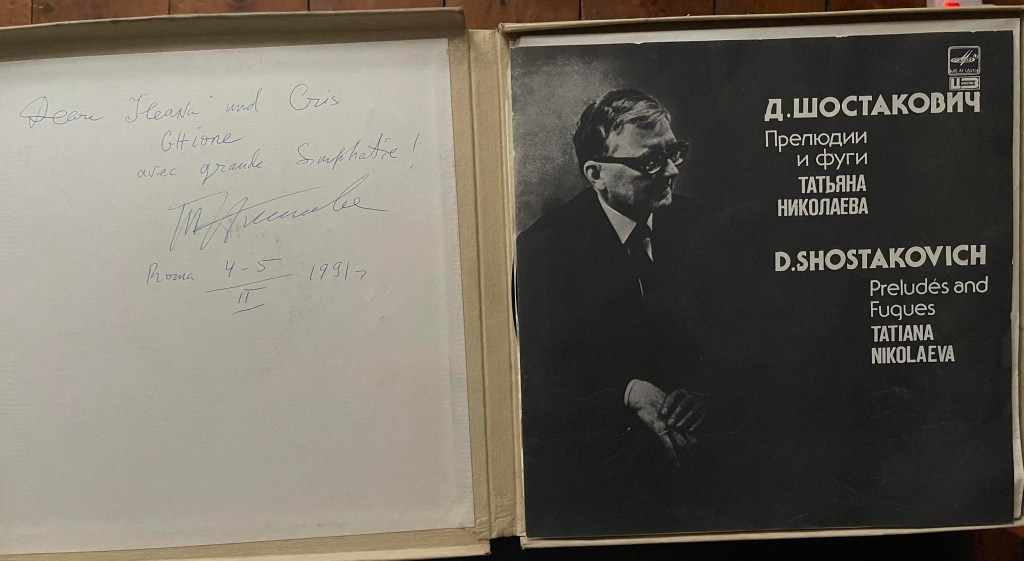
Nikolaeva to whom the Shostakovich Preludes and Fugues were dedicated, gave me her original box set of recordings but I have never had the courage to listen as I am not an admirer of the post revolution Russian violence towards the piano. Sofya today showed me a side of Shostakovich of fantasy and beauty that touched me deeply.

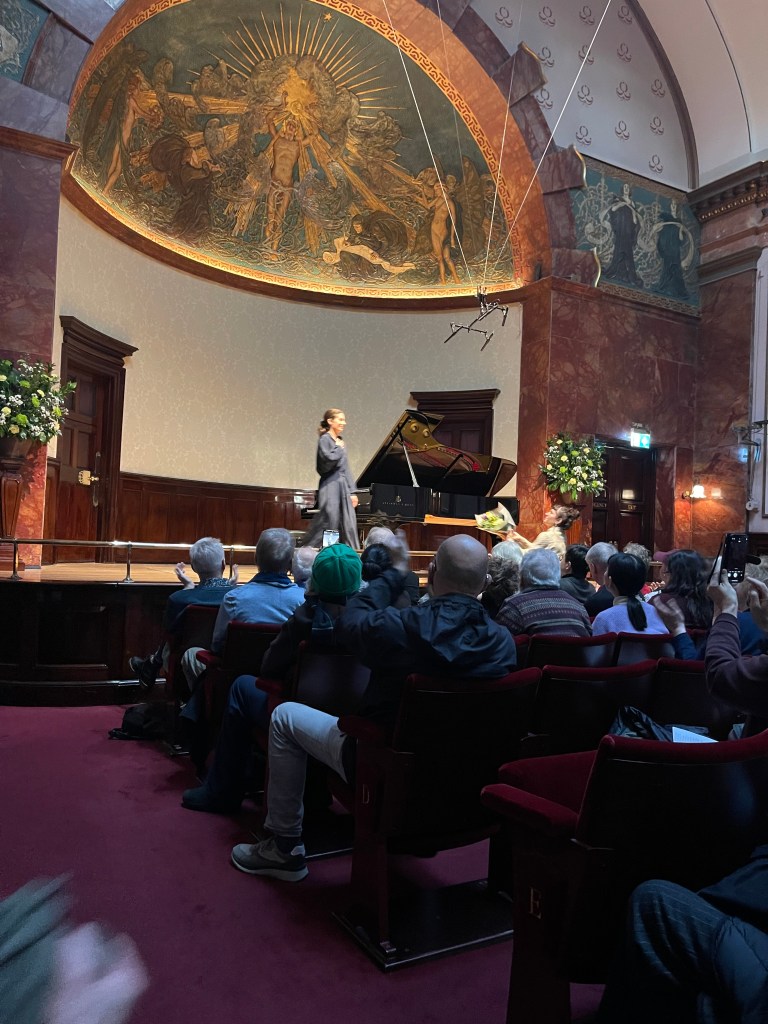
Having broken the spell Sofya was persuaded with two bouquets of flowers and much applause to share with us Kabalevsky’s Prelude and Fugue in C op 61 ‘Becoming a Younger Pioneer’ which she played with remarkable technical ease and conviction. But she was now preaching to the converted!

Játékok (Hungarian: Games) is an ongoing collection of “pedagogical performance pieces .He has been writing them since 1973. Ten volumes had been published as of 2021 (by Editio Musica Budapest). Volumes I, II, III, V, VI, VII, IX and X are for piano solo. Volumes IV and VIII are for piano 4-hands or two pianos.
Volume I was essentially completed in 1973 but not published until 1979, by which time Volumes II, III and IV had also been composed. Volumes V and VI were published in 1997, Volume VII in 2003, Volume VIII in 2010, Volume IX in 2017, and Volume X in 2021.
Several pieces from the collection have started to be regularly performed, including a Prelude and Chorale, an Antiphon in F♯, and one called 3 in memoriam.
Kurtág began the composition of Játékok to try to recapture something of the spirit of a child’s play He started with a few ideas set out in the foreword to the first four volumes:
The idea of composing Játékok was suggested by children playing spontaneously, children for whom the piano still means a toy. They experiment with it, caress it, attack it and run their fingers over it. They pile up seemingly disconnected sounds, and if this happens to arouse their musical instinct they look consciously for some of the harmonies found by chance and keep repeating them.
Thus, this series does not provide a tutor, nor does it simply stand as a collection of pieces. It is possibly for experimenting and not for learning “to play the piano”. Pleasure in playing, the joy of movement – daring and if need be fast movement over the entire keyboard right from the first lessons instead of the clumsy groping for keys and the counting of rhythms – all these rather vague ideas lay at the outset of the creation of this collection.
Playing is just playing. It requires a great deal of freedom and initiative from the performer. On no account should the written image be taken seriously but the written image must be taken extremely seriously as regards the musical process, the quality of sound and silence. We should trust the picture of the printed notes and let it exert its influence upon us. The graphic picture conveys an idea about the arrangement in time of the even the most free pieces. We should make use of all that we know and remember of free declamation, folk-music, parlando-rubato, of Gregorian chant, and of all that improvisational musical practice has ever brought forth. Let us tackle bravely even the most difficult task without being afraid of making mistakes: we should try to create valid proportions, unity and continuity out of the long and short values – just for our own pleasure!
 ChristopherAxworthy-MusicCommentary