
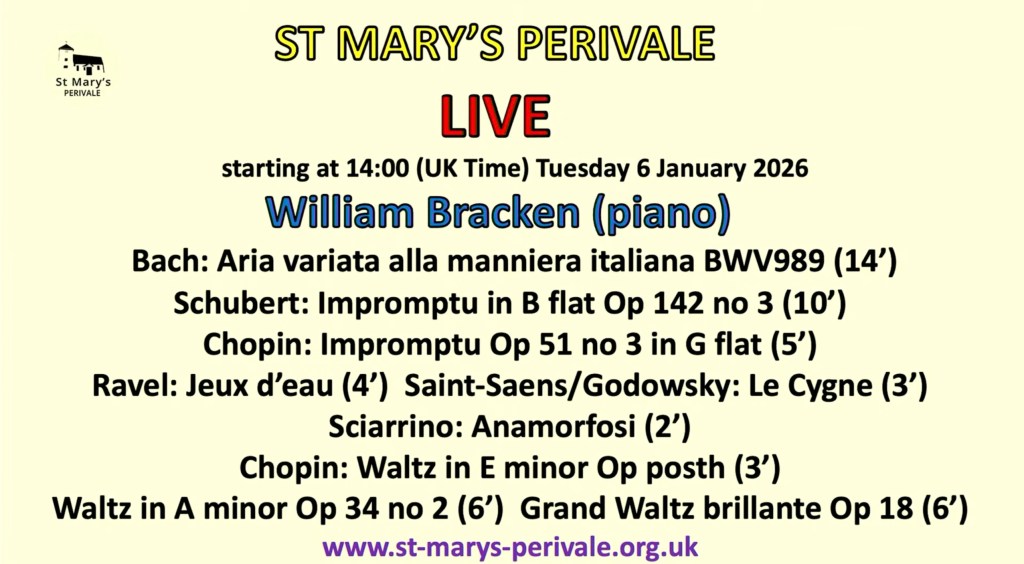
It is fascinating to follow the evolution of young pianists and see what influences they follow during their long training in many of the finest music institutions of the land. William has been studying for the past years with Martin Roscoe and I was with Martin last summer to applaud William’s final graduation recital at Milton Court . I had heard William for the first time when he won the Beethoven prize at the Guildhall playing a very fine Beethoven ‘Les Adieux’ Sonata. A musical pedigree nurtured by Martin Roscoe, that superb musician who many moons ago we both played to Stephen Kovacevich at the Dartington Summer School in the era of William Glock. Martin has gone on to be not only a celebrated solo pianist but also a much sought after chamber music player. Spending much time walking in the Scottish Highlands where he lives he still finds time to help nurture talented young musicians at the Guildhall. The last time I heard William he played Messiaen with extraordinary conviction and technical mastery and I was sure this would be the path his talent would lead him. Today I heard a completely different pianist ,one completely immersed in the magic world of pianists from the Golden Era of piano playing when pianists were magicians. Godowsky,Lhevine,Rosenthal,Levitski, Moiseiwitch and Cherkassky. I was lucky to live close to the Brentford Piano Museum and my teacher and father figure Sidney Harrison was President of Frank Holland’s extraordinary collection of player pianos. They were kept in a leaky church and there was no way that Frank would allow his ‘babies’ to end up in the V&A as was on the cards. Frank was an engineer and could not appreciate, as Sidney could, the gold mine of piano roll recordings that he had in his cupboard. Frank was interested in the mechanics not the music. Sidney had been the first teacher to give piano lessons on the BBCTV when it was a box that sat in the corner of a few houses and with a giant magnifying glass attached would transmit programmes for four hours a day! Thanks to Sidney the BBC recorded some of these piano roll performances and they were heard late at night on the third programme and were even issued as 33rpm records. The refined piano playing from these pianists, mainly of the Russian school, was something that we were not used to. A black box of hammers and strings that could be made to sing?! These pianists were illusionist who could create sounds with subtle piano playing and a sense of balance and touch that I had never heard before. They were musicians ,some more capricious than others, who were also showmen and would play a repertoire of short pieces, often their encores, that could fit easily into the limited time span of the rolls. It was much later with the arrival in the west of Richter ,Gilels and Ashkenazy that we could full appreciate this ‘Russian’ school of playing. The astonishing thing about Richter for example was not his astonishing mastery and virtuosity but was how quietly he could play and project sounds into the hall that were within the range of piano and pianissimo rather than forte and fortissimo.

From the very first notes today there was a crystalline clarity to the playing of delicacy and sensitivity.Variations that gradually unfolded without ever loosing the clarity or luminosity due to a very precise sense of touch and mastery of the pedals. Playing of great poise and aristocratic simplicity with moments of sublime almost religious reflection. Ornaments that shone like jewels but that were always part of the musical line giving poignant meaning and expression to the simple outpouring of Bach’s masterly knotty twine.
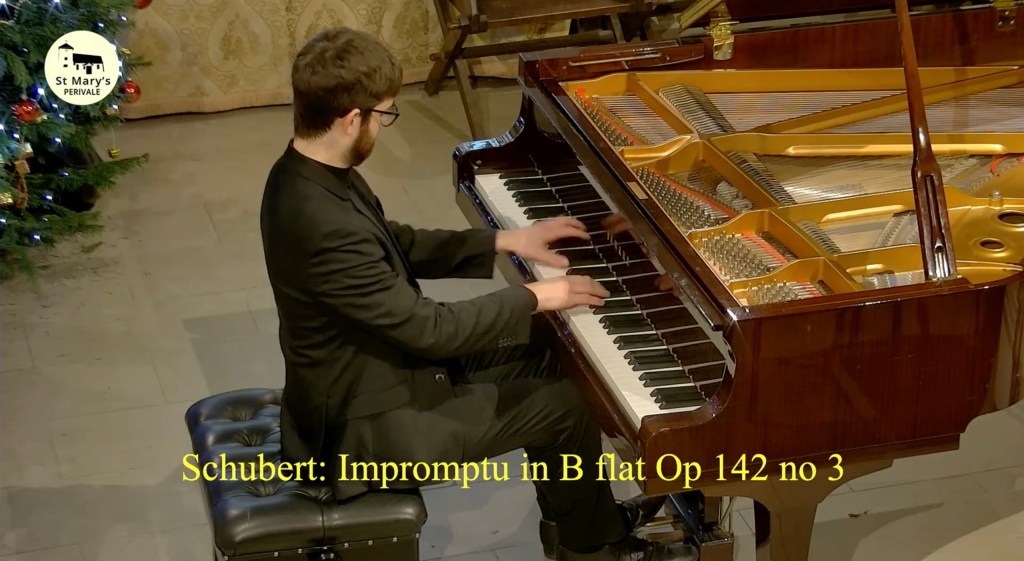
It was interesting to hear Schubert’s Impromptu followed by an improvised link to Chopin’s G flat Impromptu . Pianists of the Golden era and before, when a keyboard player was also a kapellmeister. would often improvise between pieces to link the key changes into one harmonious music journey. William brought great fluidity to this theme and set of variations. A subtle kaleidoscope of colours was played with extraordinary sensitivity and with a jeux perlé of beguiling charm and grace.
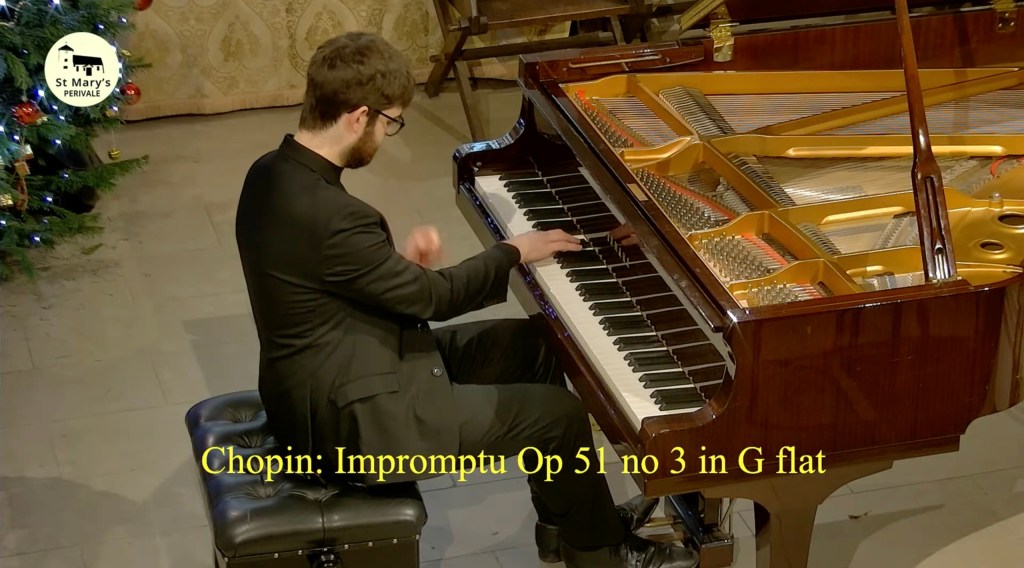
Chopin was played with more robust passion but also with a sense of improvised freedom and irresistible charm. The subtle beauty of the central tenor melody was a moment to cherish as great artistry was combined with simplicity and radiance.
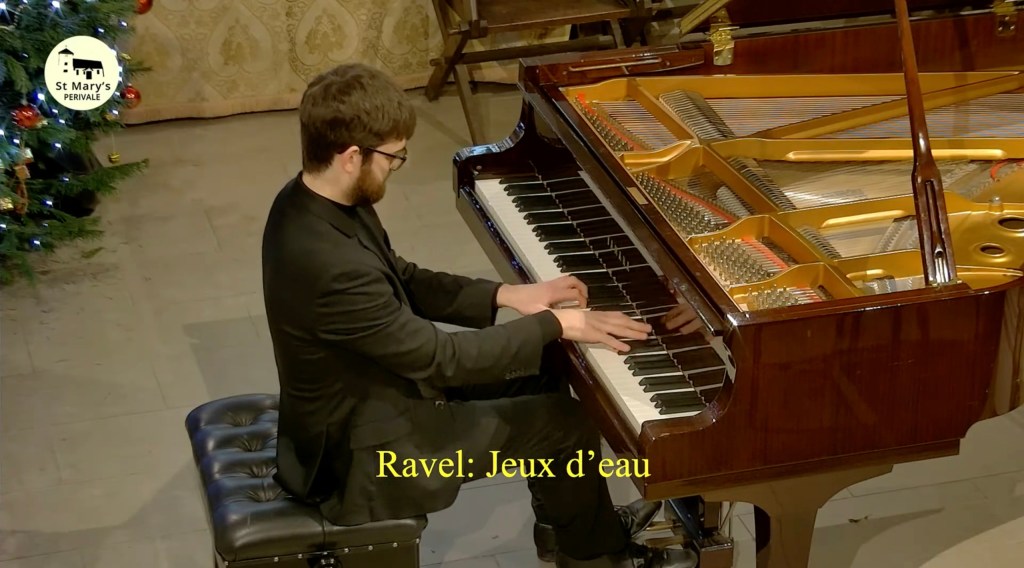
Ravel’s Jeux d’eau had the same clarity and delicacy as “Dieu fluvial riant de l’eau qui le chatouille” (“river god laughing at the water that tickles him”), which is inscribed on Ravel’s manuscript, and is the epigraph to the printed score. ‘Tickles’ with masterly pedalling that added a subtle sheen to William’s playing without ever clouding the luminosity of the overall texture. As my old teacher Perlemuter said “this work opens up new horizons in piano technique, especially if one remembers that Debussy’s ‘Jardins sous la pluie’ was not written until two years later, in 1903”.There was a beautiful radiance as the swells of sound spread over the keyboard as the golden light of the sun shines down on such marvels.
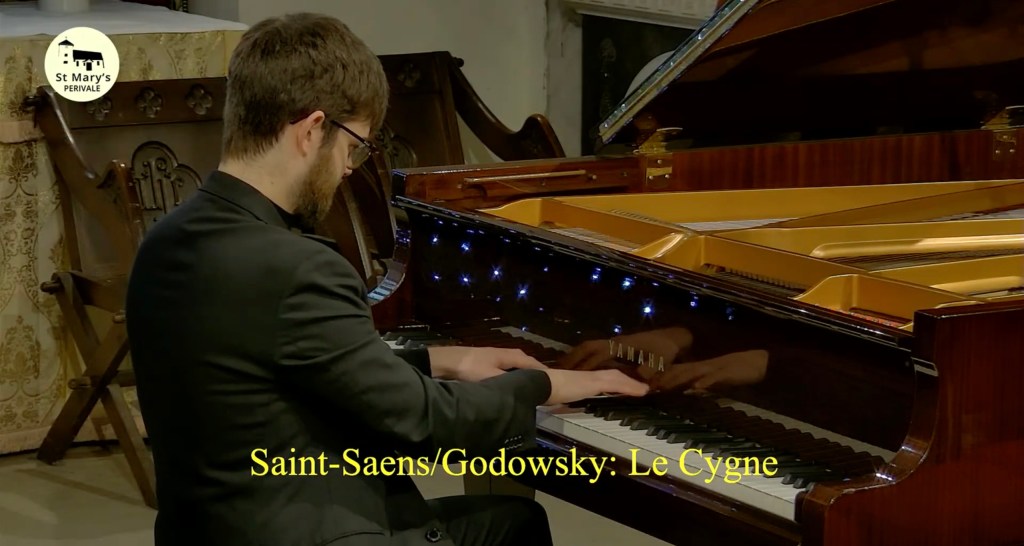
More marvels were to follow with Saint -Saens ‘The Swan’ in the magical transcription by Godowsky, perhaps the most subtle of all pianists of the Golden age and certainly one of the most reticent. I first heard this from the hands of Cherkassky on a 45rpm recording on which there was this and the Ravel Pavane and I have never forgotten the impact of that discovery when I was a student.
https://youtu.be/Ur7LCtKPzzA?si=A10GdtoucuG882be
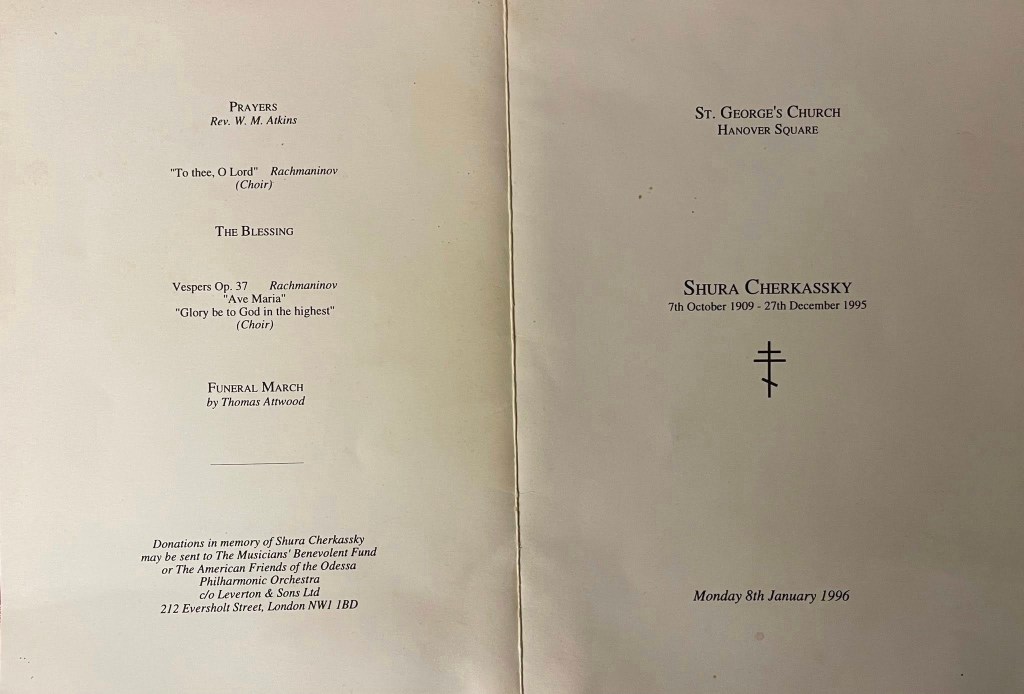
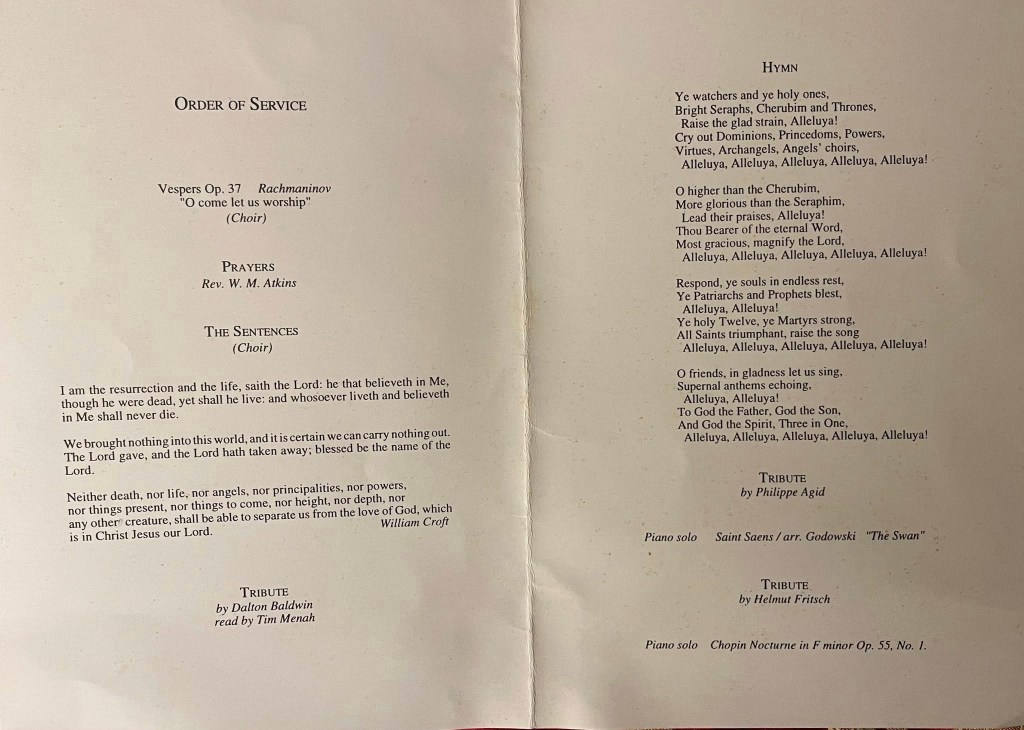
Cherkassky even played it at his own funeral ……..as Sidney Harrison played Funerailles at his ! William played it with the same beguiling insinuating half colours and whispered counterpoints imbued with a rubato of enticing decadence.
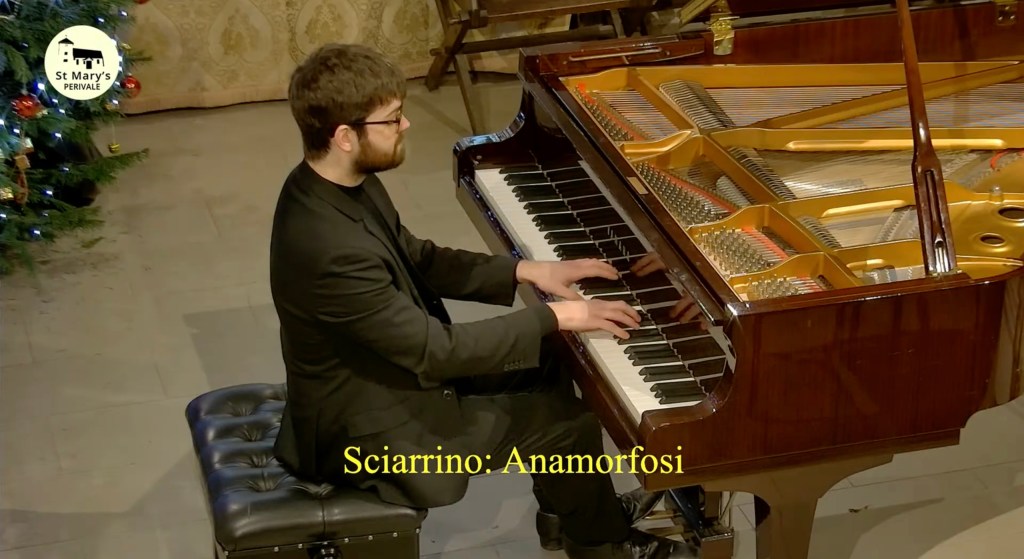
What fun the piece by Sciarrino is taking Ravel’s water works and having them singing in the rain. I spotted ‘Jeux d’eau’ and ‘Une barque sur l’océan’ and of course this : https://youtu.be/swloMVFALXw
It just shows William’s inexhaustible curiosity to search for unknown works and to include in this context what is obviously an improvised piece of fun by a serious contemporary composer.

William who holds a class at the Guildhall in improvisation explained that the three Chopin Waltzes he would play were linked by his own improvisations to make one unified whole almost as a Sonata – fast- slow -fast. This was in fact the tradition in Chopin’s day and so it was a return to the original moment of creativity in an age when instrumentalists were musicians with a capital ‘M’.

Substituting Chopin’s own opening flourish in the E minor with his own, leading into the waltz played with a sense of style and beauty that he was to bring to all three. Ravishing beauty to the languid A minor was followed by a beautiful improvisation that took us to E flat and the famous Grand Waltz Brillante op 18 of ‘Les Sylphides’.

Scintillating playing of buoyancy and brilliance but also of quite extraordinary musicality where even the acciaccatura’s we could have danced to with elegance and grace.

Pianist William Bracken’s creative voice stems from a deep fluency with the language of music itself, dissolving musical boundaries through improvisational state of mind, curiosity and acute contextual awareness. A visionary musician with a vast repertoire of classical masterworks, contemporary works and equally at home in jazz and improvised music, the Wirral-born pianist has won numerous awards including 1st prize at the 2022 Liszt Society International Piano Competition, 1st prize, press prize and audience prize at the 2023 Euregio Piano Award international piano competition, 2nd prize at the 2023 Livorno international piano competition 3rd prize at the 2024 UniSA international piano competition. He currently holds a position as a member of teaching staff in the Centre for Creative Performance and Classical Improvisation at the Guildhall School of Music and Drama in London.
Concert highlights include concerto performances at The Barbican, Liverpool Philharmonic Hall, St. John’s Smith Square and recitals at Carnegie’s Weill Hall in New York, Chipping Campden Festival, LSO St. Luke’s and Wigmore Hall, where he was praised by the Telegraph for his “ courage and stamina and musicality in abundance ” and “ an ability to hold an audience in the palm of his hand ”. He is also active as a core member of the improvisation group Ensemble+ and bandleader of the Will Bracken trio.
Bracken has collaborated with conductors such as Nicholas Collon (Aurora Orchestra) and Domingo Hindoyan (Royal Liverpool Philharmonic) and his chamber partners have included Michael Barenboim, Angela Hewitt and Jonathan Aasgard. During his studies in London William was made a scholar of the Imogen Cooper Music Trust which involved participating in a week of intensive study in the south of France with renowned pianist Dame Imogen Cooper. He also won a full scholarship to attend the Aspen Music Festival and Summer School in Colorado U.S.A in 2022, studying with Hung-Kuan Chen and Fabio Bidini.
 ChristopherAxworthy-MusicCommentary