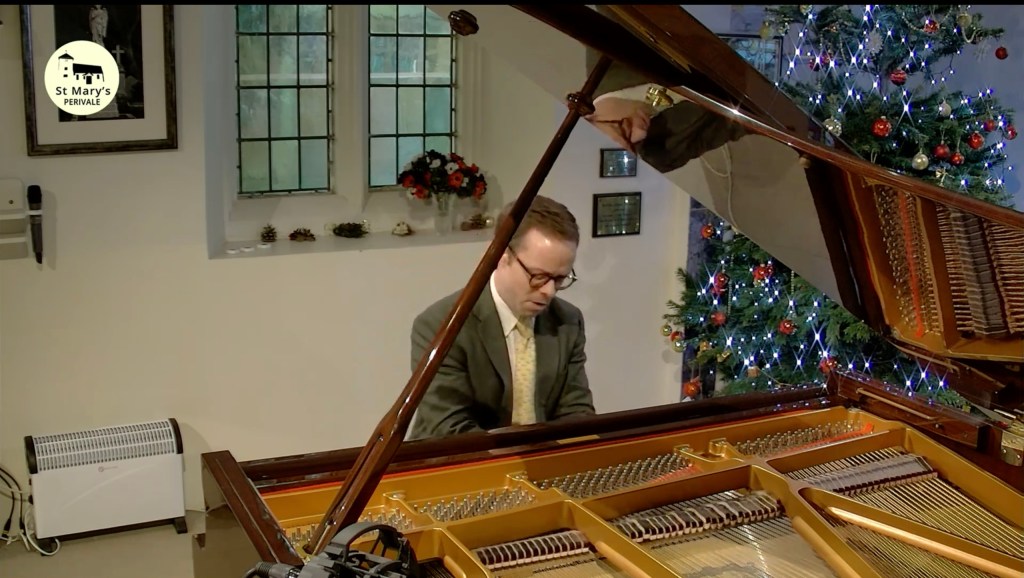
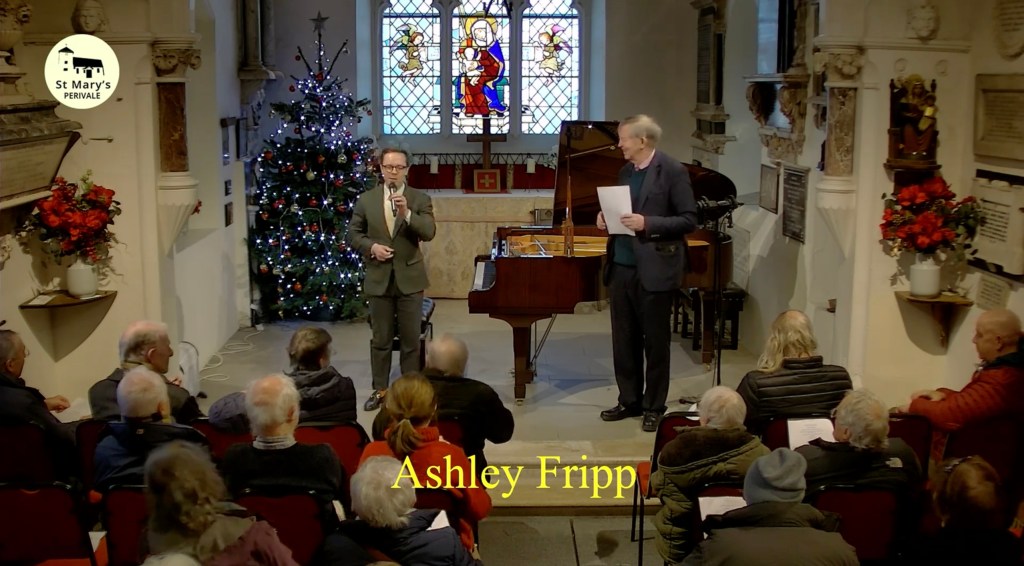
The tenth day of Christmas when ’10 Lords are Leaping’ and ‘Pipers are Piping.’ Ashley Fripp with his aristocratic demeanour is certainly a piped piper with twenty five recitals in Perivale to his credit over the past twenty years. I remember Eliso Virsaladze telling me about this remarkable young ‘English’ man that she had in her class that she held for many years in the little hillside town of Sermoneta, halfway from Rome or Naples and just a stones throw from my home in Sabaudia. Later I was to meet Ashley again in Fiesole on the hills above Florence where Eliso now gives five classes a year to master students. It was Ashley who gave one of the first recitals in the Harold Acton Library in a ‘Room with a View’ overlooking the Ponte Vecchio. Inspired by his performance I was invited by the director of the British Institute, Simon Gammell, to fill this beautiful space with music and aspiring young musicians eager to find an eclectic audience to share their music with. Ashley is now a distinguished member of the music profession but is still happy to continue playing in places run by friends who share the same passion that he has for music.
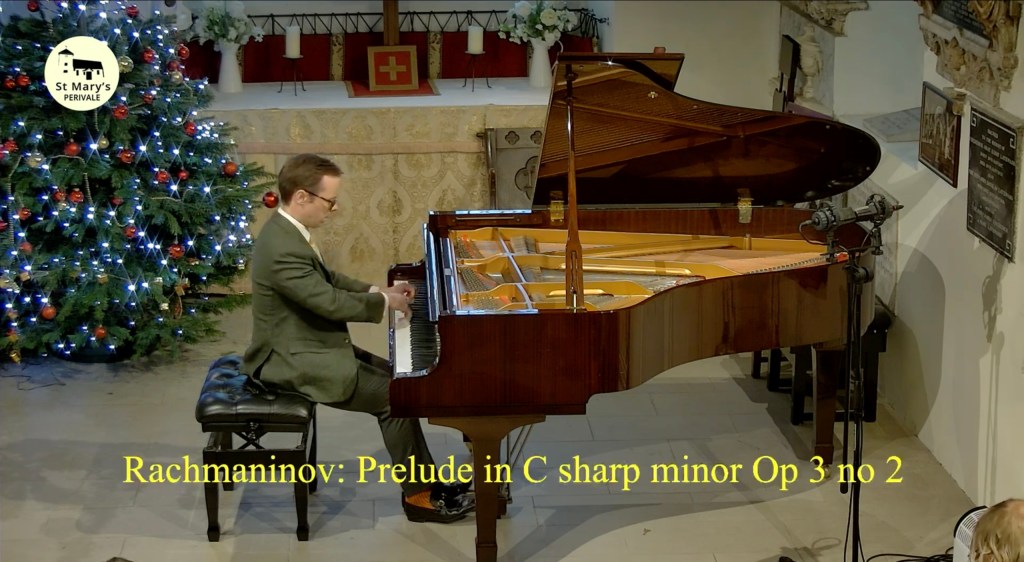
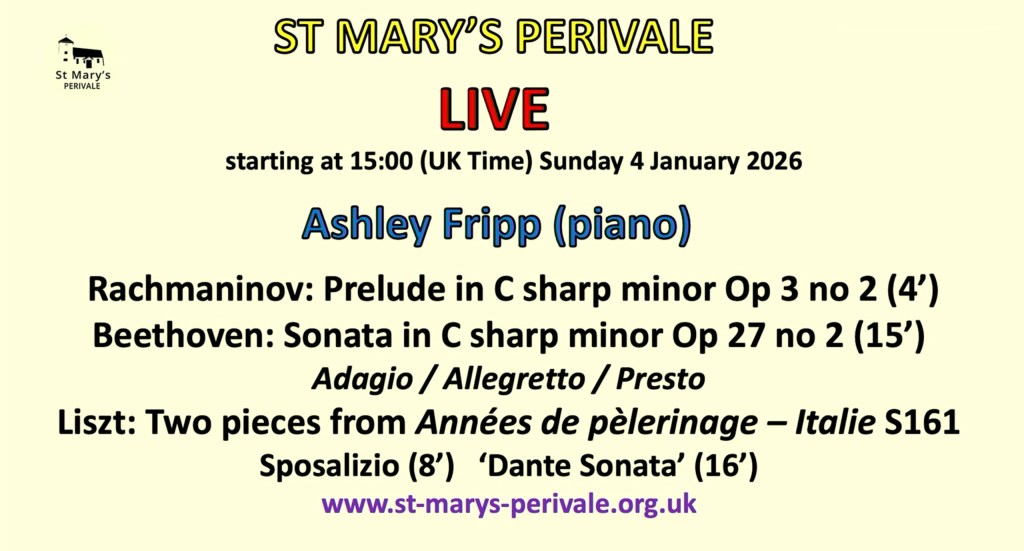
Beginning this recital, on what must be the coldest day of the year, with Rachmaninov’s Prelude – ‘The Bells of Moscow’ . Written when only 19 and bought for a pittance, it became so popular that it was referred to as “The Prelude”, and audiences would demand it as an encore, shouting: “C-sharp!” Because of this, Rachmaninoff grew very tired of it and once said: “Many, many times I wish I had never written it.” He called it his “Frankenstein” (alluding to a creation that got out of control) . It is a rarity now in the concert hall where we hear more often his two sets of Preludes op 23 and op 32 ,and so it was refreshing to hear the three mighty chimes ringing out with such authority today. It was played with great majesty , but also delicacy, as the bells are allowed to reverberate with pianississimi comments suspended in mid air. The central ‘agitato’ was played with great weight and the melodic line clearly played in what is usually a gabbled haze from lesser hands. Ashley’s masterly musicianship could steer its way with clarity and architectural shaping as this central episode gradually built in tension to a cadenza of alternating chords before the final triumphant outpouring of the opening theme, this time written orchestrally on four staves. After such a tumultuous outpouring the final few bars and the whispered glistening final notes were full of poetic imagination and startling beauty.
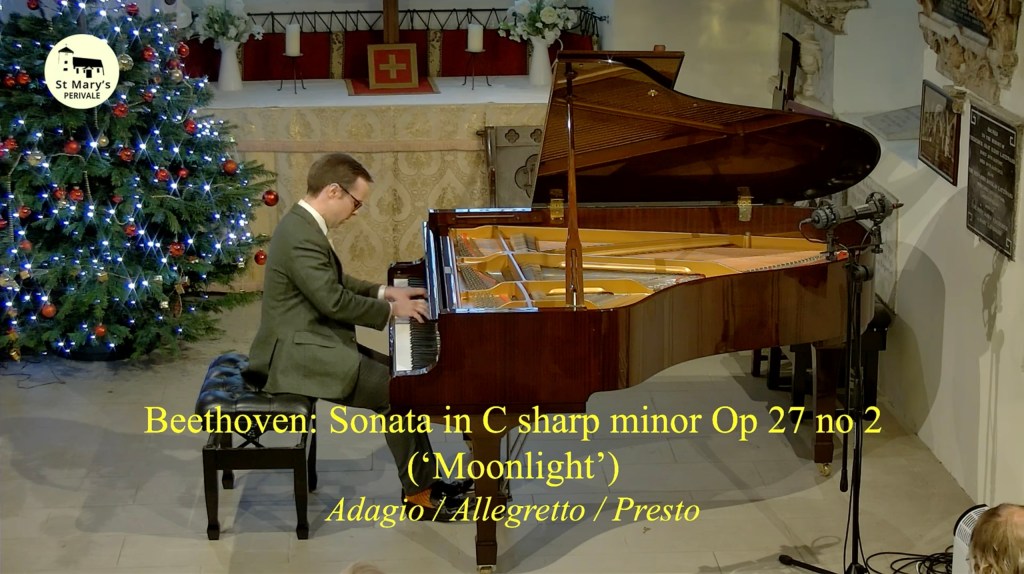
Ashley is a great scholar, as one can hear from his playing, but he is also a very fine orator and it was good to be reminded of Liszt’s description of the second movement of the ‘Moonlight’ Sonata as being ‘a rose between two chasms’. Also that this was one of two sonatas ‘quasi una fantasia’ whereas the Dante Sonata that was to close the programme was ‘una fantasia quasi una sonata’! The first movement was played with great fluidity with the accompanying triplets played in groups of six as the melodic line was allowed to float from treble to bass with aristocratic poise and poetic sensibility. The ‘Allegretto’ was played at a sprightly gait as the ‘Trio’ loomed over the proceedings with sombre resonance. The ‘Presto’ was played with dynamic drive and remarkable clarity bearing in mind the arctic temperature that surrounded this charming redundant church today. A crystalline brilliance and a real orchestral Beethoven sound of solidity and inevitability as Ashley drove his forces forward to the final cadenza. A moment of reflection before the final tumultuous outpouring of irascible Beethovenian impatience.
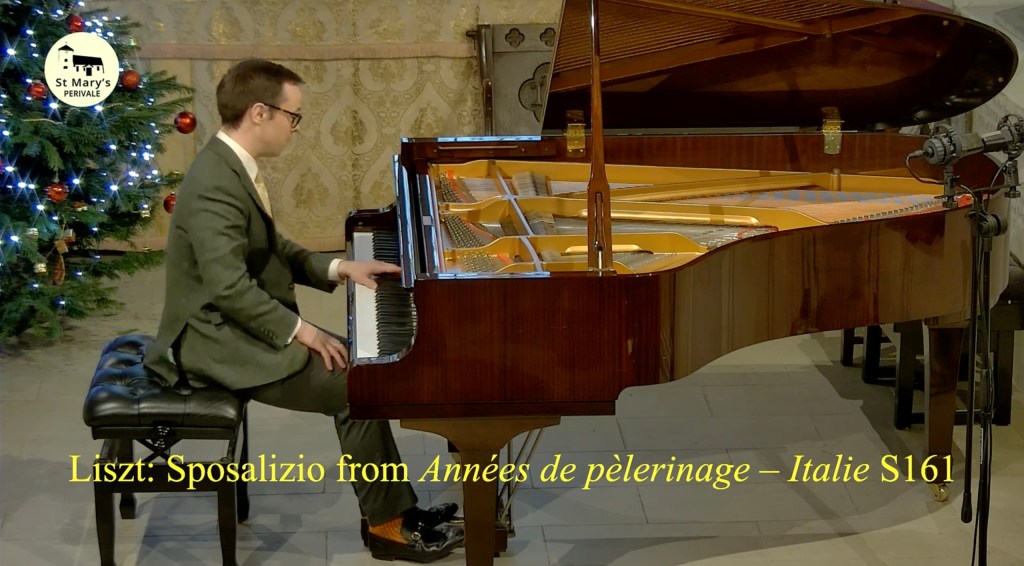
As Ashley pointed out the bells of Rachmaninov are of the Russian Orthodox Church whereas the bells of Liszt in ‘Sposalizio’ are those of a devout Catholic. This beautiful tone poem was inspired by Liszt’s visit to the Brera Gallery in Milan, where Raffaello’s ‘The Marriage of the Virgin’ sits and can still be seen to this very day. A sumptuous outpouring of sounds that even with the octave accompaniment Ashley’s superb musicianship and mastery never covered the ‘Virgin’ in glitzy mud but always allowed her to shine on high with radiance and heartfelt beauty.
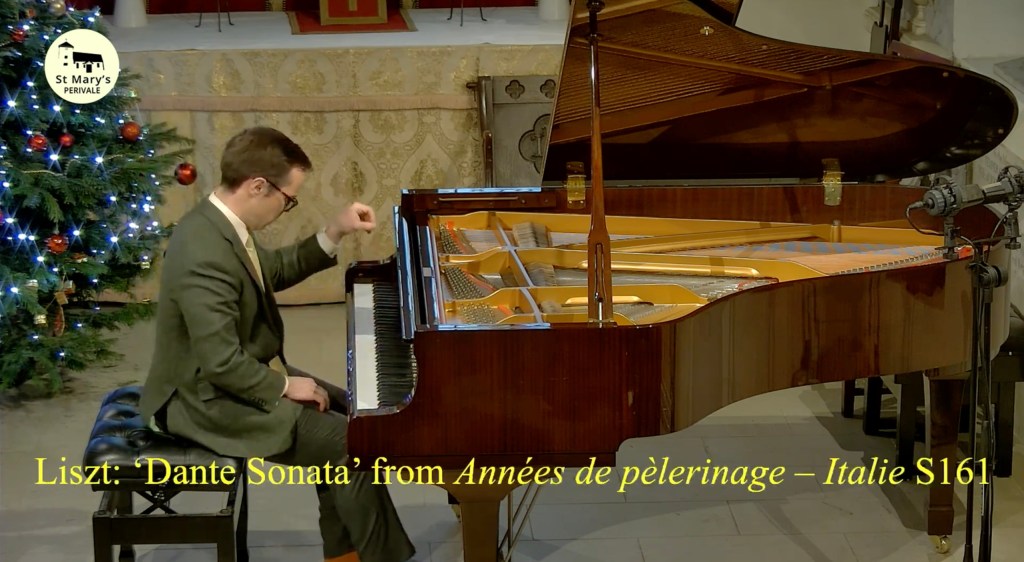
As Ashley said on introducing the Dante Sonata :’now from heaven we get a glimpse of hell!’. A masterly performance where musicianship and architectural understanding were accompanied by playing of technical mastery and poetic sensibility. Ashley showed us that in music there is no such thing as difficulty but more of misunderstanding. A powerful performance with moments of passionate abandon but also of searing beauty and poignant significance and above all music that spoke so eloquently.
Ashley amongst friends knew he would not get away without an encore! He had prepared especially for his friendsElgar’s ‘Salut D’Amour’ which he played exactly as the title suggests. Ashley playing with the refined aristocratic simplicity that I remember well from Aldo Ciccolini for whom it was a favourite and much requested encore.
British pianist Ashley Fripp has performed extensively as recitalist, concerto soloist and chamber musician throughout Europe, Asia, North America, Africa and Australia in many of the world’s most prestigious concert halls. Highlights include the Carnegie Hall (New York), Musikverein (Vienna), Concertgebouw (Amsterdam), the Philharmonie halls of Cologne, Paris, Luxembourg and Warsaw, the Bozar (Brussels), the Royal Festival, Barbican and Wigmore Halls (London), the Laeiszhalle (Hamburg), Palace of Arts (Budapest), the Megaron (Athens), Konzerthaus Dortmund, the Gulbenkian Auditorium (Lisbon) and the Konserthus (Stockholm).

He has won prizes at more than a dozen national and international competitions, including at the Hamamatsu (Japan), Birmingham and Leeds International Piano Competitions, the Royal Over-Seas League Competition, the Concours Européen de Piano (France) and the coveted Gold Medal from the Guildhall School of Music & Drama. Ashley was awarded the Worshipful Company of Musicians’ highest award, The Prince’s Prize, and was chosen as a ‘Rising Star’ by the European Concert Hall Organisation (ECHO). He has also performed in the Chipping Campden, Edinburgh, Brighton, Bath, Buxton, City of London, and St. Magnus International Festivals as well as the Oxford International Piano Festival, the Festival Pontino di Musica (Italy) and the Powsin International Piano Festival (Poland). Ashley also gave an open-air Chopin recital beside the world-famous Chopin monument in Warsaw’s Royal Lazienki Park to an audience of 2,500 people. A frequent guest on broadcasting networks, Ashley has appeared on BBC television and radio, Euroclassical, Eurovision TV and the national radio stations of Hungary, Spain, Luxembourg, the Netherlands, Poland, Belgium and Portugal. Commercial recordings include Chopin Piano Concertos Nos. 1 & 2 with the Kammerorchester der Universität Regensburg (Spektral Records, 2013); an album of solo repertoire by J. S. Bach, Thomas Adès and Chopin (Willowhayne Records, 2018); and The Saxophone Craze: Homage to Rudy Wiedoeft with classical saxophonist Jonathan Radford (Champs Hill Records, 2022).
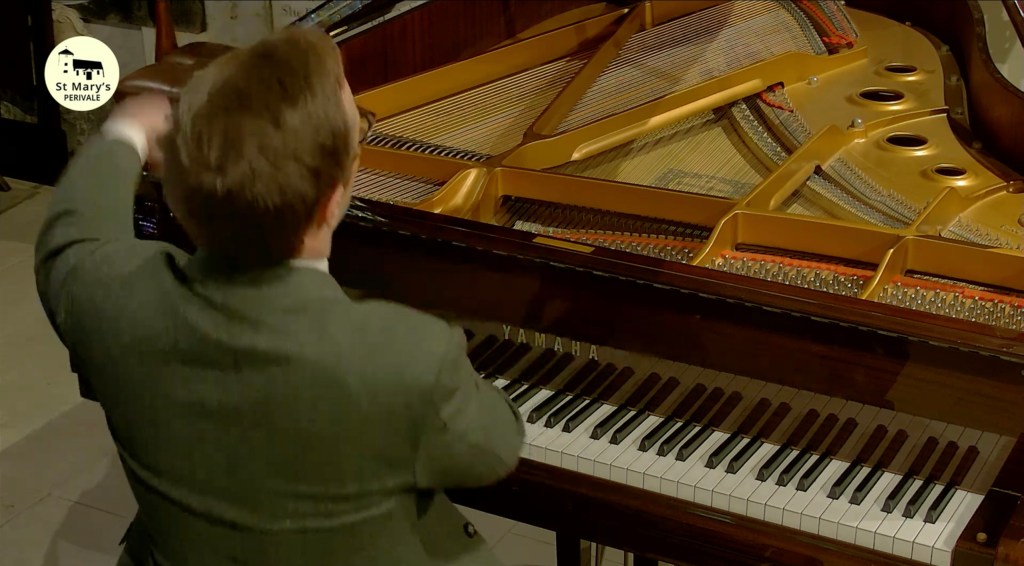
Ashley Fripp studied at the Guildhall School of Music & Drama with Ronan O’Hora and with Eliso Virsaladze at the Scuola di Musica di Fiesole (Italy). In 2021 he was awarded a doctorate for his research into the piano music of British composer Thomas Adès. Ashley has subsequently presented at doctoral conferences, given lecture recitals and is in demand to give masterclasses both in the UK and overseas. He holds regular masterclass residencies in the picturesque medieval village of Kallmünz in Germany.

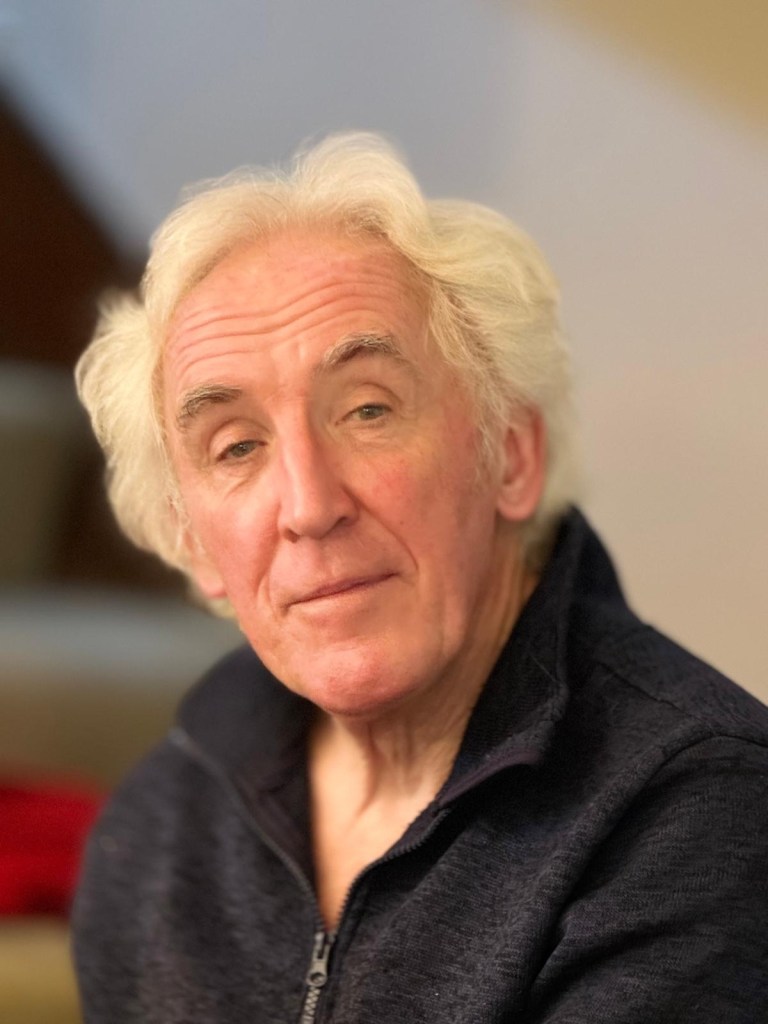
 ChristopherAxworthy-MusicCommentary