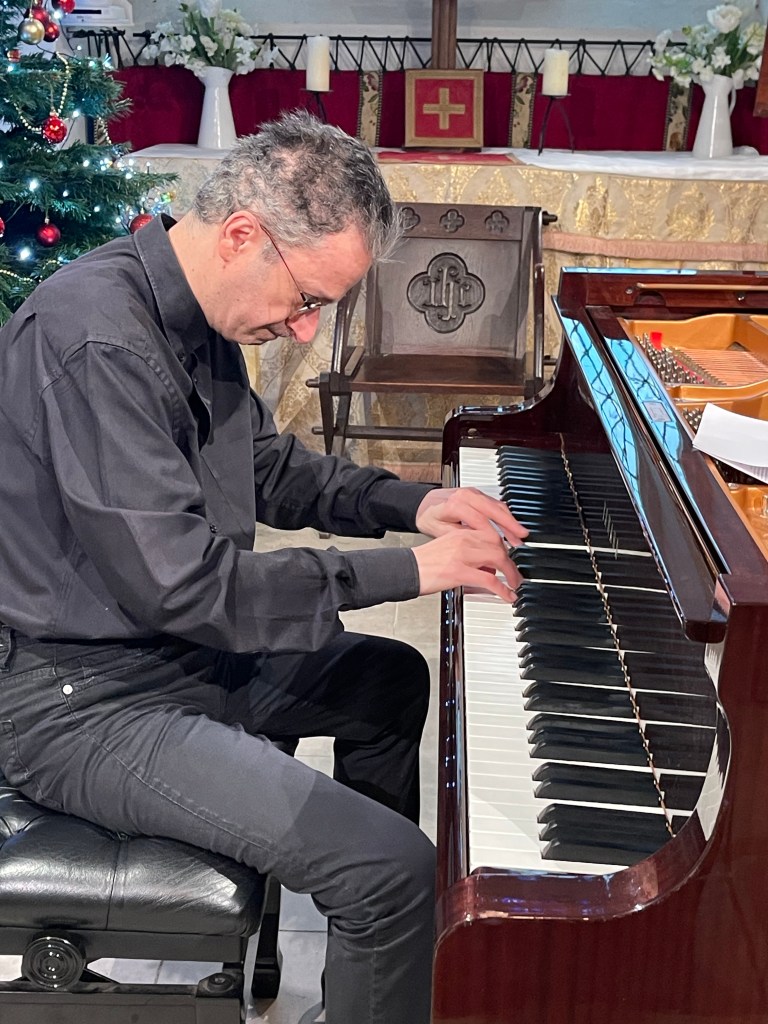
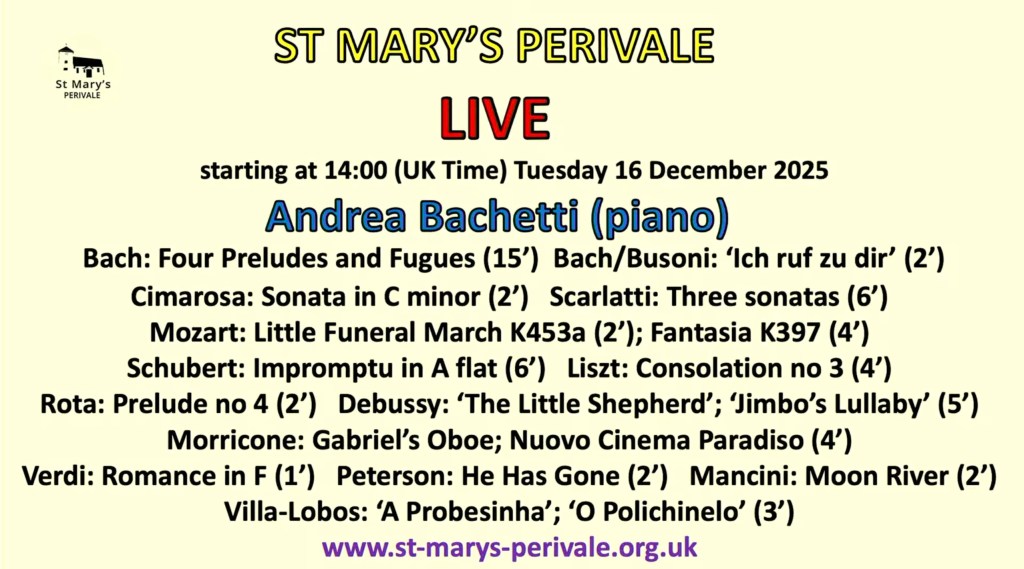
A quite extraordinary recital by a pianist who was as a child much admired by Karajan, and since birth has been linked to the piano which is his friend and companion and whose secrets he has unearthed over a lifetime dedicated to a continual research of sound. In 2006 he played in my series in Rome the ‘Goldberg Varatiations’ and during the pandemic he recorded in an empty hall in Genoa,where he lives ,the second book of the Well Tempered Klavier. I was honoured when he asked me to write the notes for the CD that was issued of that performance.
Today in a programme that spanned two centuries he opened with Four Preludes and Fugues from Book 2. He had asked me if the piano in Perivale had three pedals, and neither I ,Dr Hugh Mather or even Michael Lewis the piano tuner understood why he needed to know about a pedal that is almost obsolete for the vast majority of pianists. The reason soon became evident as Michael pointed out in the rehearsal that he was only using the central pedal. Could it be that he had got lost and was confusing the middle pedal for the sustaining pedal? Michael asked me not to mention it in case it was just pre concert nerves! Well I did gently mention it and he said I was quite right to notice, and for classical music he only uses the middle pedal that can fill in some holes in his finger legato. In fact from Bach to Mozart taking in Scarlatti, Cimarosa and surprisingly the unknown Romance of Verdi there was a quite extraordinary clarity of his perfect finger legato without any smudging from the sustaining pedal, creating a purity and radiance to the sound that I have rarely heard before.
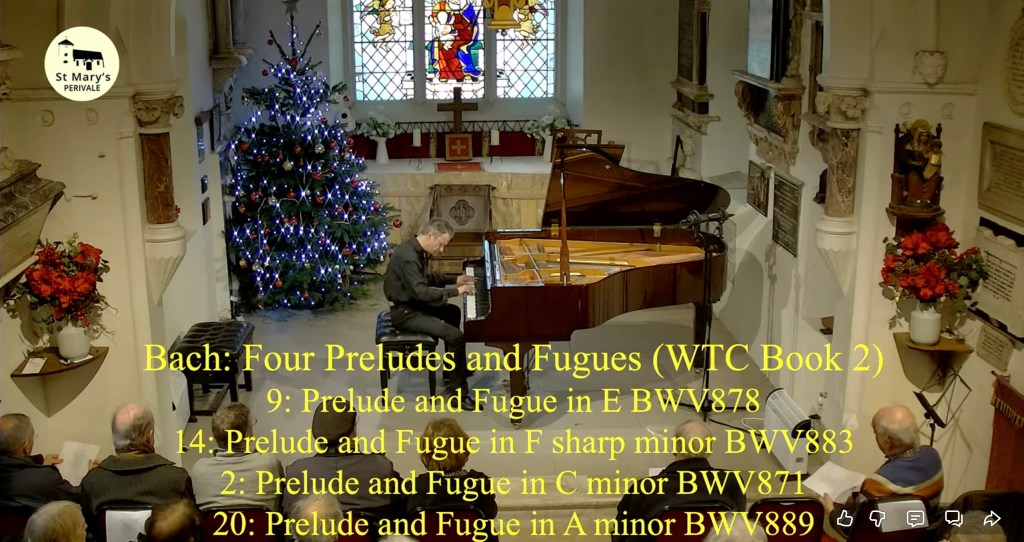
The Four Bach were played with crystalline clarity and a range of sound where his finger independence could lead the way with Bach’s knotty twine and make the path forward always so clear. A sense of balance that was quite extraordinary as the gradations of sound seemed to be infinite and never throughout the whole recital was there any ugly or forced sound.
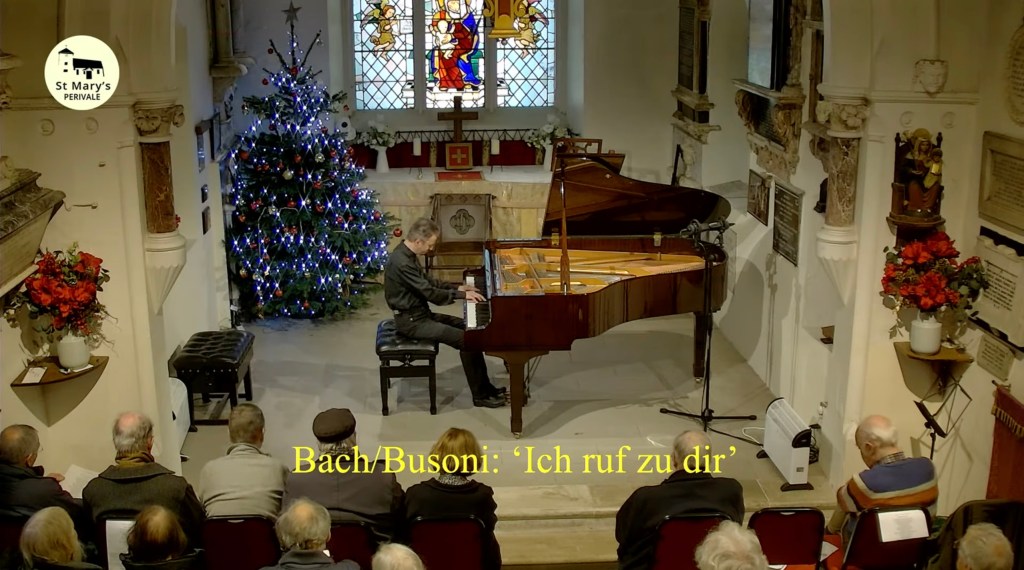
Even the Busoni transcription of ‘Ich ruf zu dir’ was played with shining beauty with a very dry bass accompaniment, very measured and unusually respectful for a work that is usually drowned in pedal. It lost nothing of its beauty as the bass sustained the melodic line with deep majestic sonorities. A remarkably original and ravishingly beautiful performance that in a way mirrors Busoni’s own playing,as much as we can discern from the piano roll recordings that he bequeathed to the world and that were housed by Frank Holland in the Brentford Piano Museum just a stones throw away.
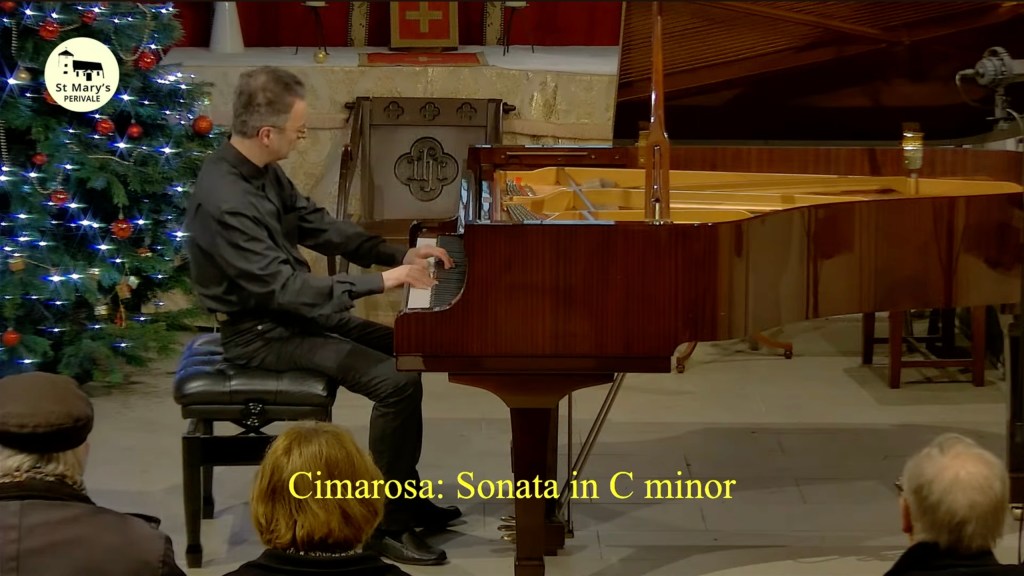
The little Cimarosa Sonata was beautifully shaped with great delicacy with only the use of the central pedal giving a chiselled beauty to this disarming short work.
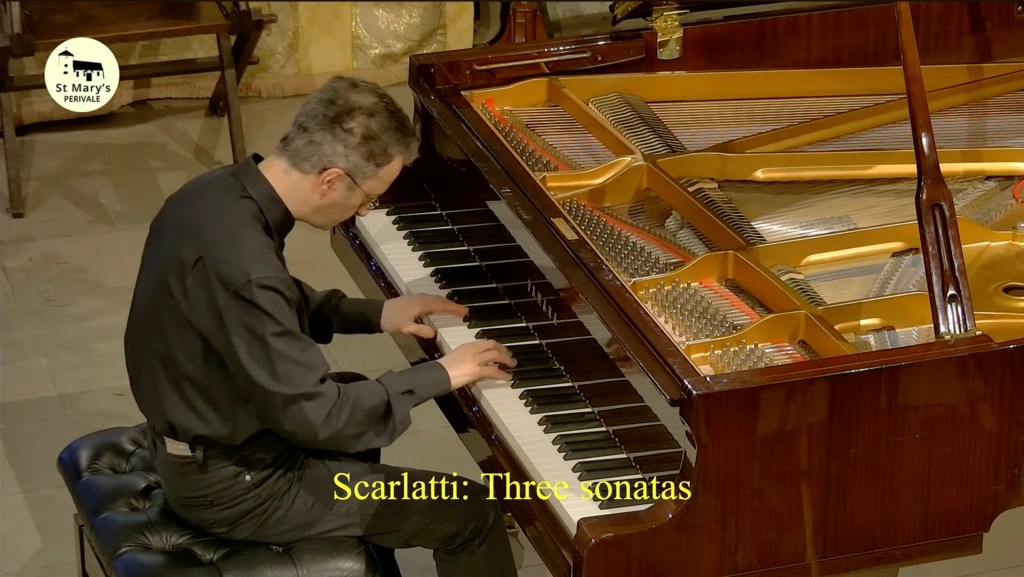
Scarlatti too was played with a poignant shining beauty where Andrea’s finger legato could bring infinite colour to three of these remarkable jewels of which the composer was to pen over 500 during his lifetime.
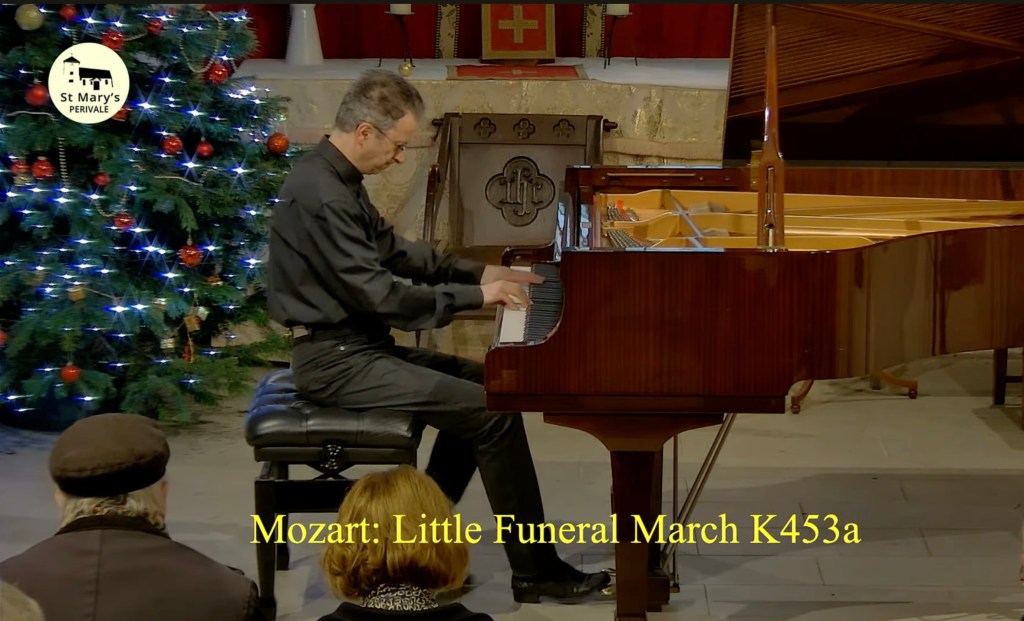
What a voyage of discovery this recital was turning out to be, as Andrea opened Mozart’s Little Funeral March with noble majesty and imperious authority.
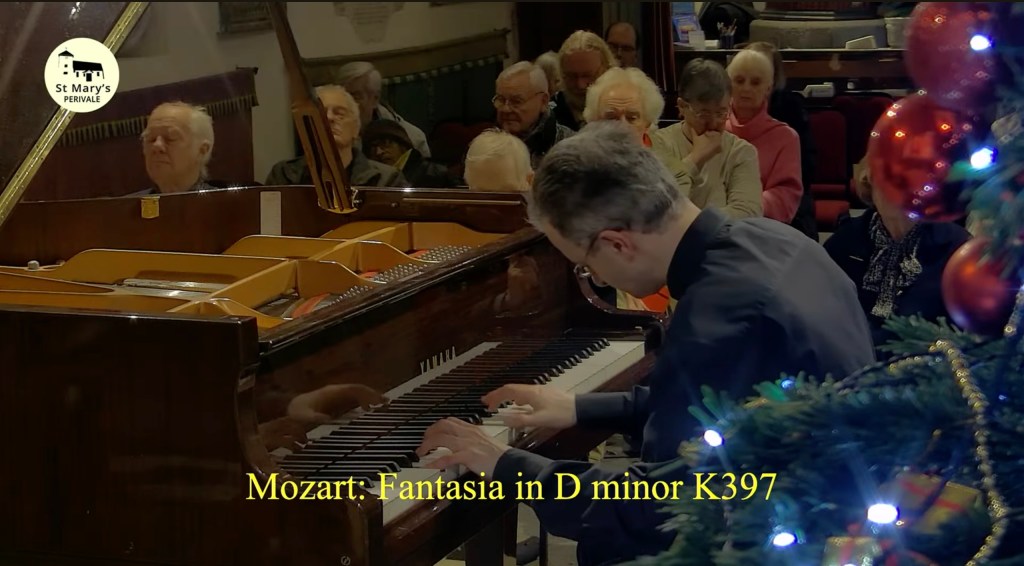
The Fantasy in D minor that was to followed I have never heard played with such poignant clarity. All the usual rhetoric and over pedalled cadenzas were gone and replaced with sounds of chiselled beauty. A radiance and multitude of sounds where Andrea’s sensitive fingers could dig deep into the notes and extract sounds of quite extraordinary delicacy and significance. Gasping phrases played with discreet sensitivity and long repeated notes played with fearless authority. Very discreet ornamentation to the final episode was just enough to bring a smile for a work that I had never considered to be the miniature tone poem that Andrea showed us today. Around the world in eight minutes ,you might say, with a range of emotions and characters of a piece that I played for grade six, and is certainly too difficult for children and considered much too easy by most budding virtuosi!
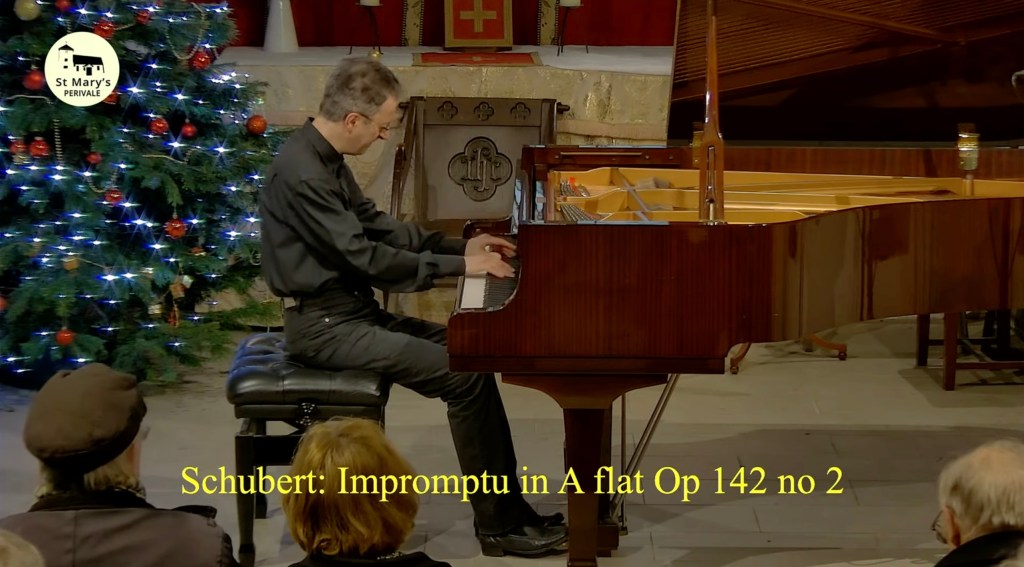
Schubert played with both pedals in the traditional manner except that Andrea’s perfect legato was just enhanced by the sustaining pedal adding a radiance and ravishing beauty to one of Schubert’s most beautiful melodies. Just underlining some inner harmonies on the repeat that were like jewels shining in this wonder world of Schubert. Streams of notes in the central episode played with remarkable poignant clarity as this work rose from its companions like a mighty eagle rising out of the depths and showing us the miracle of creation.
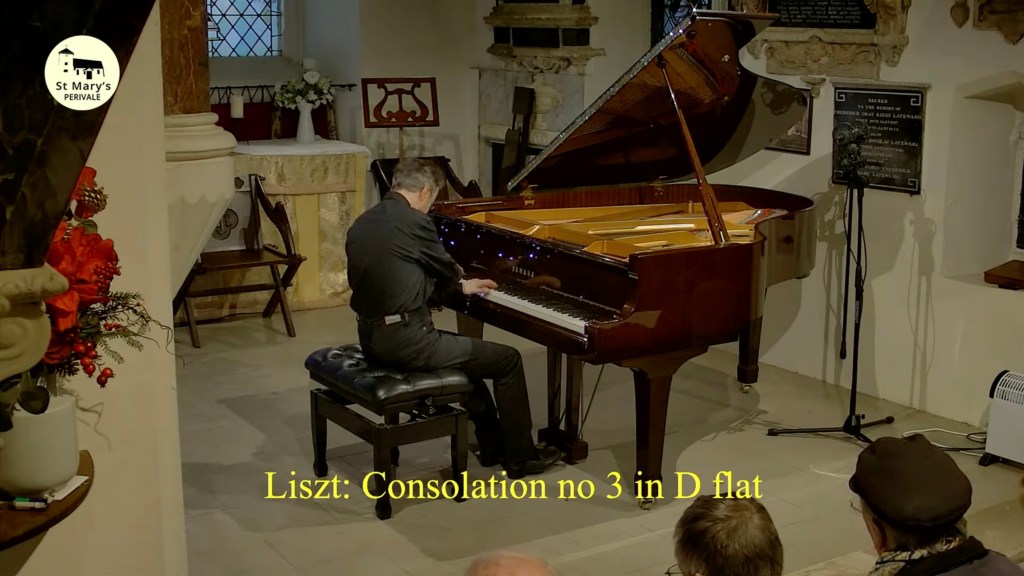
The Liszt consolation was bathed in pedal as the deep D flat sustained the glowing beauty of the chiselled melodic line of timeless refined elegance and nostalgic beauty.
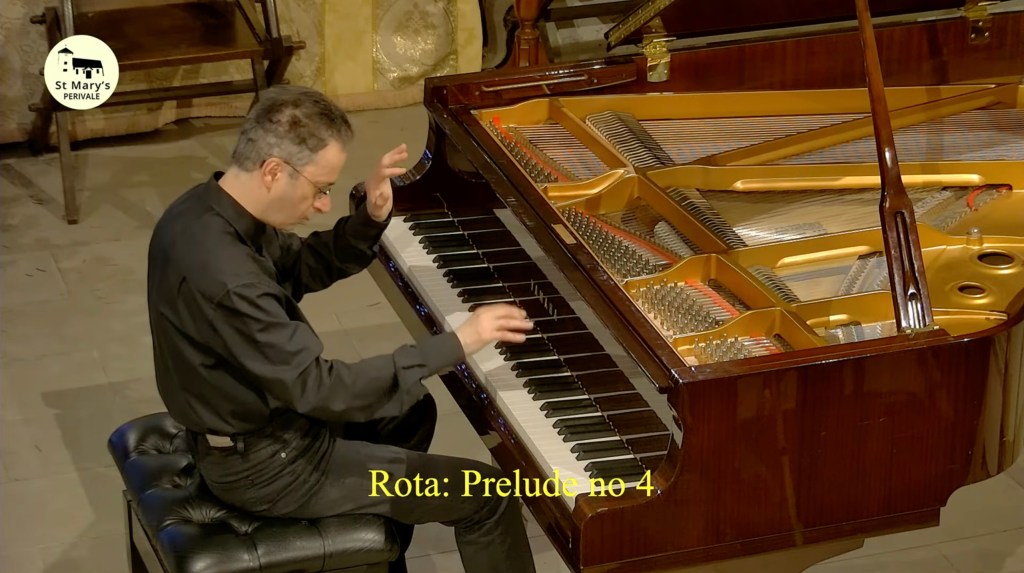
The Rota I had not heard before but was played with the same chiselled beauty as Liszt, but with a melodic line of purity and piercing directness.
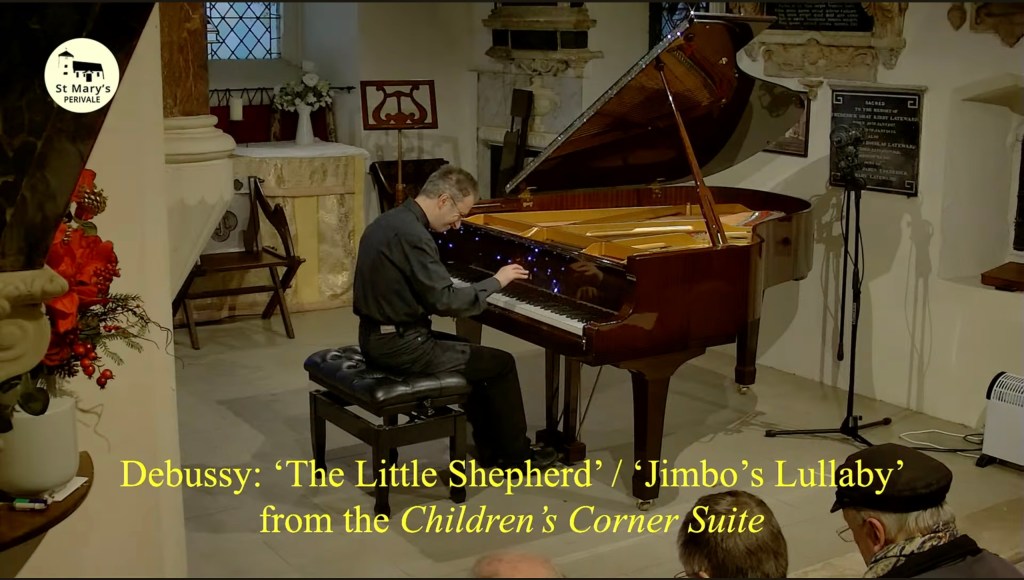
Debussy’s lonesome Little Shepherd was of haunting beauty as his single long lament rang out with beseeching luminosity. Greeted by the bass of Jumbo’s lullaby with haunting bells ringing out as he trespassed into unknown territory only to return more deeply into the woods with ever more decisive bass meanderings!
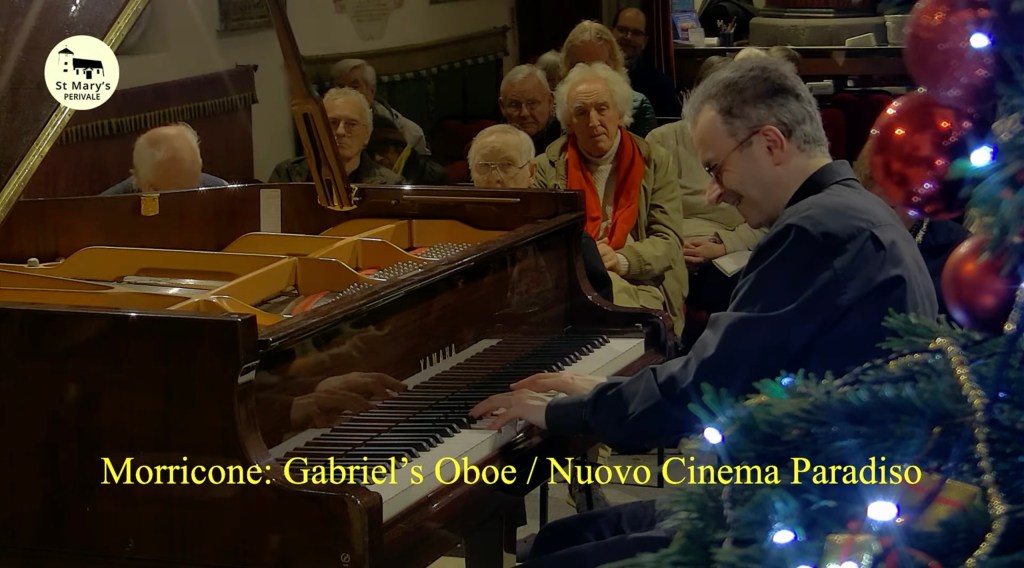
There had been a slight change of order so Verdi and Oscar Peterson remained without captions which had no importance when the playing was of such ravishing beauty . The Verdi we actually got to hear twice, as I asked Andrea if he would play it again at the end as an encore, together with one of the four of the preludes and fugues advertised but had realised he only played three at the beginning ! As Hugh said ‘who is counting when playing of such magnificence is unfolding on this cold winter’s day!’
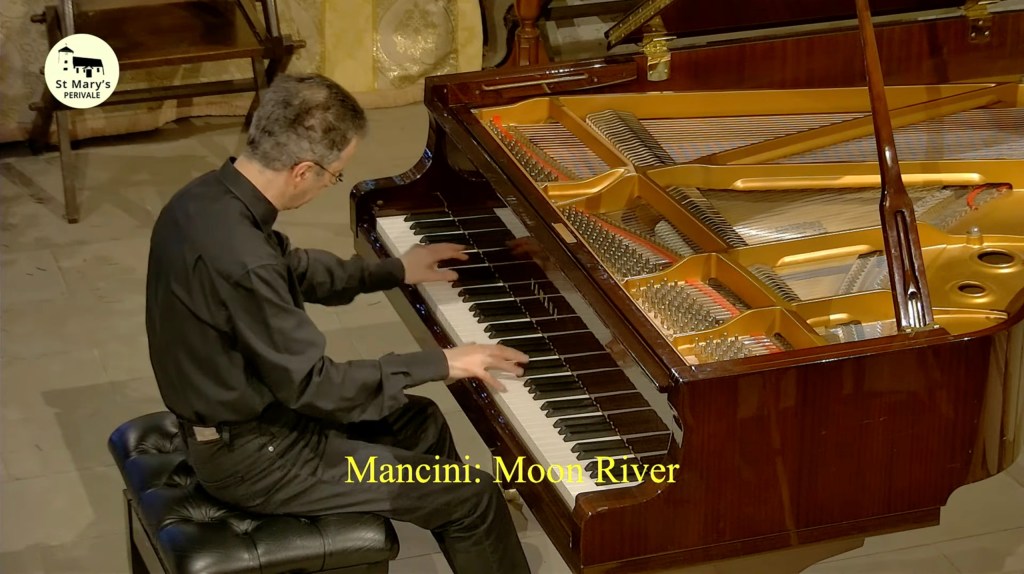
The Verdi was a ‘song without words’ indeed with the fiortiori of Bel Canto played with the same radiance and incredible perfection as Monserrat Caballé. What nostalgia to hear the pieces by Morricone forever linked for me by two of the most evocative films I have ever seen. Moon River was to follow, even more nostalgic as Audrey Hepburn of Breakfast at Tiffany fame was my next door neighbour in Rome. Taking her son, Luca, to school every day as she had split up with his father Dr Dotti but did not intend abandoning their son. She was the refined icon of a period but also one of the most generous and kindest people I have ever known. Even in illness she thought of the poor and suffering and used her fame to create funds to make the world she was about to leave a better place for others.
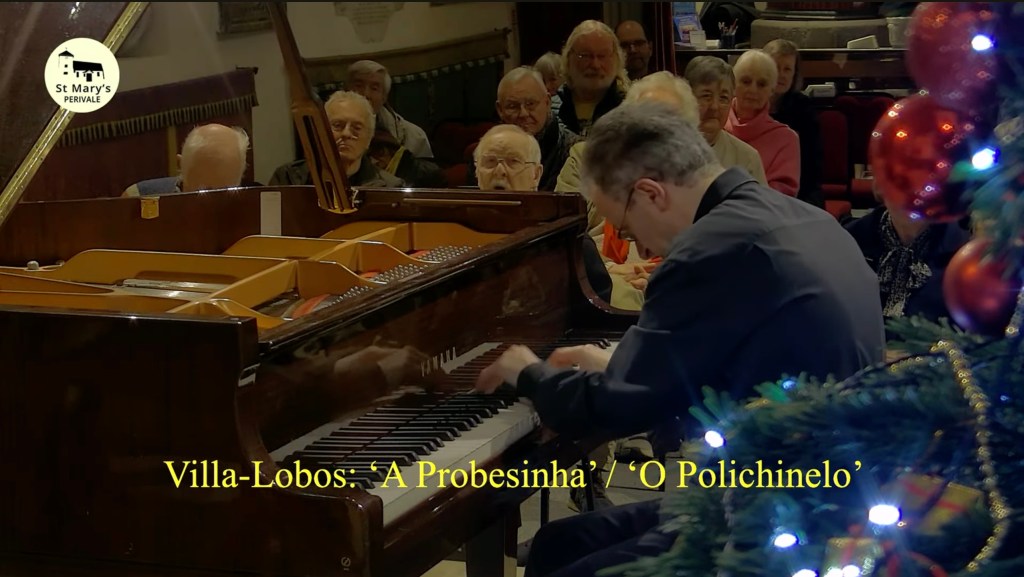
The last two pieces are rarely played in public but the Doll Suite by Villa Lobos is a collection of beautifully evocative pieces that Joan Chissell, the critic, described in a performance with words that have remained with me ever since : “Mr Rubinstein turned baubles into gems” . It was Rubinstein who was responsible for bringing Villa Lobos to Europe in the thirties having a whole orchestra play his music in his hotel suite to his friendly impresarios . Andrea too turned them into gems and it was a fitting end to a memorable recital of mastery and quite simply pianistic genius.
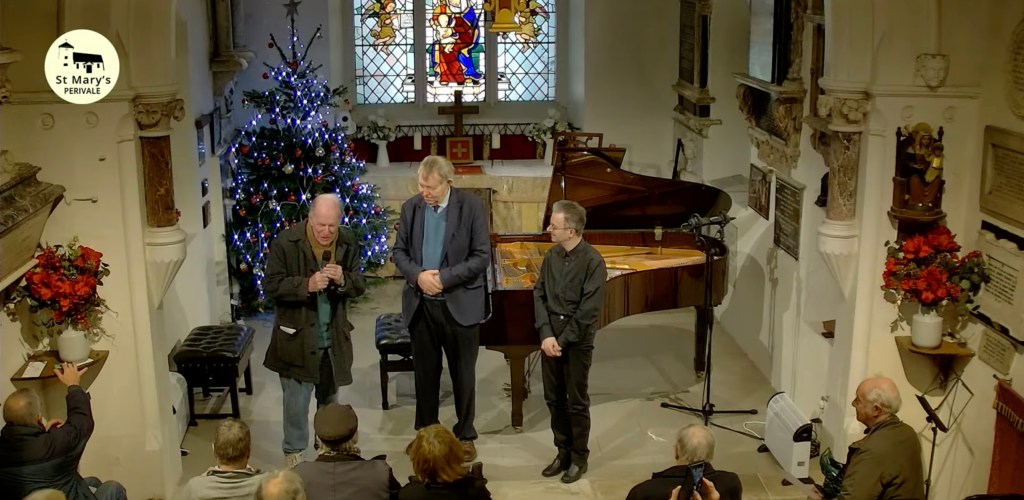
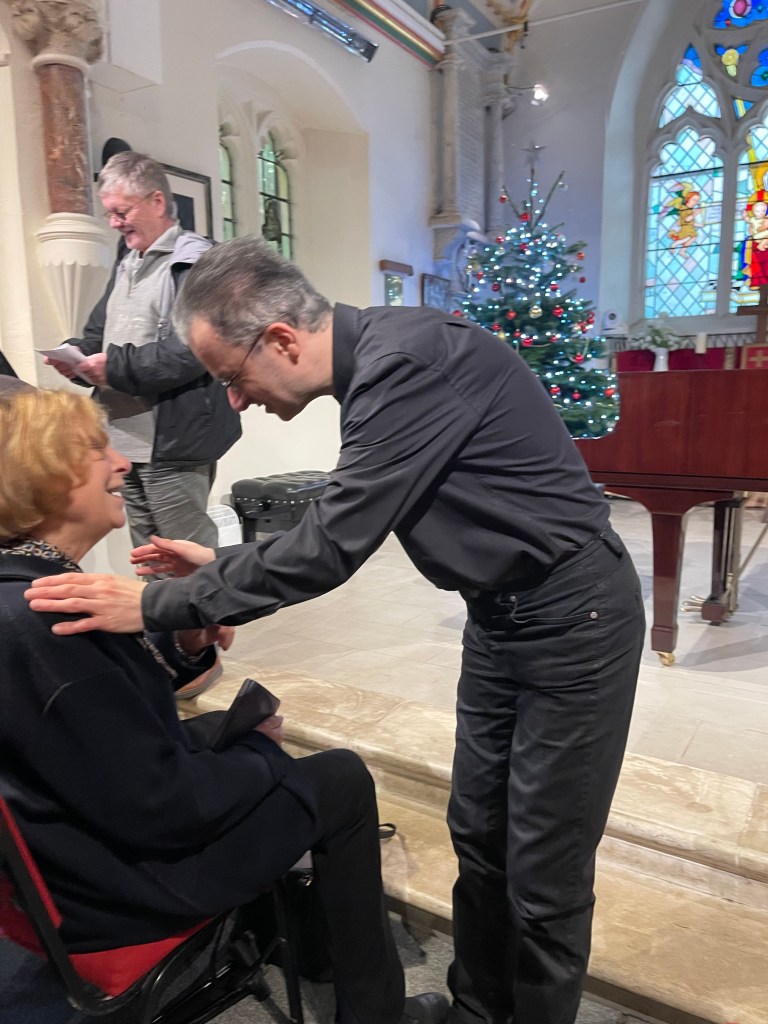
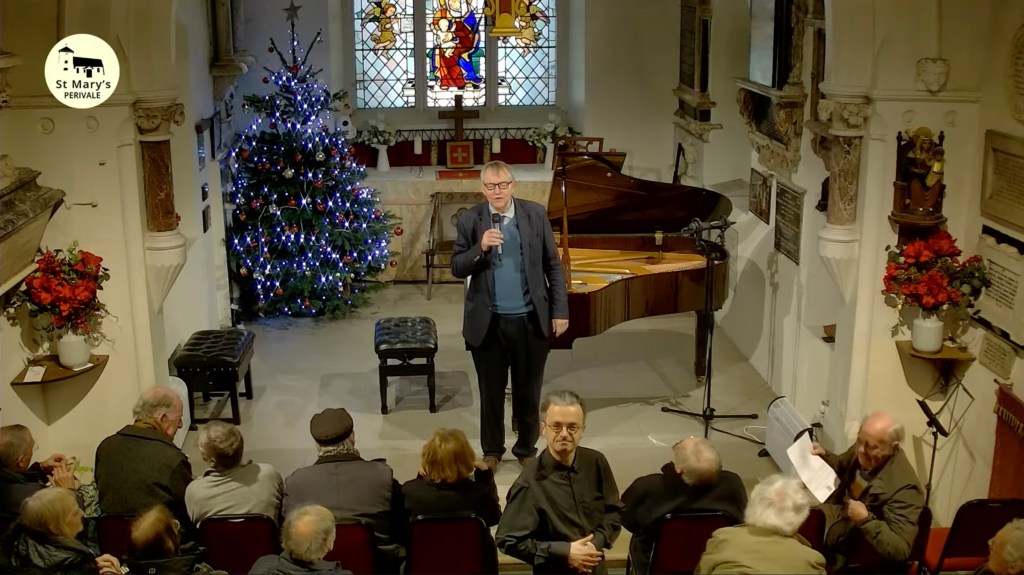
Andrea Bacchetti was born in Recco (GE) in 1977. A precocious talent, he took inspiration from Karajan, Berio, Horszowsky, and Magaloff at a young age. He earned a Master’s degree from the Imola Piano Academy with Franco Scala. He made his debut at age 11 in Milan with the Solisti Veneti conducted by Scimone. Since then, he has performed at major festivals such as Lucerne, Salzburg, Sapporo, La Coruña, Toulouse, La Roque d’Anthéron, Warsaw, Ravenna, Brescia, and Bergamo. He has performed at international music centers in Berlin, Paris, Tokyo, Moscow, Prague, Madrid, São Paulo, Bern, and Leipzig, and with orchestras such as Festival Strings Lucerne, Camerata Salzburg, PKO Prague, Filarmonica della Scala, OSN Rai Turin, Filarmonica Enescu, Bucharest, Kyoto Symphony, and ORF Vienna, with conductors such as Baumgartner, Gimeno, Lü Jia, Urbanski, Luisi, Venzago, Manacorda, Flor, Chung, and Tjeknavorian.
He records for Sony Classical, and his extensive discography includes the Cherubini Sonatas (Penguin Guide UK Rosette), The Scarlatti Restored Manuscript, for which he won the 2014 ICMA Award, and Bach’s The Inventions and Sinfonias (CD of the Month in BBC Music Magazine). He is passionate about chamber music, collaborating with R. Filippini, the Prazak Quartet, U. Ughi, F. Dego, the Quatour Ysaye, and the Cremona Quartet.
In recent seasons, he has performed with the Milan Symphony Orchestra, the OSI Lugano, the Haydn Orchestra of Bolzano, the Teatro Comunale di Bologna, the Teatro Carlo Felice in Genoa, the Solisti Aquilani, and in recital at two consecutive editions of the Brescia and Bergamo International Piano Festivals. He performed Book II of Bach’s Well-Tempered Clavier in a single performance in the Aula Magna of Sapienza University for the IUC, at the Teatro Carlo Felice in Genoa for the G.O.G., and at La Fenice in Venice for Musikamera, as well as in a recital for the Friends of Music of Florence. This season, he has performed in South Africa, South America, Germany, Japan, Switzerland, and Portugal.
 ChristopherAxworthy-MusicCommentary