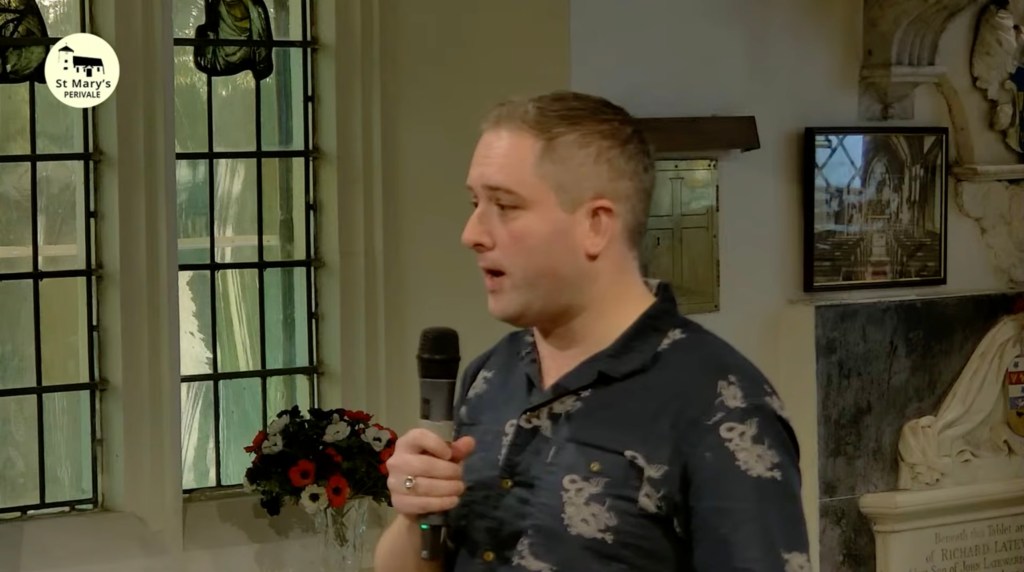

I have heard Tyler many times over the past few years and his simplicity and mastery have never astounded me more than today. Complaining of a sleepless night and arriving more in beach attire than for a concert streamed worldwide, he proceeded to play with an architectural understanding and immediate sense of communication that was astonishing. A technical mastery gained from the class of Tessa Nicholson as his colleague Mark Viner can readily confirm. He presented works from the Russian school, with playing of ravishing sensibility and astonishing technical mastery. He had also commented on his attire which allowed me to chip in too, but with playing like this it really is of no importance. Yuja Wang playing the ‘Hammerklavier’ in nightclub attire with stiletto heels is one of the greatest live performances that one could wish to hear !

I had heard Tyler play the Rubinstein Sonata a month ago at the National Liberal Club, but today listening to the live stream there was a sense of line and communication that I had not noticed before. The opening movement an outpouring of melodic invention written by a teenage composer with heroic virtuosity and a pulsating energy. A beautiful tenor second subject surrounded by glistening sounds before bursting into song with youthful romantic fervour. It is easy to see where Tchaikowsky and Rachmaninov inherited their wonderful melodic invention from. A hymn like chordal Andante with playing of nostalgic sentiment of extraordinary sensitivity and with a rare tasteful sense of style of great poise never descending into sentimentality. The ‘Moderato’ March like movement with a contrapuntal twist to it’s insistent forward movement of Military style, with ornaments that clicked with twinkling brilliance of the traditional Russian dance like the last movement of Tchaikovsky’s B flat minor concerto . The last movement was a call to arms of brilliance and demanding insistence, played with dynamic drive and quite considerable technical authority. A fiendishly spindly fugato of finger twisting ingenuity lead to the triumphant ending with glorious mellifluous outpouring that we are more used to hearing from Tchaikowsky as it is obviously in the pre revolution Russian blood.

After Rubinstein, Tyler played three short pieces op 51 by his pupil Tchaikovsky. ‘Natha -valse’ was a brilliant and scintillating dance played with great dexterity and sense of style . The Andante was a tipical Tchaikowskian outpouring tinged with the unmistakable Russian dialect of sadness and nostalgia.The ‘Valse sentimentale’, with which Tyler ended this group of three from six pieces op 52 , was also tinged with beguiling flexibility and extraordinary sensibility.
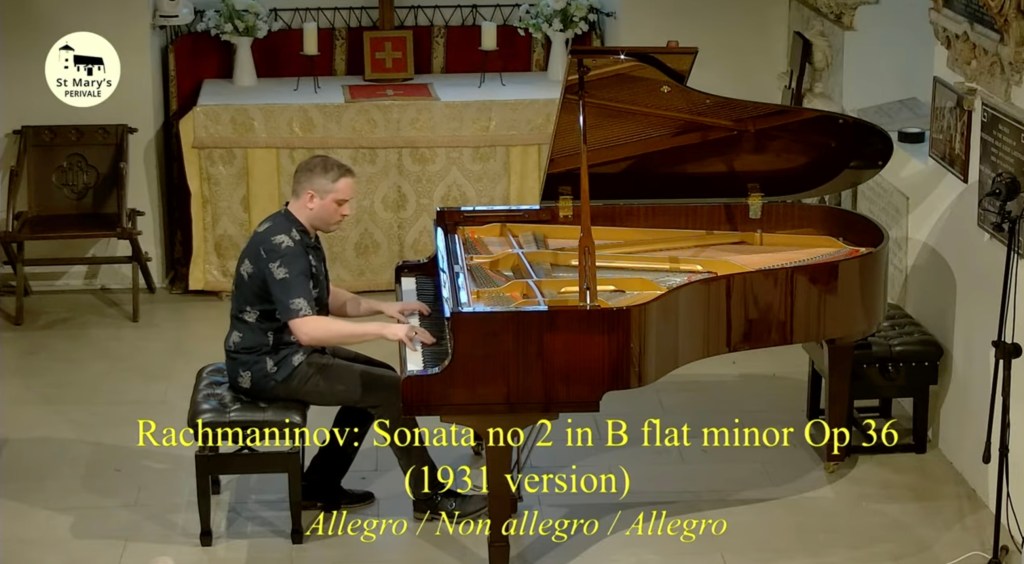
It is always a surprise that Tyler not only possesses an extraordinary technical and musicianly mastery but that his imposing presence also hides his heart of gold. The Rachmaninov Second Sonata since the performances on the apparition of Horowitz in his Indian Summer, has become a classic of the concert hall and of conservatory students. The Second has now been ousted by the First ,since Kantarow showed us the golden trail that lesser mortals seemed to have lost. Tyler has an extraordinary musicianship that can devour greatly neglected works and bring them to life with the ability to see the overall shape and he is able, with his superb technical mastery, to show us the wood rather than just individual trees. It was this that struck me as the opening flourish of Rachmaninov sped into bass rumourings of great turbulence that would be transformed into mellifluous beauty. He brought a languid beauty of penetrating fluidity where the musical line was never obscured by sentimentality. Even in the most ravishingly beautiful outpourings as in the slow movement there was always a forward movement full of kaleidoscopic sounds. The Moderato con fuoco could be likened to a flower opening from the whispered murmurings of the opening gradually becoming more and more intense until the flower opening to reveal a gloriously Hollywoodian climax before the breathtaking final flourishes.
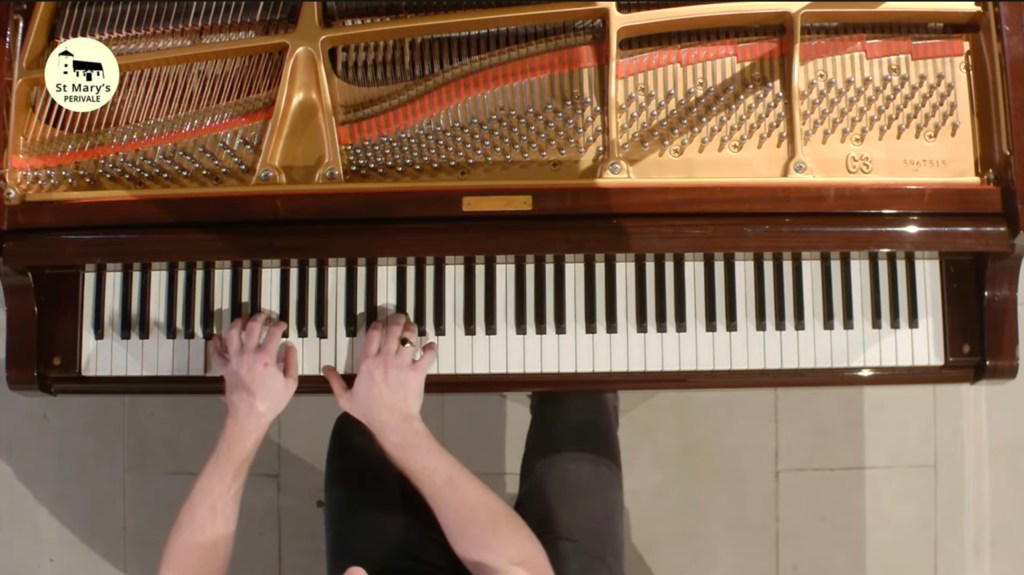
As Tyler said he is no chronometer and his programmes regularly overrun . A concert he gave a year or so ago of Czerny Studies famously finished at teatime ! But Tyler’s concerts are always such an enjoyable and exhilarating experience and even though running over time he did not need much persuading to play his grandfather’s own transcription of ‘Stardust’.
What can one say after a concert like that, except when is the next?

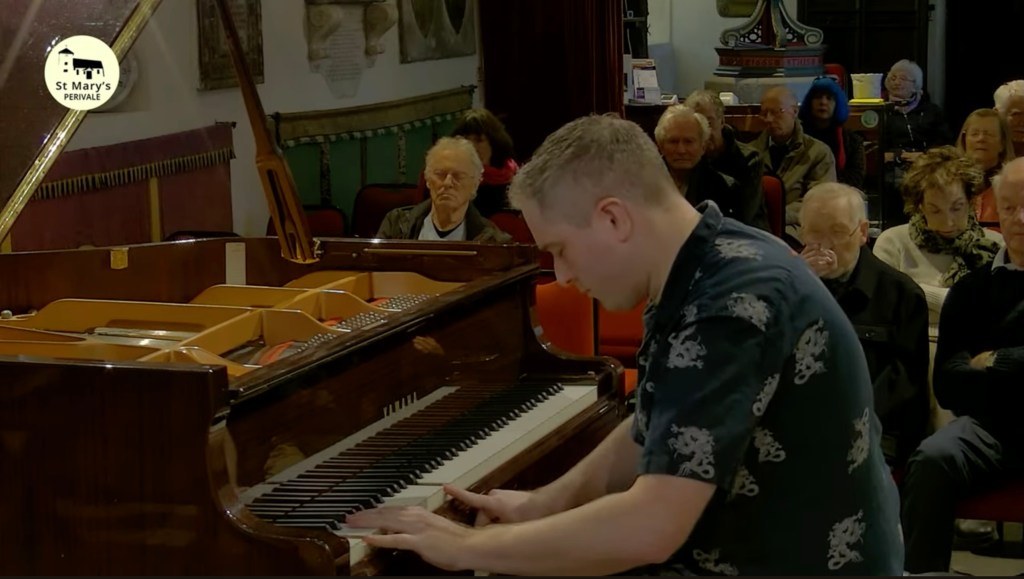
Known for his virtuosic programmes and witty audience interactions, Tyler Hay first showed a prodigious talent for the piano when he won the Dennis Loveland award in Kent for his performance of Liszt’s Mephisto Waltz no 1 at the age of 11. He gained a place to study at the Purcell School in 2007 where he studied under Tessa Nicholson. He has since studied with pianists such as Frank Wibaut, Gordon Fergus-Thompson and Steven Osborne. Tyler has performed programmes at Wigmore Hall, Cadogan Hall and the Purcell Room and has played Ravel’s Concerto for Left Hand Alone at the Queen Elizabeth Hall and Saint-Saëns’ Piano Concerto no 2 at Symphony Hall with the City of Birmingham Symphony Orchestra. In 2016, Tyler won first prize in the keyboard section of the Royal Overseas League Competition and as well as winning the RNCM’s Gold medal competition, also won first prize in the Liszt Society International Competition. Tyler won 1st prize in the Dudley International Piano Competition in November, 2022. CDs of Liszt, John Ogdon, Kalkbrenner and Field are available on Brilliant Classics and an album of virtuoso piano music by contemporary British composer Simon Proctor is also available on Navona Records.
 ChristopherAxworthy-MusicCommentary