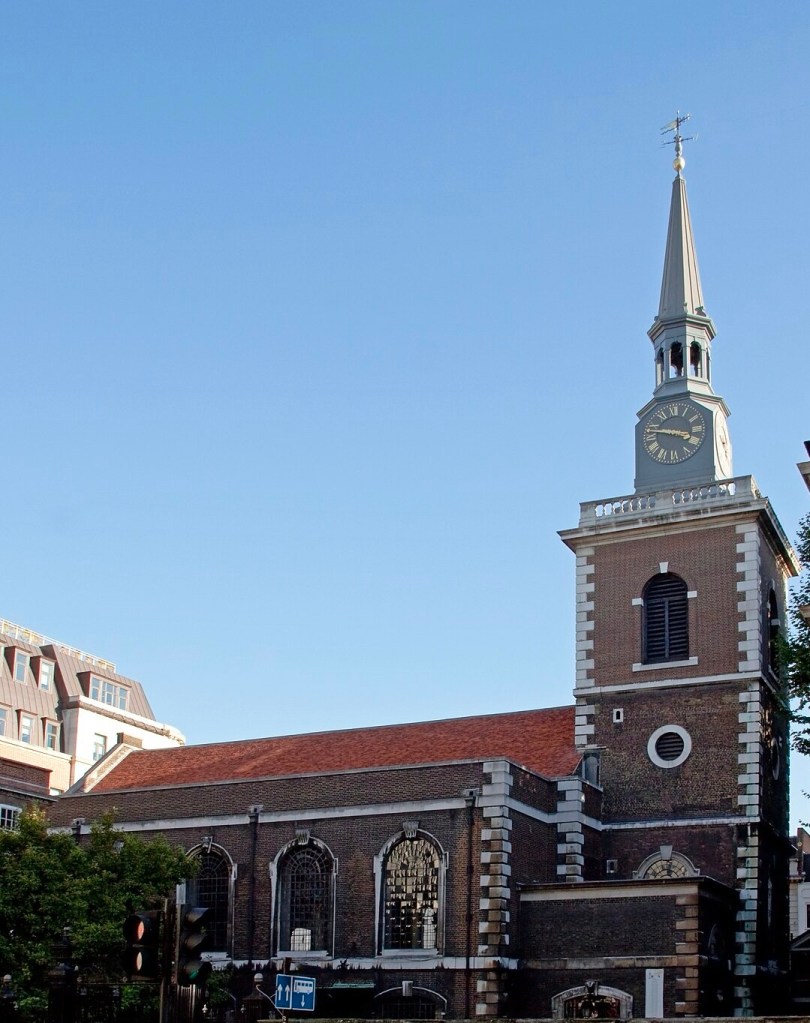
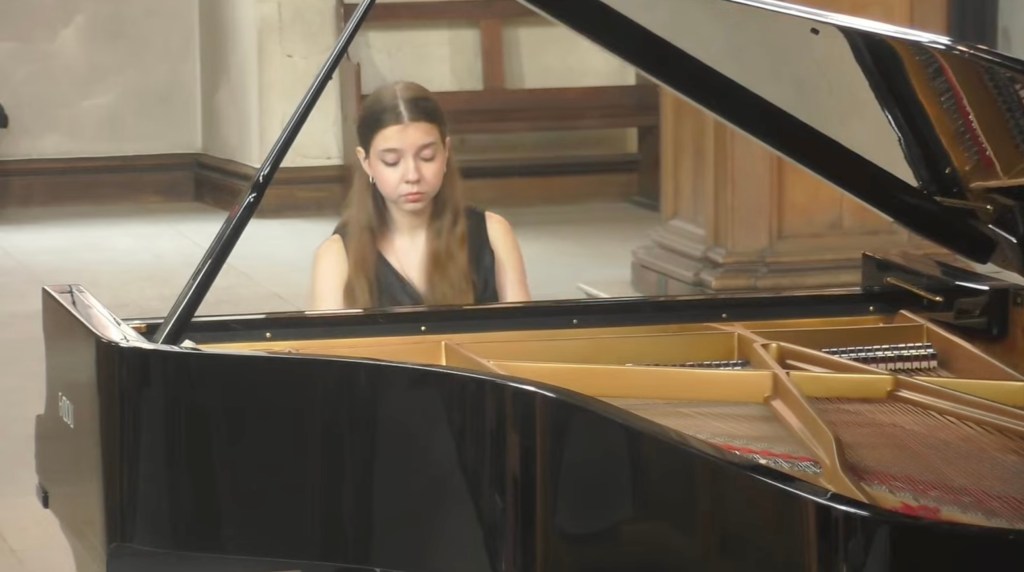
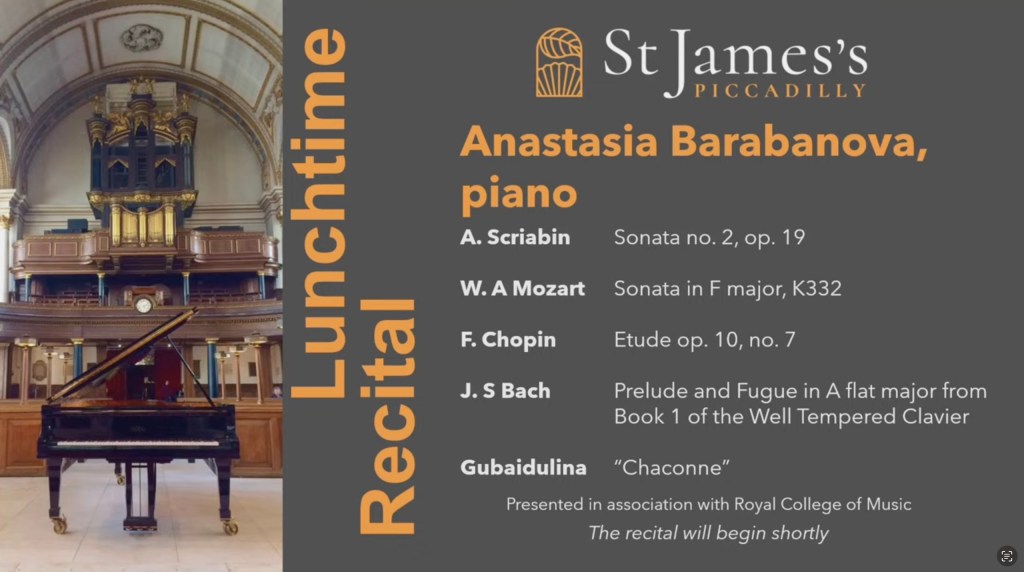
Some very fine musicianly playing of simplicity and intelligence which was reflected in Anastasia’s finely chosen programme that spanned the Romanticism of early Scriabin through the age of enlightenment of Mozart . The innovative pianistic world of Chopin and the baroque discipline of Bach to end with the extraordinary present day sound world of the Chaconne by Gubaidulina.
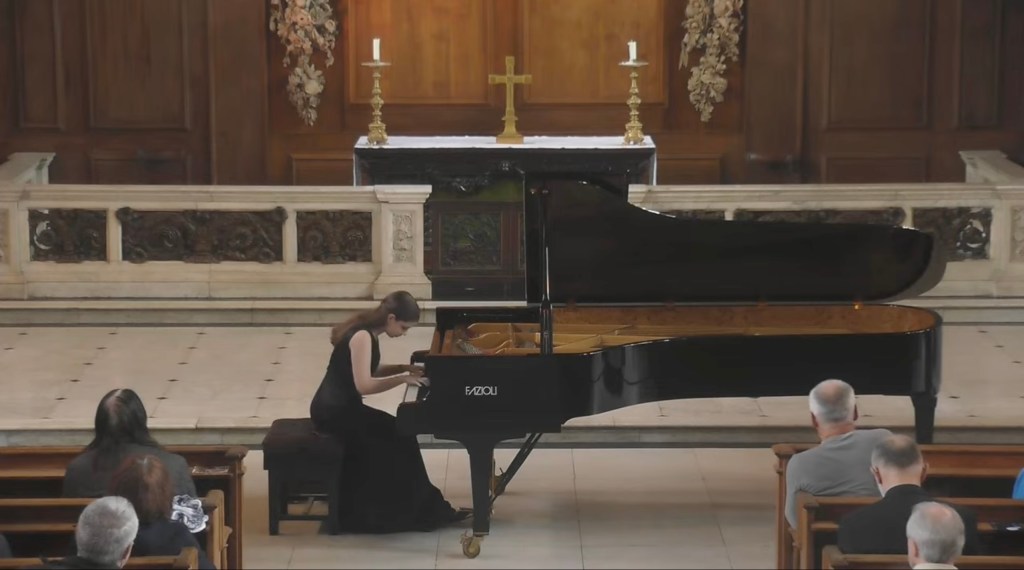
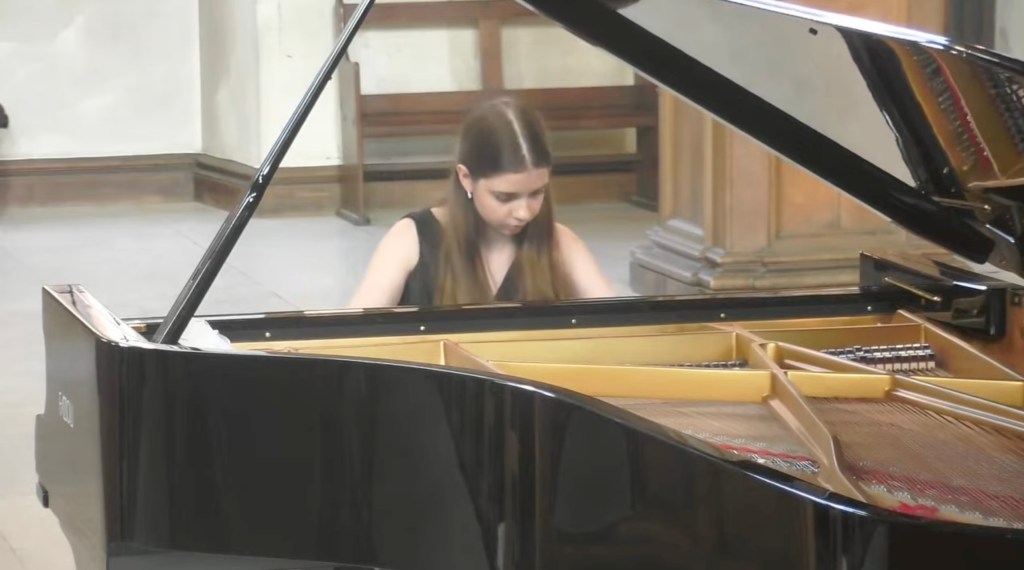
Scriabin’s early Fantasy Sonata in two movements showed off Anastasia’s refined palette of colour opening with a beautiful tempo of radiance and natural fluidity. As the rays of sunlight shone down on the piano they seemed to ignite the prism of sounds that were in Anastasia’s hands too, caressing the keys with delicacy and sensibility. There was passion and dynamic drive concealed within these sensitive hands as the cauldron reached boiling point . A beautiful sense of balance allowed the melodic line to glow so beautifully surrounded by a golden web of intricate sounds. The ‘Presto’ was played with great technical control and well oiled fingers, as the clouds passed and radiant sumptuous beauty could be heard with the passionate outpourings of the romantic exuberance of youthful Scriabin.
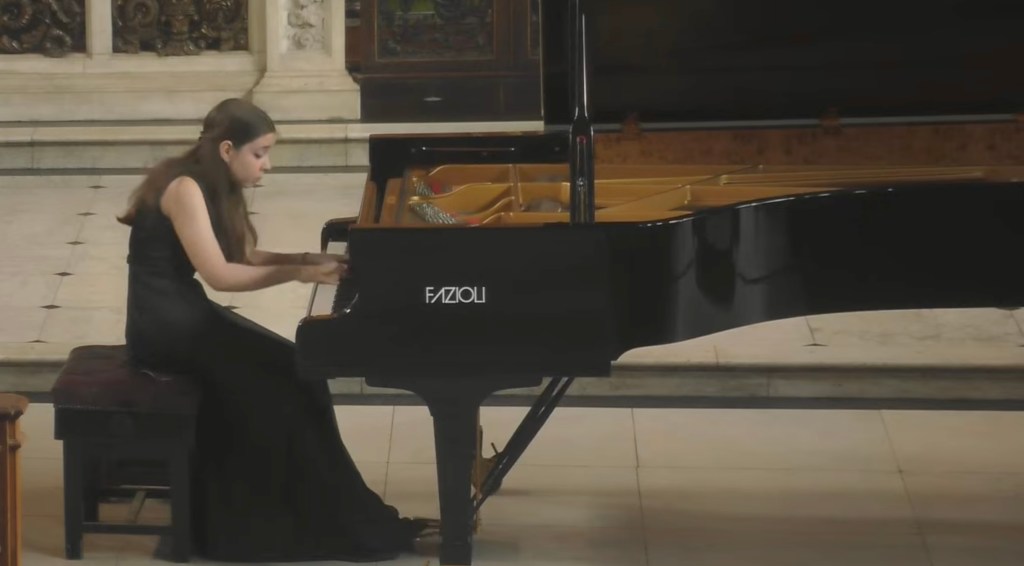
Mozart’s Sonata in F, the one on most piano stands in the living room of many families before the advent of television! It was played with clarity and simplicity as the operatic characters secretly hidden within the notes were revealed with subtlety and refined good taste. Schnabel is often quoted as saying that Mozart is too easy for children but too difficult for adults, because with so few notes Mozart could describe a whole world. With poignant meaning and character Anastasia gave us today a superb example of the ‘classical style’ so often overlooked by young pianists just raring to bite the bit! There was a crystalline beauty that she brought to the ‘Adagio’ where the trills and ornaments were played with a refined mastery and simplicity as she allowed the movement to speak with poignant meaning. The Assai Allegro just shot from her fingers as the movement sprang to operatic life with charm, wit and above all character.

The Chopin study op 10 n. 7, although not the so called ‘Butterfly’ study ( op 25 n. 9) is just the same a continual outpouring of repeated notes and a true feux follets. Whilst Anastasia had studied it well, I felt it was too earthbound and just needed wings to allow it to buzz around the keys with more gossamer lightness.

Her Bach Prelude and Fugue, however, was a true lesson in measure and clarity. Beautiful sounds where the voices were allowed to converse with simplicity as they were given the overall architectural shape of a true musician.


The Chaconne by Gubaidulina seems to be having something of discovery these days. In fact there were three performances last year in concerts I heard in the same week and by coincidence it was between the second and third that the sudden death of the composer was announced from Germany where she had lived in exile. It is a very complex piece full of pungent dissonances with a kaleidoscope of colours and moods . Deep bass notes out of which emerges a spiky marcato fugato before a hypnotic outpouring of repeated arpeggiandi are spread over the keyboard with ever more insistence and dissonance. This remarkable work finishes lying exhausted at the bottom of the keyboard with a whispered gasp of quite extraordinary effect. Anastasia revealed this wondrous world with masterly conviction and clarity but above all a fearless technical assurance that was breathtaking in its audacity.

Anastasia Barabanova, prize winner of numerous international competitions, made her debut as a soloist performing with an orchestra at the age of nine. Since then she has been performing internationally both solo and with various orchestras, such as Moscow State Symphony Orchestra, Lerman Chamber Orchestra, Kostroma Gubern Symphony Orchestra and others.
Her performance venues include Carnegie Hall (New York), St. George’s Church Hanover Square, St. Stephens Church, St. Mary Abbots Church (UK), Rachmaninov Hall and Small Hall of the Moscow Conservatory, Ehrbar Hall (Vienna). During season 24/25 she played recitals in such venues as Bechstein Hall, Burgh House, St Botolph without Aldgate, Holy Sepulchre (UK). Anastasia has performed actively in many festivals in Estonia, Germany, Israel, Russia, Spain and took part in master classes with Stanislav Ioudenitch, Vladimir Ovchinnikov, Oxana Yablonskaya, Leonel Morales Alonso, Dinara Klinton and others. She is a regular participant of concerts held by the Vladimir Spivakov International Charity Foundation. Anastasia was also a fellow of «New Names» Charity Foundation.
She is currently studying at the Royal College of Music, London for a Bachelor of Music degree with professor Ilya Kondratiev, where she is a Milstein Medal Award Holder, supported by the Kenneth and Violet Scott Scholarship. In 2022 Anastasia graduated with an honours diploma from Central Music School (Moscow).
She is a laureate of such competitions as Virtuoso International Music Awards Competition (UK), Gold Prize; American Protege International Concerto Competition, 1st prize; Clara Schumann International Competition, 1st prize; IV Future Stars International Piano Competition, Grand Prix and many others.
Anastasia’s repertoire ranges from Baroque era to Contemporary composers. She is also a very collaborative musician, performing a wide range of piano trios and duos, vocal repertoire with vocalists
Presented in association with Royal College of Music
 ChristopherAxworthy-MusicCommentary