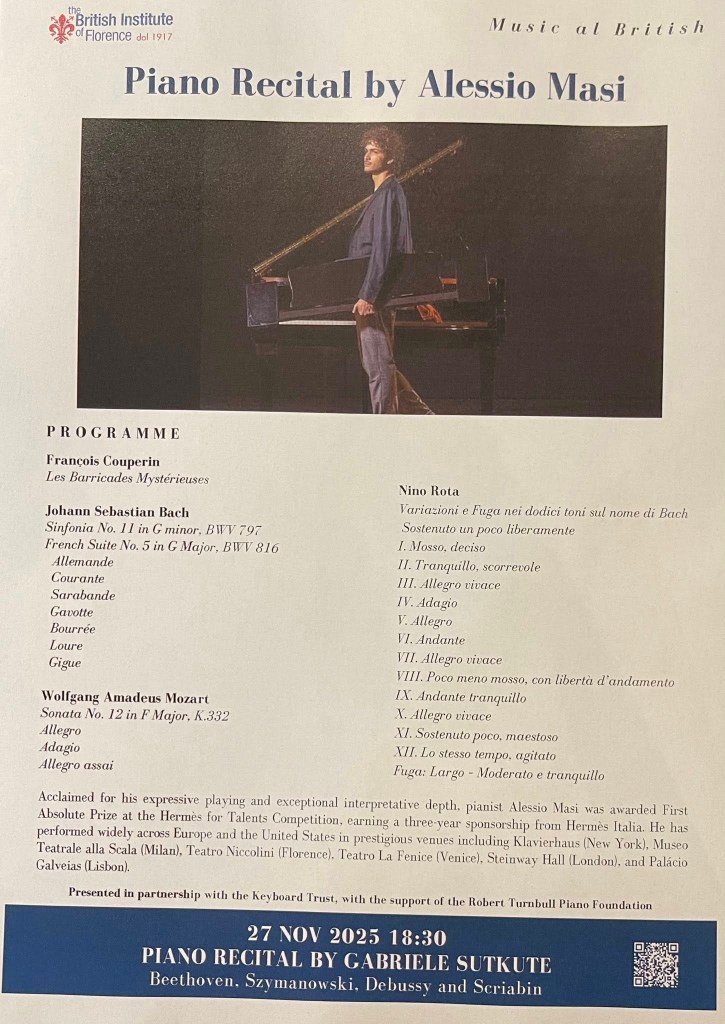
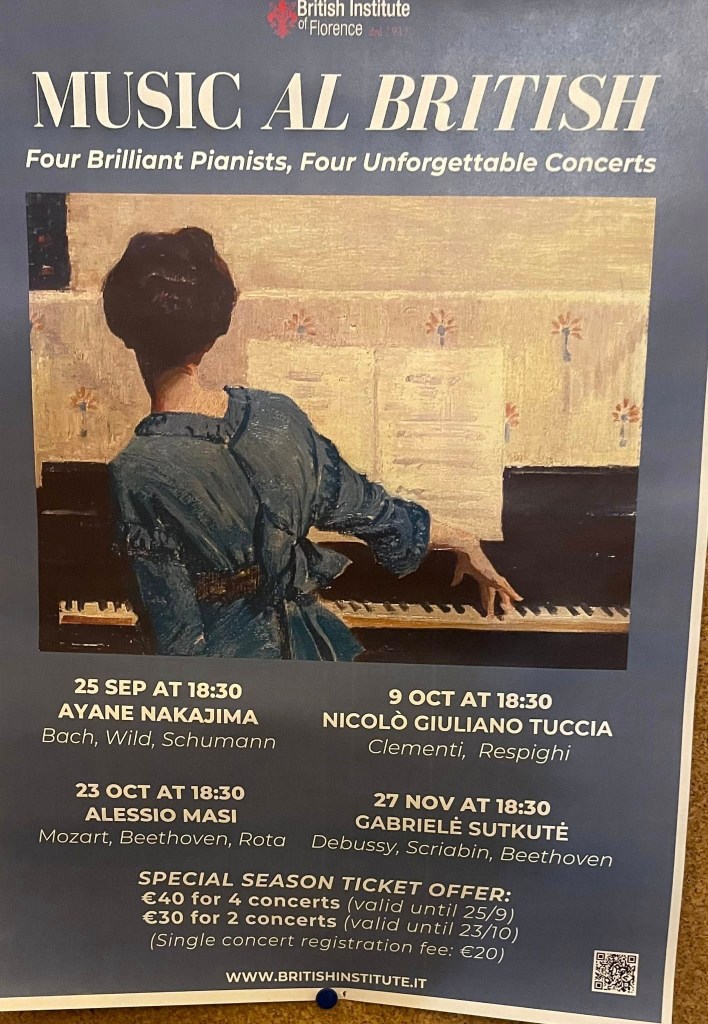
The British Institute are thrilled to present the next rising star from the Keyboard Trust, Sicilian-born Alessio Masi.


Programme
François Couperin – Les Barricades Mystérieuses
Johann Sebastian Bach
Sinfonia No. 11 in G minor, BWV 797
French Suite No. 5 in G Major, BWV 816
Allemande
Courante
Sarabande
Gavotte
Bourrée
Loure
Gigue
Wolfgang Amadeus Mozart – Sonata No. 12 in F Major, K.332
Allegro
Adagio
Allegro assai
Nino Rota: Variazioni e Fuga nei dodici toni sul nome di Bach
Sostenuto un poco liberamente
I. Mosso, deciso
II. Tranquillo, scorrevole
III. Allegro vivace
IV. Adagio
V. Allegro
VI. Andante
VII. Allegro vivace
VIII. Poco meno mosso, con libertà d’andamento
IX. Andante tranquillo
X. Allegro vivace
XI. Sostenuto poco, maestoso
XII. Lo stesso tempo, agitato
Fuga: Largo – Moderato e tranquillo
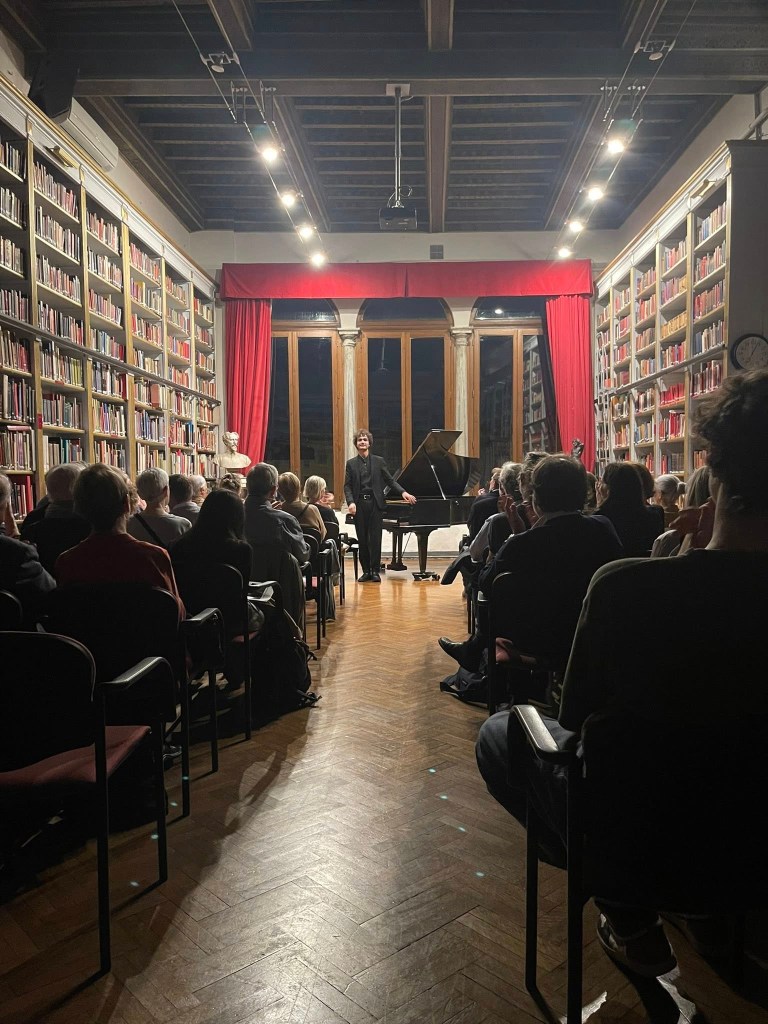
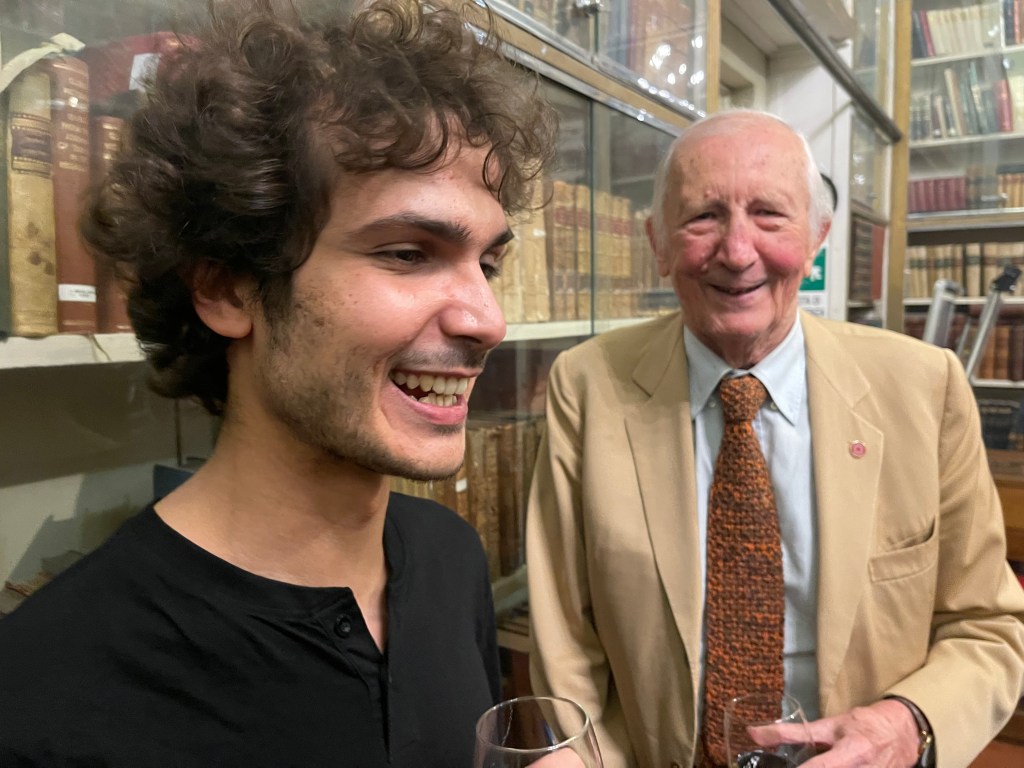
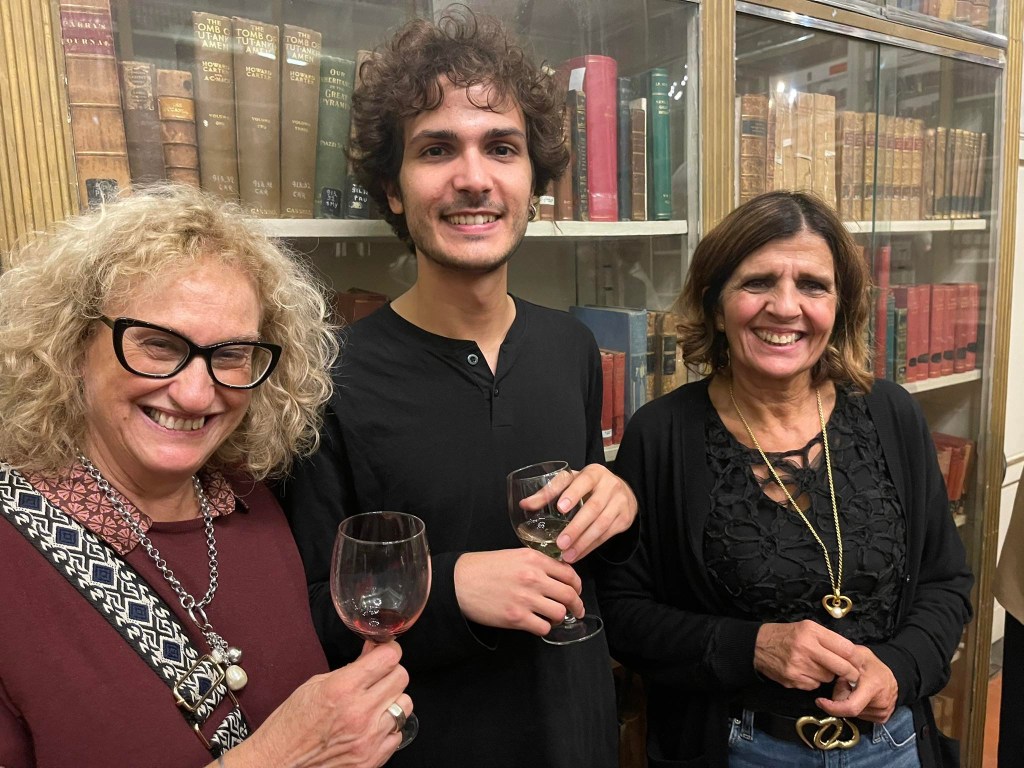
A room with a view that I have rarely seen so full as for the recital by the young Sicilian pianist Alessio Masi. Mentored by Roberto Prosseda, graduating with honours in Italy, he is now completing his studies at the Manhattan School of Music in New York. A flying visit with concerts in Rome and Florence where his passionate advocacy for the works of lesser known Italian composers was very much in evidence. He has been busy recording the original piano works by Nino Rota and his programmes included the rarely heard Variations and Fugue in 12 keys on the name of Bach.
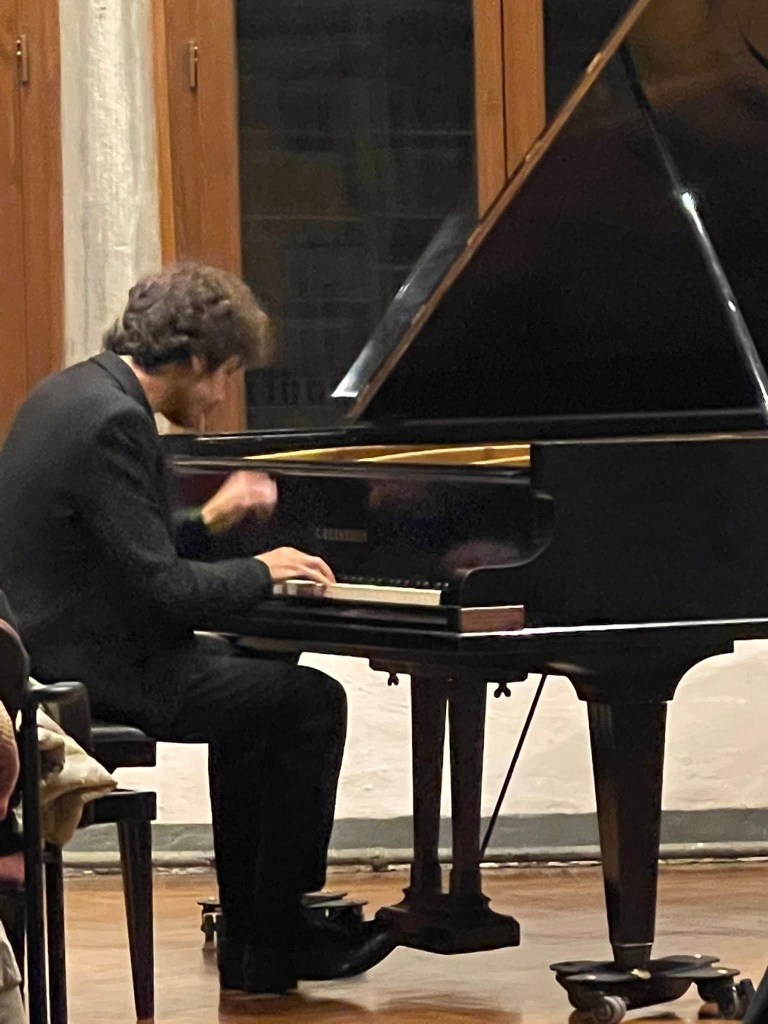

An eclectic thinking musician he even included as an encore two enticing waltzes on the name of Bach from Rota’s Suite Casanova di Fellini . He had played the entire suite in Rome the day before but in Florence he presented a more varied programme that included Couperin, Bach and Mozart . Works that with his intelligent musicianship he could enjoy adding improvised embellishments giving a new lease of life to such well known works. All done with refined good taste of delicacy and elegance that held us spellbound as he revealed a kaleidoscope of colours in this noble 1890 Bechstein that sits in this room with a view (rainy today) surrounded by the books of the Harold Acton library.

Beginning with Couperin’s beguiling ‘Barricades Mystérieuses’, a work that has long been part of the encore repertoire of Grigory Sokolov . Today there was the vision of a thinking musician who had taken the ‘mystérieuse’ very much to heart. Instead of the more usual web of intricate sounds and ornaments like tightly wound springs, Alessio played with a whispered elegance with ornaments that did just that, and sparkled like jewels rather than blinding headlights. There was a gentle relaxed flow to the music that was shaped with unusual flexibility and freedom with some wonderful bass notes that I had never until today been aware of. Strands of counterpoints or different voices each one with a life of it’s own combining to create this miniature tone poem. There was the same gentle whispered sounds that this vintage instrument was only too happy to accommodate under such sensitive hands, in the Bach Sinfonia in G minor. Sounds produced with delicacy and subtle shaping with never any brittle hard edges but nevertheless with a strong backbone of poetic authority. Here Alessio defined a refined duet between the voices.

Not wanting to break this pastoral atmosphere the ‘Fifth French Suite’ entered on the wings of the radiant beauty that had been created. I have a feeling we should not have applauded, even after the Couperin, because this sensitive poet of sounds with these three works wanted to create a single unit before the entry of the operatic marvels of Mozart. Bach’s ‘Fifth French Suite’ is surely one of his most beautiful and like the ‘First Partita’ exudes beauty and simplicity from the very first notes. It was within the same atmosphere that Alessio had created, that the ‘Allemande’ unfolded with its pastoral beauty and with Alessio adding delicate ornamentation with knowing refinement. Suddenly the atmosphere changed and we were immersed in a brilliant ‘Courante’ springing to life using the bass notes as an anchor for this busy web of notes. It contrasted with the simple sublime beauty of the ‘Sarabande’ played with aristocratic finesse and ornaments that shone like jewels. He brought beguiling charm to the ‘Gavotte’ with his spirited joyous ornamentation too . The ‘Bourée’ sprang into life with great rhythmic energy that almost caught Alessio unawares. The strange questioning of the ‘Loure’ was where Alessio’s disarming simplicity and delicacy spoke louder that words. It wove it’s way to the rhythmic refined energy of the Gigue that was given an architectural shape and insinuating inevitability.

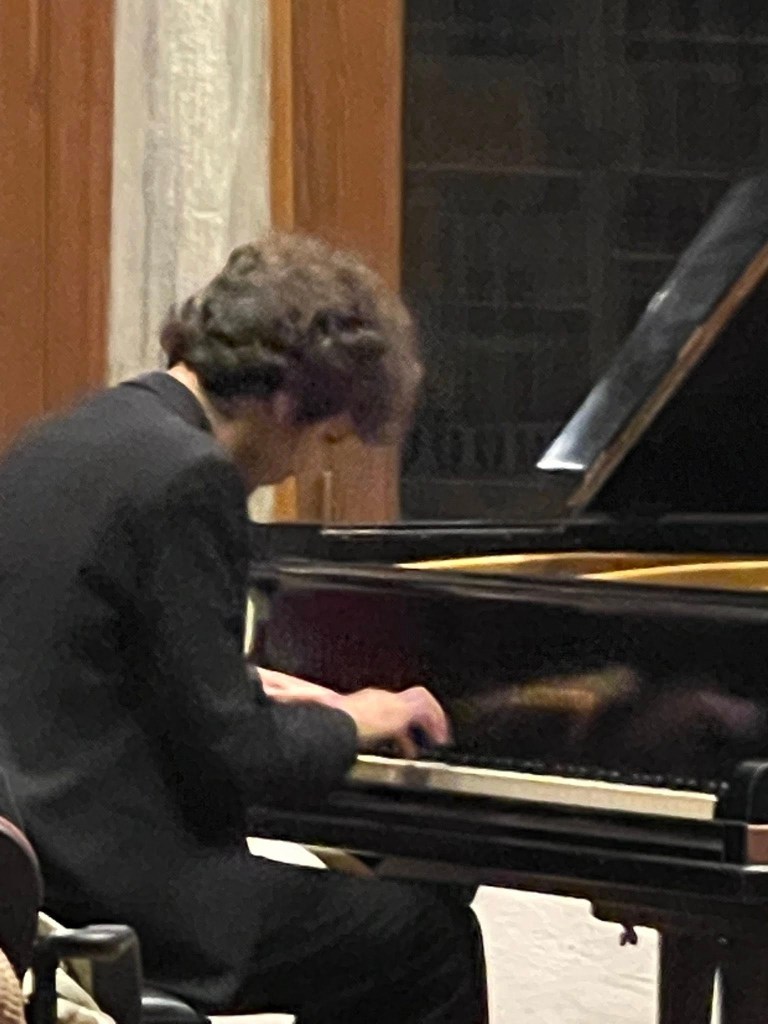
Greeted now by applause from a public who he had led into this magic world of elegance and poetic meaning and to an age where reason and measure were of fundamental importance. We were being prepared now for the age of the human voice and stage drama of which Mozart was the guiding genius of his age. The Sonata in F is like an opera with its characters so well defined with their changes of moods and the differing scenes. In Alessio’s sensitive hands we could almost see the characters entering the stage with a multitude of differing personalities. Mozart played with perfect equilibrium where once the scene was set we were in a sound world almost as if we were on stage and everything was in perfect proportion. A sound world that Alessio had found hidden away in this instrument that he certainly would have had difficulty finding on the modern day Fazioli that he had in Rome the night before.
It was Chloe Jiyeong Mun playing all of Schubert’s Impromptus in this hall who declared that it was on this vintage instrument that she felt most at home and able recreate with poetic simplicity the genial outpourings of Schubert.
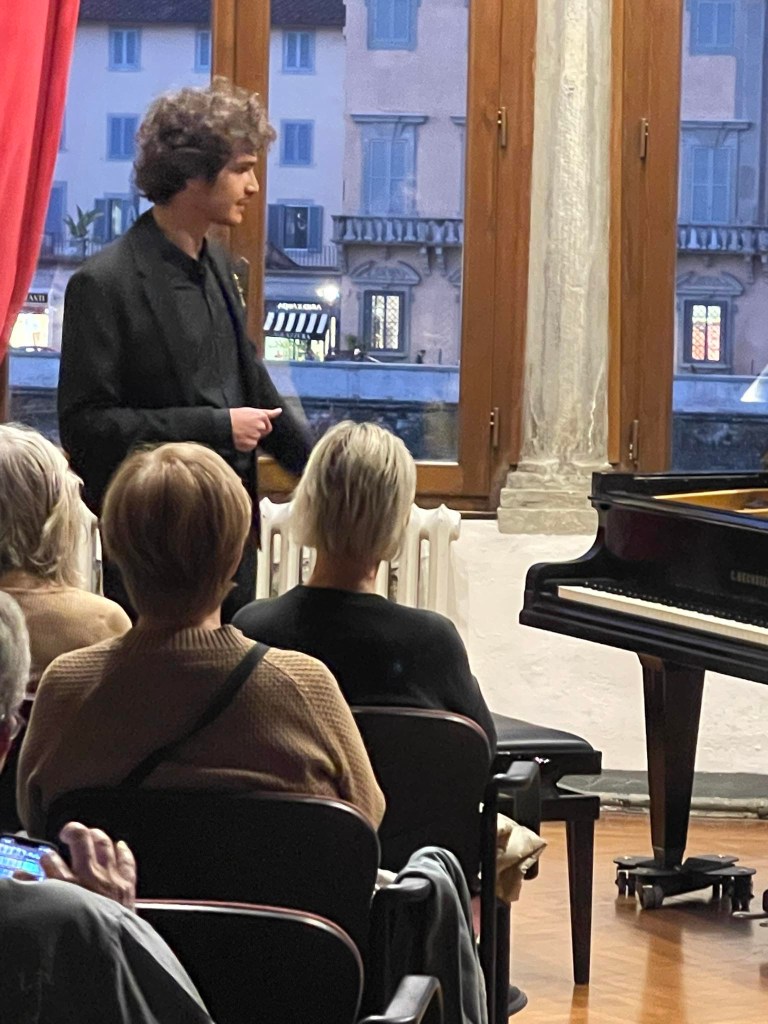

The Mozart F major sonata K 332 opened with flowing simplicity and very delicate phrasing with feeling for orchestral colour and the tonal palette of a chamber ensemble. Mischievous ornaments were added on the repeats as Alessio was recreating this almost operatic experience and having such fun giving each character a life of its own. The Adagio was beautifully phrased with great delicacy and poignant beauty. The Allegro assai just shot from his well oiled fingers with an infectious ‘joie de vivre’ and Mozart’s little trick false ending did not catch out the learned audience of the British, who were listening to every note with rapt attention.


A complete change of mood and colour from the very first flourishes of Rota’s Variations. Playing of absolute authority and burning conviction with a range of sounds that truly illuminated this instrument that had been reconditioned in 2008 by Mrs Mary Foreman, one of the members of the British Institute, with the idea of bringing music to this beautiful ‘Room with a View’.
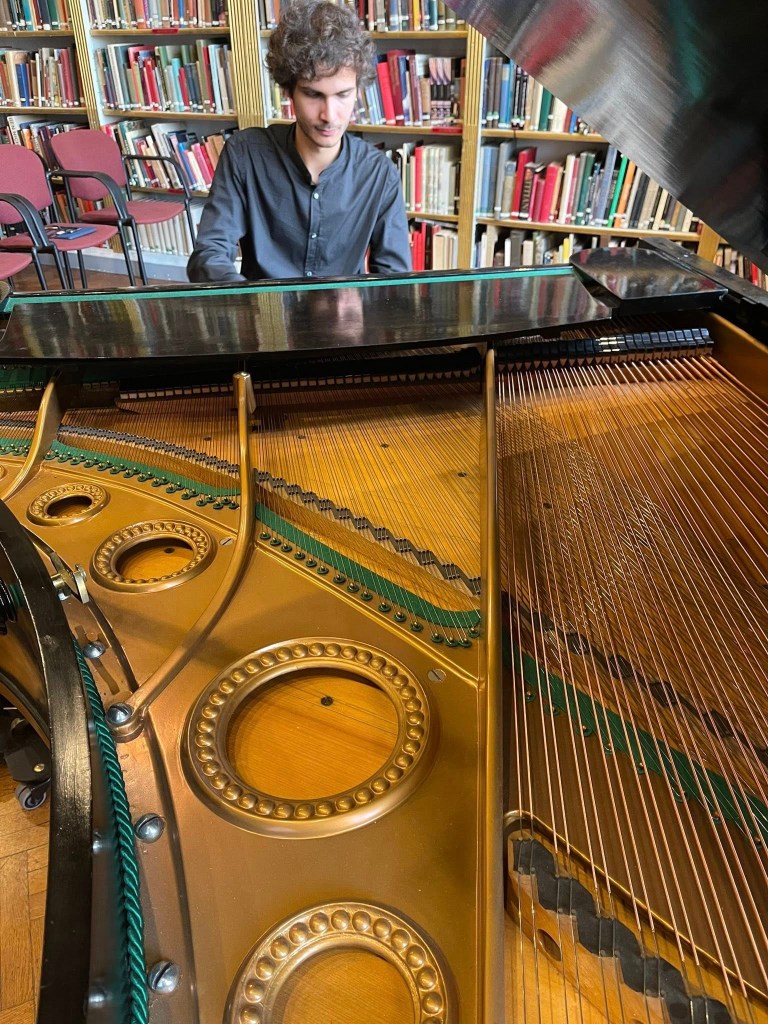
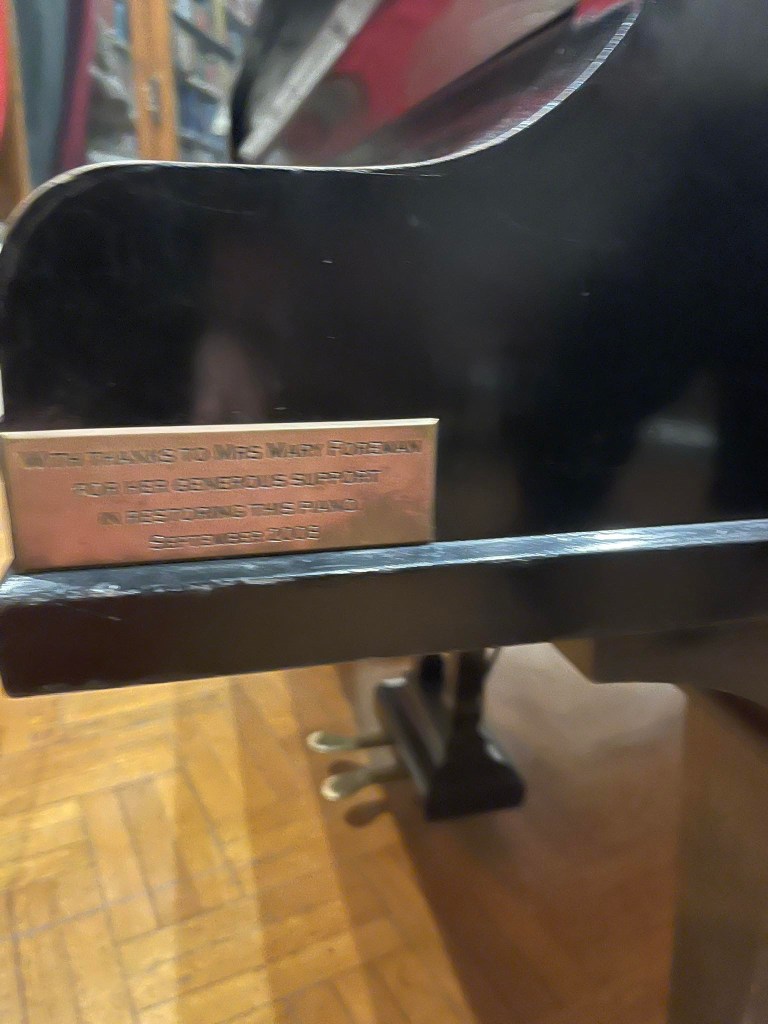
It has taken time and courage for the genial director and his wife Simon and Jennifer Gammell and their dedicated staff to respect her wishes and establish the Harold Acton Library as the ideal place to enjoy real music making. With not a little help from the Keyboard Trust a chance has opened up for exceptionally talented musicians to perform in the city where the Renaissance was born.






.https://youtu.be/UbcqeFc5VS8?si=kt0IhzCrUZWyqkTk
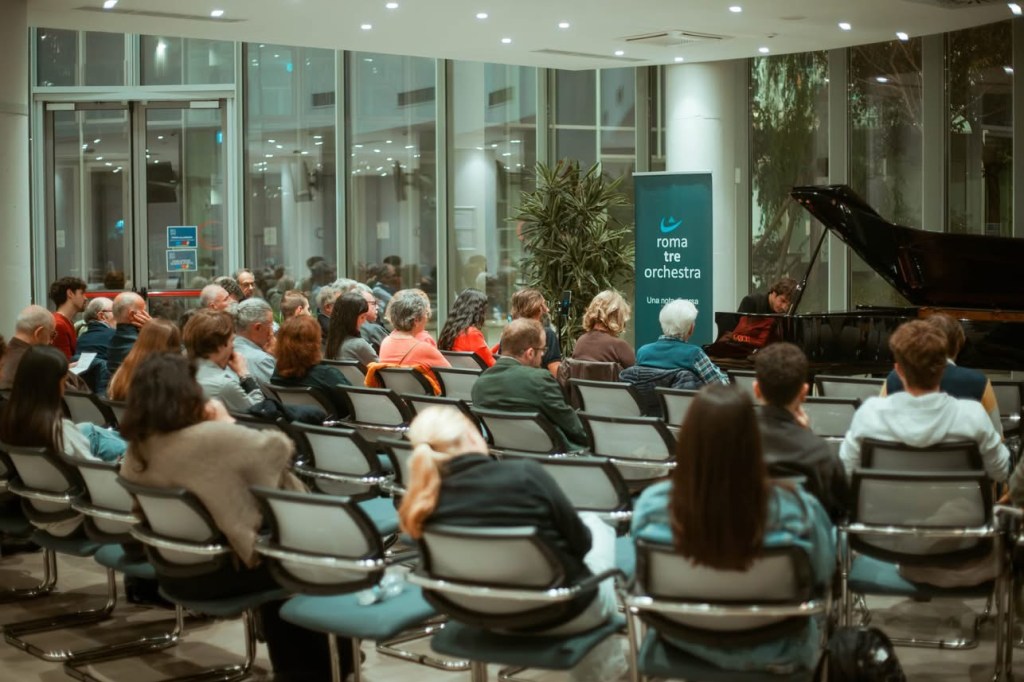
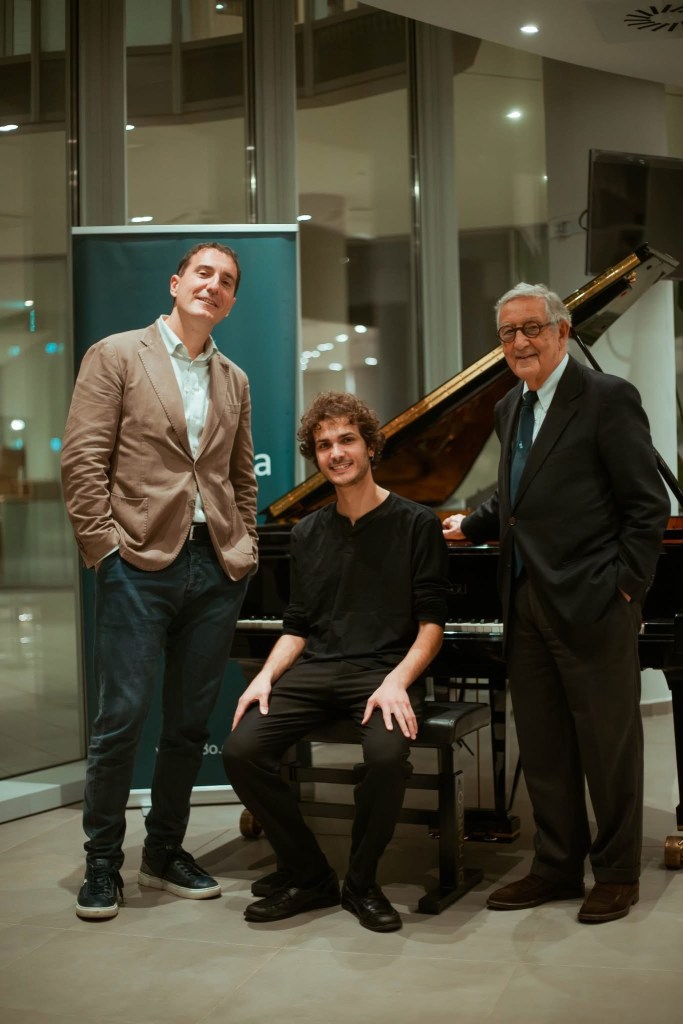


Alessio Masi was born in Sicily. In September 2025, he began his Professional Studies course at the Manhattan School of Music in New York, studying with Daniel Epstein. He has been studying piano with Alessandra Ammara and Roberto Prosseda in Italy.
Alessio has attended masterclasses with Roland Pöntinen, Inna Faliks, Jed Distler, Maria Narodystka, William G. Naboré, Alexander Malofeev, Andrea Lucchesini, Pietro De Maria, Maurizio Baglini and others.
He won First Prize in the Hermès for Talents Competition, which granted him a three-year sponsorship from Hermès Italia and a European tour organized by the H.Y.T.A. project. He also attends the Verbier Festival Academy annually.
Alessio was awarded the Second Prize, the Audience Prize, and a Special Mention for the performance of a contemporary work at the Premio Brunelli in 2025. This recognition also marked his début at the Teatro Olimpico in Vicenza where he was the soloist in Beethoven’s Fifth Piano Concerto.
Alessio has performed in numerous prestigious venues and theatres in the UK, Portugal, Spain, USA, Germany and Italy, sharing his interests in Italian piano music and the musical legacy of Bach through recitals of music with strong thematic connections.
In 2025, his album dedicated to the piano music of Nino Rota will be released on the Brilliant Classics label.
Alessio is also active as a composer and will soon release his first album of original piano music.
Here is a video of Alessio playing in New York: https://www.youtube.com/watch?v=QHyypmp9qRM
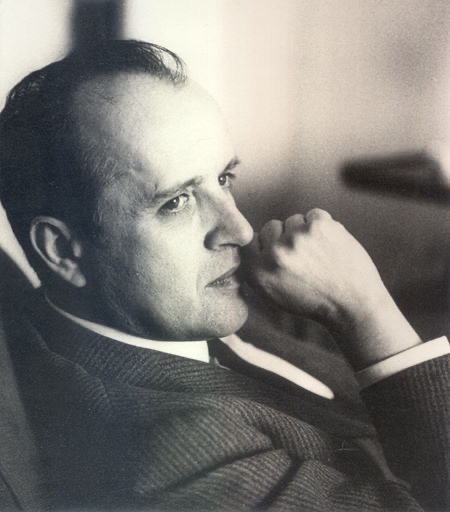
Composer Nino Rota (1911 – 1979) was born into a family of musicians in Milan. He was initially a student of Giacomo Orefice and Ildebrando Pizzetti until he moved to Rome while still a child and completed his studies under Alfredo Casella at the Conservatory of Santa Cecilia in 1929. In the meantime, he became an enfant prodige, famous as both a composer and a conductor. His first oratorio, L’infanzia di San Giovanni Battista, was performed in Milan and Paris as early as 1923, and his lyrical comedy, Il Principe Porcaro, was composed in 1926.From 1930 to 1932, Rota lived in the U.S.A. He won a scholarship to the Curtis Institute of Philadelphia and studied composition under Rosario Scalero and orchestra under Fritz Reiner.
Rota returned to Italy and earned a degree in literature from the University of Milan. In 1937, he began a teaching career that led to the directorship of the Bari Conservatory, a title he held from 1950 until his death in 1979.After his ‘childhood’ compositions, Rota wrote the following operas: Ariodante (Parma 1942), Torquemada (1943), Il cappello di paglia di Firenze (Palermo 1955), I due timidi (RAI 1950, London 1953), La notte di un neurastenico (Premio Italia 1959, La Scala 1960), Lo scoiattolo in gamba (Venezia 1959), Aladino e la lampada magica (Naples 1968), La visita meravigliosa (Palermo 1970), and Napoli milionaria (Spoleto Festival 1977).
He also wrote the following ballets: La rappresentazione di Adamo ed Eva (Perugia 1957), La Strada (La Scala 1965), Aci e Galatea (Rome 1971), Le Molière Imaginaire (Paris and Brussels 1976) and Amor di poeta (Brussels 1978) for Maurice Bejart.
In addition, countless of Rota works are performed worldwide.
Rota’s work in film dates back to the early forties and his filmography includes virtually all of the noted directors of his time. The first of these is Federico Fellini. Rota wrote the scores for all of Fellini’s films from The White Sheik in 1952 to The Orchestra Rehearsal in 1979.
Rota also collaborated with other directors, including Renato Castellani, Luchino Visconti, Franco Zeffirelli, Mario Monicelli, Francis Ford Coppola (he received the Oscar for Best Original Score for The Godfather II), King Vidor, René Clément, Edward Dmytrik and Eduardo de Filippo. Additionally, he composed the music for many theatre productions by Visconti, Zefirelli and de Filippo .He is best known for his film scores, notably for the films of Federico Fellini and Luchino Visconti. He also composed the music for two of Franco Zeffirelli’s Shakespeare screen adaptations , and for the first two installments of Francis Ford Coppolas’s The Godfather Trilogy , earning the Academy Award for the Best Original Score for The Godfather Part II in 1974
A prolific composer :
Music for pianoforte
- 1919: Il Mago doppio – Suite per quattro mani
- 1920: Tre pezzi
- 1922: Preludio e Fuga per pianoforte a quattro mani (Storia del Mago Doppio)
- 1924: Illumina Tu, O Fuoco
- 1924: Io Cesserò il Mio Canto
- 1924: Ascolta o Cuore June
- 1925: Il Presàgio
- 1925: La Figliola Del Re (Un Augello Gorgheggiava)
- 1930: Ippolito gioca
- 1931: Campane a Festa
- 1933: Campane a Sera
- 1935: Il Pastorello e altre Due Liriche Infantili
- 1938: La Passione (poesia popolare)
- 1941: Bagatella
- 1945: Fantasia in sol
- 1946: Fantasia in do
- 1954: Azione teatrale scritta nel 1752 da Pietro Metastasio
- 1964: 15 Preludi
- 1971: Sette Pezzi Difficili per Bambini
- 1972: Cantico in Memoria di Alfredo Casella
- 1975: Due Valzer sul nome di Bach
- 1975: Suite dal Casanova di Fellini


 ChristopherAxworthy-MusicCommentary