
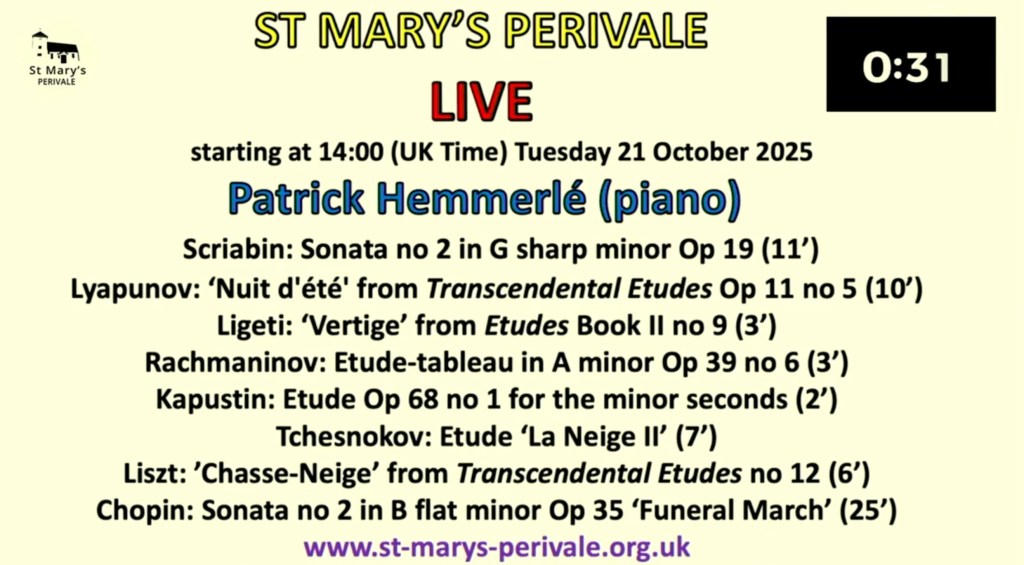
Another fascinating programme from this eclectic master pianist who has shone a light on many neglected works over the past few years and as Semprini used to say playing : ‘Something old,Something new’. A sandwich of two second sonatas by Scriabin and Chopin with a sumptuous filling of six studies . Two Russian , two Hungarian and two Ukrainian . Nothing political but simply a coincidence and what it is.
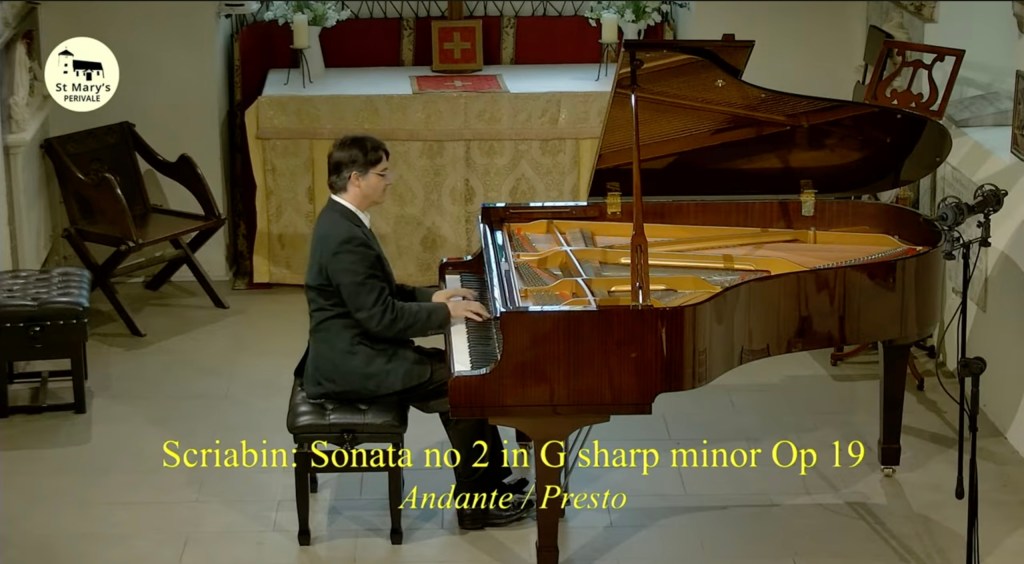
From the very first notes of Scriabin’s ‘Fantasy’ Sonata there was a fluidity of natural hand movements on the keys that conveyed so well the rhapsodic nature of this opening movement . A luminosity to the sound with a luxuriant melodic outpouring of beguiling rubato and timeless beauty. A wondrous sense of balance that allowed the melodic line to pass from one register to another without ever disturbing the flowing golden arabesques in which they were so warmly wrapped. There was a musicianly sense of line to the second movement that in lesser hands can seem like a study. Patrick showed us washes of colour and changing harmonies opening up to one of those sumptuous Tschaikovskian melodies that was very much part of Russian pre revolution opulence and style.

Lyapunov was a study in beautiful glowing cantabile that was played with sumptuous style and gloriously rich sonorities with a featherlight cadenza and ravishing accompaniments.
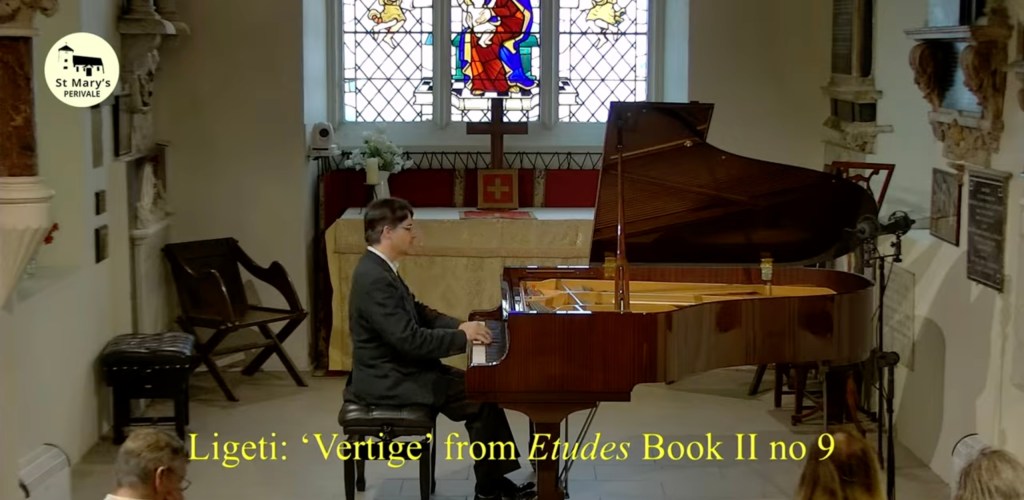
Ligeti on the other hand was a continual perpetuum mobile stream of notes that Patrick managed to shape into an extraordinarily atmospheric sound world. A technical mastery that allowed him to give a sense of line and shape to these spider webs of notes.

The Etude Tableau by Rachmaninov is often known as the ‘Red Riding Hood’ study because of the terrifying interruptions with gusts of notes. It was played with brilliance and character. There was a remarkable bass melodic line as the temperature rose to fever pitch only to dissolve to one last fearful gasp.

The Kapustin jazz study in thirds showed Patrick’s transcendental mastery as double thirds were shaped into a non stop stream of jazz excitement with breathtaking and breathless brilliance. He was able to throw off the ending with nonchalant ease that brought a smile even to his face.

Tchesnokov’s Etude ‘La Neige II’ is a remarkable tone poem that begins with beautiful suggestive tremolando sounds on which are placed clusters of notes like boulders falling on the keys.It created a desolate atmosphere that built to a tumultuous climax and enormous sonorities that spanned over the entire keyboard. A really original work that deserves to be better known as it even anticipates the hypnotic repetition of bells of Steve Reich .

Liszt Chasse Neige is the last of the transcendental studies and it was very interesting to see it played in this context with that of Tchesnokov. It is a masterpiece of painting a picture in sound – exactly like Rachmaninov’s Etude Tableaux. Patrick played it with a remarkable sense of balance where the melodic line rose above the tremolandos creating an overall kaleidoscope of sounds with a sense of control no matter how passionate and sumptuous the climax.

Chopin’s Second Sonata is one of the composers greatest works even though Schumann at the time described the sonata as ‘four of his maddest children under the same roof.’ Describing the last movement :’ seems more like a mockery than any sort of music’. Patrick played the first movement with aristocratic authority with the ‘doppio movemento’ rather slow and measured but that contrasted so well with the second subject that he allowed to unfold with beauty and style. Adding an occasional bass note to give more depth to the sound as he quite rightly ignored the much debated repeat and went straight into the development that he played with grandeur and masterly control. The ‘Scherzo’ was played very rhythmically and clearly with absolute technical assurance that contrasted with the trio where he allowed himself an unusual freedom with playing of ravishing beauty. A flowing Funeral March of poignant beauty was contrasted with the trio of unusually expressive freedom and passionate intensity. The last movement was played with great clarity as the wind blew over the graves . He phrased the whirlwind of notes in such a musicianly way but that did in the end interrupt the continual flow of this extraordinary movement .

Patrick Hemmerlé is a French pianist based in Cambridge, UK, known for his intellectually rich programming, technical mastery, and commitment to rediscovering overlooked repertoire. Trained at the Conservatoire de Paris, where he won First Prize under Billy Eidi, Hemmerlé went on to study with several distinguished pianists including Joaquín Soriano and Eric Heidsieck, shaping a style that combines French elegance with analytical depth.
Hemmerlé’s performances span major cultural centres across Europe, China, and the United States. As Musician-in-Residence at Clare Hall, University of Cambridge, he curates the Intimate Engagements concert series and regularly gives masterclasses and lecture-recitals. His programming often explores large-scale cycles—such as the 24 Chopin Études or Bach’s Well-Tempered Clavier—and unusual pairings, including Beethoven’s Diabelli Variations alongside Bach’s Goldberg Variations. These innovative formats have earned him praise for both conceptual originality and interpretive insight.
He is a passionate advocate for underrepresented composers such as Novak, Roger-Ducasse, and Tchesnokov, several of whom feature in his discography on labels including Orpheus and Indésens. His 2023 recording project paired Bach with Fischer’s Ariadne Musica, highlighting the deep connections between these two composers.
Alongside his performance career, Patrick Hemmerlé is a dedicated teacher and musical thinker. He gives masterclasses and lecture-recitals in the UK and France, and his academic role at Cambridge allows him to engage students and audiences in discussions about structure, interpretation, and musical context. His concerts often include spoken introductions or in-depth programme notes that reflect his commitment to fostering deeper listening.
Critics have praised Hemmerlé’s performances for their “sheer brilliance and intellectual strength,” often drawing comparisons to pianists like Nelson Freire and Guiomar Novaes. Whether in recital, on disc, or in the lecture hall, he offers audiences an experience that is as thoughtful as it is musically compelling.

 ChristopherAxworthy-MusicCommentary