

A ‘tour de force’ from Filippo Tenisci who after his heroic dedication to the Liszt Transcriptions of Wagner has now set his sights on rarely if ever heard works of Béla Bartók. A seemingly infallible memory that allowed him to master the intricate rhythms and continual changing character that Bartók uses from the folk idioms of his native Hungary.

His programme had begun, though, with Debussy which immediately showed off his kaleidoscope of sounds allied to a musical intelligence that could always perceive the overall line and architectural shape of works that in lesser hands can loose their noble identity. ‘La Cathédrale Engloutie’ seemingly rather slow at the beginning, with a very particular way of coaxing the sounds out of the piano but creating an atmosphere as the music gradually took wing. The ending too was rather slow but of great contemplation and poignant beauty. It was just the contrast that he found as the great chorale outpouring was allowed to flow with noble richness, the hands always caressing the keys with fluidity and radiance.

It was this glowing fluidity that made the ‘Images’ book two so full of ravishing colours and fleeting lights. Debussy’s magical bells were played with a piercing beauty as the melodic line was allowed to float on a wave of magic sounds. Sounds that became ever more of glistening radiance as the bells became closer. But it was the whispered ending that was played with the beauty of artist who is also a poet of sound. It was the same with the emptiness that he could convey as the moon shone on the imaginary temple.There was a beautiful whispered purity to the plaintive melody that arose above such a ravishing accompaniment. The desolation that sounds could convey from Filippo’s wondrous tonal palette was immediately interrupted by the vision of Debussy’s lacquered Gold fish . There was a seemingly improvised freedom but also a great sense of line that gave architectural shape to the impish devils darting around in Debussy’s imagination until they disappeared into the distance.

Wagner’s or should I say Liszt’s ‘Liebestod’ has long been in Filippo’s repertoire and I imagine it was the work that inspired him to delve deep into the other transcription’s or should I say recreations by Wagner’s son in law. Mastery and authority went hand in hand as the noble opening declaration dissolved into a vibrant interweaving of counterpoints of red hot passion. Finally exploding into the tumultuous climax that Filippo played with overwhelming power and conviction. It was here in the mighty climax that Filippo allowed the bass to give an anchor to the sumptuous sounds that poured from his hands but never hardening or ungrateful but ever more grandiose and all embracing.
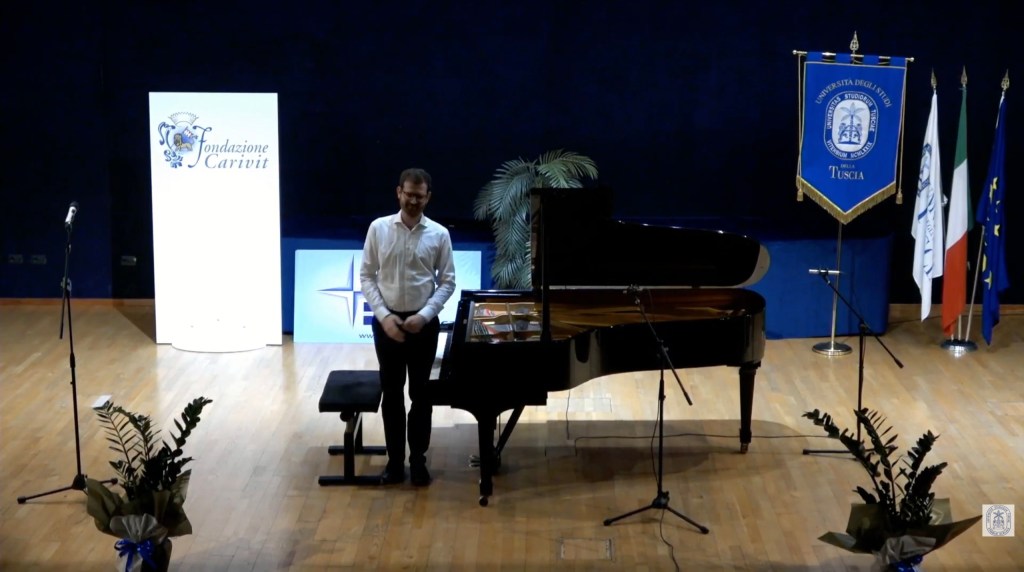
These works by Bartók strangely I have never heard before in concert even if György Sándor ,who was a friend of the composer and the first to play his third piano concerto in public, was a regular visitor to my concert seasons in Rome with works other than these.


There must be a vast amount of Bartók’s works that I am sure Filippo will discover in the archives and bring at long last before the public . Works that he will bring to life as today with his wondrous palette of colour and kaleidoscope of sounds together with a technical mastery that can cope with such complex rhythmic juxtapositions.

Marvellous though it was to hear such revelations Filippo had thought carefully about an eventual encore. Refreshing the air with the purity and simplicity of one of the Bagatelles op 126 that Beethoven had written at the end of his life when he could foresee the vision of paradise that awaited after such a tormented existence on earth.




 ChristopherAxworthy-MusicCommentary