
Beethoven Sonata in C-sharp minor, Op. 27 No. 2 ‘Moonlight’ Adagio sostenuto- Allegretto – Presto agitato
Schumann Fantasiestücke, Op. 12 Des Abends – Aufschwung – Warum – Grillen -In der Nacht – Fabel – Traumes Wirren – Ende vom Lied
Gounod/Liszt Faust Waltz

Rachel Cheung playing for the Beethoven Piano Society of Europe, how could she not open but with Beethoven.The thirty two sonatas Julian Jacobson had presented in this very hall a few years ago in a marathon non stop performance of all thirty two at one sitting. He was now presenting his colleague from Hong Kong with just one of the thirty two steps of Beethoven that map the long and tormented existence of a genius.
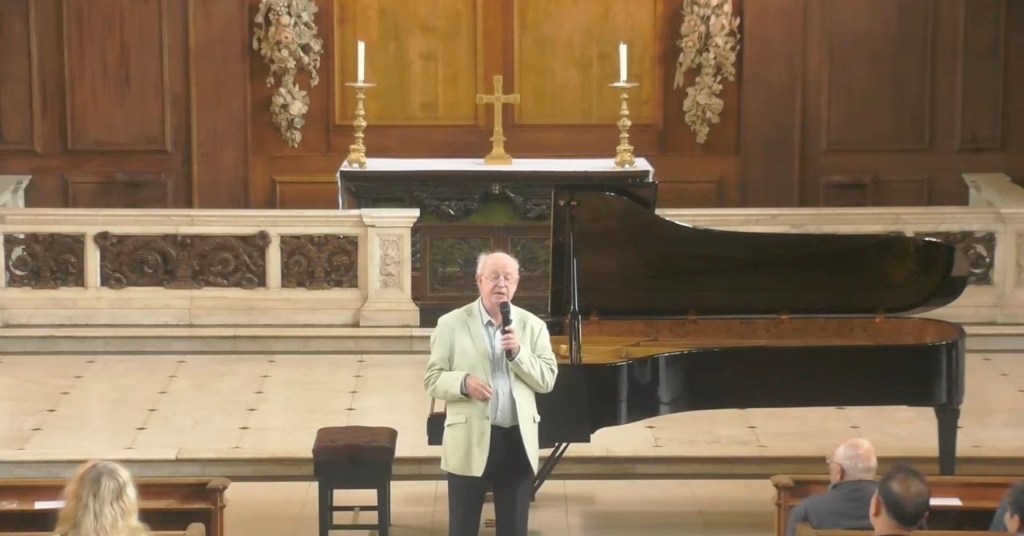
Today he was presenting Rachel in whose Academy in Hong Kong he had recently given masterclasses. Rachel today just presented one Sonata ,but it is the most well known of all sonatas , known as the ‘Moonlight’. A title that Beethoven did not choose but his publisher thought would sell better if it had a title ! One of his two Sonatas ‘quasi una fantasia’ that make up op 27. Both extraordinarily original works where Beethoven is breaking away from his teacher Haydn and the classical model sonata form .
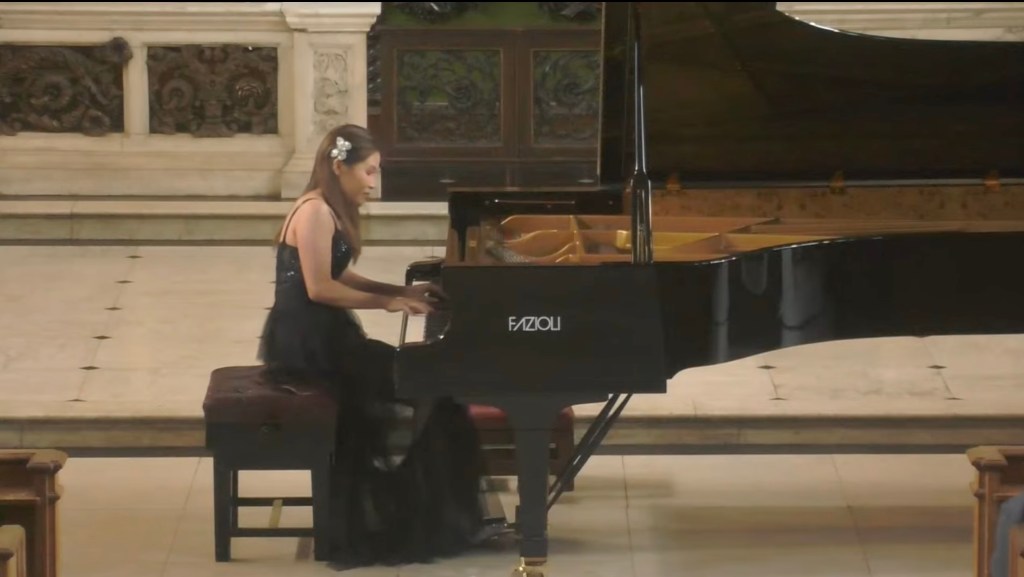
Op 27 n.2 which Rachel played today suffers from its title in that people usually play the first movement too slowly gazing into the magical inexistent moonlit waters. It is infact written in two and the continual triplets are but an accompaniment to the melody that is floated above. Rachel played it as Beethoven had written and her beautiful flowing tempo and the glistening clarity of the melodic line was given an architectural shape that gave a noble beauty to this ‘Adagio sostenuto.’ The ‘Allegretto’ was played with Beethovenian severity where grace and Haydenesque charm would have contrasted better with the Trio that she played with great authority. The ‘Presto agitato’,last movement was played with masterly control and burning intensity. Even the beautiful mellifluous passages had an urgency to them that brought us to the tumultuous cascades of notes, and after a brief relieving cadenza, the final burst of driving urgency was played with masterly authority.
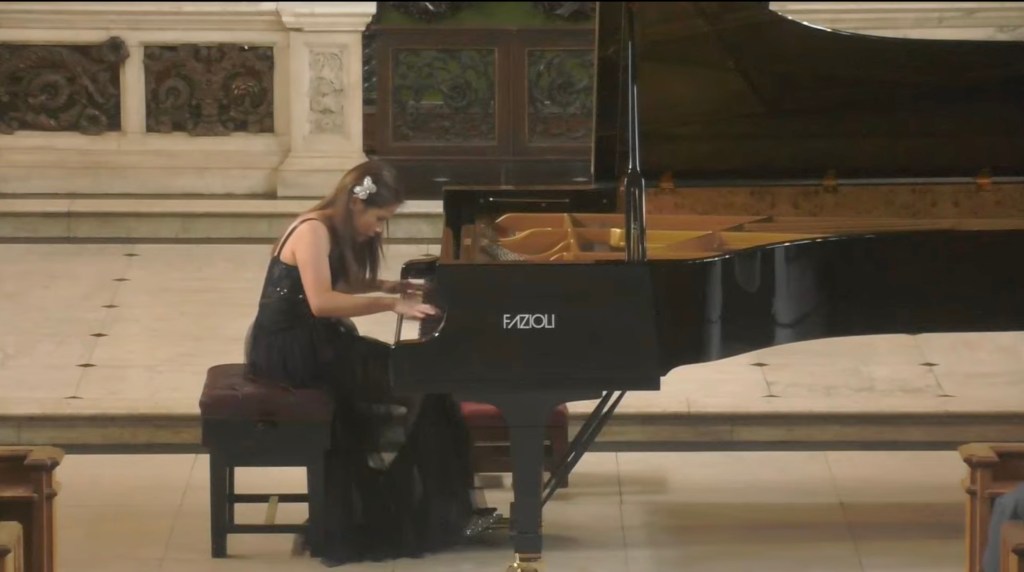
It was the world of Schumann where Rachel’s mastery really shone brightly. There was an authority and beauty to all that she did, where even the opening ‘Des Abends’ was played with a chiselled beauty and timeless beauty. A magical accompaniment on which the melodic line could float with poignant meaning. ‘Auschwung’ just sprung from her fingers with a passionate outpouring of driving intensity , but even here there was a beautiful melodic line that floated magically above an ever more agitated accompaniment . There was wondrous beauty to ‘Warum’ where the beauty of the duet between the voices was played with ravishing sounds with exquisite phrasing and magical colouring. She brought a great sense of character to ‘Grillen’ with a continuous whimsical display of rhythmic and melodic episodes played with extraordinary brilliance and beguiling capricious charm. ‘In der Nacht’ brought a superb web of weaving sounds played with absolute mastery and clarity and with a terrifying driving force. Even here, wondrous melody suddenly appeared, as Schumann in this period, like Schubert, seemed to have a never ending song in his heart. ‘Fabel’ brought capricious comments of improvised lightness in reply to the slow melodic story that was unfolding with such poetic imagination. ‘Traumes Wirren’ was played with fearless mastery as this ‘perpetuum mobile’ drove its way relentlessly over the entire keyboard with exhilarating exuberance. There was a nobility to the ‘Ende vom Lied’ that Rachel played with aristocratic authority. The absolute stillness that she brought to the final few bars was magic indeed. As Schumann wrote so poignantly to Clara : ‘everything ultimately dissolves into a merry wedding – but my distress for you came back at the end, and the wedding bells sound as if commingled with a death knell.”

A masterly performance that held us spellbound with the poetic beauty and authority of her playing
The final work was the Gounod /Liszt Faust paraphrase. A pianistic show piece that Rachel played with fearless abandon but with masterly control . A kaleidoscope of colours illuminated the extraordinary brilliance of the jeux perlé as Liszt weaves a magical web of sounds incorporating Gounod ‘s magical melodies . Grandeur and sumptuous rich sounds filled this beautiful church with sounds of the opera where glissandi were thrown off with the same natural ease as a singer with the embellishments of bel canto. A breathtaking ‘tour de force’ of a work that in Liszt’s day would turn refined aristocratic ladies into a screaming mob wanting souvenirs of their idol to take home . Rachel’s performance ,too, generated such excitement that the final tumultuous bars were greeted with a spontaneous standing ovation.
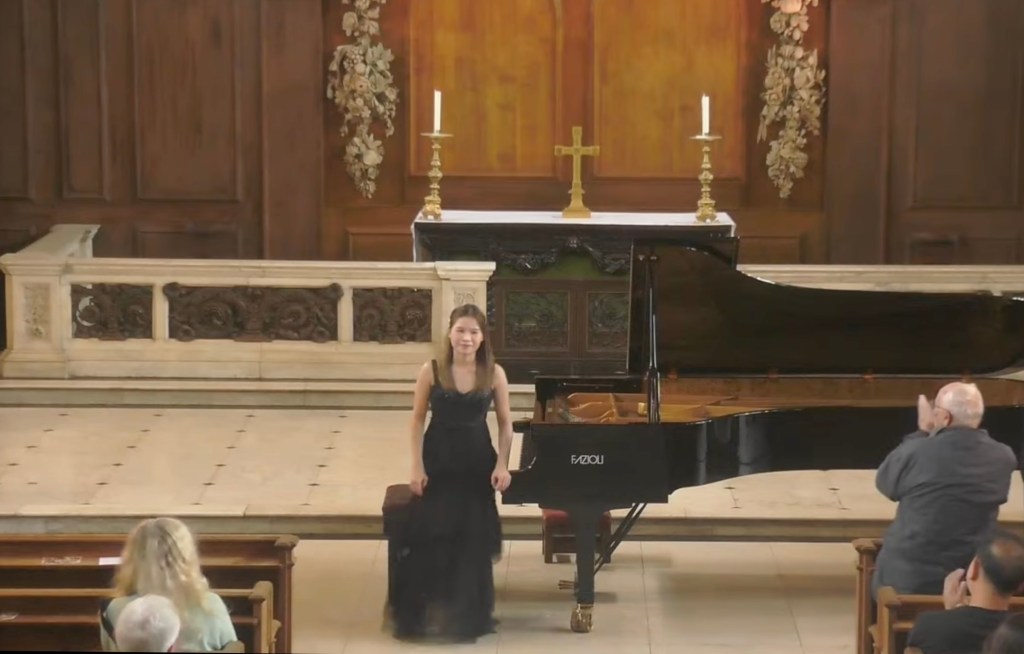

Hong Kong-born pianist Rachel Cheung is recognized as one of the most sought-after artists in Asia. She has been hailed as “a poet, but also a dramatist,” displaying “the most sophisticated and compelling music-making” (The Dallas Morning News). She won over audiences and critics alike as a finalist at the 2017 Van Cliburn International Piano Competition with “stunningly imaginative” (Musical America) interpretations marked by “flights of both beauty and virtuosity” (Theater Jones) and was awarded the Audience Prize by online vote. Also a Steinway Artist, she continues to build a reputation for her elegant stage presence, giving sensitive and refined performances across three continents.
Rachel has appeared with the St. Petersburg Philharmonic, Hong Kong Philharmonic, Jerusalem Symphony, Hong Kong Sinfonietta, Sydney Symphony, London Chamber, and Fort Worth Symphony Orchestras, collaborating with conductors including Edo de Waart, Vladimir Ashkenazy, Jaap van Zweden, Leonard Slatkin, Sir Mark Elder, Christopher Warren-Green, and Nicholas McGegan.
She has performed in recital at the Auditorium du Louvre in Paris, Elbphilharmonie in Hamburg, Steinway Hall in London, Weill Recital Hall at Carnegie Hall, Richmond Hill Centre for Performing Arts in Toronto, Philharmonie de Paris, and in other cities across the United States, Europe, and Asia.
As an active chamber musician, Rachel has collaborated with world-renowned artists including soprano Anna Netrebko, tenor Yusif Eyvazov, mezzo-soprano Virpi Räisänen, violinists Joshua Bell and Ning Feng, violist Vladimir Mendelssohn, cellists Camille Thomas, Zlatomir Fung, and Narek Hakhnazaryan, as well as the Brentano String Quartet and Quatuor Hanson.
Born and raised in Hong Kong, Rachel graduated with first-class honors from the Hong Kong Academy for Performing Arts under the tutelage of Eleanor Wong and later studied with Peter Frankl at the Yale School of Music, where she was awarded the Elizabeth Parisot Prize for outstanding pianists. Her additional competition honors include prizes at the Leeds, Chopin, Vladimir Horowitz, Gina Bachauer, and Geneva International Piano Competitions.
In 2019, Rachel was awarded Artist of the Year (Music) by the Hong Kong Arts Development Council. In 2025, she founded the Rachel Cheung Music Academy in Hong Kong, aiming to create a vibrant musical community and inspire the next generation of musicians. Her first concert DVD was released by VAI in 2007, and her debut international album, Reflections, featuring the Chopin Preludes, was released by Universal Music.
Presented in association with the Beethoven Piano Society of Europe
 ChristopherAxworthy-MusicCommentary