
After the wonders of Cremona in these past days a gift from the Gods indeed with the recreation of music by Richard Goode.
Beethoven Bagatelles may be trifles but they spoke tonight with a voice I have never heard before . A scrupulous attention to the composers wishes with the score in front of him as he thinks more of the music than any outward appearances.
Sounds I have never imagined wafted around the hall with breathtaking magic of disarming simplicity and beauty.
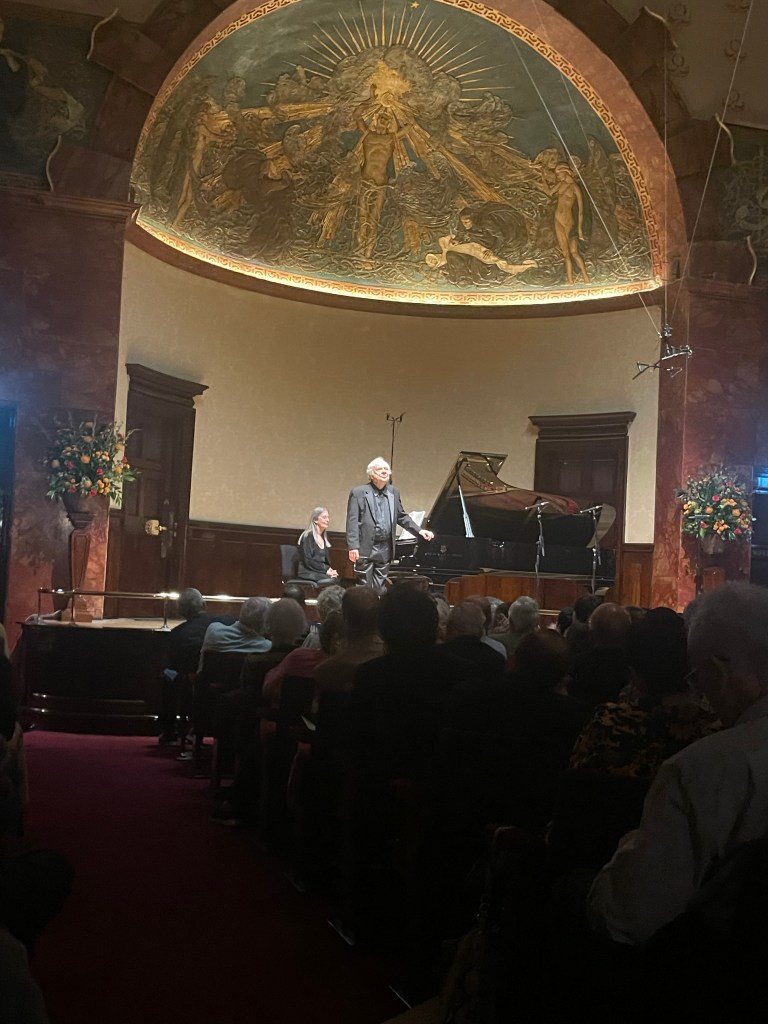

The two Sonatas op 90 and 101, where the beauty of the end of one was continued with the opening of the other. A range of sound that was orchestral but that never shouted at us but was always with beautiful fluidity where energy and surprise abounded but within the very notes themselves. We were under the cloud of a sound world where everything was so perfectly balanced and phrased that there was no need to shout and scream as there was much more power allowing Beethoven to speak for himself.

Schumann Davidsbündler seemed much shorter than usual because such was the intense concentration and kaleidoscope of colours and character, that time stood still as we were immersed in a wondrous land of magical sounds and passionate effusions. Florestan and Eusebius had such fun bickering that they hardly noticed that they had been transported to a land of dreams and as the clock struck twelve with a twinkle in their eye and nostalgia in their heart this marvel came to a close.

Cremona may be the city where dreams become reality but today in London I have never experienced a dream like this before ……….
In the meantime time comments are flooding in from great musicians far and wide :
‘A very great artist’. Craig Shepherd
Christopher Axworthy replying : ‘sweat and tears, an endless struggle to find the real meaning behind the notes . The circus element of concertising just does not enter into the equation…. We are allowed to eavesdrop on his work in progress ……reminds me of Pressler or Horszowski …..a voyage of discovery not of ego but as a humble servant .If only they would take note in Warsaw !!!!
‘Christopher, I agree with all of the above. You have named three of my favorite artists. It can take many years for young pianists to leave behind the circus of the competition circuit and concentrate on becoming artists. By the way (and this might interest you), the greatest revelations I’ve had from Richard have not been in the German composers, but rather some years back when he performed the second book of Debussy Preludes. I’ve never heard such extraordinary Debussy from anyone. He and I had a correspondence about that subsequently.’ Craig Shepherd
‘I couldn’t agree more! I was also in heaven from start to finish and very much in Menahem’s vein! Of course when you look at the pedigree and you see Claude Franck and Horszowski … and the sound, the voicing, the control, the miraculous left hand! Of course he was playing on the Old Lady, I knew it and checked with him! Then the way he listens to himself and shares the love of the music, so much like Menahem! I haven’t heard playing like that since Menahem ! To my mind these young students are not hearing the greats enough, they are so busy practising and working so hard!’ Annabelle Weidenfeld
‘What an exquisite concert… he stole my heart with those Bagatelles, one of the finest performance I’ve heard at the Wigmore. Schumann so beautifully layered, unusual, not as we’re used to hearing it. But he always made us listen to details, whilst his ideas invariably always made sense – beautiful sounds and cohesive discourse. Remember the final bass note of Schumann? Never knew that a lower bass note can be made to sound so optimistic, full of love: just like Schumann’s heart for Clara’. Cristian Sandrin
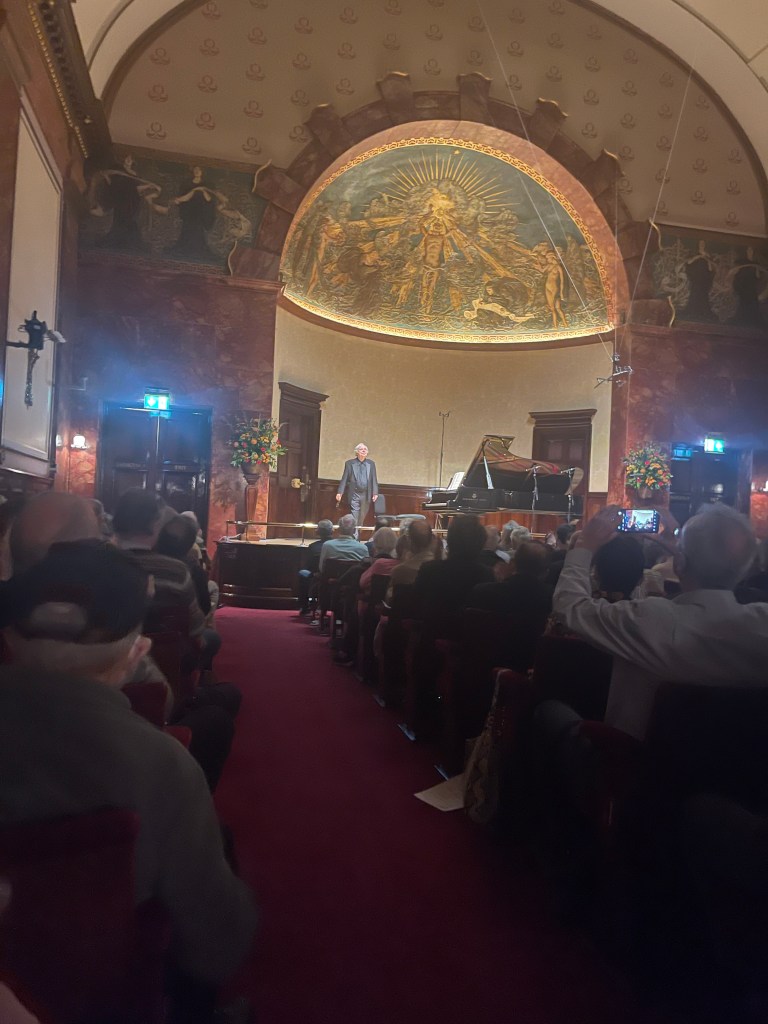
A luminosity and extraordinary range of dynamics with an impeccable sense of balance. A sound created within a roof of noble musicianship and sense of architectural shape .Orchestral colouring where individual phrasing added to the amalgam of music making that spoke so eloquently . The question and answer of the opening of op. 90 was of pastoral beauty until the rest! Whispered octaves of glowing beauty were uttered so surprisingly until suddenly there was a Beethovenian eruption of dynamic drive and fervent conviction. A momentary passionate cry before the agitation of the left hand where the deep bass notes had an independent line as the searing soprano melody just swooped over it . A ray of sunlight appeared of radiance and beguiling beauty as Beethoven’s miraculous Schubertian outpouring was embellished with a golden jeux perlé of breathtaking beauty. The meandering seemingly lost entry to the recapitulation was played with such character that it brought a smile to my face as I am sure it did Beethoven’s. The coda was played with even more orchestral colours and the final notes just allowed to dissolve into oblivion without any ritardando or false emotion. The mellifluous beauty of the second movement was exactly that which opened the following Sonata op 101. The contrasting character of a question and answer played with absolute dynamic mastery as it burst into song with a Schubertian outpouring that seemed unstoppable. What subtle beauty Richard Goode brought to the appearance of the melody in the tenor register, not projecting the sound but allowing it to emerge with touching nostalgia. Beethoven’s magic web of final sounds and his own built in rubato sounded so natural just as a singer would utter the final phrase with nonchalant ease and marvellous breath control!
One was aware in the opening of op 101 of delicacy but also what weight and sense of line there truly was. Radiant beauty from the pianissimo right hand chords as the left hand just hinted at the melody with haunting suggestion. A beautiful pastoral feel even to the most energetic passages with Beethoven’s phrasing just giving that extra lift to this lazy atmosphere.Disappearing to a whisper as the Scherzo entered with dynamic drive but never loosing that radiant fluidity where all the dotted rhythms, so reminiscent of Schumann, were given a sense of direction and beauty instead of the more rumbustious treatment from less attentive interpreters. Played with an extraordinary sense of legato and masterly pedalling even the mellifluous Trio became part of a whole of a marvellous song without words. An extraordinary change of instrumentation for the ‘Langsam’ gave such weight and poignant meaning to this one page introduction (like op 53 ) with a silvery cadenza leading to the genial return of the opening theme before bursting into the Presto. Notoriously difficult, but Richard Goode made it sound so easy, like a bubbling brook in this most pastoral of Beethoven’s late works. Beethoven’s stop and questioning ‘where do we go now’ was so masterly it could have come from a Mozart opera until bursting into a whispered fugato where those seemingly pointless trills became merely vibrations of teasing Scarlattian insinuation (K.1 ) . Building to massive breathtaking sounds as the whole hall seemed to erupt from such masterly hands until the return of the chattering fugato. Absolute mastery of a coda over a vibrating pedal note gradually disintegrating before Beethoven’s irascible slamming of the door.
The real jewels in the crown were kept to the end of the first half of the programme, with one of the last works that Beethoven was to pen for the piano, just three years before his death. Beethoven had come to terms with his turbulent life and was looking to a place far better than we could ever imagine. He could not only imagine it but could describe it in sound in these very pieces. ‘Trifles’ he called them as titles and words have no place here, call them what you will. A sound world of infinite emotions and radiant wondrous beauty. Goode played them with the Godliness with which they were penned.The serene beauty of the first with its silvery cadenza and its gradual slowing down written into the actual fabric with no need of additional help! The rumbustious second with sudden quiet interludes all played with masterly control of sound bursting into a beautiful cantabile. Leading to the tempestuous rhythmic drive where the sforzandi became cries for help as time and tide waited for no one on a journey of burning intensity. Radiant beauty to the third with its cadenza that sounded, from Goodes magic hands, like some wondrous aeolian harp, before the intricate elaborations of chiselled delicacy. Beethoven’s pedalling in the final five bars created a magic which I am sure the composer could have imagined but is rarely recreated in performance. Goode showed us the way with sublime etherial sounds with no rallentando but just a hovering cloud to the final whispered chord.The Presto of the fourth was played under a roof of controlled sound with the opening just forte (not fortissimo) with a full robust but not hard sound, which made so much architectural sense in contrast with the long pedal note on which the melodic line eventually floats. In this way the contrast between dynamic drive and floating beauty became part of a whole of driving forward movement.Radiance and simplicity were the key to the fifth Bagatelle.The opening and closing flourishes to the last were just the frame in which Beethoven’s poetic imagination could mesmerise us with its gasping fragmented beauty.
After the interval Schumann’s Davidsbündler kept us transfixed with eighteen scenes of beguiling beauty and passionate effusions. Goode’s attention to detail was remarkable and had me racing to look again at the score. The difference between dynamics all clearly written by Schumann was scrupulously observed with poetic beauty, nowhere more than in the opening scene where even Schumann’s precise pedalling gave such a lift to the insinuating musical line. Ravishing purity of the second where Eusebius is allowed to wallow in a beautiful reverie before being interrupted with the rumbustious hi jinx of Florestan. Goode’s way of underlining the bass in the final few bars gave a remarkable sense of diminishing closure without ever slowing down.The sixth scene I have never heard the bass played with such mastery that sounded like a gentle vibration on which the syncopated melodic line floated.The final D, allowed to resonate as the seventh grew out of the final reverberations. What fun he had with the eight,with the sparkling difference between staccato and legato. A sense of harmonic grandeur to the tenth of Brahmsian richness as Florestan passed on to Eusebius the eleventh with it’s tender simplicity where the tenor melody was barely whispered but so poignantly felt.The twelfth was thrown of with masterly ease and crystal clear articulation, the dangerous skips negotiated without a glance at the score. Florestan and Eusebius were now united with burning intensity and sumptuous chorale like majesty. The fourteenth is one of the most beautiful melodies that Schumann ever wrote and was played with a radiance and touching simplicity always moving inexorably forward. The fifteenth sprang for Goodes fingers with sprightly nobility only to be interrupted buy a wave of sumptuous harmonies over which a long melodic line was allowed to unfold. The friendly bickering of the sixteenth was gradually interrupted by a vision of loveliness that Richard Goode played with a subtle refined radiance and purity . Building to the exhilarating ending that drifted off to the final languid nostalgic waltz played with extraordinary dynamic control and touching beauty.
After such wonders just one encore was offered to a public that had listened with baited breath to such beauty. Chopin’s Nocturne op 62 n. 2 was played with the aristocratic beauty and radiance that we had enjoyed all evening .
 ChristopherAxworthy-MusicCommentary