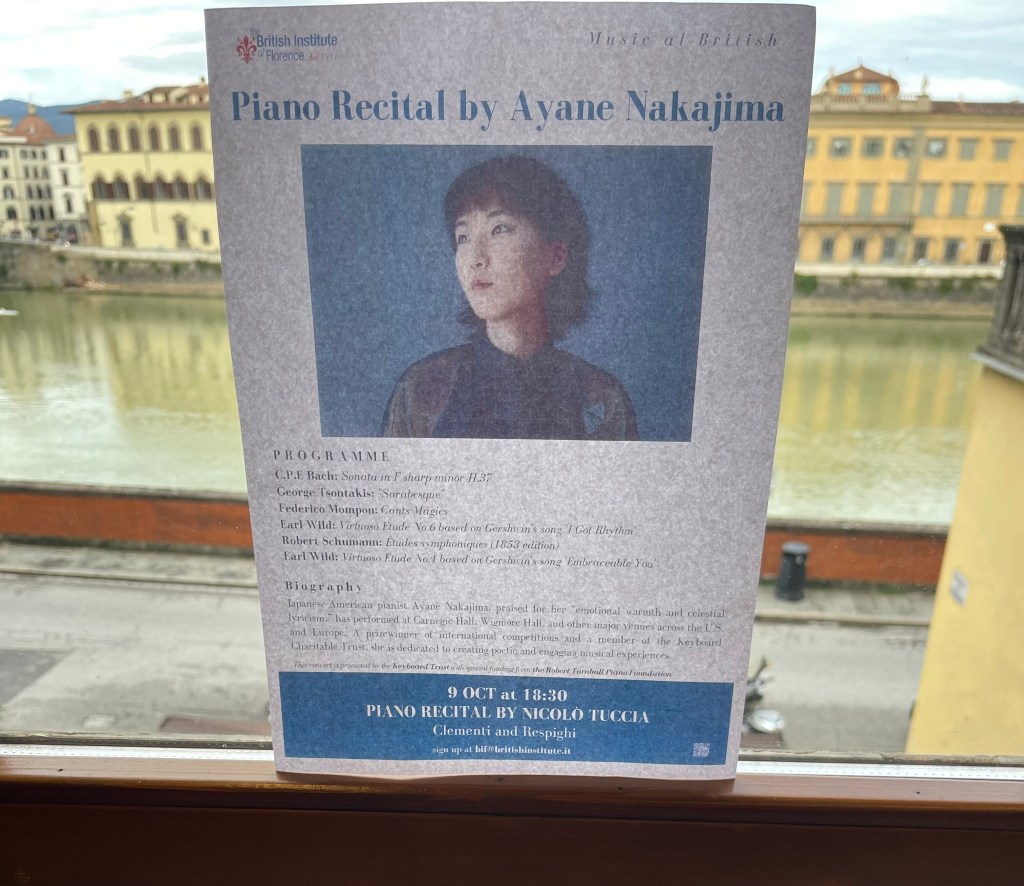
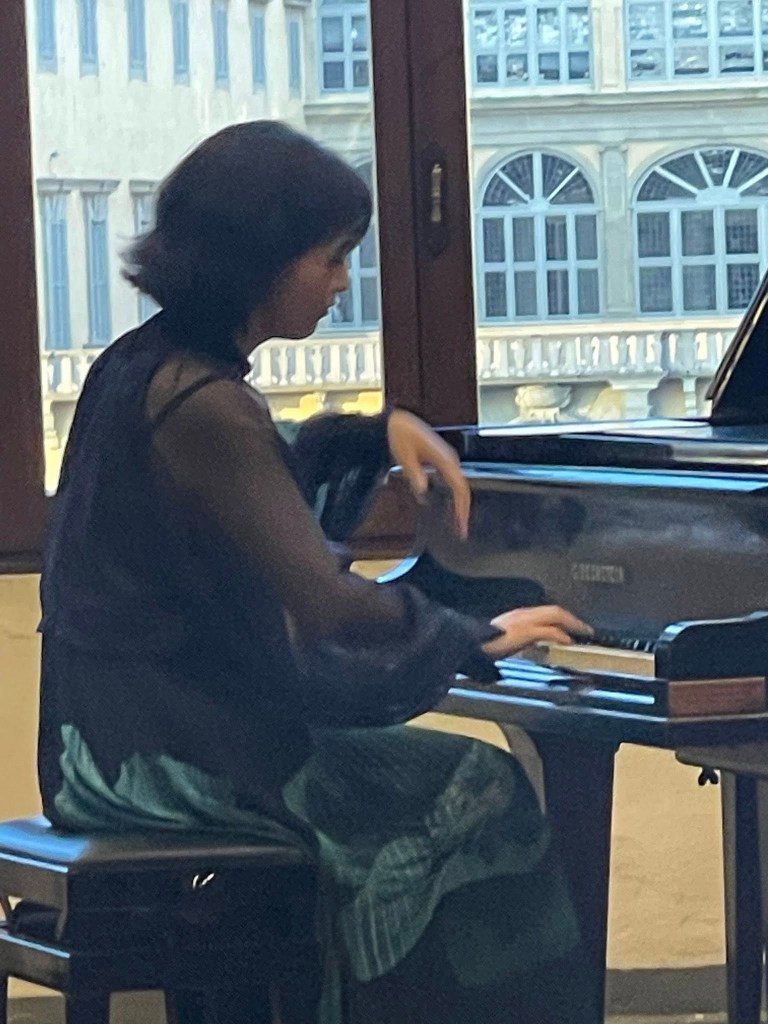
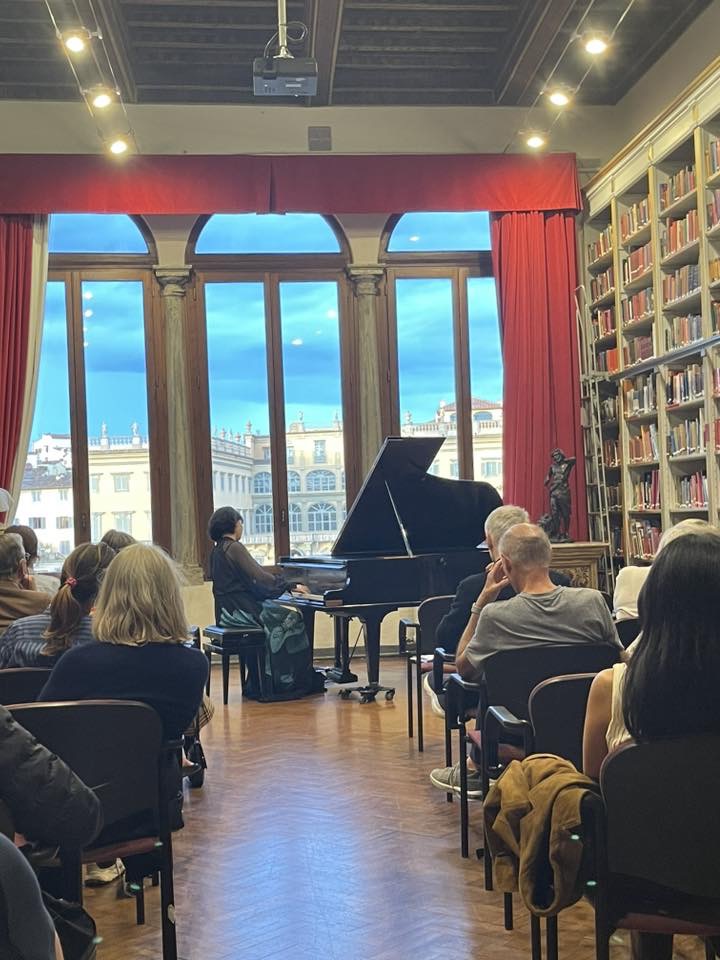
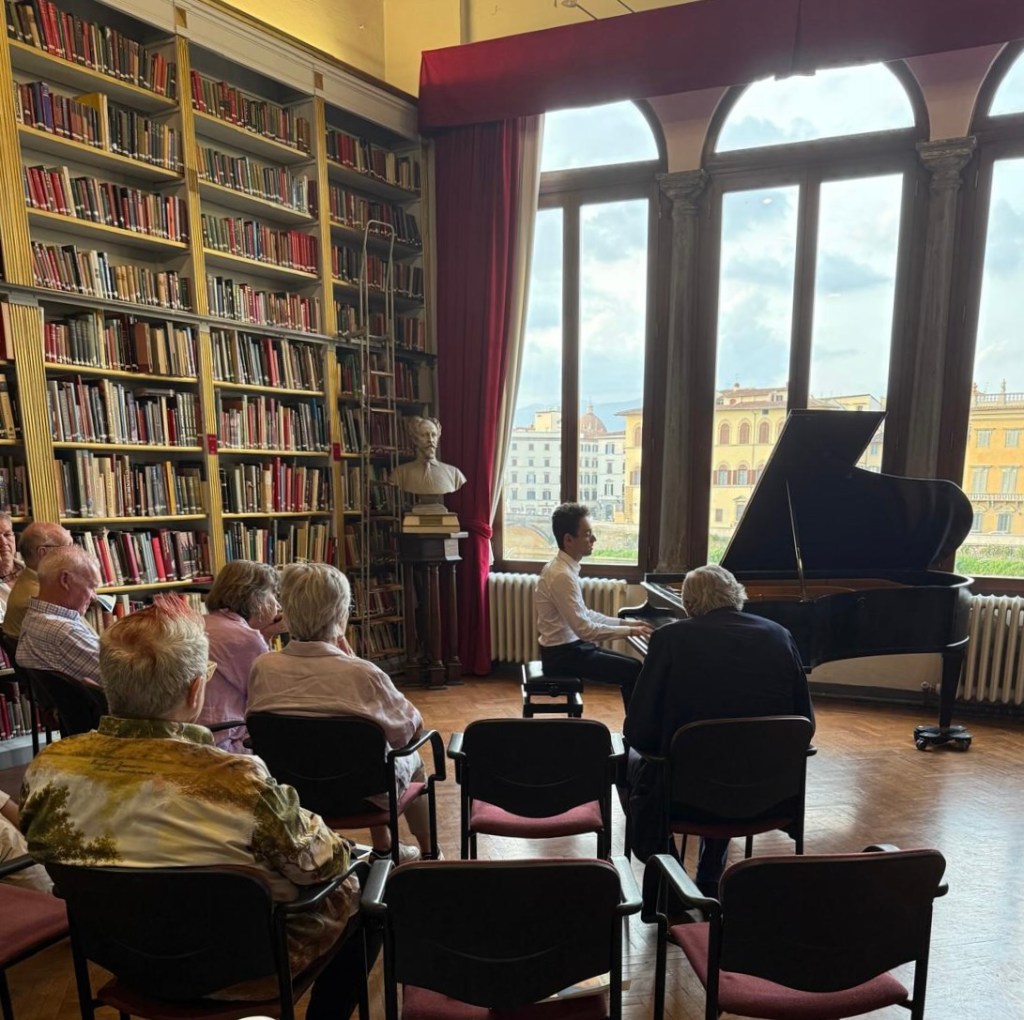
Ayane Nakajima in a room with a view. Finishing her recital on this rainy day in Florence with Earl Wild’s ‘Embraceable You’ played with ravishing insinuating beauty. Irresistible indeed !
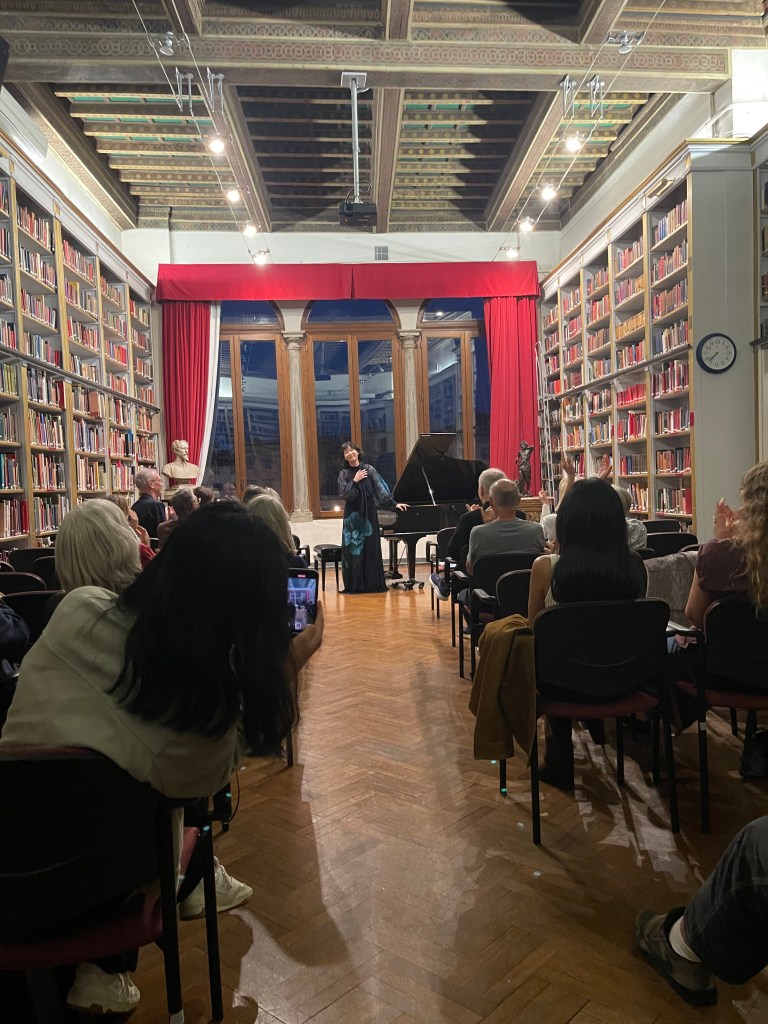
A C.P.E Bach played with brilliance and clarity where the rapid changes of character had nothing on Schumann. Washes of sound of rapid lightweight embellishments between the intervals of melodic recitativi Languid beauty of the second movement played with delicacy and poignant nobility and a surprise final movement all halting elegance and lilting charm.
Ayane has an extraordinary palette of sounds that with her searching musicianship could bring Tsontakis’ ‘Sarabesque’ inquisitively to life and even combine his world of gentle floating sounds with those of another dreamer, Mompou.
In Tsontakis there was a fluidity of sounds spread over the keyboard with luminosity and beguiling atmospheres. Gently floating sounds of glissandi and pulsating notes on high gradually building in intensity only to disappear into the magic world from where it had been born.
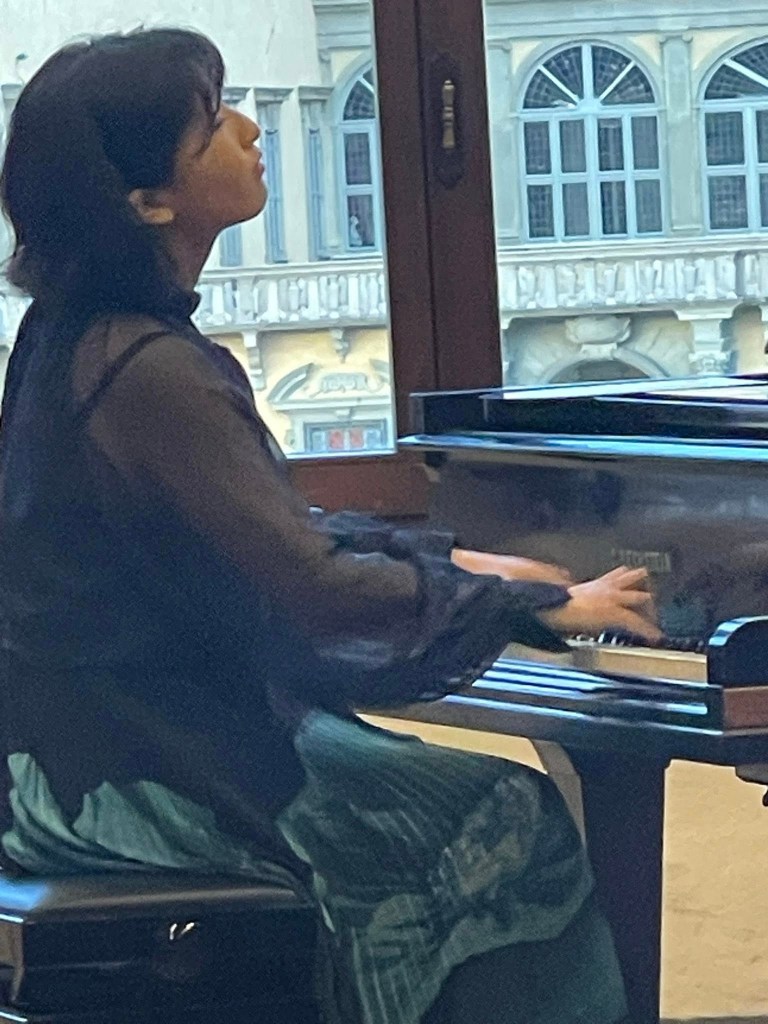
An unexpectedly dramatic entry of Mompou out of which emerged a song etched always in Spanish idiom. Lonely isolated melodies heard from afar with a hypnotic repetition of great suggestion.Bursting into a wave of sounds over the entire keyboard. All played with Ayane’s extraordinary kaleidoscope of sounds of poetic sensitivity.
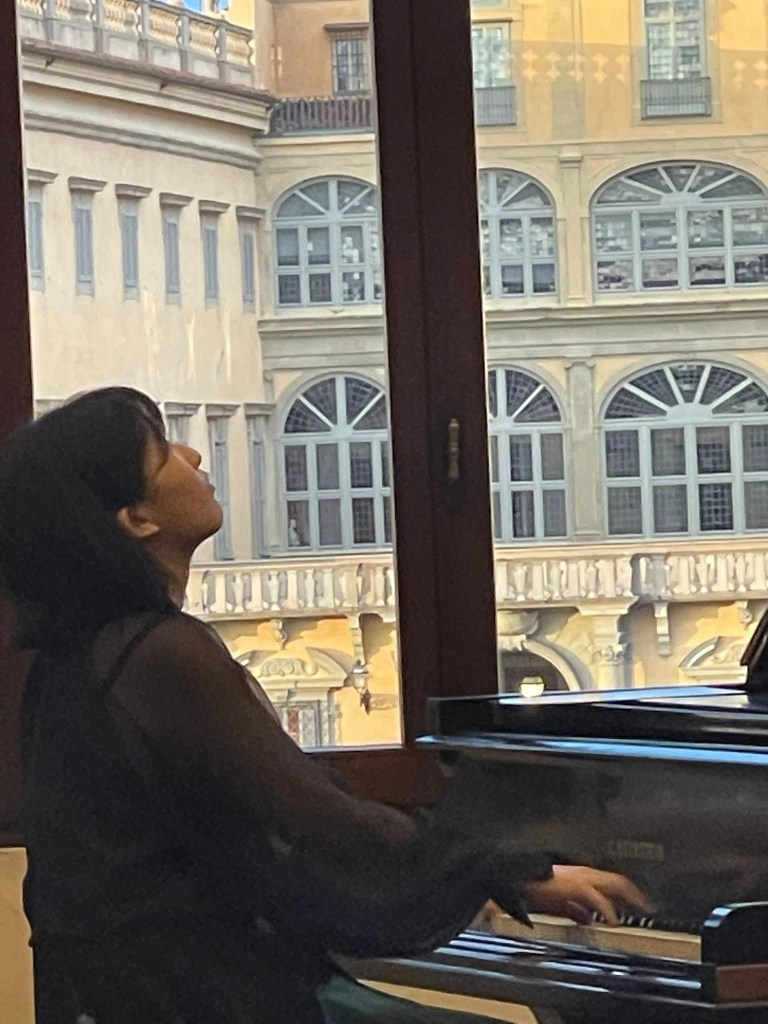
A performance of Schumann’s Études Symphoniques found an ideal interpreter where the subtle beauty of her playing was contrasted with the dynamic drive of a Florestan of quite considerable technical mastery.The opening theme played with delicate beauty as the variations unfolded with ever more poetic poignancy. Gradually the architectural shape took her to great flights of dynamic drive with the great ‘Gothic Cathedral ‘ variation unfolding with majestic nobility. A finale after the most Chopinesque of variations sprung from her fingers with dynamic drive and brilliance. Like with Schubert there was always a song ready to burst into bloom and Ayane allowed these moments the time of aristocratic freedom in-between the energy that took us to the triumphant conclusion .
CPE Bach Sonata in F sharp minor H.37
Tsontakis “Sarabesque”
Mompou Cants Mágics
Earl Wild Virtuoso Etude No.6 based on Gershwin’s song ‘I Got Rhythm’
Schumann Études Symphoniques (1853 edition)
Earl Wild Virtuoso Etude No.4 based on Gershwin’s song ‘Embraceable You
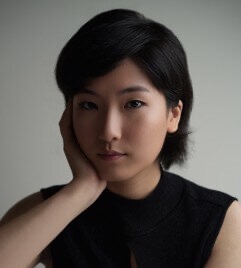
Japanese-American pianist Ayane Nakajima has garnered recognition for her “emotional warmth and celestial lyricism” (Elena Vorotko, Keyboard Charitable Trust) as a soloist and chamber musician. Active across the United States and Europe, she has appeared in major venues such as Wigmore Hall, Carnegie Hall, Alice Tully Hall, New World Center, and both Steinway Hall New York and London. She will make her German and Italian recital debut in the 2025/26 season with performances in Florence, Bayreuth, and Fulda.
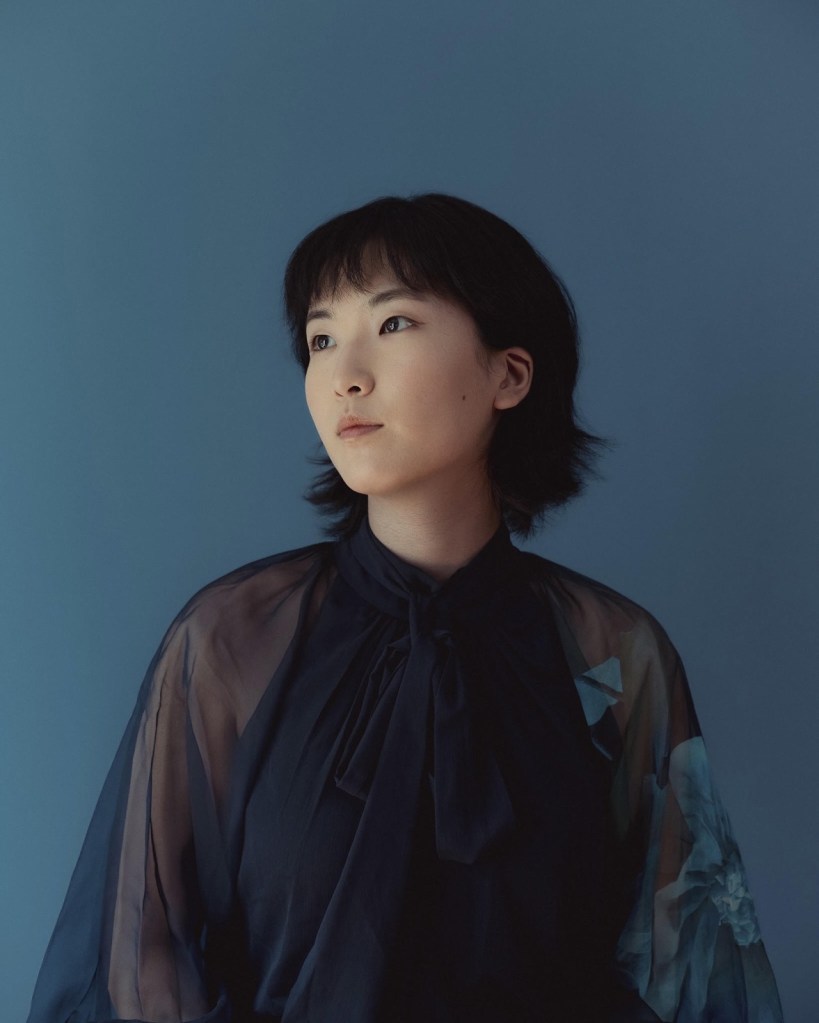
She is a celebrated prize winner of the Pianale, YoungArts, International Keyboard Odyssiad, and Young Texas Artists competitions, and is a member of Talent Unlimited and the Keyboard Charitable Trust. Among numerous accolades, she was nominated as a 2019 U.S. Presidential Scholar, awarded the 2023 Louis Sudler Prize in the Arts from Rice University, and named the winner of the 2024 Royal College of Music Concerto Competition. Additionally, she has participated in masterclasses with renowned artists such as Jeremy Denk, Dina Yoffe, Akiko Ebi, Uta Weyand, Ronan O’Hora, Caroline Hong, Elena Levit, and Marina Lomazov.
A devoted song pianist and chamber musician, she has won the top prize at the Young Musicians’ Chamber Music Society of Lincoln Center competition, as well as the pianist prizes at the AESS Patricia Routledge National English Song Competition and the RCM Brooks Van der Pump English Song Competition. She has received coachings from Malcolm Martineau, Radu Bildar, Simon Lepper, Audrey Hyland, Kathleen Winkler, and Desmond Hoebig.
Growing up in New York City, Ayane began her piano journey at the age of three under the mentorship of Chaim Freiberg at the Kaufman Music Center. From ages six to seventeen, she studied with Dr. Hiromi Fukuda and graduated from Fiorello H. LaGuardia High School of Music & Art and Performing Arts. She received her Bachelor of Music from Rice University’s Shepherd School of Music in Houston, Texas, under Dr. Jon Kimura Parker, and completed her Master’s degree at the Royal College of Music in London, under the guidance of Danny Driver. She is now perfecting her studies at the Guildhall with Ronan O’Hora.
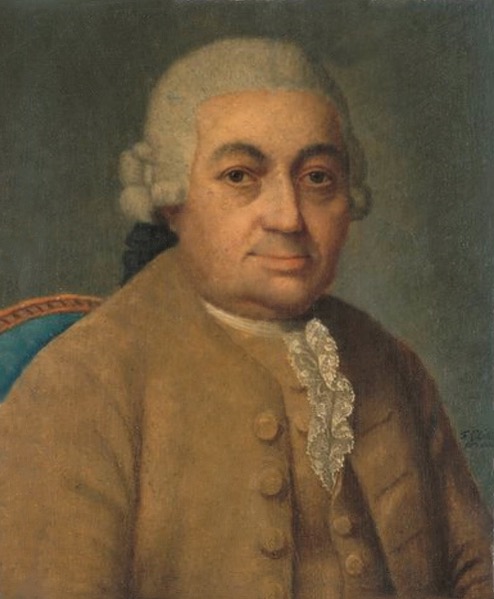
Carl Philipp Emanuel Bach (8 March 1714 Weimar – 14 December 1788 Hamburg ), also formerly spelled Karl Philipp Emmanuel Bach, and commonly abbreviated C. P. E. Bach, was a German composer and musician of the Baroque and Classical eras. He was the fifth child and second surviving son of Johann Sebastian Bach and Maria Barbara Bach .
Bach was an influential composer working at a time of transition between his father’s Baroque style and the Classical style that followed it. He was the principal representative of the empfindsamer Stil or ‘sensitive style’. The qualities of his keyboard music are forerunners of the expressiveness of Romantic music , in deliberate contrast to the statuesque forms of Baroque music. His organ sonatas mainly come from the galant style.
To distinguish him from his brother Johann Christian , the “London Bach”, who at this time was music master to Queen Charlotte of Great Britain . Bach was known as the “Berlin Bach” during his residence in that city, and later as the “Hamburg Bach” when he succeeded Telemann as Kapellmeister there.To his contemporaries, he was known simply as Emanuel. His second name was in honour of his godfather Georg Philipp Telemann a friend of his father J. S. Bach.Through the later half of the 18th century, the reputation of Carl Philipp Emanuel Bach stood very high,surpassing that of his father.Haydn, Mozart and Beethoven admired him and “avidly” collected his music. Mozart said of him, “Bach is the father, we are the children.”[
His work has been described as “sincere in thought” and “polished and felicitous in phrase”. His keyboard sonatas, for example, “mark an important epoch in the history of musical form”. “Lucid in style, delicate and tender in expression, they are even more notable for the freedom and variety of their structural design”; they break away altogether from the hardened conventions of the Italian school
Sonata in F sharp minor, H37 Wq52/4 Allegro- Poco Andante – Allegro assai
Carl Philipp Emanuel Bach (1714-17880
The sonata in F sharp minor H37 (Wq52/4) dates from 1744. The most remarkable movement is the opening Allegro, built on a contrast between fantasia and lyric passages. The movement opens with rapid passagework in semiquaver triplets. After the first four bars, which are grounded by irregularly spaced accented notes in the bass, Bach confuses the rhythm through metric displacement of the lowest notes within rising scalic or arpeggiated passages. Rather than reinforcing the beat, these low notes are often placed on the second semiquaver of a triplet. The result is rhythmic instability, resolved only by the ultimate arrival on a long note at the end of the phrase. Bach follows this fanciful opening with a contrasting galant theme accompanied by steady repeated quavers. Although the movement as a whole is in a standard rounded binary form, within each section the fantasia and lyrical elements alternate, sometimes in short fragmentary phrases.
In comparison to this unusual opening movement, the following Poco andante, in D major, is a study in restrained elegance. Here Bach evokes a trio sonata, with two treble voices in imitative texture set over a steady bass in quavers. The finale is again in binary form featuring dotted rhythms and occasional sudden rests setting off dramatic harmonic progressions. In one case, the rest lasts for an entire bar, placing in relief a diminished third in the bass, soon followed by still another silence preceding a diminished triad. More restrained than some of his other early finales, this movement balances continuity with rhetorical irregularities.
Carl Philipp Emanuel Bach composed over 300 works for solo keyboard, with the majority being sonatas, and also composed numerous other pieces including over 200 symphonies, 21 settings of the Passion, about 70 cantatas, motets, and liturgical pieces, along with various other concertos, secular cantatas, and chamber works
His works have been catalogued in different ways. The first comprehensive catalogue was that by Alfred Wotquenne first published in 1905, and this led to Wq. numbers being used. In 1989, E. Eugene Helm produced a revised catalogue, and H numbers are now also used.
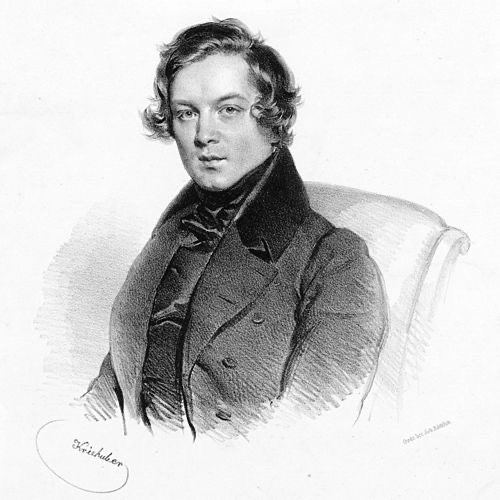
8 June 1810 Zwickau,Saxony – 29 July 1856 (aged 46) Bonn
Schumann’s Op 13 is one of a number of his piano works—others include the Impromptus, Op 5, and Davidsbündlertänze, Op 6—that exist in two distinct published versions, the first dating from the 1830s and the second a consequence of a process of revision undertaken in the early 1850s. In the case of Op 13, the original composition took place between December 1834 and January 1835, and the resulting publication of 1837 was entitled XII Etudes symphoniques; the revision, issued by a different publisher in 1852, bore the title Etudes en forme de Variations; it is this version, from which the third and ninth pieces of the original sequence are omitted, and other revisions made, that is recorded here.
Each of the two titles both reveals and suppresses information about the music. The 1852 version acknowledges that the work effectively belongs to the genre of theme and variations, each ‘study’ being a relatively strict variation on the sixteen-bar theme heard at the outset. (Moreover, the individual variations are identified as such, whereas in the 1837 edition the term ‘étude’ is employed, consistent with the overall title.) On the other hand, the reference to ‘symphonic’ quality in the 1837 version acknowledges the frankly orchestral conception of much of the writing, which demands real pianistic virtuosity; to this extent, the designation ‘étude’ is appropriate, in that each étude/variation explores a particular pianistic figuration and thus fulfils Schumann’s demand that an étude should ‘develop technique or lead to the mastery of some particular difficulty’.
An even earlier idea for the title is more revealing still: ‘Etüden im Orchestercharakter … von Florestan und Eusebius’ not only reinforces the understanding of symphonique noted above, but offers a means of understanding the ‘poetic’ content of the music. Evidently Schumann meant to express the contrasting aspects of his own character through the fictive personalities of his two ‘best friends’, as he called them: the active, dynamic Florestan, and the more passive, introspective Eusebius. Whether he initially intended to sign each of the études ‘F’ or ‘E’, as in the first edition of Davidsbündlertänze, is unclear; in any case, neither in 1837 nor in 1852 did Eusebius feature very prominently, despite the ostensibly Eusebian nature of the theme itself, marked ‘Andante’. (That there was originally more of Eusebius in the work is suggested by five further études, omitted from both versions and published posthumously in an edition by Brahms.)
Schumann claimed that the sixteen-bar theme was composed by the Baron von Fricken, father of Ernestine, with whom Schumann had fallen in love during 1834 (the family lived in Asch, the musical translation of the letters of which name provided Schumann with the ‘Sphinxes’ which underpin the music of his Carnaval, Op 9). The études/variations which follow tend to hold fast to the harmonic and melodic structure of the theme, though not to the suppression of all inventiveness: in Variation II, for example, the original melody becomes the bass underpinning of a new soprano line; and Variation VI substitutes E major for C sharp minor, the key of the theme and all other variations except the extended finale, which provides a triumphant major-mode ending and incorporates in its main theme a quotation from the (then) well-known Romance ‘Du stolzes England, freue dich’, from Marschner’s Der Templer und die Jüdin: a subtle homage, perhaps, to the nationality of the dedicatee, Schumann’s friend and fellow-composer William Sterndale Bennett. Prior to the finale, fugato and canonic writing are prominent in Variations I, III, and IV, while Variation VII alludes to the stylistic world of the Baroque, and specifically the French overture.
In his sketches for the first version, Schumann completed five further variations and the majority of a sixth further variation. These are sometimes incorporated into and played with the set.
| Douze Études symphoniques (1837) | Études en forme de variations (1852) |
|---|---|
| Thème | Thema |
| Étude I | Variation I |
| Étude II | Variation II |
| Étude III | – |
| Étude IV | Variation III |
| Étude V | Variation IV |
| Étude VI | Variation V |
| Étude VII | Variation VI |
| Étude VIII | Variation VII |
| Étude IX | – |
| Étude X | Variation VIII |
| Étude XI | Variation IX |
| Étude XII | Finale |
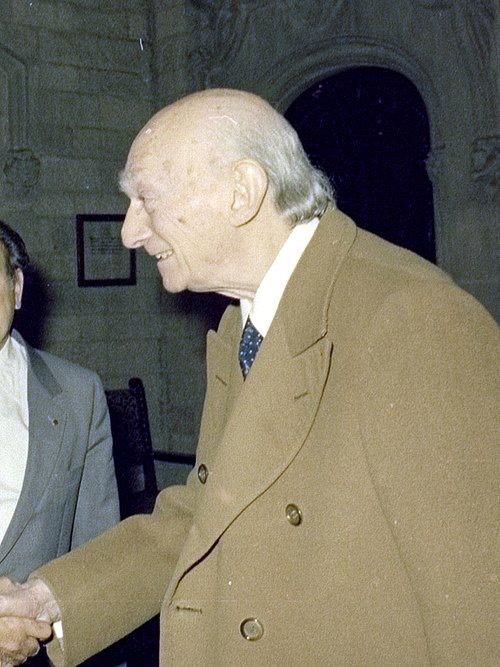
Born in Barcelona the 16th of April 1893 and died in the same city on the 30th of June 1987.
While studying with the well-known professor Pere Serra he discovered the music in vogue at the time in a concert in the Sala Mozart in Barcelona where Gabriel Fauré presented his latest compositions, the event inspired Mompou to compose. Two years would go by before he found his own chord: the metallic chord that reminded him of the familiar ring of the bells from his grandfathers Dencausse factory, that is how he started his creative work.
He traveled to Paris for the first time in October 1911, and stayed there the academic year. He worked with Ferdinand Motte-Lacroix (who would later become his principal promoter and interpreter giving world premieres of his music). Mompou returned to Paris the following years but was forced to return to Barcelona because of the First World War. In Barcelona he composed Impressions Intimes, Pessebres, Scènes d’Enfants, Suburbis, Cants Màgics…Mompou was a quiet, timid and introverted man, with many communication problems and the arrival on the scene of new music, especially the second school of Vienna, provoked a creative crisis in 1933.
Once again he returns to Barcelona in 1941, fleeing from war (he would remain in Barcelona until his death). In Barcelona he met the young pianist Carmen Bravo, who would later become his wife. He began to compose again, beginning a long period of creativity that lasted until 1979, when health problems stopped him from composing permanently.The musical world of Mompou is full of color, sounds and images, all a mark of the Catalonia that surrounded him. An easy going man, a great observer, he searched for ways to express the profound feelings that were hidden deep inside of him. Timid and soft spoken, his music reflects the thought and ideas that represent the man that he was
His first published work, Cants magics, came to fruition in 1920, encouraged by his friend Augustín Quintas. This early work showcased what would become one of Mompou’s musical signatures, the use of bell-like sonorities. The publication of this work garnered an enthusiastic response from critics.Reception of his music later in his career was infrequently negative, with most writers recognizing his unique and authentic musical personality. Socially and professionally, he was relatively well-connected despite his shyness, maintaining friendships with notable musical figures such as Francis Poulenc and the painter Joan Miró.
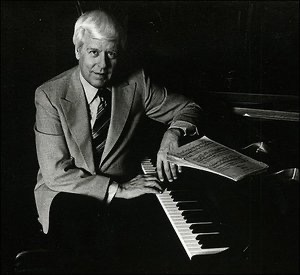
Royland Earl Wild was born in Pittsburgh Pennsylvania , in 1915. Wild was a musically precocious child and studied under Selmar Janson at the Carnegie Institute of Technology there, and later with Marguerite Long, Egon Petri, and Helene Barere (the wife of Simon Barere), among others. As a teenager, he started making transcriptions of romantic music and composition.
A musical giant of the 20th century is the pianist Earl Wild (1915-2010). His name might not be all that familiar, but he was one of the last of the great Romantic pianists in a long line of great virtuoso pianists/composers. In fact, he was called a super virtuoso. He was the first pianist to perform a recital on U.S. television in 1939 and the first to stream a performance over the internet in 1997.Wild had immensely large hands, absolute pitch, a graceful stage presence, and an uncanny facility as a sight-reader and improviser. Already as a teenager, Wild started to produce devilish difficult transcriptions of romantic music.Every great virtuoso Romantic pianist was a master of composing piano transcriptions, just think of Franz Liszt . Earl Wild is a direct descendant of that golden age of piano transcriptions, and he was called “the finest transcriber of our time.” And it is not surprising that Wild would turn his attention to the music of George Gershwin.
Gershwin’s songs are miniature masterpieces, full of enduring charm, melodic appeal, and twinkling wit. Earl Wild’s arrangements are an affectionate tribute from one American virtuoso to another. As Wild writes, “Out of respect for Gershwin’s original notation, I have not changed one rhythmic value of the melodies in my transcriptions of the Seven Virtuoso Études.” Wild started work on his virtuoso Gershwin etudes in the late 1950s, but he revised the set and added another song in 1976. They are all based on some of Gershwin’s most popular songs and are strictly treated as études or studies. And this kind of treatment is closely associated with the Chopin’s Études to highlight some particular technical difficulty.
Already, the Chopin etudes go far beyond mere technical exercises, and the same is true of Wild’s handling of the seven Gershwin songs as they transcend any mere technical achievement. That does not mean that the virtuosic demands are out of this world, as they address almost every piano technique known to the best players. However, once the focus falls on the music, they are delicious pieces to savour.It has been said that Earl Wild managed to pack more notes per square inch than anyone else to produce etudes of obscene difficulty. Once you have all the notes down, however, how do you not make it sound too square and too classical? The solution to that problem is given by Wild’s arrangements.
They are not mere literal translations of Gershwin’s song but use the original melodies simply as a springboard for something far more elaborate and interesting. Wild always colours the tunes with exotic harmonies and complex counterpoint. The combination of Gershwin’s tunes and Wild’s harmonies and lines is a winning combination.

“Sarabesque” is a six minute solo piano work written in 2003 for his friend ,pianist Sarah Rothenberg . It was first recorded by Rothenberg and later included on the 2005 CD Man of Sorrows, which featured Stephen Hough performing Tsontakis’s tone poem for piano and orchestra alongside the solo piano work. Described as a “delicate bagatelle” and a “bijou,” the piece is a short but evocative work that showcases the composer’s strengths in creating a resonant musical soundscape.
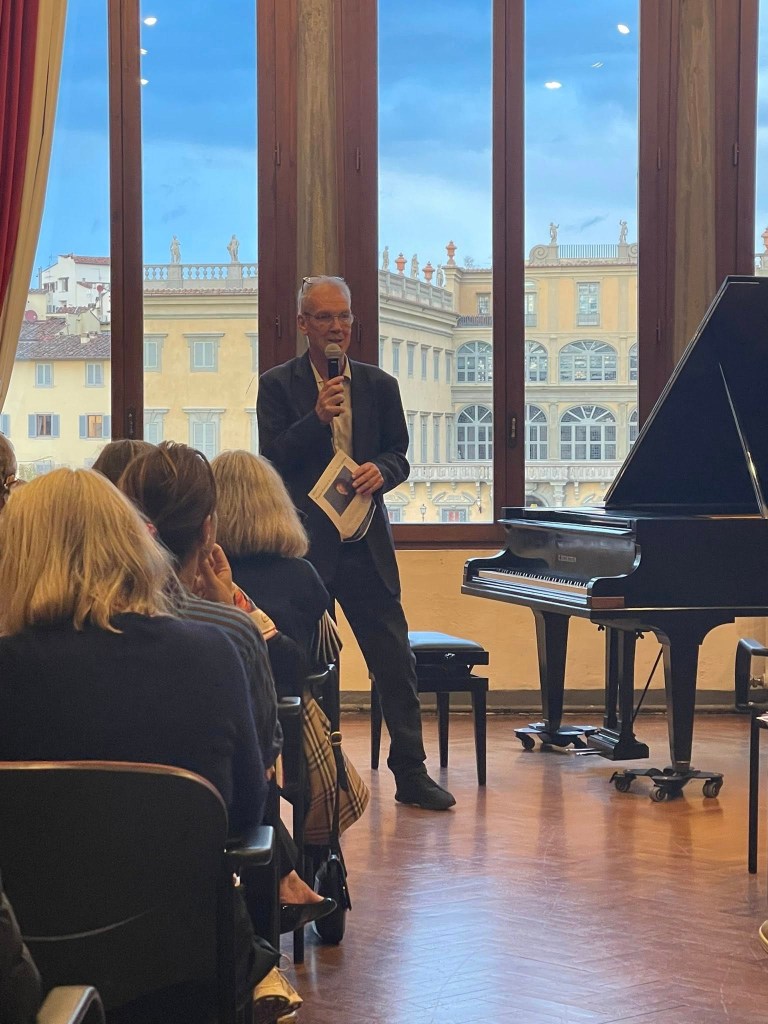
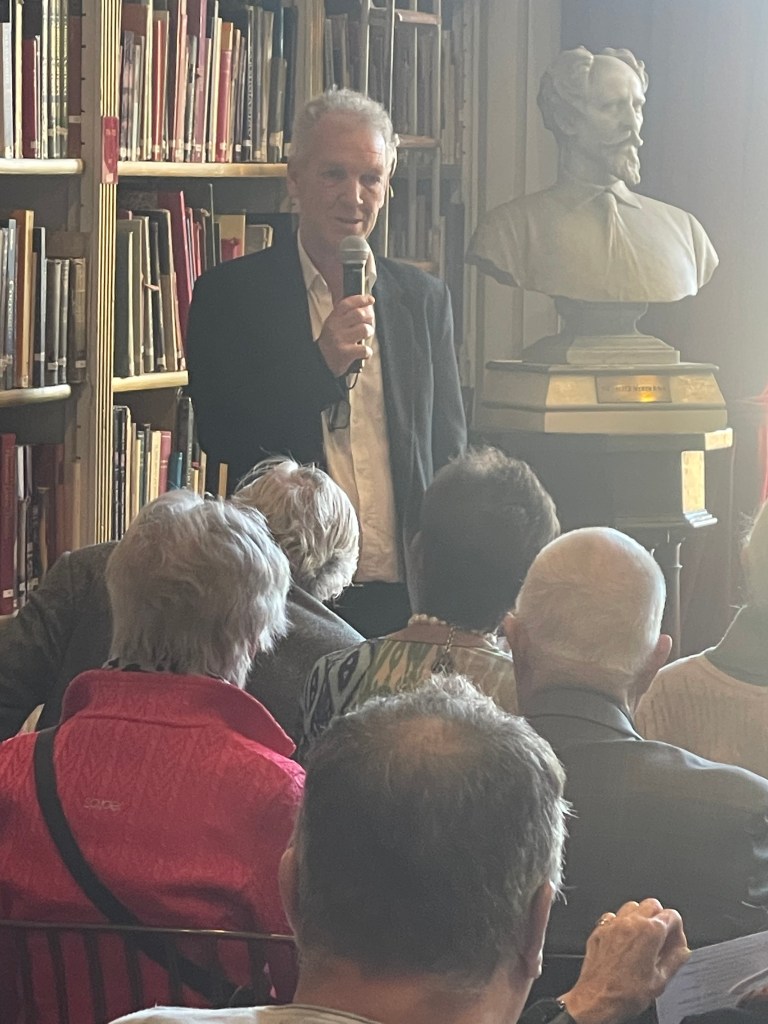
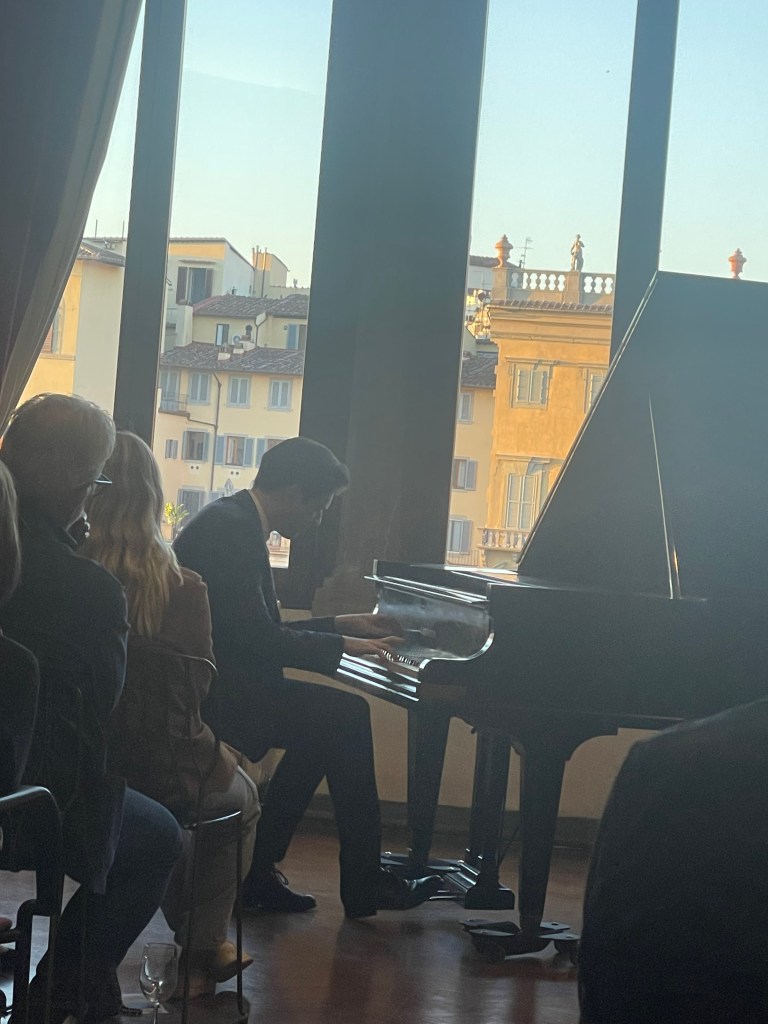
Dear All,
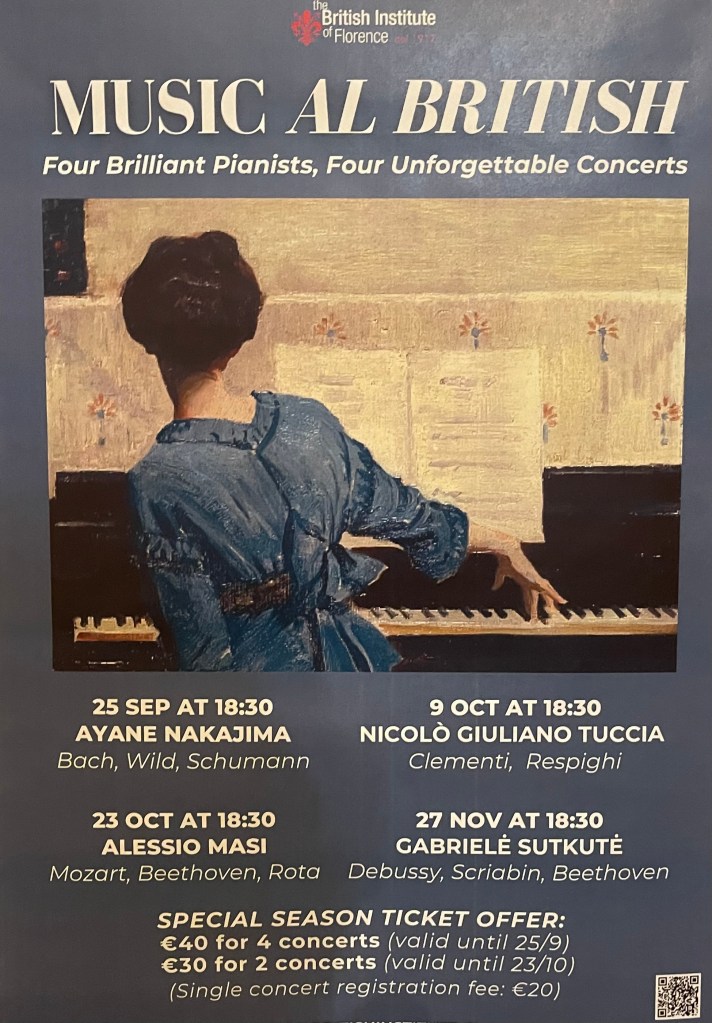
As you have probably seen, we have lined up an exceptional series of piano recitals in the Library this autumn. As someone who has enjoyed our Music al British concerts, I do hope that we will have you with us for some of the concerts by these brilliant young pianists:
25 September Ayane Nakajima performs music by Bach, Wild and Schumann
09 October Nicolò Giuliano Tuccia performs Clementi and Respighi
23 October – Alessio Masi performs Mozart, Beethoven and Rota
27 November – Gabrielé Sutkuté performs Debussy, Scriabin and Beethoven
These remarkable talents have been brought to us by our friends at the Keyboard Trust, whose mission it is to identify the finest young pianists in the world and give them vital experience of professional concert making. We are so fortunate to have them come to play in our glorious Library with its perfect acoustics and magical view!
Hope to see you there!
With my very best wishes,
Simon
Simon Gammell OBE Director
The British Institute of Florence
Palazzo Lanfredini, Lungarno Guicciardini, 9, 50125 Firenze
Tel: +39 055 26778280 Email: director@britishinstitute.it

 ChristopherAxworthy-MusicCommentary