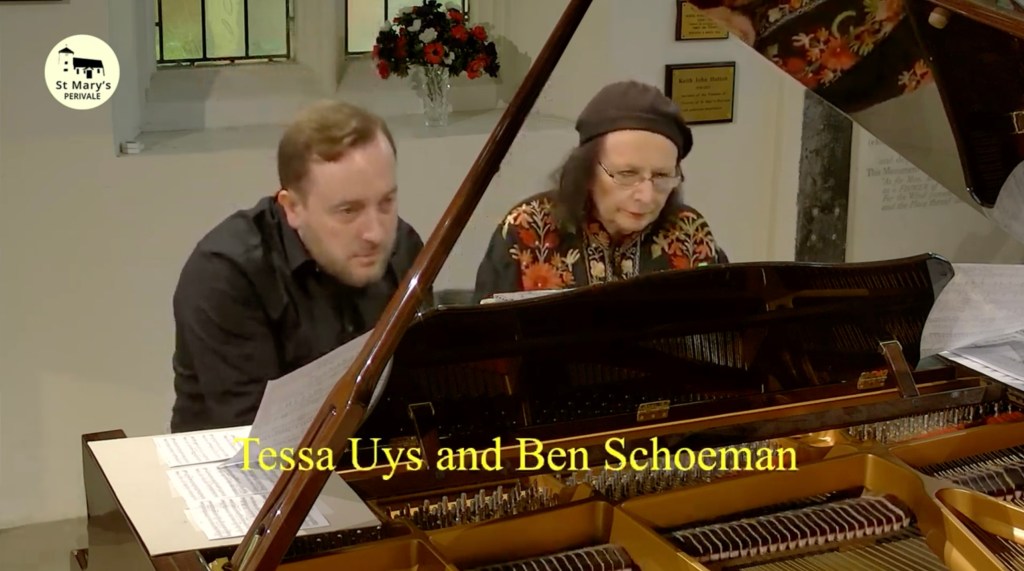
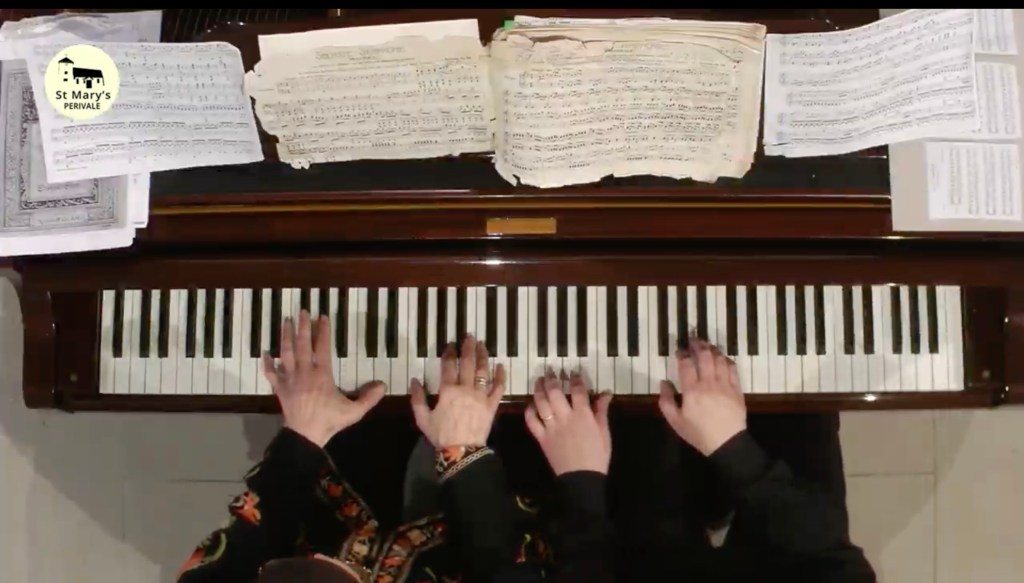
I have heard Tessa and Ben play many of the Scharwenka transcriptions of the Beethoven Symphonies over the past seven years. It is very touching to see the old battered copy of the Symphonies on the piano stand and know that it was the very copy that stood in her mother’s studio when Tessa was growing up.
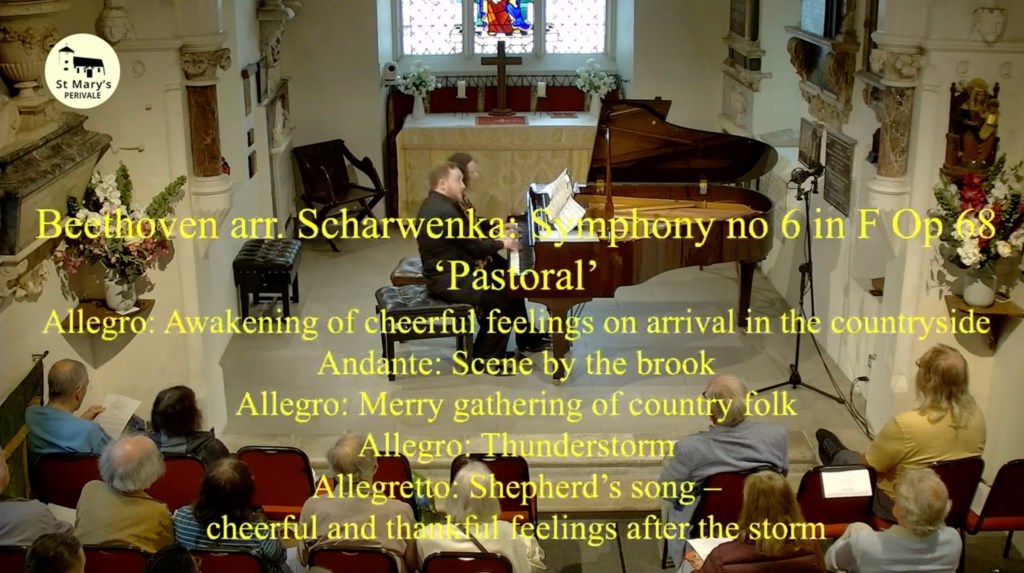
Tessa and Ben are both highly esteemed artists not only in their homeland but also in their adopted home in London. Since those early days when I first heard them they have been discovered and have now made some highly acclaimed CD’s as a piano duo. As Dr Mather said St Mary’s may be too small for an orchestra but Sharwenka has proven him wrong, as today we heard the Pastoral Symphony in all it’s glory on this newly restored piano that is more used to Sonatas than Symphonies.
Tessa and Ben over the years have truly learnt how to play as one with an extraordinary sense of balance created by two great artists that listen to themselves and adjust accordingly. Tessa may have been at the bass end for the Beethoven but even when she played at the top the balance was just as superb.
I have written many times about their Beethoven performances but today I was overwhelmed by their superb performance of Elgar. The Introduction and Allegro like the violin or cello concerti have something so unique about the sound world that one can envisage the green pastures and wondrous landscapes that surrounded the composer as he wrote music that fits the era of Bernard Shaw or Constable and fills it with such sumptuous rich sounds.
The British Brahms you could almost call him and when I hear this music I immediately envisage Sir John Barbirolli or Sir Adrian Boult who I was lucky enough to experience in my student days at the Royal Academy and Royal College that I frequented almost daily in my teenage years. I remember Barbirolli when I, like Tessa, was a student at the Royal Academy, and I followed his rehearsals with the student orchestra. I can still see this short very passionate man walking through the cello section and looking the players in the eye to get them to play with more passion. The first recording of the cello concerto with Jaqueline du Pré is legendary but she was often criticised for playing with too much passion. ‘ But if you don’t play with passion when you are young what will you pare off later in life?’ Little was he to imagine that we would never know ,as she was struck down at only 28. Luckily she had Daniel Barenboim at her side who had managed to give her the maturity and security that only true love between genius can provide. A Golden couple indeed!
Boult on the other hand at the college would stand on the podium like a Military gentleman waving a very long stick. But the intelligence and passion that the stick contained was a great lesson indeed and it was his recording of the Elgar Introduction that I would play over and over again as a student.
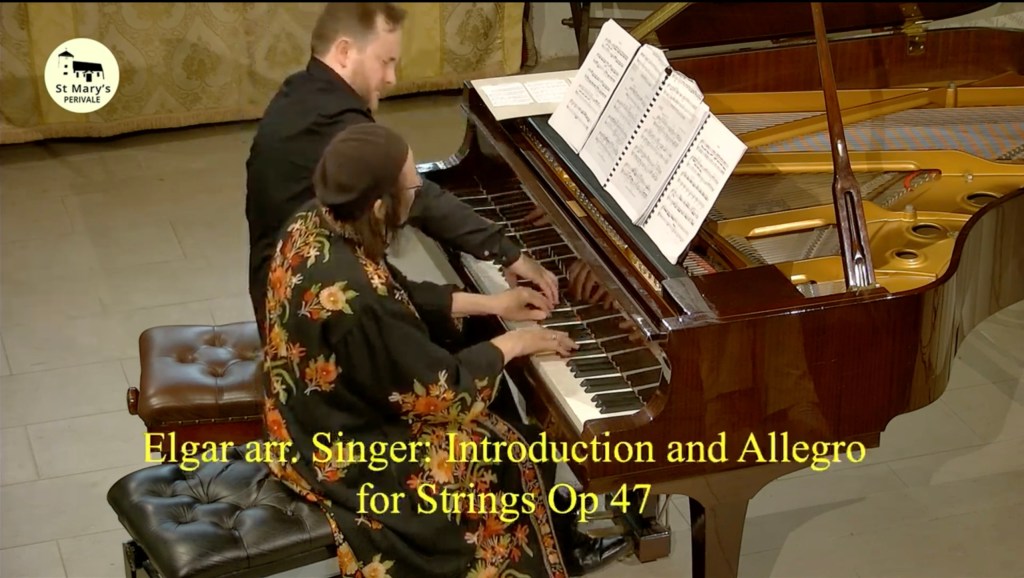
Beethoven’s Pastoral Symphony is one of the marvels of creation and the fantasy and imagination that Beethoven was able to portray was made even more poignant by the titles he gave each movement.
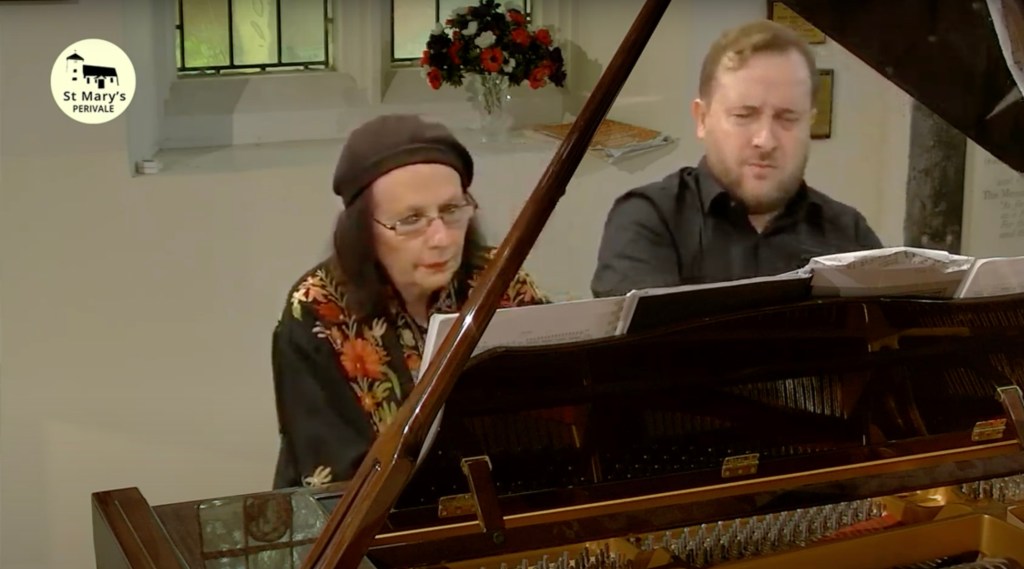
It was such a good idea to play these two ‘Pastoral’ gems one after the other. Not to compare but to wallow in genius that can portray in music such wondrous scenes. Tessa suggested, as a future project , Bruckner Symphonies in the arrangement of Otto Singer which sounds like a wondrous voyage of discovery .

I know that Jed Distler ,who will shortly play in Perivale is preparing Shostakovich Leningrad symphony with Cristian Sandrin that they will play in London shortly.He is also playing four hands all the Mahler Symphonies. St Mary’s may be redundant no longer !! Watch out Hugh ……….as the little one said move over !
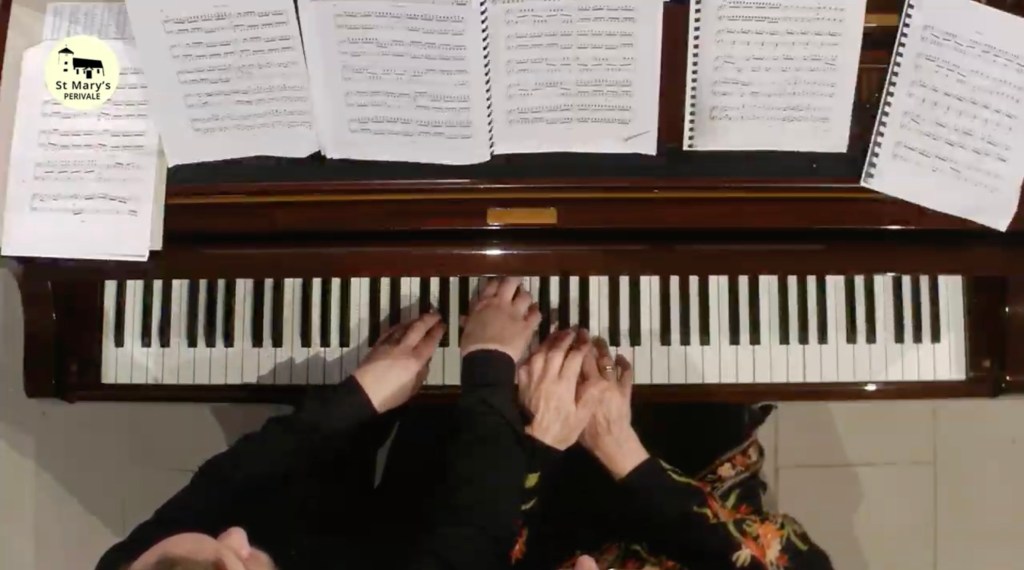
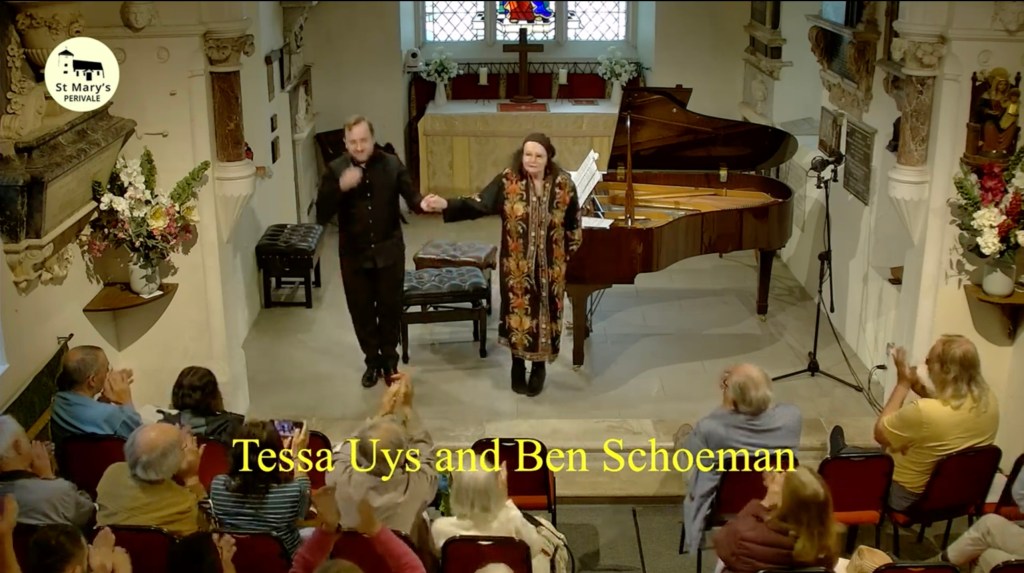
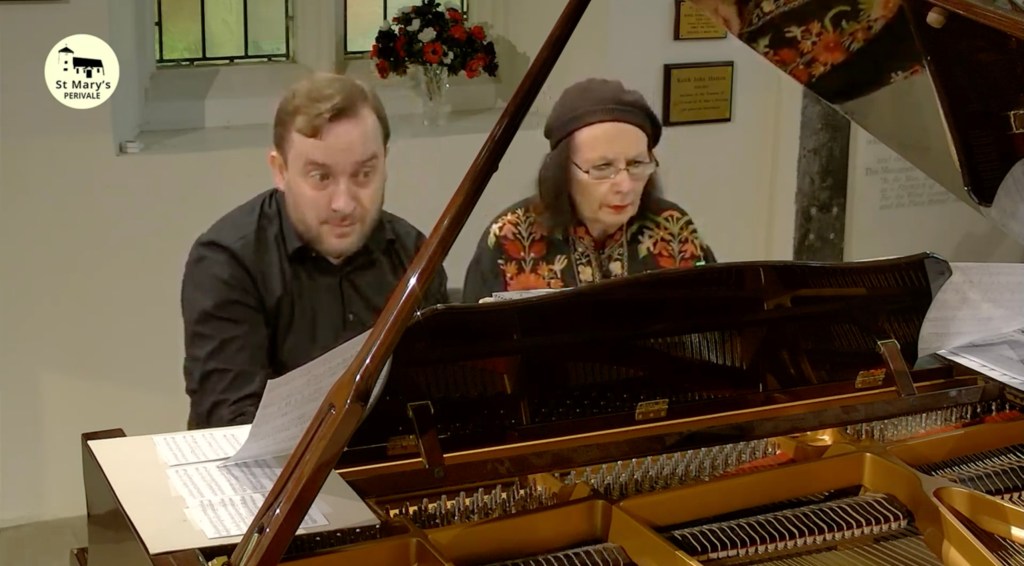
In 2010, Tessa Uys and Ben Schoeman established a duo partnership after being invited to give a two-piano recital at the Royal Over-Seas League in London. Ever since, they have performed regularly at music societies, festivals and at the BBC. They have recorded six volumes encompassing the nine symphonies by Beethoven arranged for piano duet by Xaver Scharwenka, alongside two-piano works by Schumann, Saint-Saëns and Busoni for SOMM Recordings. They have received praise for this “landmark” project, and it has been described as a “tour-de-force” in the BBC, Gramophone and International Piano Magazines.
Tessa Uys Born in Cape Town, Tessa Uys was first taught by her mother, Helga Bassel, herself a noted concert pianist. At sixteen, she won a Royal Schools Associated Board Scholarship and continued her studies at the Royal Academy of Music in London where she studied with Gordon Green. In her final year she was awarded the MacFarren Medal. Further studies in London with Maria Curcio, and in Siena with Guido Agosti followed. Shortly after this Tessa Uys won the Royal Over-Seas League Competition and was elected an Associate of the Royal Academy of Music. During the past decades, Tessa Uys has established herself an impressive reputation, both as concert performer, and as a broadcasting artiste, performing at many concert venues throughout the world. She has performed at the Wigmore Hall, Southbank, Barbican and St John’s Smith Square, and has played under such distinguished conductors as Sir Neville Marriner, Walter Susskind, Louis Frémaux and Nicholas Kraemer. https://www.impulse-music.co.uk/tessauys/
Ben Schoeman Steinway Artist, Ben Schoeman was the first prize laureate in the 11th UNISA International Piano Competition in Pretoria, winner of the gold medal in the Royal Over-Seas League Competition in London and was also awarded the contemporary music prize at the Cleveland International Piano Competition. He has performed in prestigious halls on several continents, including the Wigmore, Barbican and Queen Elizabeth Halls in London, Carnegie Hall in New York, the Konzerthaus in Berlin, the Gulbenkian Auditorium in Lisbon, Cape Town City Hall and the Enescu Festival in Bucharest. As a concerto soloist he has collaborated in over 40 works with conductors including Diego Masson, Gérard Korsten, Yasuo Shinozaki, Bernhard Gueller, Jonathan McPhee and Wolfram Christ. He studied piano with renowned musicians such as Joseph Stanford, Michel Dalberto, Boris Petrushansky, and Eliso Virsaladze, and obtained a doctorate in music from City, University of London and the Guildhall School of Music and Drama with a thesis on the piano works of the composer Stefans Grové whose African-inspired music Schoeman has premiered and performed in numerous countries. Over the past decade, he has been a senior lecturer and research fellow at the University of Pretoria. He has served on the jury of international music competitions and his students have won top prizes. www.benschoeman.com
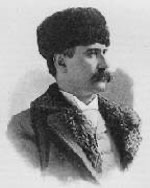
born: 6 January 1850
died: 8 December 1924
Franz Xaver Scharwenka was born on 6 January 1850 at Samter, near the Polish city of Poznan, which was then in East Prussia. Both Xaver and his older brother Philipp (1847–1917) showed early signs of musical talent and were much encouraged by their father in their first music lessons. In 1865 the Scharwenka family moved to Berlin where the two brothers were enrolled at Theodor Kullak’s Neue Akademie der Tonkunst. Xaver made rapid progress, studying the piano with Kullak himself, a pupil of Carl Czerny, and composition with Richard Wuerst who in turn had studied with Mendelssohn in Leipzig. This formal musical education, together with his own natural ability and dedication, ensured Scharwenka’s success as both pianist and composer, and in 1869, a year after his pianistic debut at the Berlin Singakademie, his first compositions were published. Before 1874, when he took up a career as a travelling virtuoso, he had already been on Kullak’s teaching staff for some five years as professor of piano, and the experience thus gained was to prove invaluable in later years when he turned his attentions more to teaching, opening his own conservatory in Berlin in 1881, and subsequently a branch in New York in 1891 following his successful American debut. By the middle of the 1890s that institution had become one of the world’s largest, universally acknowledged as offering the highest quality of musical education. It was the outbreak of war in 1914 which forced Scharwenka’s retirement from the international concert platform after some forty years, during which time he had achieved the highest reputation worldwide, not only as a pianist of exceptional quality but also as a fine all-round musician, receiving numerous decorations and orders from most of the crowned heads of Europe, as well as many honours from various educational institutions. The last few years of his life were spent in semi-retirement in Berlin, where he died, a much respected man, in December 1924.
Otto Singer Jr., (September 14, 1863 – January 8, 1931), composer and conductor, produced piano transcriptions of all nine of Beethoven’s symphonies, at least 57 of Liszt’s songs, all four of Brahms’s symphonies, vocal-piano reductions (vocal parts plus solo piano) of 12 of Wagner’s operas (as well as instrumental solo piano versions for some of them), as well as transcriptions of other works by Richard Strauss, Brahms, Beethoven, Bruckner, Tchaikovsky, Mozart, and Mahler, among others including this Elgar
 ChristopherAxworthy-MusicCommentary