
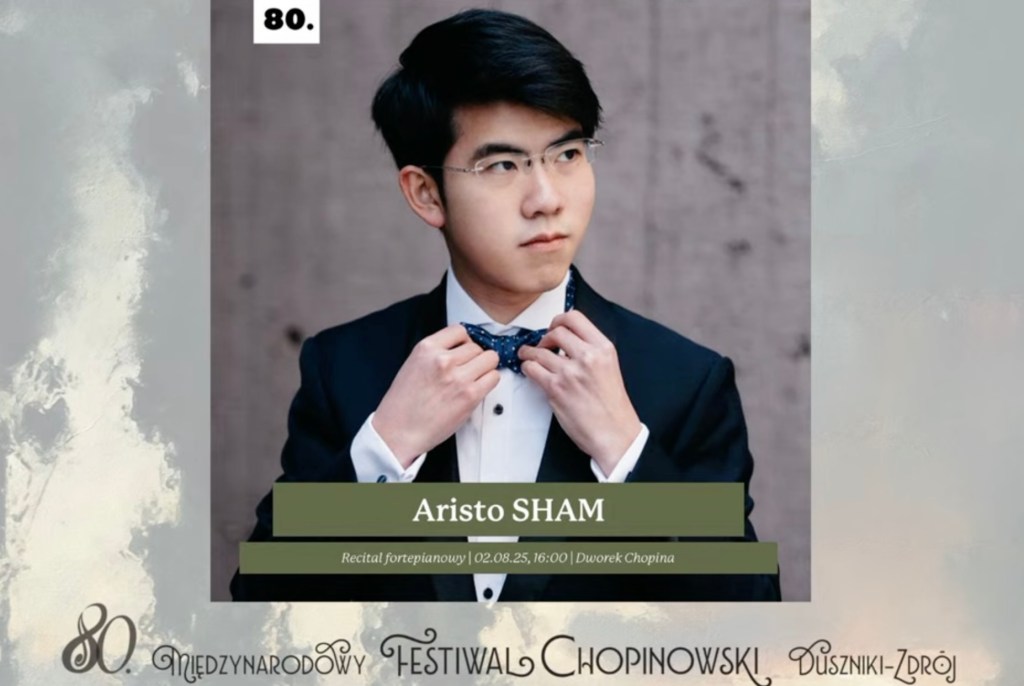
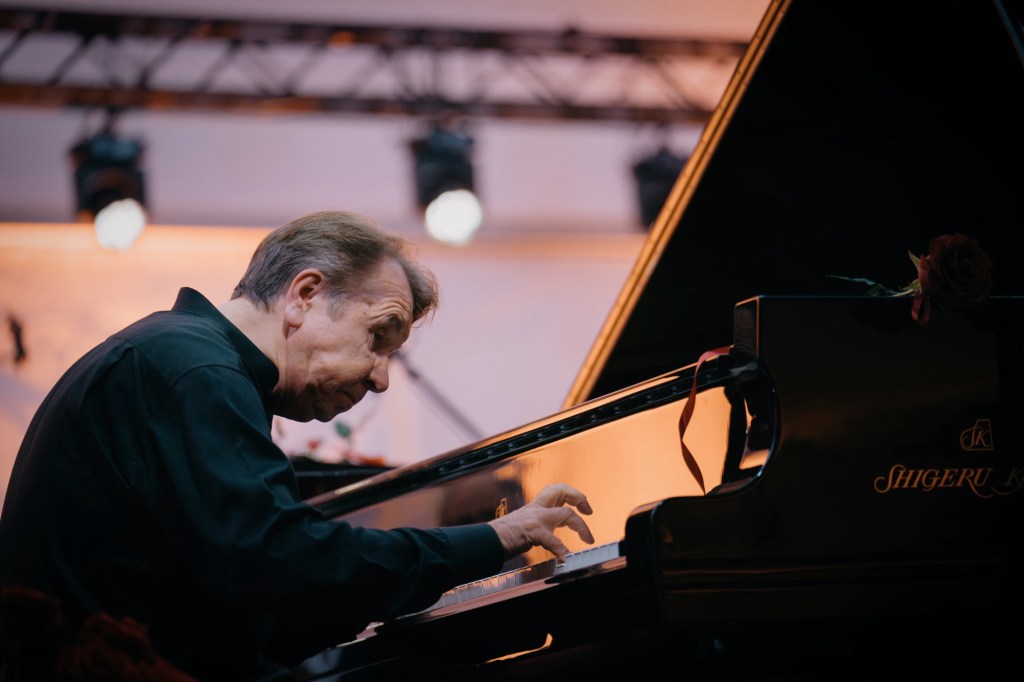
Some remarkable playing from a pianist who I have heard many times over the past few years, but the absolute mastery and intellectual authority that he has shown since playing in Fort Worth has astounded me. A very talented young man of an intelligence that allowed him to graduate from some of the finest institutions starting with Harrow in England and finishing at Harvard in America. I had heard him when he played Mozart A major concerto at a school concert in Harrow and later at the Music fair that is held every year in Cremona in preparation, via the Fazioli studio, for International Competitions. Very fine intelligent playing but somehow he could not see the wood for the trees. Chopin Mazurkas that were exquisite but the Sonata in B flat minor was missing an overall sense of architectural shape. Since then he has gone on to study with that magnificent trainer of pianists, Robert McDonald who has liberated all the musical values that have been bestowed on him by his other illustrious teachers ( above all the remarkable Eleanor Wong in early studies in Hong Kong ).McDonald who was the assistant to Leon Fleisher at Curtis that I heard from some of his students about the gruelling training that he insisted on giving them as a basis of authority and keyboard mastery, born of hours of hard work! Curzon exclaimed that playing the piano was 90% hard work and 10% talent – Rubinstein had something famously to say about that too https://youtu.be/gex0sOR7XZ0?feature=shared
Aristo has an impeccable musical pedigree and intelligence, but now he has a towering authority and absolute mastery that allow him to express himself with simplicity and humility.
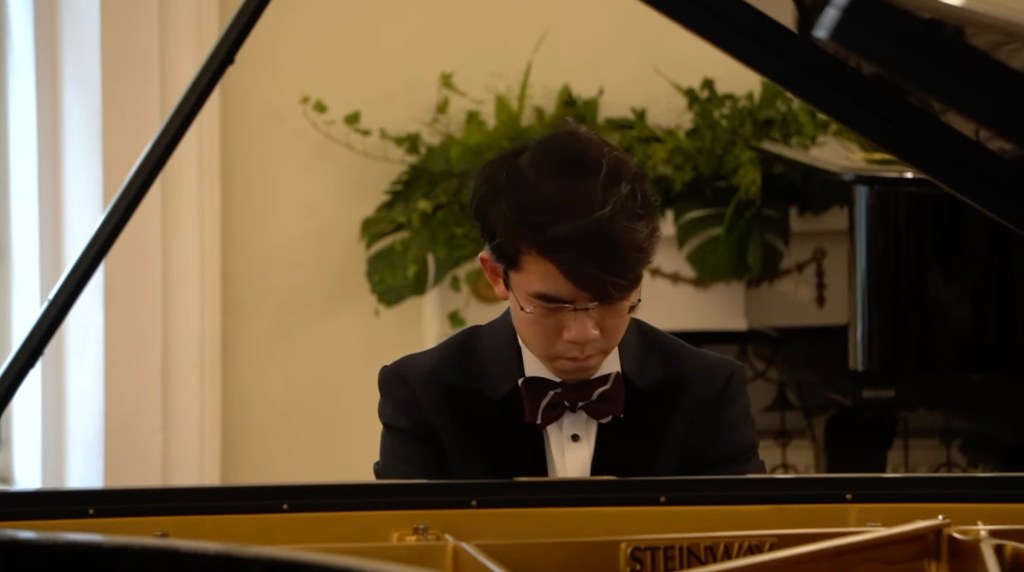
Johann Sebastian Bach (1685–1750) / Sergei Rachmaninov (1873–1943) Partita in E major from the violin suite BWV 1006 (1720) Preludio , Gavotte and Gigue. There was a crystalline clarity to his playing with a dynamic drive of brilliance and jewel like perfection. The Gavotte was played with charm and elegance but above all the beauty of the melodic line shone out like light shining on a prism. The knotty twine of the Gigue was played with incredible clarity and a rhythmic drive that was within the very notes themselves .An inner energy and forward propulsion allied to a clarity of vision that was to be the hallmark of all he played.

Johann Sebastian Bach (1685–1750) / Ferruccio Busoni (1866–1924) Chaconne from the Partita n 2 in D minor for violin BWV 1004 (1720). The very first time I heard this work was a recording of Michelangeli, whose perfection and sumptuous beauty of sound was an inspiration not only for me but for generations of pianists that followed. I have heard many pianists play it since, including Rubinstein with his inimitable aristocratic nobility and beauty. Today I heard a performance that was of such perfection that it was hard to believe that I was watching a live stream performance. Opening the chaconne with two hands ( something his innate musicianship would not allow him to do in the ‘Hammerklavier’ ) because he was searching for a piercing clarity with a sense of purity and at the same time simplicity. There was a poignant noble beauty that pervaded the whole of this remarkable performance.The octaves entered like a whispered wind that gradually grew in intensity adding an inner tension and a noble sense of exhilaration. There was a relentless sense of line and forward movement no matter what hurdles Busoni throws in the path of Bach. We were caught up in a continual wave of sounds that fearlessly enveloped all in its path. There were moments of absolute stillness and calm with a ravishing kaleidoscope of sounds that strangely were not preceded by silences but rather by masterly changes of colour. This was a true ‘tour de force’ of musicianship and mastery and was a wonderful way to open a concert, declaring so openly his complete dedication to the masters he was serving.
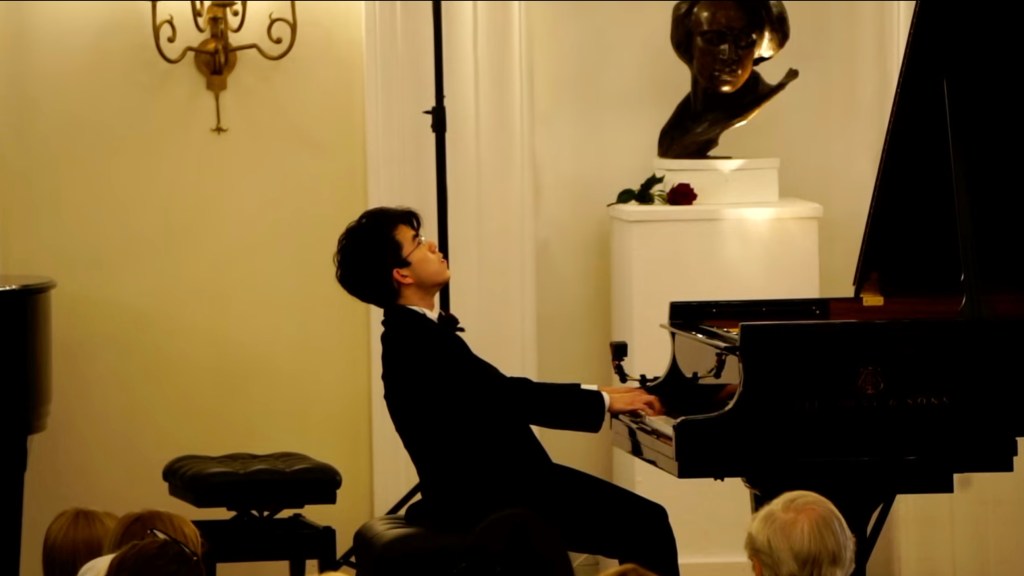
Fryderyk Chopin (1810–1849) Nocturne in C minor op. 48 nr 1 (1841) Ballade F minor op. 52 (1842–1843). Of course in Duszniki Chopin is ‘de rigueur’ and what better than one of the true pinnacles of the pianistic repertoire with the Fourth Ballade and the longest of his twenty one nocturnes. The Nocturne in C minor op 48 is a miniature tone poem and was played by Aristo with the same burning intensity and sense of architectural shape that I remember from Fou Ts’ong, who could give such strength and meaning to Chopin’s extraordinary bel canto. There was a luminosity and fluidity with a superb sense of balance and a subtle shaping of phrases that was so disarmingly simple that it was quite breathtaking in its originality. Passion and beauty combining with poetry and nobility. An intensity to the final outpouring that was quite overwhelming in its impact as this masterpiece was brought to life with such vibrant beauty.
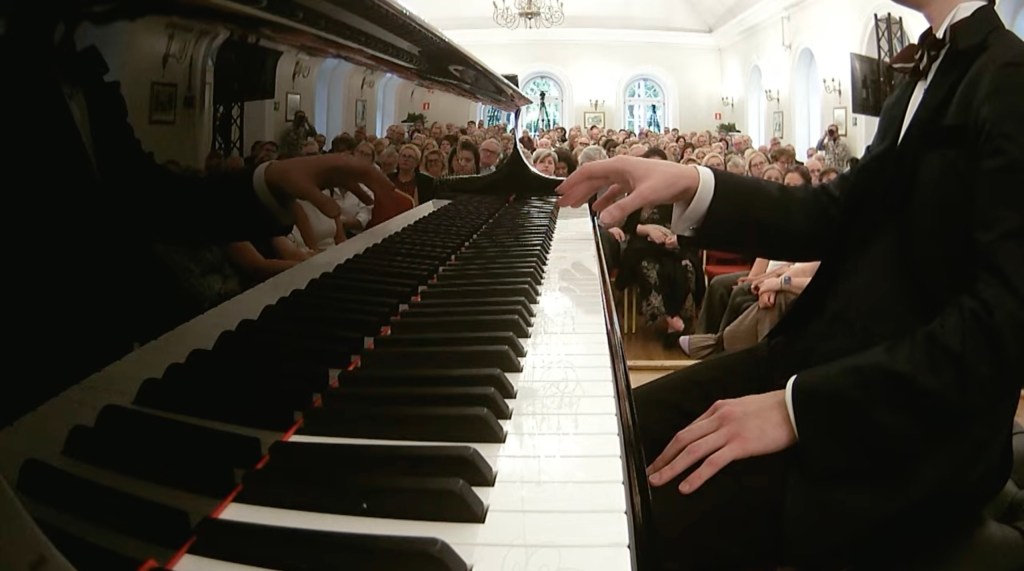
There was no break between these two Chopin works that were an oasis of ravishing colours and a lesson in simplicity and intelligence. A beautiful theme unwound with a flowing tempo of tender poetic beauty with each variation evolving so naturally. Leading to the return of the murmured opening which with ‘un sentiment de regret ‘ was allowed to take flight with a very slow and delicate cadenza.There followed an intricate knotty counterpoint and the passionate build up to the great emotional climax, with its wave of arpeggios sweeping across the keys like a tidal wave of passionate declamations. A coda that just flew from his fingers but with a musical shape and dynamic drive that swept all before it until the final imperious chords. This was Chopin playing of great authority and musicianship but above all of intelligence and humility with no traditional extravagances or personal interventions. This was the rock on which Chopin stood with aristocratic nobility and pride.

Ludwig van Beethoven (1770–1827) Sonata in B flat op. 106 „Hammerklavier” (1817–1818) Allegro – Scherzo. Assai vivace – Adagio sostenuto Introduction . Largo – Fugue: Allegro risoluto. A monumental performance that I remember hearing together with Brahms Second Concerto and Ravel Gaspard at the Cliburn. The ‘Hammerklavier’ gave the impression that it was even more impressive now, but that may just be because taking away the pressure of the circus arena may have allowed me to concentrate more fully on this quite extraordinary performance. It was bursting with energy from the very first imperious declamations that were fearlessly played by a musician who could transmit the burning intensity and irascible impatience of Beethoven, but also the poetic soul hidden deep within the notes of a composer who had suffered such a turbulent life. There was an absolute clarity of thought and execution with a sense of orchestral colour that was of a radiant purity and originality. Even in the Scherzo there was a certain grace but tempered by menace or the demons that were ever present in Beethoven’s world.Suddenly being chased across the keyboard with extraordinary dynamic drive from Artisto, only to be greeted by an impatient full stop before continuing as if nothing had happened at all. The ‘Adagio sostenuto’ was played with remarkable concentration and some truly whispered wonders and if it missed the burning intensity of Serkin it gained in its inner simplicity and deeply felt weight. There was a quiet ravishing beauty to the introduction or transition before a fugue that I have never heard played with such clarity and burning rhythmic drive. I have heard many great pianists play this monumental edifice including Richter, Serkin,Brendel,Pollini and Annie Fischer but rarely have I heard such pianistic perfection or musical intelligence as today from this young man.
The Brahms Intermezzo op 117 n. 1 was a gentle antidote to the searing emotions of Beethoven and was played with a disarming simplicity and once again a simple musicianship of radiance and sensitivity.


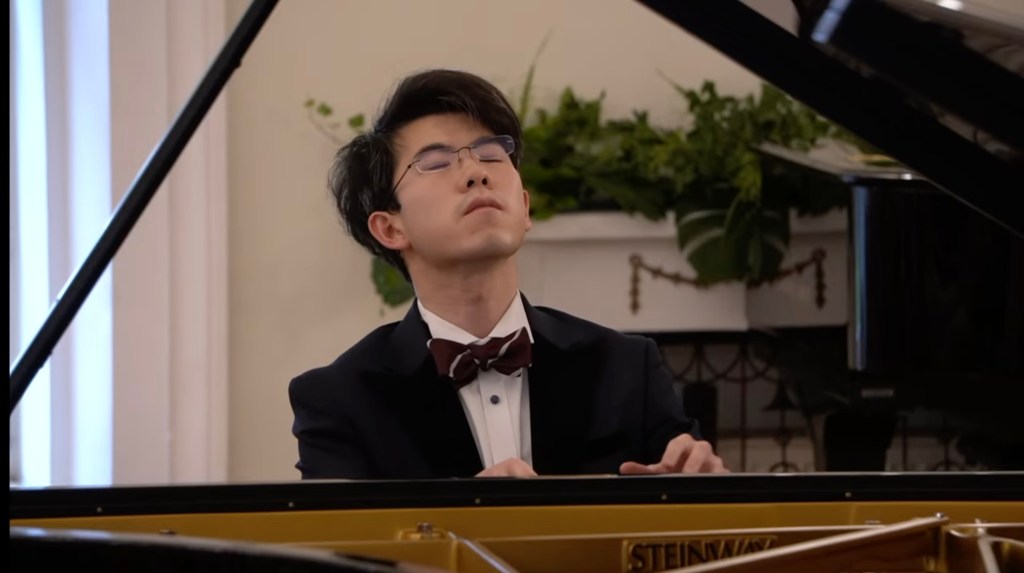
a marvel of deft characterization and sophisticated interaction with the orchestra. – The Dallas Morning News
…with purpose, direction, structural awareness, technical finesse and mature artistry. – Gramophone
Pianist Aristo Sham exudes astounding intellect and a deep emotional resonance; a cultivated sophistication and an immediately engaging presence; a penchant to take on the great monuments of the piano repertoire and a natural, infectious spontaneity. This makeup is fueled by a fascination with the world and its rich cultures: he was an international prodigy, is a voracious student of wide-ranging interests, and currently splits his time between three continents.
At the 2025 Van Cliburn International Piano Competition, Aristo found his breakthrough moment, taking home both the gold medal and the audience award at “one of the most prestigious contests in classical music” (The New York Times, June 2022). And the critics showered him with imaginative praise, calling him “a marvel of deft characterization,” “consistently authoritative,” “a card-carrying risk taker,” “a dapper, aristocratic figure on stage,” “a pianist I look forward to hearing again” (The Dallas Morning News, Gramophone, Texas Classical Voice). In just two months’ time, he was mentioned in more than 800 news articles, and his Cliburn performance videos were streamed 2 million times across 125 countries.
Aristo was featured in the 2009 documentary The World’s Greatest Musical Prodigies on Channel 4 (UK), has performed for royalty including King Charles, and was hailed by The New York Times in 2020 as an artist “whose playing combines clarity, elegance and abundant technique.” He has concertized across Asia, Europe, and the United States, with major highlights including the London Symphony Orchestra under Sir Simon Rattle, Hong Kong Philharmonic Orchestra under Edo de Waart, English Chamber Orchestra under the late Sir Raymond Leppard, Orchestre de Chambre de Lausanne, and Minnesota Orchestra. His 2025–2026 debut season as Cliburn winner includes a major tour of Asia through South Korea and China, and U.S. recitals for Aspen Music Festival, La Jolla Music Society/The Conrad, UCSB Arts and Lectures, and the Skyline Piano Artist Series at Northwestern University.
Recently, he recorded and hosted the complete Brahms solo piano music on RTHK4, Classical Radio in Hong Kong. Upcoming seasons will see the release of two albums on Platoon: a Cliburn live release, as well as his debut studio album.
Aristo Sham’s mother taught piano in their Hong Kong home, so he says: “I was enveloped in the environment of the piano even before I was born.” His parents recall his immense curiosity towards the instrument when he was a toddler and started him in lessons when he was 3. At the age of 10, he began competing and concertizing. But he also went to regular schools, never making the conscious decision to focus solely on the piano or his other studies; this made the dual degree program at Harvard and the New England Conservatory a perfect fit when he went to college. Aristo holds a Bachelors in Economics from Harvard University and a Masters in Piano Performance from New England Conservatory. His principal teachers include Eleanor Wong, Colin Stone, Victor Rosenbaum, and Julia Mustonen-Dahlkvist, and has been mentored by Gabriela Montero. He finished his Bachelor of Arts at Harvard in 2019 and master’s at NEC under Victor Rosenbaum in 2020. He then went to the Ingesund School of Music in Sweden to study with Julia Mustonen-Dahlkvist before returning to the States to earn an artist diploma at The Juilliard School with Robert McDonald and Orli Shaham. In addition to the Cliburn, he’s a laureate of international competitions, with first-prize wins at Young Concert Artists, Ettlingen, Gina Bachauer, and Monte Carlo Music Masters.

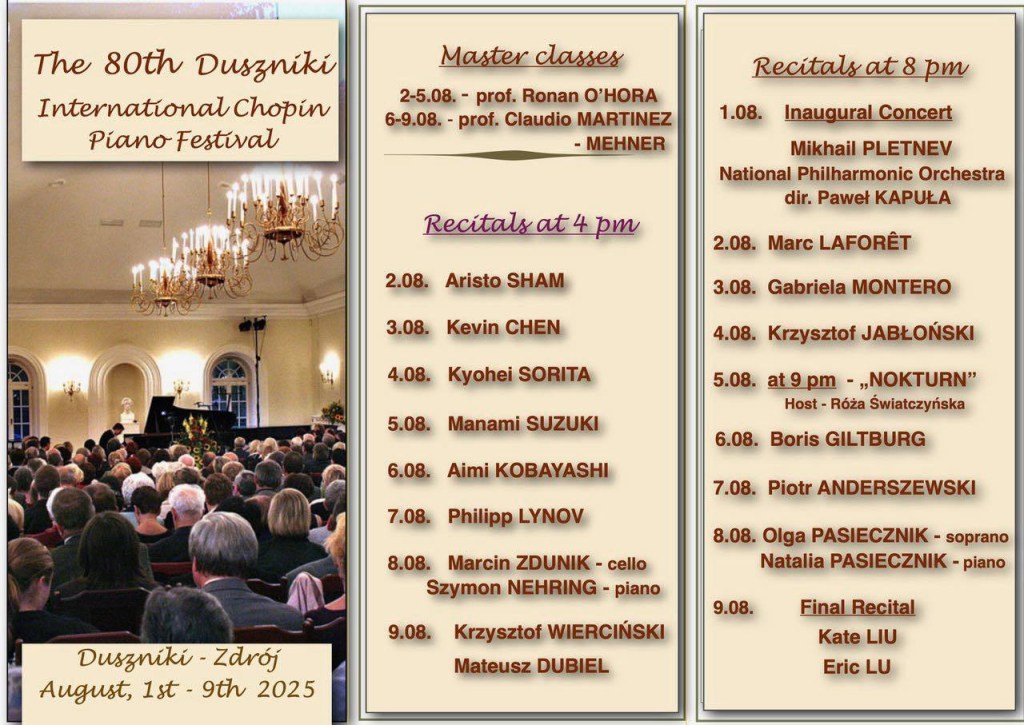
in Duszniki-Zdrój !
 Radio broadcasts:
Polish Radio – 2nd Programme
3.08. 16.00 – Kevin Chen
4.08. 20.00 – Krzysztof Jablonski
6.08. 20.00 – Boris Giltburg
8.08. 20.00 – vocal recital
Olga Pasiecznik – soprano
Natalia Pasiecznik – piano
Almost all invited Artists have agreed to online broadcasts.However, we did not receive permission and therefore there will be no online streaming of the 3 concerts:
* 2.08. 2025 – Inaugural Concert
Mikhail Pletnev
National Philharmonic Orchestra
* 7.08. 2025 – Peter Anderszewski
* 9.08. 2025 – Final Recital
Kate Liu & Eric Lu.
The remaining concerts will be streamed on this YouTube channel:
https://www.youtube.com/@fundacjamiedzynarodowychfe7529/featured



http://www.michael-moran.com/2025/07/duszniki-zdroj-international-chopin.html?m=1
 ChristopherAxworthy-MusicCommentary