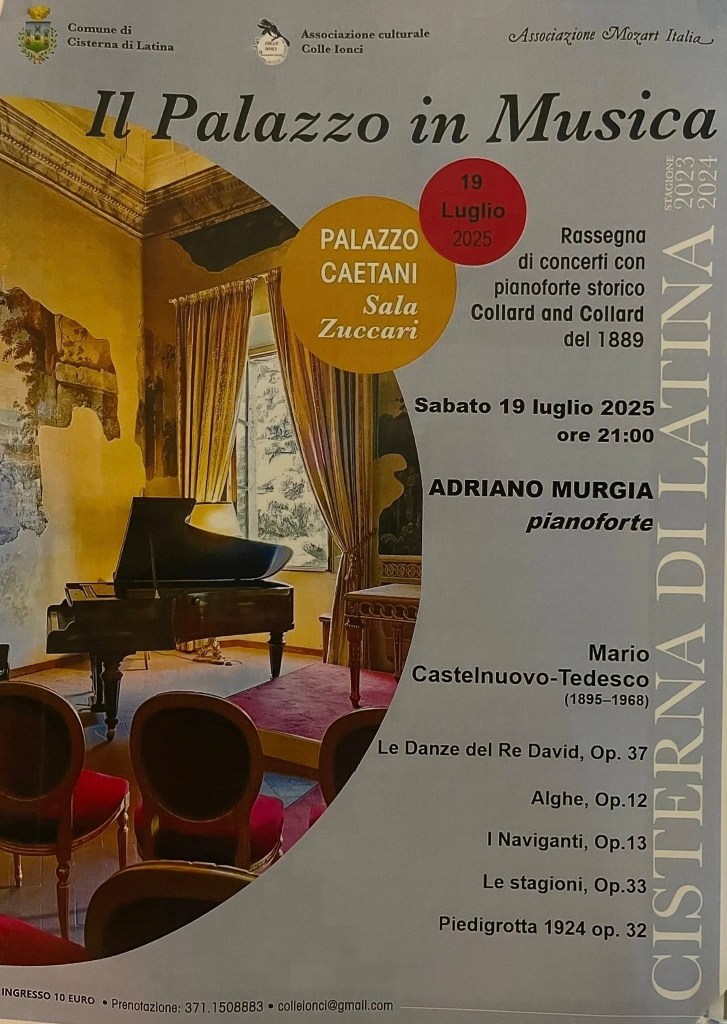
More superb music making from the class of Roberto Prosseda, born in Latina although brought up in the shadow of the Ghione theatre in Rome, with the Cafaro’s next door, and the genial inspiration of Fou Ts’ong there too, and later in the International Piano Academy, Lake Como. Now arrived at his half century he is an established, much respected musician on the world stage, with his own class at the Rovigo Conservatory, and his own school and recording studio ‘happily’ (sic) established with his wife and three children in Prato.
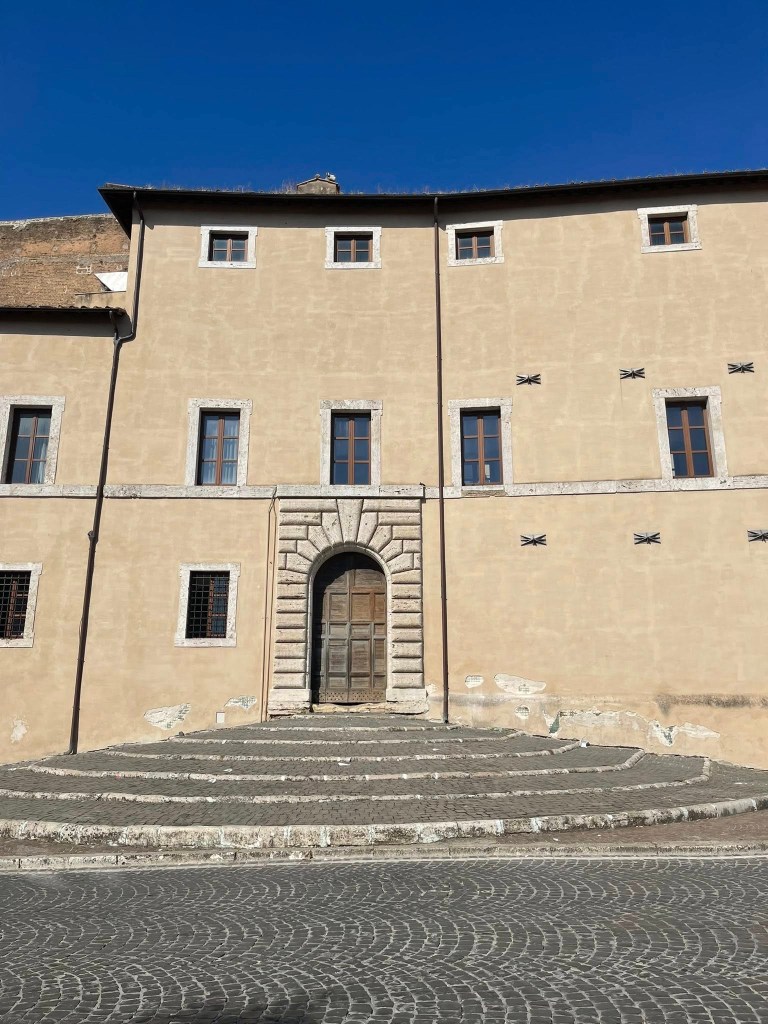
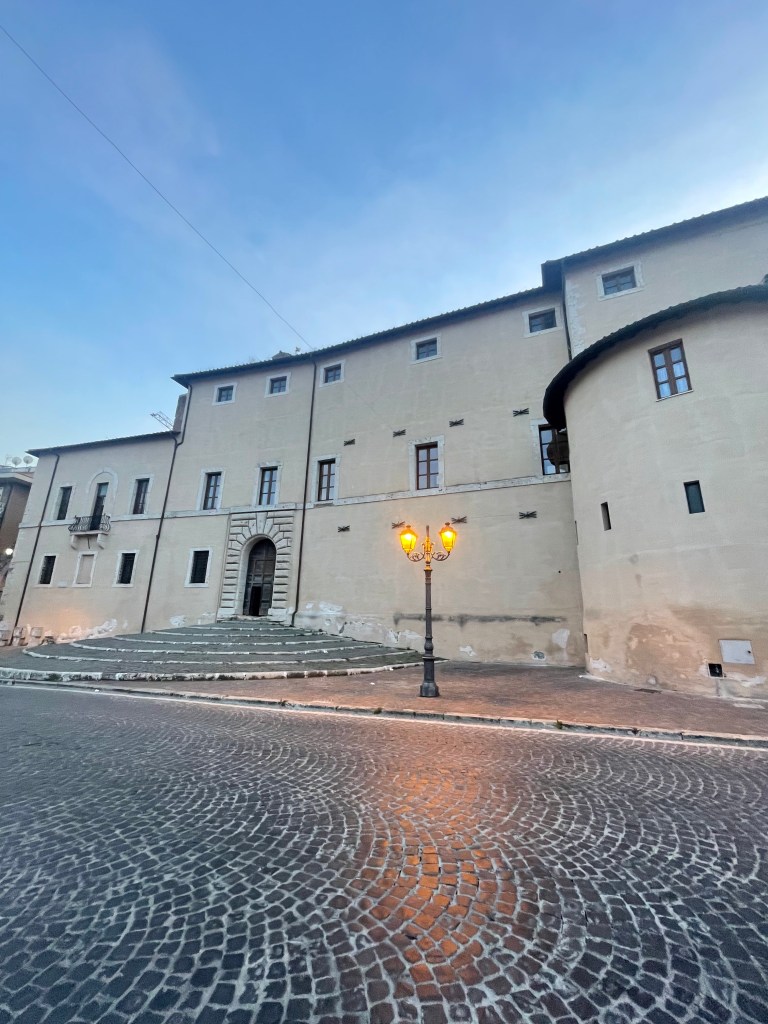
His roots though have never left him, and unknown to many he had discovered this wondrous Caetani Palace in a small town next to Latina.
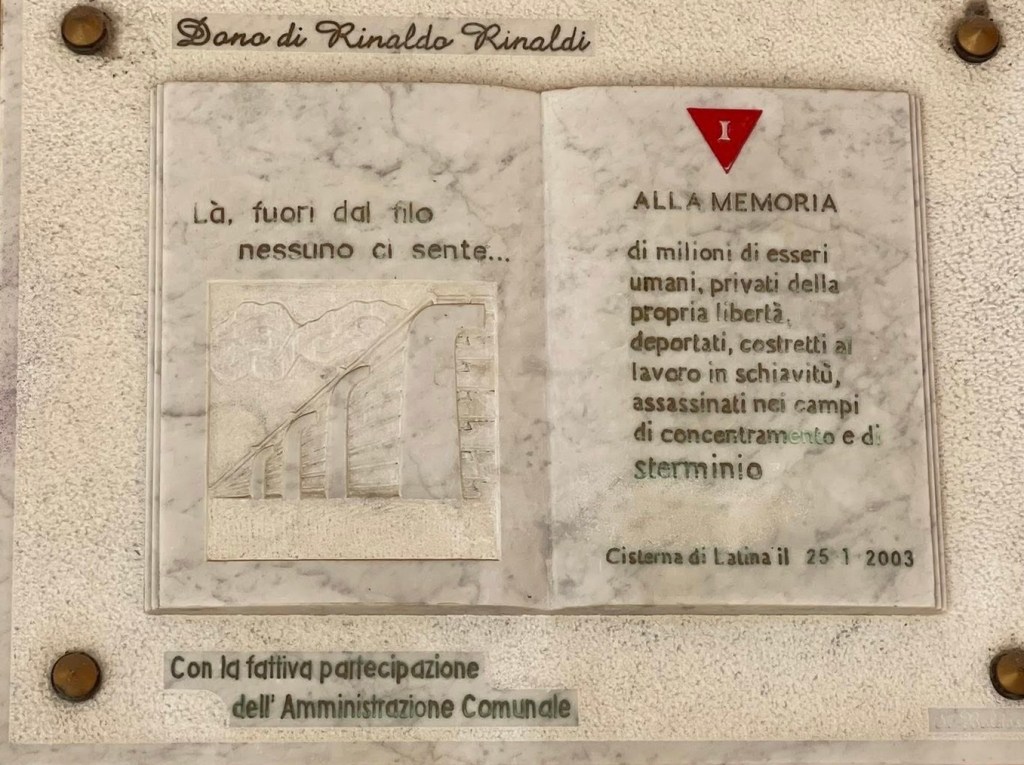
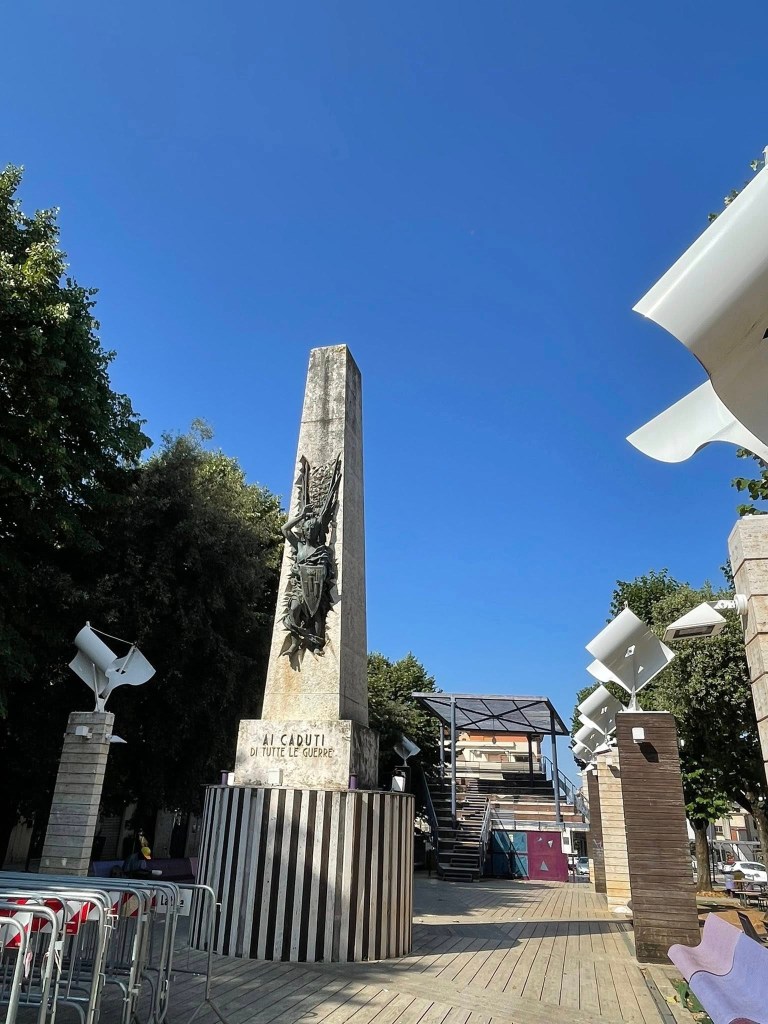
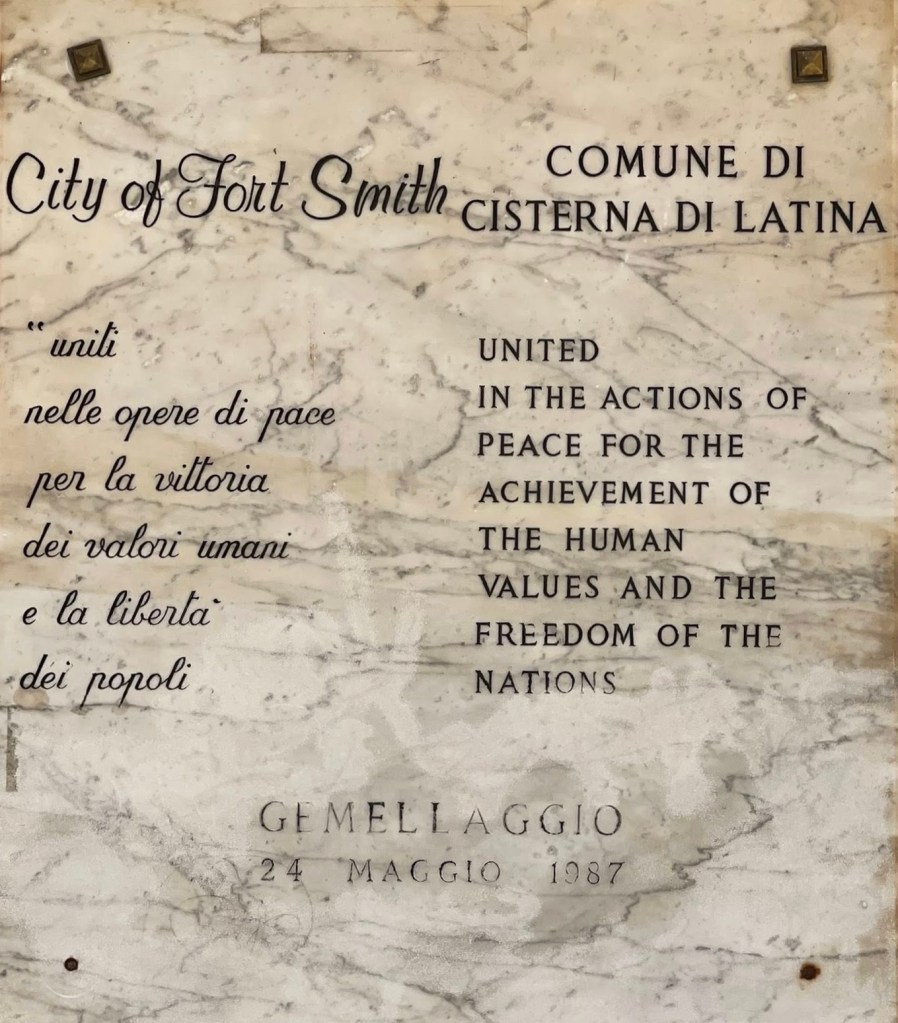
A town that has suffered as it lay in the malerial swamps around Rome that Mussolini drained and turned into the most arable land around the Eternal City. Until war struck and this area saw the landings of the troops as the war came to it’s tragic end.
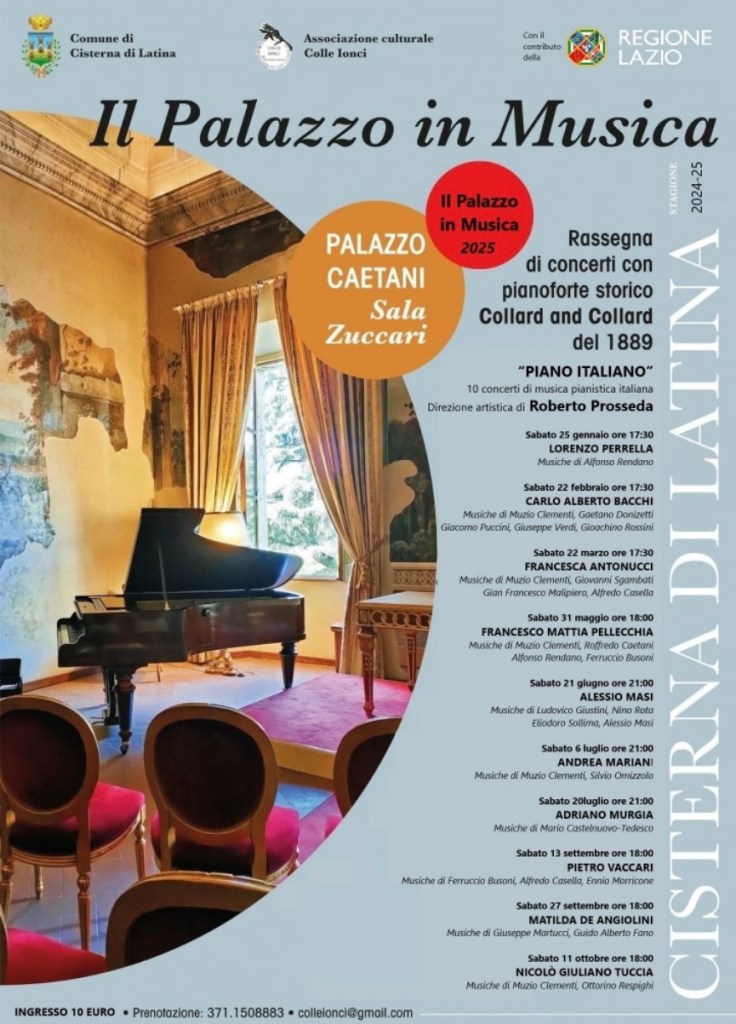
Not only had Roberto Prosseda found it but he has a mission to dedicate a series of concerts to launch superb but unjustly neglected Italian music, played and video recorded by his very accomplished master students.
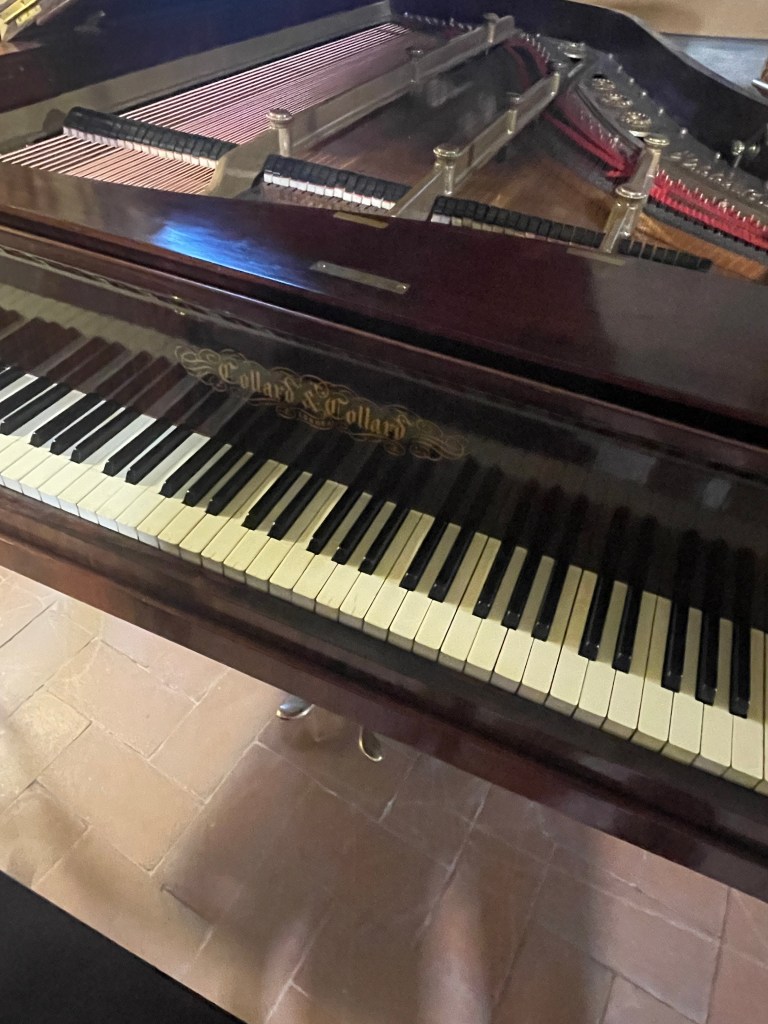
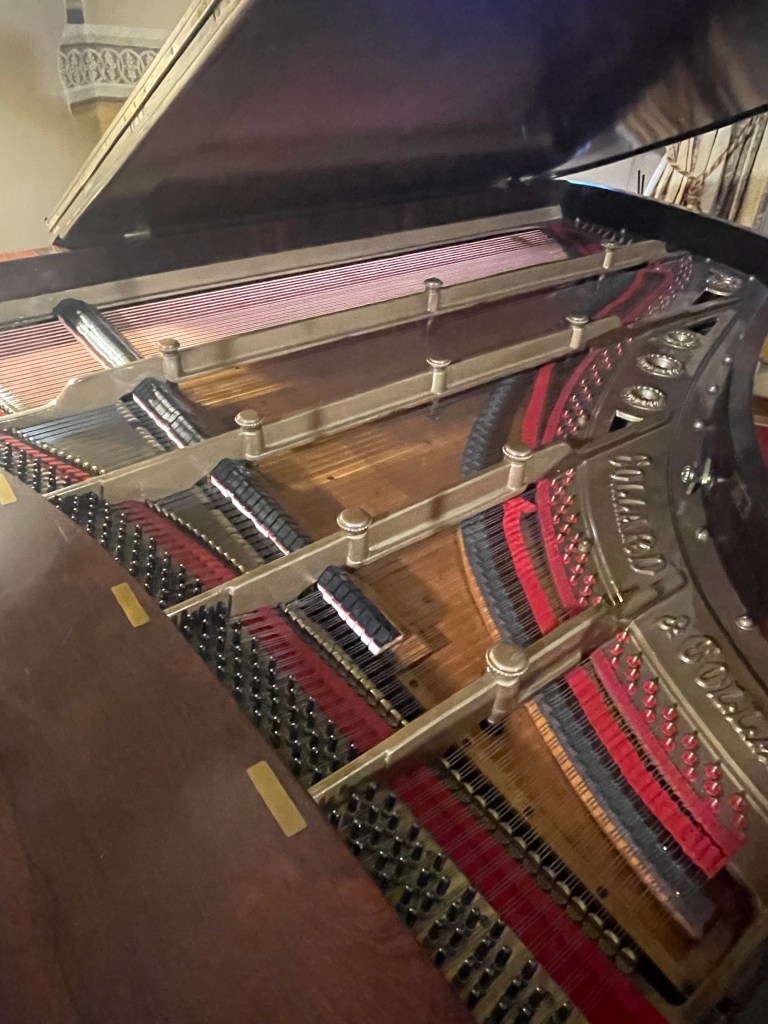
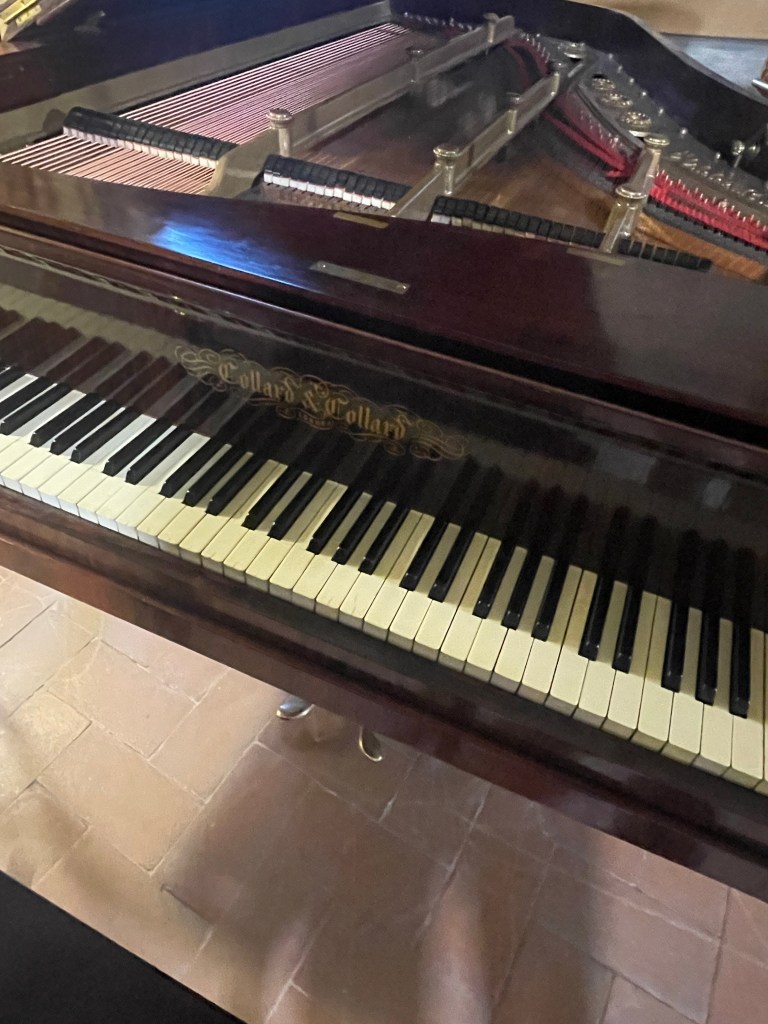
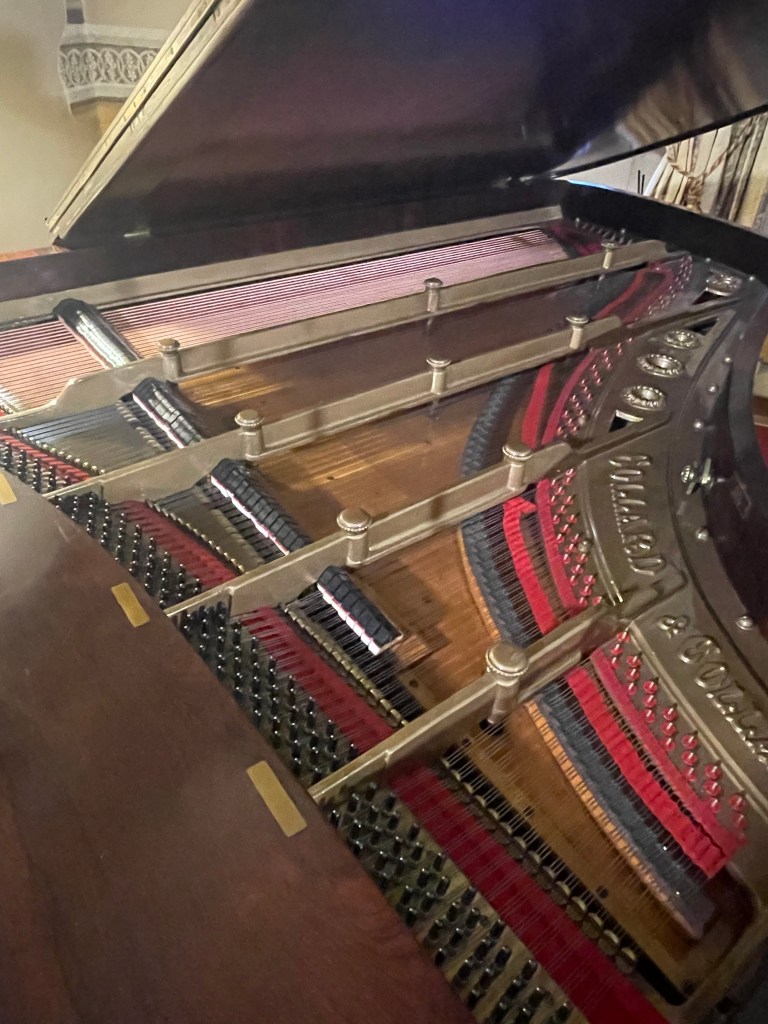
He even managed to find an antique 1890 Collard and Collard piano that had lain in disuse in the Savoy Hotel in London until an extravagant story brought it to Rome. It is now in the hands of experts passionately able to restore this and an antique Erard back to its former glory.
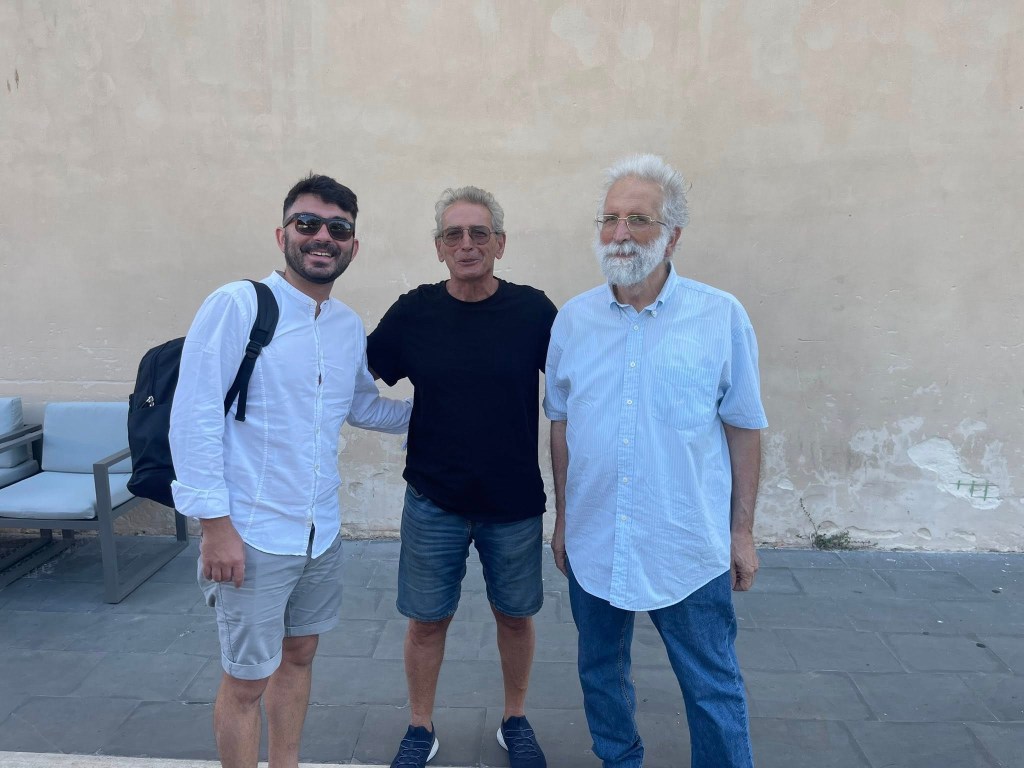
Just a month ago I had discovered the very talented Alessio Masi from Sicily with hands submerged in the music of Nino Rota ,Eliodoro Sollima , Ludovico Giustini and his own compositions .https://christopheraxworthymusiccommentary.com/2025/06/22/alessio-masi-at-palazzo-caetani-cisterna-di-latina-latin-blood-ignites-and-illuminates-his-musical-heritage/
Today was the turn of the Sardinian pianist Adriano Murgia who dedicated an unexpected Sunday morning concert to Castelnuovo -Tedesco. By a cruel turn of fate Castelnuovo -Tedesco had fled Italy with the beginning of Fascism and was helped by Toscanini and Heifetz to flee persecution. He was invited like so many refugee musicians to Hollywood where his scores like those of Rota and others became an integral part of the glory that was Hollywood.
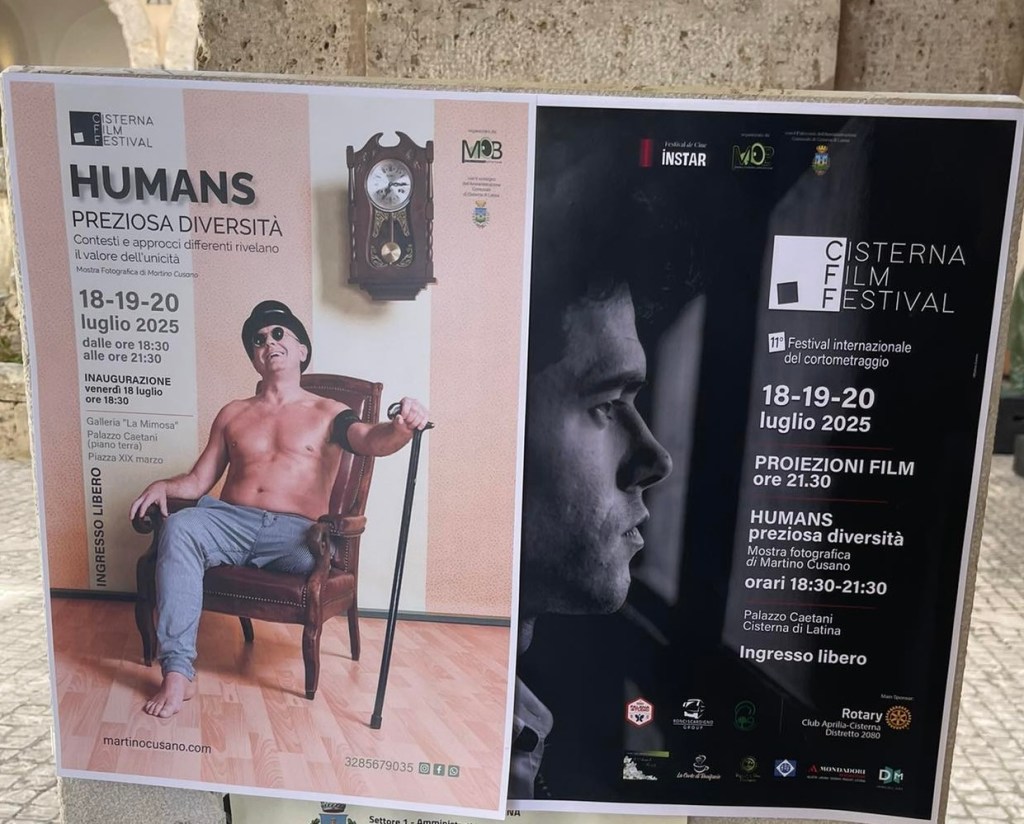
The concert was supposed to be Saturday evening but the town hall had give two permits for public performances on the same day. One in the antique Palace on a period instrument and the other in the square under the window of the concert hall. A celebration of Cinema amplified as only the locals know how to ruin the atmosphere of their historic heritage and the eardrums of their inhabitants.
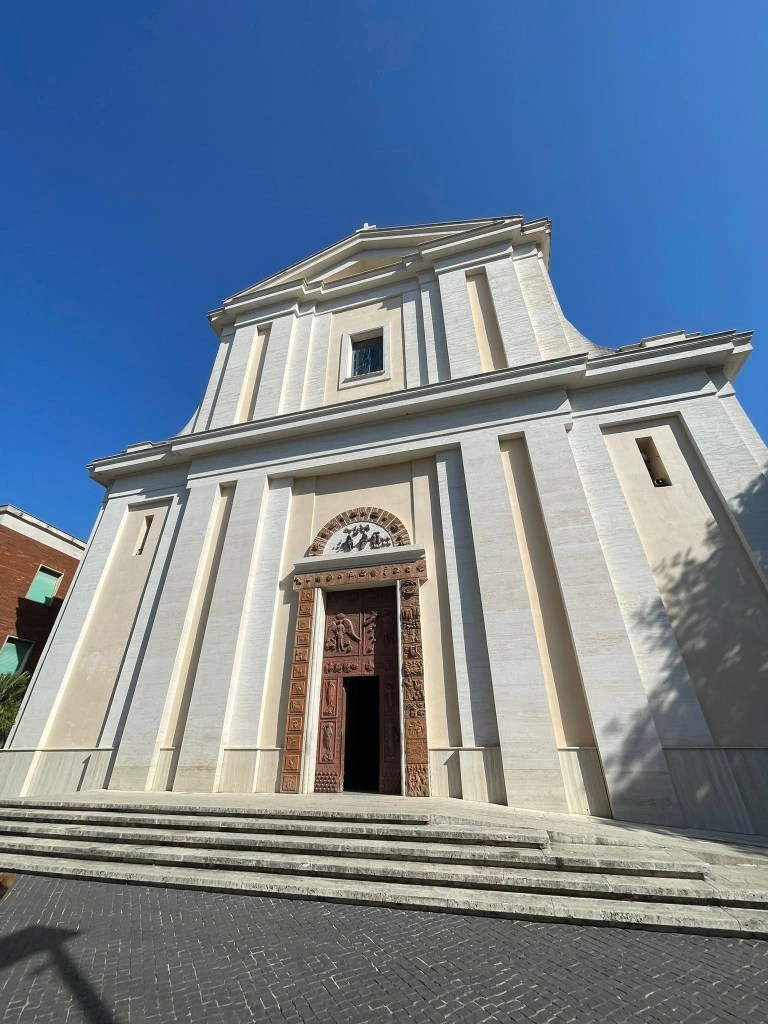
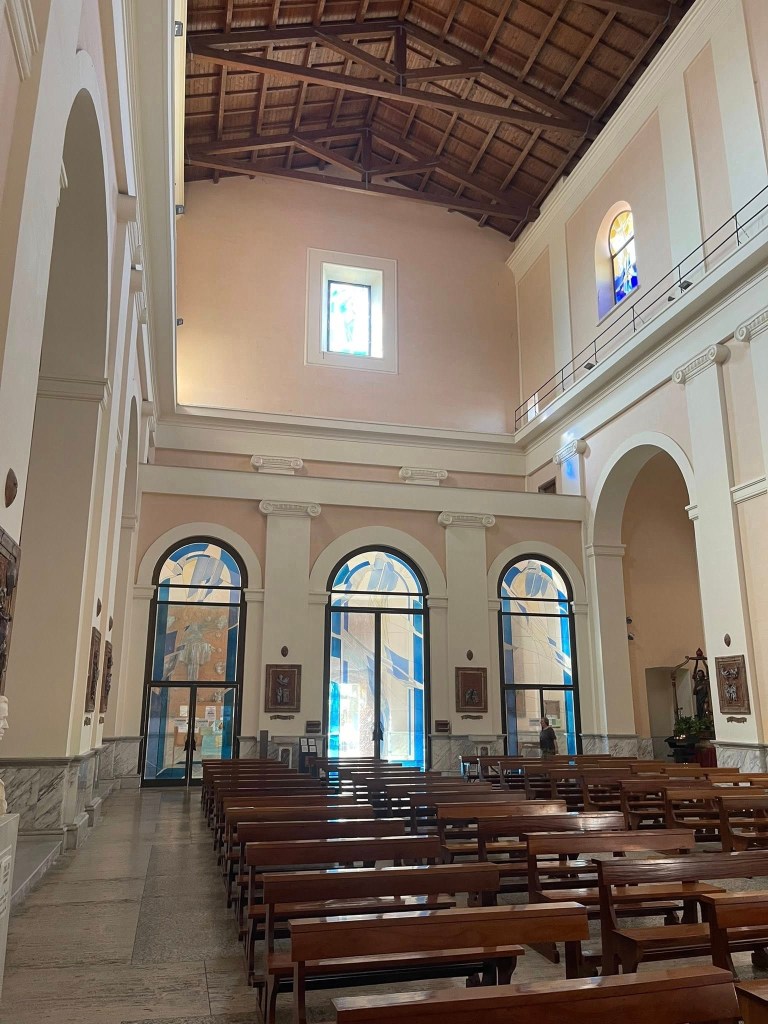
A blissfully peaceful Sunday morning with cars jammed bumper to bumper on the roads nearby that lead to the wonderful beaches, but the road to cultural enlightenment was completely empty !
A programme of original piano music by Castelnuovo – Tedesco from his early period spanning from 1919 to 1925.
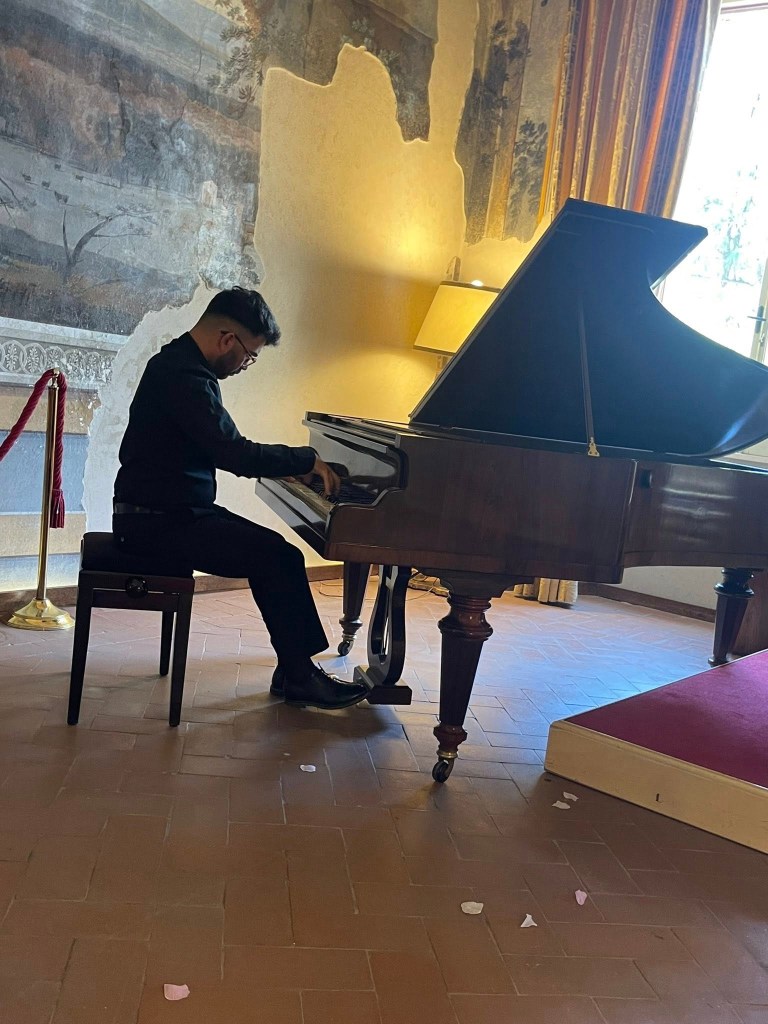
Played with remarkable authority but also a musicianship that could give an architectural shape and sense of line to all he played. The 7 pieces that make up ‘Le Danze del Re David’ were given a vivid characterisation from the opening dynamic drive and declamation, dissolving to a bass melody with gently accompanying arabesques stretched over the upper part of the keyboard. Very expressive with the voice of a complete believer coming through with a poignant clarity. There was a luminosity and resonance on this very subdued Collard and Collard, with a very particular voice, almost like looking at a faded postcard. A melodic line doubled at the octave with poignant innocence was very moving. Soon awoken with a rhythmic dance of violent interruptions, played with commanding authority almost Bartókian in its vehemence, dissolving into a whispered deeply felt mellifluous outpouring. There followed a march of sublime indifference, where Prokofiev springs to mind, before the bold chordal ending played with commanding energy and drive.
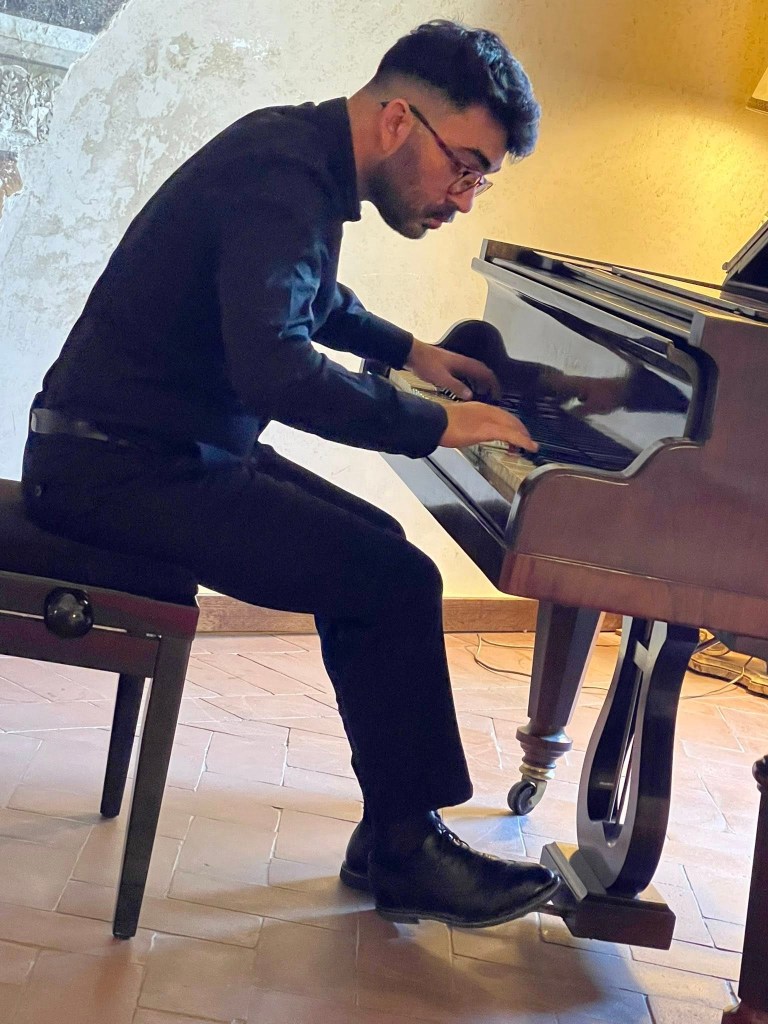
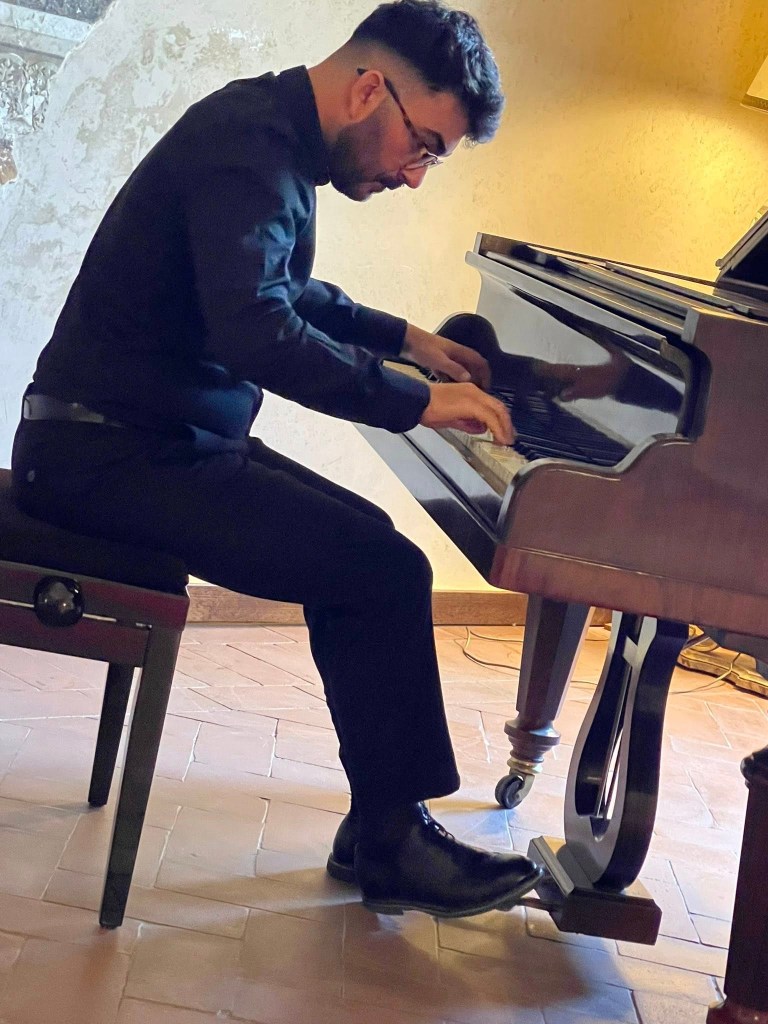
‘Alghe’ and ‘Naviganti’ were two short works of a mellifluous outpouring of luminosity and were simple fantasy pieces of a somewhat difficult musical personality which on first hearing can seem more intellectual than instantly communicative.
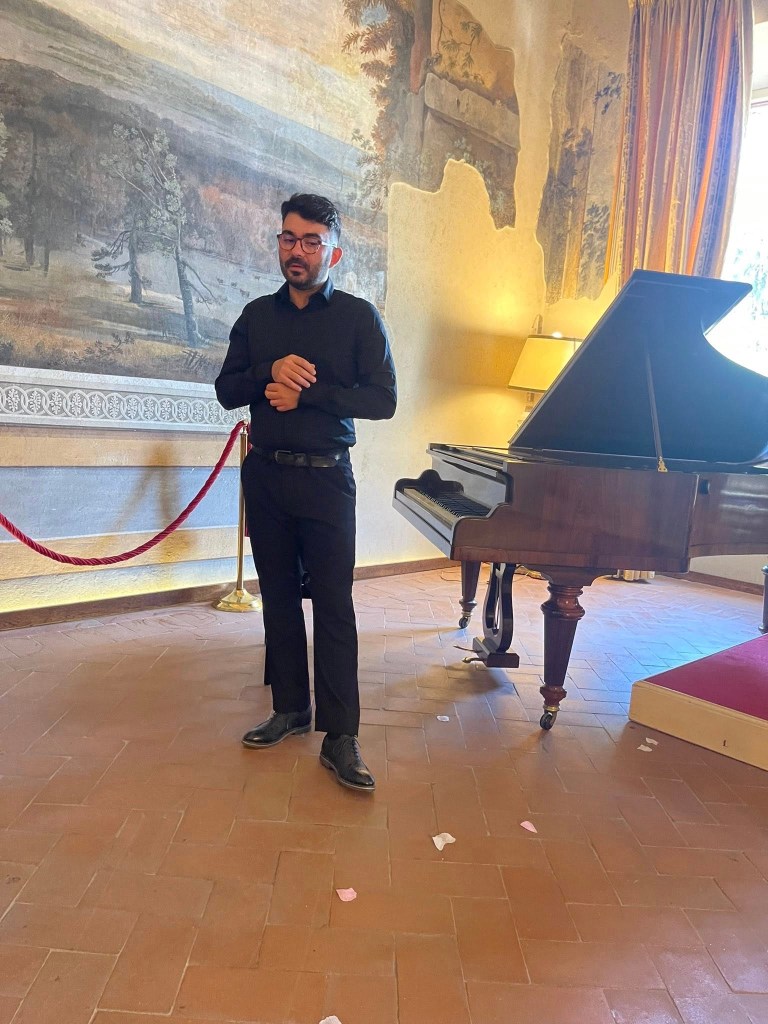
The Seasons too with its open intervals was interrupted by an enticing perpetuum mobile and bells tolling, with a gentle duet between tenor and soprano voices that Adriano played with bold sentiment and searing intensity.
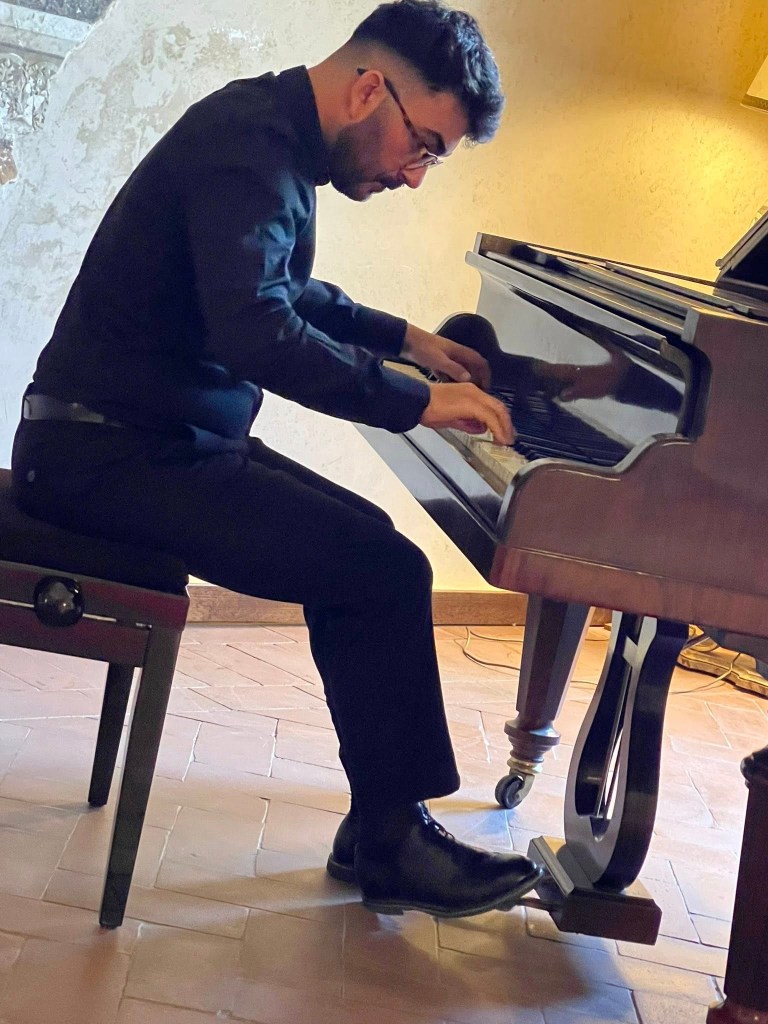
Of course the ‘Piedigrotta Rhapsody’ burst onto the scene with all the exhilaration and excitement of Naples. A chiselled melodic line floated above a gently flowing accompaniment . Enticing gaiety to a ‘Dolls dance’ of great character and with the bells tolling outside at midday adding to the Neapolitan folk flavour that Adriano was describing so well.
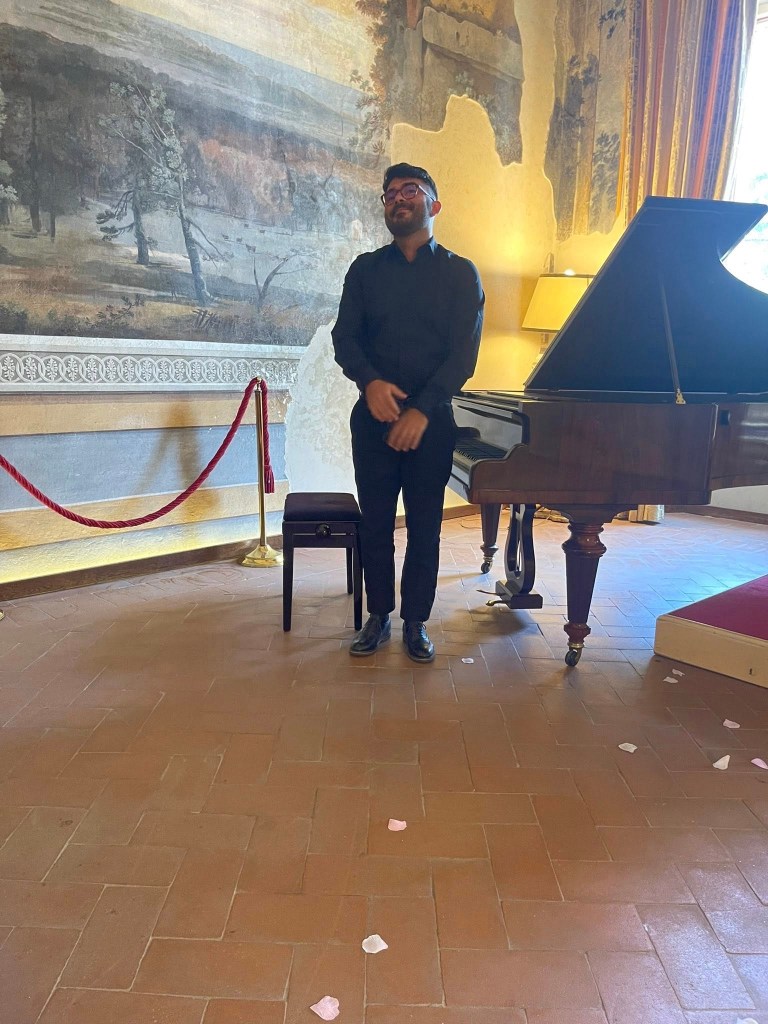
A Chopin Mazurka just highlighted Castelnuovo-Tedesco’s refusal in this period to adhere to Bel Canto, preferring to search for his own musical language as many in that period were struggling to do. Of course the commissions from Heifetz, Piatigorsky and Segovia in a later period were to crown Castelnuovo -Tedesco as one of the finest composers of his day.
After his move to the USA he became known as the ‘Maestro dei Maestri’ , such was the success of his students who included : Henry Mancini, André Previn, Nelson Riddle, John Williams etc etc.
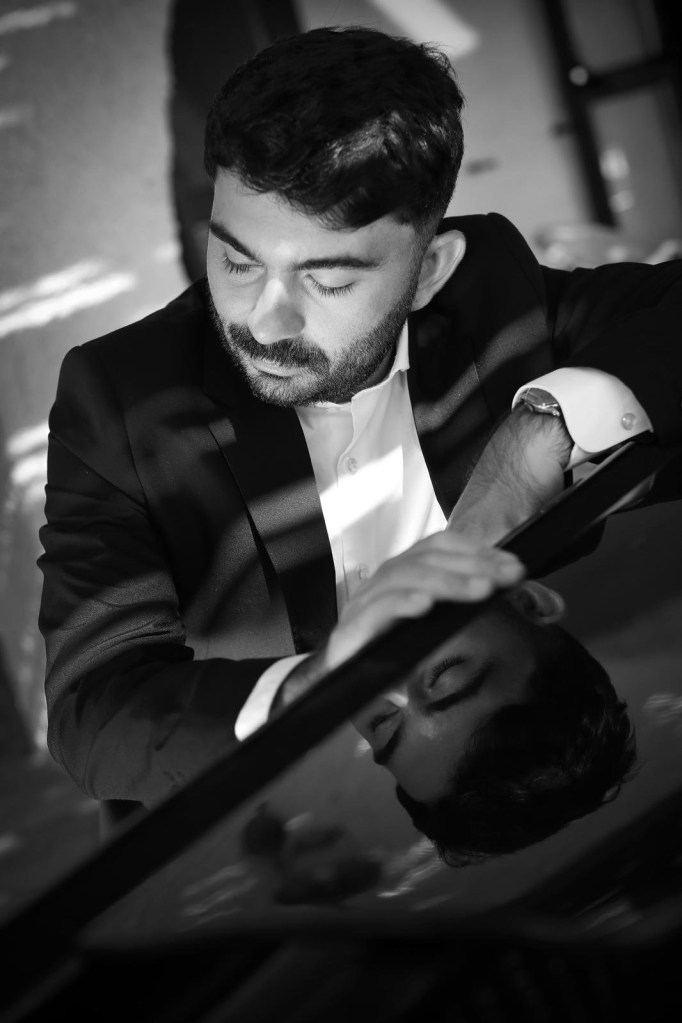
Adriano Murgia was born in Alghero in 1996. He began his piano studies under the guidance of Maria Giovanna Piras, and then continued his training with Genny Basso, assistant to Aldo Ciccolini. In 2022 he graduated with highest honors and honorable mention in piano at the “L. Canepa” Conservatory of Music in Sassari, studying with Maestro Andrea Ivaldi. Today he attends the “Academia Internacional de Musica Aquiles Delle Vigne” in Coimbra, Portugal.In 2023 he completed a second level master’s degree at Rovigo Conservatory, under the guidance of Maestro Roberto Prosseda.He has participated in piano masterclasses with internationally renowned artists such as G. Basso, A. Ciccolini, M. Baglini, E. Stellini, A. Ivaldi, M. Baek, M. Araujo, R. Andres S. Coombs, P. Iannone, A. Pizarro, B. Petrushansky, J. Rink, W.G Naboré, B. Berman and R. Prosseda.In the 2020/2021 academic year he was accepted into the Hochschule fur Musik “Carl Maria von Weber” in Dresden, Germany. He has performed concerts both as a soloist and with chamber ensembles in various Italian and European cities, including Alghero, Sassari, Cagliari, Chianciano, Funchal (PT), Nuoro, Dresden (DE), Rovigo, Asolo, Sardoal (PT), Coimbra (PT), Dulken (DE), Madrid (ES), Vienna (AT), New York (USA), Castanheira de Pêra (PT), Vila Nova de Gaia (PT) and Lisbon (PT). In 2019 he performed Franz Liszt’s Totentanz as a soloist with the symphony orchestra of the Sassari Conservatory, first at the Teatro Comunale in Sassari and then at the Teatro Eliseo in Nuoro. In 2024 he opened the concert season of the Sardoal International Piano Meeting in Portugal, performing J.S. Bach’s BWV 1060 with the professional orchestra Filarmonica das Beiras. In 2025 he performed the Concerto for Piano and Orchestra by A. Salieri with the Filarmonica das Beiras Orchestra in Coimbra in the Sala S. Tomás. He has distinguished himself in various national and international competitions, obtaining a second prize in the “Monte Acuto” regional competition, the third prize in the “Prime note” competition, the third prize in the Vittorio Nannarelli international competition and the first prize in the 10th edition of the Villa Las Tronas competition. In 2024 he won the award as Best Resident Artist and third Absolute Prize at the “Sardoal International Piano Competition”, the third prize at the “Coimbra World Piano Competition” and the first Prize in the “Prof. Dichler” competition at the Wiener Musikseminar of the University of Vienna. Between 2022 and 2025, he held the position of head of the piano department at the “Imbas International School of Music & Arts” in Cascais, Portugal. He recorded an episode about Italian piano music for “Dentro le note,” a series by Roberto Prosseda on the Italian national television channel Rai 5. He is involved in the Lux Fidelis project, which promotes Portuguese music worldwide. After completing his Master’s in Piano Performance at the Venezze Conservatory of Rovigo with Roberto Prosseda, Adriano is currently beginning his PhD program at the Venezze Conservatory, focusing on the piano music of Mario Castelnuovo-Tedesco. His first CD, dedicated to Castelnuovo-Tedesco, will be released by Piano-Classics in 2025 and has already been presented in New York at Barge Music on November 3, 2024.
Born in Florence , he was descended from a prominent banking family that had lived in Tuscany, specifically in Siena, until the latter half of the 19th century. His father was Amedeo and his elder brothers Ugo (born in 1890, lawyer) and Guido (born in 1891, engineer). Castelnuovo-Tedesco was first introduced to the piano by his mother, Noemi Senigaglia, and he composed his first pieces when he was just nine years old. After completing a degree in piano in 1914 under Edgardo Del Valle de Paz (1861-1820), well-known composer and pianist pupil of Beniamino Cesi, he began studying composition under renowned Italian composer Ildebrando Pizzetti , and received a diploma in composition in 1918. He soon came to the attention of composer and pianist Alfredo Casella , who included the young Castelnuovo-Tedesco’s work in his repertoire. Casella also ensured that Castelnuovo’s works would be included in the repertoires of the Società Italiana di Musica Modern (later the Corporazione delle Nuove Musiche ), granting him exposure throughout Europe as one of Italy’s up-and-coming young composers. Works by him were included in the first festival of the International Society of Contemporary Music , held in Salzburg,Austria , in 1922. In 1926, Castelnuovo-Tedesco premiered his first opera La Mandragola, based on a play by Niccolò Machiavelli . It was the first of his many works inspired by great literature. Another major source of inspiration for him was his Jewish heritage, most notably the Bible and Jewish liturgy. His Violin Concerto No. 2 (1931), written at the request of Jascha Heifetz, was also an expression of his pride in his Jewish origins, or as he described it, the “splendor of past days”, in the face of rising anti-Semitism that was sweeping across much of Europe. At the 1932 festival of the International Society of Contemporary Music, held in Venice, Castelnuovo-Tedesco first met the Spanish guitarist Andrés Segovia. The meeting inspired Castelnuovo-Tedesco to write for the guitar, beginning with his Variazioni attraverso i secoli (Variations à travers les siècles)(Variations through the ages), Op. 71 (1932), and later his Guitar Concerto No. 1 (1939). All in all, he wrote almost one hundred compositions for this instrument, which earned him a reputation as one of the foremost composers for the guitar in the twentieth century. Some of them were written and dedicated to Segovia, who was an enthusiast of his style (Segovia called him an “incorruptible servant of artistic truth”). Even before the Italian government promulgated the Italian racial laws in late 1938, Castelnuovo-Tedesco was banned from the radio and performances of his work were cancelled. The new racial laws, however, convinced him that he should leave Italy. He wrote to Arturo Toscanini , the former musical director of La Scala , and violinist Jascha Heifetz, explaining his plight, and both responded with support. As an American citizen, Heifetz began paperwork to sponsor Castelnuovo-Tedesco as an immigrant in the United States . Castelnuovo-Tedesco left Italy in 1939, shortly before the outbreak of World War II, and settled in Larchmont ,Westchester County,New York (state). He wrote his Cello Concerto in G minor, Op. 72, for Gregor Piatigorsky . It was premiered with the dedicatee under Arturo Toscanini in New York in 1935. For Piatigorsky he also wrote a Toccata (1935), and a piece called Greeting Card, Op. 170/3, based on the spelling of Piatigorsky’s name. Like many artists who fled fascism, Castelnuovo-Tedesco ended up in Hollywood , where, with the help of Jascha Heifetz, he landed a contract with Metro- Goldwyn- Meyer as a film composer. Over the next fifteen years, he worked on scores for some 200 films there and at the other major film studios. Rita Hayworth hired him to write the music for The Loves of Carmen (1948), produced by Hayworth for her Beckworth Productions and released by Columbia Pictures . As a teacher, Castelnuovo-Tedesco had a significant influence on other major film composers, including Henry Mancini ,Nelson Riddle,Herman Stein and André Previn. Jerry Goldsmith,Marty Paich, and John Williams were all his pupils, as was Scott Bradley, who studied privately with him while both were on staff at MGM. He also maintained close contact with composer Robert Strassburg. His relationship to Hollywood was ambiguous: later in life he downplayed the influence that it had on his own work, but he also believed that it was an essentially American artform, much as opera was European. In 1946 he became a U.S. citizen, but he remained very close to Italy, which he frequently visited. In 1958 he won the Concorso Campari with the opera The Merchant of Venice, which was first performed in 1961 at the Maggio Musicale Fiorentino under the baton of Gianandrea Gavazzeni. In 1962 he wrote Les Guitares bien tempérées (“The Well-Tempered Guitars”) for two guitars, a set of 24 preludes and fugues in all 24 major and minor keys, for the duo-guitarists Alexandre Lagoya and Ida Presti . This was inspired by The Well – Tempered Clavier by Johann Sebastian Bach , a composer Castelnuovo-Tedesco revered. In the United States, Castelnuovo-Tedesco also composed new operas and works based on American poetry, Jewish liturgy, and the Bible. He died in Beverley Hills,California , in 1968 at the age of 72. He is buried at Westwood Village Memorial Park Cemetery. The Library of Congress in Washington, DC, hosts the Mario Castelnuovo-Tedesco Collection, a collection of the composer’s manuscripts donated by his family in 2000. The catalogue is accessible online. His oldest son was the psychiatrist Pietro Castelnuovo-m Tedesco. His younger son was the architect Lorenzo Castelnuovo-Tedesco of Los Angeles.
Works for Piano
- Cielo di Settembre, Op. 1 (1910)
- Questo fu il carro della morte, Op. 2 (1913)
- Il raggio verde, Op. 9 (1916)
- Alghe, Op. 12 (1919)
- I Naviganti, Op. 13 (1919)
- Cipressi, Op. 17 (1920)
- La sirenetta e il pesce turchino. Fiaba marina, Op. 18 (1920), also for two pianos (1935)
- Cantico (per una statuetta di San Bernardino di Niccolò dell’Arca), Op. 19 (1920)
- Vitalba e Biancospino, Fiaba Silvana, Op. 21 (1921)
- Epigrafe (per la tomba di Madonna Ilaria del Carretto, scolpita da Jacopo della Quercia, che è in Lucca), Op. 25 (1922)
- Alt Wien. Rapsodia Viennese, Op. 30 (1923), also for two pianos (1923)
- Piedigrotta 1924: Rapsodia napoletana, Op. 32 (1924), also for two pianos (1940)
- Le Stagioni, Op. 33 (1924)
- Le danze del Re David: Rapsodia ebraica su temi tradizionali, Op. 37 (1925)
- Tre Corali su melodie ebraiche, Op. 43 (1926)
- Tre poemi campestri, Op. 44 (1926)
- Piano Sonata, Op. 51 (1928)
- Passatempi, Op. 54 (1928)
- B-A-BA: Variazioni sopra un tema infantile, Op. 57 (1929)
- Crinoline, Op. 59 (1929)
- Fantasia e Fuga sul nome di Ildebrando Pizzetti, Op. 63 (1930)
- Media difficoltà: Quattro pezzi, Op. 65 (1931)
- 2 Film Studies, Op. 67 (1931)
- Tre preludi alpestri, Op.. 84 (1935)
- Onde: 2 studi, Op. 86 (1935)
- Stars, 4 sketches, Op. 104 (1940)
- Candide: Six Illustrations from the Novel by Voltaire, Op. 123 (1944)
- Suite nello stile italiano, Op. 138 (1947)
- Evangèlion: The story of Jesus, narrated to the children in 28 little piano pieces, Op. 141 (1949)
- Six Canons, Op. 142 (1950)
- Six Pieces in Form of Canons, Op. 156 (1952)
- El encanto. Three California Sketches, Op. 165 (1953)
- From the set of Greeting Cards, Op. 170[1]
- Tango for Piano on the Name of André Previn, Op. 170/1 (1953)
- Mirages for Piano on the Name of Gieseking, Op. 170/4
- Fandango for Piano on the Name of Amparo Iturbi , Op. 170/9 (1954)
- Lullaby on the name of Claudia, Op. 170/9a (1954)
- Etude on the name of Jacob Gimpel, Op. 170/11 (1955)
- “Für Erna” (instead of “für Elise”) Albumblatt für Klavier von Mario (instead of “Ludwig van …”), Op. 170/12 (1956)
- A Canon for Robin, Op. 170/13 (1956)
- A Fandango for Escovado, Op. 170/16 (1958)
- Ricercare sul nome di Luigi Dallapiccola, Op. 170/17 (1958)
- Little March on the name of Scott Harrison, Op. 170/20 (1960)
- Slow, with variations on the name of Nicolas Slonimsky, Op. 170/22 (1960)
- Leggenda per pianoforte sul nome di Gisella Selden – Goth , Op. 170/26 (1960)
- Angelus sul nome di Nino Rota-Rinaldi, Op. 170/27 (1960)
- Melodia sul nome di Claudio Sartori, Op. 170/30 (1961)
- Prelude and Fugue on the name of Gerhard Albersheim, Op. 170/31 (1962)
- Prelude, Aria and Fugue on the name of Hugh Mullins, Op. 170/32 (1962)
- Canzonetta on the name of Nick Rossi, Op. 170/35 (1964)
- The Stories of Joseph, Op. 178 (1955)
- Sonata zoologica, Op. 187 (1960)
- Works for piano without Opus
- Arie Antiche (1905)
- Notturno (1905)
- Ninna Nanna (Bérceuse) [aka “Piccola bérceuse”] (1905)
- English Suite for harpsichord or piano. Homage to Dr. Thomas Augustine Arne(1710-1778) (1909)
- Calma (a Giramonte) (1910)
- Primavera fiorentina: Le nozze di Lisa Ricasoli e di Bocaccio Adimari (da un cassone muriale custodito nel Museo dell’Accademia); Scene musicali (1911)
- 6 Novellette (1913)
- Lucertolina (1916) – became third movement of Sonatina zoologica (Op. 187)
- Mi-La (1931)
- Preludio su L’Annunciazione di Andrea della Robbia , che è alla Verna (1934)
- Terrazze (1936)
- Nocturne in Hollywood (1941)
- Homage to Paderewski (1941)
- Toccata (based on a theme by Harold Gelman) (1941)
- Prelude (1948) (also as “Preludio e Fanfara: 2 études in 12-tone”)
- Ninna-Nanna del dopoguerra, sul nome di Guglielmo Sangiorgi (1952)
- Transcriptions for piano
- “La Pisanella” di Ildebrando Pizzetti : 4 trascrizioni da concerto (1916–17) for piano
- Valse, from “Serenade for Strings, Op. 48”, by Tchaikowsky (1943) for one piano, four hands
- Works for Two Pianos
- La sirenetta e il pesce turchino. Fiaba marina Op. 18 (1920), arranged for two pianos(1935)
- Alt Wien. Rapsodia viennese, Op. 30 (1923) for two pianos
- Notturno e tarantella da Piedigrotta 1924: Rapsodia napoletana, Op. 32a (1940) for two pianos
- From the set of Greeting Cards, Op. 170
- Duo-Pianism:impromptu for two pianos on the names of Hans and Rosaleen Moldenhauer, Op170/19 (1959)
- 2 Balladen von Schiller. Melodrama für einen Sprecher, zwei Klaviere und Schlagzeug, Op. 193 (1961)
- The Importance of Being Earnest . Three Acts after the comedy of Oscar Wilde , Op. 198 (1962), Chamber opera for 8 soloists: 2 soprano, mezzo, contralto, 2 tenor, baritone, bass, two pianos, percussion
- Works for two pianos without Opus
- Napolitana on the theme of the song “Funiculi, Funicula” (1945) for two pianos
- Transcriptions
- Valse, from “Serenade for Strings, Op. 48”, by Tchaikovsky (1943) for two pianos
- “Pavane pour une Infanta défunte” by Ravel (1944) for two pianos
- “Minuet”, from L’Arlesienne suite by Bizet (1944) for two pianos
- “Waltz”, from Masquerade Suite by Khachaturian (1950) for two pianos
- “Cinderella’s Waltz”, from “Cinderella” (Op. 87) by Prokofiev for two pianos
 ChristopherAxworthy-MusicCommentary