
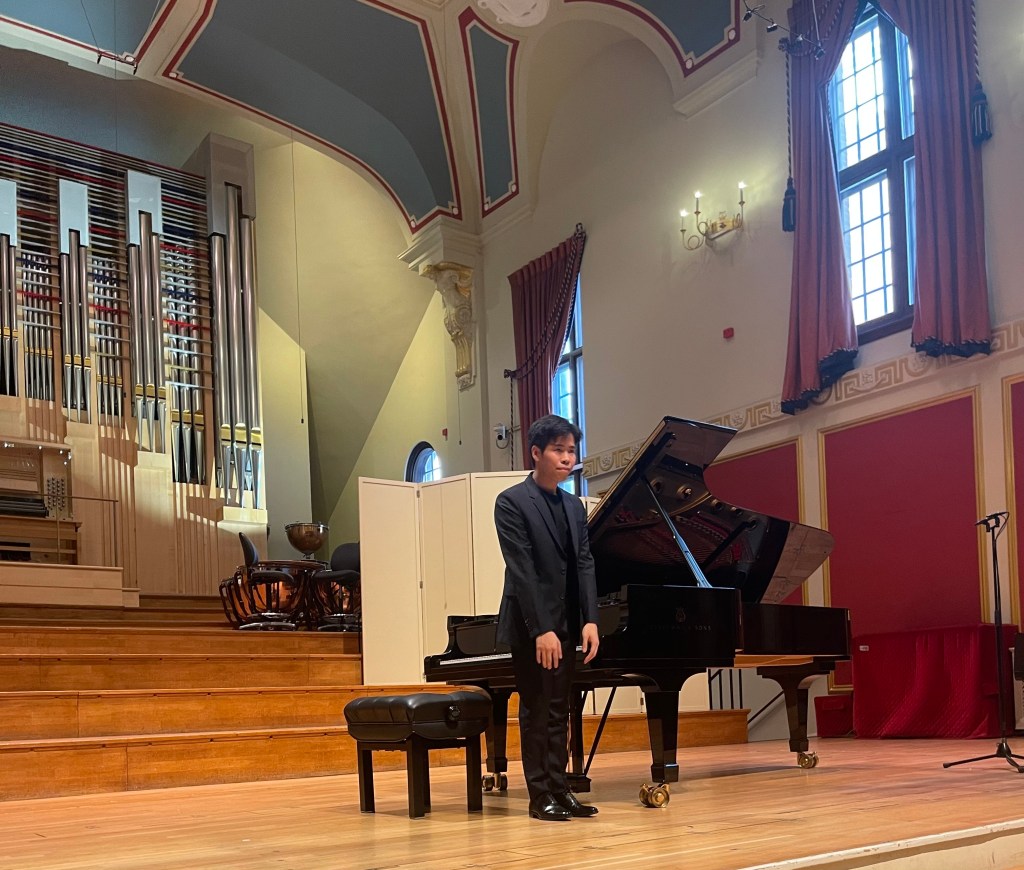
I have heard many graduation recitals in the past few days and am very impressed by what I have heard especially for the musicianship and respect for the composers intentions that has shone through even minor mishaps that could occasionally happen under the strain of condensing four years of intensive study into an hour long recital. Anyone who knows me or is silly enough to read my thoughts that I all to all too readily share with anyone wanting to know my personal reaction to what I have heard. I listen to each performance and it stands on its own. I do not do comparative performance preferring to leave the circus aspect of competitions to others. But if I had to say of all the wonderful performances that I have heard at the RCM and the RAM in the past days, which was the one that shone most brightly in my memory, it would have to be the performances by Anson Wong.
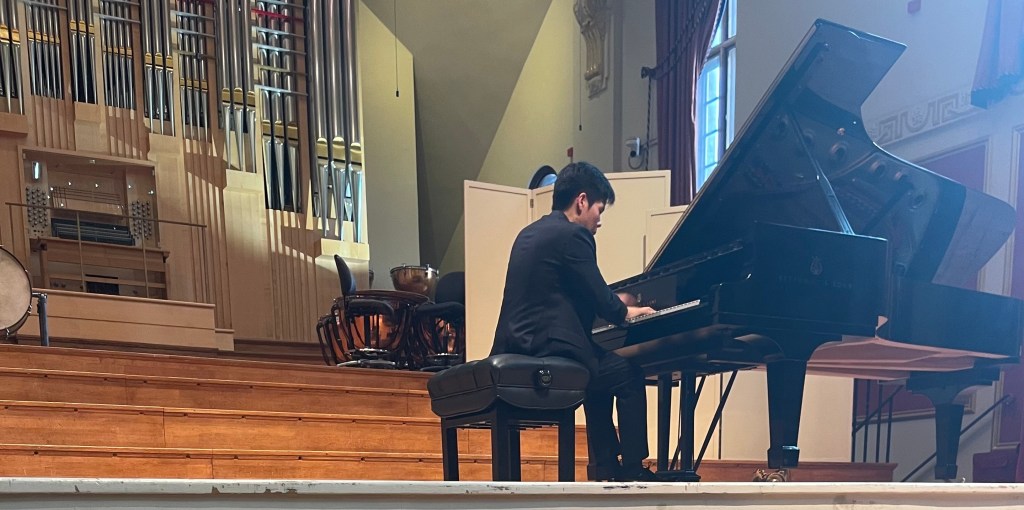
Everything he played sang with a radiance and beauty but above all a sense of balance that was of the magic of a past era. The transcription of the ‘Adagietto’ by Mahler was worthy of Cherkassy, with that golden sound of the melody and insinuating notes swirling above and below in a web of ravishing sounds. This was a transcription in the style of Godowsky and amazingly not only played with an extraordinary sensitivity and kaleidoscope of colour but was also written by Anson. A transcription worthy of becoming part of the standard repertoire for many pianists who are only too happy to delve into the archives and find dusty copies of Alkan,Chaminade,Blumenthal or Thalberg. Works that belong to an age when pianists were magicians who through a subtle use of the pedals and infinite gradations of touch could give the impression that a box of hammers and strings could sing as beautifully as any of the greatest bel canto singers of their day.
https://youtu.be/IHlz43QCliQ?feature=shared
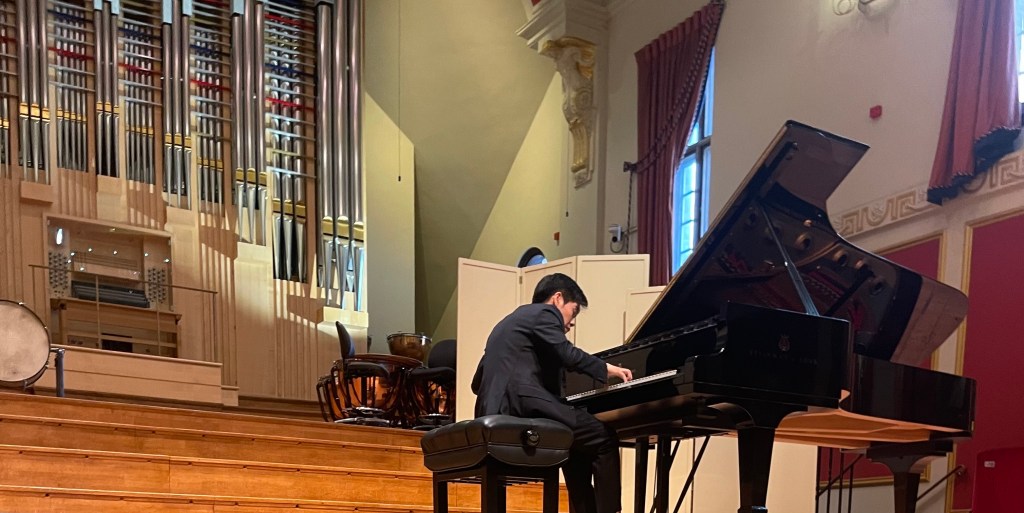
But it was not only the transcription that was of subtle beauty but also Beethoven’s op 101 Sonata and even more remarkably Prokofiev 8th Sonata ,so often played by the militia instead of a poet.
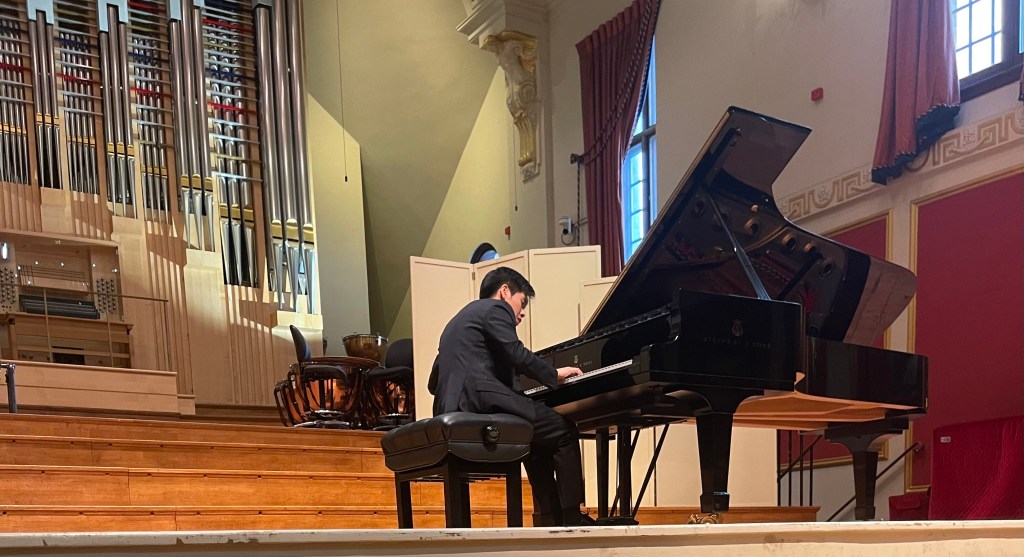
The opening movement of Beethoven was a great wave of sounds that had begun somewhere in the distance and just came into view only to disappear into the distance again. So similar to op 109 where the undulating sounds enter like the water in Visconti’s film ‘Death in Venice’ where a black screen begins to come alive as we are made aware of the water lapping in the lagoon of that city of dreams. Anson played it with a fluidity and no hard edges but a sense of architectural shape that had strength but always under the umbrella of genial creation. Technical mastery too, with the diabolical dotted rhythms of driving intensity. A slight respite with the trio but always with a cauldron ticking away under Anson’s feet .There was a simple aristocratic beauty to the slow movement that was allowed to flow with ornaments that were those of a singer not an instrumentalist. Even the cadenza unwound with poetic sensibility following Beethoven’s very sparing use of pedal, as the opening theme wafted in as if in a dream. A spell soon to be broken by Beethoven’s irascible temperament and quite extraordinary transcendental mastery. To maintain the rhythmic impetus with all the difficulties that Beethoven strews in the path, requires a mastery of musicianship and technical perfection that is of the very few. The fugato last movement, although not quite as complex as the sonata that follows, is certainly a great preparation where only those with a transcendental command of the keyboard can do justice to Beethoven’s knotty twine. Anson proved himself to be a master, as the tension never sagged or had to be accommodated. Even the imperious interruptions were far more arresting because the tension within the silences became fundamental to Beethoven’s irascible impatience.

Prokofiev’s 8th Sonata ,although the last of his trilogy of ‘War’ sonatas, is the one where peace and reconciliation reign after the stormy volcanic eruptions from the very start of the sixth and seventh. Too often hammered out by pianists more interested in the technical genius of Prokofiev than the poetry that lies within . The opening is every bit as poetic as Beethoven’s op 101 and was played by this young man with a deeply felt improvisatory sense of discovery. Of course there were explosions too and the extraordinary sweep across the keyboard before the recapitulation was overwhelming and alarming but never ugly. Massive full sounds but never that metallic sound that so often passes for ‘echt’ Prokofiev. This was one of the sonatas written for two of the greatest poets of the keyboard : Gilels and Richter who showed us that frenzy and diabolical abandon were those of poets not the militia.The second movement was indeed a dream as the melodic line unfolded with dance like simplicity and an extraordinary sense of balance that could show us so clearly the musical line that too often can be confused. The last movement was a whirlwind with a kaleidoscope of sounds and changing character. An astonishing ‘tour de force’ of resilience and stamina even the final notes saying ‘he is dead but will not lie down!’ The genius of Prokofiev in this young man’s hands shone through with a mastery and poetic beauty that was quite extraordinary. I see that in the Dublin competition, where he was a top prizewinner last week, he had played Prokofiev’s second concerto – one of the most transcendentally difficult in the repertoire , but like this sonata there is a poetic fantasy, too often neglected by lesser pianists only concerned with flexing their muscles instead of revealing their soul as this young man certainly did today.

#dublín #dublininternationalpianocompetition #piano #ireland #competition #music

Anson Wong was born in Hong Kong, his music journey starts at the age of four. He graduated from Diocesan Boys’ School and had been a junior student at the Hong Kong Academy for Performing Arts (HKAPA) since nine, majoring in piano, bassoon and composition. He is now a bachelor degree piano student at the HKAPA, studying with Prof. Gabriel Kwok. He has won numerous prizes in the annual Hong Kong School Music Festivals, Silver prize of 17th Chopin International Piano Competition in Tokyo, the Gold Prize Award and two additional special jury prizes in the Ishikawa International Piano Competition held in Kanazawa, Japan. He was invited to perform in the 6th Shenzhen Piano Music Festival in 2018, alongside other awarded students from Beijing, Shanghai, Macau, Taiwan and Shenzhen. He had also participated in masterclasses by Professors Robert Levin, Gottlieb Wallisch, Arnulf von Arnim and Andreas Frölich in the Salzburg Mozarteum International Summer Academy. Apart from being an able pianist, he is also an accomplished composer. He has studied composition at the Hong Kong Academy for Performing Arts since 2013 with Ms. Poly Ng. In 2017, he won the first prize of the 69th Hong Kong School Music Festival Open class Composition Category with the piece ‘The 5 Elements’. In 2018, he was awarded the Gold standard composition winner in the notation category of the TI:ME Electronic Music Composition Contest in the United States with his composition ‘D’Urban’. He had also presented his original compositions ‘Galaxy’ and ‘Pearl of Orient’ at the 2012 and 2013 Yamaha Asia Pacific Junior Original Concert respectively held in Malaysia and Hong Kong, each with favourable reviews. His abilities in composition is also showcased in his participation in the 2010, 2014 and 2016 Yamaha Asia Pacific Electone Festival held in Taiwan, Malaysia and Macau respectively, in which he composed and performed his compositions himself. In the 2016 season, he was awarded the Grand Prix of the Senior Section, championing in improvisation, performance and composition. He is completing his studies at the Royal Academy of Music with Christopher Elton and this is his final exam performance for his Masters of Music – Piano performance M.Mus.

 ChristopherAxworthy-MusicCommentary