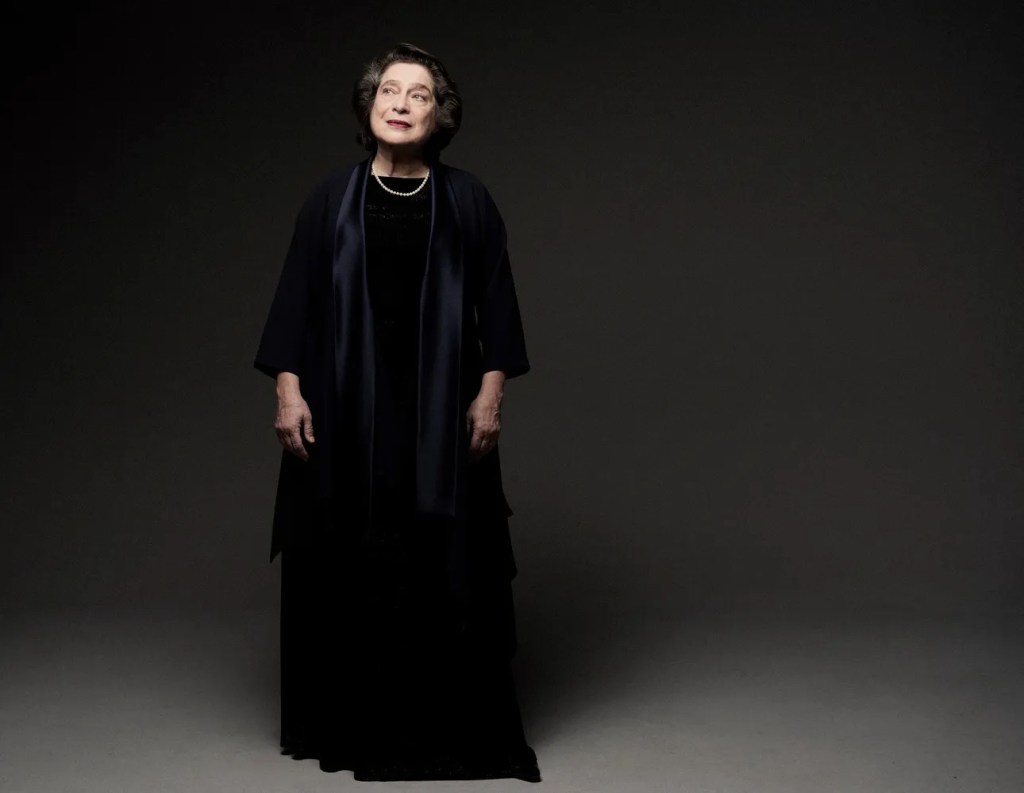


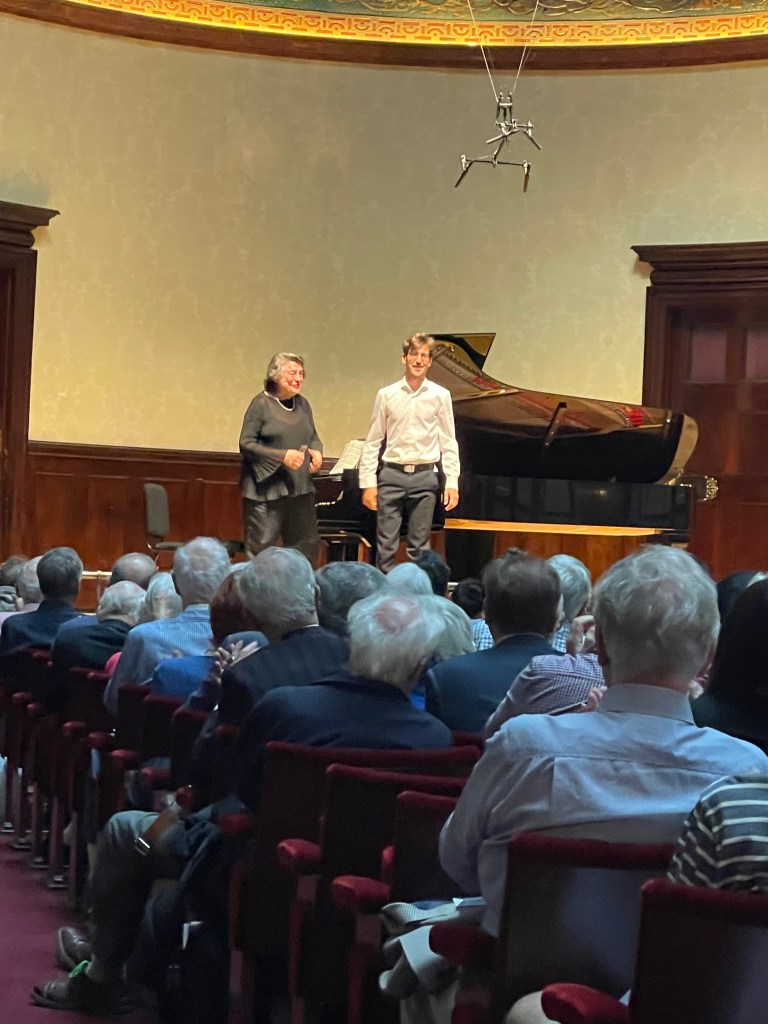
La Leonskaja, the last of the four great dames of the piano, sharing the platform with a young musician in a display of humility, generosity and above all the enjoyment of making music together.
And what music!

Seven of Brahms Hungarian dances played with a young prodigy from the Liszt Academy in Budapest and the Royal Academy in London.
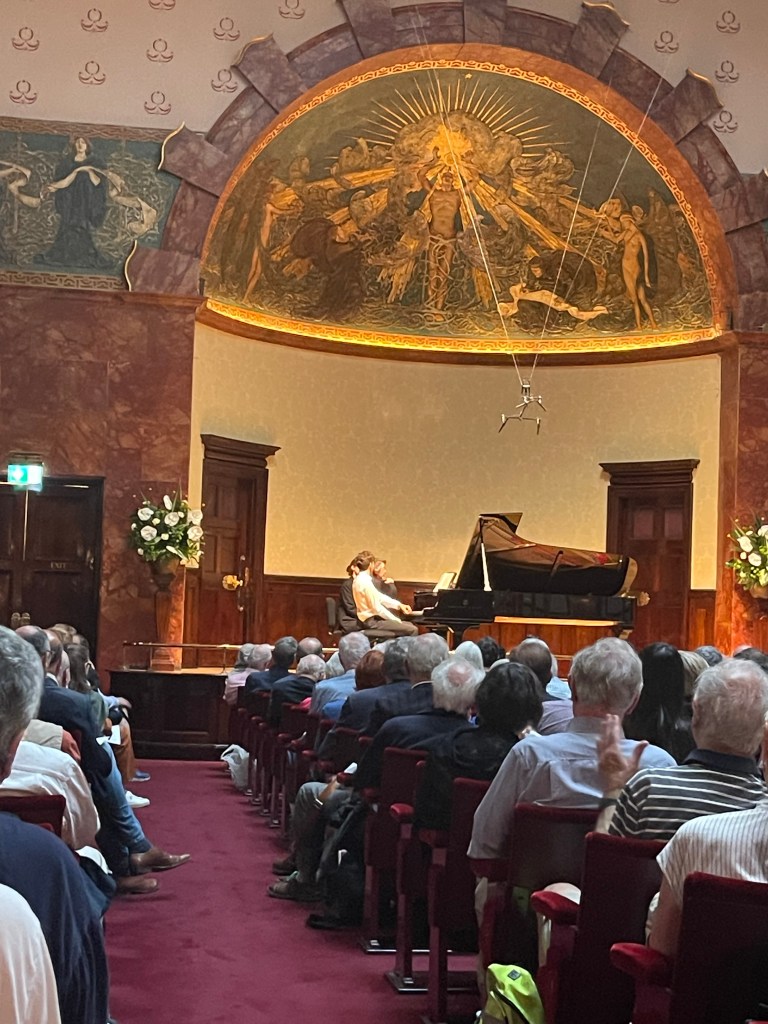
Madame Leonskaja taking back seat from where she could control and direct the refined musicianship of her youthful partner.
It is this humility and generosity that marks out the truly great artists.
Martha Argerich and Maria João Pires help young musicians too by sharing their platform with them .
I remember thanking La Pires when she played the Mozart double concerto in Oxford with Julian Brocal, a young musician who I had noted at the Monza Competition. ‘But it is not what I do for them, it is what they give to me.!’ I know that Madame Leonskaja played in the south of France, too, in a series of concerts dedicated to teacher and pupil . On that occasion she shared the piano with Evelyne Berezovsky .
Youthful energy, enthusiasm and technical mastery are part of the baggage of youth. Artistry, dedication and hard work are part of the baggage of the mature, truly great artists of our day.
Nikolaeva ,Virsaladze ,Yablonskaya and Leonskaja, four great ladies and master musicians and who are ( or were, as alas Nikolaeva died on stage in San Francisco some years ago ) blessed with an early discipline which is that of the true kapellmeister, where music has been planted from an early age into their very being. A technical mastery where the fingers have been moulded into the keys as they have grown, with a limpet- like rubbery flexibility that can dig deep into the keys without any hardness. A musicianship that can allow them to transpose or improvise as Mozart, Bach or Beethoven would have been expected to do.
I remember Kempff walking into the recording studio asking which pieces from his vast classical repertoire would they like him to play. Ilona Kabos told her students that your repertoire is what you can produce flawlessly at a moments notice, as her husband Louis Kentner would often demonstrate.
So Leonskaja is in the back seat, but I have never heard of backseat driving like this !
Britten tried with Richter but just got his feet trodden on. Leonskaja, who was also a duo partner of Richter, was listening carefully to her gifted young colleague never overpowering but sustaining his music making. Adding an occasional injection of energy and a depth of sound where, as all great musicians know, music is created with roots firmly planted in the ground.
Thinking upwards from the bass but always playing horizontally.
What a lesson!
Some extraordinary counterpoints underlined with refined exhilaration and some final chords with that unmistakable rich full sound in the bass that we were to hear in the solo Schubert that was to follow in the second half of the programme.
The D minor dance played with a great sense of freedom with Leonskaja directing from the bass with the unmistakable sound that only she seems to find, and a real injection of power at the end.The F minor was unusually slow and luxuriant with a very flexible beat.There was a teasing rubato in the D flat dance and a hesitancy to the A major contrasting with the sumptuous outpouring of the one in A minor. There was a yearning intensity of the D minor and finishing with the languid opening of the F sharp minor that was transformed into a joyous dance. There were dynamic left hand interruptions from Leonskaja and the ravishing charm they brought to the central episode. Mihály dashed into the hall after his performance to listen to the oracle speak.
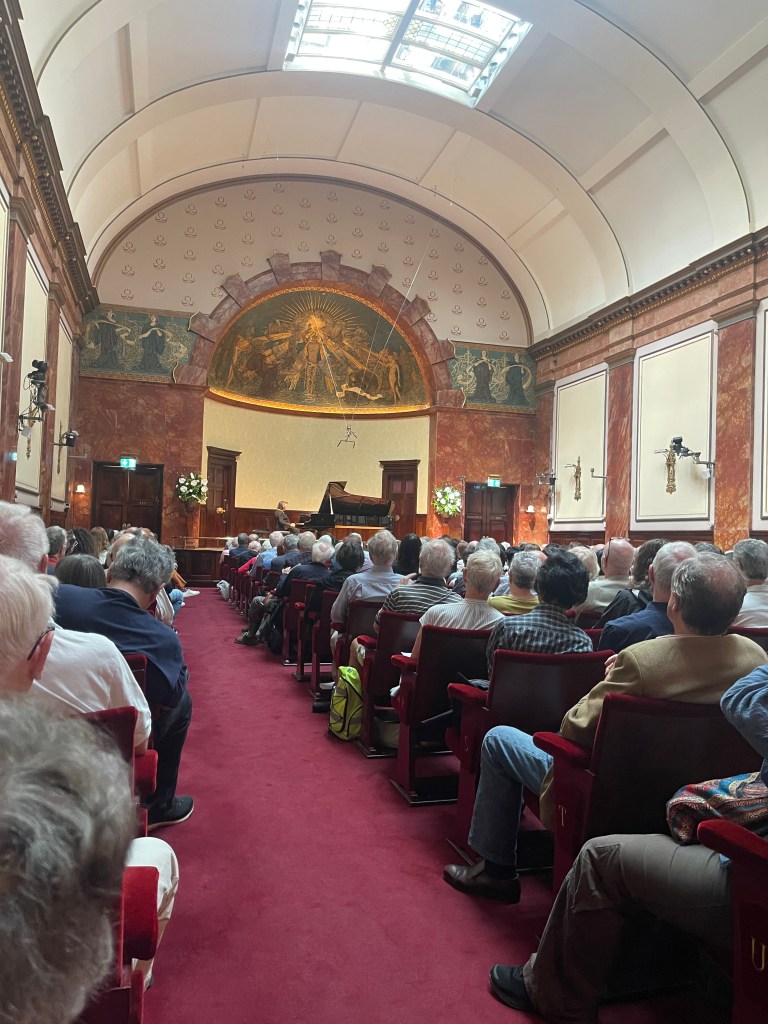
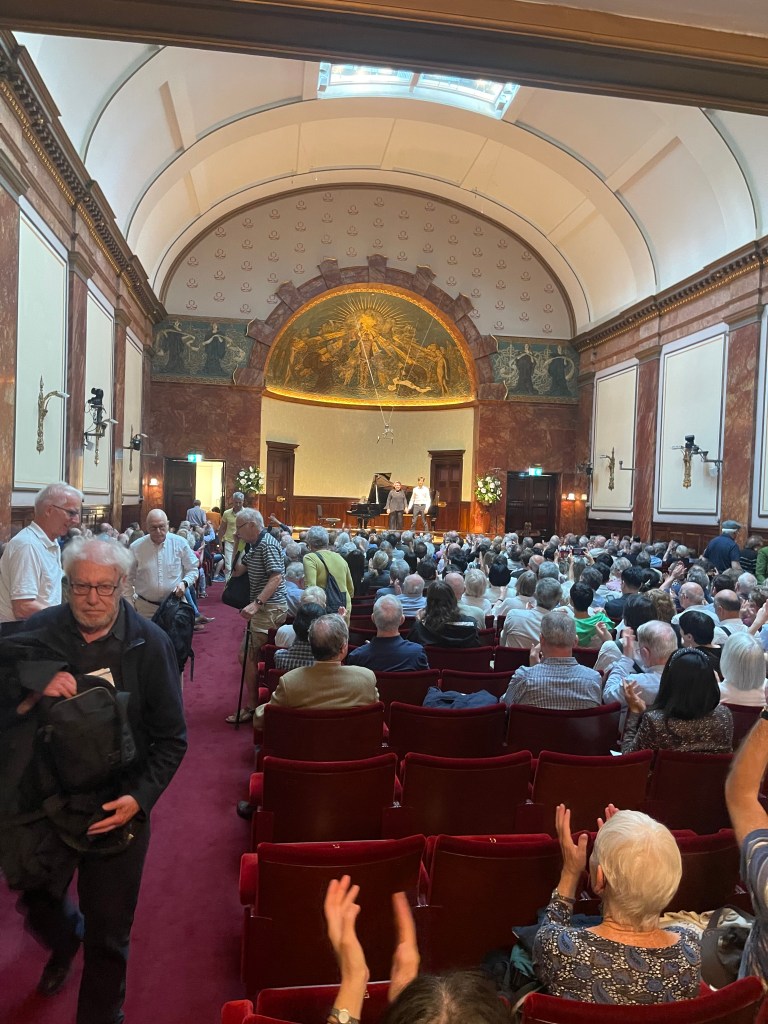
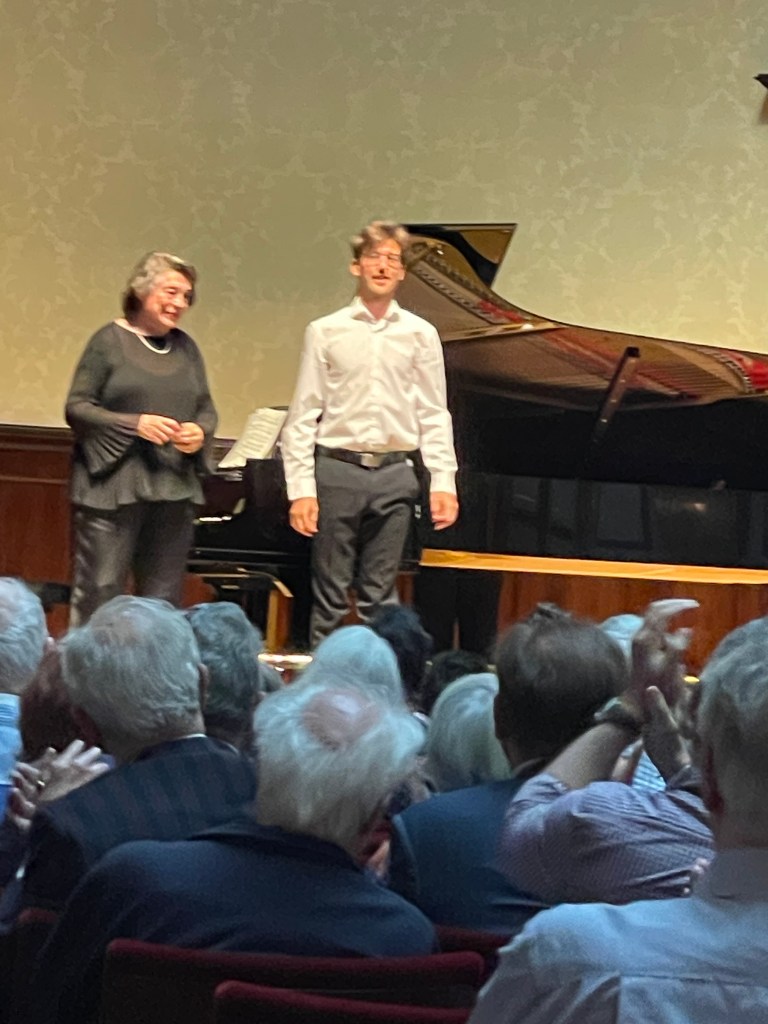
Leonskaja’s playing of Schubert is a marvel of simple musicianship allowing the music to unfold naturally without any personal interruptions. But every so often she would take Schubert into the world of Beethoven with passionate outbursts of almost orchestral proportions. Taking us by surprise even with the opening octave of the first impromptu that after the shock, she allowed the vibrations to die down as a plaintive voice could be heard in the distance emerging with purity and simplicity. An extraordinary jeux perlé and delicate brilliance in the second ,leading to the central episode that was more restrained that usually heard, being melodic rather than militaristic.There was a chiselled beauty of aristocratic poise to the G flat impromptu played with the same weight that I remember hearing in this hall from Perlemuter and Tagliaferro many years ago. It is the weight of inevitability and simplicity that there could be no other way in that moment. The delicacy of the fourth impromptu was more of a dance than the usual digital delight of well oiled fingers. Greeted with sincere thanksgiving by a full hall Madame Leonskaja returned with a book in her hand and beckoned her young partner to join her in celebrating in music their success and joy at making music together.
Winner of the Liszt-Bartók Prize at the 15th Concours Géza Anda 2021 Mihály Berecz was born in Budapest in 1997 and began to learn the violin at the age of six. Later, in parallel with his work in various orchestras, he began to devote himself to the piano with Edit Major and Erzsébet Belák.
He obtained his First Class Honours Bachelor of Music degree at the Royal Academy of Music in London with Christopher Elton, however. Winner of the Debut Berlin International Concerto Competition, Mihály performed for the first time at the Berlin “Philharmonie” in June 2017.
Previous awards include the Golden Prize of the 2nd Manhattan International Music Competition and the Harriet Cohen Bach Prize of the Royal Academy of Music. At the 2013 Young Euro Classic Festival he performed Liszt’s “Hungarian Fantasy” at the Konzerthaus Berlin. Also in 2013, and upon the invitation of Zoltán Kocsis, he made his debut at the Béla Bartók National Concert Hall, Budapest.
At the Liszt Academy, where he frequently performs, he recently played Mozart’s “Jenamy” concerto under the baton of Mikhail Pletnev. Mihály’s interest in historical interpretation has led to performances of fortepiano concertos with renowned orchestras playing on period instruments, such as the Orfeo Orchestra. Between 2020 and 2022, as part of a scholarship from the Hungarian Academy of Arts, he performed Béla Bartók’s complete solo works of in eight concerts at the Hungarian Radio’s Marble Hall.
Mihály Berecz has won first place at the 2023 Kissingen Piano Olympics (Kissinger Klavier Olymp).

Elisabeth Leonskaja (born 23 November 1945) is a Georgia-born naturalized Austrian pianist. She made an international career after she won the Enesco International Piano Competition in Bucharest in 1964, and has lived in Vienna since 1978.
Leonskaja was born on 23 November 1945 to a family of Jewish and Polish origin living in Tbilisi then the capital of the Georgian Soviet Socialist Republic.
When Leonskaja was six and a half, her parents were able to buy her first upright piano. At 7, she passed the entrance exam of one of Tbilisi’s sixty music schools. At 11, she gave her orchestral debut with Beethoven’s Piano Concerto in C major, at 13 her first solo recital. At 14, she began an intense four-year period of study in secondary school with a new piano teacher from Kyiv. In 1964, Elisabeth Leonskaja won the Enesco International Piano Competition in Bucharest. The judges included the composer and conductor Aram Khachaturian and the pianist Arthur Rubinstein.
In 1964, Leonskaja began studies in the Moscow Conservatory. During her conservatory years she won prizes in the Long-Thibaud- Crespin Competition in Paris and the Queen Elisabeth Music Competition in Brussels.
Leonskaja left the Soviet Union in 1978 and has since then resided in Vienna. A notable recording of hers is of Edvard Grieg’s arrangement for two pianos of Mozart’s piano sonatas K.545 and K.533/494, accompanied by Sviatoslav Richter , with whom she built a close friendship and collaboration. She recorded many years for Teldec, now for German label MDG, and presently for several different labels including Warner, who have also re-released a number of recordings. She also gives many masterclasses.

Leonskaja was married for a short time to the violinist Oleg Kagan.
 ChristopherAxworthy-MusicCommentary