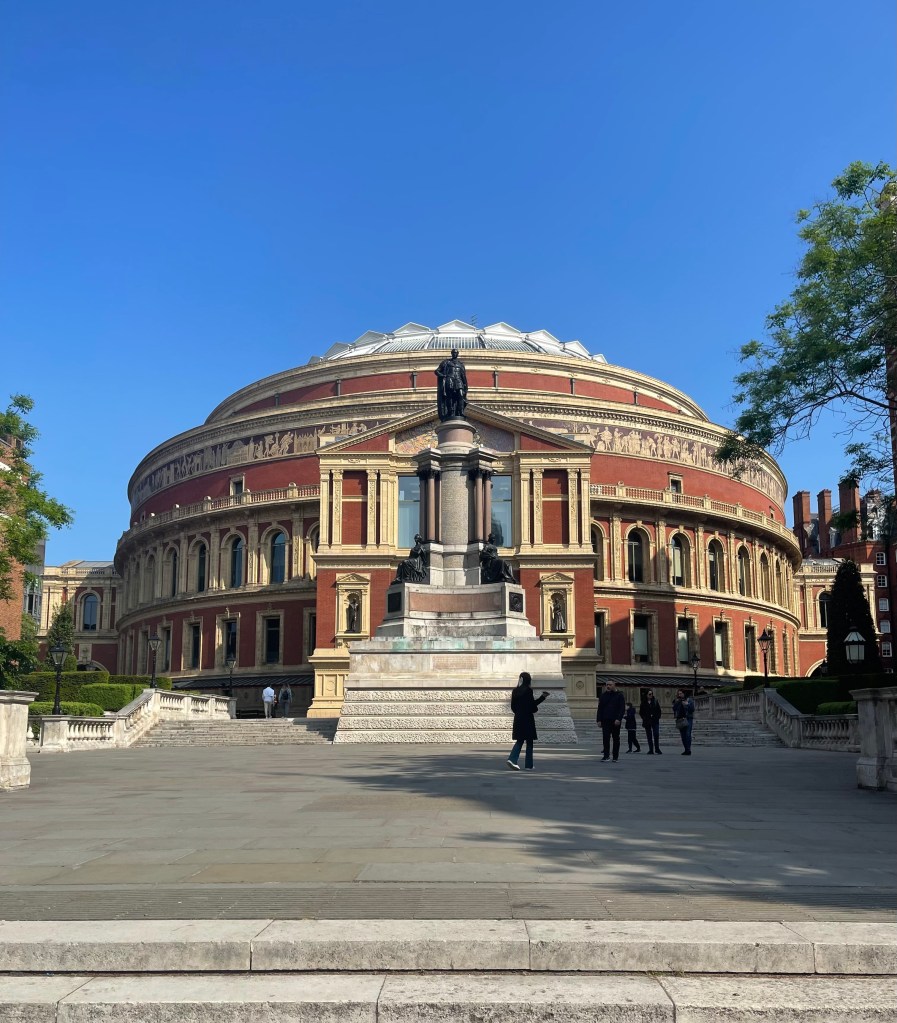
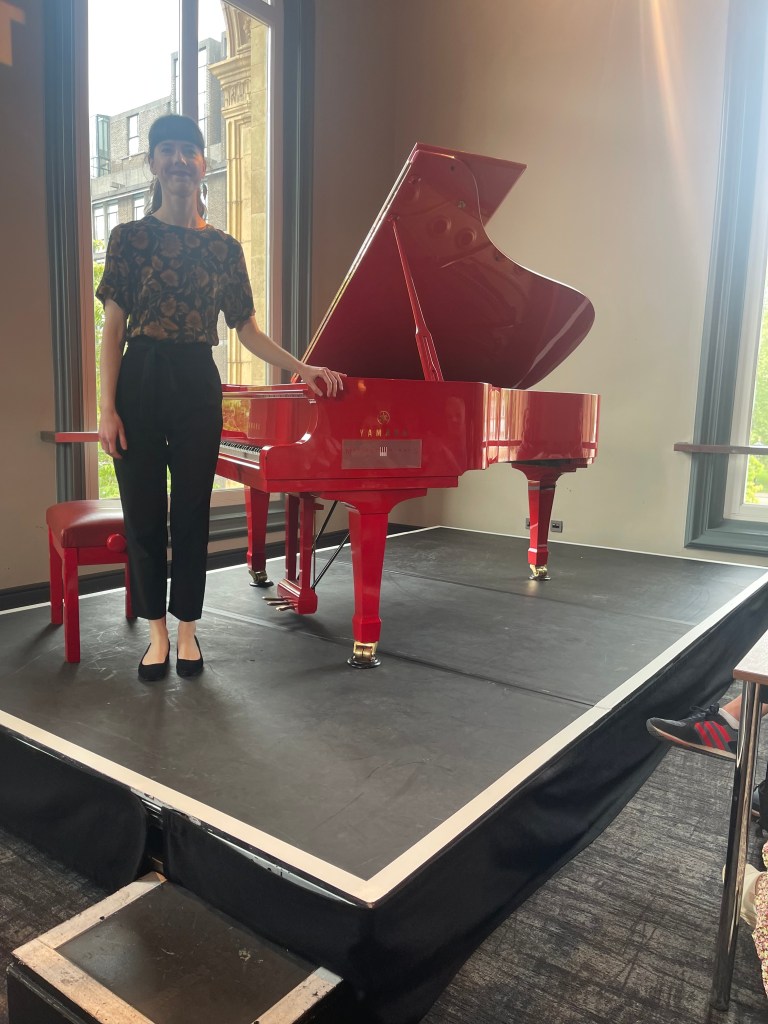
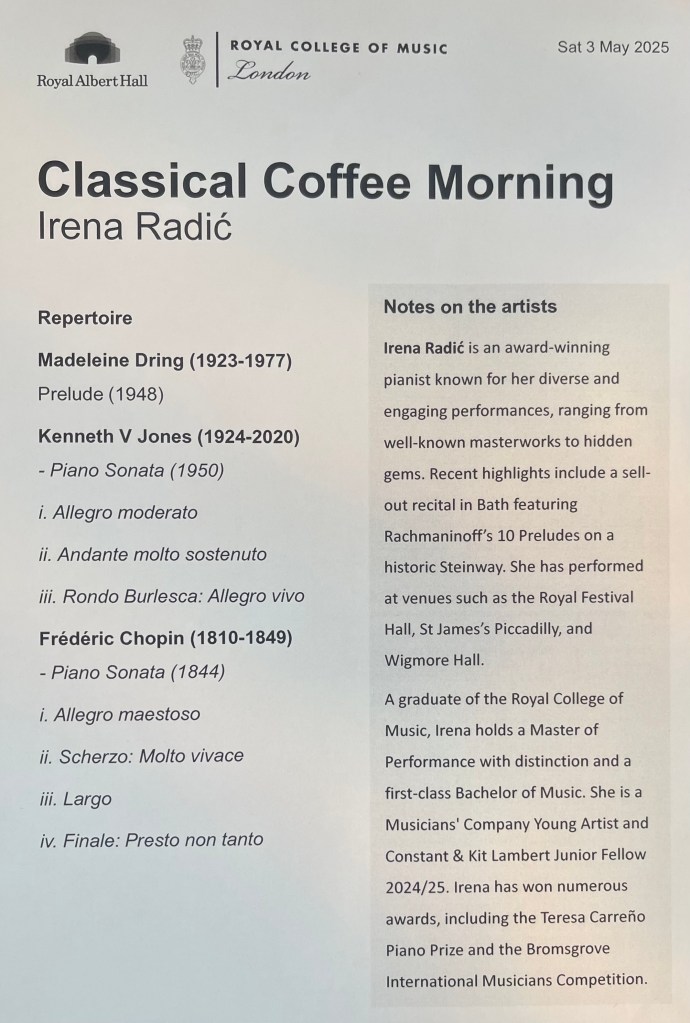
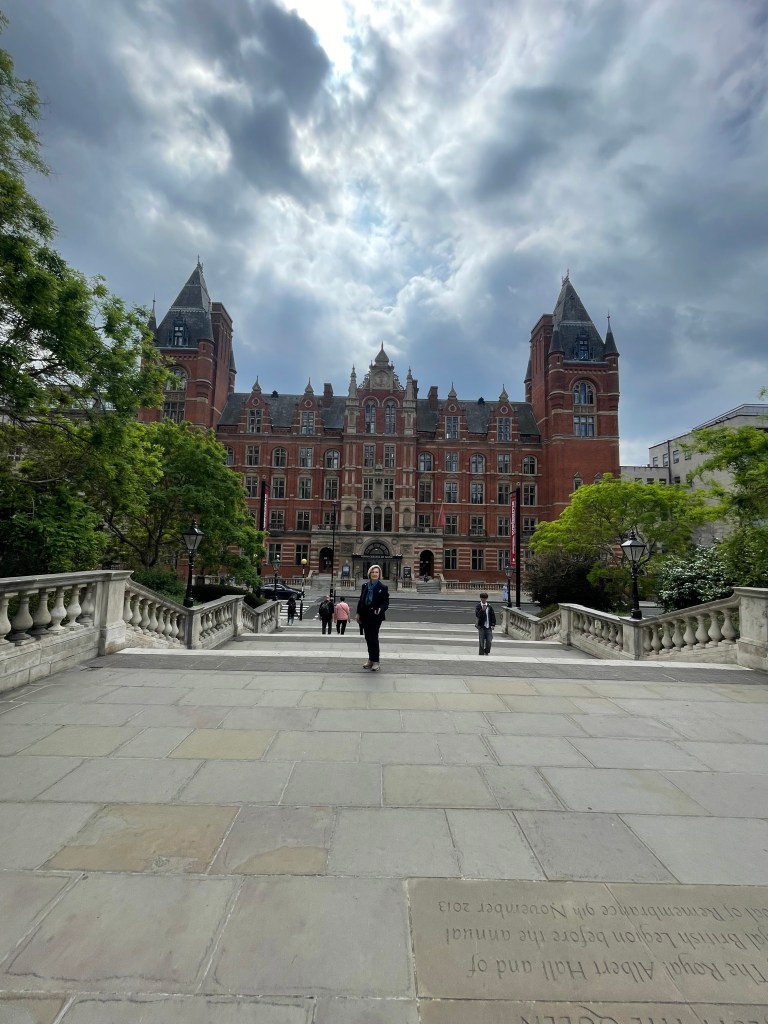
Some very interesting music making from the British Croatian pianist Irena Radić at the Royal Albert Hall . A classical coffee morning given by musicians from their next door neighbours of the Royal College of Music .
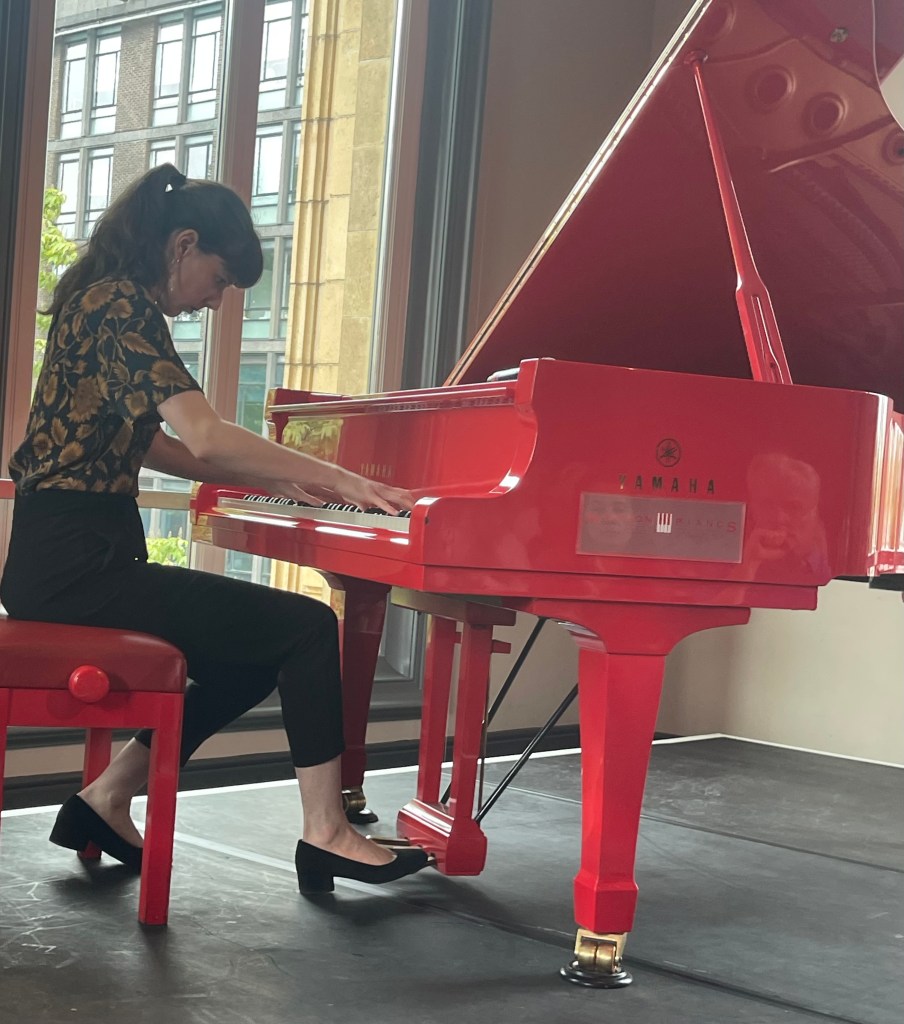
Irena playing a work by her great uncle that she found in the archives of the RCM and had learnt especially. Kenneth Jones’s very spiky sonata of 1950 Irena played with great authority and rhythmic drive .The knotty fugato of the Rondo Burlesca was unravelled with clarity and a forward insistence
The Prelude of 1948 by another ex RCM student ,Madeleine Dring owed more to Rachmaninov than Herbert Howells or Ralph Vaughan Williams with whom she had studied. A Reichian insistence of almost improvised repetition revealed a palette of sounds of clarity and beauty.
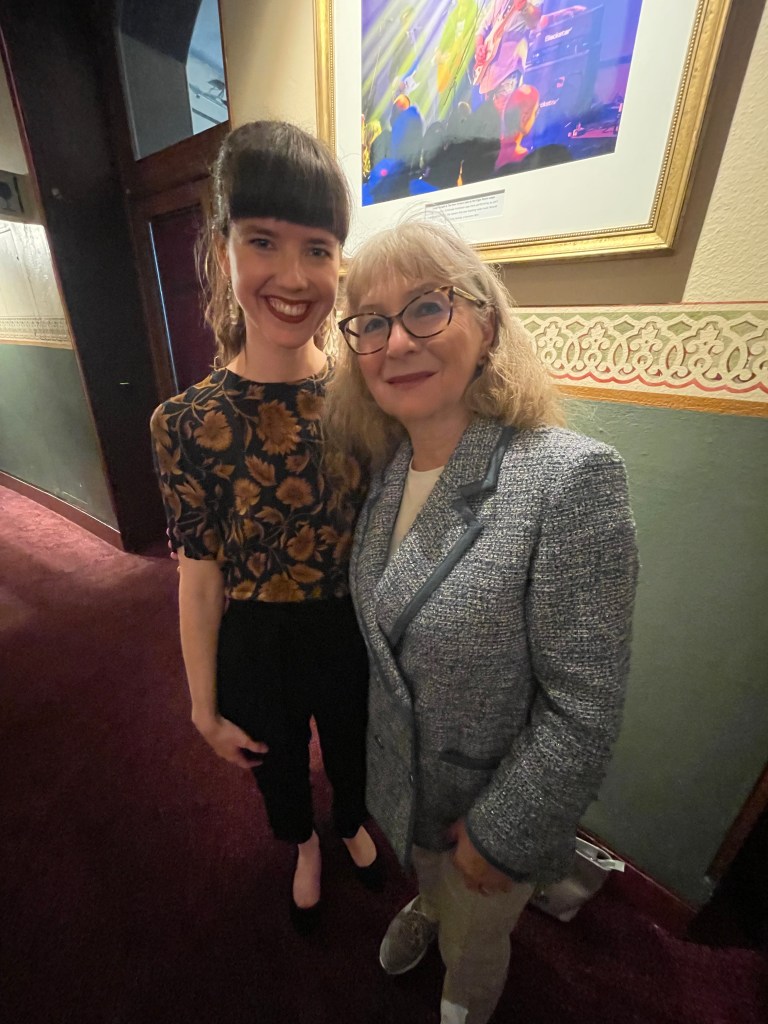
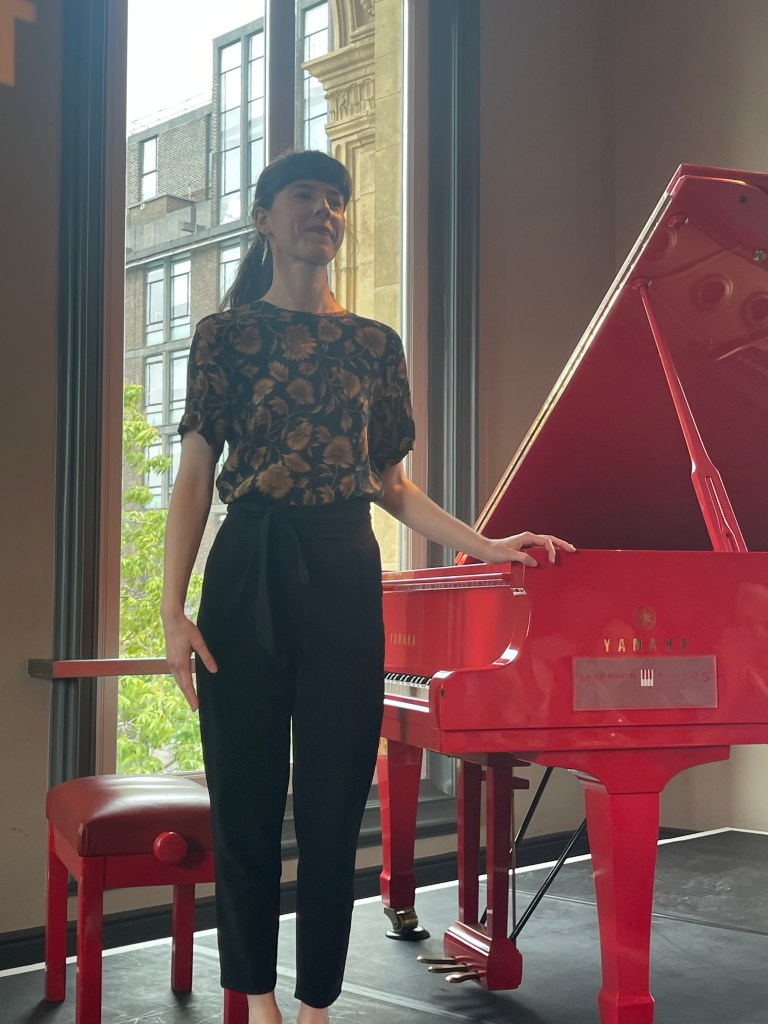
Chopin’s B minor Sonata op 58 was played with grandeur end eloquence. Solid,musicianly playing as you might expect from the class of Dina Parakhina with the repeat in the first movement unusually respected, and the second subject ringing out with noble radiance. A Scherzo that just flew from her fingers, but it was the Trio where she found a sense of line as the music was kept continually flowing. The Largo opened with imperious authority and was an introduction to cantabile playing of beauty and robust sound that was played with great sentiment but never sentimental. The flowing middle episode was shaped with musical authority where Irena gave the musical line great strength and direction. She also found poignant beauty and subtle colouring with the return of the opening melody. The finale : Presto non tanto was played with musicianly control as she added more weight to the Rondò each time it returned, until the final explosion of exhilaration and transcendental excitement brought this very enjoyable recital to a brilliant conclusion.
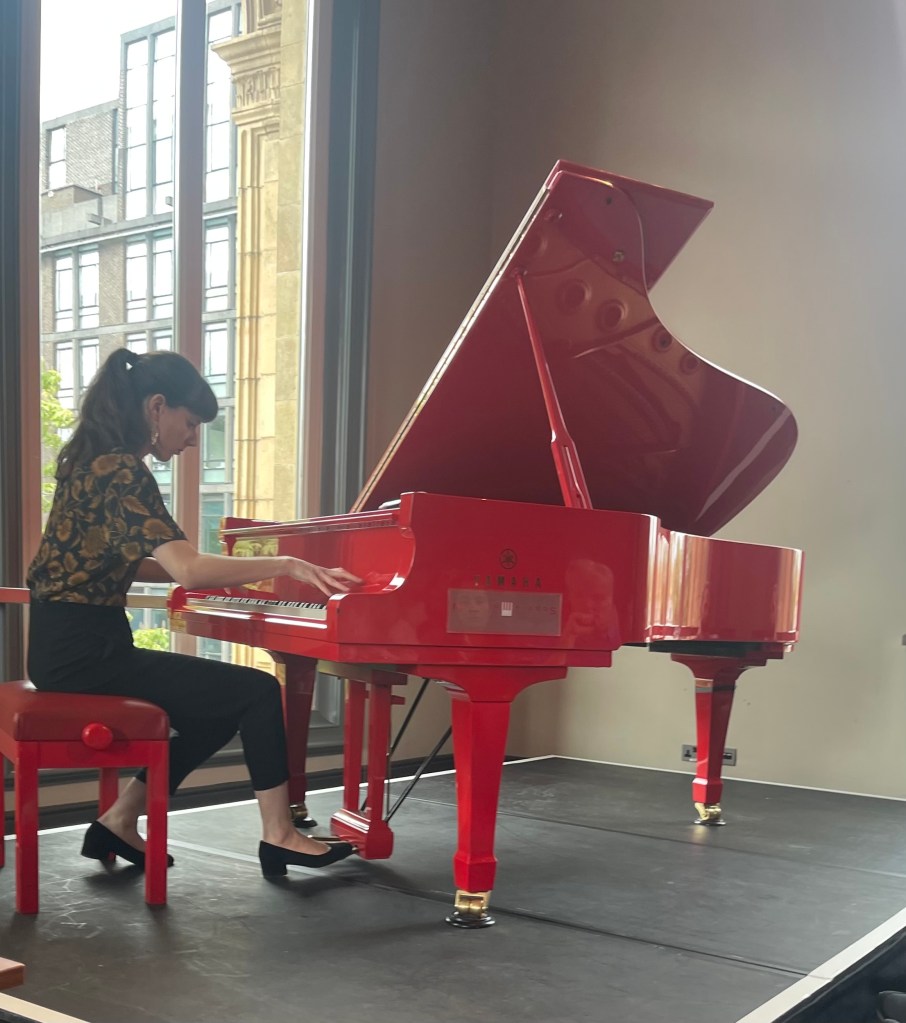
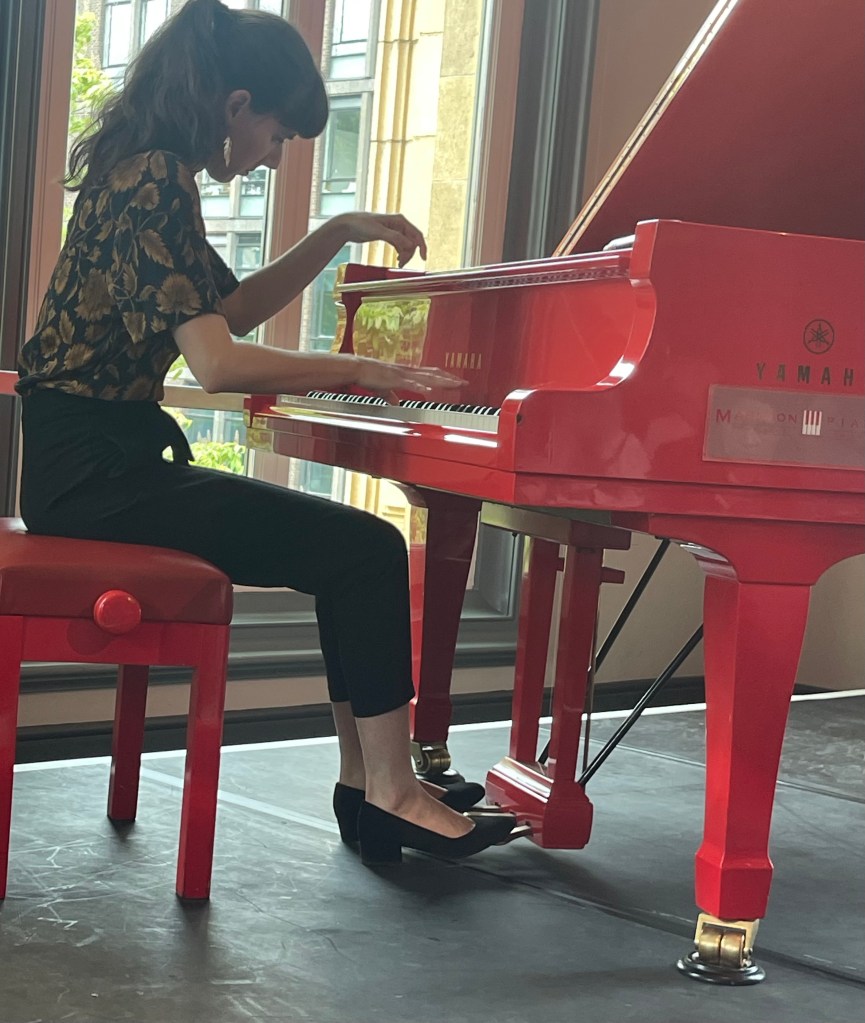
Irena Radić is an award-winning pianist known for her diverse and engaging performances, ranging from well-known masterworks to hidden gems. Recent highlights include a sell-out recital in Bath featuring Rachmaninoff’s 10 Preludes on a historic Steinway. She has performed at venues such as the Royal Festival Hall, St James’s Piccadilly, and Wigmore Hall, with upcoming performances of piano sonatas by Chopin and Kenneth V Jones. As a founding member of Duo Ravellion, Irena collaborates with Swedish guitarist Jonatan Bougt, and she has also worked with various musicians across a wide range of chamber music projects.

A graduate of the Royal College of Music, Irena holds a Master of Performance with distinction and a first-class Bachelor of Music. She is a Musicians’ Company Young Artist and Constant & Kit Lambert Junior Fellow 2024/25. Irena has won numerous awards, including the Teresa Carreño Piano Prize and the Bromsgrove International Musicians Competition. In addition to her concert career, she is a passionate teacher, drawing from her Suzuki method training, and is a Visiting Music Teacher at St Catherine’s School. Irena also has extensive experience in orchestral piano and celeste, performing with prominent conductors such as Vladimir Ashkenazy and Bernard Haitink.
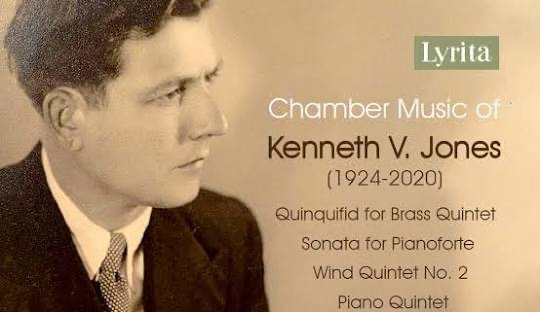
Kenneth Victor Jones FRCM (14 May 1924 – 2 December 2020) was a British composer of film scores and concert works, and a conductor
After the war he enrolled at the Royal College of Music (1947-50), where his teachers included R.O.Morris ,Bernard Stevens and Gordon Jacob . He became a professor at the RCM in 1958.
Jones was appointed as conductor to the London Metropolis Symphony Orchestra in 1957, and was the founder and original conductor of The Wimbledon Symphony Orchestra in 1961, where he stayed for ten years. He made his Royal Festival Hall conducting debut that year. He was also principal conductor at the Sinfonia of London (from 1966), the Hill Singers (1954-60), and the Reigate and Redhill Choral Society (1956-1964).
Jones married a teacher, Anne Marie Heine, in 1945 and there were two children, Frances (born 1949) and Anthony (born 1953). In 1966 he acted as one of the Governors of Rokeby School, helping to raise the £50,000 that was needed to save it from closure in 1966. In the late 1960s their address was 121, Church Road in Wimbledon. By the early 1970s the family had moved away from London and settled in Bishopstone, East Sussex. His wife died in 2009. He died in December 2020 at the age of 96, survived by his daughter and son.
Jones composed many film scores (mostly at Shepperton and Ealing studios and for British Transport Films). Among his best known scores are How to Murder a Rich Uncle (1957), Oscar Wilde (1961) and The Projected Man (1966). He also composed incidental music for television and theatre and many concert works, including four sonatas, 44 piano works and six song cycles.Lyrita released recordings of some of his chamber music for the first time in 2024.
His concert compositions include :
Hesperides, song cycle Piano Sonata, Op.4 (1950) String Quartet No.1, Op.6 (1950) Wind Quintet No.2, Op.2 (1952) Concerto for string orchestra (1956) Concerto for oboe and strings (1963) The Pollock,) orchestral prelude (1963 O Light Invisible, cantata for soloists, chorus and orchestra (1963) Sequences, chamber ensemble (1964) Concert Overture (rev. 1966) Quintet for piano and string quartet, Op.26 (1967) Violin Sonata (1967) Two Contrasts for solo cello (1971) Dialysis, for violin and harpsichord (1973) A Gay Psaltery, harpsichord (1975) Quaquaverse, for saxophone quartet (1979) Quinquifid for brass quintet (1980) Paean for organ (1983) Organ Sonata (1985) Three Sinfonias for orchestra Symphony Violin Concerto song cycles church music
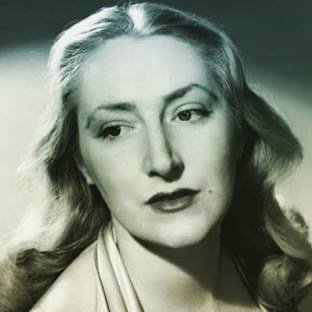
Madeleine Winefride Isabelle Dring (7 September 1923 – 26 March 1977) was an English composer,pianist,singer and actress. Showing talent at an early age and was accepted into the junior department of the Royal College of Music where she began on her tenth birthday. She was offered scholarships for violin and piano and chose violin. She studied piano as a secondary instrument, with RCM students guiding her studies for the first several years.She continued at the Royal College for senior-level studies where her composition teacher was Herbert Howells . She had occasional lessons with Ralph Vaughan Williams (an official substitute for Howells). She dropped the violin study after the death of her instructor, W.H.Reed, at the end of the first year. She focused on piano and composition and studied mime, drama and singing. Dring’s love of theatre and music co-mingled; many of her earliest professional creations were for the stage, radio , and television .
In 1947, she married Roger Lord who was Principal Oboist with London Symphony Orchestra for over thirty years. She composed several works for Roger, including Dances for solo oboe. Soon after her marriage, her first pieces were published with Lengnick and with Oxford (1948). The Lords had one son in 1950.Dring’s favourite composer in her youth was Rachmaninov and she owned much piano and vocal sheet music by Rachmaninov, which is now in the possession of Ro Hancock-Child. Dring studied with Herbert Howells but her own work shows no debt to his musical style. Occasionally she was taught by Ralph Vaughan Williams but again there is little obvious influence, and her music does not reflect the English folk song tradition, although she studied this genre as a singer. She sometimes set a text she had encountered in a solo or choral work, leaving her mark on it. She looked further afield.
In 2018 three volumes of songs were engraved and published as well as four volumes of cabaret and musical revue numbers. Duets and ensembles were also published.
Instrumental
- Italian Dance (1960) Oboe and Piano
- Fantasy Sonata in one Movement (1938, published 1948), solo piano
- Three Fantastic Variations on Lilliburlero for Two Pianos (1948), two pianos
- Jig (1948), piano
- Prelude and Toccata (1948), piano
- Tarantelle (1948), piano duet
- Festival Scherzo: Nights in the Garden of Battersea (1951), piano and string orchestra;
- Sonata for two pianos (1951)
- March: for the New Year (1954), piano
- Caribbean Dance (Tempo Tobago) (1959), piano duet or solo
- Dance Suite (1961), piano
- Polka (1962), oboe and piano
- Colour Suite (1963), piano
- Danza Gaya (1965), two pianos or oboe and piano (original score housed at Royal College of Music, London)
- Three Dances (1968; Josef Weinberger), piano
- Trio for Flute, Oboe, and Piano (1968)
- Valse française (1980), solo or duo piano * (original scores housed at Royal College of Music, London)
- Three Pieces: WIB Waltz, Sarabande, Tango (1983), flute and piano*
- Waltz (1983), oboe and piano*
- Suite (1984), harmonica and piano (later arranged by Roger Lord for oboe)*
- Trio for oboe, bassoon, and harpsichord (1986)* (original score housed at Royal College of Music, London)
- Idyll for oboe (viola) and piano (The composer’s husband Roger Lord, disappointed that the piece remained unplayed and unpublished for many years, perhaps because of its chromaticism , decided to transcribe the solo part for oboe, his own instrument, to which it is well suited. Idyll was first recorded in 2007 by Thierry Cammaert , oboist of the Quartz Ensemble, a Belgian winds ensemble. The ensemble has also performed the work as a trio for flute, oboe and piano.)
Vocal
- Three Shakespeare Songs (original score housed at Royal College of Music, London), (1949) (Published by Legnick 1949, republished with 4 additional Shakespeare songs, Thames 1992, published as Dring Volume 1)* First performance 10 May 1944 with Ifor Evans, Baritone, Madeleine Dring, Accompanist, performed at the RCM
- Thank you, Lord (1953), vocal, text L. Kyme (not published as composed – Dring did not approve of this edition)
- An additional four songs with texts by L. Kyme were written in 1953. They have now been published.
- The Pigtail (1963) vocal duet, text A. von Chamisso.
- Dedications: Five poems by R. Herrick (1967), vocal suite (published 1992 by Thames as Dring Volume 2)* (original score housed at Royal College of Music, London)
- Love and time: Four Songs (1970s) (published in 1994 by Thames as Dring Volume 5)*
- Four Night Songs: texts of Michael Armstrong (1976), (published 1985 Cambria (US) 1992 Thames as Dring Volume 3)*
- Five Betjeman Songs (1976) (published in 1980 by Weinberger)* (original score housed at Royal College of Music, London)
- Seven Songs for Medium Voice (various compositional dates, compiled and published by Thames in 1993 as Dring Volume 4)*
- Six Songs for High Voice (various compositional dates, compiled and published by Thames in 1999 as Dring Volume 6)* Includes: My true-love hath my heart, Echoes, The Cherry Blooming, The Parting, The Enchantment, Love is a Sickness
- Previously Unpublished Vocal Works Volume 1: Art Songs and Arrangements: Lyrics of Shakespeare, Herrick, Rossetti, Ellison, Anon, and Arrangements of Horn, Pinsuti, Kjerulf, and Pattison. Classical Vocal Reprints, Fayetteville, AR. Published 2018 Copyright Simon Lord.
- Previously Unpublished Vocal Works Volume 2: Cabaret Songs: All Music and Lyrics of Madeleine Dring. Classical Vocal Reprints, Fayetteville, AR. Published 2018 Copyright Simon Lord.
- Previously Unpublished Vocal Works Volume 3: More Art Songs: Lyrics of Cibber, Marlowe, Goldsmith, Blake, Dring, Longfellow, and Tynan. Classical Vocal Reprints, Fayetteville, AR. Published 2018 Copyright Simon Lord.
- Previously Unpublished Vocal Works Volume 4: More Cabaret Songs: Lyrics of Madeleine Dring and Charlotte Mitchell. Classical Vocal Reprints, Fayetteville, AR. Published 2018 Copyright Simon Lord.
- Previously Unpublished Vocal Works Volume 5: Still More Art Songs, Arrangements, and Love Songs: Lyrics of Herrick, Campbell, Lord, Dring, and Kyme. Classical Vocal Reprints, Fayetteville, AR. Published 2018 Copyright Simon Lord.
- Previously Unpublished Vocal Works Volume 6: Still More Cabaret and Theatre Songs: Lyrics of Dring, Mitchell, Vanbrugh, and Bridie. Classical Vocal Reprints, Fayetteville, AR. Published 2018 Copyright Simon Lord.
- Previously Unpublished Vocal Works Volume 7: Cabaret Duets: Lyrics of Aitken, Breton, Dring, Howitt, Lear, Mitchell, and Rafferty. Classical Vocal Reprints, Fayetteville, AR. Published 2018 Copyright Simon Lord.
- Previously Unpublished Vocal Works Volume 8: Cabaret Ensembles of 3 or More Voices: Lyrics of Dring, Mitchell, and Aitken. Classical Vocal Reprints, Fayetteville, AR. Published 2018 Copyright Simon Lord.
- Previously Unpublished Vocal Works Volume 9: Songs from West End Revues: Lyrics of Dring, Mitchell, and Rafferty. Classical Vocal Reprints, Fayetteville, AR. Published 2018 Copyright Simon Lord.
Theatre, drama, and television
Incidental music
- The Emperor and the Nightingale (1941) Performed at the RCM 20 December 1941. No score is available at this time.
- Tobias and the Angel (1946) Incidental music and two songs published 2018
- Somebody’s Murdered Uncle (1947) for BBC radio; Duets: “I should have trusted you darling” and “There’s nothing to stop us now” There are also two quartets: “There’s no such thing as a perfect crime” and “Bloggins, Birch, and Frome,” as well as a solo entitled, “J. Allington Slade.” Songs published 2018
- The Buskers (1959), for which she provided music for the Wedding Song, not located at this time.
- Little Laura Cartoons (1960–61), Dring provided and played music for six episodes. Four episodes were broadcast in New Zealand in 1976.
- The Jackpot Question (1961), for Associated TV, repeated in 1962 with another cast.
- The Whisperers (1961), for ITV Season 7, Episode 7.
- The Provok’d Wife (1963), texts by Vanbrugh: Four pieces typeset by Alistair Fisher. Published in 2018
- The Lady and the Clerk (1964), for Associated TV
- I Can Walk Where I Like, Can’t I? (1964), for Associated TV
- When the Wind Blows (1965), for Associated TV
- Helen and Edward and Henry (1966), for Associated TV
- Variation on a Theme (1966), for Associated TV
Musical revues
- Airs on a Shoestring (1953) Songs: “Model Models,” “Films on the Cheap Side at Cheapside” “Strained Relations,” and “Snowman” (all lyrics by Charlotte Mitchell), “Sing High, Sing Low” (Lyrics by Madeleine Dring). Songs published 2018
- Pay the Piper (1954) “Pay the Piper” (Lyrics at BL) Location of song scores unknown at this time).
- From Here and There (1955) “Resolutions” and “Life Sentence” (Lyrics Charlotte Mitchell) (Lyrics at BL) (Location of song scores unknown at this time)
- Fresh Airs (1955) “Mother knows,” Sketch “Witchery,” and “Miss Spenser,” (Lyricist Madeleine Dring) (Lyrics at BL, but location of song score for Miss Spenser unknown at this time). Mother knows published 2018
- Child’s Play (1958) Overture, “High in the Pines,” “Love Song,” and “Hearts and Arrows” have been recovered. (Location of scores for four other songs missing this time)) (Lyricist Sean Rafferty) These are not at the BL because Players’ Theatre is a private club and was not censored.
- Four to the Bar (1961) “Diedre” was included in this, also known as “Mother knows” from “Fresh Airs”(Lyricist Madeleine Dring.) An LP was produced by Philips of this music. Published 2018.
Ballet
- Waiting for ITMA (1947), for BBC TV
- The Real Princess (1971), scored for 2 pianos
Opera
- Cupboard Love (performed posthumously 19 December 1983, at St John’s Smith Square by Intimate Opera Company). Published in 2017 by Classical Vocal Reprints, Fayetteville, AR, American staged Premiere in April 2018, Florida State University. European staged premiere Byre Opera, St Andrews University scheduled for June 2019. London staged premiere by The Operatists, Tête à Tête Opera Festival 6 September 2023.
Other compositions
The Scarlet Crabapple, Cygnet Company
The Wild Swans (1950), children’s play, Cygnet Company
The Fair Queen of Wu (1951), dance-drama for BBC TV, Score at RCM
The Marsh Kings’s Daughter (1951), children’s play, Cygnet Company
 ChristopherAxworthy-MusicCommentary