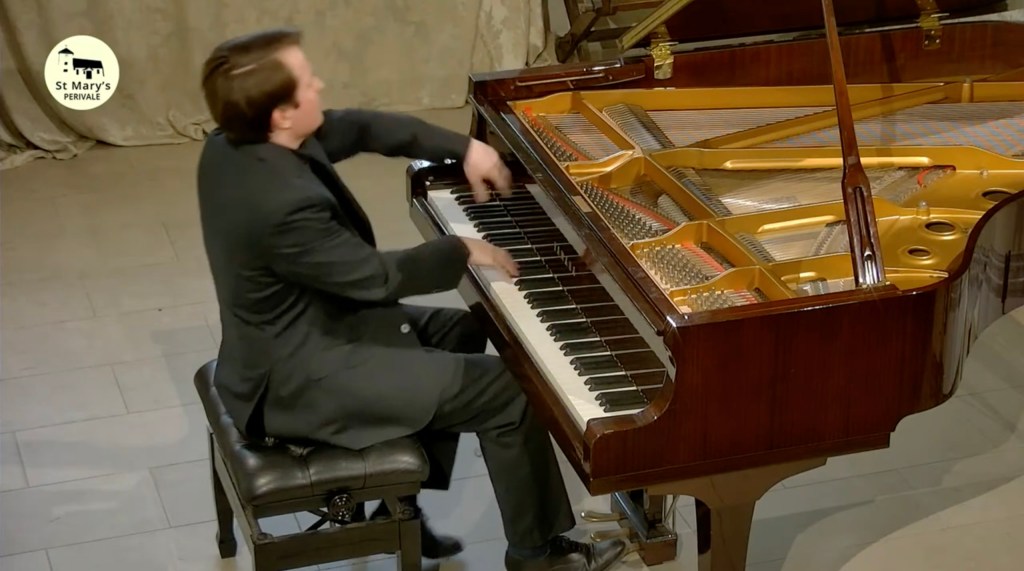
I have heard Misha play many times over the past four years since I was invited by his teacher Ian Jones to listen to him playing Rachmaninov First Concerto at Cadogan Hall whilst he was still just a ‘fresher’.https://christopheraxworthymusiccommentary.com/2022/10/13/misha-kaploukhii-plays-rachmaninov-beauty-and-youthfulness-triumph/
It has been a great pleasure to see this young student turn into an artist of considerable importance as he has now reached the final stages of his student career. Important friendships with other musicians at the RCM have played their part in this formation. In particular that with Magdalene Ho frequenting each others concerts with a mutual respect and admiration learning from each other as the road to perfection becomes ever more an impossible dream but also the raison d’être of their lives. https://christopheraxworthymusiccommentary.com/2024/12/01/chopin-reigns-at-the-national-liberal-club-and-st-marys-perivale-the-triumph-of-misha-kaploukhii-and-magdalene-ho/
It was just a few months ago that I heard Magdalene Ho give remarkable performances of this same Davidsbündler together with Schubert’s magical Fantasy Sonata. https://christopheraxworthymusiccommentary.com/2025/01/17/magdalene-ho-a-star-is-born-on-the-rising-sun-of-inspired-mastery/
Today Misha coupled the Schumann with Liszt’s masterly entry into the operatic world of Bellini. Listening to Bellini in Sicily obviously takes on another meaning ( I am writing from Trapani where the 3rd International Piano Competition,Domenico Scarlatti is taking place), but the mastery and transcendental command that Misha showed today must have been the similar to that of Liszt who was to take Paris by storm, together with his great rival Thalberg.
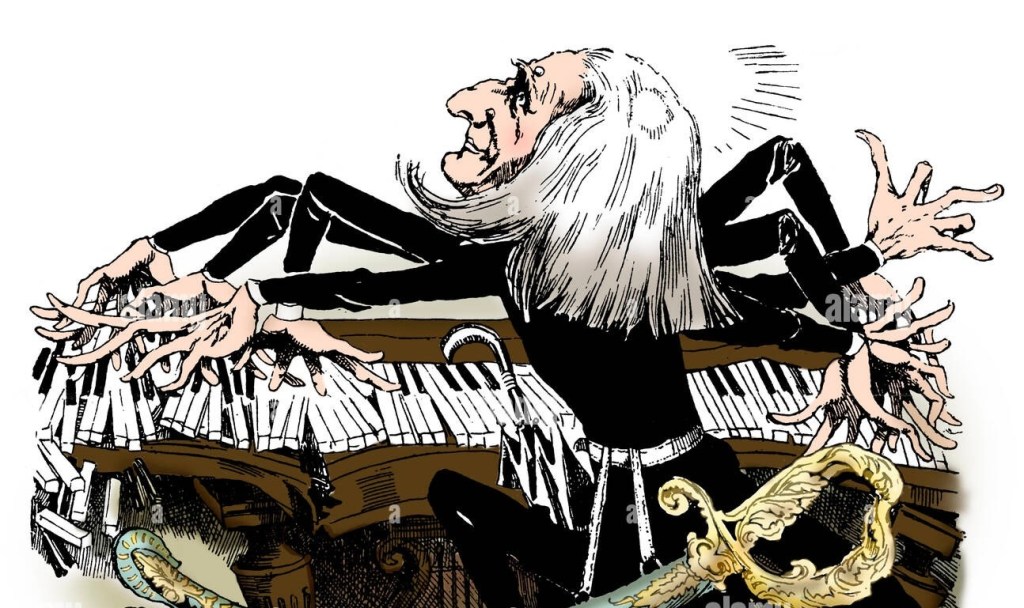
Their three handed pianism was just one of the wonders that could be created on a piano where the addition of pedals allowed sounds to be held and create effects that had Liszt’s pupil Anton Rubinstein declare that the pedal was the ‘soul’ of the piano! The pedal too allows for a sense of balance where the melodic line can be floated of a wave of sounds ( as Chopin’s playing of his study in A flat op 25 n.1 was described as a melody floating on an Aeolian Harp of sounds).
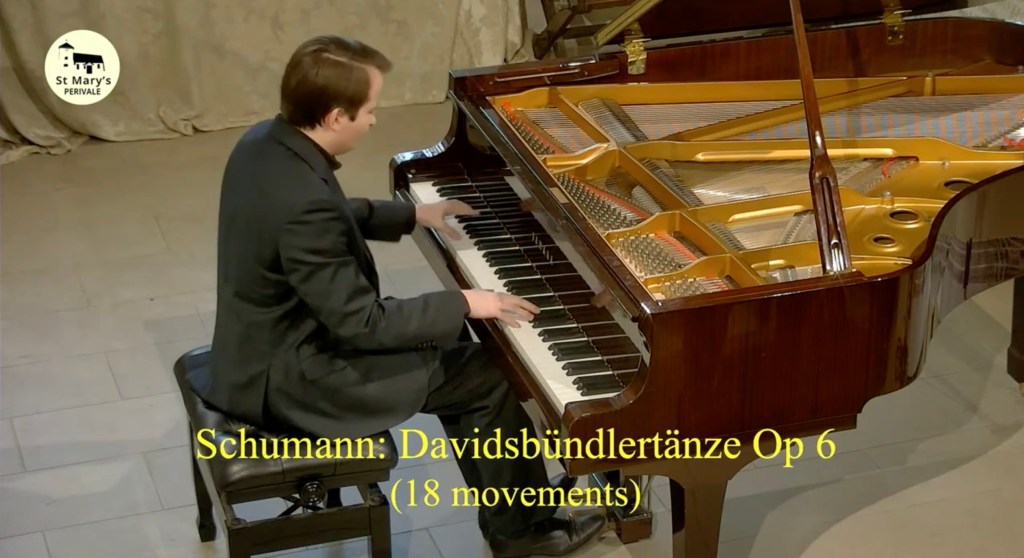
For a young musician simplicity is the thing that is so difficult to find, especially after years of study and hard work now being able to master the works that have inspired him to take the long path of becoming a professional pianist. Of course a certain showmanship and bravado is only natural but it can also lead to not listening to ones’ self and relying on physical euphoria to take command. Today Misha showed that he has passed through that difficult phase as the music was revealed with simplicity and flowing beauty. A masterly performance of understatement in the sense of real poetic understanding and commitment. It was summed up so succinctly by Artur Schnabel talking about Mozart being too easy for children but too difficult for adults!
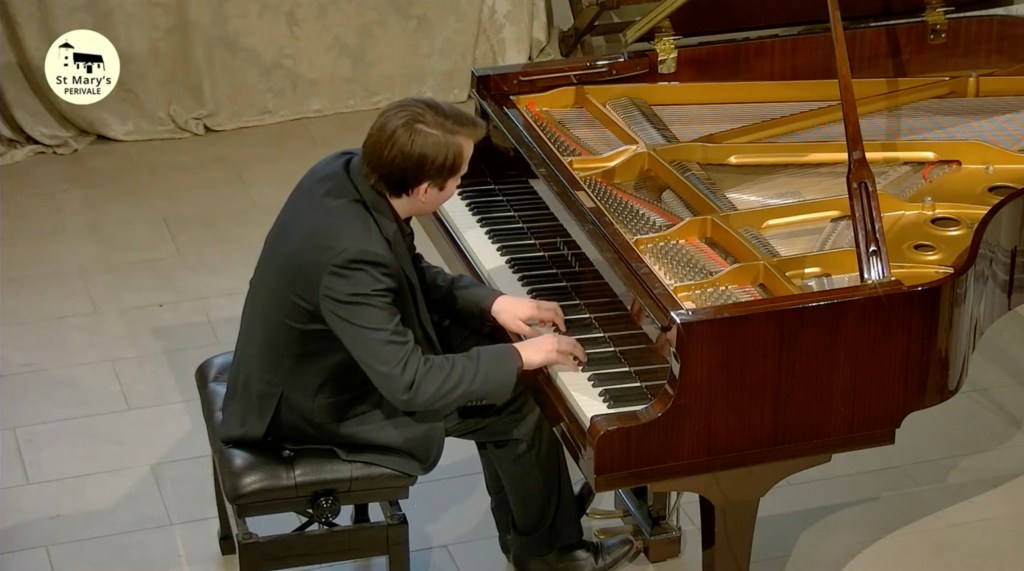
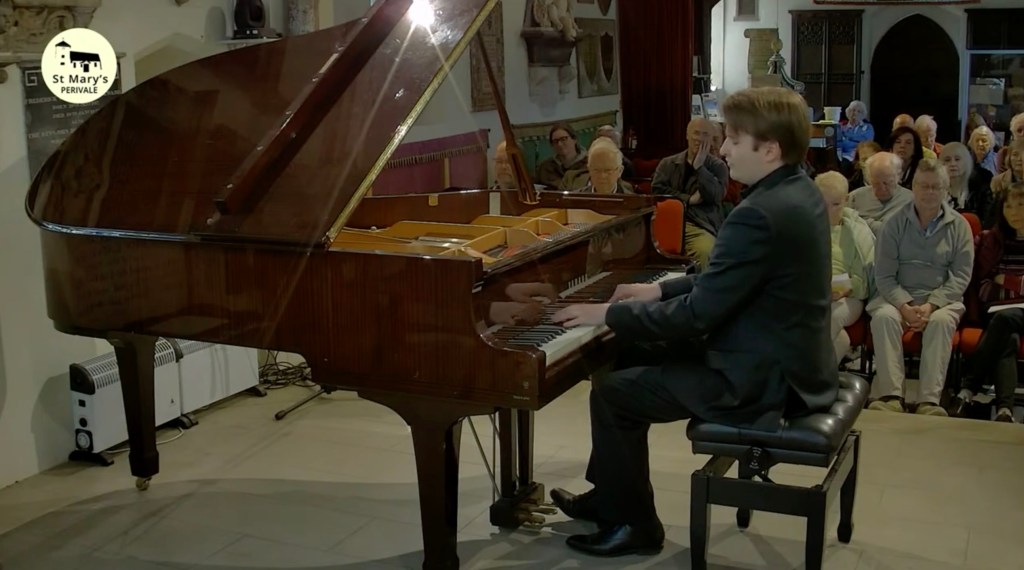
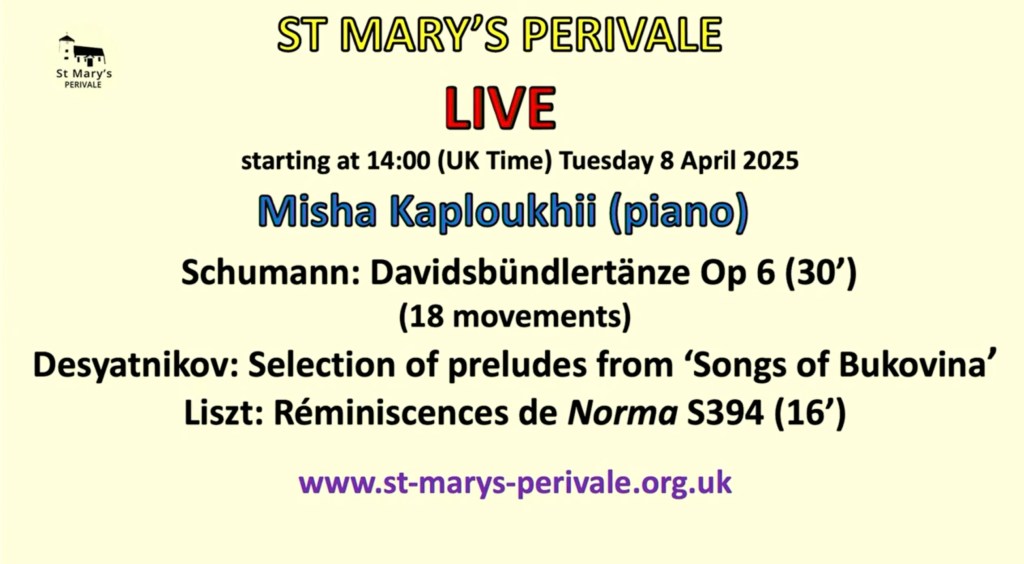
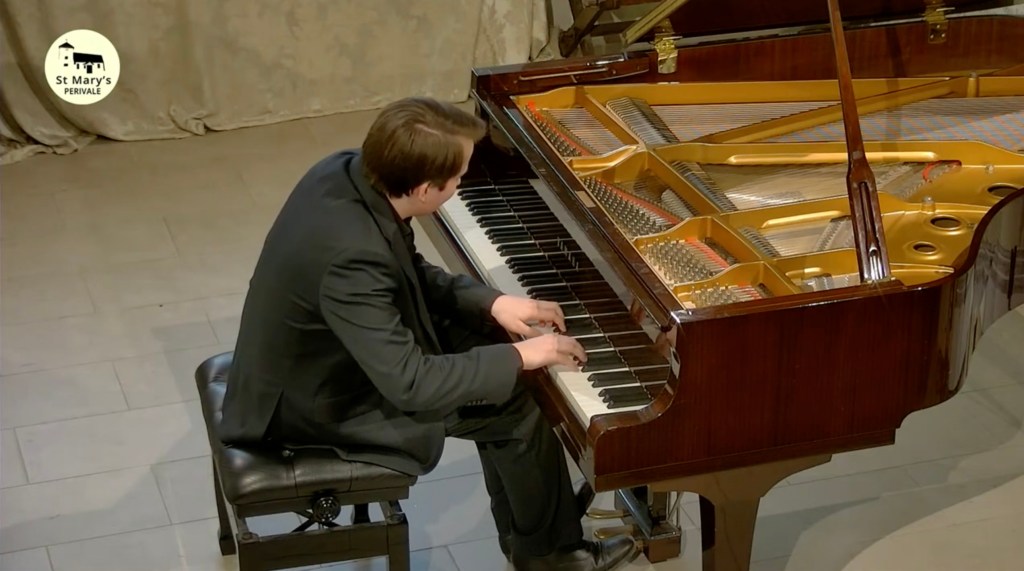
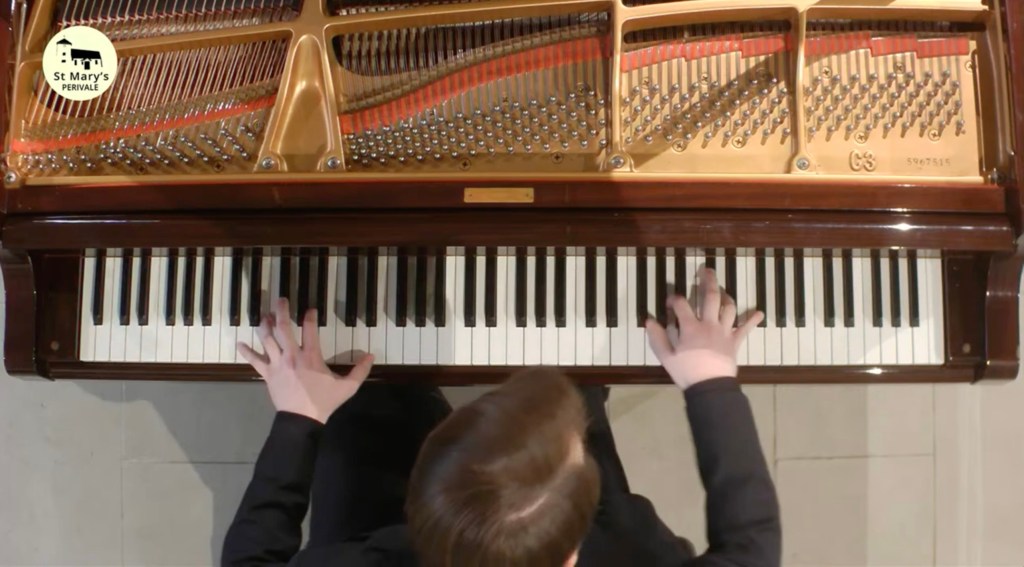
There was a mastery of the pedal nowhere more apparent than in the the very first dance where Florestan and Eusebius combine with their legato and non legato escapades so clearly played with not a little rearranging of the hands too! Refined beauty and luminosity of the second sprang to life with the grandeur of the third. There was passion but also intelligence of the fourth as the melodic line was beautifully etched with searing beauty and authority.Timeless phrasing of great mastery with the simple grace and beauty he brought to the fifth.There was clarity to the sixth but also a dynamic drive and refined aristocratic phrasing and the seventh just unfolded with poignant tenderness like a flower slowly opening.The eighth, too, was played with deeply felt sentiments of beauty contrasting with the ‘joie de vivre’ and rhythmic buoyancy that Misha brought to the ninth. A beautiful architectural shape to the tenth was followed by the sumptuous Brahmsian richness of the eleventh.There was the beseeching questioning of the twelfth as the melodic line is doubled and given slightly more weight allowing more depth and poetic sensibility to this dance that ends with a question mark. Quixotic playing of great character and technical mastery of the thirteenth was contrasted with the fourteenth. A rare sense of balance that allowed the melodic line to sing in the right hand before the sumptuous rich sounds of the middle section of unsentimental mellifluous strength making such a telling contrast to the outer sections.The fifteenth, one of Schumann’s most perfect creations was played with etched beauty allowing the music to speak for itself with poignancy and deeply felt meaning. The opening majesty and authority of the sixteenth just opened the flood gates for an emotional outpouring of sumptuous passionate beauty. There was busy chattering between the hands, of the seventeenth,as they chased each other around the keyboard before gradually dissolving, as Schumann finds the Eutopia of his dreams and we are enticed into a world of sublime inspiration ( only to be found later by Ravel In the final epilogue of his noble and sentimental waltz world!). A magical performance with a kaleidoscope of sounds and a masterly use of the pedal that made one think deeply of how right Anton Rubinstein was. The final waltz played with that simplicity that Schnabel knew was so difficult to capture but that Misha today had found the key, as the final gentle chimes in the bass merely vibrated with his extraordinary poetic understanding.
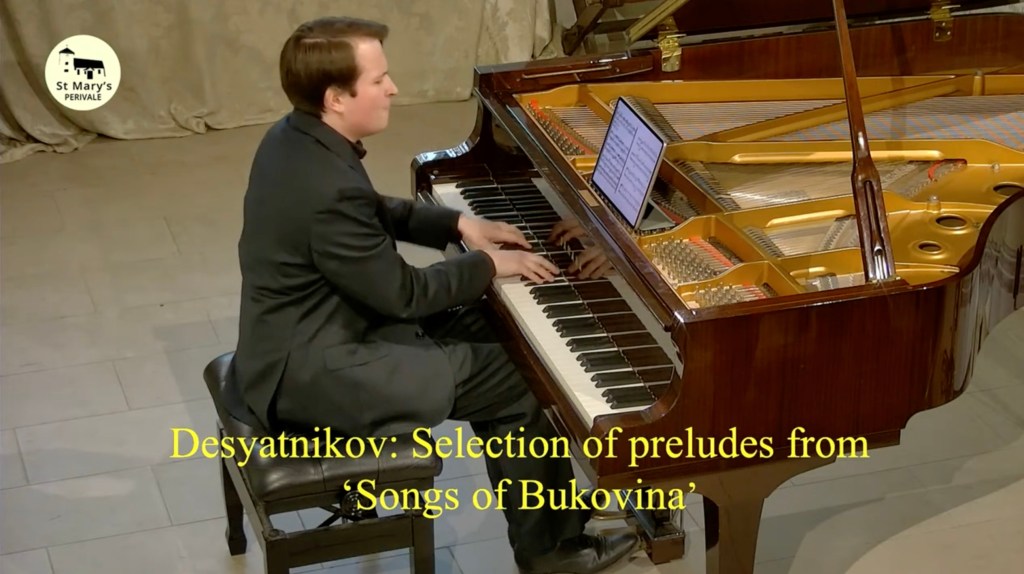
Leonid Desyatnikov was born in 1955 in Kharkiv, Ukraine and is a graduate of the Leningrad conservatory , where he studied composition and instrumentation. Misha chose four of his preludes.Typical traditional dances of his homeland were played with great commitment and the second was very similar to the Schumann’s Romance in F sharp played with languid beauty as the third entered in mazurka style of questioning rhythmic improvisation. The opening deep bass chimes of the fourth brings to mind Liszt’s Funerailles but with its chiselled folk melody with impish syncopations and dynamic ending.
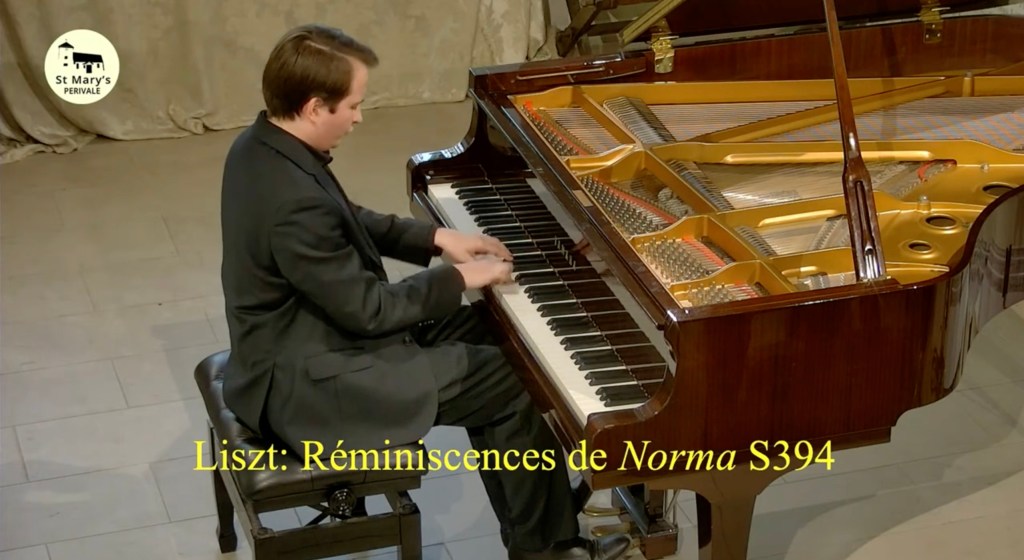
There was an imperious opening to the Liszt Norma Fantasy followed by luxuriant sumptuous sounds and a gradual build up played with a masterly control of dynamics as fragments gradually linked together until arriving at the triumphant outpouring of the main melody. A glorious melodic outpouring played with rich full sound where Misha never lost sight of the melodic line, even though accompanied by cascades of octaves, that could easily be overpowering in the hands of a lesser artist. There was a languid brooding and passionate commitment to the central episode as it gradually builds to an eruption of dynamic drive and energy. A technical mastery that even though the intensity and drive of the music are taking over the emotional sensibilities, Misha was always in control with a command and seemingly endless technical reserves of fearless virtuosity .Even the final where Liszt combines the two main themes with diabolical technical wizardry the music moved inexorably forward and swept all before it. A quite remarkable performance of one of the great warhorses of the romantic virtuosi par excellence.
An encore would seem superfluous after such and extraordinary performance but Misha managed to pull even more magic out his hat with a beguiling, teasingly titivating performance of Liszt’s elusive Bagatelle sans tonalité.
Misha graduates from the RCM this summer as a great career ahead obviously awaits.
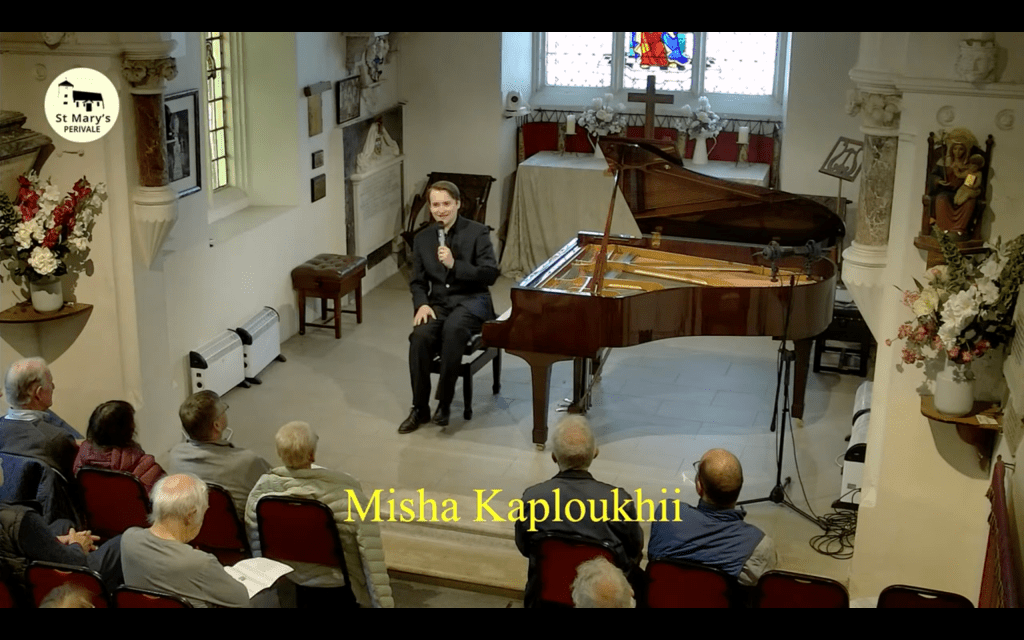
Born in 2002, Misha Kaploukhii is an alumnus of the Moscow Gnessin College of Music. He has recently completed his undergraduate studies at the Royal College of Music and is an ABRSM award holder generously supported by the Razumovsky Trust, Eileen Rowe Trust, Talent Unlimited Charity, The Keyboard Charitable Trust, and The Robert Turnbull Foundation. He is now studying for a Master of Performance with Professor Ian Jones and was incredibly honoured to receive the LSO Conservatoire Scholarship 2024/25. His recent prizes include RCM Concerto Competition, International Ettlingen Piano Competition, Hopkinson Gold Medal at the Chappell Medal Competition and the 1st and Audience prizes at the 2024 Sheepdrove Piano Competition. Misha has gained inspiration from lessons and masterclasses with musicians such as Claudio Martínez Mehner, Dmitri Bashkirov, Jerome Lowenthal, Dinara Klinton, Konstantin Lifschitz, Dame Imogen Cooper.
His performances with orchestras in UK include debuts in Cadogan Hall playing Rachmaninov’s 1st Concerto with YMSO and James Blair, Liszt’s 2nd Concerto with RCM Symphony orchestra with Adrian Partington and very recently, Rachmaninov’s 4th Concerto performed with the Albion Orchestra.He has performed in the UK, Italy and France at the venues including St Mary’s Perivale, Razumovsky Recital Hall, Leighton House, Cadogan Hall, Sala dei Notari and Giardini La Mortella with a wide range of solo and chamber repertoire. Misha’s future engagements include solo recitals in St Mary Le Strand, 1901 Arts Club, British Institute in Florence and Steinway Hall in Milan. In February he performed Brahms 2nd Piano Concerto in Cadogan Hall with James Blair.
 ChristopherAxworthy-MusicCommentary