
22 October 1811 Doborján,Kingdom of Hungary, Austrian Empire
31 July 1886 (aged 74) Bayreuth, Kingdom of Bavaria, German Empire

Liszt had been sketching themes for A Symphony to Dante’s Divine Comedy,S 109 since the early 1840s.The French poet Joseph Autran recalled that in the summer of 1845, Liszt improvised for him “a passionate and magnificent symphony upon Dante’s Divine Comedy” on the organ of the empty Marseille Cathedral at midnight, and later invited him to collaborate with him on a Dante oratorio or opera, which the poet failed to pursue. In 1847, he played some fragments on the piano for his Polish mistress Princess Carolyne zu Sayn-Wittgenstein. At this early stage in the composition, it was Liszt’s intention that performances of the work be accompanied by a slide show depicting scenes from the Divine Comedy by the artist Bonaventura Genelli and also planned to use an experimental wind machine to recreate the winds of Hell at the end of the first movement. Although Princess Carolyne was willing to defray the costs, nothing came of these ambitious plans and the symphony was set aside until 1855 when Liszt wrote to his future son-in-law Richard Wagner. “So you are reading Dante. He’s good company for you, and I for my part want to provide you with a kind of commentary on that reading. I have long been carrying a Dante Symphony around in my head – this year I intend to finish it. Three movements, Hell, Purgatory and Paradise – the first two for orchestra alone, the last with chorus. When I visit you in the autumn I shall probably be able to bring it with me; and if you don’t dislike it you can let me inscribe your name on it.” Liszt had been reading Dante’s Divine Comedy in Lake Como in 1937 whilst initially in the company of Marie d’Agoult. A work that would combine music ,poetry and visual arts. Wagner was enthusiastic, but advised against including a choral finale as “Paradise could not be depicted in music.” Liszt discarded the idea of a choral finale and added a brief setting for women’s voices of the first two verses of the “Magnificat,” all ending with a “Hallelujah.”
Liszt played the Dante symphony for Wagner in Zürich in October 1856, who disliked the fortissimo conclusion and as he wrote in his autobiography “If anything had convinced me of the man’s masterly and poetical powers of conception, it was the original ending of the Faust Symphony, in which the delicate fragrance of a last reminiscence of Gretchen overpowers everything, without arresting the attention by a violent disturbance. The ending of the Dante Symphony seemed to me to be quite on the same lines, for the delicately introduced “Magnificat” in the same way only gives a hint of a soft, shimmering Paradise. I was the more startled to hear this beautiful suggestion suddenly interrupted in an alarming way by a pompous, plagal cadence. No! I exclaimed loudly, not that, away with it! No majestic Deity! Leave us the fine soft shimmer!”
Liszt dedicated the Dante Symphony to Wagner but kept both endings; the loud one is indicated in his version for two pianos, but in the orchestral score it is usually omitted.The first performance on 7th November 1857 took place in the Royal Theatre in Dresden conducted by Liszt and ‘the occasion proved a fiasco ‘ wrote Liszt’s son in law Hans von Bulow and even Liszt commented that the performance was ‘very unsuccessful due to lack of rehearsals’
George Bernard Shaw reviewed the work in 1885 and wrote, “the manner in which the program was presented by Liszt could just as well represent a London house when the kitchen chimney is on fire.”
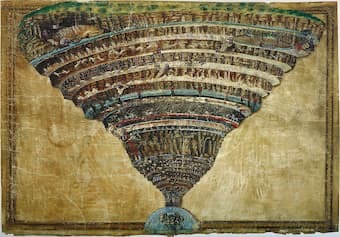
The opening movement is entitled “Inferno” and guides us through the nine Circles of Hell. The “Gates of Hell” opens with a slow introduction (Lento) based on three recitative-like themes, which Liszt has set to four of the nine lines inscribed over the Gates of Hell: Inferno Canto 3
| Per me si va nella città dolente, Per me si va nell’eterno dolore, Per me si va tra la perduta gente. … Lasciate ogni speranza voi ch’entrate. | Through me is the way to the sorrowful city, Through me is the way to eternal sorrow, Through me is the way among the lost people. … Abandon all hope you who enter here. | 1 3 9 |
and at “The Vestibule and First Circle Hell” the music becomes frantic. When Dante and Virgil enter the “Second Circle of Hell,” the infernal “Black Wind” that perpetually shakes the damned greets them. Here is depicted the tragic love of Francesca, whose adulterous affair with her brother-in-law Paolo cost her life and soul.Liszt sets the music to the words of Francesca da Rimini :Inferno canto 5
| …. Nessun maggior dolore che ricordarsi del tempo felice ne la miseria. | …. There is no greater sorrow Than to recall happy times In the midst of misery. | 121 122 123 |
The “Black Wind” motif returns in the “Seventh Circle of Hell,” and Liszt writes, “this entire passage is intended to be a blasphemous mocking laughter.” The “Eight” and “Ninth Circles of Hell” present slightly varied themes, as Dante and Virgil gradually emerge from Hell. They ascend Mount Purgatorio in the second, initially solemn and tranquil movement. Dante and Virgil ascend the two terraces of Ante-Purgatory, where souls repent their sins. The “Seven Cornices of Mount Purgatory” represent the seven deadly sins, and “Earthly Paradise” guides the soul to Paradise. In the score, Liszt directs that the choir be hidden from the audience in the concluding “Magnificat.” declaring that “Art cannot portray heaven itself, only its image in the hearts of those souls, which have turned to the light of heavenly grace. Thus for us the radiance is still shrouded, although it increases with the clarity of understanding.” Curiously, the Magnificat is not mentioned anywhere in the Commedia; nor is there any Hallelujah; the Hosanna, however, is heard both in the Earthly Paradise of the Purgatorio and in the Paradiso.In the score, Liszt directs that the choir be hidden from the audience:
‘The female or boys’ choir is not to be placed in front of the orchestra, but is to remain invisible together with the harmonium, or in the case of an amphitheatrical arrangement of the orchestra, is to be placed right at the top. If there is a gallery above the orchestra, it would be suitable to have the choir and harmonium positioned there. In any case, the harmonium must remain near the choir.‘
The orchestra concludes with a quiet plagal cadence in B major; the timpani add a gentle authentic cadence of their own. The work ends molto pianissimo.
The second ending, which follows rather than replaces the first ending, is marked Più mosso, quasi Allegro. The ppp of the first ending gives way to ff. Majestic trumpets and trombones – accompanied by rising scales in the strings and woodwind, and by chords in the horns, harps, harmonium and strings – set the scene for a reappearance of the chorus. Three repetitions of a single word, Hallelujah, bring the work to a towering conclusion with a plagal cadence in B major.
The Dante Symphony is not so much a symphony in the classical sense as it is two descriptive symphonic poems consisting of two movements, both in a loosely structured ternary form with little use of thematic transformation.
The Symphony is in three movements : Inferno- Purgatorio – Magnificat
The transcription of the symphony – Liszt’s own, dating from 1859 S 648 – makes for a disquieting experience. Uncompromisingly stark and austere in comparison with the more sensuous orchestral original, the piano writing, particularly in the Purgatorio, seems to pre-empt the dissonant terseness of Liszt’s later works.
LES PRÉLUDES S.97
Andante maestoso, Allegro tempestoso, Allegretto pastorale, Allegro marziale animato, Vivace, Andante maestoso
The symphonic poems of Franz Liszt are a series of 13 orchestral works, numbered S.95–107. The first 12 were composed between 1848 and 1858 (though some use material conceived earlier); the last, Von der Wiege bis zum Grabe (From the Cradle to the Grave), followed in 1882. In developing the symphonic poem, Liszt satisfied three of the principal aspirations of 19th century music: to relate music to the world outside, to integrate multi-movement forms … and to elevate instrumental programme music to a level higher than that of opera, the genre previously regarded as the highest mode of musical expression. In fulfilling these needs, the symphonic poems played a major role, widening the scope and expressive power of the advanced music of its time. Their historical importance is undeniable; both Sibelius and Richard Strauss were influenced by them, and adapted and developed the genre in their own way. The symphonic poems offer many examples of Liszt’s unique pioneering spirit.
In the late 1840s, Franz Liszt settled in Weimar and gave up the life of the international concert star to devote himself to composition and conducting. Liszt’s pioneering series of 12 symphonic poems came to fruition during his time as Kapellmeister at the court of the Duke of Weimar . The final order of the works was not conceived until all the pieces were ready for publication, but it is clear that he thought of all 12 works as a gigantic cycle. He issued them in versions for orchestra, for two pianos, and for piano duet. Its premiere was on 23 February 1854, conducted by Liszt himself. It was published in 1856 by Bretikopf & Härtel and dedicated to Carolyne zu Sayn-Wittgenstein and is the earliest example of an orchestral work entitled “Symphonic Poem”
Thus, although works such as Les Préludes are familiar in their orchestral guise, they were conceived from the outset for the keyboard. The two-piano versions of these pieces are no mere transcriptions: Liszt allows quite considerable variance from the orchestral scores in order to make real duos, occasionally even adding or omitting some bars or even transforming the material with new harmonies .Les Preludes was published as the third of his twelve symphonic poems but was probably the earliest of orchestral origins, if one considers that the thematic material was derived from his cantata Les Quatre Élémens (The Four Elements), produced at Marseilles in 1844. Liszt’s starting-point for the cycle was Les aquilons (“The North Winds”), a male chorus with piano accompaniment composed on 24 July 1844 . Liszt had arrived in Marseille the day before and met with choristers of a German travelling company, who requested an original chorus piece from Liszt . The poet Joseph Autran, whom Liszt had visited, offered him the poem Les aquilons. In the afternoon of the 24th, Liszt composed the piece. The work was performed on 6 August at Liszt’s fourth concert in Marseille. The accompaniment was on two pianos, one played by Liszt himself .Besides Les aquilons, Autran gave three further poems to Liszt: La terre (“The Earth”), Les flots (“The Floods”) and Les astres (“The Stars”), and Liszt also set these to music. As a series, La terre, Les aquilons, Les flots and Les astres formed a cycle Les quatre élémens (“The Four Elements”). Liszt was not happy with Autran’s words for the movements which depict “The Earth, The North Winds, The Floods, and The Stars,” and looked to Victor Hugo to write him a new text. Hugo, whose Ce qu’on entend sur la montagne was the subject for his first symphonic poem, did not comply. In 1849, while making a fair copy of Ce qu’on entend sur la montagne, he also brought out his earlier score and drafted a purely symphonic version. However, he laid it aside again.
In 1854, wanting a new piece for a pension fund concert of the court orchestra at Weimar, Liszt turned once more to the incomplete symphonic poem, which now had its first association with the poem of his friend Alphonse Lamartine (1790-1869), the fifteenth number of the Méditations poétiques. It is probable that this symphonic poem underwent considerable remodeling when it acquired its final title and form. Les préludes is the final revision of an overture initially written for the choral cycle Les quatre éléments (The Four Elements, 1844–48)
The chorus Les Aquilons was composed and created in a version for male chorus with 2 pianos accompaniment in Marseille in 1844, and the first sketches of the Ouverture des quatre élémens date from 1845, during Liszt’s tour through Spain and Portugal. A manuscript of the overture from 1849 to 1850 shows that the work had by then reached its almost definitive structure and thematic content.
After being partially orchestrated, the choral cycle project was abandoned. The overture was revised in 1853-54 as a stand-alone piece, with a new title inspired by an ode by the French poet Alphonse de Lamartine,Les préludes. Written for a large orchestra of strings, woodwind, brass (including tuba and bass trombone), harp and a variety of percussion instruments (timpani, side drum, bass drum and cymbals). The full title of the piece, “Les préludes (d’après Lamartine)” refers to an Ode from the Alphonse de Lamartine’s Nouvelles méditations poétiques of 1823. The final version no longer contains any reference to Autran or to the Chorus cycle Les quatre élémens.
The 1856 published score includes a text preface, which however is not from Lamartine. ‘What else is our life but a series of preludes to that unknown Hymn, the first and solemn note of which is intoned by Death?—Love is the glowing dawn of all existence; but what is the fate where the first delights of happiness are not interrupted by some storm, the mortal blast of which dissipates its fine illusions, the fatal lightning of which consumes its altar; and where is the cruelly wounded soul which, on issuing from one of these tempests, does not endeavour to rest his recollection in the calm serenity of life in the fields? Nevertheless man hardly gives himself up for long to the enjoyment of the beneficent stillness which at first he has shared in Nature’s bosom, and when “the trumpet sounds the alarm”, he hastens, to the dangerous post, whatever the war may be, which calls him to its ranks, in order at last to recover in the combat full consciousness of himself and entire possession of his energy.’
The earliest version of this preface was written in March 1854 by Carolyne zu Sayn-Wittgenstein and comprises voluminous reflections of the Princess, into which some lines of quotations from the ode by Lamartine are incorporated. It was drastically shortened for publication in April 1856 as part of the score; there only the sentence, “the trumpet sounds the alarm” and the title “Les préludes”, survive from Lamartine’s poem.
A different version of the preface was written for the occasion of a performance of Les préludes on 6 December 1855, in Berlin. In the 1855 version the connection with Lamartine is reduced to his alleged query, “What else is our life but a series of preludes to that unknown Hymn, the first and solemn note of which is intoned by Death?” However this sentence was actually written not by Lamartine, but by Princess Wittgenstein.
For the occasion of a performance of Les préludes on 30 April 1860, in Prague a further version of the preface was made. This version was probably written by Hans von Bulow who directed the performance. It is rather short and contains no reference to Lamartine at all. According to this version, Les préludes illustrates the development of a man from his early youth to maturity. In this interpretation, Les préludes may be taken as part of a sketched musical autobiography.
Nevertheless, no specific statement by Liszt himself has been found in favour of a particular programme. In a letter to his uncle Eduard List, dated 26 March 1857, he refers to his préludes as: « my preludes (which, by the way, are only the prelude to my path of composition)…», which seems to mean nothing more than the beginning of his interest in cyclical form and new orchestration techniques : the rest of the letter contains indeed only technical considerations on the principle of thematic transformation in his 1st piano concerto, and a plea for percussion instruments despite the reproaches of many other musicians.
Liszt made his own arrangements for two pianos S 637 and for piano duet.The first American orchestral performance of Les Préludes S.97 took place in New York in May 1858 with an unnamed orchestra under the direction of Carl Bergmann (a duo-piano performance had in fact preceded it by a year).
The 12 Symphonic Poems
1 Ce qu’on entend sur la montagne (Symphonic Poem No.1), S635
2 Tasso – Lamento e Trionfo (Symphonic Poem No.2), S636
3 Les préludes (Symphonic Poem No.3), S637
4 Orpheus (Symphonic Poem No.4),
5 Prometheus (Symphonic Poem No.5), S639 12’27
6. Mazeppa (Symphonic Poem No.6), S640 16’26
7 Festklänge (Symphonic Poem No.7), S641 18’56
8 Héroïde-funèbre (Symphonic Poem No.8), S642
9 Hungaria (Symphonic Poem No.9), S643 21’21
10 Hamlet (Symphonic Poem No.10), S644 13’34
11 Hunnenschlacht (Symphonic Poem No.11), S645 15’04
12 Die Ideale (Symphonic Poem No.12), S646
 ChristopherAxworthy-MusicCommentary