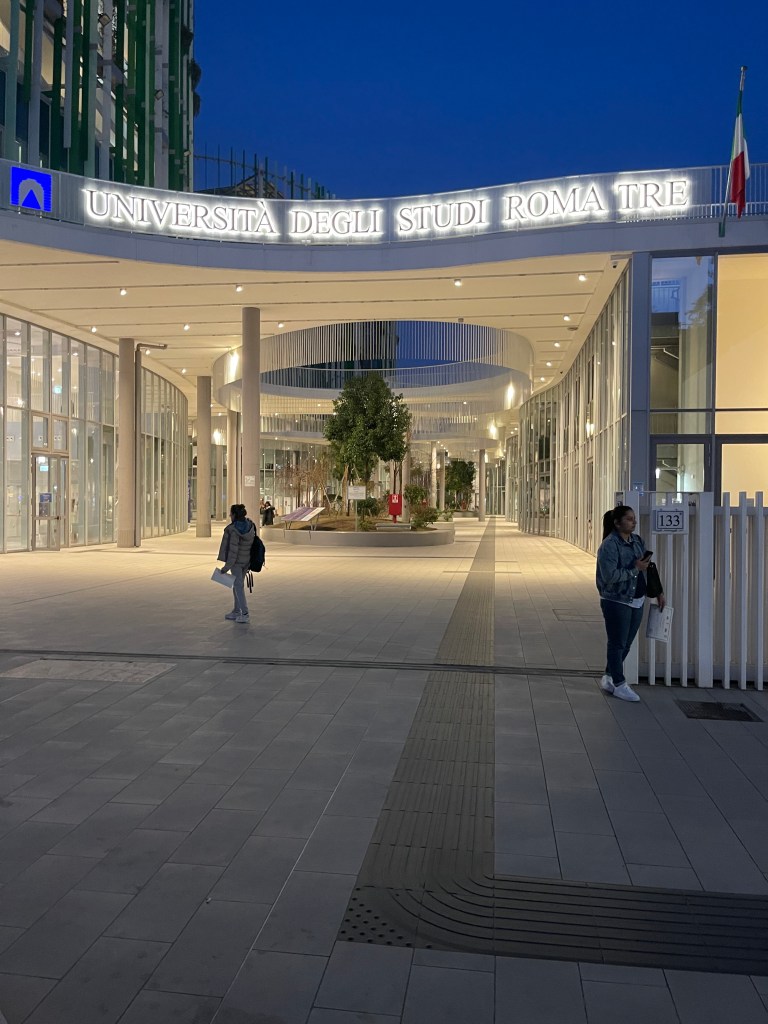
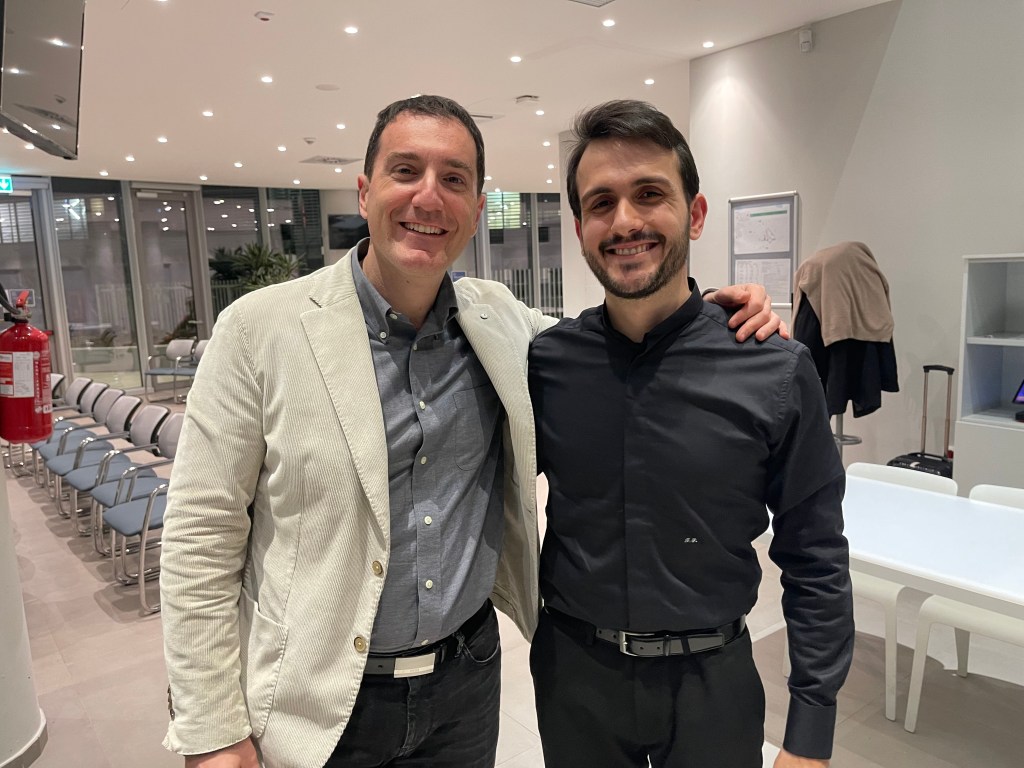
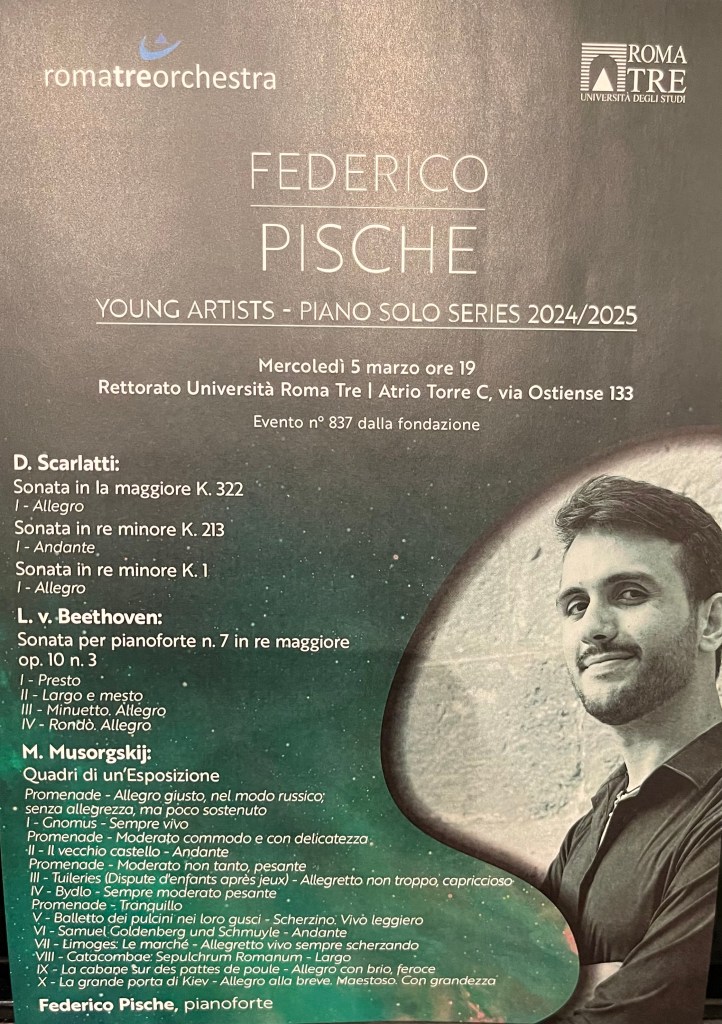
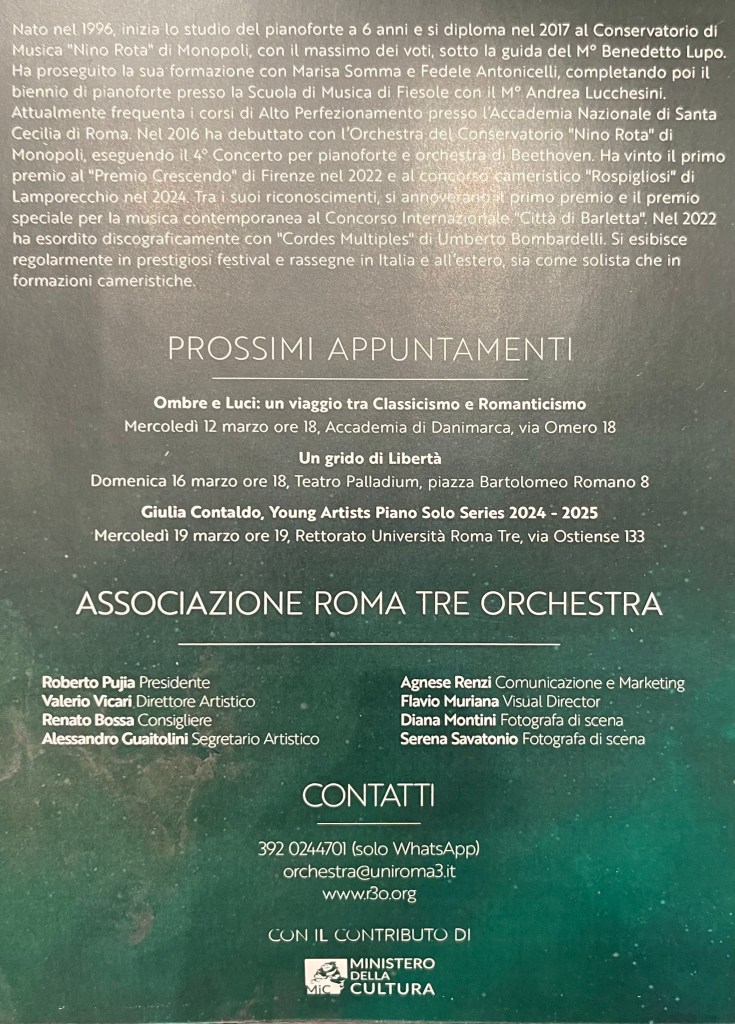

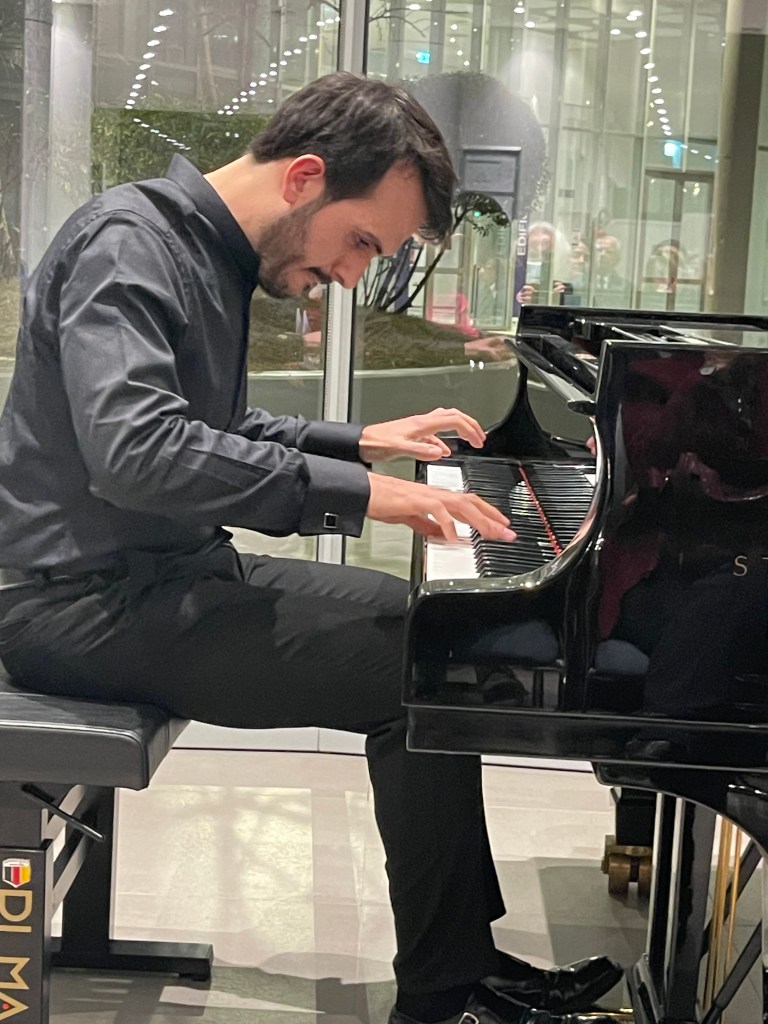
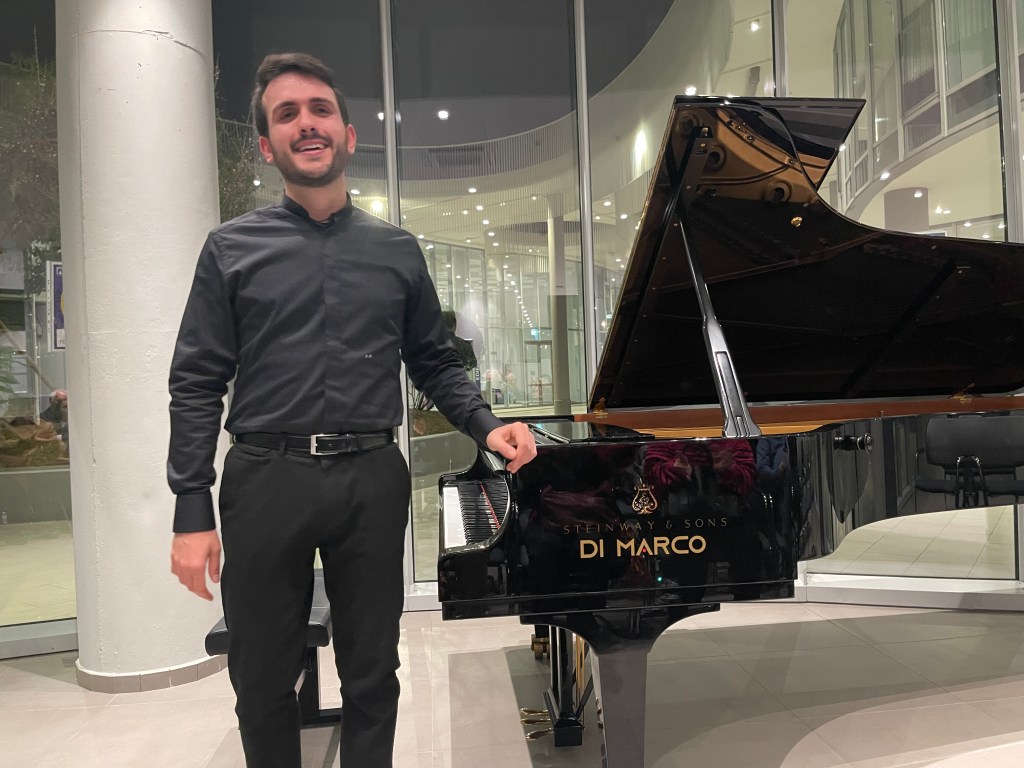
Federico Pische in the Young Artists series at Roma 3 University . From the class of Benedetto Lupo with a programme of Scarlatti, Beethoven and Mussorgsky. Played with a musical intelligence and integrity where his technical mastery was at the service of the composers he was playing and just underlined the title he had given to his recital of ‘Form and Significance’. Crystalline purity of three Scarlatti Sonatas, a poignant profundity to the early Beethoven Sonata op 10 n 3 where the Largo e mesto already marks out the genius that was to recreate the sonata form, bringing it to the celestial heights of his final trilogy. But it was Mussorgsky that marked this young man out as an artist of refined good taste and remarkable technical mastery. A pianist who listens to himself with a sensitivity to balance and a kaleidoscopic range of colours can bring this old war horse back to where it truly belongs as one of the pinnacle’s of the pianistic repertoire.

.The A major Scarlatti sonata was played with a purity and clarity of sound with very discrete ornaments and an even more discrete use of the pedal which gave a glow to his playing of refreshing fluidity.The slow D minor sonata K.213 was beautifully shaped with the refined elegance of it’s time and a glowing poignant fluidity reaching a burning intensity diffused by the ebullient ‘joie de vivre’ of the other D minor sonata K.1 with ornaments that sparkled like tightly wound springs overjoyed to be part of such busy chattering of great buoyancy.


There are three sonatas from Beethoven’s early period that immediately show the genius who could take his master, Haydn’s, model and add his explosive temperament and genius in a fast changing world where music was a personal expression and not just an expression of elegant denial. This was a new age where the sonatas opus 2 n. 3, op 7 and op 10 n. 3 all pointed to a brave new world where the slow movements are personal statements of burning intensity and poignancy. Federico opened the op 10 n. 3 quite gently, a radiance gradually building in intensity .There was a dynamic drive and a sense of architectural shape to the first movement with it’s constant changes between rhythmic and lyrical,without ever loosing that burning drive. The ‘Largo e mesto’ was played with a musical intelligence of aristocratic beauty with a sense of balance that allowed the melody to glow without any forcing but with a kaleidoscope of colours and emotions that was breathtaking in it’s intensity. A sense of orchestral colour with deeply agitated bass notes of frenzied emotional impact diffused with a subtle recitativo of purity and naked emotions.There was a simple elegance to the ‘Minuetto’ that was allowed to unfold so simply as the ‘Trio’ burst into life with its enticing question and answer between the hands. The same questioning but with uncertain answers of the Rondò that was played with refined brilliance and rhythmic energy disappearing into the bass of the piano from where this great tale had begun.
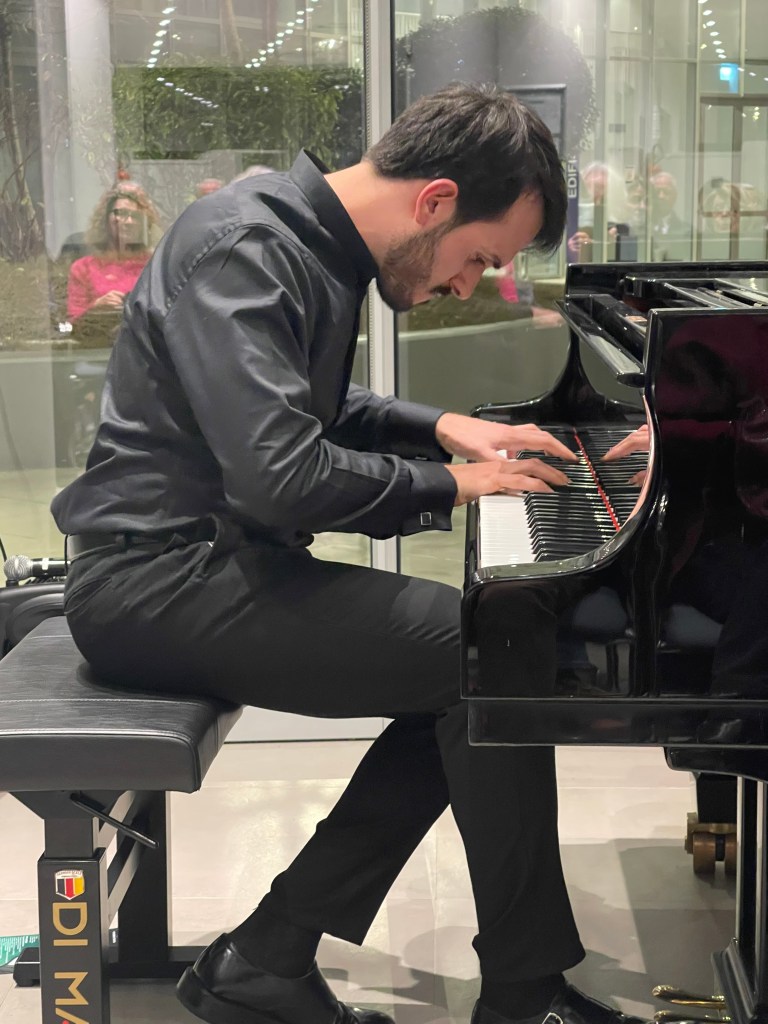

Mussorgsky’s Pictures and tribute to his friend Victor Hartmann,were given a monumental performance with an extraordinary range of colours. Even in the most energetic episodes the sound was never allowed to harden as everything Federico did was shaped like the true musician he is. ‘Gnomus’ burst onto the scene with extraordinary impertinence but also with subtle colouring and an ending played with fearless courage. ‘The Old Castle’ of simple beauty as a heartbeat deep inside the piano carried us into this mysterious landscape. Federico brought an irresistible lilt to the children squabbling in the ‘Tuileries’ only to be overpowered by the prepotentious Bydlo. Federico even played it with a pointed finger but gradually allowed the old cart to disappear into the distance with barely audible whispers. A promenade that was now bathed in pedal as he caught sight of the chicks chattering away with insistent clarity and sparkle. ‘Samuel Goldenberg’ took centre stage with unstoppable authority as he was answered by the beseeching cries of ‘Schmuyle’, only to be overridden by the dynamic drive a extraordinary technical prowess of the hustle and bustle of the ‘Market Place in Limoges’. Suddenly ‘Catacombae’ appeared with a vision of terrifying desolation played with great conviction and enormous resonating sonorities, dissolving magically to ‘cum mortuis in lingua mortua’. ‘Baba Yaga’ entered at a fearsome gait as the tension and excitement rose to fever pitch only to be cut short by the wondrous vision of the ‘Great Gate of Kyiv’. Bells pealing all over the keyboard with a mastery of transcendental playing of overwhelming authority. There was beauty too with the interruption of a gentle chorale gradually becoming overwhelmed by the pealing of bells and the glorious vision of the grandeur of such a monumental vision of peace …………
Rachmaninov ‘s D major Prelude offered as soothing balm after a monumental performance of the Great Gate of Kyiv, demonstrated in just a few bars the simple poetic artistry of this extraordinary young artist
 ChristopherAxworthy-MusicCommentary