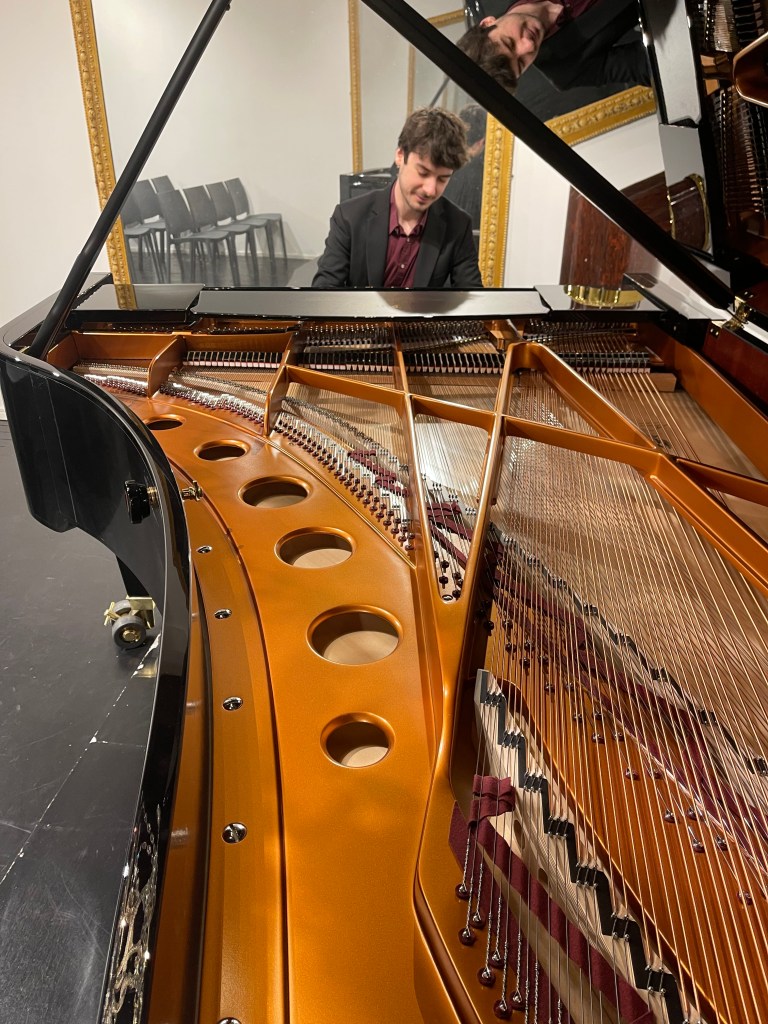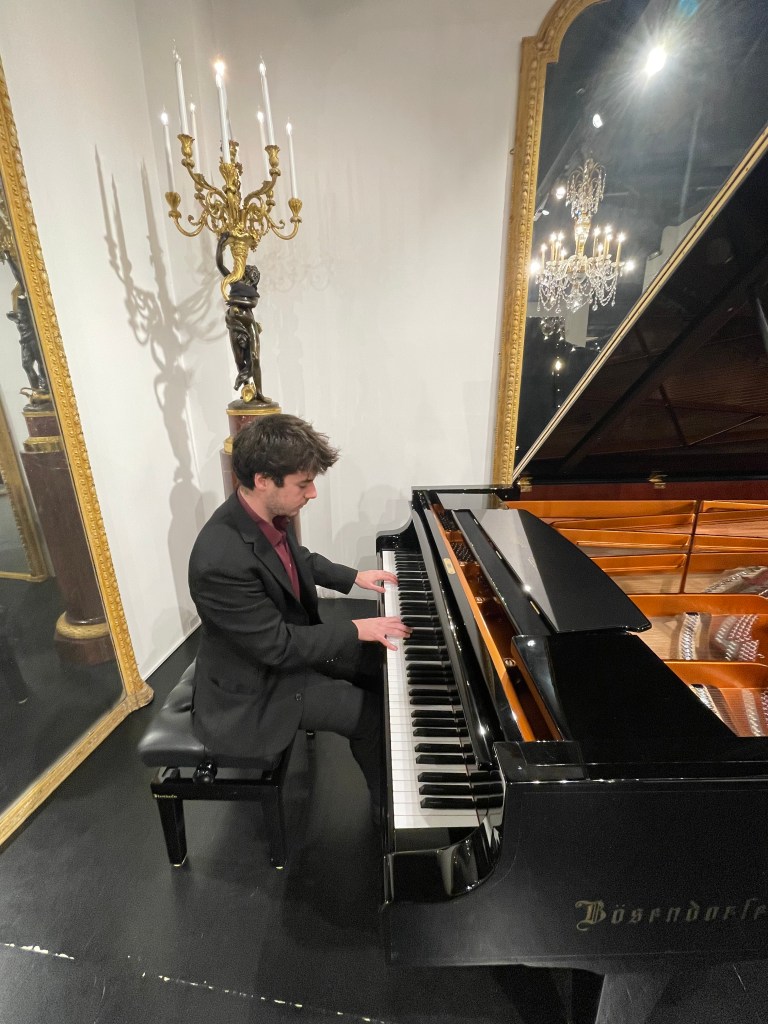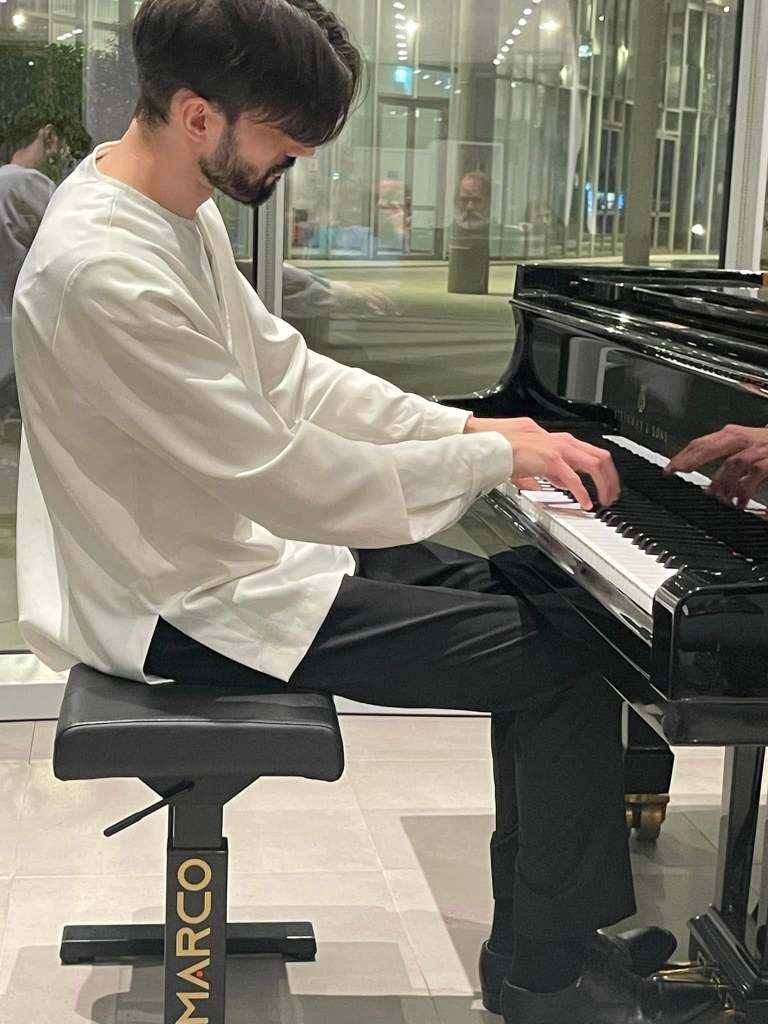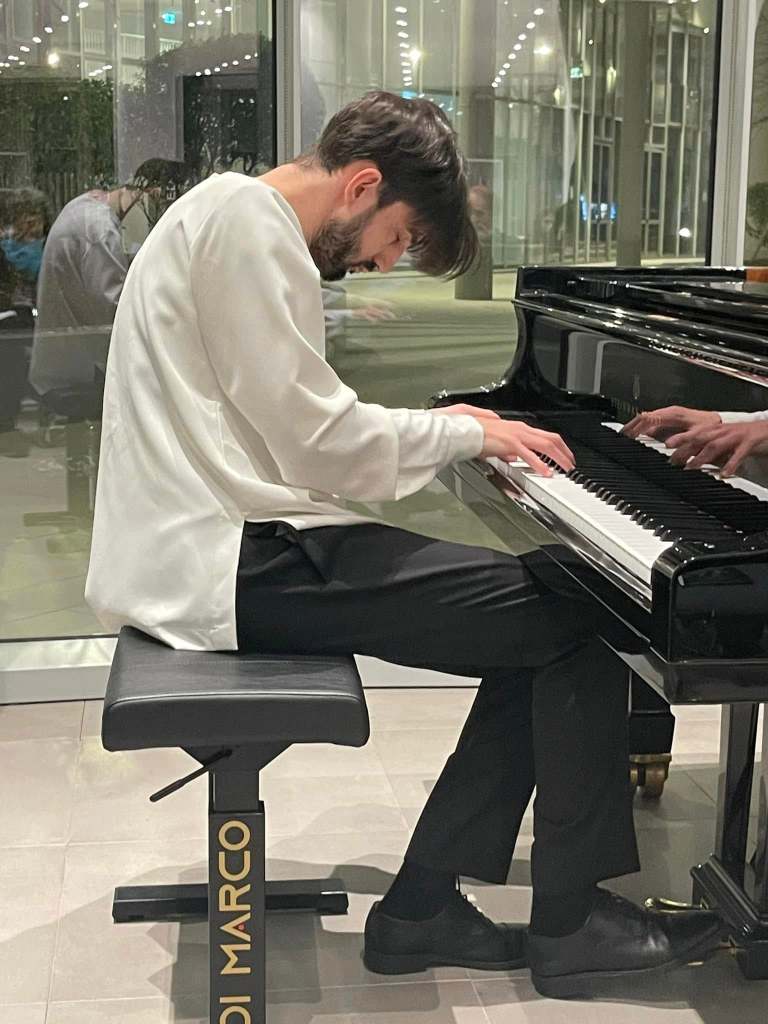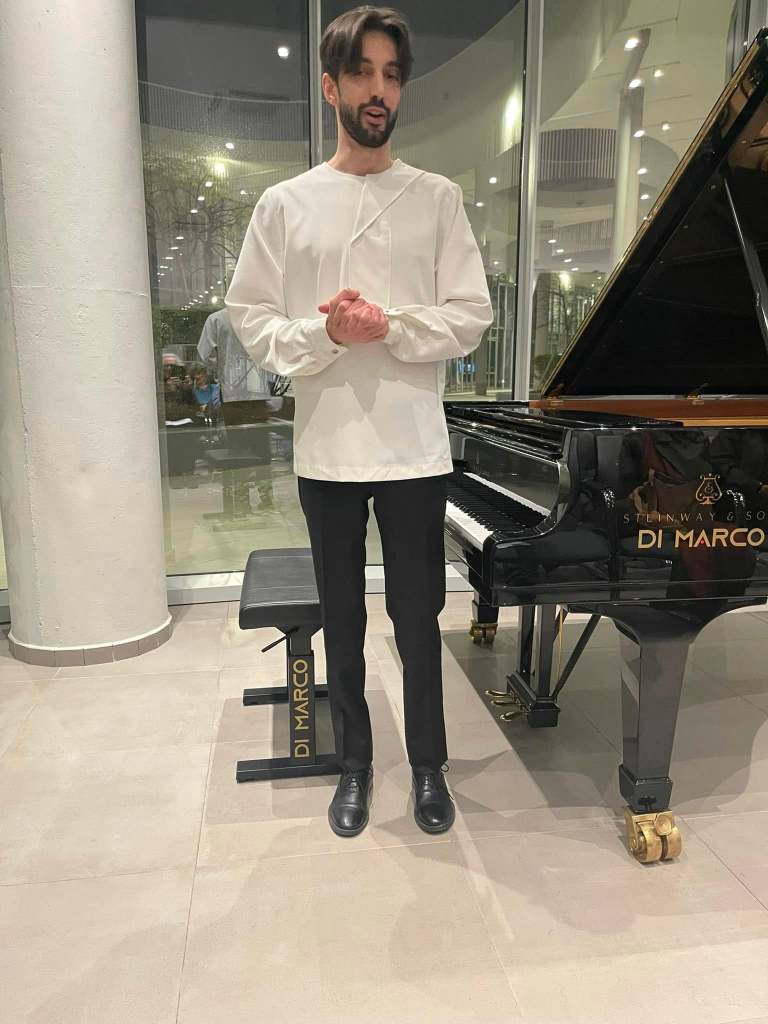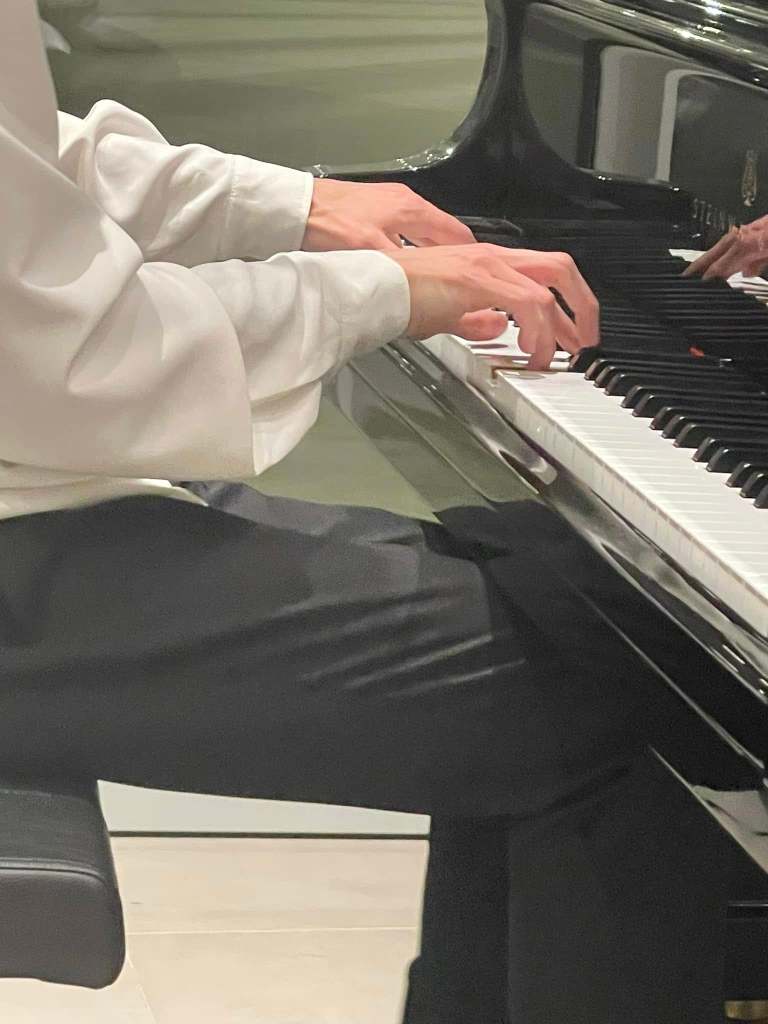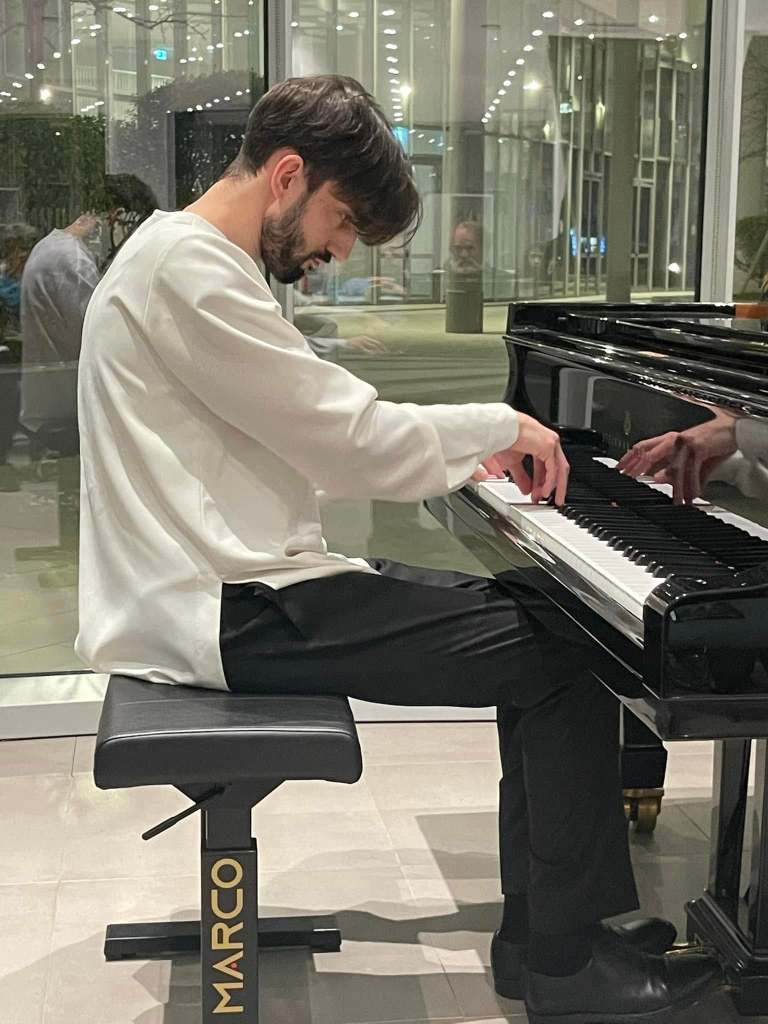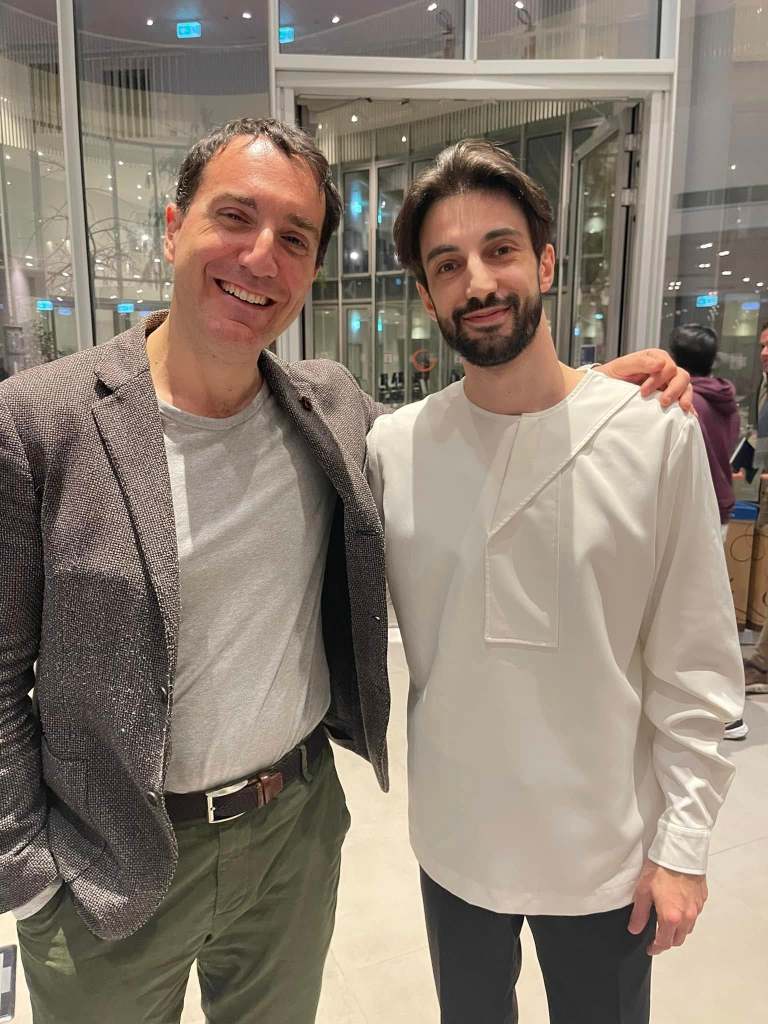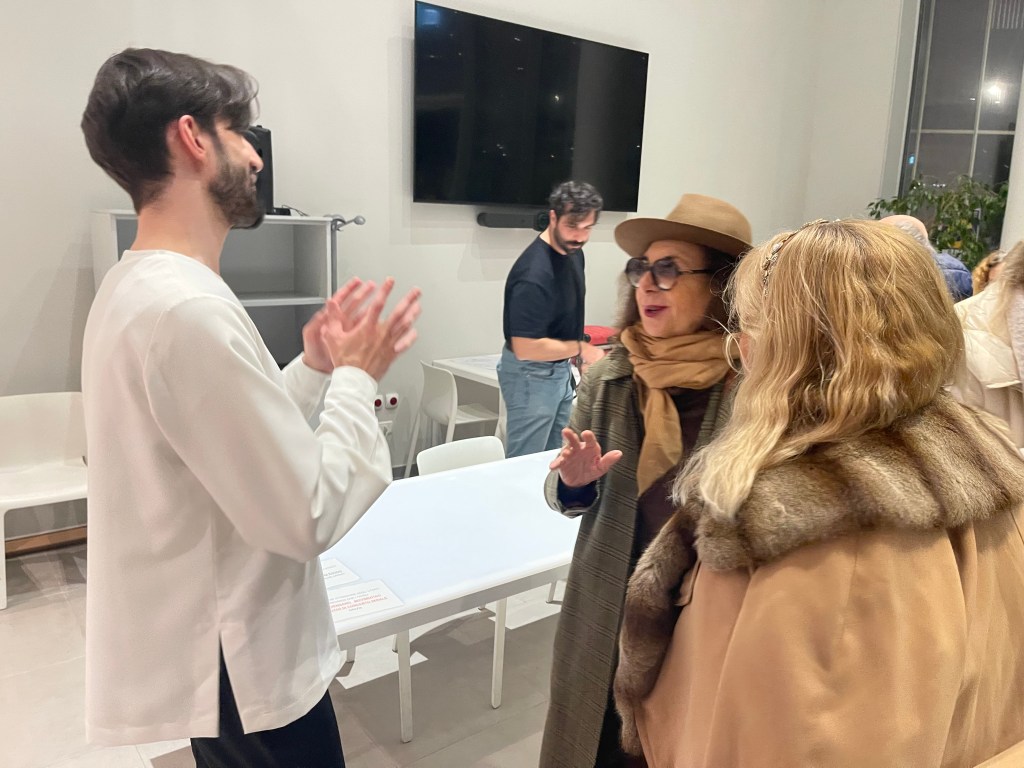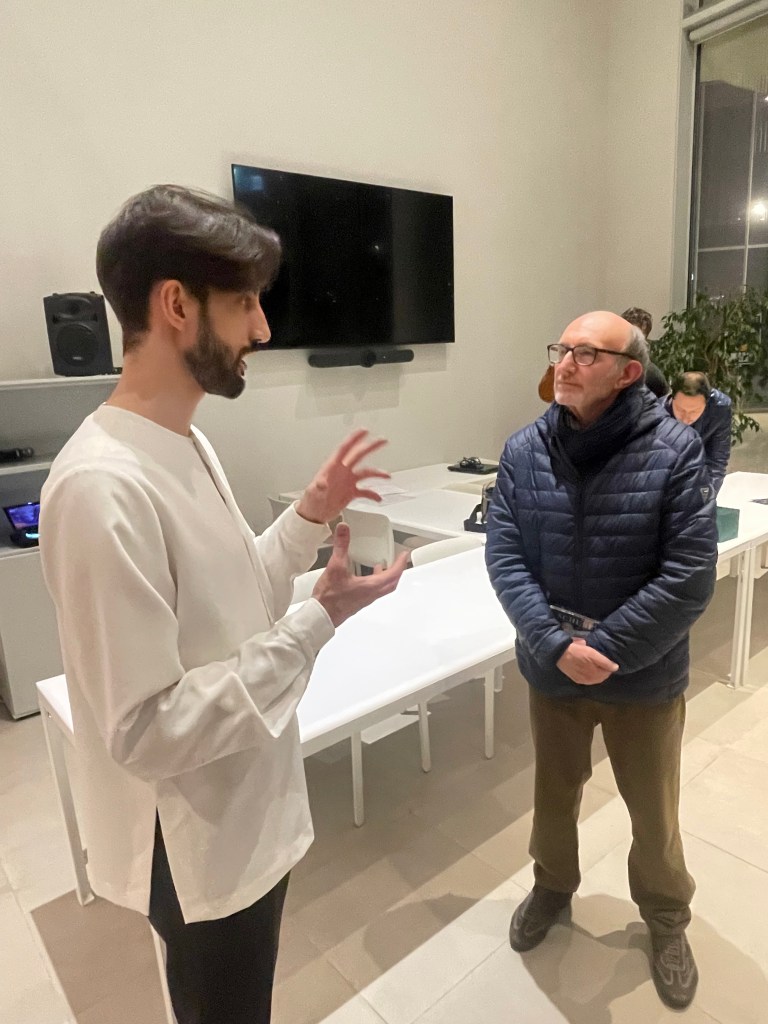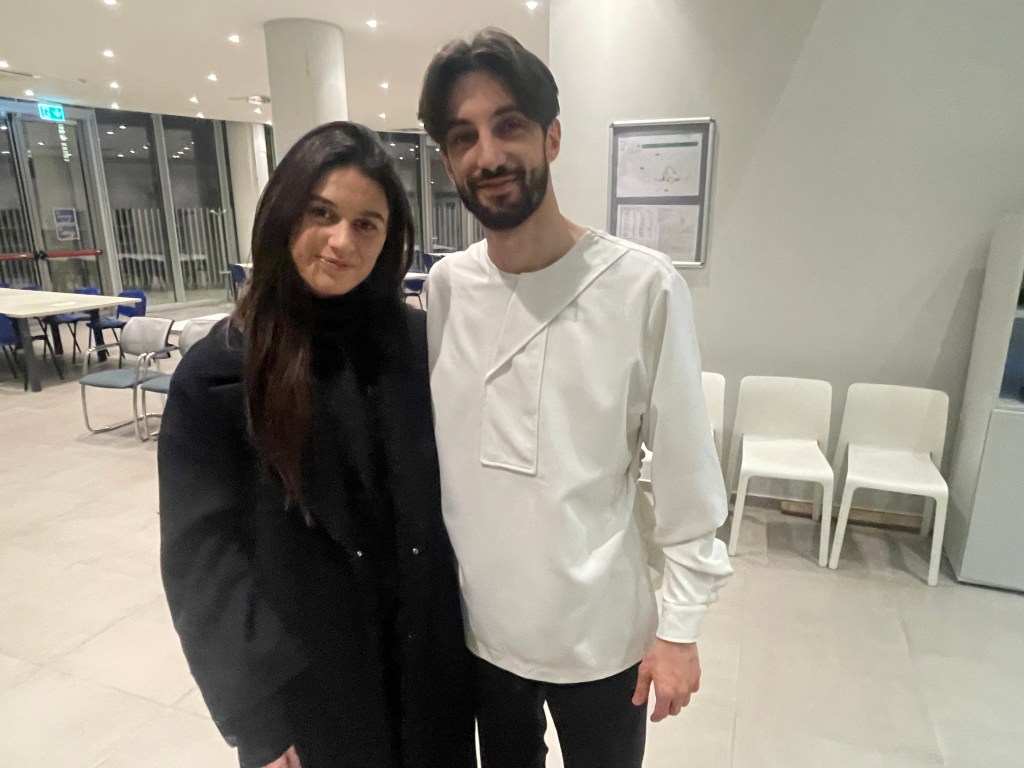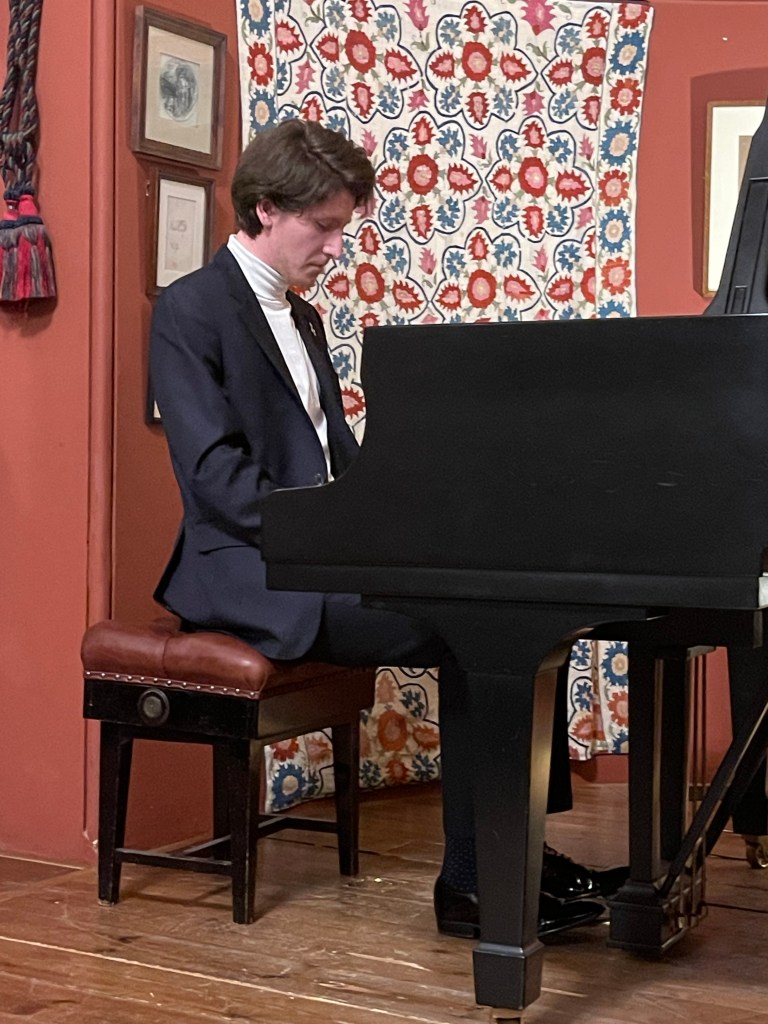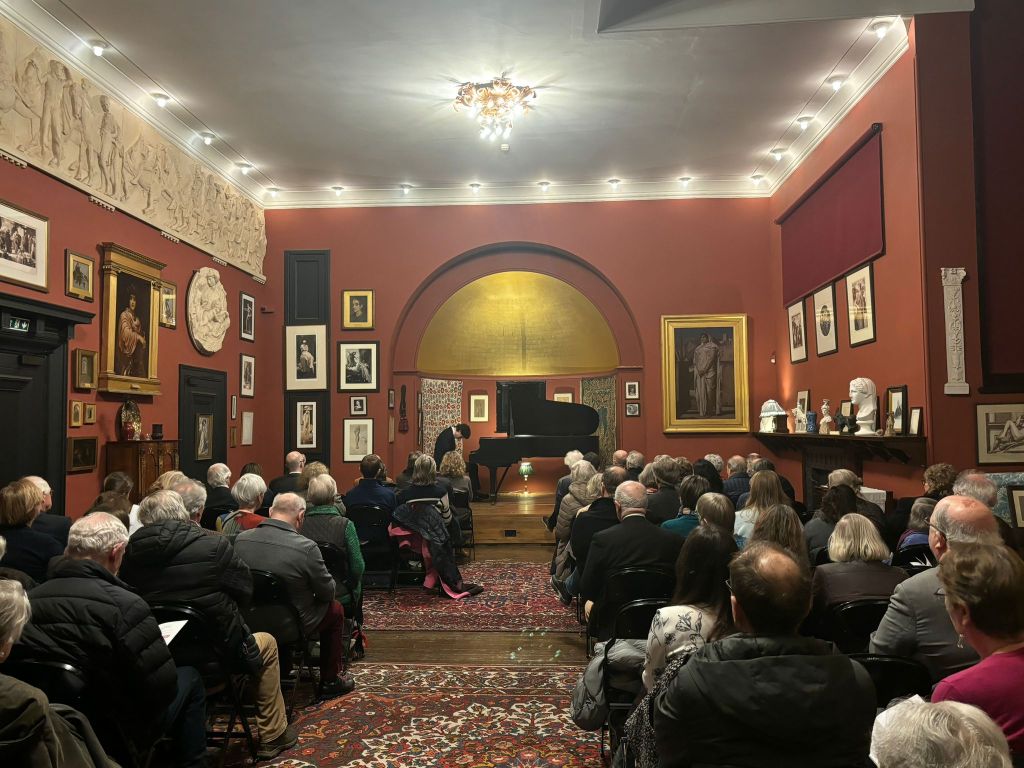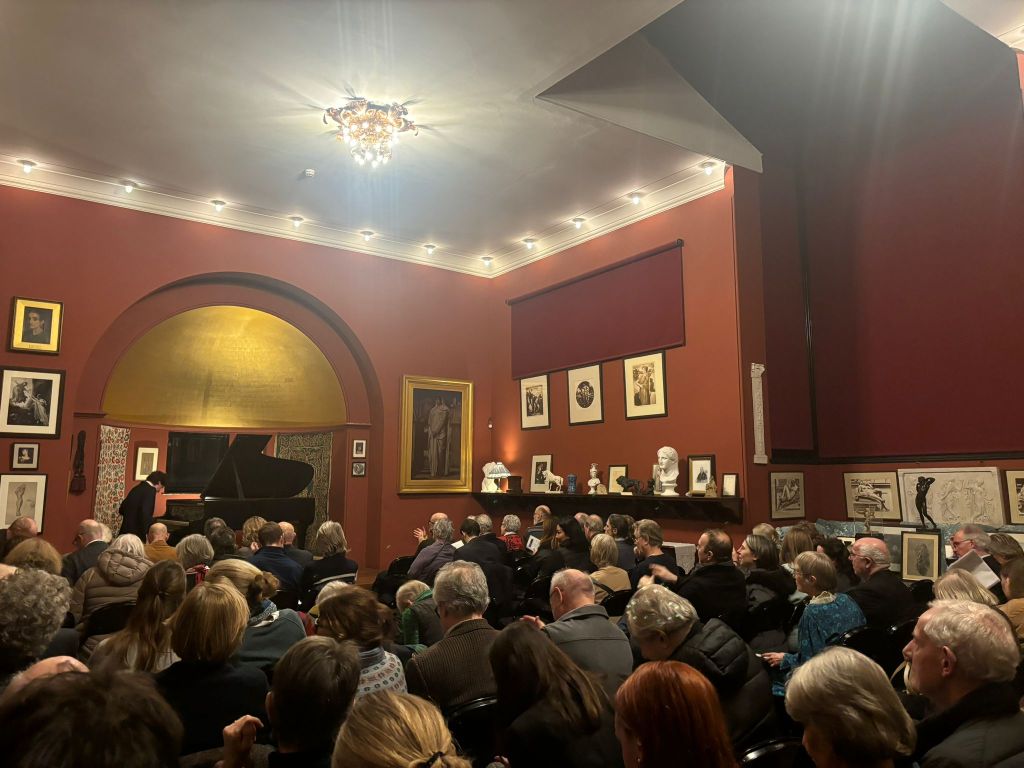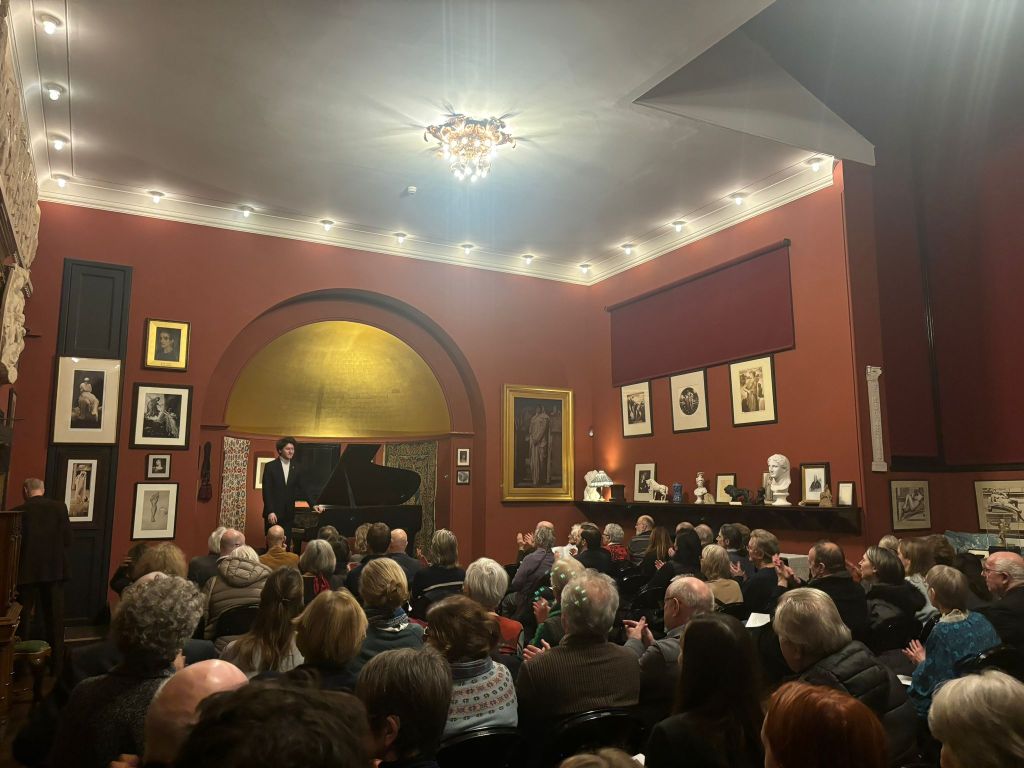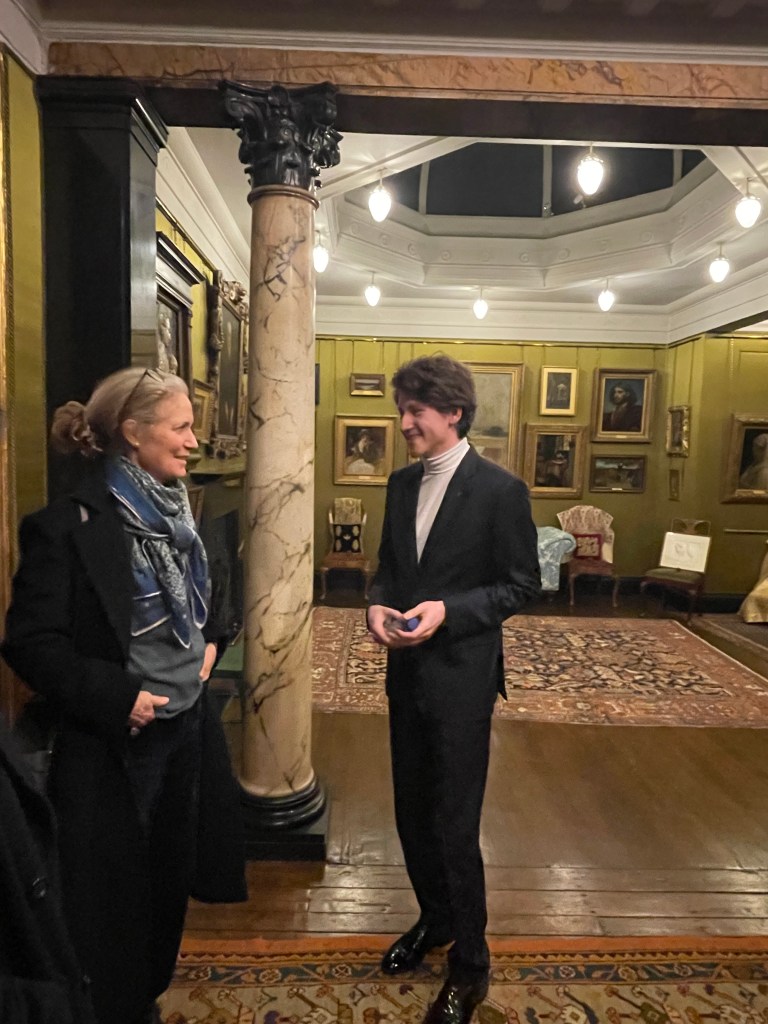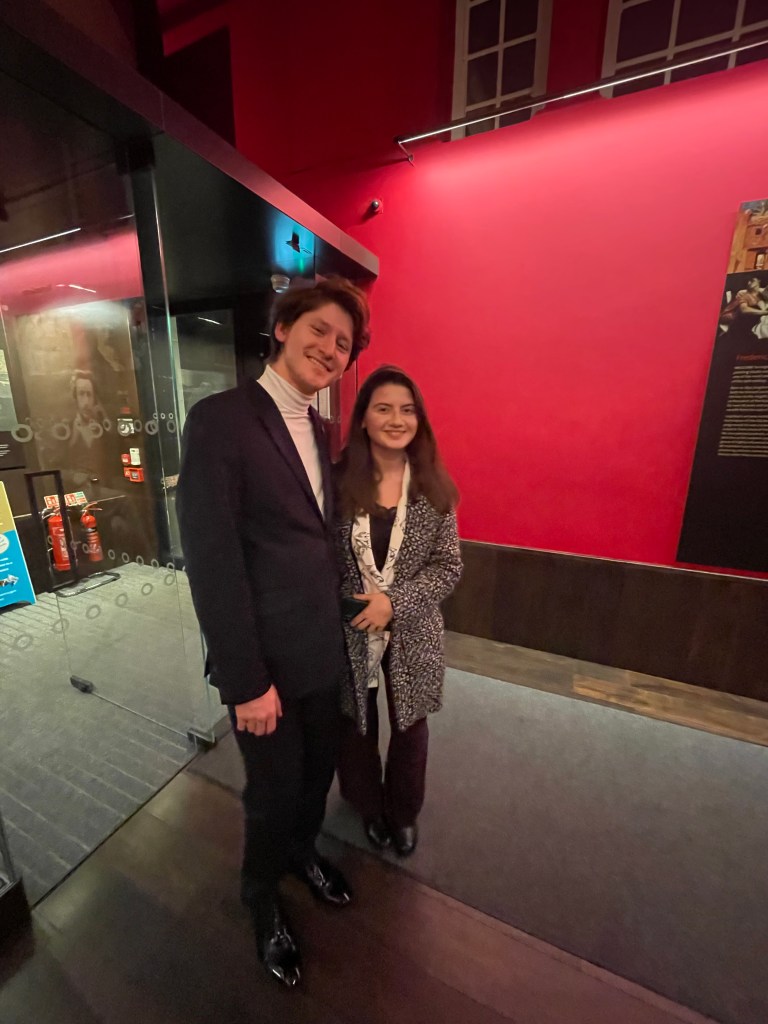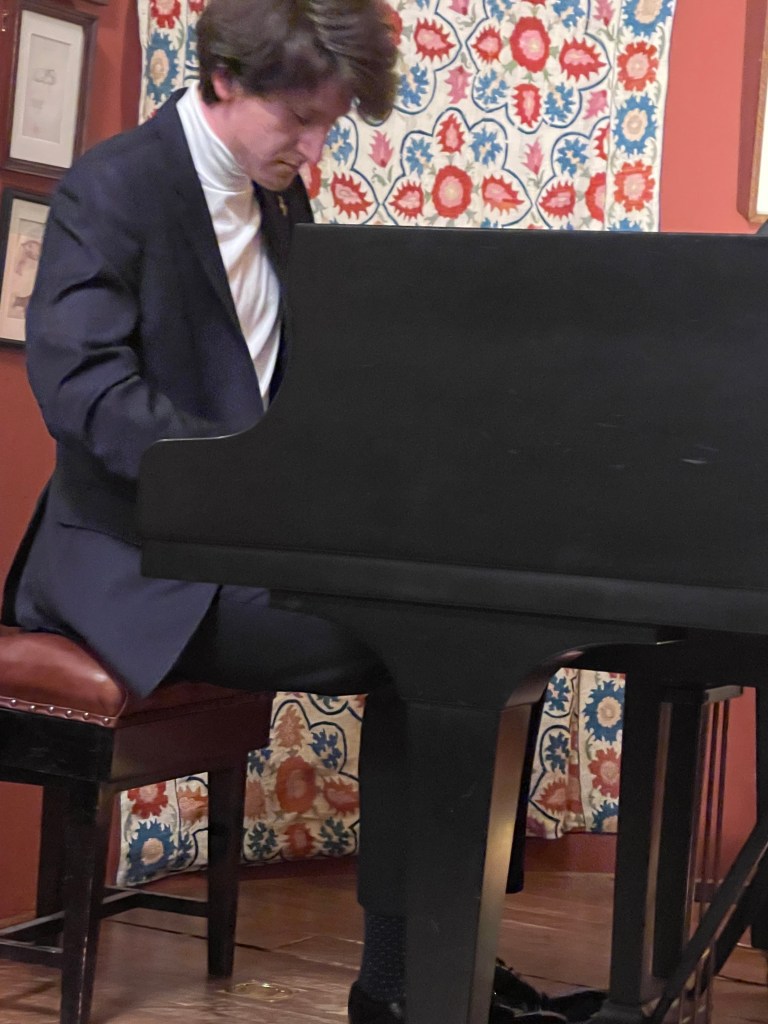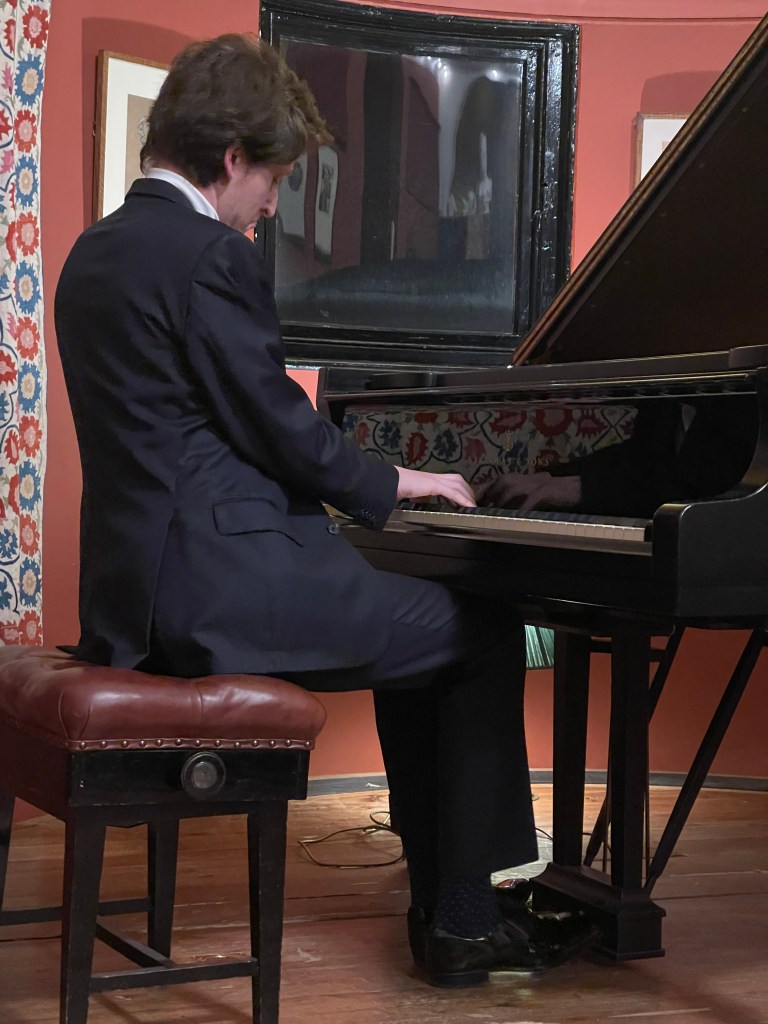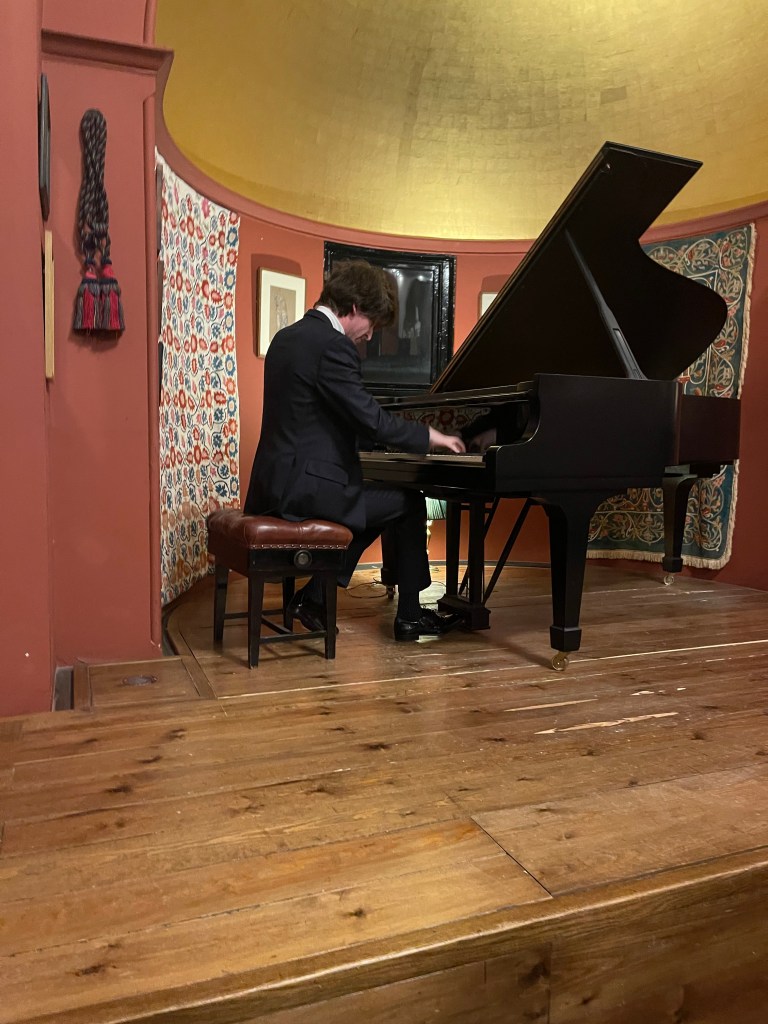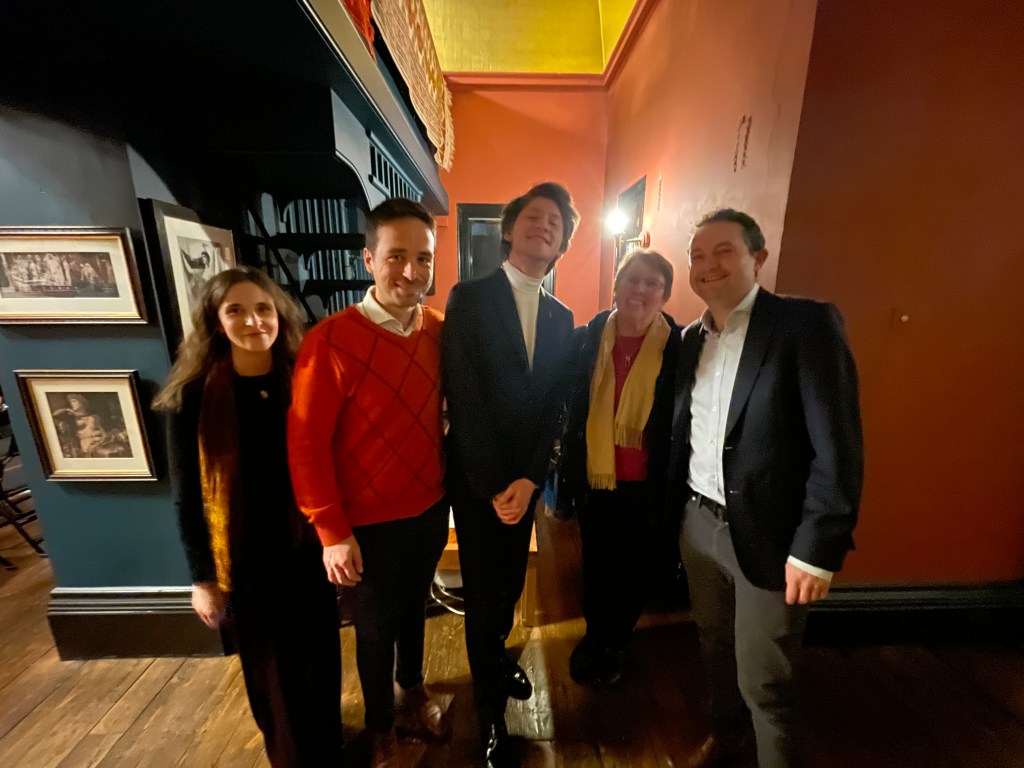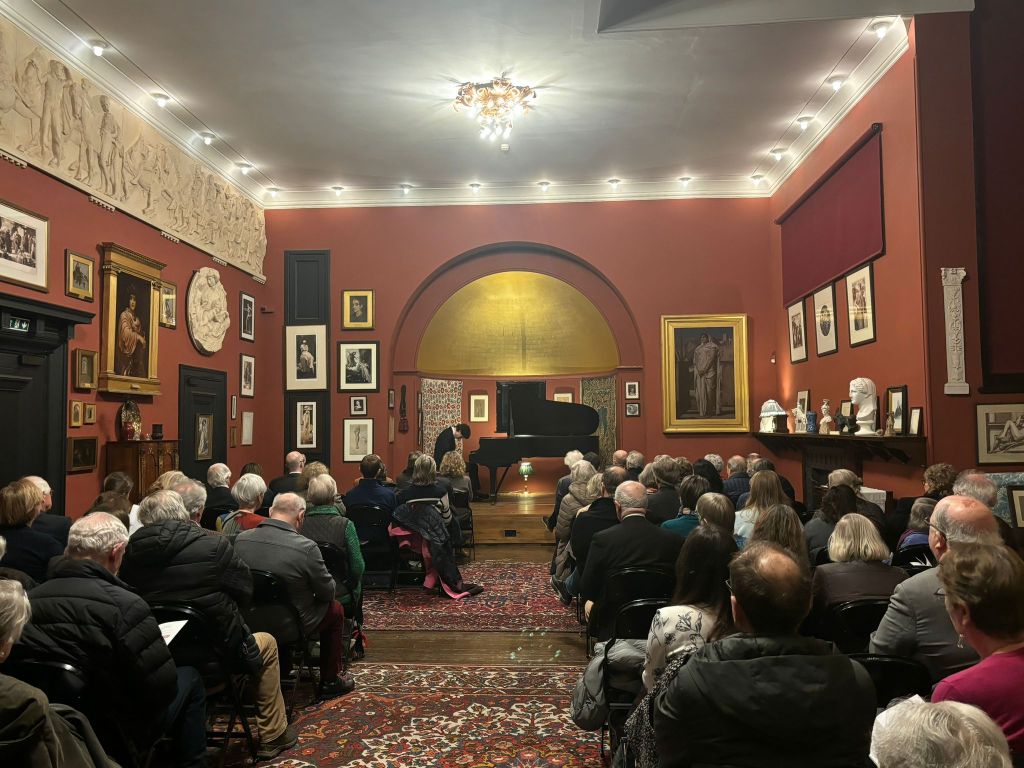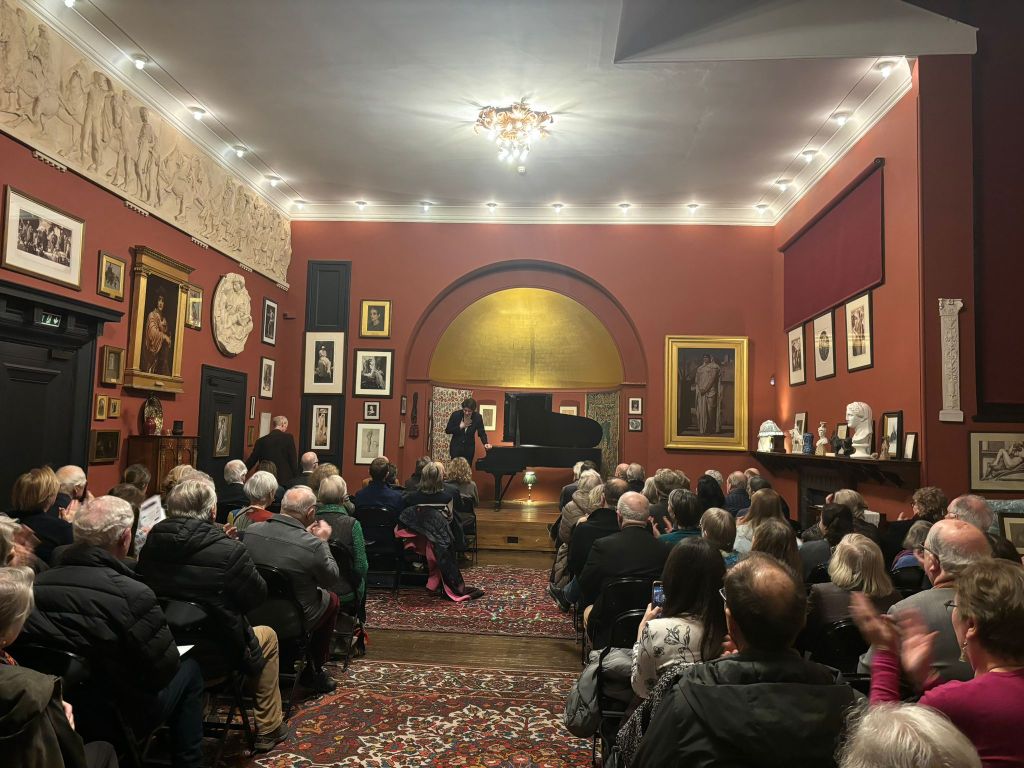
Can Arisoy ‘Dichterliebe’ a voyage of discovery for his first quarter of a century

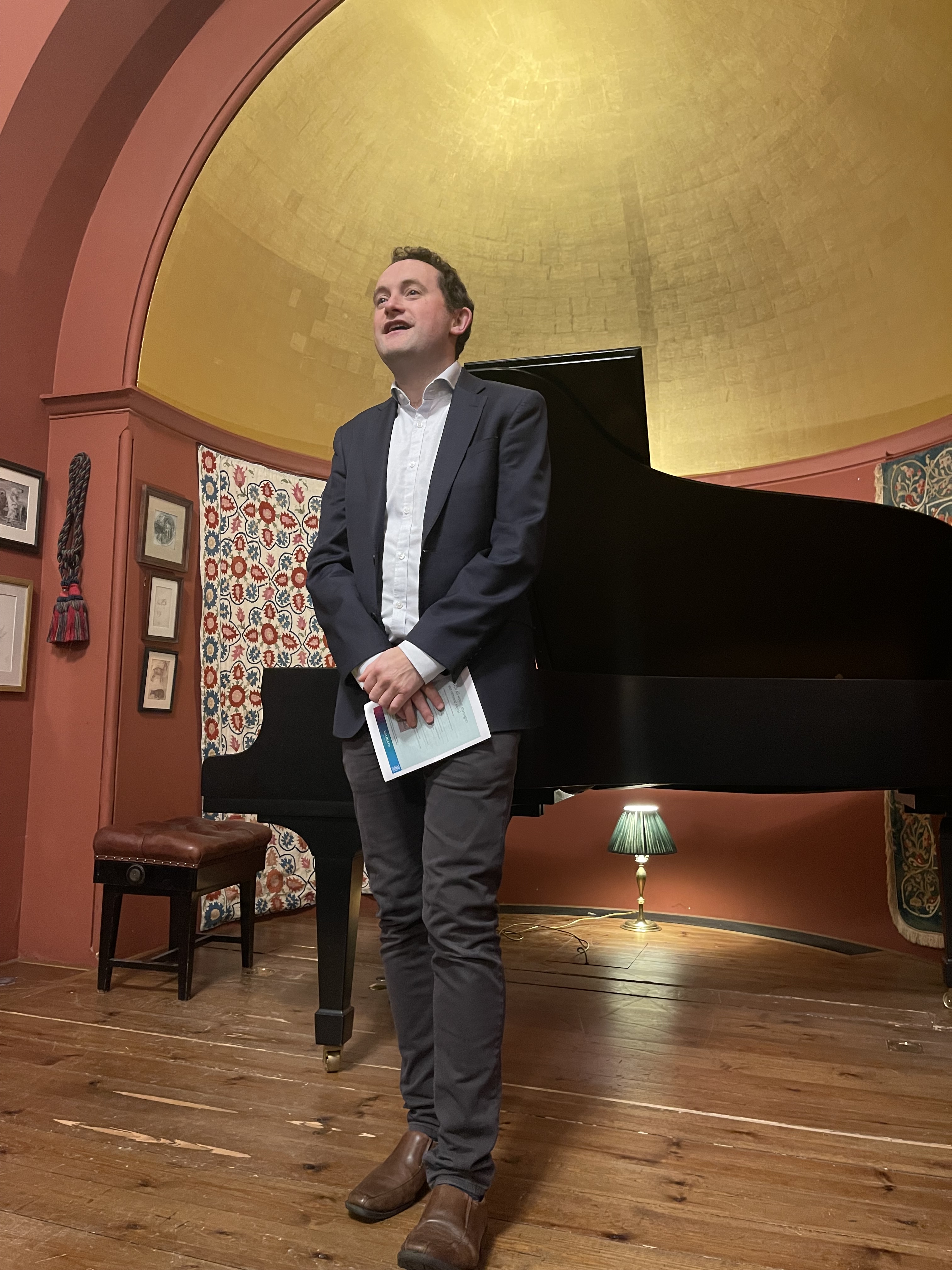
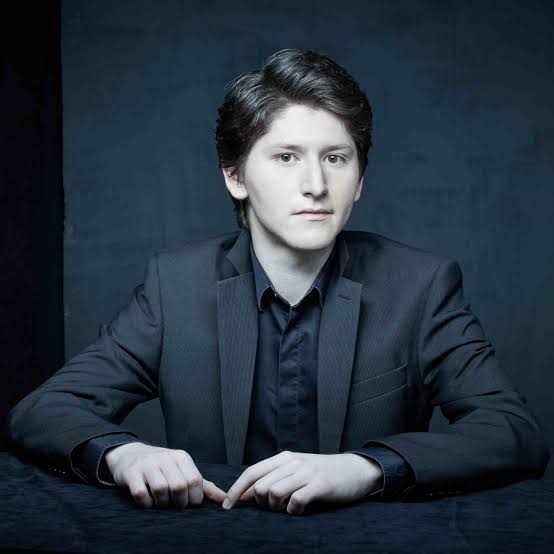
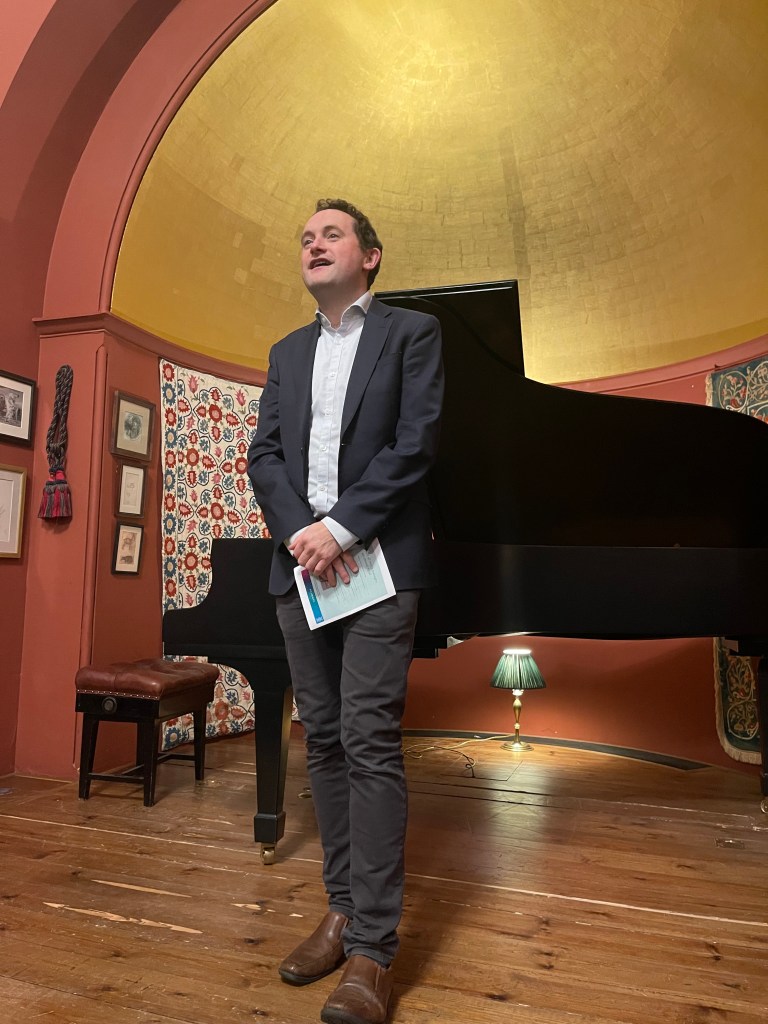
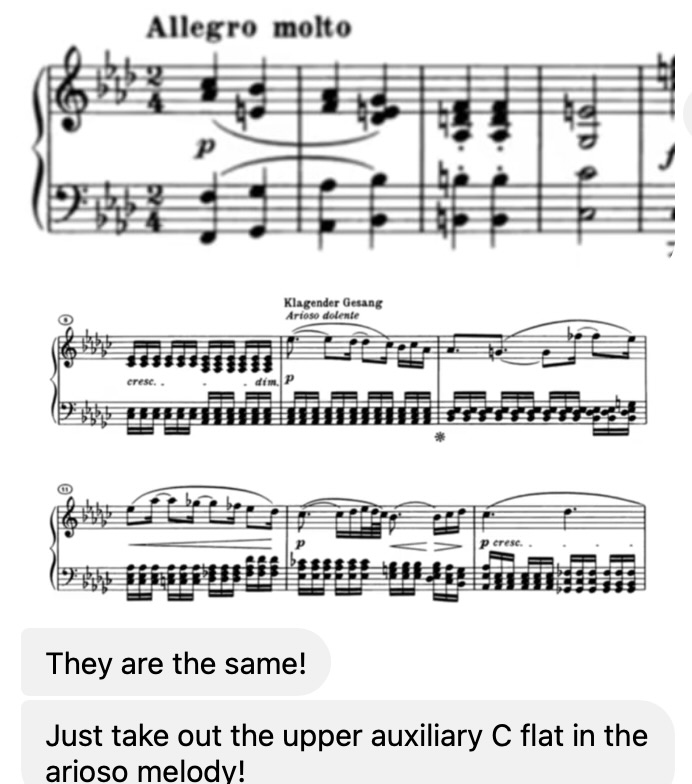
Can Arisoy became aware that there were actually no recordings of the transcriptions for solo piano of Schumann’s Dichterliebe even though there exist the transciptions of the Italian composer Gian Paolo Chiti. The transcriptions of Frédéric Meinders with Gian Paolo Chiti are strictly transcriptions but the pieces that Can wrote are solo piano arrangements where there was more freedom in the creative process.

Liszt seemed to ignore the better known songs of Schumann and as Leslie Howard notes : ‘Some of Liszt’s Schumann transcriptions have withstood all vagaries of fashion and have featured in the repertoire of every generation of pianists, while others remain sadly unknown, as do some of the Schumann originals. Liszt’s choice of Schumann seems largely to ignore the well known and to investigate some of the later, most intimate works. Andersen’s ‘Christmas Song’ is really a very simple hymn, and ‘The Changing Bells’ is a straightforward setting of a little moral fable by Goethe in which a recalcitrant boy is frightened by a dream of bells into going to church as his mother has told him.
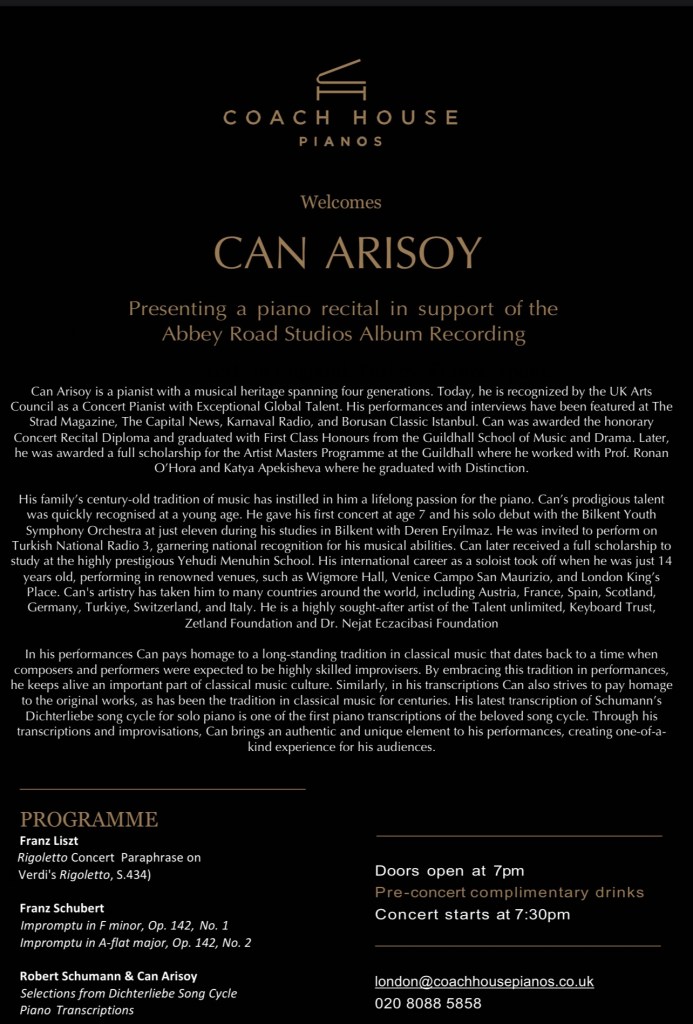
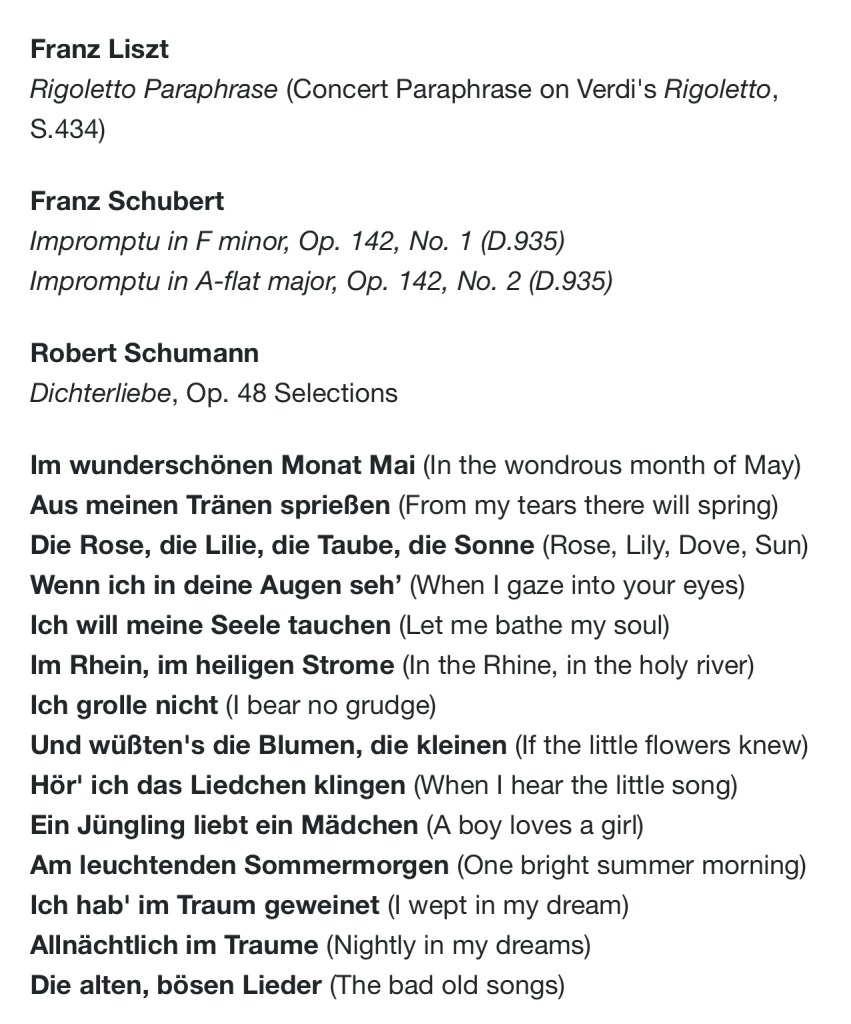
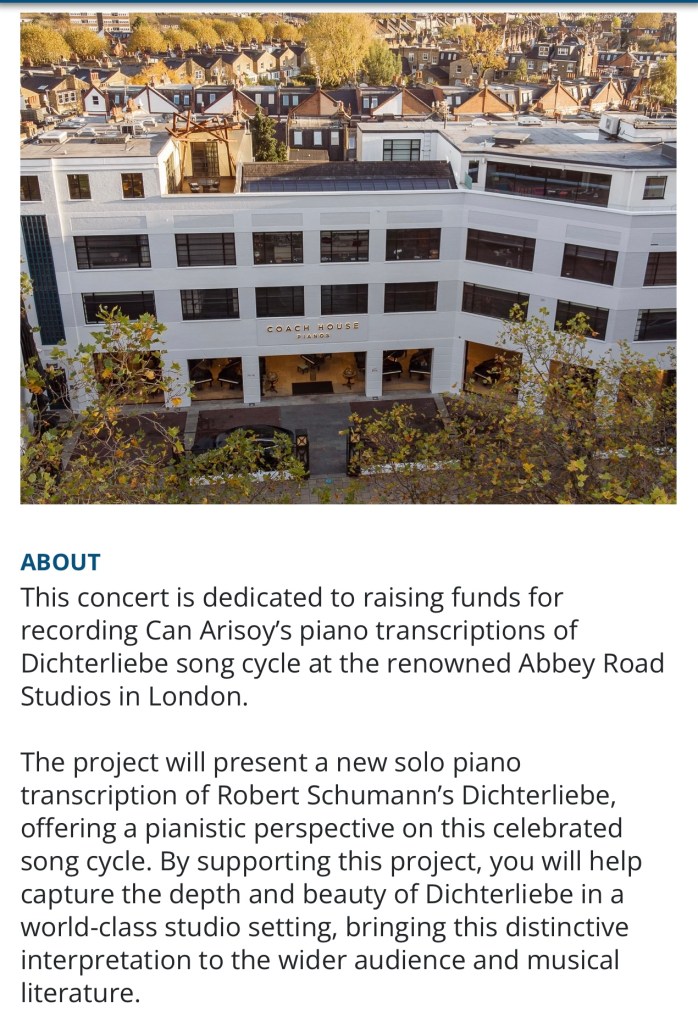
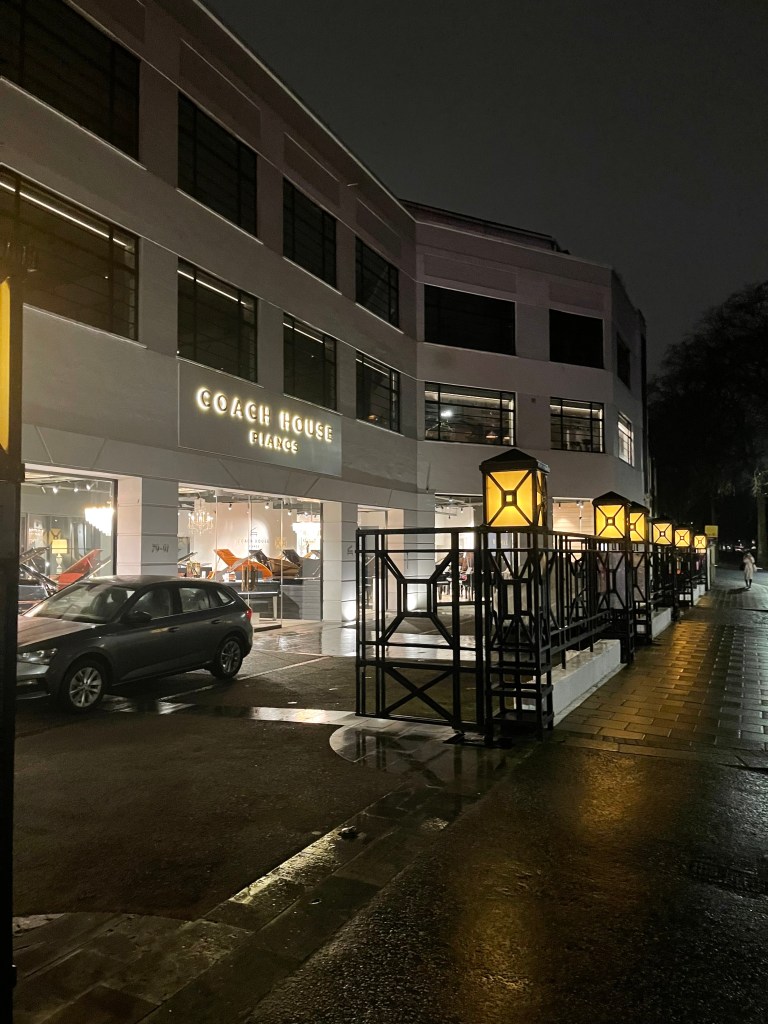
It may have been due to the appalling rudeness eventually shown to Liszt and his music by Clara Schumann—she removed his name from the dedication on Robert Schumann’s Fantasy, opus 17, and she rejected Liszt’s dedication to her of his Paganini Études. However Can has for sometime been preparing these transcriptions for piano solo and it is thanks to the encouragement of Coach House Pianos that there is a project to add a piano solo version of Dichterliebe to the CD catalogue.
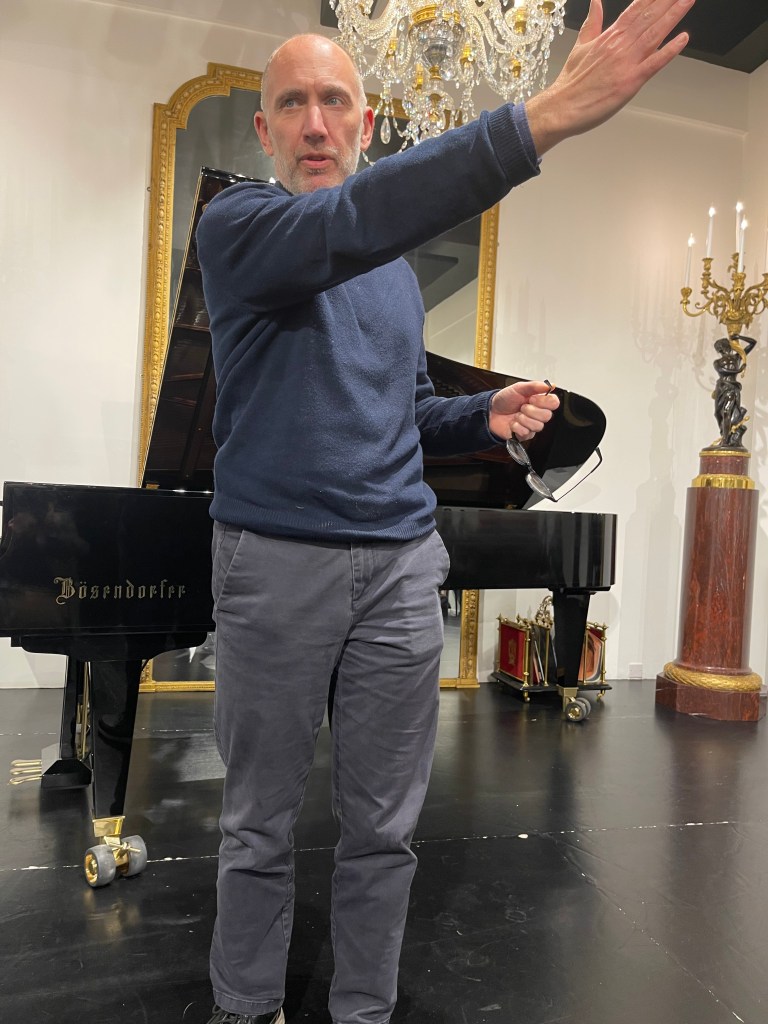
David Halford, Education Business Manager of Coach House Pianos

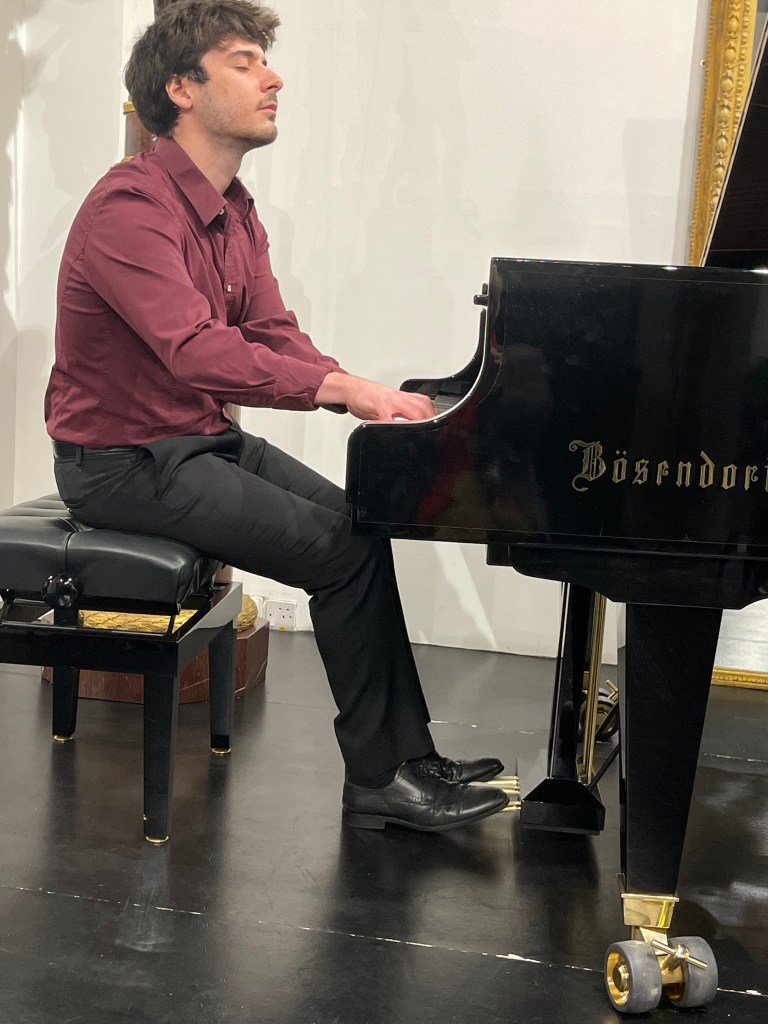
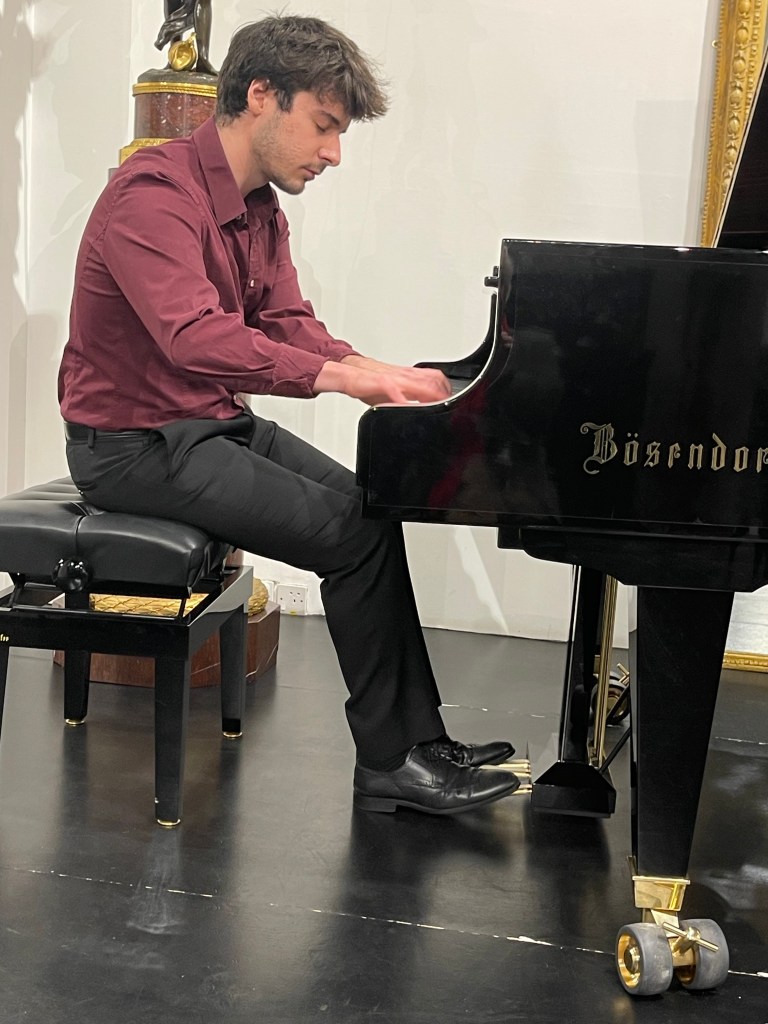
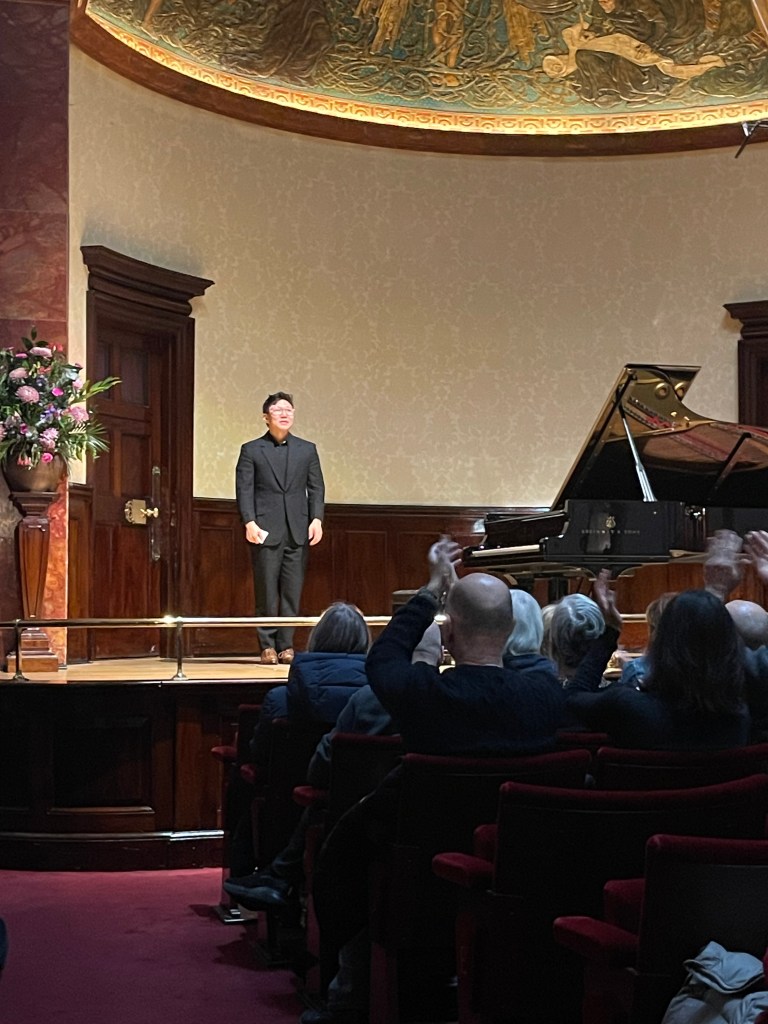
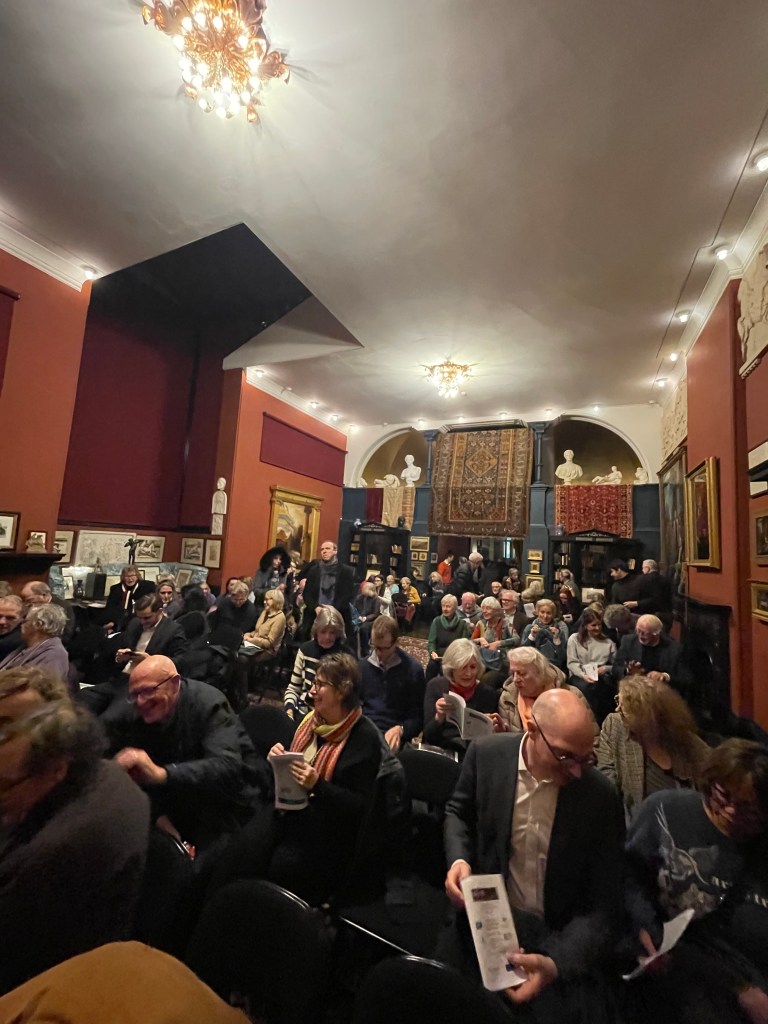
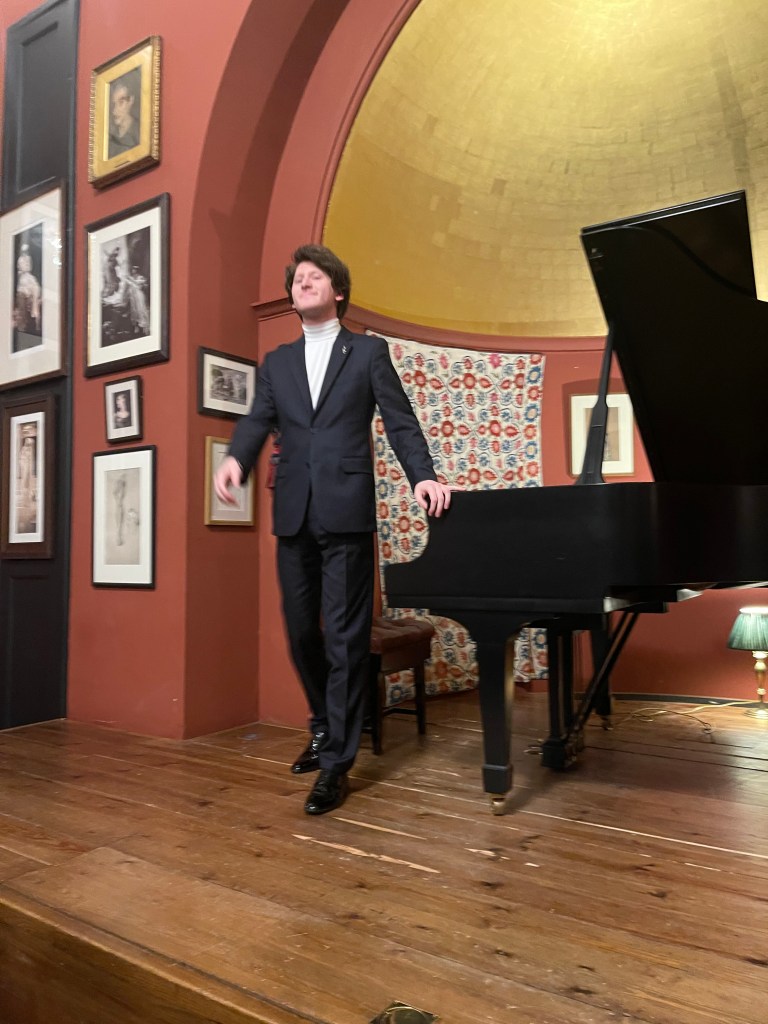
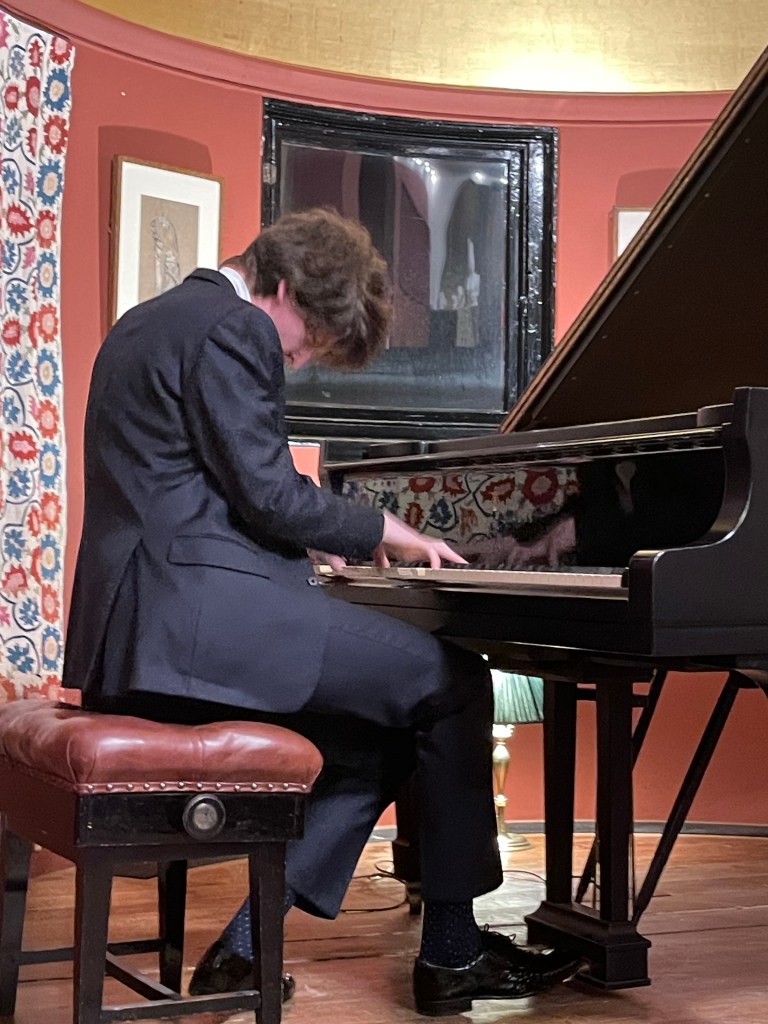
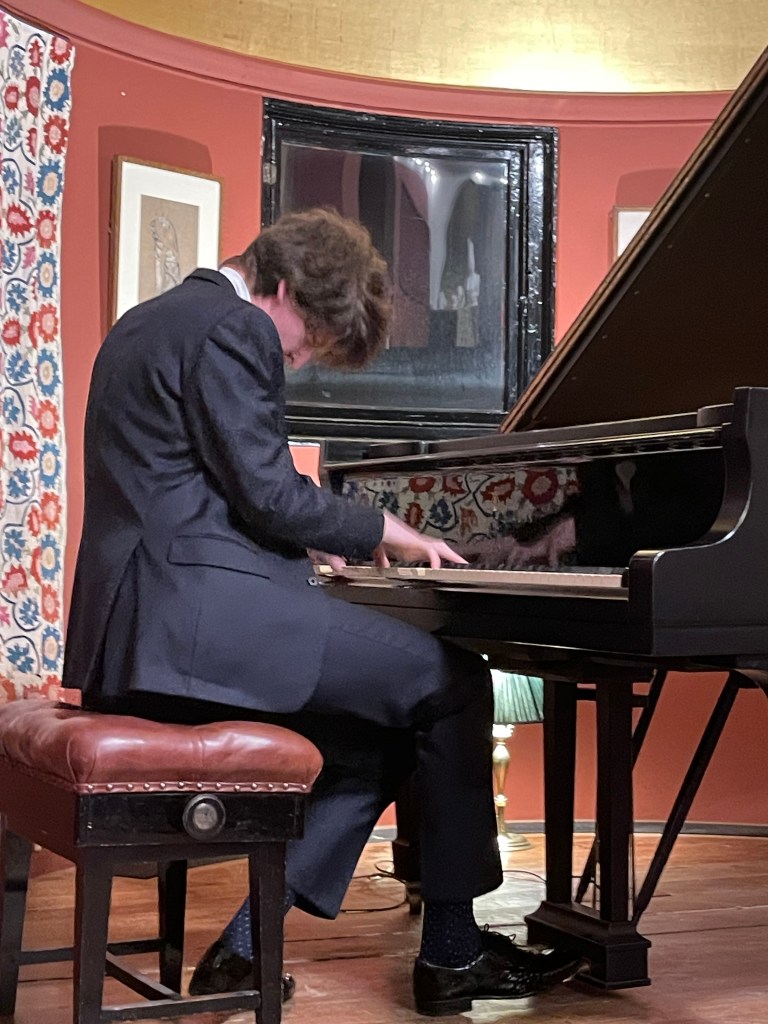
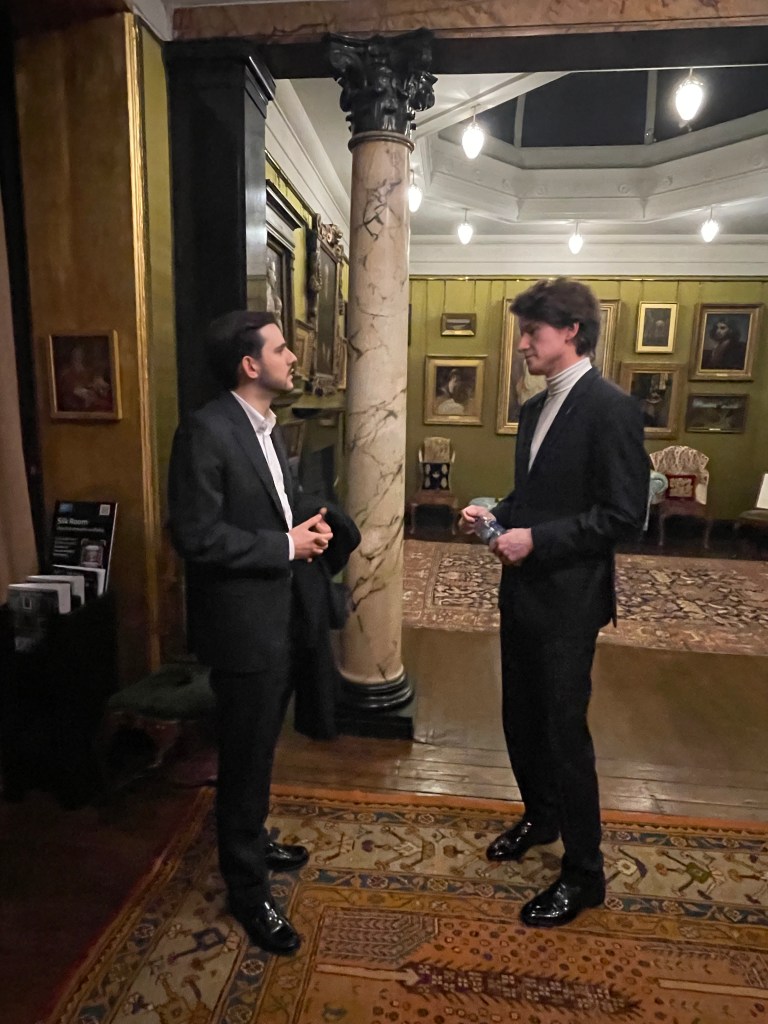
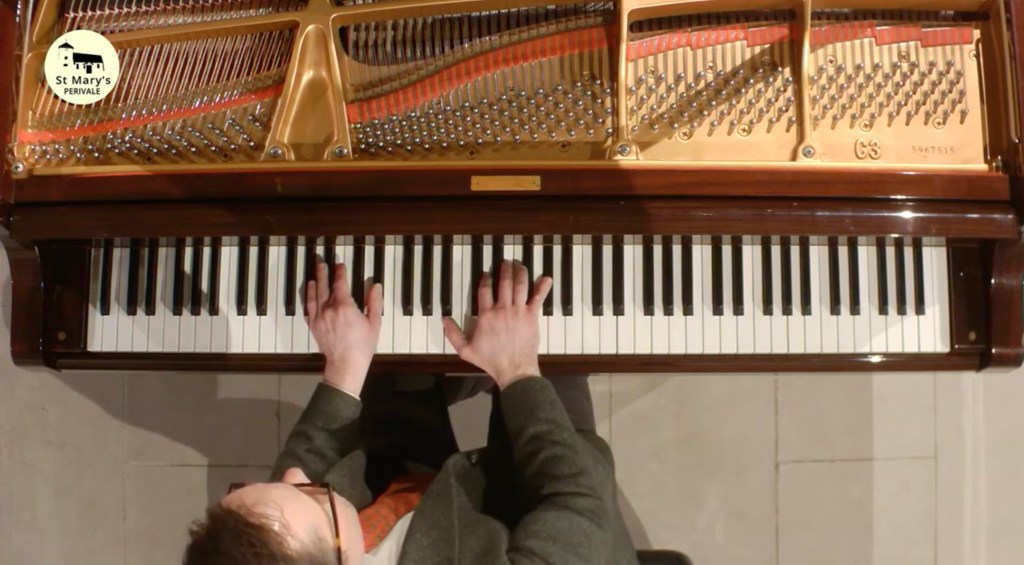
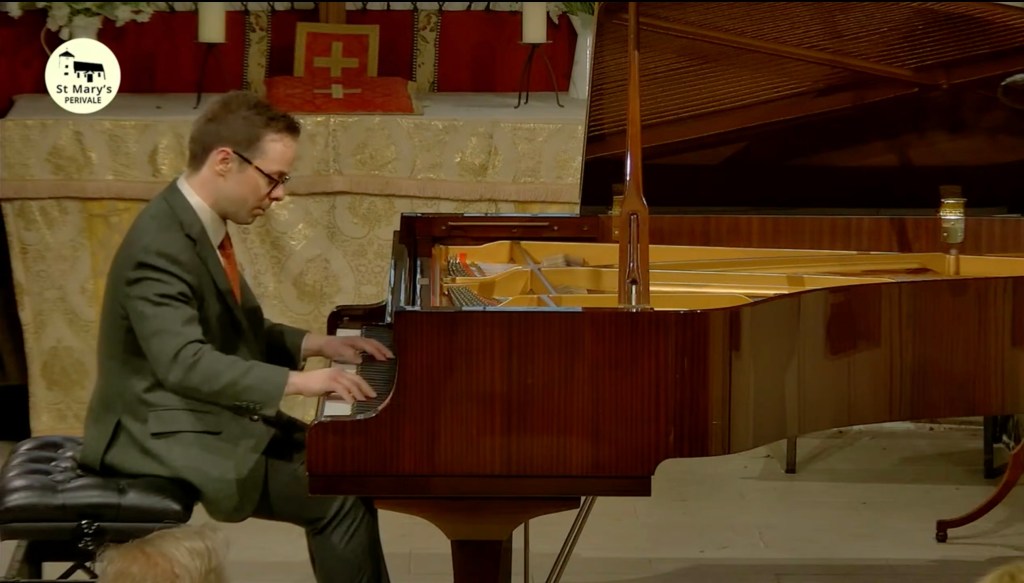
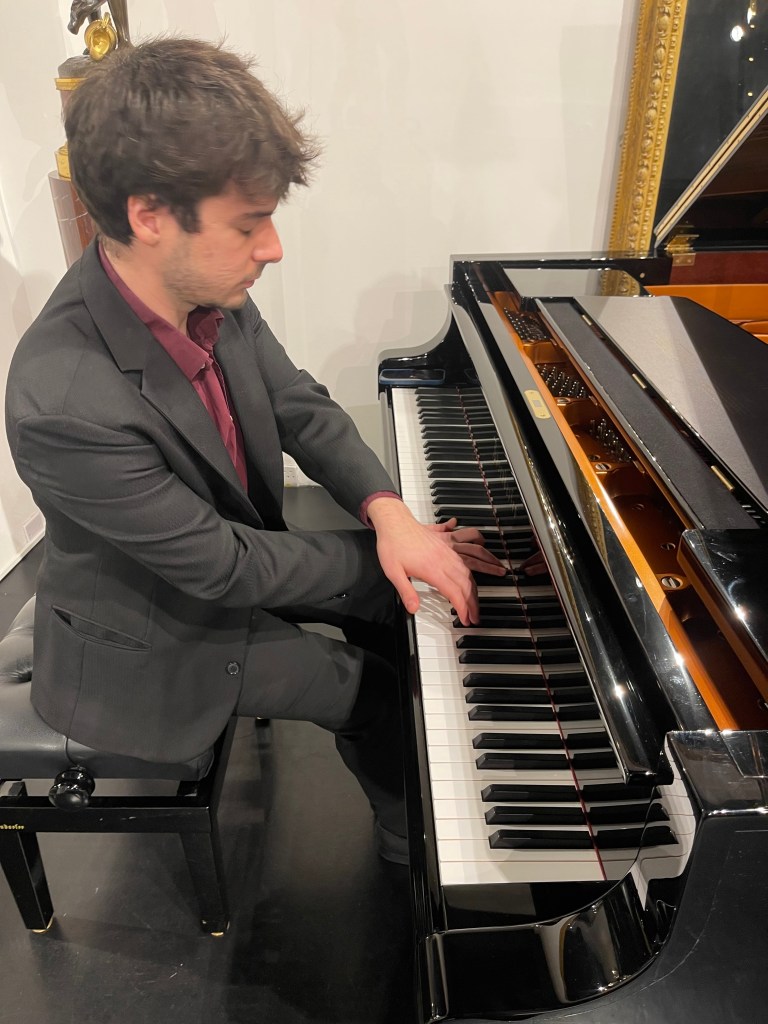
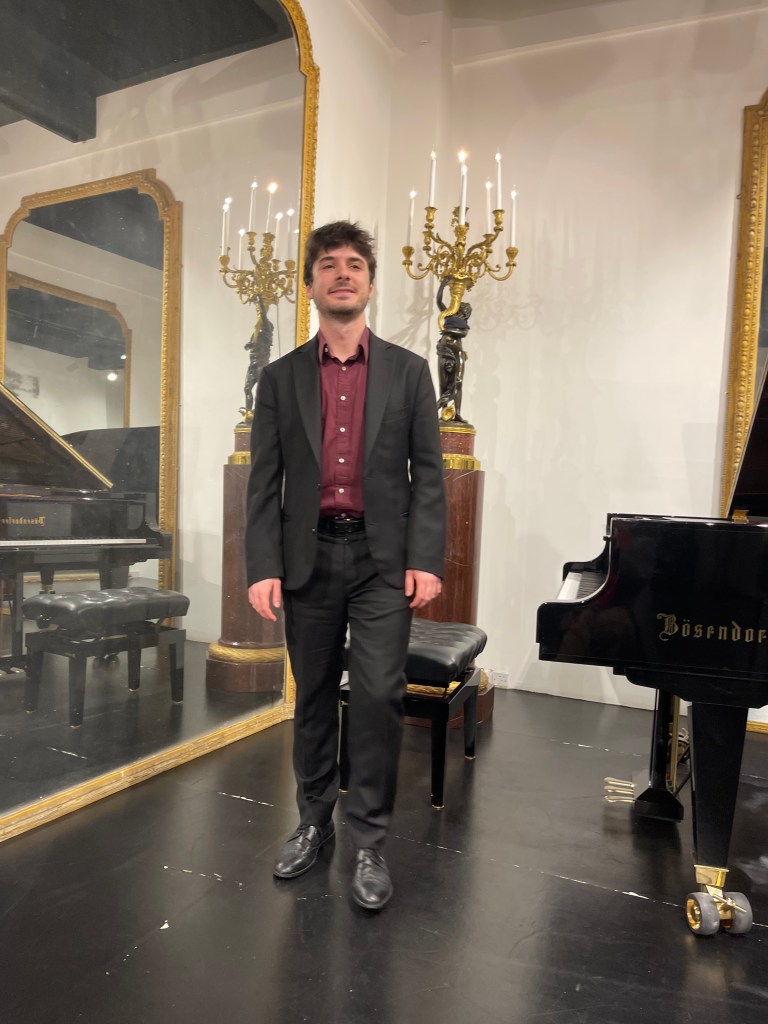
Can a true musician having received remarkable early training in musicianship from Marcel Baudet at the Yehudi Menuhin School,has dedicated his energy to creating these pianistic versions of Schumann, some more elaborate than others ( indeed one seemingly inspired by Pletnev). But basically the poetic message has been transformed into pianistic terms where so often music speaks much louder than words. How many great lieder are completed by the solo piano especially in the Dichterliebe reaching places where even the poetry of Heine is not enough? Playing a selection of 14 songs from the 16 of the Cycle, Can’s poetic playing created an atmosphere that filled the air, on his 25th birthday, with the rarified sounds of this magnificent Bösendorfer Imperial offered so generously by Can’s mentor at Coach House Pianos, David Halford.

Opening his birthday party with one of the most perfect of Liszt’s operatic transcriptions, that of Verdi’s ‘Rigloletto’. Played with operatic abandon and great style with ravishing sounds and scintillating virtuosity. Everything Can plays is pure music and never a hard or ungrateful sound is to be heard from his agile fingers. Following with two Impromptu’s from Schubert’s second set, written in the last year of his all too short 31 years, Can showed his musical pedigree as he shaped these final mellifluous outpourings with heartrending simplicity and architectural understanding.

Drama and poetry united as indeed he has aspired to do in his own transcriptions of Schumann.
Brazil 200 and Keyboard Trust 30 a collaboration born on wings of Brazilian song

Can Arisoy Keyboard Trust New Artists Recital

Can Arisoy Elfida su Turan Damir Durmanovic at St James’s Talent Unlimited presents music making at its most refined

https://christopheraxworthymusiccommentary.com/2023/12/12/point-and-counterpoint-2023-a-personal-view-by-christopher-axworthy/
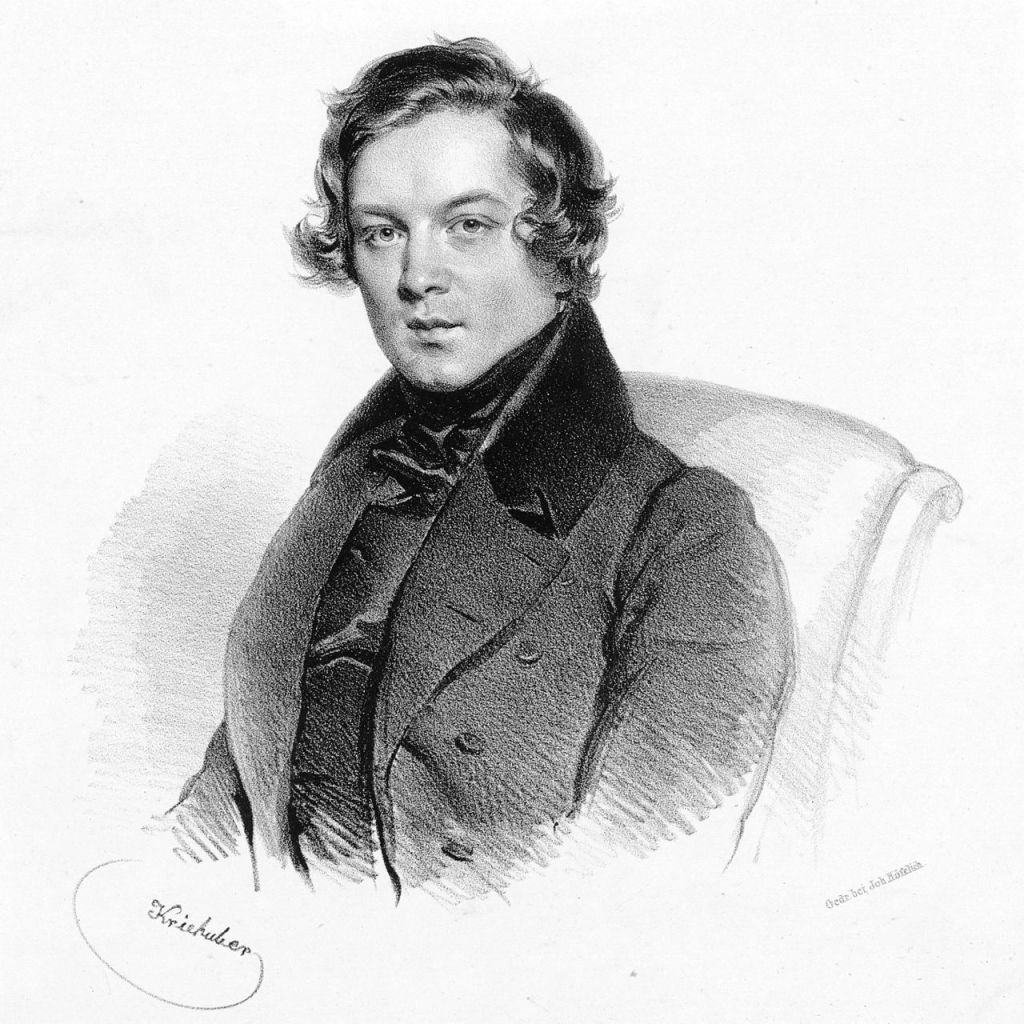
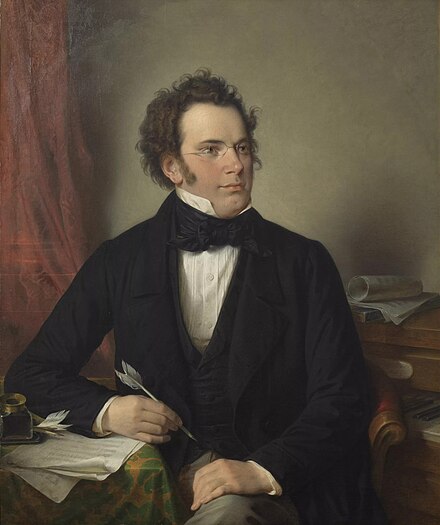
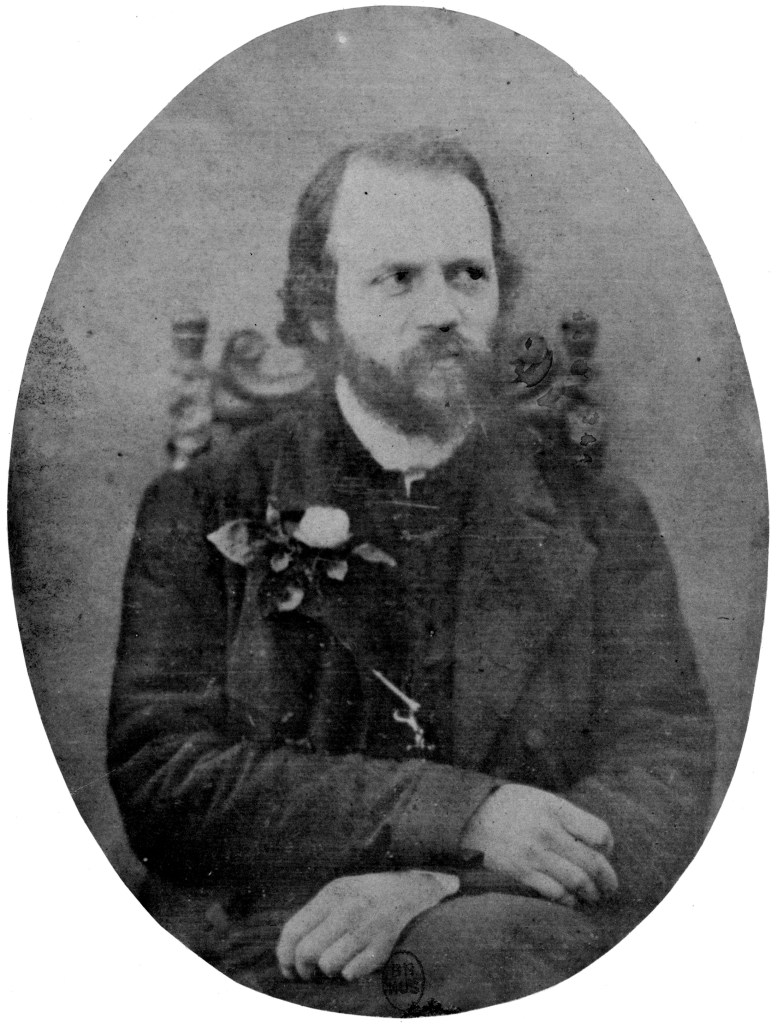
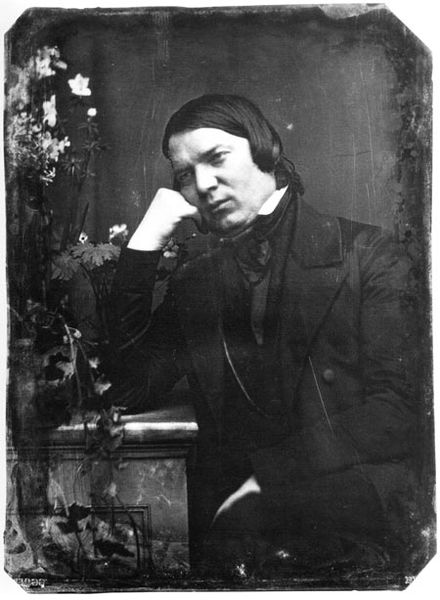
Robert Schumann in 1839

8 June 1810. Zwickau, Kingdom of Saxony – 29 July 1856 (aged 46) Bonn

DichterliebeA Poet’s Love  op 48 was composed by Robert Schumann in 1840. The texts for its 16 songs come from the Lyrisches Intermezzo by Heinrich Heine, written in 1822–23 and published as part of Heine’s Das Buch der Lieder.The songs were composed in 1840, and the first edition of Dichterliebe was published in two volumes by Peters, in Leipzig , in 1844. In the original 1840 version with the 20 songs (originally dedicated to Felix Mendelssohn Bartholdy), the cycle had the following, longer title: “Gedichte von Heinrich Heine – 20 Lieder und Gesänge aus dem Lyrischen Intermezzo im Buch der Lieder (“Poetry by Heinrich Heine – 20 Lyrics and Songs from the Lyric Intermezzo in the Book of Songs”)”. Though Schumann originally set 20 songs to Heine’s poems, only 16 of the 20 were included in the first edition. Dein Angesicht (Heine no. 5) is one of the omitted items. Auf Flügeln des Gesanges, On Wings of Song (Heine no 9), is best known from a setting by Mendelssohn.

The famed introduction to the first song, Im wunderschönen Monat Mai, is a direct quotation from Clara Wieck’s Piano Concerto in A minor (1835). It comes from the third beat of measure 30 through the second beat of measure 34 of the second movement. Robert uses the same key, same melodic pattern, similar accompaniment textures, tempo and rhythmic patterns in measures 1 through 4 of the opening to Dichterliebe.

Although often associated with the male voice, Dichterliebe was dedicated to the soprano Wilhelmina Schröder-Devrient] so the precedent for performance by female voice is primary. The first complete public recital of the work in London was given by Harry Plunket Greene , accompanied from memory by Leonard Borwick, on 11 January 1895 at London’s St James’s Hall.

  1. Im wunderschönen Monat Mai (Heine, Lyrical Intermezzo no 1). (“In beautiful May, when the buds sprang, love sprang up in my heart: in beautiful May, when the birds all sang, I told you my desire and longing.”)
  2. Aus meinen Tränen sprießen (Heine no 2). (“Many flowers spring up from my tears, and a nightingale choir from my sighs: If you love me, I’ll pick them all for you, and the nightingale will sing at your window.”)
  3. Die Rose, die Lilie, die Taube, die Sonne (Heine no 3). (“I used to love the rose, lily, dove and sun, joyfully: now I love only the little, the fine, the pure, the One: you yourself are the source of them all.”)
  4. Wenn ich in deine Augen seh (Heine no 4). (“When I look in your eyes all my pain and woe fades: when I kiss your mouth I become whole: when I recline on your breast I am filled with heavenly joy: and when you say, ‘I love you’, I weep bitterly.”)
  5. Ich will meine Seele tauchen (Heine no 7). (“I want to bathe my soul in the chalice of the lily, and the lily, ringing, will breathe a song of my beloved. The song will tremble and quiver, like the kiss of her mouth which in a wondrous moment she gave me.”)
  6. Im Rhein, im heiligen Strome (Heine no 11). (“In the Rhine, in the sacred stream, great holy Cologne with its great cathedral is reflected. In it there is a face painted on golden leather, which has shone into the confusion of my life. Flowers and cherubs float about Our Lady: the eyes, lips and cheeks are just like those of my beloved.”)
  7. Ich grolle nicht (Heine no 18). (“I do not chide you, though my heart breaks, love ever lost to me! Though you shine in a field of diamonds, no ray falls into your heart’s darkness. I have long known it: I saw the night in your heart, I saw the serpent that devours it: I saw, my love, how empty you are.”)
  8. Und wüßten’s die Blumen, die kleinen (Heine no 22). (“If the little flowers only knew how deeply my heart is wounded, they would weep with me to heal my suffering, and the nightingales would sing to cheer me, and even the starlets would drop from the sky to speak consolation to me: but they can’t know, for only One knows, and it is she that has torn my heart asunder.”)
  9. Das ist ein Flöten und Geigen (Heine no 20). (“There is a blaring of flutes and violins and trumpets, for they are dancing the wedding-dance of my best-beloved. There is a thunder and booming of kettle-drums and shawms. In between, you can hear the good cupids sobbing and moaning.”)
  10. Hör’ ich das Liedchen klingen (Heine no 40). (“When I hear that song which my love once sang, my breast bursts with wild affliction. Dark longing drives me to the forest hills, where my too-great woe pours out in tears.”)
  11. Ein Jüngling liebt ein Mädchen (Heine no 39). (“A youth loved a maiden who chose another: the other loved another girl, and married her. The maiden married, from spite, the first and best man that she met with: the youth was sickened at it. It’s the old story, and it’s always new: and the one whom she turns aside, she breaks his heart in two.”)
  12. Am leuchtenden Sommermorgen (Heine no 45). (“On a sunny summer morning I went out into the garden: the flowers were talking and whispering, but I was silent. They looked at me with pity, and said, ‘Don’t be cruel to our sister, you sad, death-pale man.'”)
  13. Ich hab’ im Traum geweinet (Heine no 55). (“I wept in my dream, for I dreamt you were in your grave: I woke, and tears ran down my cheeks. I wept in my dreams, thinking you had abandoned me: I woke, and cried long and bitterly. I wept in my dream, dreaming you were still good to me: I woke, and even then my floods of tears poured forth.”)
  14. Allnächtlich im Traume (Heine no 56). (“I see you every night in dreams, and see you greet me friendly, and crying out loudly I throw myself at your sweet feet. You look at me sorrowfully and shake your fair head: from your eyes trickle the pearly tear-drops. You say a gentle word to me and give me a sprig of cypress: I awake, and the sprig is gone, and I have forgotten what the word was.”)
  15. Aus alten Märchen winkt es (Heine no 43). “(The old fairy tales tell of a magic land where great flowers shine in the golden evening light, where trees speak and sing like a choir, and springs make music to dance to, and songs of love are sung such as you have never heard, till wondrous sweet longing infatuates you! Oh, could I only go there, and free my heart, and let go of all pain, and be blessed! Ah! I often see that land of joys in dreams: then comes the morning sun, and it vanishes like smoke.”)
  16. Die alten, bösen Lieder (Heine no 65). (“The old bad songs, and the angry, bitter dreams, let us now bury them, bring a large coffin. I shall put very much therein, I shall not yet say what: the coffin must be bigger than the great tun at Heidelberg. And bring a bier of stout, thick planks, they must be longer than the Bridge at Mainz. And bring me too twelve giants, who must be mightier than the Saint Christopher in the cathedral at Cologne. They must carry away the coffin and throw it in the sea, because a coffin that large needs a large grave to put it in. Do you know why the coffin must be so big and heavy? I will put both my love and my suffering into it.”)
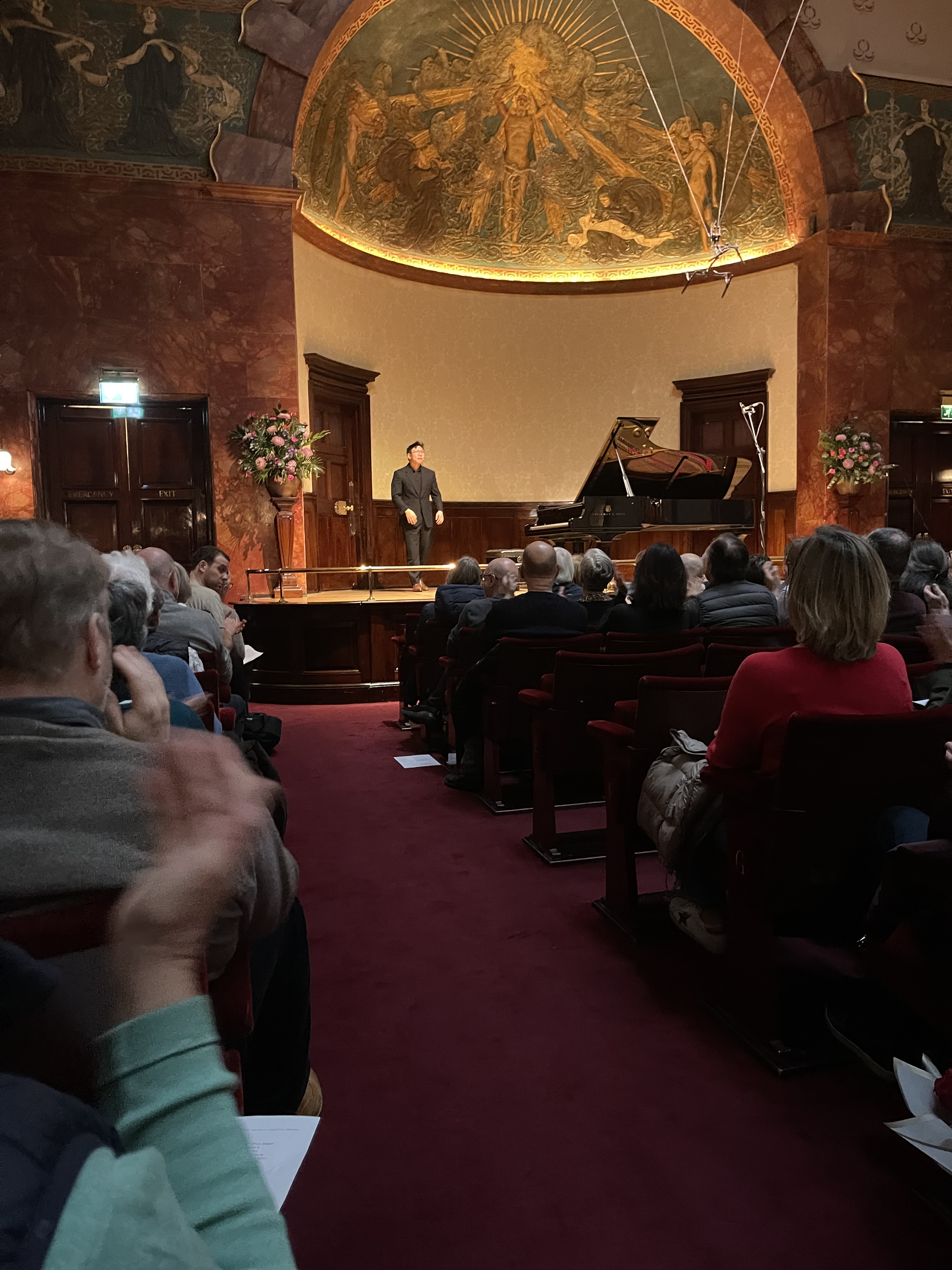
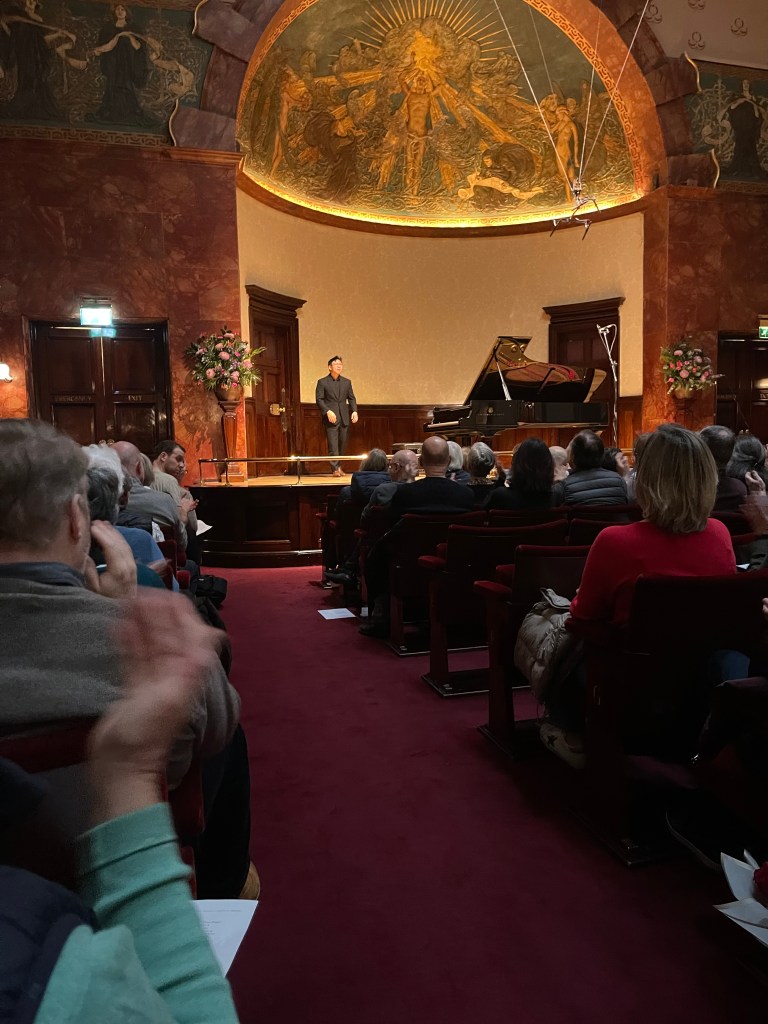
Noah Zhou at the Wigmore Hall Royal Academy of Music Series ‘Fearless music making of beauty and exhilaration’

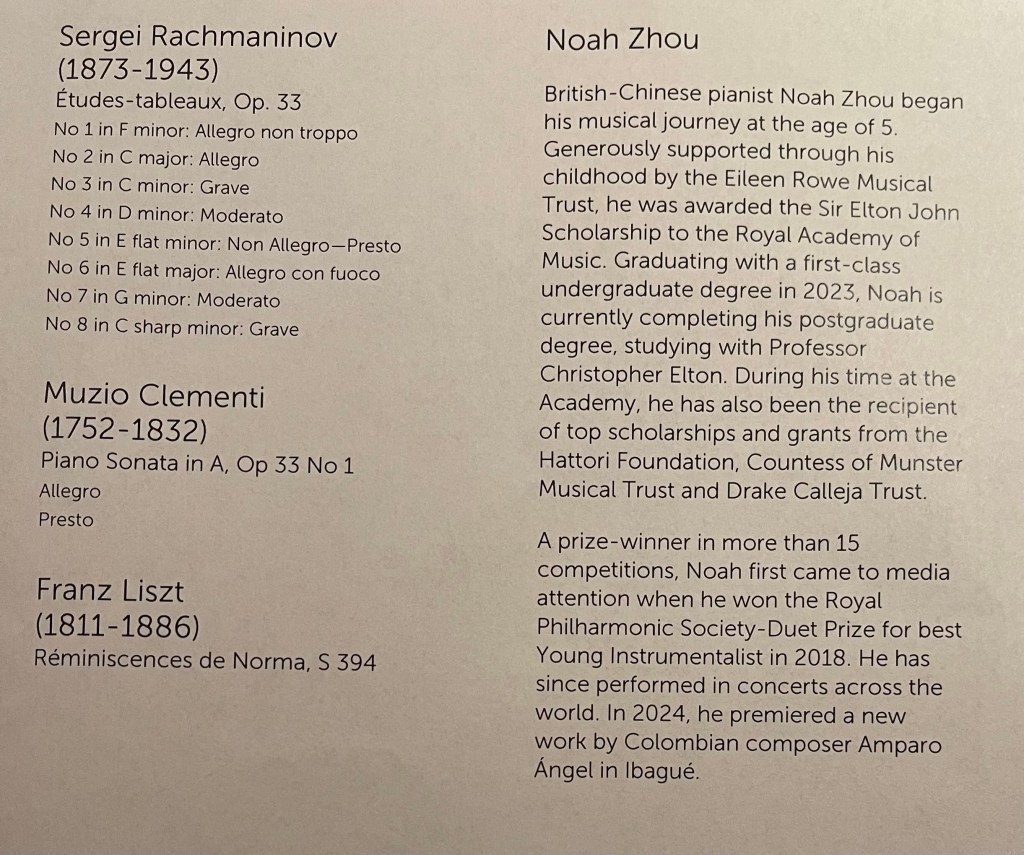
The young British-Chinese pianist Noah Zhou, currently a Master’s student at the Royal Academy of Music, is the recipient of many awards including the Young Pianist Foundation European Grand Prix, Horowitz International Competition, Drake Calleja Trust and the Hattori Foundation. A first prize winner at competitions in Rio and Valsesia in Italy, recent concerto performances include appearances in the Netherlands, Ukraine and Brazil. Noah’s virtuosic lunchtime recital ranges from Rachmaninov’s magnificent Etudes-tableaux to the elegance of Clementi and Liszt’s stormy imagination – a literature of dark and turbulent ecstasy.

Noah Zhou at St Mary’s A tiger on the rampage with artistry and total mastery

https://christopheraxworthymusiccommentary.com/2024/12/25/point-and-counterpoint-2024-a-personal-view-by-christopher-axworthy/

Christopher Axworthy writes

Noah Zhou, another star pianist from the studio of Christopher Elton at the Royal Academy, giving a recital in their piano series at the Wigmore Hall. Nice to see that other Elton supporting this remarkable young musician with a scholarship .

The RAM is surprisingly Sir Elton John’s own Alma Mater.

It was even nicer to see the indomitable Eileen Rowe mentioned as supporting this young man’s childhood studies. In death, as in life, Eileen Rowe has meant so much to so many aspiring young musicians.

A house full of pianos in Ealing and generously giving a days teaching to starving future stars like Katherine Stott,Tessa Nicholson, Danielle Salamon and myself. Not only a days teaching, but a full roast dinner cooked by her lovable housekeeper with vegetables grown in her own garden. Miss Rowe would listen outside my room in any pauses between students, when I would work at the Norma Fantasy or Danielle would play through a Mozart Concerto. Her star pupil was Vanessa Latarche who indeed shines brightly in the piano world.

Piano and tennis were Miss Rowe’s passions, and sometimes went hand in hand with a TV perched on the piano so she could not miss a match, but also not miss a note of her pupils. She would be so proud to witness the standing ovation that awaited Noah after his breathtaking last encore.

As if Liszt’s Norma Fantasy was not enough! Noah was persuaded to play an encore, which was a mind boggling transcription of Mozart’s Marriage of Figaro. No idea who concocted such a cocktail of pianistic gymnastics, but at a guess Volodos ,Horowitz.Cziffra and I suspect Noah were all in there somewhere. Noah writes : ‘The encore is the Ginzburg transcription on Figaro’s aria.’

But this was not just mindless note spinning, because whatever Noah played was of overwhelming beauty and musicianship

Eight Etudes Tableaux op 33 that were miniature tone poems, where Noah turned these seeming baubles into the gems that Rachmaninov had bequeathed to the world. Noah showed us Rachmaninov’s world of scintillating streams of gold and silver sounds. Moments of overwhelming Russian nostalgia and finally a cauldron of Scriabinesque sounds that were quite breathtaking in their demonic dynamism.

Clementi’s Sonata in A was a breath of fresh air after such devilish sounds . Streams of notes as Clementi played with his new found toy. Sometimes almost Mendelssohnian in the way they just flew from Noah’s fingers with such mellifluous ease. But there was also a great sense of character that brought a smile for the insolent charm of the first movement .

The great Norma Fantasy opened with the just operatic gestures, but then the left hand octaves that I have never heard played with such mastery, was where he sacrificed the nobility and grandeur of the grandest of grand operas for the incredible speedy Gonzales!

It was in the subtle beauty of the lyrical central episode that Noah allowed the music to breathe again with sumptuous beauty. The deep sound of the bass, like a heartbeat, on which floated the magic of Bellini’s Bel Canto .

Liszt on the warpath found Noah now completely in charge with a sumptuous transcendental display of three handed pianism, played with burning temperament and fearless abandon.

After Emanuil Ivanov, Kasparas Mikuzis this combination of the RAM at the Wigmore is fast becoming a collectors item.

https://christopheraxworthymusiccommentary.com/2024/10/09/emanuil-ivanov-sensational-performance-at-the-wigmore-hall-of-rzewski-the-people-united-will-never-be-defeated-a-staggering-performance-of-total-mastery-and-musical-communication/

Kasparas Mikuzis at the Wigmore Hall Masterly playing of fluidity and ravishing beauty

Franz Liszt
Réminiscences de Norma  S 394

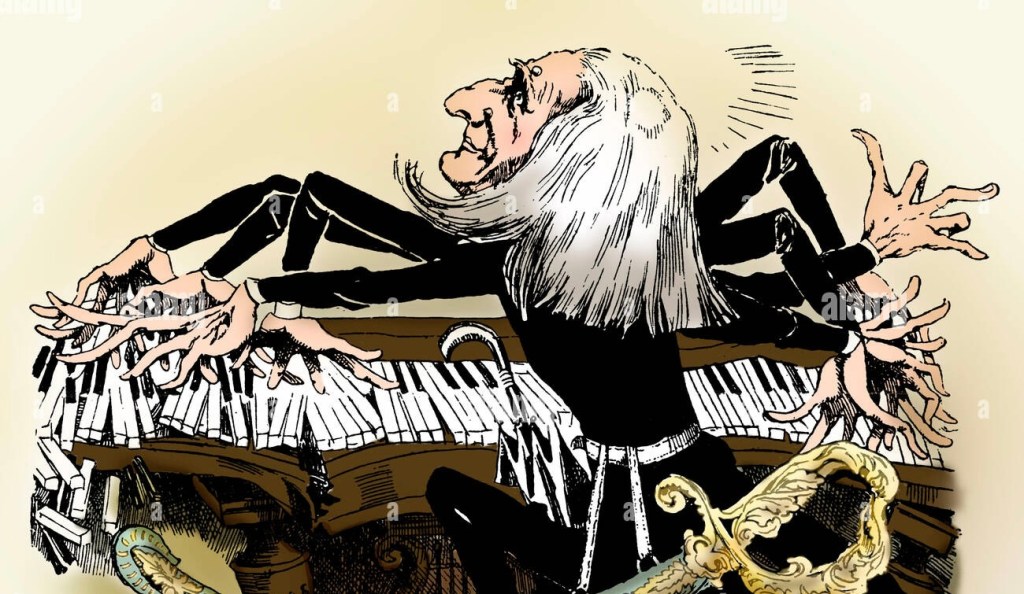
During the 1800s opera had a lot of appeal to audiences. From big dramatic storylines to emotional arias, opera was in its prime during this century. Although opera was perceived to have a glamorous aura, it was actually quite inaccessible for a large part of the public due to price and cultural differences. Therefore it is not surprising that many pianists sought to gain more audiences by composing, arranging and performing their own operatic fantasies. Liszt undertook the challenge of diluting Bellini’s opera Norma into a 15 minute solo piano work in 1841. The work easily equals the dramatic impact of the original opera through Liszt’s dynamic and highly virtuosic writing. No less than seven arias dominate Liszt’s transcription of Norma which are threaded together to create a nearly continuous stream of music.The title role of Norma is often said to be one of the hardest roles for a soprano to sing, and this adds to the drama and intensity of the music. ‘Norma, a priestess facing battle against the Romans, secretly falls in love with a Roman commander, and together they have two illegitimate children. When he falls for another woman, she reveals the children to her people and accepts the penalty of death. The closing scenes and much of the concert fantasy reveal Norma begging her father to take care of the children and her lover admitting he was wrong.”Liszt, arguably the most charismatic virtuoso of all time, was challenged for supremacy by Sigismond Thalberg, a pianist who could apparently not only counter Liszt’s legendary fire and thunder with subtlety but who played as if with three hands. Three hands were heard, two were visible! A confrontation took place in the Salon of Princess Belgioso and although it was diplomatically concluded that ”Liszt was the greatest pianist; Thalberg the only one”, the outcome was inevitable. Liszt continued on his protean and trail-blazing course while Thalberg was consigned to virtual oblivion.

Liszt offers a concentrated summary of the dramatic core of the opera by selecting melodies from Act I to evoke Norma’s leading role in opposing the Roman occupiers, and from the finale of Act II to represent her selfless renunciation of love, and of life itself, to further the cause of her warlike people.

The work opens with a series of stern chords and martial drumbeats, echoed high above by sparkling arpeggiations, to set the stage for a tale of war on earth and reward in heaven. These musical motifs recur midway through the piece as well to transition between opera’s Act I mood of heroic resolve and its tragic outcome in Act II.

Liszt’s treatment of the lyrical Qual cor tradisti, with its three simultaneous layers—melody, pulsing chordal accompaniment, and martial triplet drumbeat—has been described by musicologist Charles Suttoni as “one of the most ingenious and sublime pages ever written for the piano.”

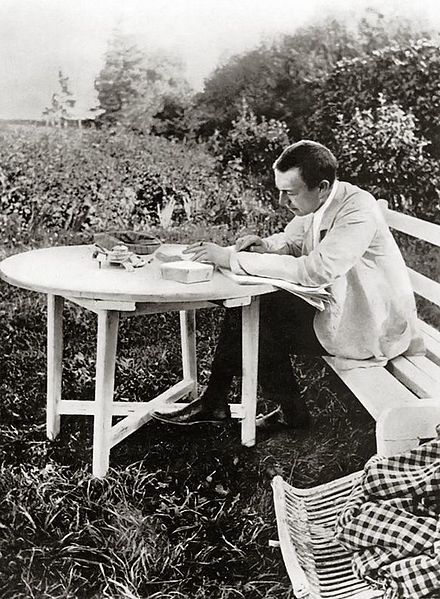
Rachmaninov writing at his Ivanovka Estate

The Études-Tableaux (“study pictures”), Op. 33, is the first of two sets of piano études  composed by Rachmaninov . They were intended to be “picture pieces”, essentially “musical evocations of external visual stimuli”. But Rachmaninov did not disclose what inspired each one, stating: “I do not believe in the artist that discloses too much of his images. Let [the listener] paint for themselves what it most suggests.”However, he willingly shared sources for a few of these études with the Italian composer Ottorino Respighi when he orchestrated them in 1930.

Max Harrison calls the Études-Tableaux  “studies in [musical] composition”; while they explore a variety of themes, they “investigate the transformation of rather specific climates of feeling via piano textures and sonorities. They are thus less predictable than the preludes and compositionally mark an advance” in technique.

Rachmaninov initially wrote nine pieces for Op. 33 but published only six in 1914. One étude, in A minor, was subsequently revised and used in the op 39 sett; the other two appeared posthumously and are now usually played with the other six. Performing these eight études together could be considered to run against the composer’s intent, as the six originally published are unified through “melodic-cellular connections” in much the same way as in Schumann’s Symphonic Studies

Differing from the simplicity of the first four études, Nos. 5–8 are more virtuosic in their approach to keyboard writing, calling for unconventional hand positions, wide leaps for the fingers and considerable technical strength from the performer. Also, “the individual mood and passionate character of each piece” pose musical problems that preclude performance by those lacking strong physical technique.Rachmaninov wrote nine études-tableaux at his Ivanovka estate  in 1911. Six of them, the original Nos. 1–2 and 6–9, were published that year. The original No. 4 is lost; the piece was revised and published as op 39 n. 6. The original Nos. 3 and 5 were published posthumously within Op. 33.

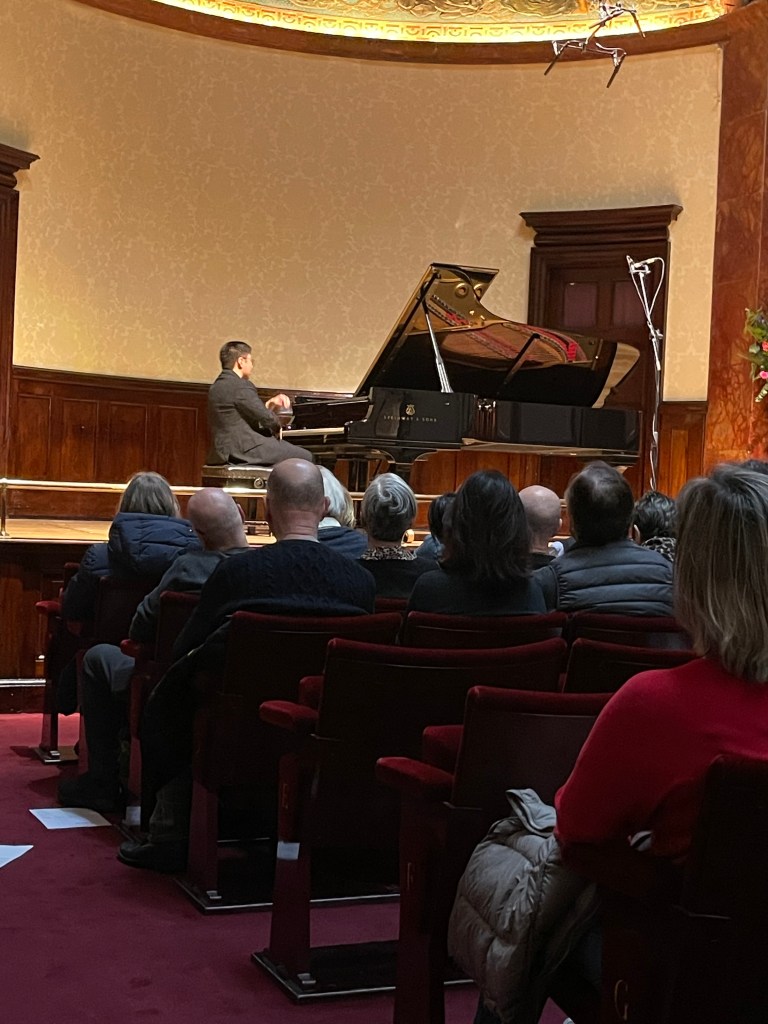
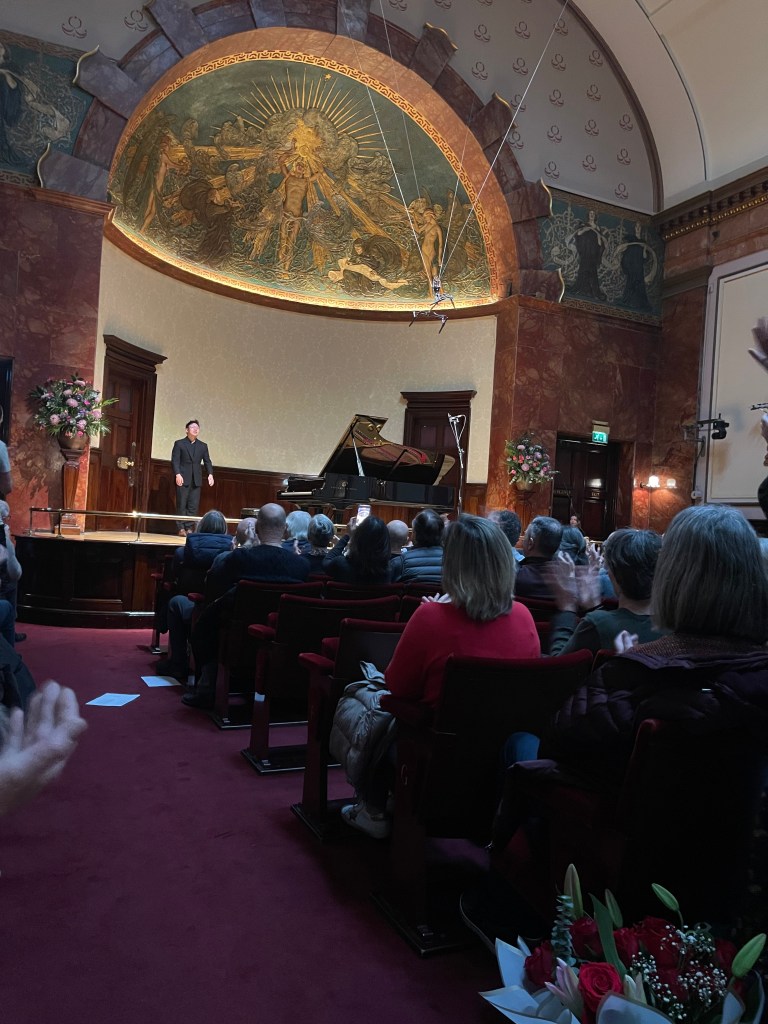
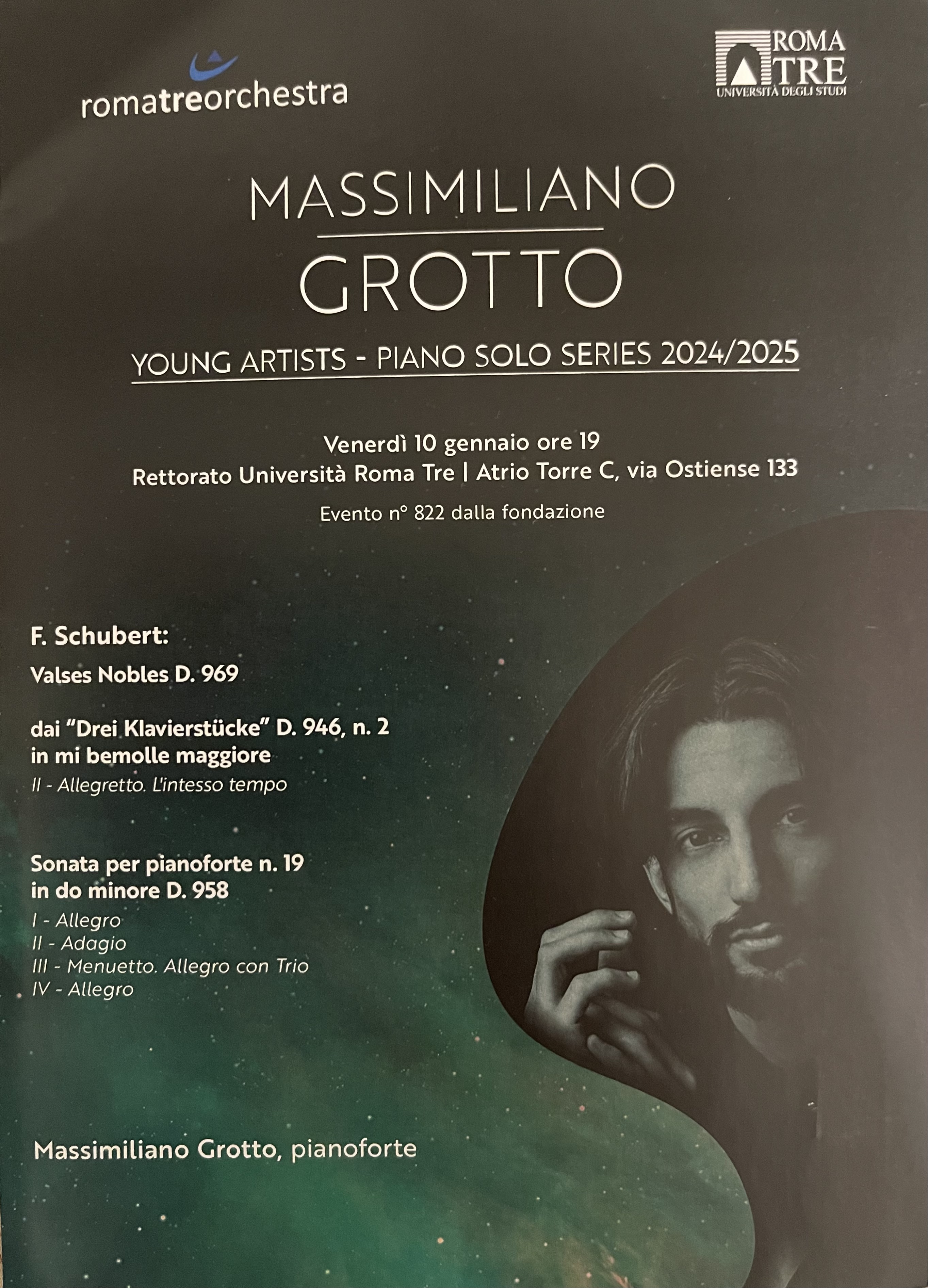
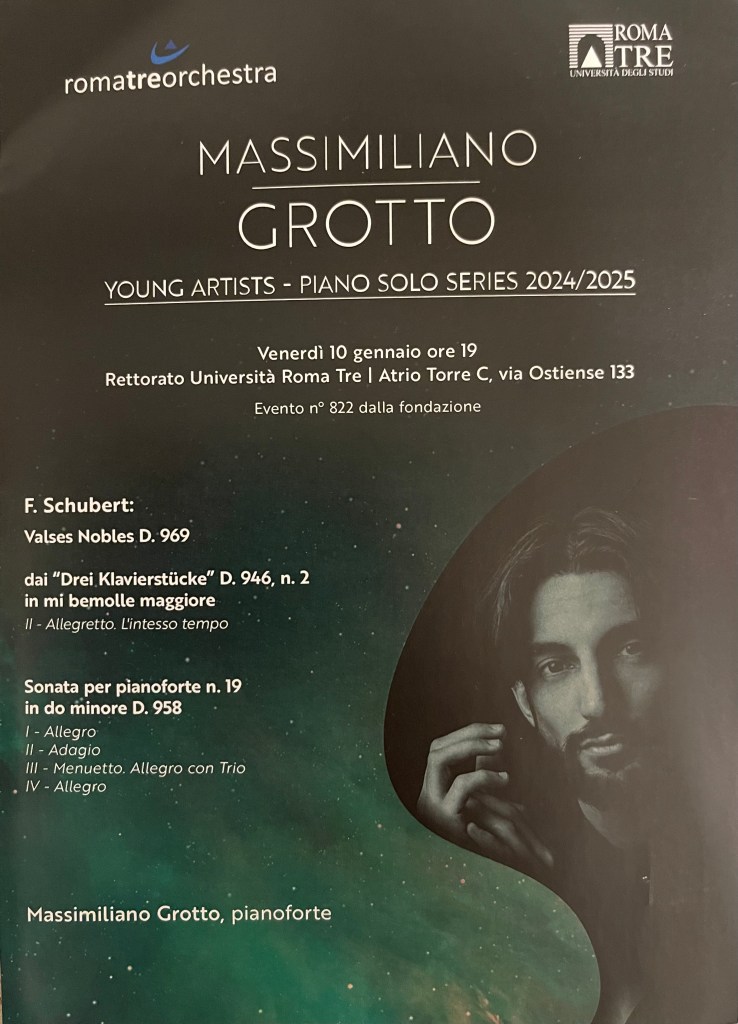
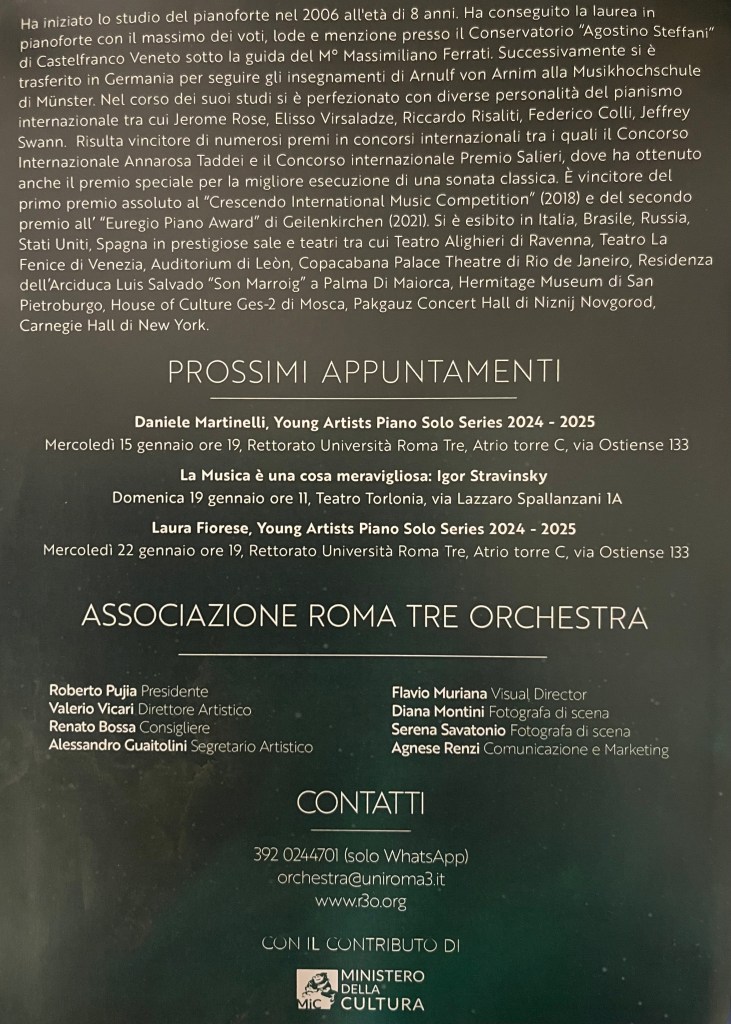
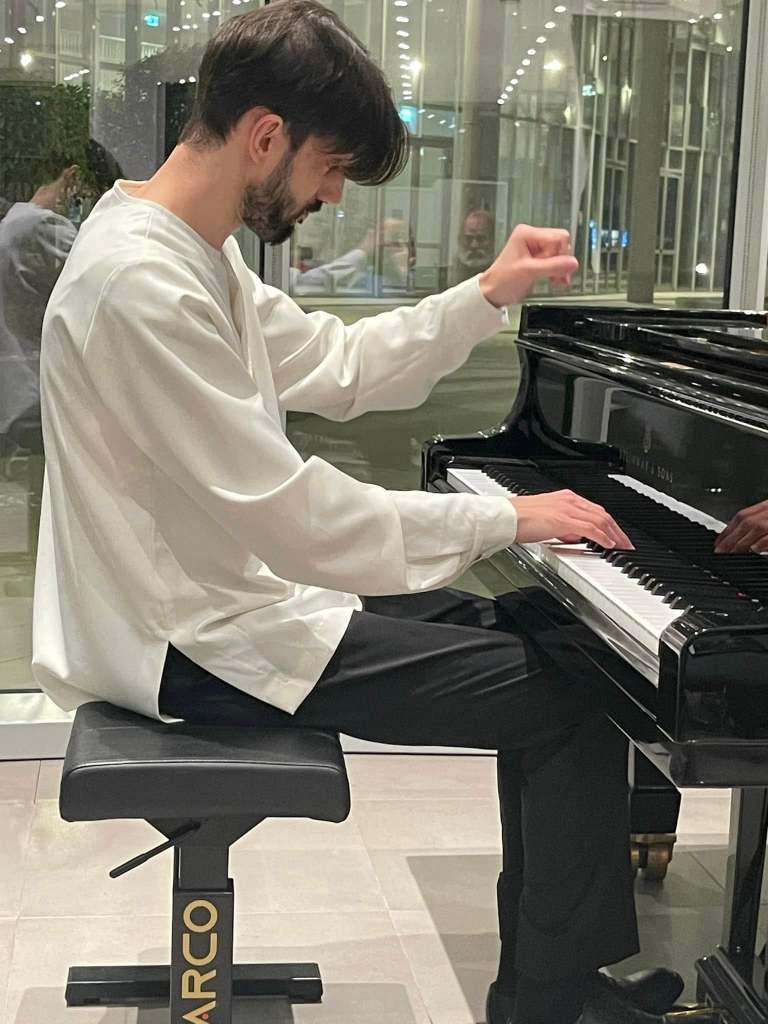
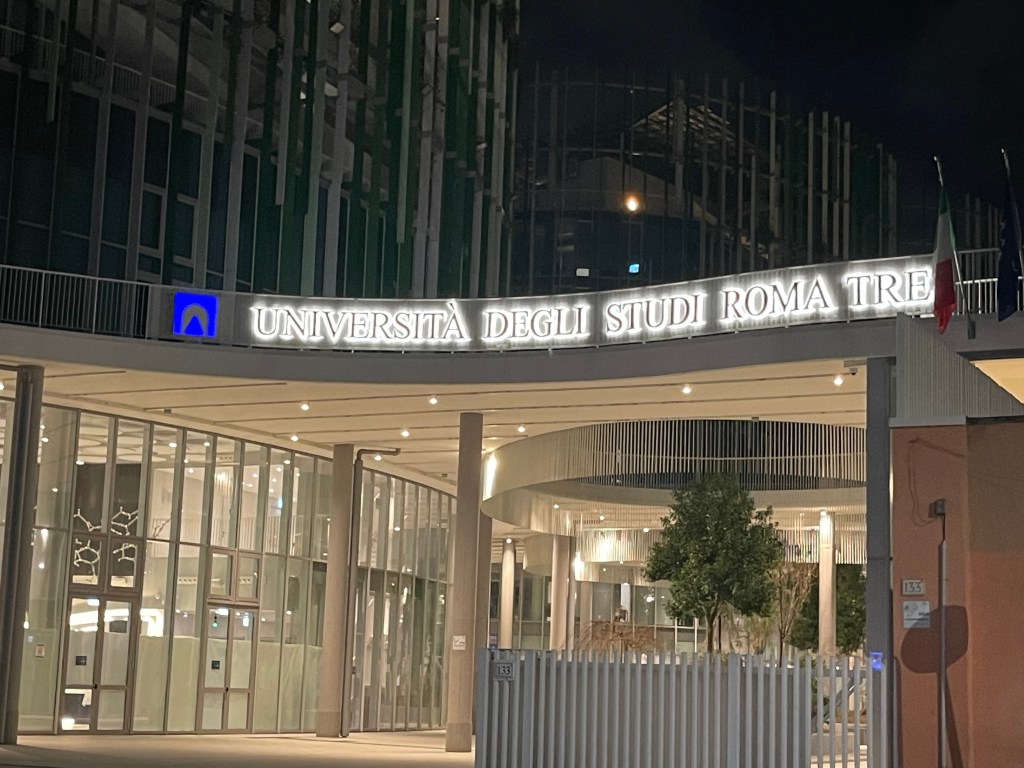
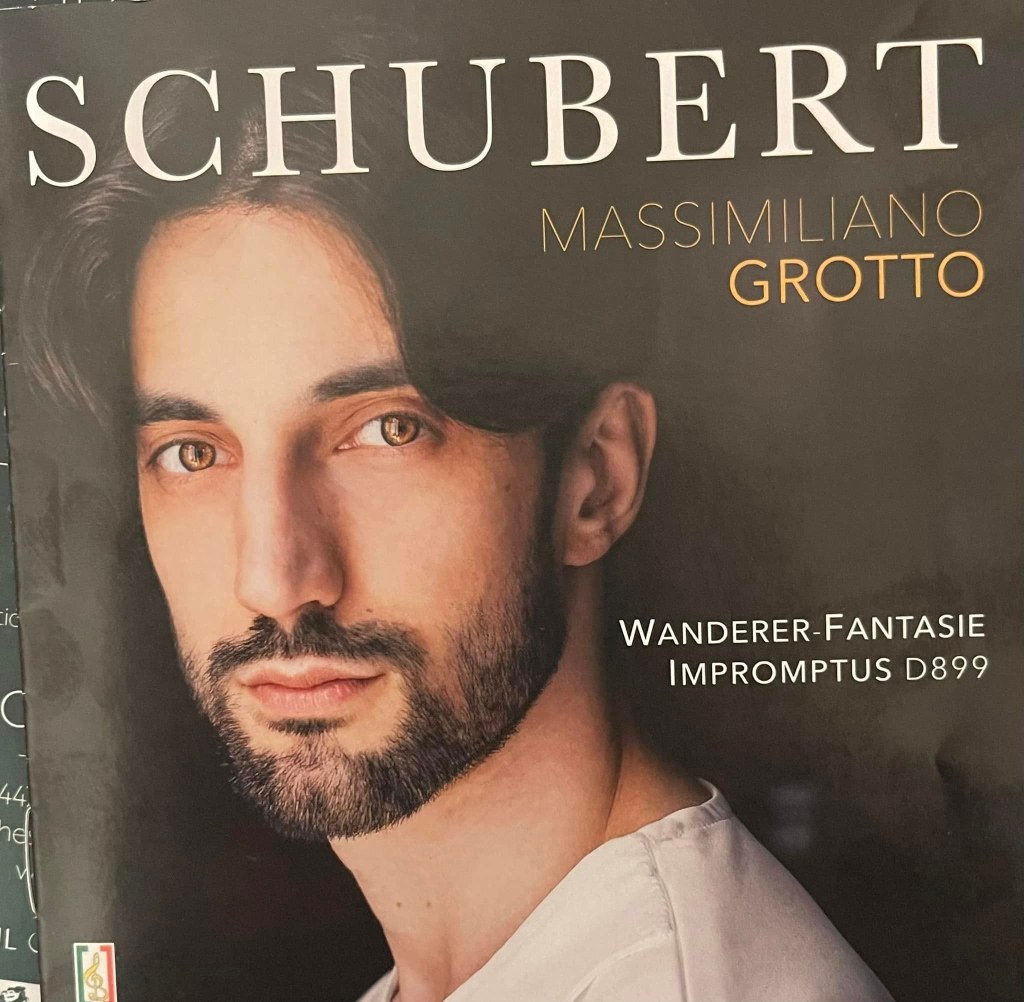
Massimiliano Grotto at Roma 3′ Schubert of searing intensity and commanding authority’

Playing of great authority and superb musicianship by Massimiliano Grotto where the elegance and Viennese charm of Schubert’s ‘Valses Nobles’ were answered by the deep meditation of his second ‘Klavierstücke’. Heralding his extraordinary vision, like Beethoven’s final pianistic trilogy, of what he could forsee at the end of an all too brief terrestrial existence.

Massimiliano playing with commanding assurance as the Beethovenian call to arms at the opening of his C minor Sonata was enacted with overwhelming impact.

So many differing emotions that could be conveyed as one complete whole of conviction. There was an extraordinary clarity and demonic rhythmic drive of intensity and profound understanding of this dark place that Schubert was to envisage before the vision of peace and light that he was to find in the final sonata of his trilogy, written in the last year of his 31 years on this earth.

Even the ‘Adagio’ was penned with great strokes of burning intensity and poignant meaning always with the menace looking on from afar. But there was the glorious relief of the gentle return of the opening melody with a barely etched accompaniment. Some playing of masterly control and use of the pedals as the theme was allowed to float with simplicity and innocence leading into the beautifully fluid ‘Menuetto’ and richly textured ‘Trio.’ The Tarantella finale took flight with the same authority and conviction that I remember from Richter many years ago in London. Even the sudden rays of sunlight that Schubert‘s genius could never fully suppress had the same feeling of whirlwind energy.

A remarkable performance from a pianist who is above all a superb musician. One that can see the burning genius of Schubert in an architectural shape with four seemingly diverse movements, transformed into a unified visionary journey of discovery.

The second of the ‘Klavierstücke’ rarely heard just on its own, in Massimiliano’s poetic hands was turned into a tone poem of ravishing beauty and searing intensity. A beautiful mellifluous outpouring with a kaleidoscope of subtle colours allowed to flow so gracefully on not always untroubled waters. There was the dynamic menace to the driving rhythms of the first contrasting episode and the passionate outpouring of the second with a melodic line etched with great intensity. Many interesting bass counterpoints were underlined with refined good taste and brought the music vividly alive as Massimiliano’s masterly musicianship knew that Schubert’s roots were firmly created from the bass upwards.

The twelve ‘Valses Nobles’ were played as a whole with contrasts that ranged from Viennese elegance to rhythmic drive and the delicacy of bel canto. Nobility and majesty too and one in particular that Liszt could not resist turning into his own ‘Soirée de Vienne.’

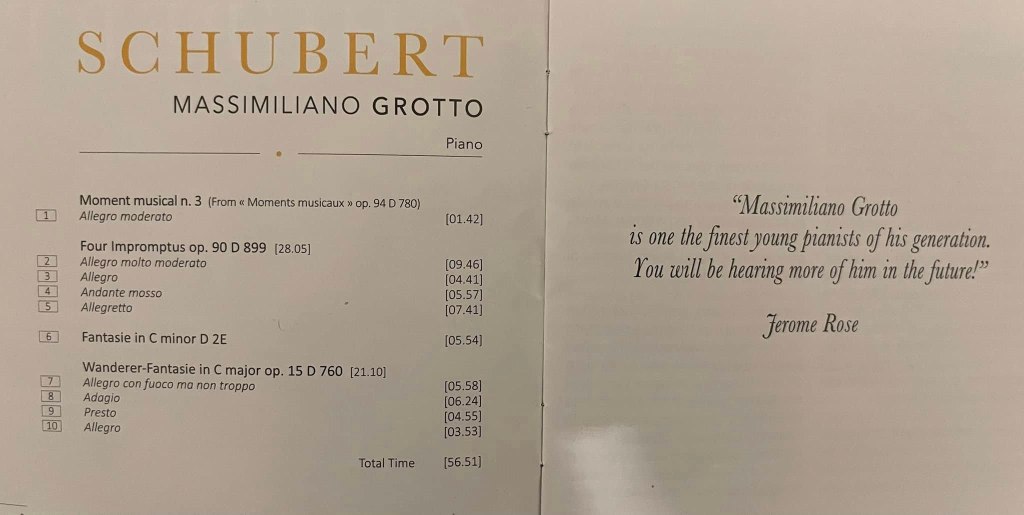
The Moment Musicaux n 3 in F minor, offered as an encore, was played with beguiling rhythmic insinuation and also a certain freedom to elaborate on Schubert’s own ornamentation.

Jerome Rose, Massimiliano’s mentor in New York, played Schubert in a recital in my series in Rome some years ago and I can only endorse what he has said about Massimiliano : ‘ one of the finest pianists of his generation. You will be hearing more of him in the future.’

Bravo too, Valerio Vicari, and his dedicated team who offer a platform to so many wonderful young players who after years of dedication all they crave is an audience with whom they can share their considerable artistry..

Massimiliano with Laura, a painter and restorer also from their home town of Castelfranco Veneto
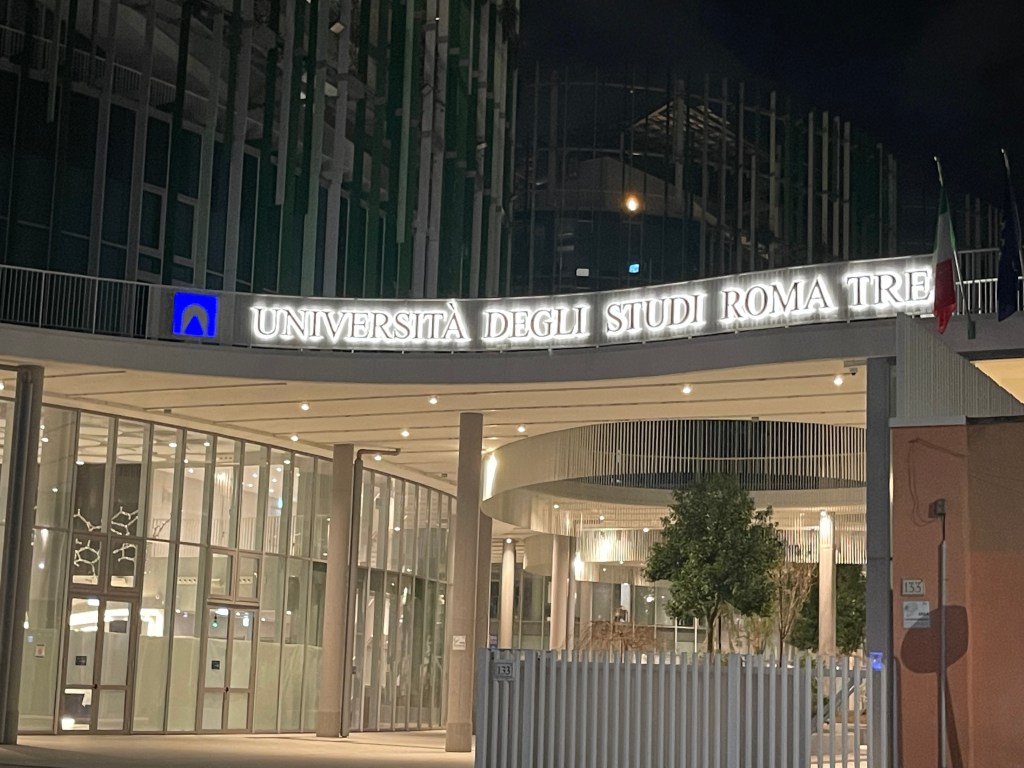
The beautiful new Roma 3 University Retorato.
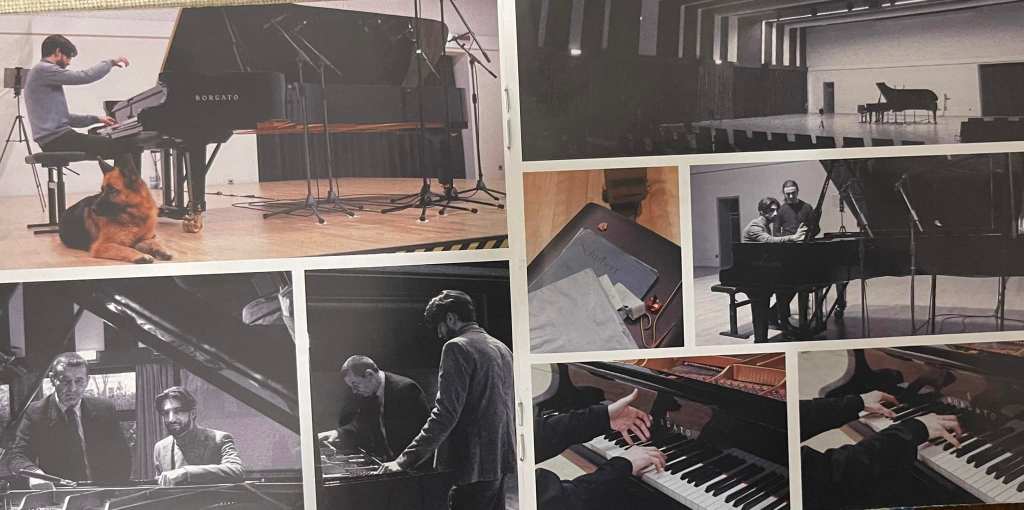
Recording made on a Borgato piano and produced by Borgato pianos. .
Franz Schubert 31 January 1797,Vienna – 19 November 1828 ,Vienna

Schubert  wrote about a hundred waltzes for piano solo. Particularly well known among these are two named collections, the 34 Valses Sentimentales (op. 50, D.779) and the 12 Valses Nobles (op 77 Op.D.969).The Valses Sentimentales were written in 1823, and the Valses Nobles are believed to have been written in 1827, the year before Schubert’s death, although the manuscript is undated.

The last three sonatas, D. 958, 959 and 960, are his last major compositions for solo piano. They were written during the last months of his life, between the spring and autumn of 1828, but were not published until about ten years after his death, in 1838–39. Like the rest of Schubert’s piano sonatas, they were mostly neglected in the 19th century. By the late 20th century, however, public and critical opinion had changed, and these sonatas are now considered among the most important of the composer’s mature masterpieces. They are part of the core piano repertoire, appearing regularly on concert programs and recordings.The last year of Schubert’s life was marked by growing public acclaim for the composer’s works, but also by the gradual deterioration of his health. On March 26, 1828, together with other musicians in Vienna, Schubert gave a public concert of his own works, which was a great success and earned him a considerable profit. In addition, two new German publishers took an interest in his works, leading to a short period of financial well-being. However, by the time the summer months arrived, Schubert was again short of money and had to cancel some journeys he had previously planned.

Schubert had been struggling with syphilis since 1822–23, and suffered from weakness, headaches and dizziness. However, he seems to have led a relatively normal life until September 1828, when new symptoms such as effusions of blood appeared. At this stage he moved from the Vienna home of his friend Franz von Schober to his brother Ferdinand’s house in the suburbs, following the advice of his doctor; unfortunately, this may have actually worsened his condition. However, up until the last weeks of his life in November 1828, he continued to compose an extraordinary amount of music, including such masterpieces as the three last sonatas.

Schubert probably began sketching the sonatas sometime around the spring months of 1828; the final versions were written in September. These months also saw the appearance of the Three Piano Pieces D .946, the Mass in E flat D.950, the String Quintet D.956, and the songs published posthumously as the Schwanengesang collection (D. 957 and D. 965A), among others. The final sonata was completed on September 26, and two days later, Schubert played from the sonata trilogy at an evening gathering in Vienna. In a letter to Probst (one of his publishers), dated October 2, 1828, Schubert mentioned the sonatas amongst other works he had recently completed and wished to publish.However, Probst was not interested in the sonatas, and by November 19, Schubert was dead.

In the following year, Schubert’s brother Ferdinand  sold the sonatas’ autographs  to another publisher, Anton Diabelli , who would only publish them about ten years later, in 1838 or 1839. Schubert had intended the sonatas to be dedicated to Johann Nepomuk Hummel , whom he greatly admired. Hummel was a leading pianist, a pupil of Mozart, and a pioneering composer of the Romantic style (like Schubert himself). However, by the time the sonatas were published in 1839, Hummel was dead, and Diabelli, the new publisher, decided to dedicate them instead to composer Robert Schumann, who had praised many of Schubert’s works in his critical writings.

Emanuil Ivanov ignites Leighton House with transcendental artistry

Kensington and Chelsea Music Society

Kensington and Chelsea Music Society

A piano recital in association with The Keyboard Charitable Trust, supported by the Robert Turnbull Piano Foundation.

‘Emanuil’s recital was absolutely thrilling. He is undeniably one of the finest pianists we have collaborated on, and it was a privilege to present him. Emanuil is on par with any big name out there and he has the qualities for a celebrated career ahead. His technical command is unparalleled, and his introspective sensitivity is rare to encounter. He performs with such natural elegance, free of any pretentiousness or affectation – a true artist.
Beyond his remarkable talent, Emanuil is a genuinely wonderful person – humble, grounded, and impressively mature for his age. We’re already looking forward to inviting him for another recital in the future.’ Yvonne Georgiadou, Artistic Director, Pharos Arts Foundation, Cyprus December 2024


Ferruccio Busoni (after J. S. Bach) Durch Adams Fall ist ganz verderbt
Ludwig van Beethoven Piano Sonata No. 17 in D minor, “The Tempest”

— interval —

Felix Mendelssohn Songs without Words, Op. 30
Charles-Valentin Alkan Symphony for solo piano

Emanuil Ivanov attracted international attention after receiving the First prize at the 2019 Ferruccio Busoni Piano Competition in Italy. This achievement was followed by concert engagements in some of the world’s most prestigious halls including Teatro alla Scala in Milan and Herculessaal in Munich. He recently completed his studies on a full scholarship at the Royal Birmingham Conservatoire under the tutelage of Pascal Nemirovski and Anthony Hewitt, and from September studies under Joanna MacGregor and Christopher Elton at London’s Royal Academy of Music as a recipient of the prestigious Bicentenary Scholarship. His programme for KCMS brings together some of the finest piano writing of the 19th century, with a respectful nod to the Baroque era via Busoni’s famous transcription of Bach.:

Emanuil Ivanov writes

‘A “prelude” is indeed an appropriate opening for a recital programme – yet the notions of mere introductory brevity the term might bring forth cannot undermine the profundity and splendour of J.S. Bach’s Chorale Preludes. Originally for organ, ten of these works were given new shape by Ferruccio Busoni,the transcriptions written around 1898. Under number seven stands “Durch Adams Fall ist ganz verderbt” (“Through Adam’s fall all is lost”) and indeed this title appears twice – as 7a and 7b. Busoni adapts two Bach works based on the same text and gives us the option to either present them separately, or as a unified pair – a prelude and fugue combination, and that is how I’ve chosen to perform them. A work of quiet, yet powerful impact. A stern, sombre sermon; a moving prayer of penitence.

Beethoven’s so-called “Tempest” sonata is one of those workswhere the “subtitle question” can be a source of endless debate. Unlike other, more arbitrarily chosen and not coming from the composer subtitles, the one associated with the op.31 no.2 Sonata could actually be traced to Beethoven himself. It has been said that in a conversation with his associate Anton Schindler, the Master suggested reading Shakespeare’s “The Tempest” as a possible key to unlocking the sonata’s secrets.Whether true or not, the work does share a certain enigmatic quality with the play and it is rather fun trying to link together episodes in the music and in the Bard’s masterpiece. And yet, an even more plausible explanation for its frequent plunges into darkness might be the time it was written in – 1801-1802, the time of increasing despair for Beethoven, on account of his worsening deafness.

The ”song without words” genre is a curious contradiction – song lyrics usually have a vital role in bringing concrete meaning and image – yet the absence of the latter makes the works in this genre even more poignant. Mendelssohn published eight collections of six songs each over his lifetime and the op.30 was written in 1833-34. These are six gems, masterful in form, delicately balanced in texture, and showcasing the composer’s melodic genius. Ranging from sumptuous arias and hushed confessions to vivacious dance and dramatic outpourings, the cycle is concluded with a famous “gondolier’s song”. I shall insert a quote from Mendelssohn himself regarding the non-verbal aspect of his “Lieder ohne Worte”: “What the music I love expresses to me, is not thought too indefinite to put into words, but on the contrary, too definite”

Boldly defying convention and calling upon the instrument’s ability to evoke a full orchestral sonority, Charles-Valentin Alkan titles this work “Symphony for solo piano”. Even more unusually, its four movements are also numbers 4 to 7 in a collection of 12 etudes in all the minor keys (1857). While it might seem superficial, the spirit of duality seems to have a prominent role in the music, navigating between searing drama and lyricism. Starting from a weighty sonata-form movement, at times quite Mendelssohnian (but Mendelssohn “on steroids”!), the work then journeys through a funeral march with a central section of great beauty, and a biting, unstable minuet with a gentle, song-like trio. This all leads to the finale, described by Raymond Lewenthal as “a ride in Hell”. And aptly so, especially for the pianist! Driving forward with extreme ferocity and throat-grabbing relentlessness, this movement is the climax of the work and, demanding every ounce of energy from the performer, it provides a remarkable conclusion to the Symphony.’

Christopher Axworthy writes

A quite remarkable recital by the 2019 Busoni winner,Emanuil Ivanov.

After his sensational recital a month ago of the Rzewski variations:https://christopheraxworthymusiccommentary.com/2024/10/09/emanuil-ivanov-sensational-performance-at-the-wigmore-hall-of-rzewski-the-people-united-will-never-be-defeated-a-staggering-performance-of-total-mastery-and-musical-communication/

And with recent performances of the Busoni Concerto in England and Bulgaria under his belt he is now turning his attention to Alkan. Even he exclaimed what a monster the Symphony op 39 4/7 is.

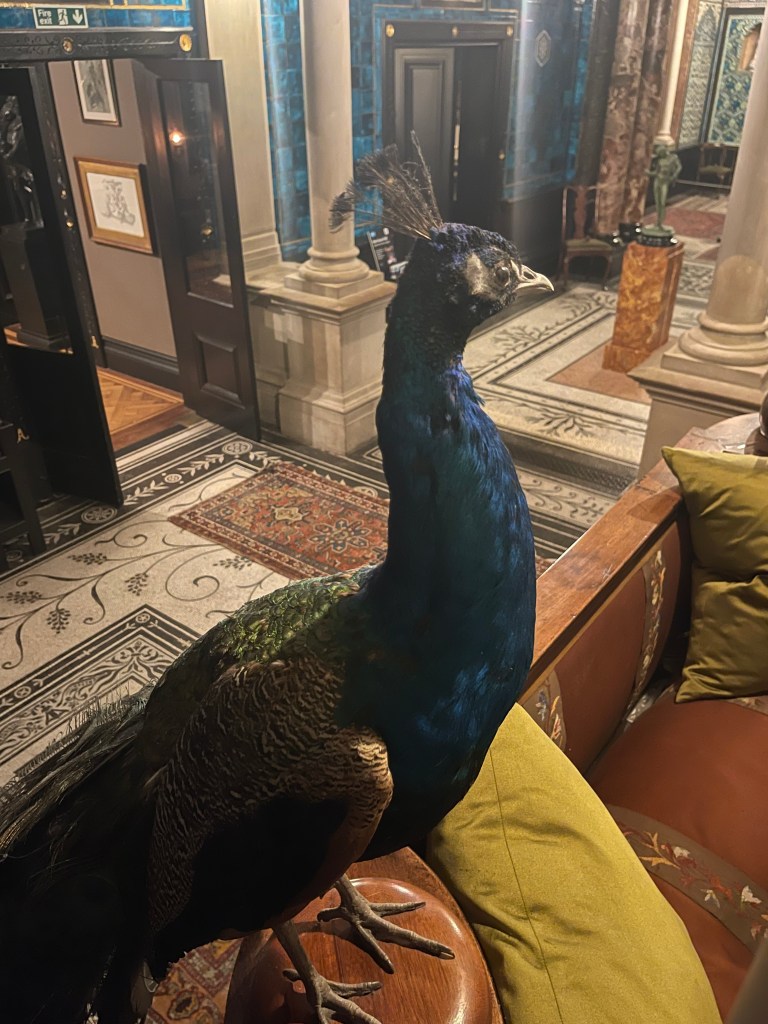
Well it almost made the peacock blush and certainly overwhelmed all those lucky enough to be present in Leighton House last night .A finale that does not give you time to breathe, exclaimed our valiant hero.

We were all totally aware of that as the transcendental demands of this mysterious colleague of Chopin and Liszt were not only met but also shaped with intelligence and mastery that was quite breathtakingly exhilarating. Alkan’s Menuet where all the devils were unleashed with a Mendelssohnian fleetness that would have put to shame his elegant Victorian refinement .An amazing Funeral March with Emanuil’s mastery of balance allowing the haunting tenor melody to sing out accompanied by devilish spiky chords.

But it was the first movement that was so remarkable .Opening like the Eroica with no nonsensical preamble but straight down to business with a palpitating agitated melodic germ that was to be varied and repeated in a million different ways in a first movement that Emanuil shaped with architectural courage and with a kaleidoscope of colour that had us on the edge of our seats .

This had been after Mendelssohn’s songs without words op 30. What ravishing beauty he unravelled with aristocratic good taste and beguiling poetry.The second of this book of six little gems was played with that quixotic fleeting lightness that Allkan was to transform into something much more sinister.The simple beauty and elegance of the Venetian Boat Song underlined the shock as the ghostly mysterious presence of Alkan was lain before us.

An encore after the Alkan would be inconceivable for any but the greatest masters and Emanuil took a few minutes to sift through his vast repertoire before calming the infernal atmosphere with Busoni’s Elegie on the most pastoral of all traditional melodies: Greensleeves. Refined jeux perlé and magical glissandi of another era accompanied the melody as never before .

If we had insisted ,Emanuil told be afterwards, we would have been rewarded with his own Gulda inspired Theme and Variations written as an engagement present for Irina. He had played them a year ago in Florence and when I met him again in London a few months ago he introduced me to his wife! How could anyone resist such an extraordinary declaration !

Emanuil with his wife Irina

https://christopheraxworthymusiccommentary.com/2023/03/31/emanuil-ivanov-premio-busoni-2019-al-british-in-the-harold-acton-library-a-room-with-a-view-of-ravishing-beauty-and-seduction/

A first half opening with the deep meditative Chorale prelude ‘Through Adam’s fall’ by Bach in a double transcription by Busoni. Emanuil’s eclectic inquisitive mind played the two transcription 7a and 7 b as a unified pair .

Beethoven’s ‘Tempest’ Sonata crept in on the wave of such profound utterings with an opening of truly ghostly proportions .The whispered recitativi barely audible as he followed the composer’s precise instructions with the microscopic intelligence of a true ‘interpreter’ at he service of the composer. It was this selfless mastery that was noted by one of the audience members sure that the Kensington and Chelsea Music Society had been honoured to have such an artist obviously headed for the stars.

The contrast in dynamics in the Beethoven took us all by surprise as the composers irascible temperament was even more schizoid than Schumann’s dual personalities of Florestan and Eusebius. An adagio that was a wash of beautiful sounds spread over the keyboard and the bed for one of Beethoven’s most noble and aristocratic melodic creations.

The final Allegretto was played with a dry lilting simplicity that was quite irresistible.Dramatic outbursts made this beguiling Rondo melody ever more hypnotic until it disappeared completely deep into the depths of the keyboard.

Simone Tavoni and fiancée Agnese Navarro , Emanuil Ivanov,Sarah Biggs CEO of the KT and William Vann,chair of KCMS
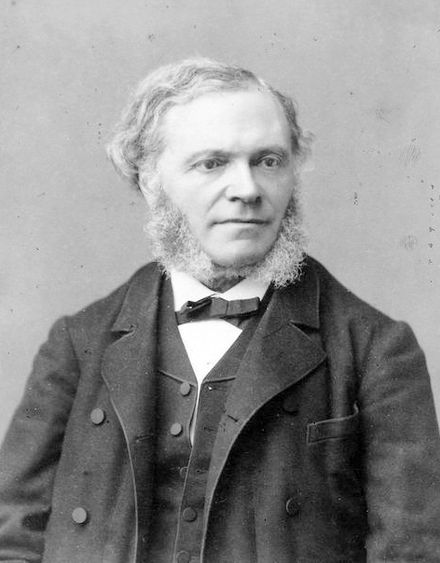
Charles-Valentin Alkan 30 November 1813 – 29 March 1888 was a French composer and virtuoso pianist. At the height of his fame in the 1830s and 1840s he was, alongside his friends and colleagues Chopin  and Liszt, among the leading pianists in Paris, a city in which he spent virtually his entire life.

The Symphony for Solo Piano op 39 4-7,is a large-scale romantic work for piano composed by Charles – Valentin Alkan and published in 1857.

Although it is generally performed as a self-contained work, it comprises études Nos. 4–7 from the Douze études dans tour les tons mineurs (Twelve Studies in All the Minor Keys), Op. 39, each title containing the word Symphonie . The four movements are titled Allegro moderato, Marche funèbre,Menuet and Finale ( described by Raymond Lewenthal as a ride in hell). Much like the Concerto for Solo Piano  (Nos. 8–10), the Symphony is written so as to evoke the broad palette of timbres and harmonic textures available to an orchestra. It does not contain the excesses of the Concerto or the Grande Sonate (Op. 33). But, rather like the Sonatine Op. 61, it proves that Alkan was also capable of writing perfectly balanced and almost ‘Classical’ works.”Unlike a standard classical symphony, each movement is in a different key, rising in progressive tonality by a perfect fourth.

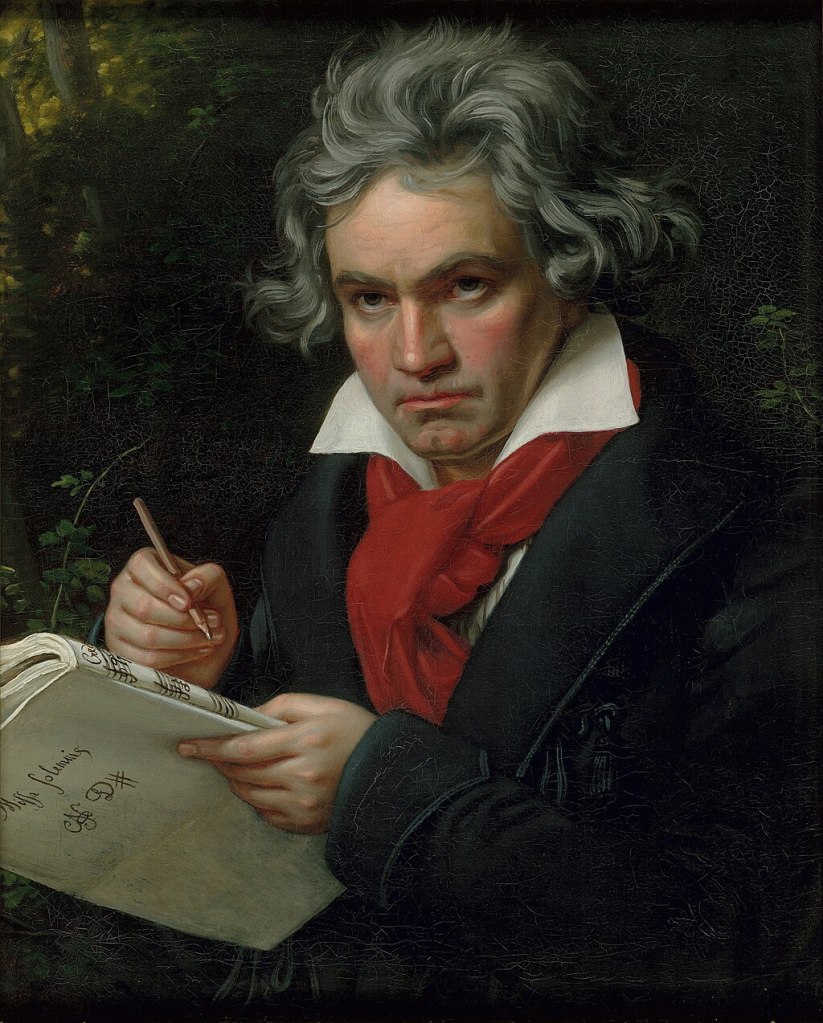
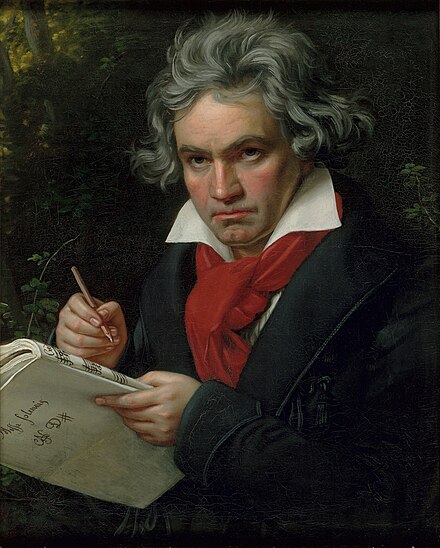
Beethoven with the Manuscript of the Missa Solemnis (1820)

Born Bonn and baptised 17th December 1770 Died Vienna 26th March 1827


The Piano Sonata No. 17 in D minor, op. 31, n. 2, was composed in 1801–02 . ‘With all the tragic power of its first movement the D minor Sonata is, like Prospero , almost as far beyond tragedy as it is beyond mere foul weather. It will do you no harm to think of Miranda at bars 31–38 of the slow movement… but people who want to identify Ariel and Caliban and the castaways, good and villainous, may as well confine their attention to the exploits of Scarlet Pimpernel when the Eroica or the C minor Symphony is being played.’ Donald Tovey .

The sonata is in three movements:

  1. Largo – Allegro
  2. Adagio
  3. Allegretto

Each of the movements is in sonata form , although the second lacks a substantial development section

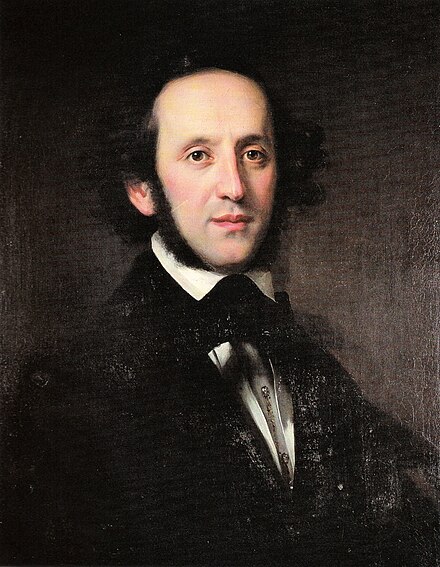
Portrait from 1846
Born 3 February 1809 Hamburg Died 4 November 1847 (aged 38)Leipzig

Songs Without Words (Lieder ohne Worte) is a series of short lyrical  works by Felix Mendelssohn  written between 1829 and 1845. His sister, Fanny, and other composers also wrote pieces in the same genre.The eight volumes of Songs Without Words, each consisting of six songs , were written at various points throughout Mendelssohn’s life and published separately. Number 2 was written for his sister Fanny to celebrate the birth of her son in 1830.

Book 2, Op. 30 (1833–34)

  1. Andante espressivo (E♭ major), MWV U 103
  2. Allegro di molto (B♭ minor), MWV U 77
  3. Adagio non troppo (E major), MWV U 104
  4. Agitato e con fuoco (B minor), MWV U 98
  5. Andante grazioso (D major), MWV U 97
  6. Allegretto tranquillo: Venetianisches Gondellied(“Venetian Boat Song No. 2”) (F♯ minor), MWV U 110
Book 2 was dedicated to Elisa von Woringen.


Ferruccio Busoni (1 April 1866 – 27 July 1924) was an Italian composer, pianist , conductor, editor, writer, and teacher. His international career and reputation led him to work closely with many of the leading musicians, artists and literary figures of his time, and he was a sought-after keyboard instructor and a teacher of composition


Alongside the Chaconne for violin, the ten Chorale Preludes for organ are Busoni’s best-known piano transcriptions of works by J. S. Bach. Unlike the Chaconne, which Busoni envisaged for concert performance, he transcribed the Chorale Preludes in “chamber-music style”. 

Emanuil Ivanov sensational performance at the Wigmore Hall of Rzewski ‘ The People United will never be defeated ’ A staggering performance of total mastery and musical communication – a happening as never before!

Emanuil Ivanov a great pianist of humility and intelligence takes St.Mary’s by storm

Emanuil Ivanov attracted international attention after receiving the First prize at the 2019 Ferruccio Busoni Piano Competition in Italy. This achievement was followed by concert engagements in some of the world’s most prestigious halls including Teatro alla Scala in Milan and Herculessaal in Munich.

Emanuil Ivanov was born in 1998 in the town of Pazardzhik, Bulgaria. From an early age he demonstrated a keen interest and love for music. He regards the presence of symphonic music, especially that of Gustav Mahler, as tremendously influential in his musical upbringing during his childhood.

He started piano lessons with Galina Daskalova in his hometown around the age of seven. Ivanov studied with renowned bulgarian pianist Atanas Kurtev from 2013 to 2018. Subsequently he studied on a full scholarship at the Royal Birmingham Conservatoire under the tutelage of Pascal Nemirovski and Anthony Hewitt, and currently an Advanced Diploma student at London’s Royal Academy of Music as a recipient of the prestigious Bicentenary Scholarship. He has received artistic guidance from Dmitri Bashkirov, Dmitri Alexeev, Sir Stephen Hough, Vladimir Ovchinnikov, Peter Donohoe, etc.

In February 2021, at the height of the Covid-19 pandemic, Ivanov performed a solo recital in Milan’s famous Teatro alla Scala. The concert was live-streamed online and is a major highlight in the artist’s career.

https://christopheraxworthymusiccommentary.com/2021/02/27/emanuil-ivanov-at-la-scala-to-the-glory-of-god-and-beyond/

In 2022, he received the honorary silver medal of the Musician’s Company, London and later in the same year became a recipient of the generous Carnwath Piano Scholarship.

Emanuil Ivanov has given critically acclaimed recitals, concerto performances and tours in japan, France, Italy, Germany, Austria, Bulgaria, Cyprus, South Africa, the United Kingdom and Poland. In the summer of 2023, he recorded an album of Scarlatti sonatas for the renowned Naxos label. Ivanov’s performances have been featured on BBC Radio 3, Italy’s Rai Radio 3 and Japan’s NHK Radio.

Emanuil has continually shown affinity towards some of the more rarely performed works in the repertoire and in 2024 he performed Busoni’s mammoth piano concerto. Apart from playing the piano, he also displays great interest in composition and has composed regularly since childhood. 

Point and Counterpoint 2024 A personal view by Christopher Axworthy

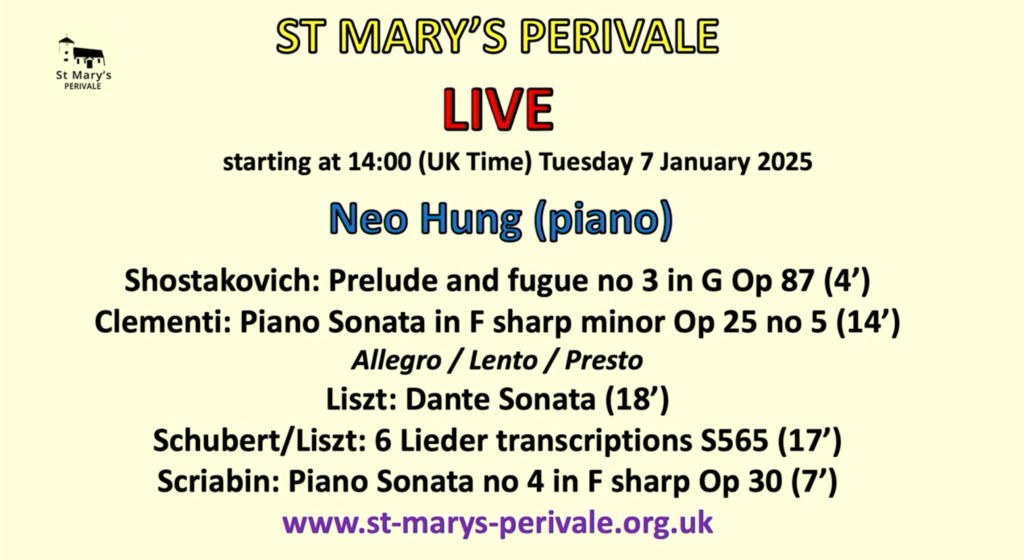
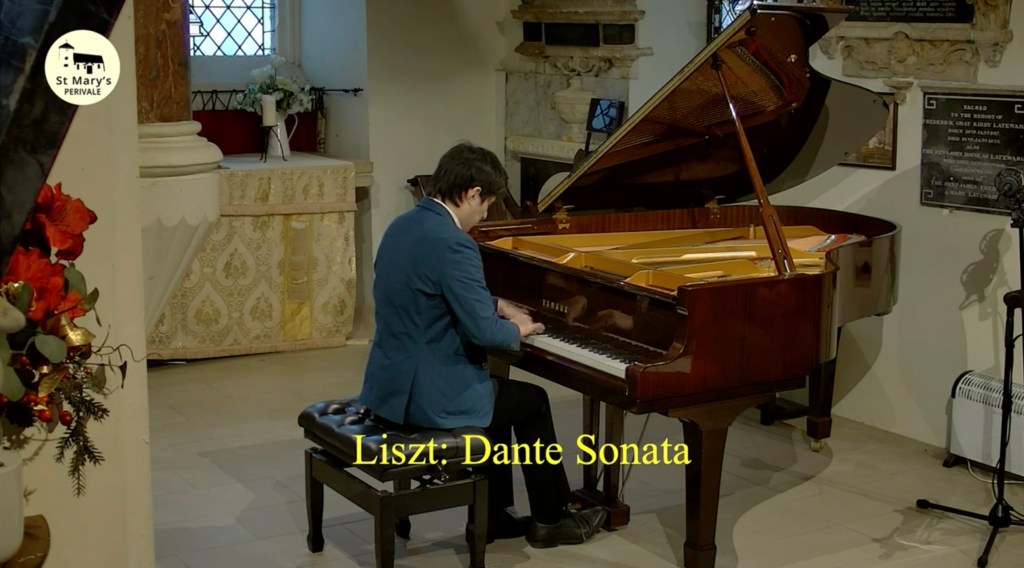
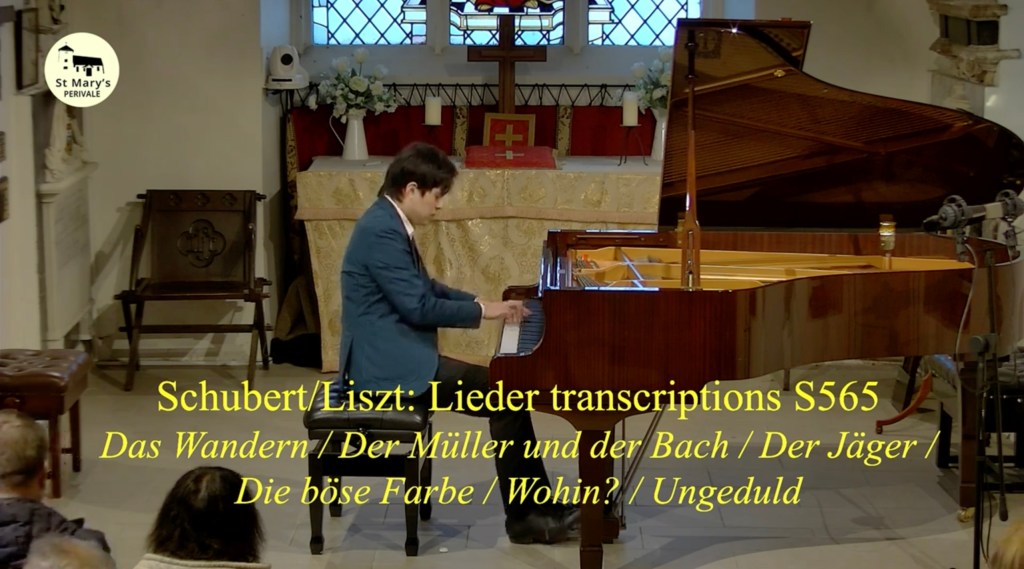
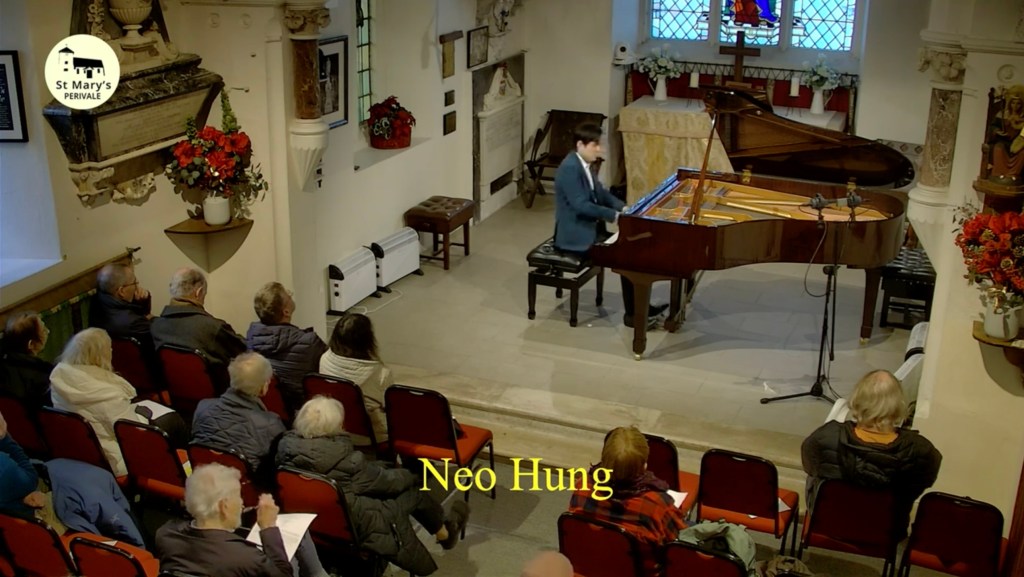
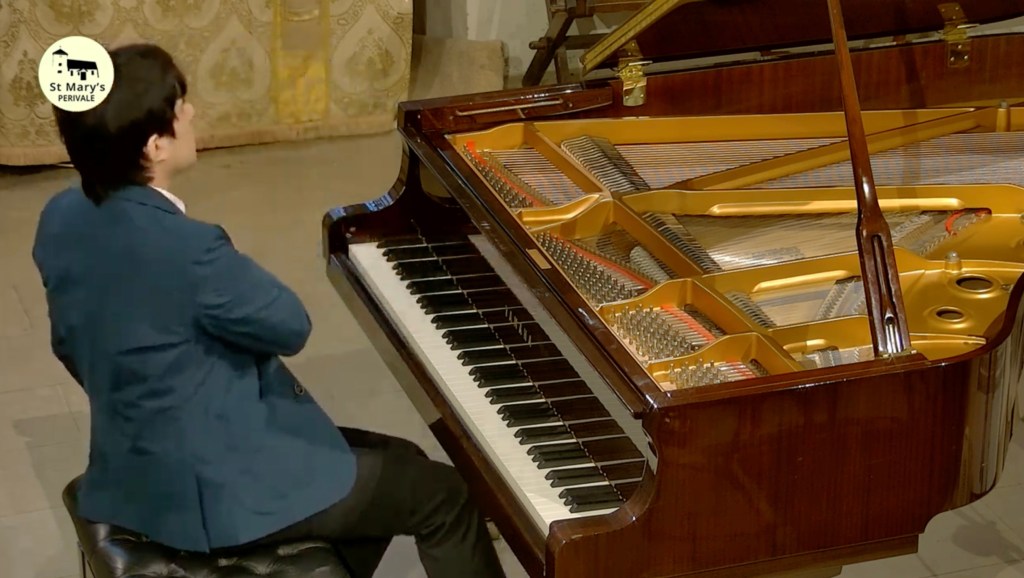
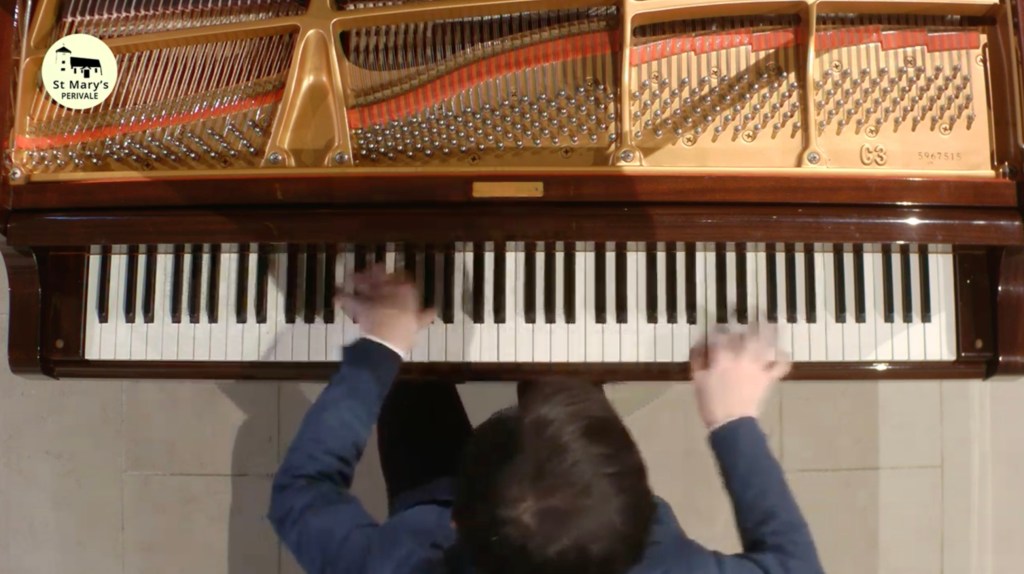
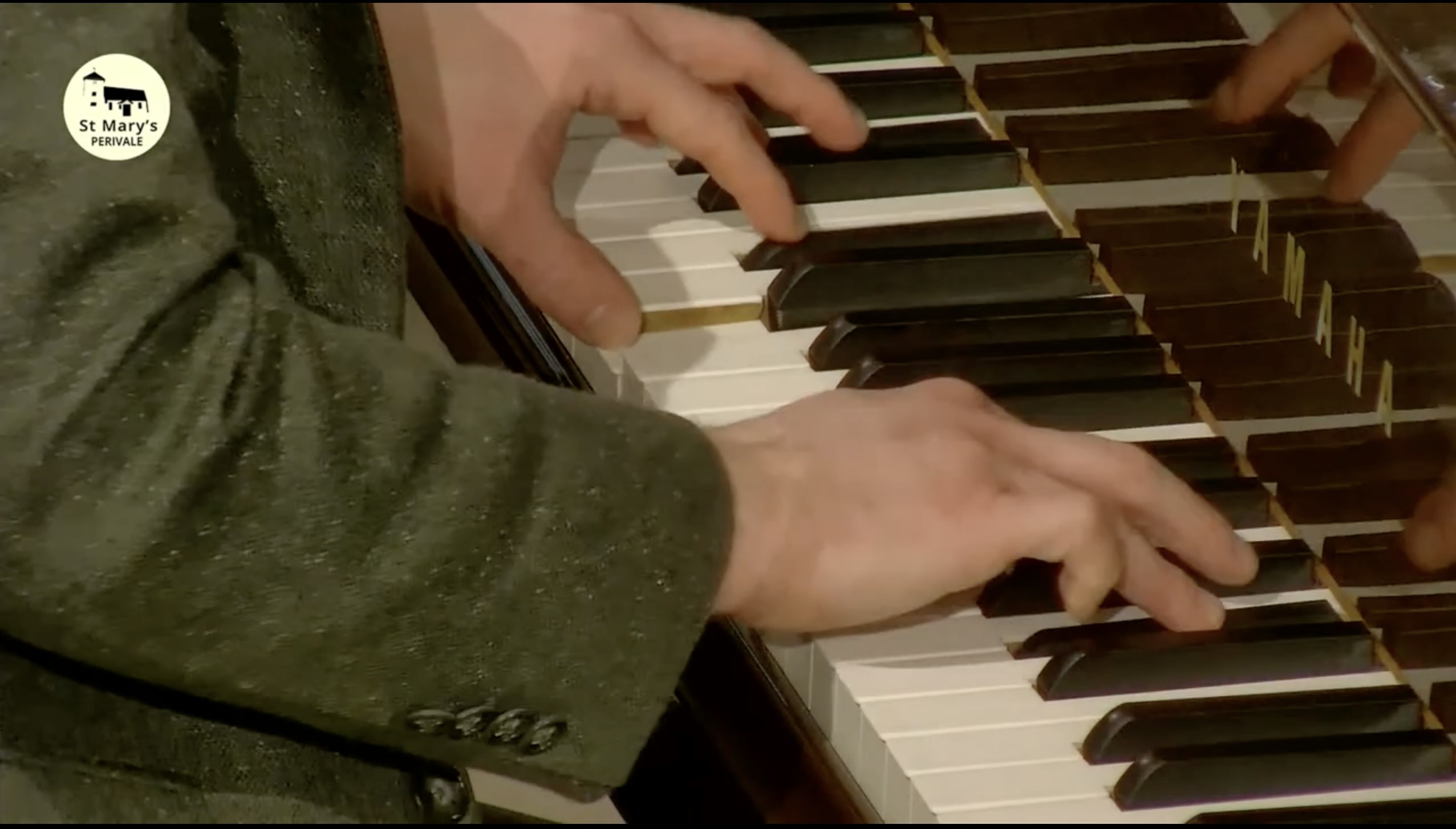
Neo Hung’s clarity and technical mastery conquers St Mary’s

https://www.youtube.com/live/sIyyt0Tv0_g?si=YJjPRYaRCZ_Q_-pC

Playing of remarkable clarity and architectural understanding with an extraordinary technical command of the keyboard that allowed him to play quite fearlessly some of the most demanding works of the piano repertoire.

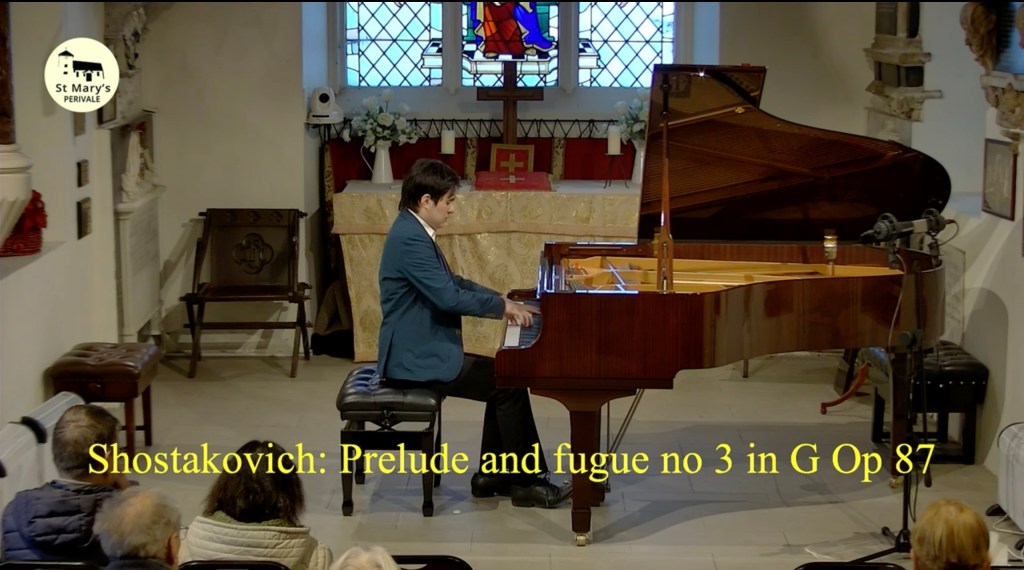
Immediately the opening Shostakovich Prelude had the resonance of an organ with long held pedal notes giving a very full fluid sound. It contrasted with the complete clarity of the fugue that was played with scintillating energy and remarkable character.

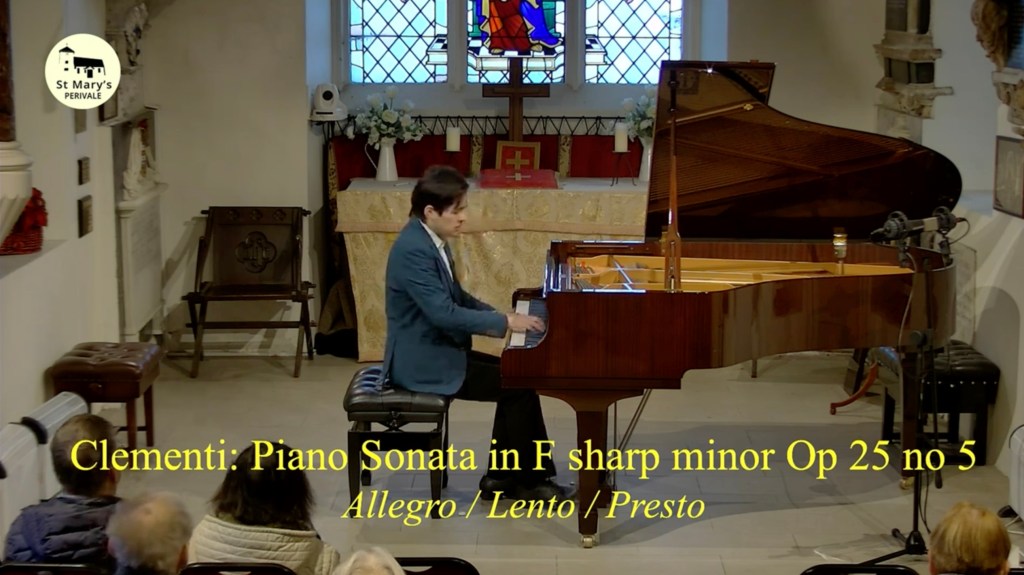
There was clarity too in the Clementi Sonata which flowed so beautifully and was shaped with great finesse. A beautifully poised slow movement was immediately contrasted with the rhythmic drive of the presto finale.

It was the Dante Sonata that showed the real artistry of this twenty one year old pianist. An architectural understanding of a work that can so often seem episodic. A quite remarkable technical command which allowed him to throw off the most demanding passages with clarity and ease. Nowhere more than in the final pages where the treacherous skips were not only mastered but also given a musical shape that is rare indeed. In the slower passages he missed the flow and romantic sweep and his breathtaking pyrotechnics could have had more passionate abandon and sense of colour but it was performance remarkable for it’s absolute clarity and commanding authority.

Hats off to Neo for including six of Liszt’s transcriptions of Schubert Songs (there are over 50 to choose from !). These transcriptions are the meeting of the mellifluous genius of Schubert and the total mastery of the piano of Liszt. A mastery that can turn the piano into an orchestra with a sense of colour and balance by use of the sustaining pedal. In fact it was Anton Rubinstein, a pupil of Liszt ,who called the pedal the soul of the piano. It was Liszt and Thalberg who exploited this newly created device to turn the piano into an instrument that could roar like a lion or sing like the greatest of bel canto singers. Neo played these six beautiful songs rather literally sacrificing the subtle beauty and inflections of Schubert for a quite extraordinary clarity and digital mastery. I wondered whether he had actually listened to the songs and discovered the real meaning of the poetry that had inspired them.

The Scriabin Sonata was played with a quite extraordinary sense of balance where the beautiful first movement was allowed to sing with ravishing beauty and simplicity.The second movement was played with quite remarkable clarity but the ‘star’ could have shone with more timeless passion and sumptuous richness.

The theme and variations from Beethoven’s Sonata op 109 was the encore that Neo so generously offered. It was in fact the finest performance of the recital, with the theme beautifully shaped with poise and delicacy.The variations were allowed to unfold with aristocratic nobility and beauty and the return of the theme hovered over a cloud of sounds with quite extraordinary mastery and poetic understanding.

Neo Hung started his first piano lesson at the age of six in Hong Kong and gave his first solo piano recital at 13. He studied at the Hong Kong Academy for Performing Arts from 2018 to 2021 under Julie Kuok. He currently studies piano with Dina Parakhina at the Royal College of Music with a full scholarship awarded by the HKSAR government. He has been supported by the Keyboard Charitable Trust since 2024, and Talent Unlimited since 2023.  

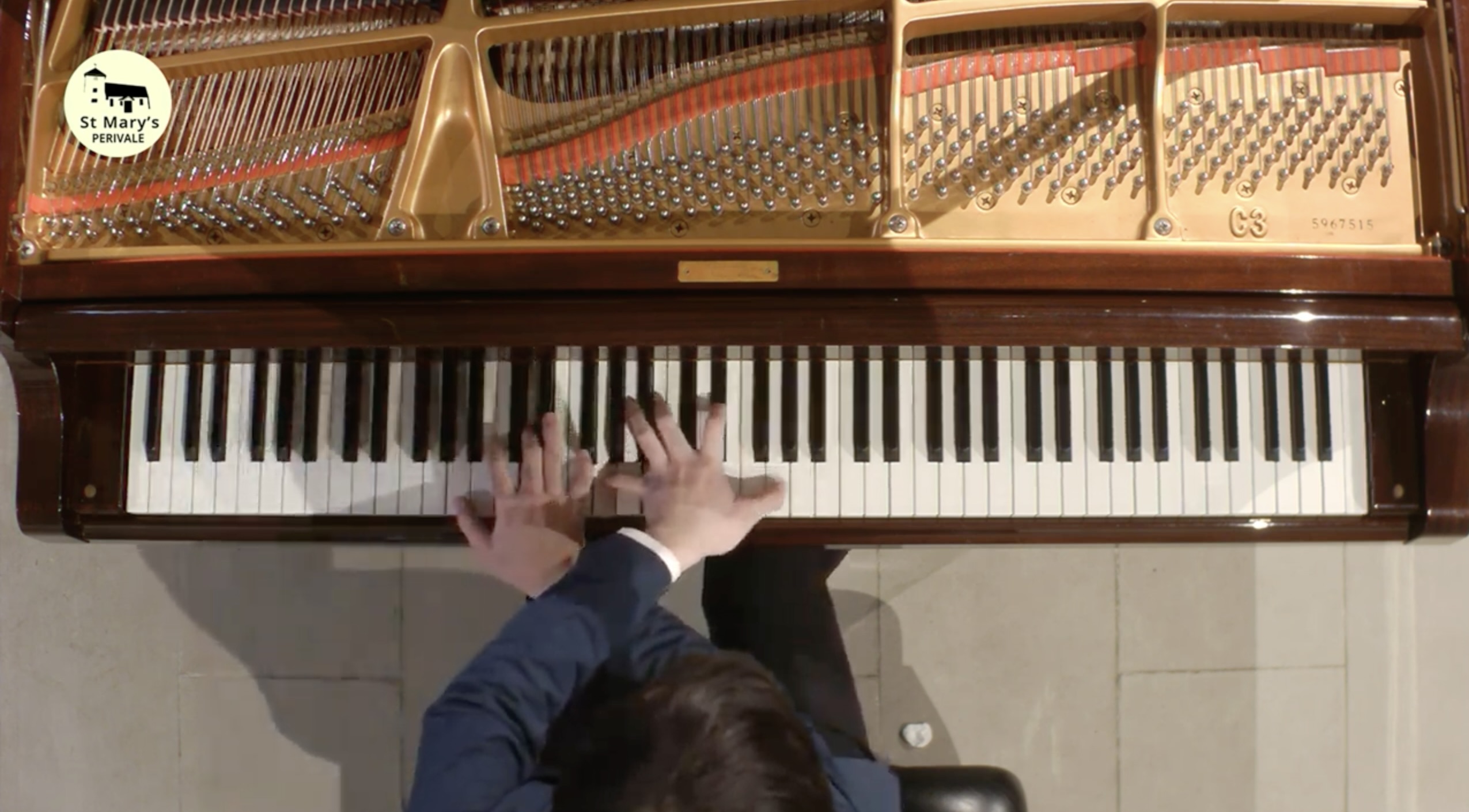
Screenshot

Neo made his concerto debut in Music Fest Perugia with Chopin’s Piano Concerto No.1 under Alessandro Alonzi in 2023. He has also performed internationally in the Amalfi Coast Music Festival, Malaga International Piano Festival, RCM Keyboard Festival, Yale University, Hong Kong City Hall and Hong Kong Cultural Centre. Recently, he has embarked on a tour with solo recitals in a variety of venues across England, such as Bath Abbey, Ely Cathedral, Wakefield Cathedral, St Mary’s Perivale Church, St James’s Piccadilly Church, University Church Oxford and Westminster Music Library, among many other venues. He made his debut as a Keyboard Charitable Trust Artist in September 2024 at Erin Arts Centre on the Isle of Man. In 2023, Neo won prizes in the Liszt Society Piano Competition, chaired by the renowned pianist Leslie Howard. https://christopheraxworthymusiccommentary.com/2023/11/27/liszt-in-perivale-the-universal-genius-the-voyage-of-discovery-continues/

Neo has gained inspiration in masterclasses by artists such as Sofya Gulyak, Niel Immelman, Ian Jones,  Juan Lago, Marina Lomazov, Gabriel Kwok, Alexandre Moutouzkine, Jerome Rose, Eleanor Wong and Jerome Lowenthal, who lauded him as “an outstanding pianist”.  

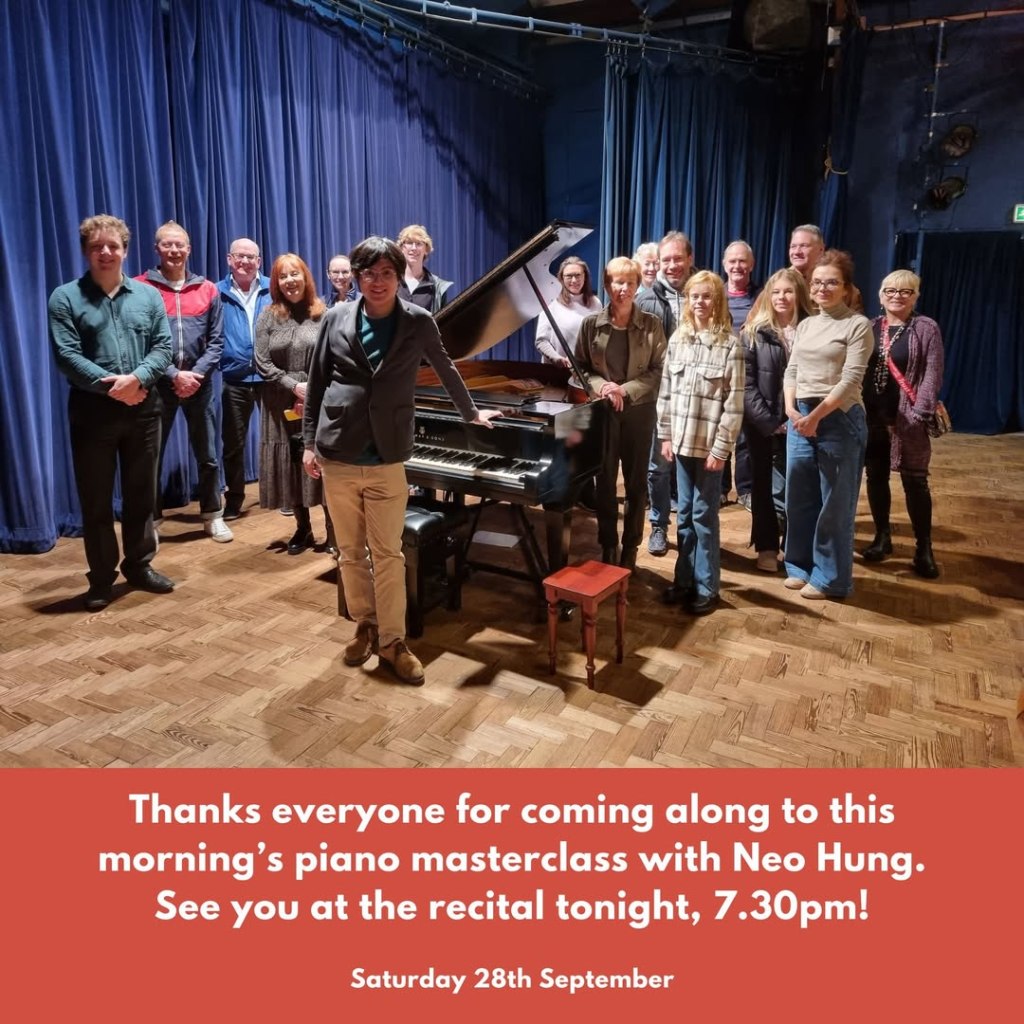
On 28th September, Neo Hung, a top prize winner of the Liszt Competition UK, gave a masterclass and concert for the Erin Arts Centre on the Isle of Man for the Keyboard Trust.

‘What a lovely, easy-going young man and such a fantastic pianist. The masterclass was detailed and informative and the recital was absolute dynamite. Everybody was fully engaged throughout the show and all shook his hand afterwards (there were about 60 of them!) and thanked him for coming. Once again thank you to you and the Keyboard Trust for finding ANOTHER exceptional young talent; we’re really happy to help give them a foothold’ – Pip Rolfe, Erin Arts Centre.

And from Neo: ‘I had a most unforgettable experience performing at the wonderful Erin Arts Centre on Isle of Man on 28th September 2024 in addition to presenting my first ever masterclass! First and foremost, I would like to thank the artistic directors of the Keyboard Trust for offering me this unique opportunity which has increased my exposure to a wider audience. I had a most unforgettable time performing for such an enthusiastic and warm audience who reacted positively as I shook hands with one by one post-concert. Thank you to everyone who has come to either or both of my masterclass and recital that day with such attentiveness and passion. It has been an absolutely fantastic day! ‘https://christopheraxworthymusiccommentary.com/2024/12/25/point-and-counterpoint-2024-a-personal-view-by-christopher-axworthy/

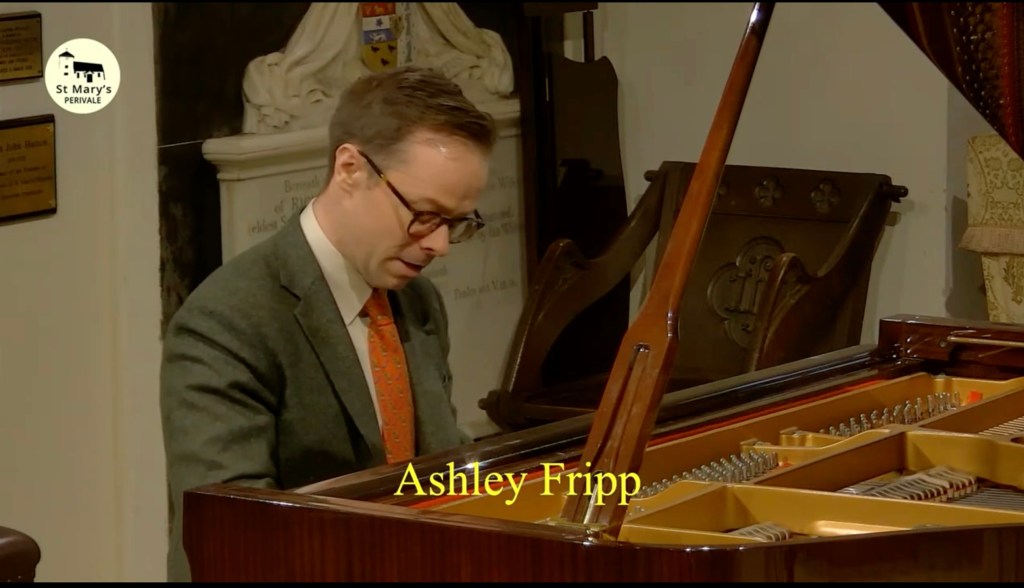
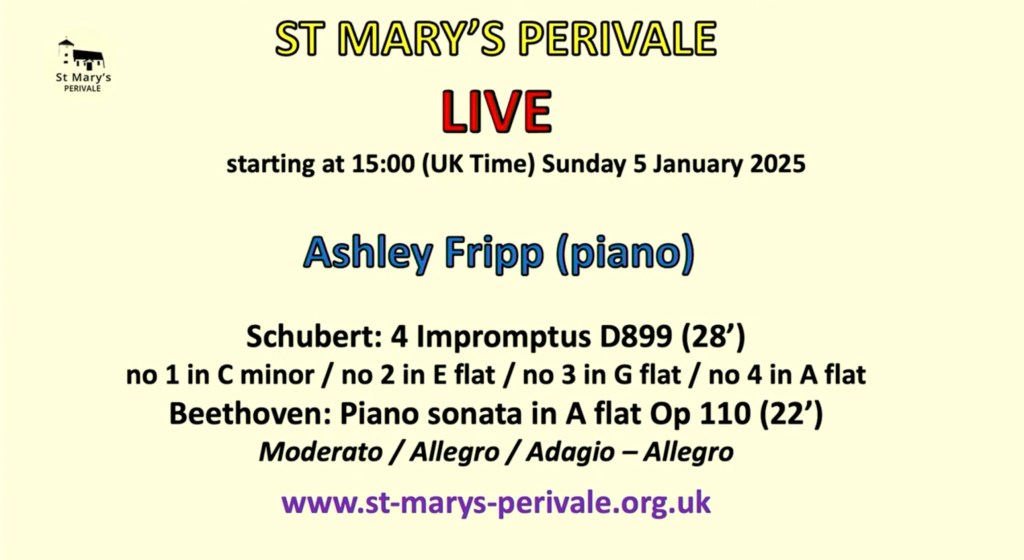
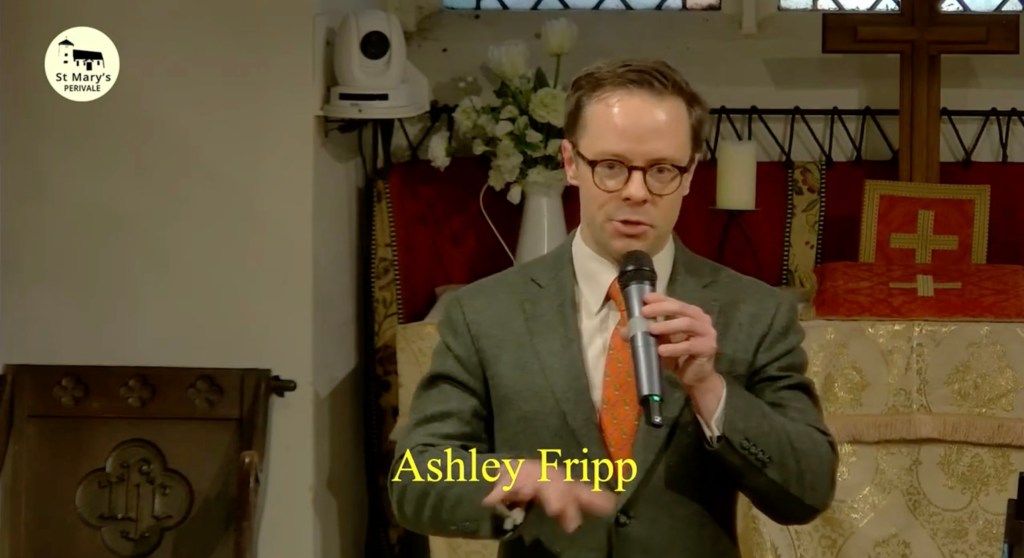
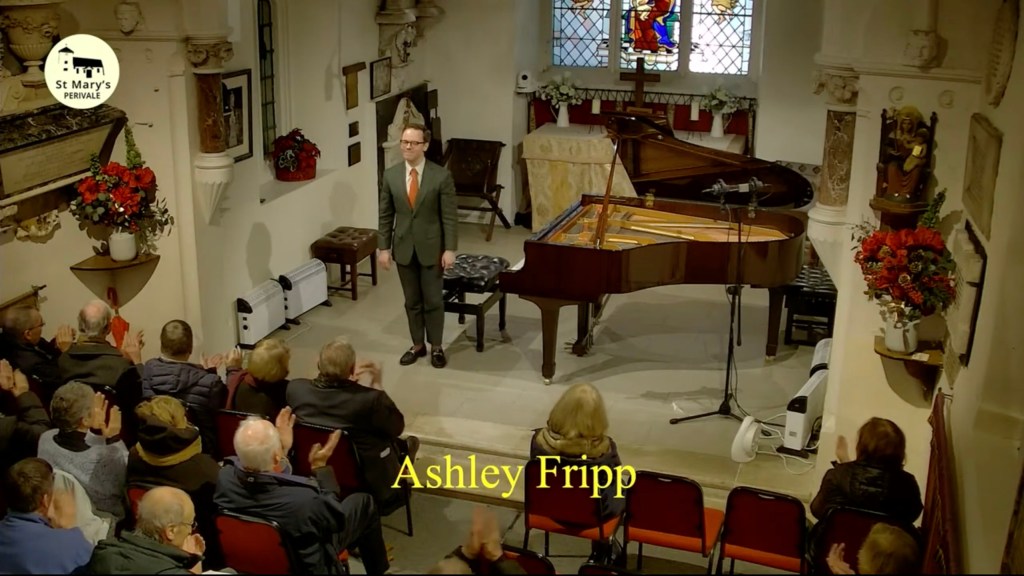
Ashley Fripp ‘A master descends on St Mary’s on Twelfth Night.’

https://www.youtube.com/live/AyqgYhDxcCE?si=wJEWbUjPkRYjXlHK

Truly masterly playing from Ashley Fripp who I have heard over the years give many recitals both in the UK and in Italy where he came to perfect his studies with Eliso Virsaladze. I remember her telling me about this very good English young man she had in her class in Sermoneta, near to my country home, where she would give masterclasses every year. I later heard him in Florence where he was one of the first to give a recital in the Harold Acton Library of the British Institute. It is thanks to that happy encounter that the Keyboard Trust now give a series of recitals there every year, allowing aspiring young pianists a chance to pay in the city that is acknowledged to be the ‘Museum of the World’. All this to say that Ashley has matured and his playing is of such seeming simplicity, full of profound poetic meaning of overwhelming authority and remarkable musicianship. Two works on the programme with only three years between their composition by Schubert and Beethoven.Two much loved works very often heard in the concert hall but rarely heard played as we heard it today from Ashley’s masterly hands. It was not only his playing that was inspired but his introductions shed such light and insight on these masterpieces and the composers that had penned them. I did not know that the Beethoven Scherzo was based on two popular songs or that he quotes in the last movement from Bach St John’s passion from the moment of Christ dying on the cross. It was this research to discover the true meaning behind the notes and the significance for their creators that came across in interpretations with profound insights and aristocratic authority.

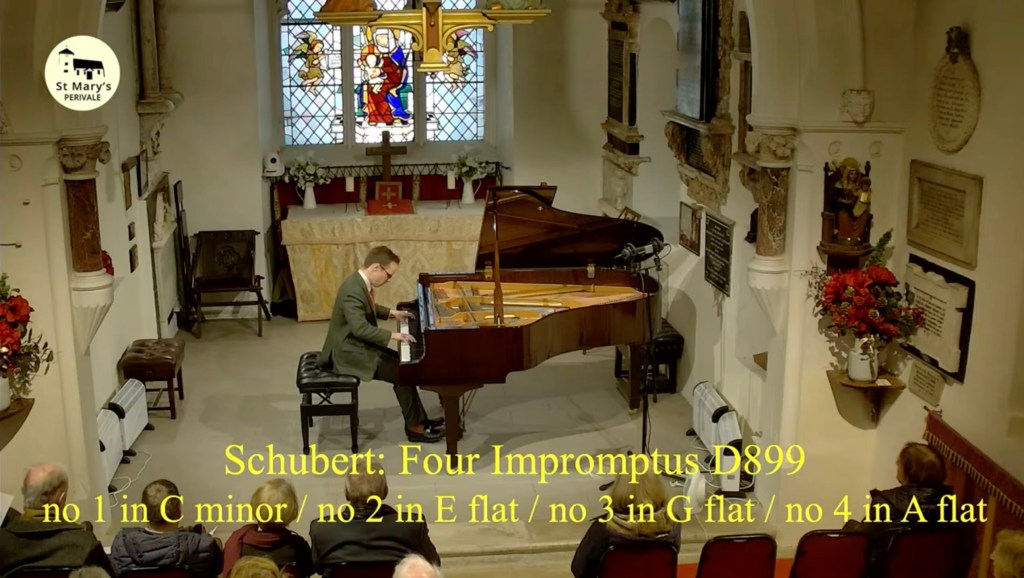
Schubert impromptus that were both measured but also full of poetic meaning with the desolate opening of the C minor and its sudden rays shining a golden light on moments of sublime beauty. The beautifully mellifluous stream of sounds of the E flat impromptu where everything sang with disarming simplicity and beauty. Refined and restrained until the finally few bars of searing excitement with an exhilarating downward scale as an astonishing release of tension.The beautiful sense of balance in the G flat impromptu where the melodic line was played with aristocratic poise of nobility and tenderness.The fourth impromptu like water flowing with cascades of gentle notes taking us to the melodic line that was shaped with architectural understand. There was great control to the central episode played with nobility and refined passion with sudden rays of light lighting up this golden prism of sound of sublime beauty.

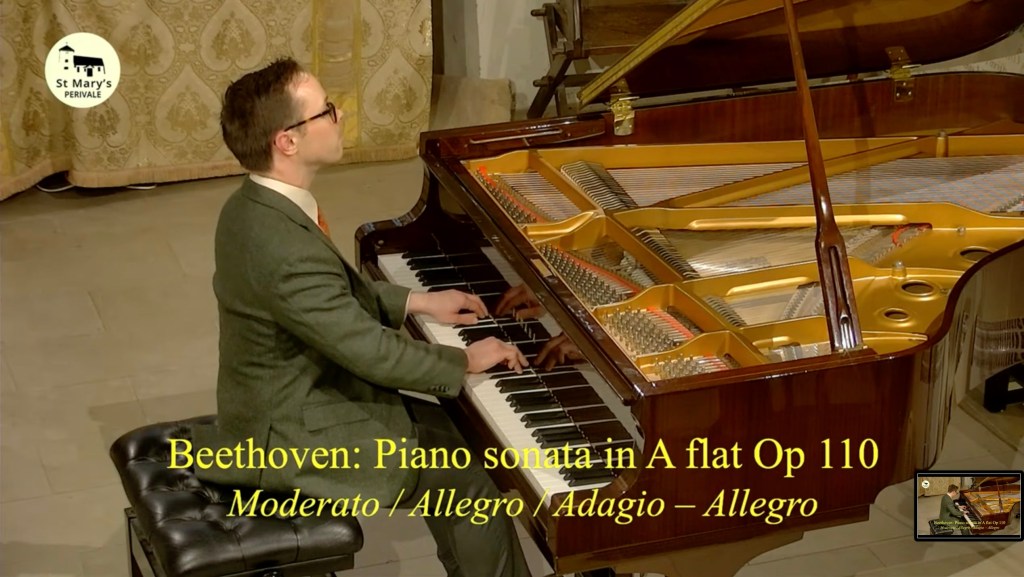
Beethoven’s penultimate sonata with Ashley’s introduction about Beethoven’s belief in humanity and how this was demonstrated, made his reading ever more enticing and full of significance. A beautifully sung first movement with flowing sounds of insight and poignant meaning. A ‘scherzo’ that seemed to grow out of the final two chords of the first movement such was the overall architectural shape and meaning that Ashley was able to convey. Of course technical difficulties just did not exist as it was the musical meaning that was uppermost in Ashley’s interpretations. But nevertheless the trio I have never heard played with such limpet like authority and assurance.There was great poise to the ‘Adagio’ where Beethoven’s own pedal enriched and enlightened this improvisatory transition to the etherial ‘Aria’. Beethoven finds a magical mixture of formal fugue and bel canto with a deep pulsating heartbeat that accompanies the ‘Aria’ and takes us to the final exhilaration and passionate acceptance of his faith in mankind.

An extraordinary performance of great significance and mesmerising authority similar to Serkin’s unforgettable performance in the Festival Hall many years ago.

Again Ashely’s spoken eloquence and informative intelligence enlightened his choice of encore by Liszt (who was the first to play Beethoven’s op 110 in public) with one of his transcriptions of Schubert’s song’s. ‘Aufenthalt‘ (Resting Place) derives from a Rellstab poem and is from the posthumous song cycle ‘Schwanengesang’. A bitter and resigned song about rejected love – “Surging river, roaring forest, immovable rock, my resting place.” It was played with sumptuous sound and hypnotic beauty with a kaleidoscope of colours that only the genius of Liszt and Schubert combined could ever have envisaged.

British pianist Ashley Fripp has performed extensively as recitalist, concerto soloist and chamber musician throughout Europe, Asia, North America, Africa and Australia in many of the world’s most prestigious concert halls. Highlights include the Carnegie Hall (New York), Musikverein (Vienna), Concertgebouw (Amsterdam), the Philharmonie halls of Cologne, Paris, Luxembourg and Warsaw, the Bozar (Brussels), the Royal Festival, Barbican and Wigmore Halls (London), the Laeiszhalle (Hamburg), Palace of Arts (Budapest), the Megaron (Athens), Konzerthaus Dortmund, the Gulbenkian Auditorium (Lisbon) and the Konserthus (Stockholm). 

He has won prizes at more than a dozen national and international competitions, including at the Hamamatsu (Japan), Birmingham and Leeds International Piano Competitions, the Royal Over-Seas League Competition, the Concours Européen de Piano (France) and the coveted Gold Medal from the Guildhall School of Music & Drama. Ashley was awarded the Worshipful Company of Musicians’ highest award, The Prince’s Prize, and was chosen as a ‘Rising Star’ by the European Concert Hall Organisation (ECHO). He has also performed in the Chipping Campden, Edinburgh, Brighton, Bath, Buxton, City of London, and St. Magnus International Festivals as well as the Oxford International Piano Festival, the Festival Pontino di Musica (Italy) and the Powsin International Piano Festival (Poland). Ashley also gave an open-air Chopin recital beside the world-famous Chopin monument in Warsaw’s Royal Lazienki Park to an audience of 2,500 people. 

Ashley Fripp studied at the Guildhall School of Music & Drama with Ronan O’Hora and with Eliso Virsaladze at the Scuola di Musica di Fiesole (Italy). In 2021 he was awarded a doctorate for his research into the piano music of British composer Thomas Adès. Future engagements include his debut at the Mecklenburg-Vorpommern Festival (Germany) and a commercial film production of Rachmaninoff Piano Concertos Nos. 1 & 2 with accompanying concert tours in Germany and the Czech Republic with the Prague International Youth Orchestra. 

Ashley Fripp at St Marys ‘The authority and impeccable musicianship of a great artist’

Ashley writes :


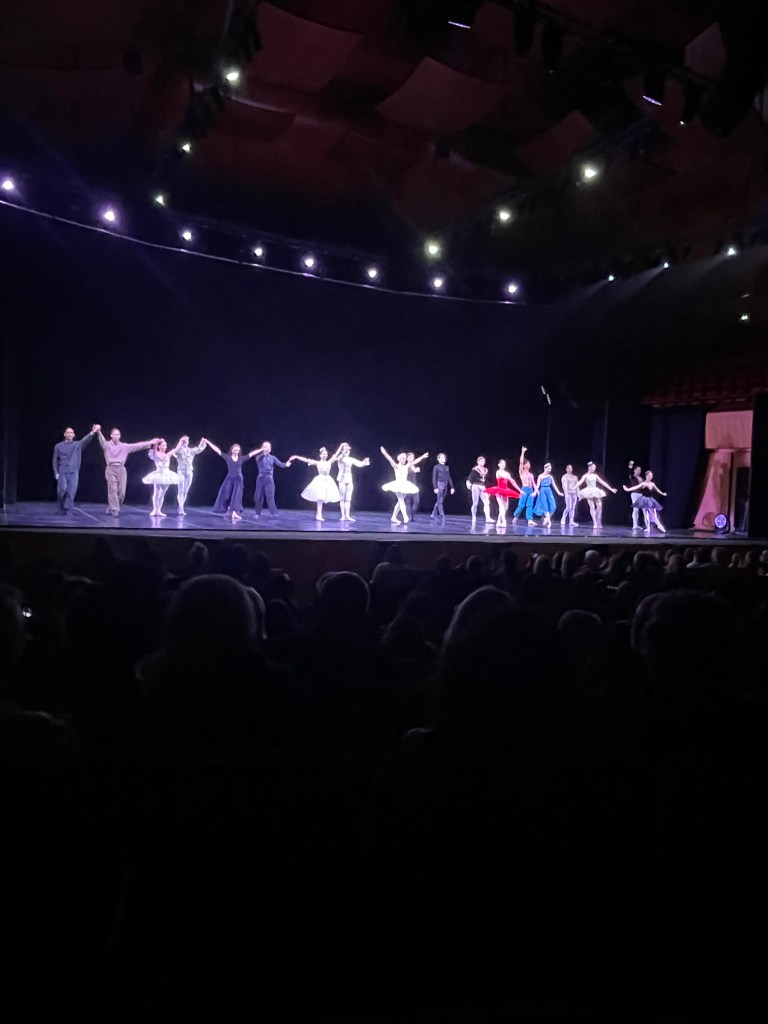
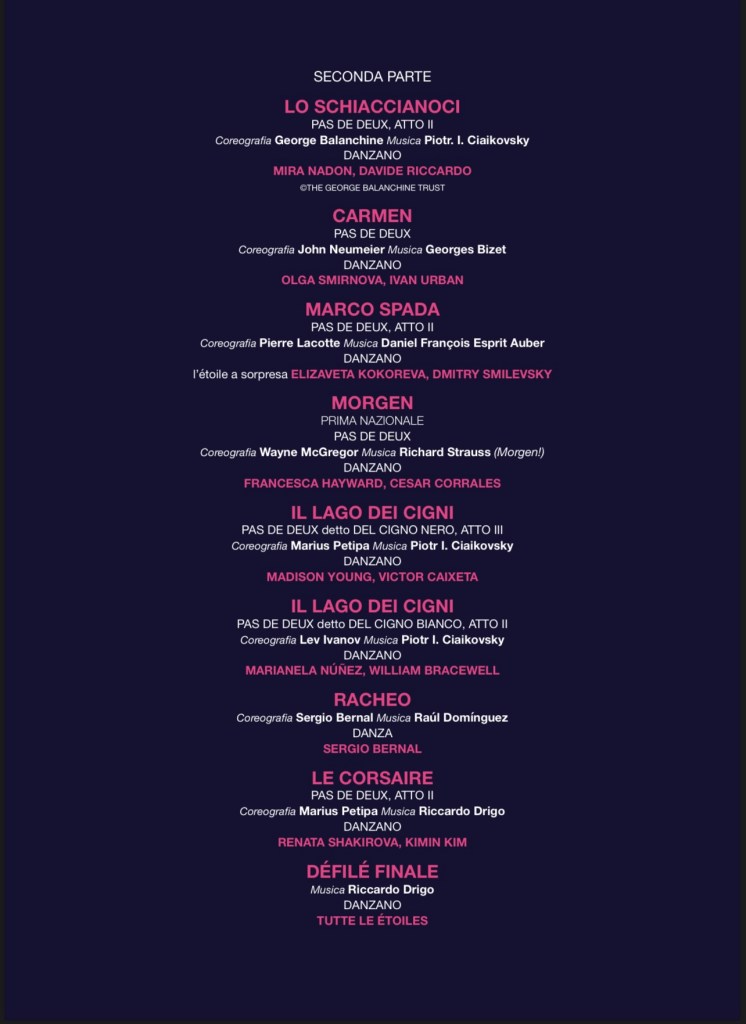
Stars shining brightly in Rome for Twelfth Night

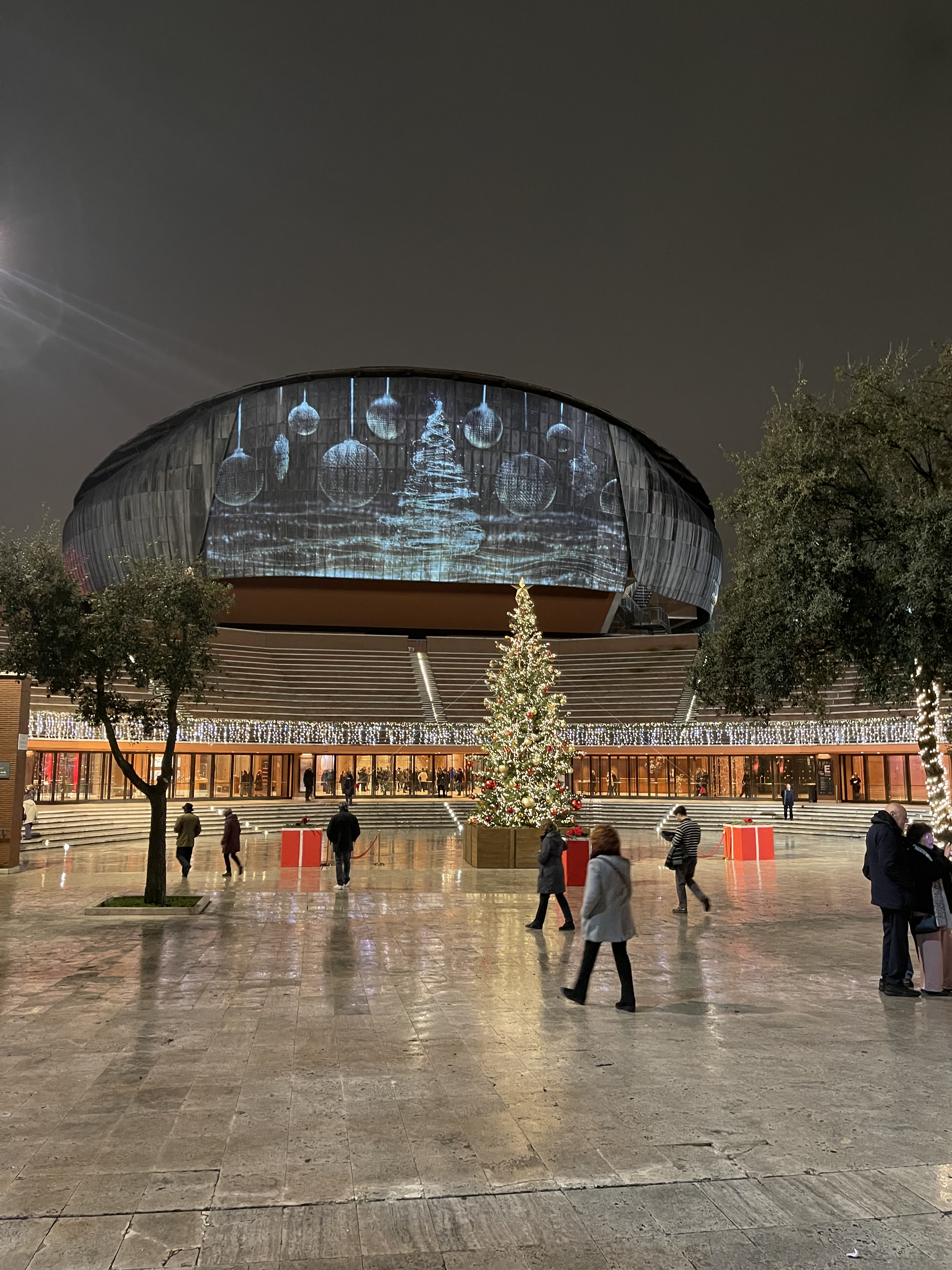
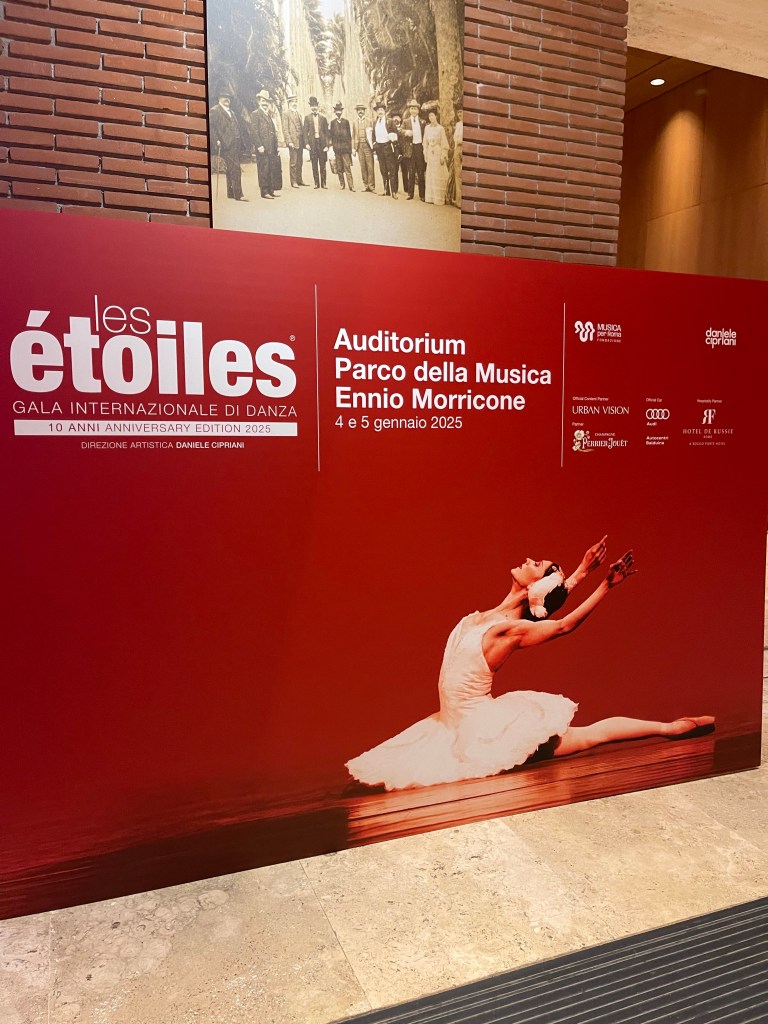
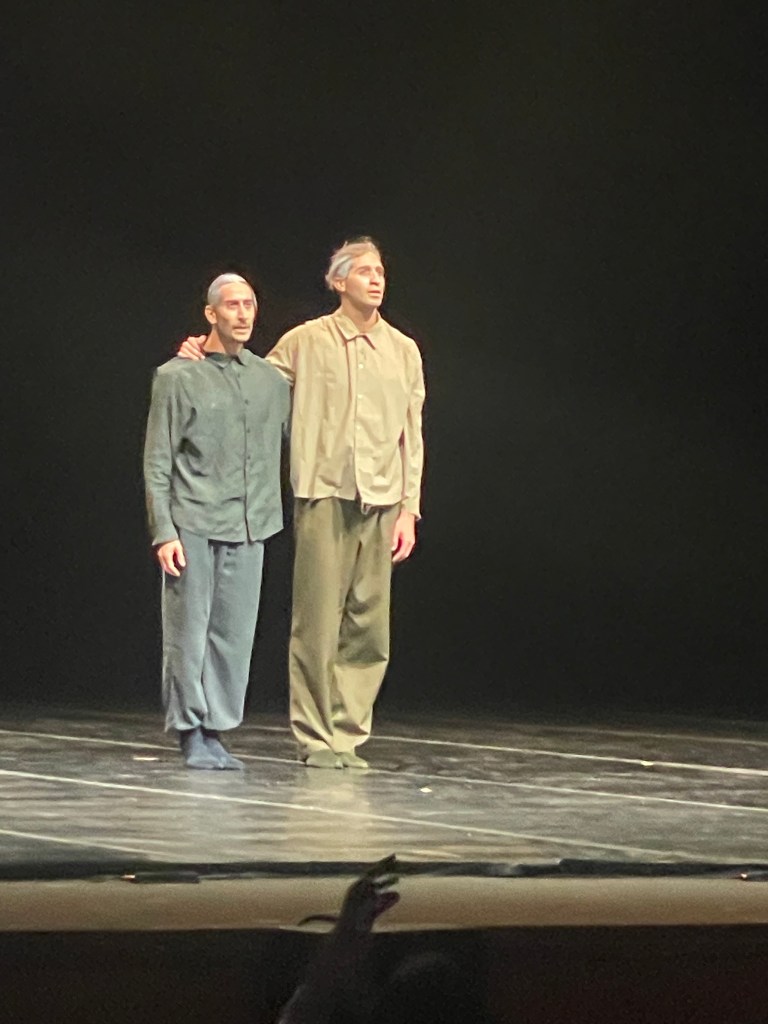
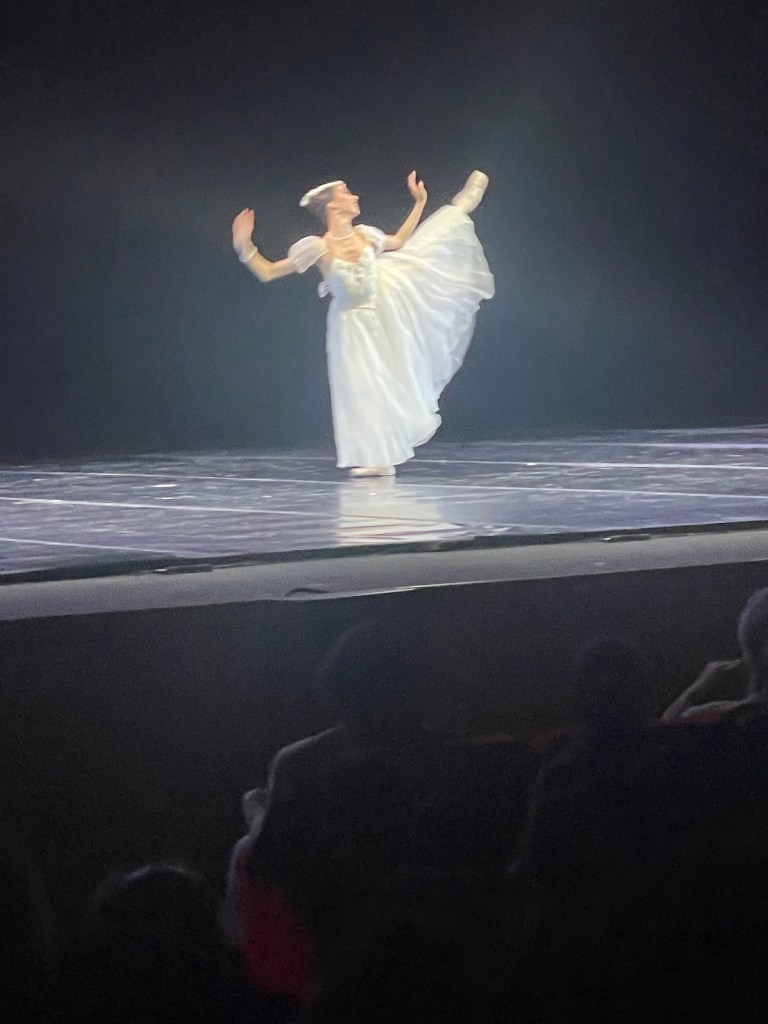
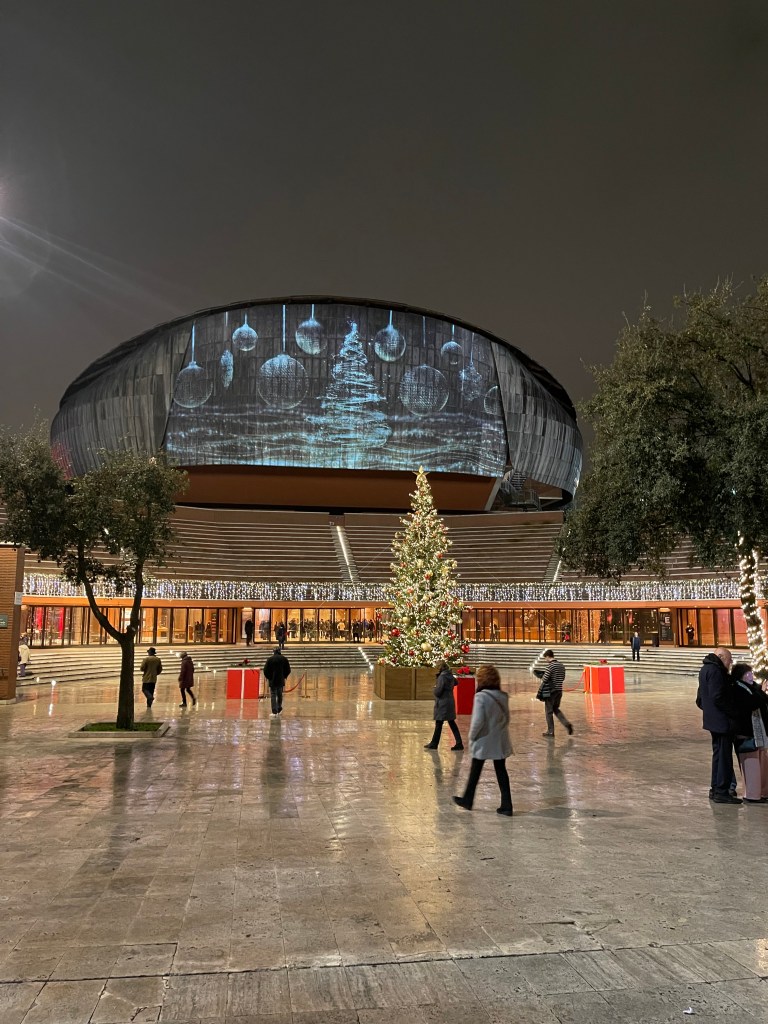
Stars shining brightly at Rome’s magnificent Parco de la Musica on the eve of the twelfth day of Christmas .

It is the evening of epiphany when by tradition the ‘Befana’ descends to give all good children their presents.

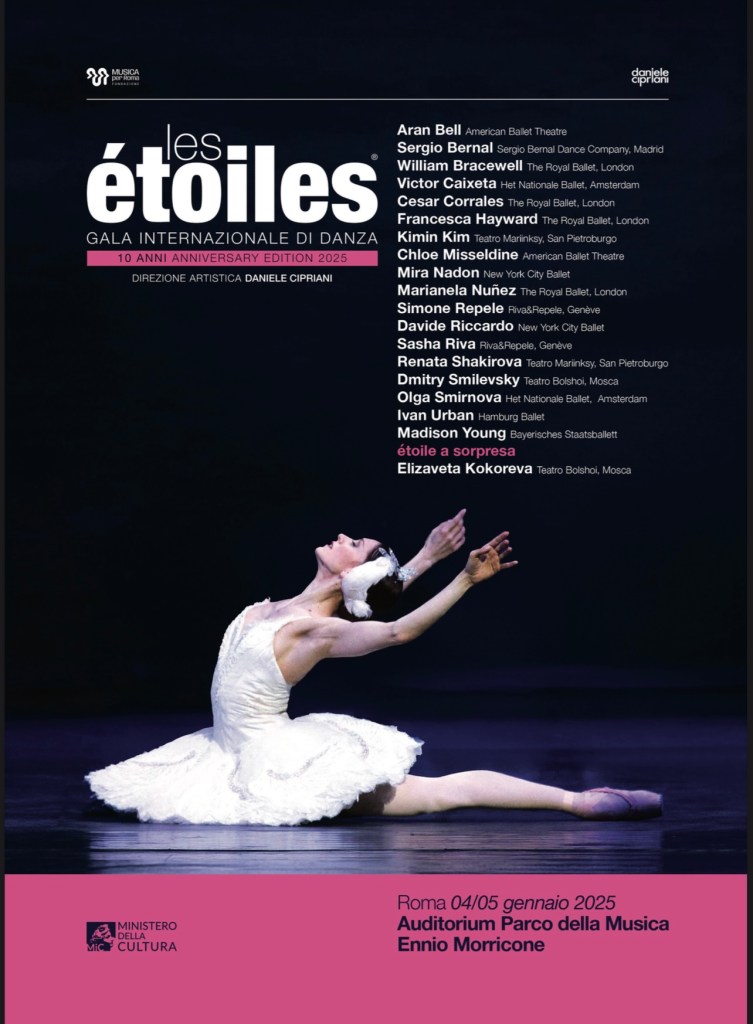
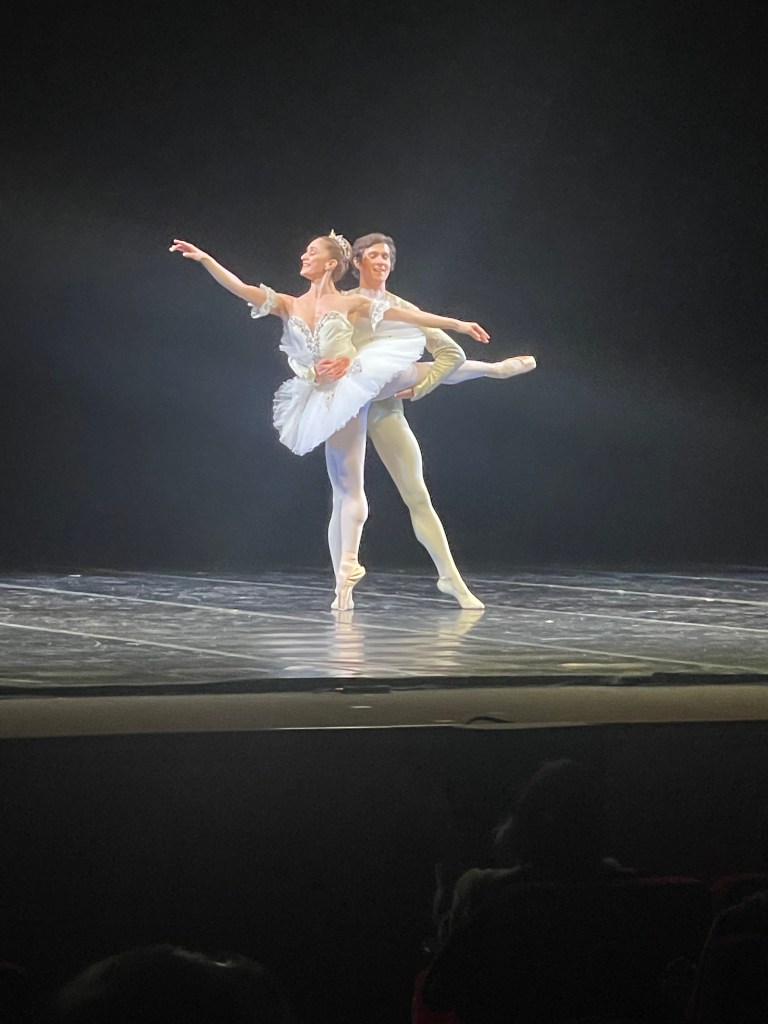
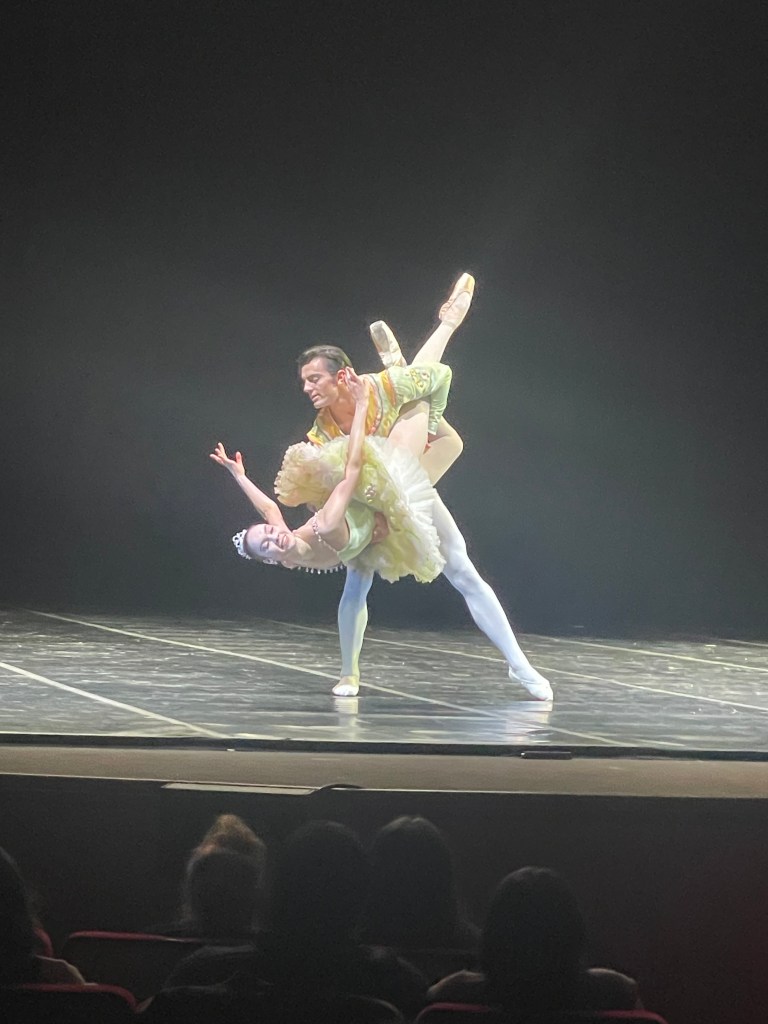
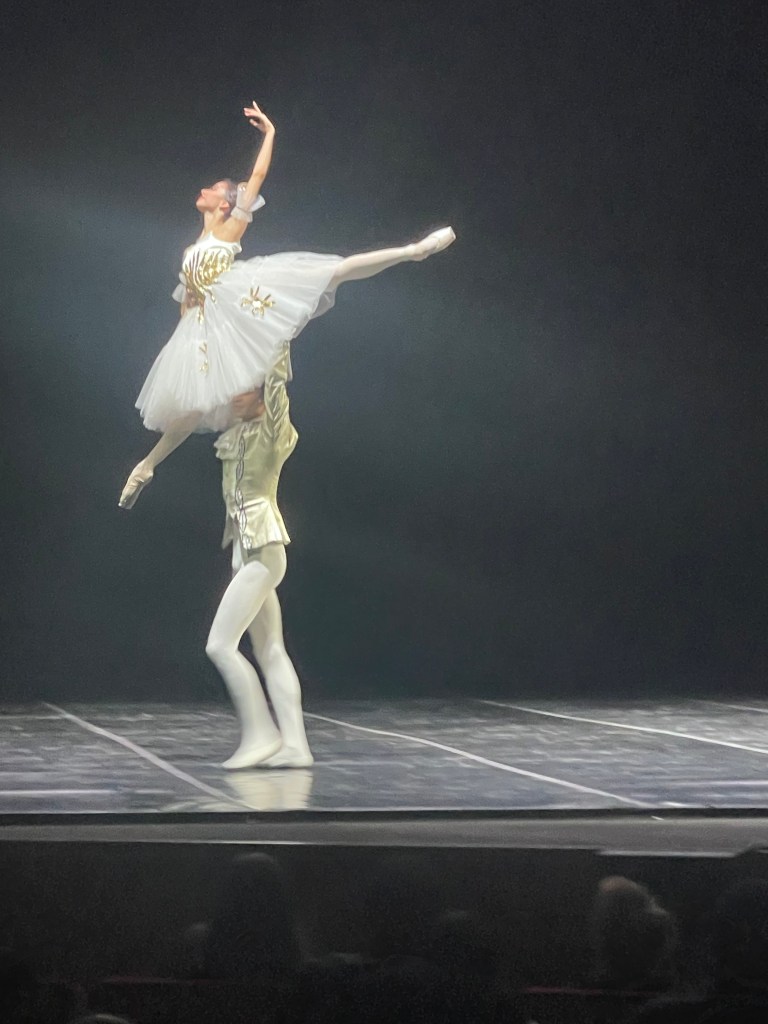
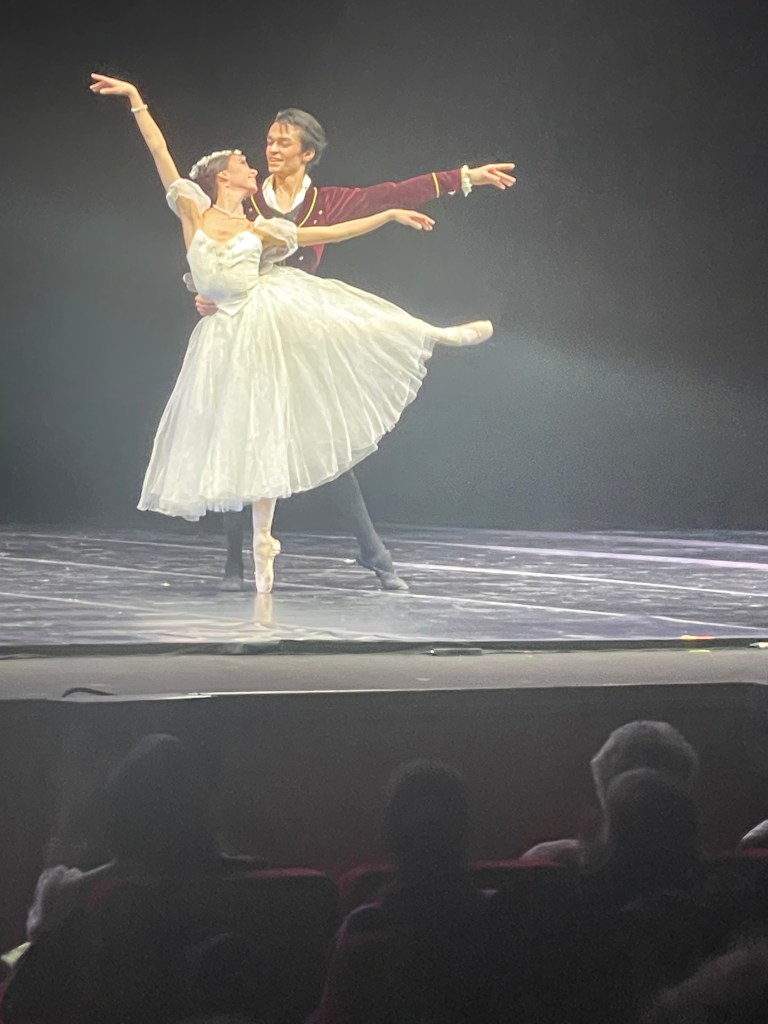
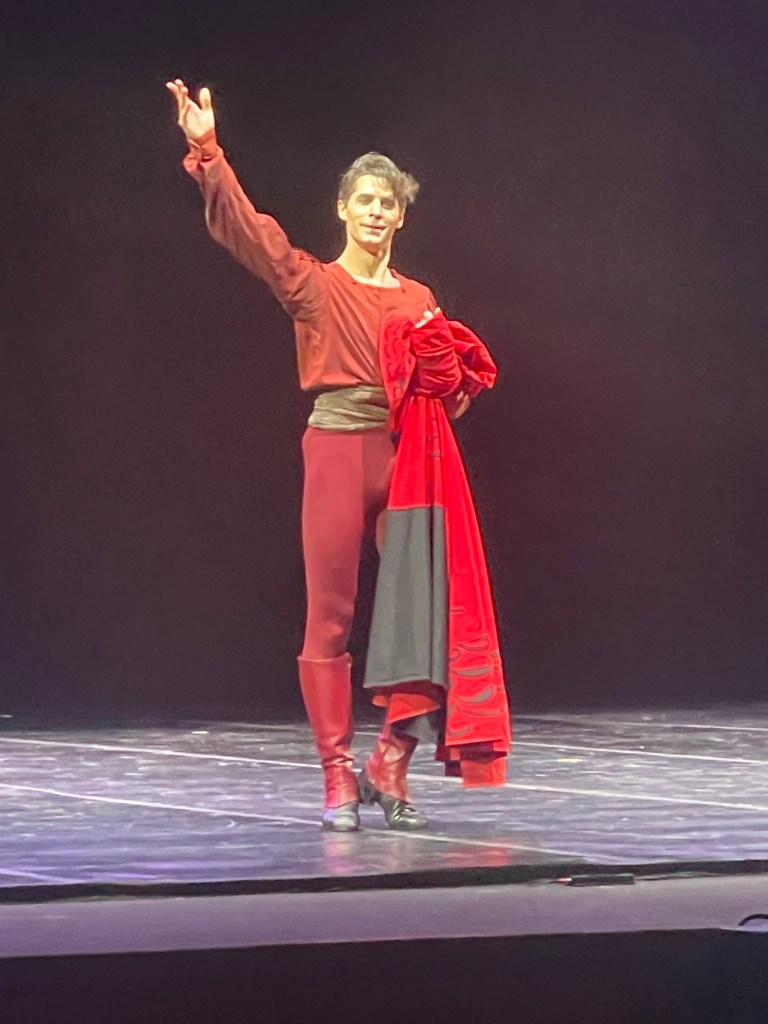
Daniele Cipriani has for many years now given us an evening of stars of the ballet world with an exhibition of pas de deux and solos greeted with stadium like enthusiasm by an audience that fills this vast space of Renzo Piano three times over .

An exhibition of refined elegance where the beauty of the human body is exulted by super human dedication to perfecting every nuance and movement.

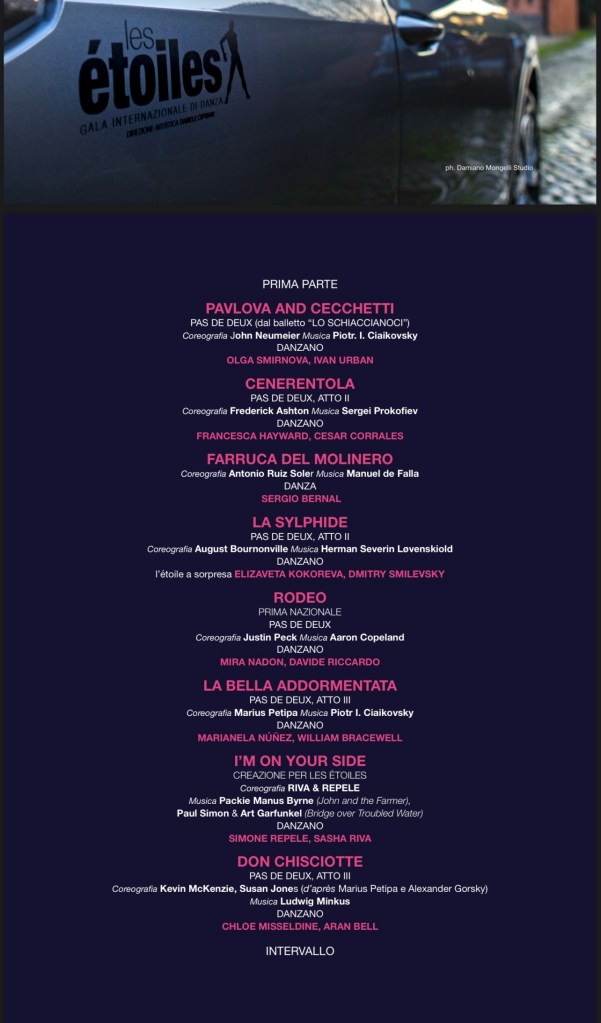
Breathtaking athleticism from Renata Shakirova and Kimin Kim were greeted by yells of delight as their jumps became higher and higher and faster and faster.

There was also the very amusing slap stick of Simone Repele and Sasha Riva were art really conceals artistry of quite extraordinary vividness with subtle non stop gymnastics.

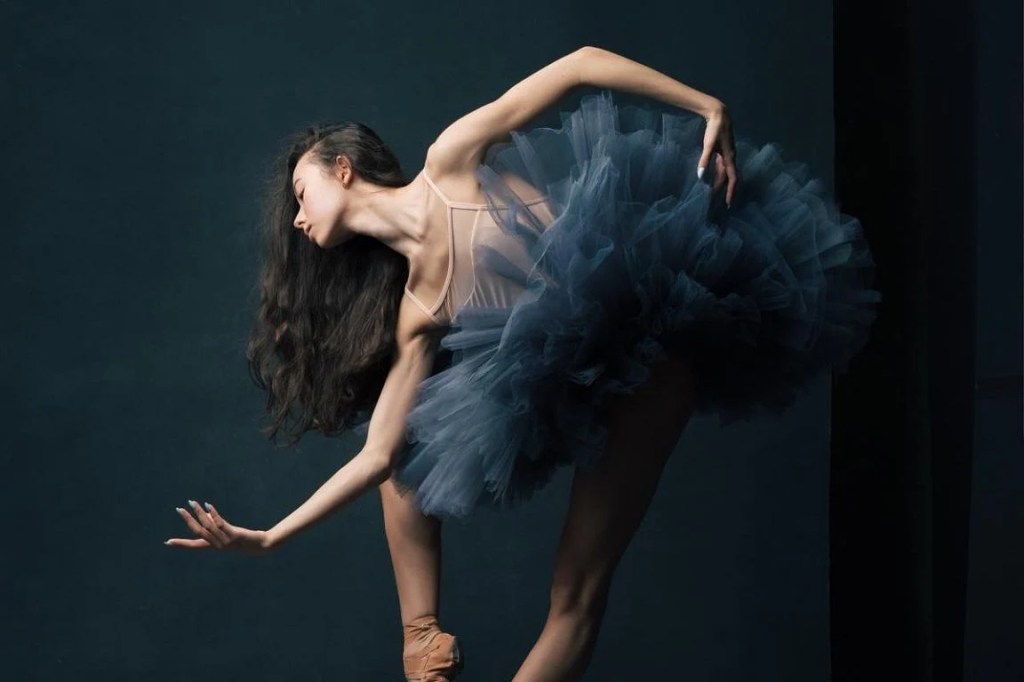
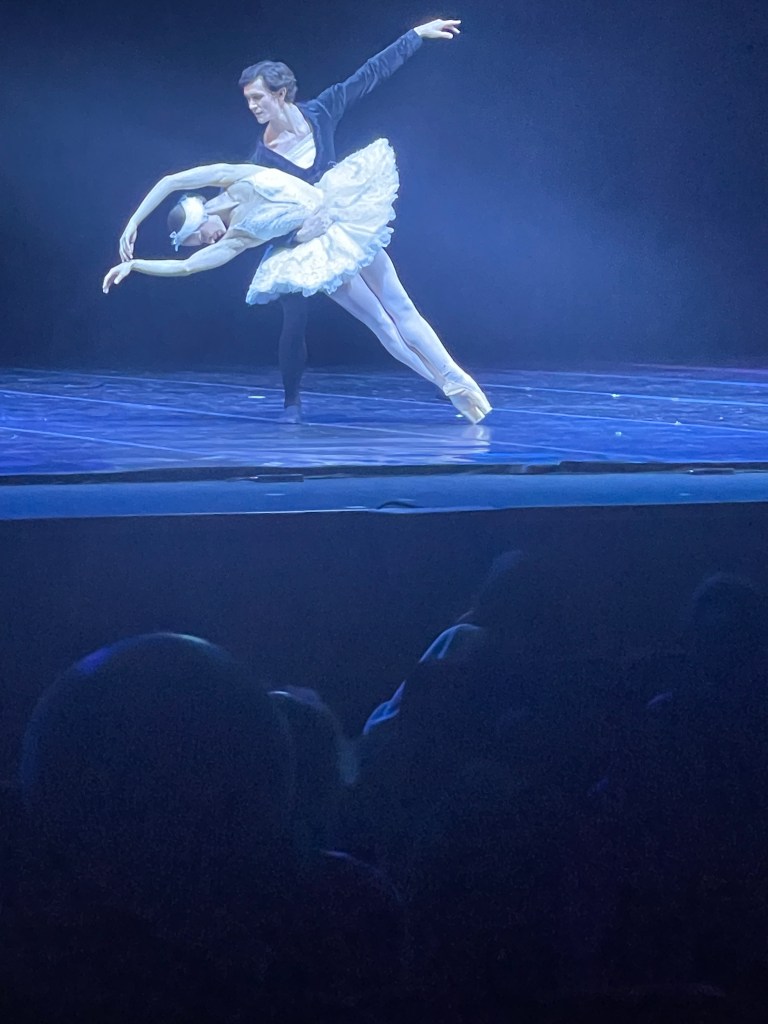
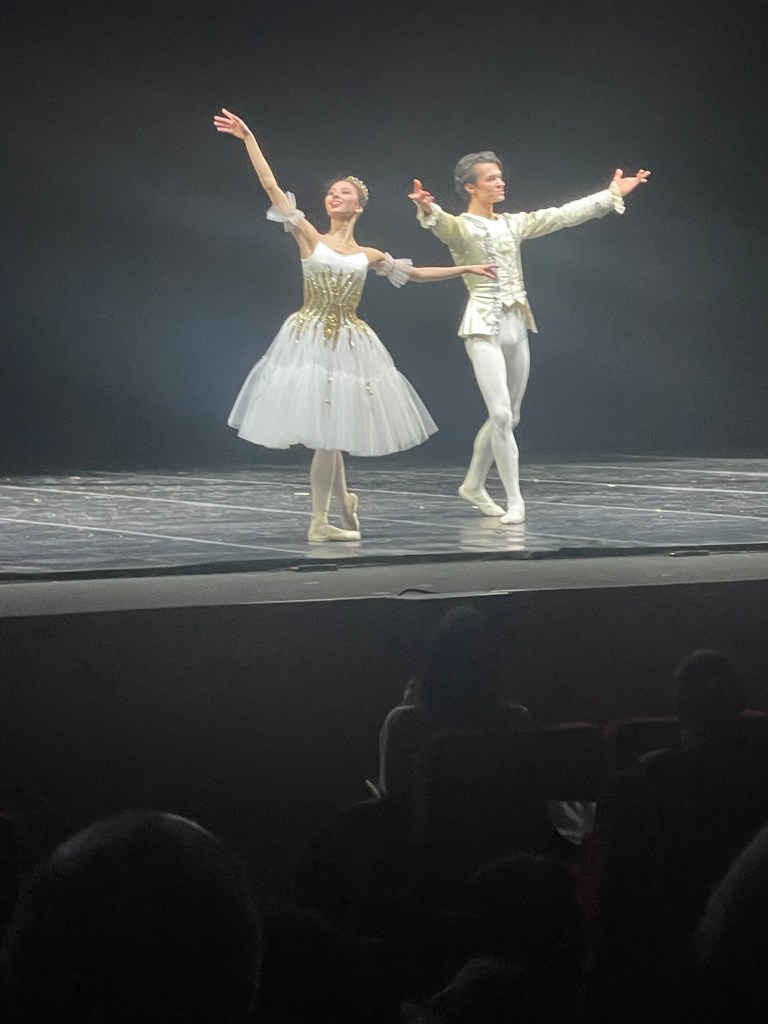
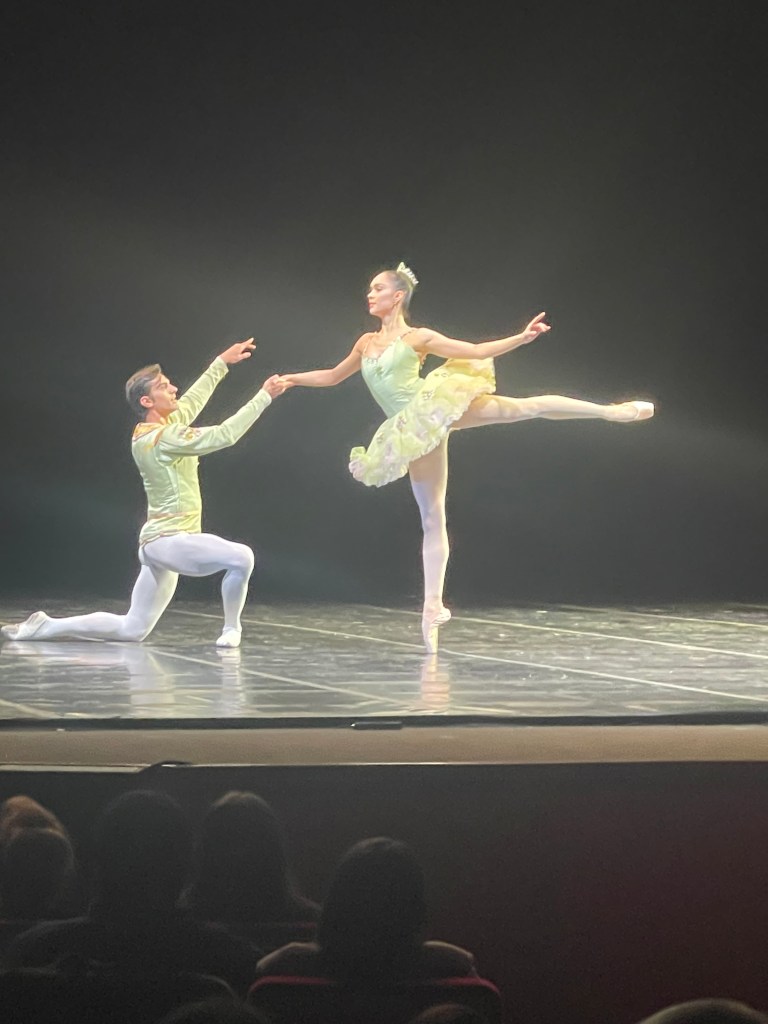
There was of course the ravishing beauty of classical ballet with the beauty and poise of the newly appointed star of the Bolshoi Ballet , Elizaveta Kokoreva and her dashingly dynamic partner Dmitry Smilevsky.

Amazing Spanish tap dancing from Sergio Bernal who also could create atmospheres of searing intensity.

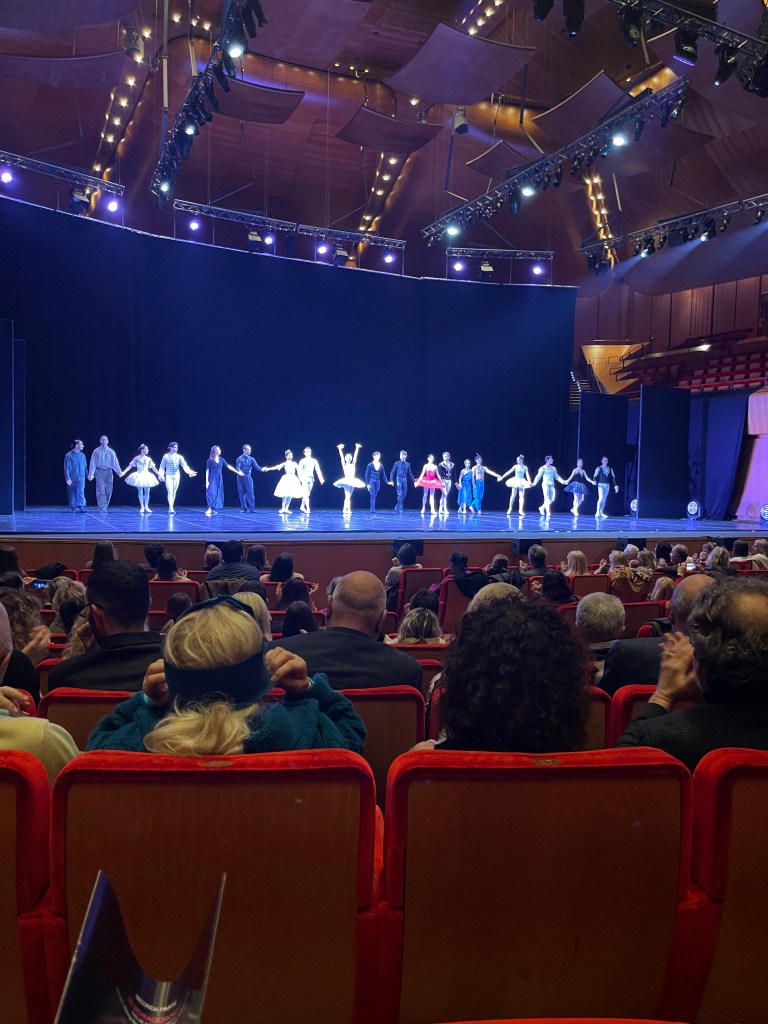
And a final non stop exhibition from all the artists one after the other in a breathtaking line up of superhuman athleticism and virtuosity.

A circus of beauty, imagination and the triumph of the human body that can be so expressive with seemingly effortless beauty with it’s only wish to exult the human spirit and poetic imagination. 

Elizaveta Kokoreva newly appointed star of the Bolshoi Ballet https://www.gramilano.com/2025/01/interview-elizaveta-kokoreva-bolshoi/

Finn Mannion and Ke Ma Mastery and passionate intensity ignite St Mary’s

Screenshot
https://www.youtube.com/live/1stXczBvT4Q?si=QVO285XOnqn3Ygew

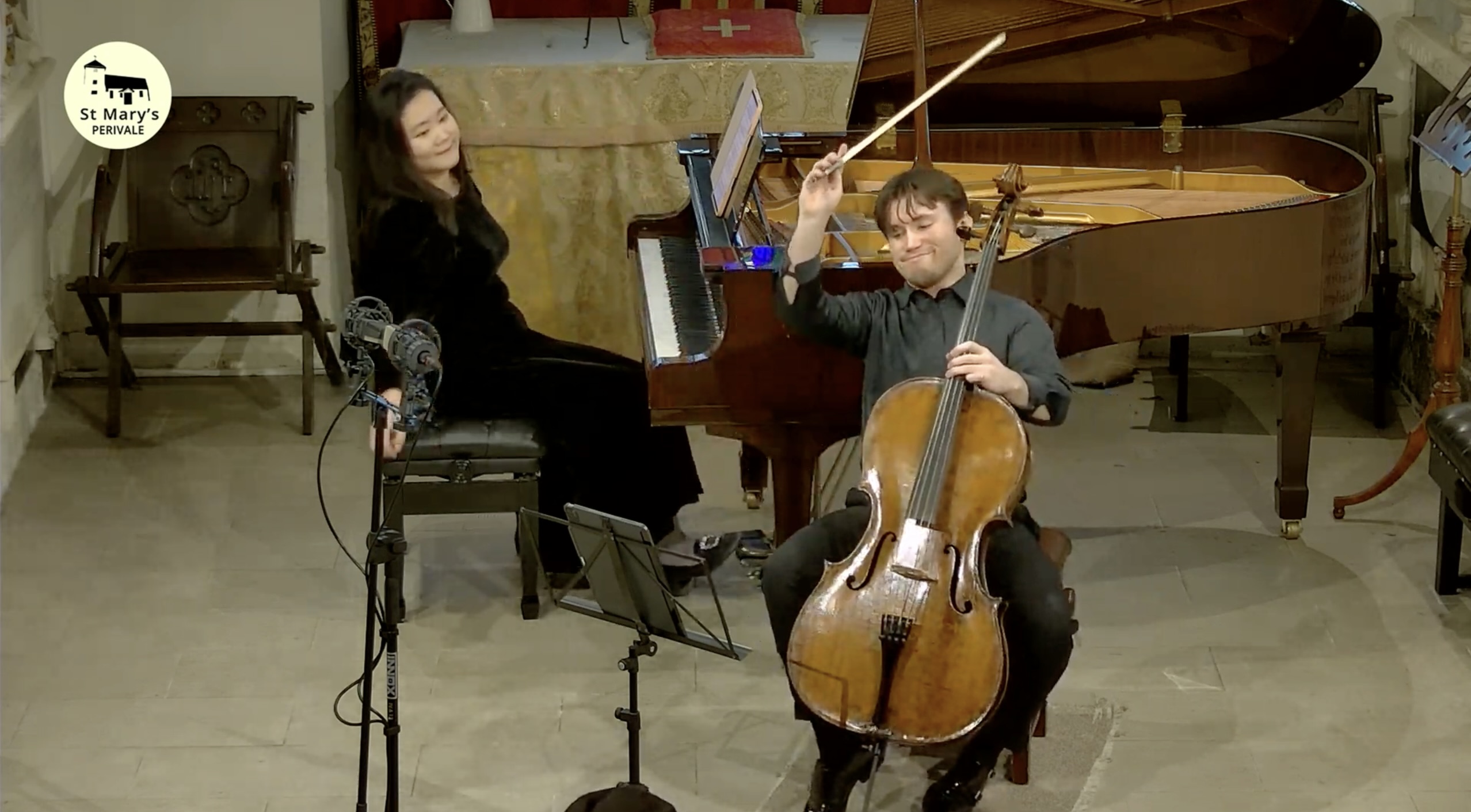
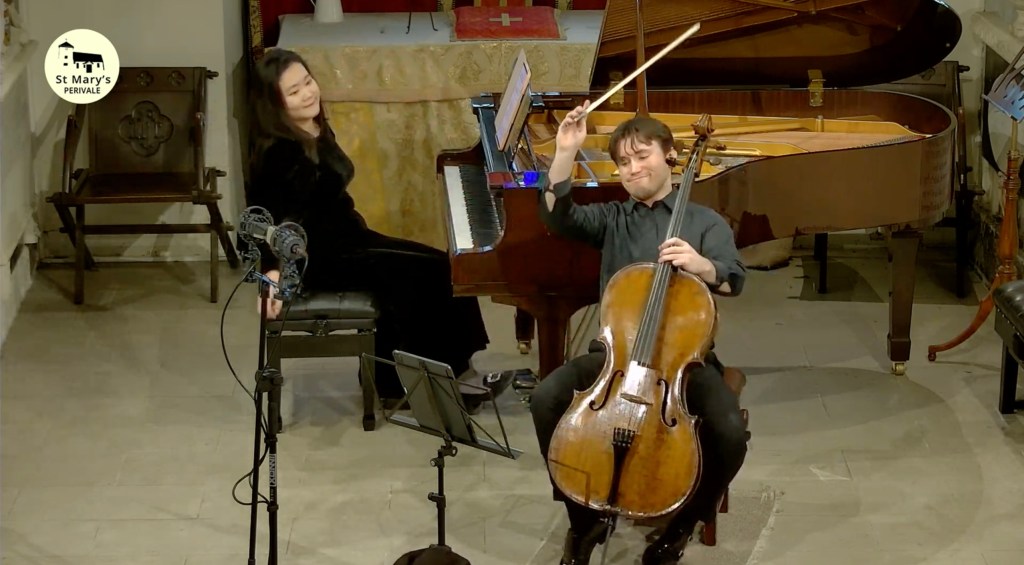
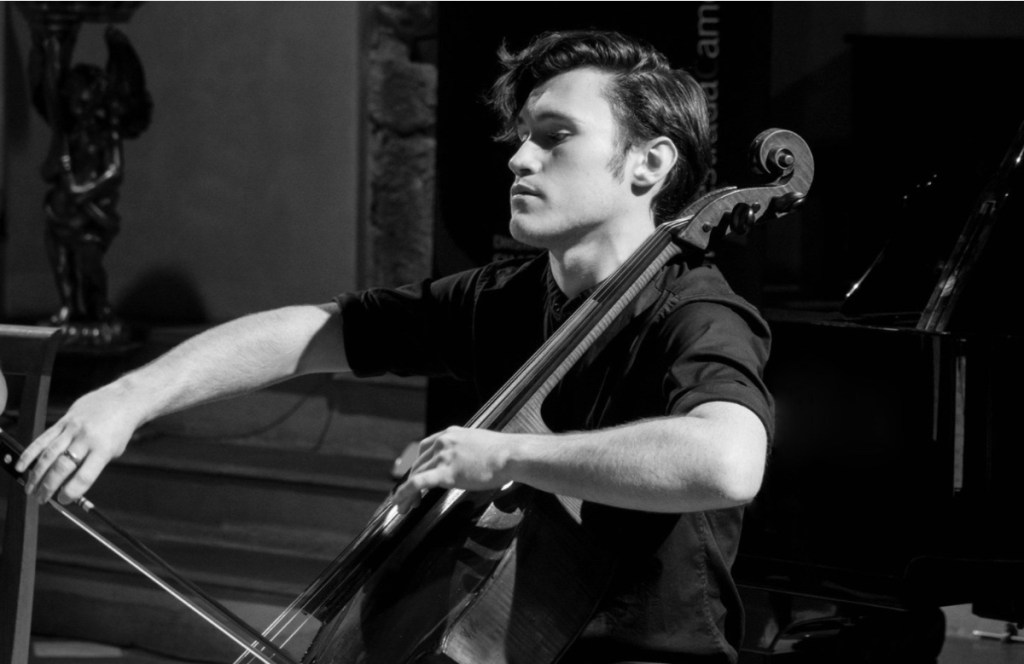
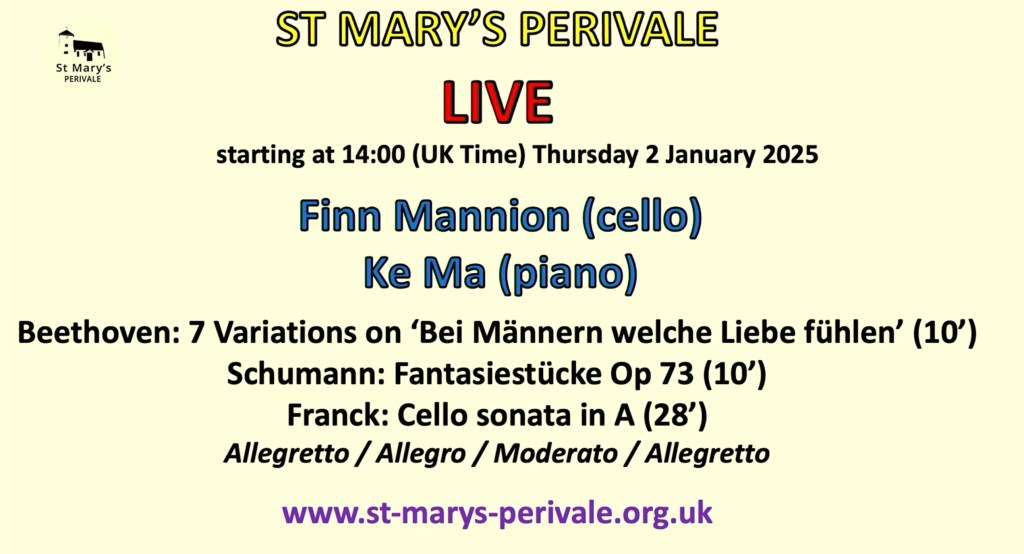
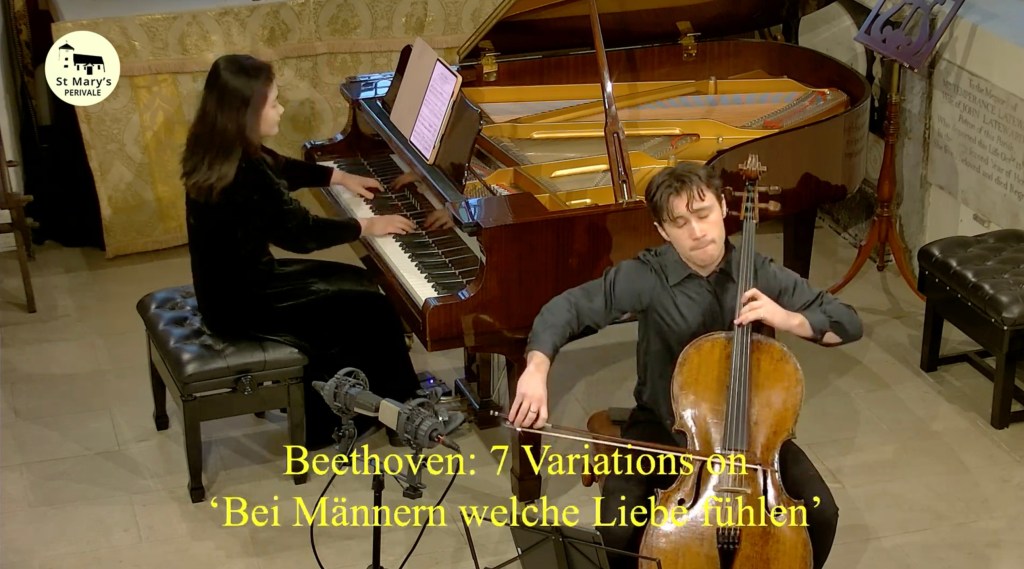
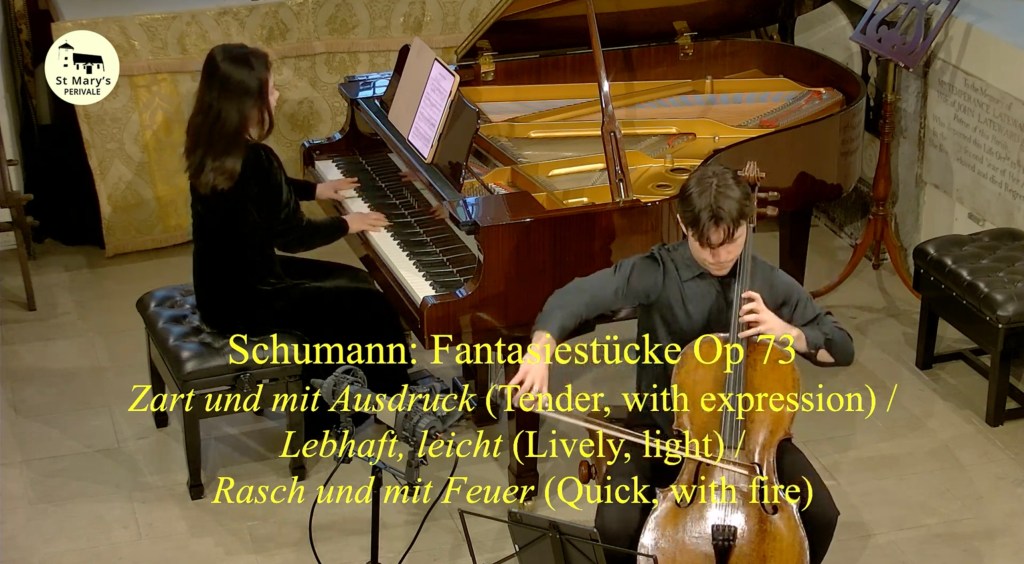
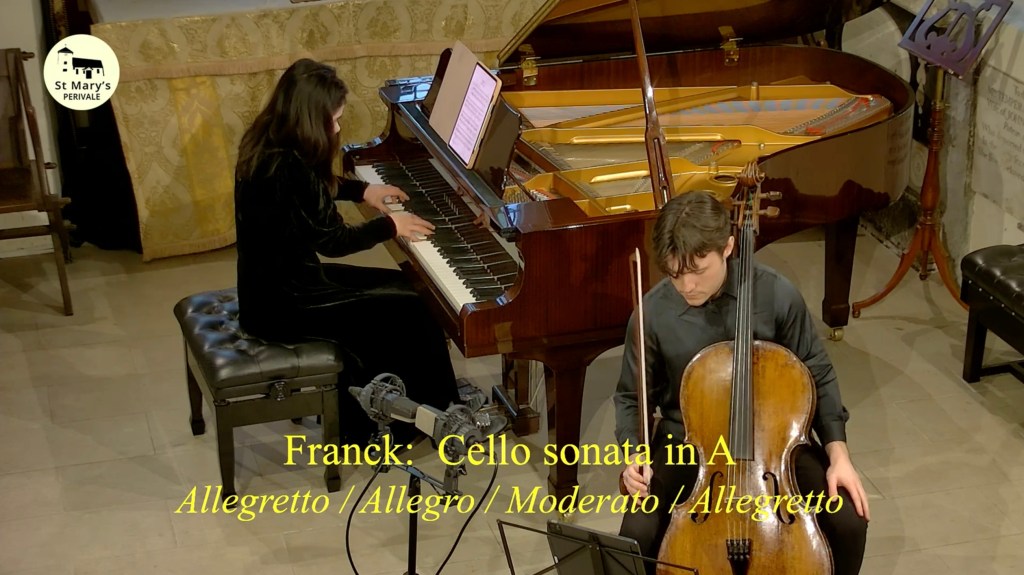
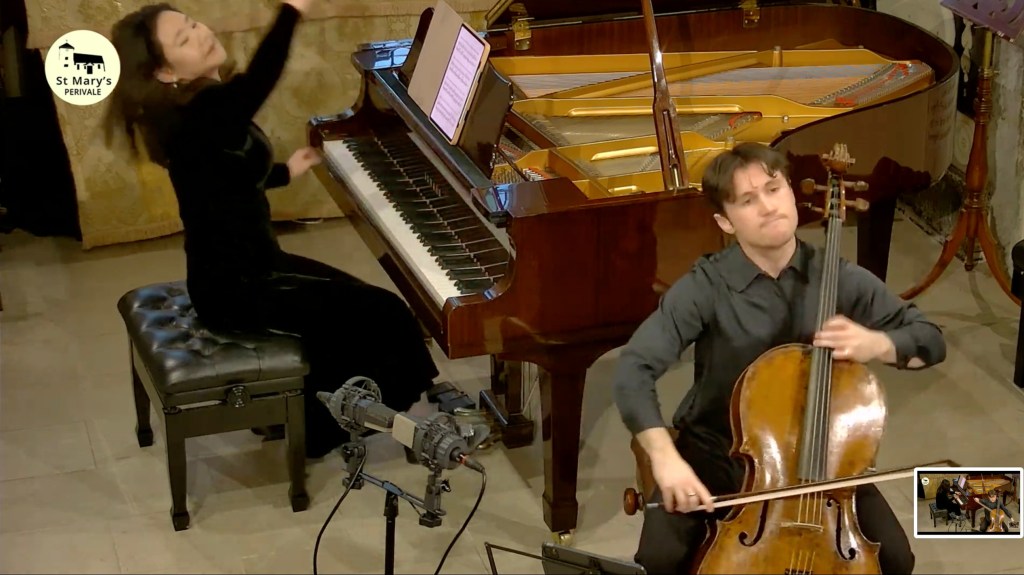
Some fine duo playing for the first concert in the 2025 season at St Mary’s ,the first of over a hundred already programmed for the future! Ke Ma I have heard many times as a solo pianist but this is the first time as an equal partner to a cellist.Finn a young cellist from Scotland who is now studying in Switzerland and already at 22 shows a maturity and mastery which will grow as his playing gains in even more weight.

Beethoven variations played with a great sense of character with a question and answer between the two players of tenderness and elegance quite apart from their dynamic rhythmic drive.The beautiful piano solo in the minor was answered by the cello with delicacy and nobility.A playful ‘joie de vivre’ between the two instruments with a joyous ending where as always the genius of Beethoven has some surprises up his sleeve that were played with innocent abandon.

The first of the Schumann Fantasiestucke was played tenderly with expression but seemed to lack the sweep and expansive line that is so much part of Schumann’s mellifluous output.It seemed to take flight with the central episode of the second piece that was played with quixotic lightness with a superb sense of ensemble between these two players now totally united in Schumann’s unpredictable changes of mood and character.Straight into the last piece with the treacherous opening played with wild abandon and mastery.Here now they both played with a great sense of architectural line with passionate intensity of great abandon and romantic fervour.

Now completely attuned to each other they gave a performance of the Franck Sonata of passionate intensity and masterly technical control.There was a beautiful fluidity from Ke Ma’s hands answered by the burning intensity of the cello. A dynamic drive to the treacherous second movement that they played with considerable mastery igniting passionate outcries of searing passion but always under control and with impeccable musicianship and mature mastery.They created a beautiful sense of discovery as the recitativo of the third movement evolved into the most passionate and fervent declamations between the two players.The last movement opening like a ray of sunshine after such a stormy journey was played with refreshing simplicity and quite considerable technical mastery with superb ensemble between these two very fine young players playing with exhilaration and excitement..

After such red hot passion ‘Ich liebe dich’ by Beethoven was played as an encore with simplicity and beauty and was an ideal antidote to such raging passions.

Screenshot

Born into an Irish family, cellist Finn Mannion grew up in the Scottish Highlands. He enjoys a richly varied musical life; a passionate chamber musician who is equally comfortable in concerto, duo and unaccompanied repertoire. A laureate of the Pablo Casals, Beatrice Huntington and Royal Philharmonic Society Isserlis Awards, Finn recently won First Prize at the 72nd Royal Over-Seas League Competition in London with his Trio Archai . He gave his Wigmore Hall debut in June 2024. Collaborating regularly with pianist Ke Ma, Finn is a Tunnell Trust award-winner and is on MakingMusic’s PDG-YoungArtist Scheme. He has been Associate Artist of the Aboyne Cello Festival since 2023. Performing extensively across the UK and Switzerland, Finn’s upcoming season will include recitals at St George’s Bristol, Hoylake Concert Society, Swiss Chamber Music Festival and Kelso Music Society to name a few. Born in 2002, Finn learnt with Ruth Beauchamp at St Mary’s Music School in Edinburgh before moving to Switzerland to study with German/Japanese cellist Danjulo Ishizaka at the Musik-Akademie Basel. He also studies Early Music with Petr Skalka at the Schola Cantorum Basilienis after formative lessons with David Watkin at the Royal Conservatoire of Scotland. Finn is grateful for the continued mentorship of Celine Flamen and Gordan Nikolic, and for further cellist encounters with Steven Isserlis, Nicolas Altstaedt, Philip Higham, Bruno Delepelaire and John Myerscough. Finn plays a fine Italian cello by Giulio Cesare Gigli c. 1788, generously on loan from a private individual. Aside from music, Finn is an avid hillwalker, lover of dogs, and passionate street/portrait photographer.  

Screenshot

Ke Ma studied at the Royal Academy of Music in London with Christopher Elton, Michael Dussek and Andrew West, graduating with a Masters with distinction (DipRAM) in 2017.  She is currently pursuing her Doctoral study at Guildhall School of Music and Drama with Professor Joan Havill, Dr Alexander Soares and Rolf Hind. Ke has won top prizes at international competitions including 1st Prize at the 2016 Concours International de la vie de Maisons-Laffitte and Karoly Mocsari Special Prize (France), 1st Prize at the 2014 Shenzhen Competition (China) and 3rd Prize at the 2012 Ettlingen Competition (Germany).  As a soloist, Ke made her debut at Wigmore Hall under the auspices of the Kirckman Concert Society, she has given concerts across the UK, Italy, France, Germany, Poland, Hungary and the US. Highlights have included appearances with the Tapiola Sinfonietta, Shenzhen Symphony Orchestra, Sichuan Symphony Orchestra, Royal Philharmonic Orchestra, Young Musicians Symphony, Suffolk Symphony Orchestra, Royal T unbridge Wells Symphony Orchestra, the Miskolc Symphony Orchestra conducted by Tamás Gál at the Palace of the Arts in Budapest. A committed chamber musician Ke has undertaken a Tunnell Trust Award tour of Scotland, given a recital at Wigmore Hall and recorded music by Vieuxtemps for Champs Hill Records with violist in Timothy Ridout. She has collaborated with cellist Margarita Balanas for The Royal Academy of Music ‘s Bicentenary Series recording. Since 2022, Ke and Finn have collaborated regularly. 

Ke Ma at St Mary’s a seduction of luminosity and musicianship

Ludwig van Beethoven 17 December 1770 Bonn 26 March 1827 Vienna

The set of variations on the duet ‘Bei Männern, welche Liebe fühlen’ from Die Zauberflöte dates from 1801. Here the music is already laid out in such a way that the two instruments are in essence equal partners. It is especially delightful to follow the dialogue of the duet, with the piano in the role of Pamina and the cello answering it as Papageno.

Robert Schumann[ 8 June 1810  Zwikau – 29 July 1856 Bonn

Fantasiestücke op. 73, were written in 1849 and although they were originally intended for clarinet and piano, Schumann indicated that the clarinet part could be also performed on violin or cello.

Robert Schumann wrote the pieces over just two days in February 1849, and originally entitled them “Soirée Pieces” before settling on the title Fantasiestücke

The three individual pieces are:

  1. Zart und mit Ausdruck (Tender and with expression)
  2. Lebhaft, leicht (Lively, light)
  3. Rasch und mit Feuer (Quick and with fire)
César Auguste Jean Guillaume Hubert Franck  10 December 1822 Liège Brussels – 8 November 1890 Paris France  

The A major Violin Sonata is one of César Franck’s best-known compositions, and is considered one of the finest sonatas for violin and piano ever written. After thorough historical study based on reliable documents, the Jules Delsart arrangement for cello (the piano part remains the same as in the violin sonata) was published by G.Henle Verlag  as an Urtext edition. In his biography of Franck, Joël-Marie Fauquet reports on how there came to be a cello version. After a performance of the violin sonata in Paris on 27 December 1887, the cellist Jules Delsart, who was actively participating in this concert as a quartet player, was so enthusiastic that he begged Franck for permission to arrange the violin part for cello. In a letter that Franck wrote his cousin presumably only a little later, he mentioned: “Mr Delsart is now working on a cello arrangement of the sonata.” According to this, the arrangement for cello did not proceed from the publishing house, but from a musician who was a friend of the composer’s (both taught at the Paris Conservatoire). There is also no doubt about Franck’s consenting to this arrangement. Since the piano part remained unchanged, the renowned publishing house Hamelle did not publish the arrangement in an edition all its own (c. 1888), but simply enclosed the cello part with its separate plate number in the score.

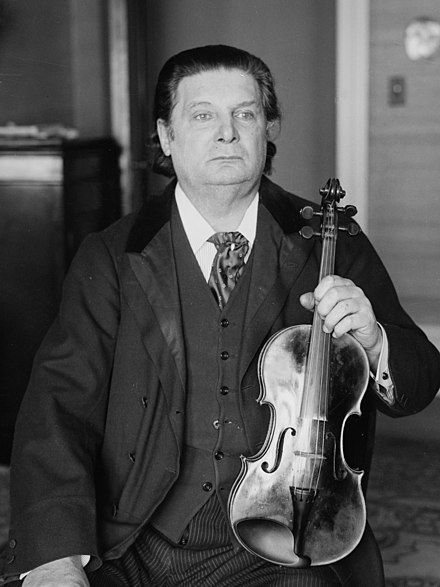
Eugène-Auguste Ysaÿe  16 July 1858 – 12 May 1931 the Belgian virtuoso was  regarded as “The King of the Violin”, or, as Nathan Milstein  put it, the “tsar”.

The Violin Sonata in A was written in 1886, when Franck  was 63, as a wedding present for the 28-year-old violinist Eugène Ysaŷe Twenty-eight years earlier, in 1858, Franck had promised a violin sonata for Cosima von Bulow  . This never appeared; it has been speculated that whatever work Franck had done on that piece was put aside, and eventually ended up in the sonata he wrote for Ysaÿe in 1886. Franck was not present when Ysaÿe married, but on the morning of the wedding, on 26 September 1886 in Arlon, their mutual friend Charles Bordes presented the work as Franck’s gift to Ysaÿe and his bride Louise Bourdeau de Courtrai. After a hurried rehearsal, Ysaÿe and Bordes’ sister-in-law, the pianist Marie-Léontine Bordes-Pène played the Sonata to the other wedding guests.The Sonata was given its first public concert performance on 16 December of that year, at the Musée Moderne de Peinture in Brussels Ysaÿe and Bordes-Pène were again the performers. The Sonata was the final item in a long program which started at 3pm. When the time arrived for the Sonata, dusk had fallen and the gallery was bathed in gloom, but the museum authorities permitted no artificial light whatsoever. Initially, it seemed the Sonata would have to be abandoned, but Ysaÿe and Bordes-Pène decided to continue regardless. They had to play the last three movements from memory in virtual darkness. When the violinist Armand Parent  remarked that Ysaÿe had played the first movement faster than the composer intended, Franck replied that Ysaÿe had made the right decision, saying “from now on there will be no other way to play it”.Vincent d’Indy , who was present, recorded these details of the event.His championing of the Sonata contributed to the public recognition of Franck as a major composer. This recognition was quite belated; Franck died within four years of the Sonata’s public première, and did not have his first unqualified public success until the last year of his life on 19 April 1890, at the Salle Pleyel , where his String Quartet in D  was premiered.

During Franck’s lifetime the A major sonata was offered in two (more or less) equal variant settings (piano and violin; piano and cello), with the explicit reference to the arranger (Jules Delsart) of the cello version. César Franck probably had nothing against the title page in that he gave away appropriate copies to friends and acquaintances, including a dedication to the musicologist Adolf Sandberger.Comparing the two solo parts (violin vs. cello) demonstrates that Delsart kept very closely to the original and generally limited himself to transposing the violin part to the lower register. In only a few passages are there exceptions where Delsart adapted the music to the technical playing conditions of the cello.Delsart’s arrangement of Franck’s sonata for piano and cello has been one of the beloved sonatas in the instrument’s repertoire. With the publication of the Urtext edition  by G.Henle Verlag in 2013, the integrity of the cello version is justified.(At the heart of G. Henle Verlag’s programme are the so-called Urtext Editions. They are characterized by their correct musical text, drawn up following strict scholarly principles, with an extensive commentary on the sources consulted – covering autographs, copies and early printings – and details regarding the readings.)

On the “oral and written history” that Cesar Franck first conceived the sonata for cello and piano (before the commission from Eugène Ysaŷe arrived), Pablo Casals wrote in 1968, “… what I remember distinctly is that Ysaÿe told me that Franck had told him that the Sonata was intended for violin or cello. That was the reason for my taking it up and playing it so much during my tours.”

Antoine Ysaÿe, Eugène Ysaÿe’s son, expressed in a letter that there is a version in César Franck’s handwriting for cello.