
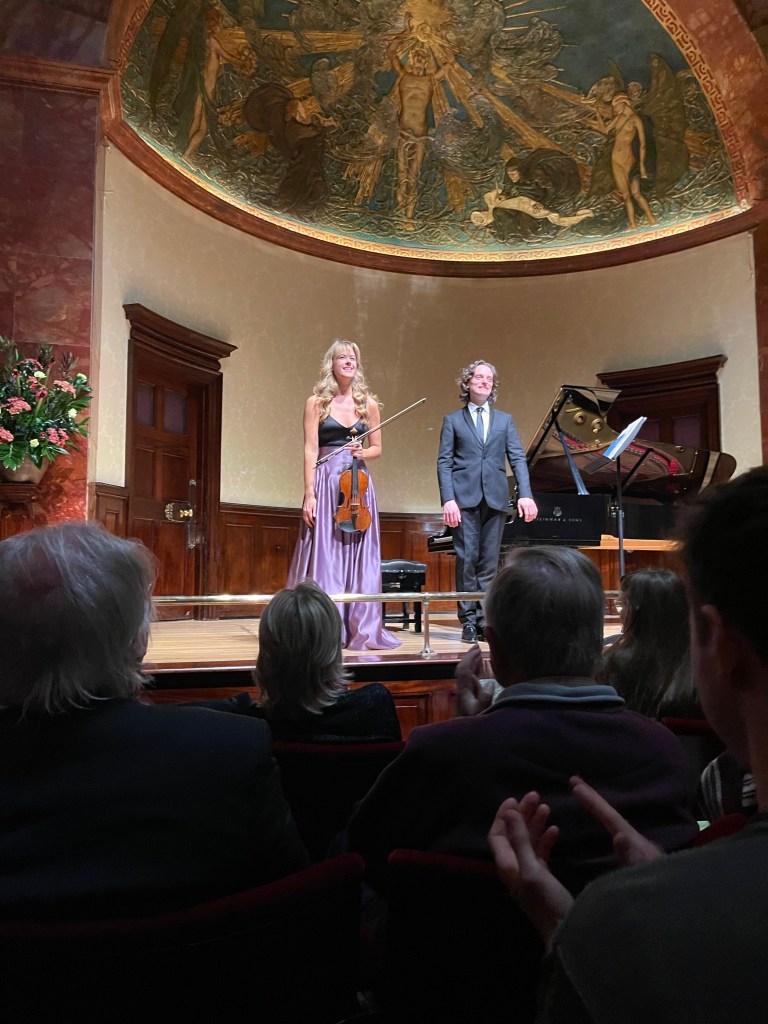
Francesca Dego and Alessandro Taverna creating sparks together that ignited the Wigmore Hall as rarely seen .
An early Strauss Sonata of overwhelming exhilaration and excitement. I have not heard this sonata since by chance I heard Krystian Zimerman with Kyung Wha Chung play in an empty church in Chelsea where there was only Fou Ts’ong and a handful of people in the audience . I have never forgotten that experience but tonight I relived something of the same emotions The superb violin soaring above the streams of golden sounds that AT played with such fluidity and ease .Both playing with red hot passion but also moments of ravishing beauty.The piano lid fully open but with masterly ears that never allowed this big black beast to smother the solo violin.A Stradivarius violin in the hands of a violinist who could weave in and out of Strauss’s sumptuously rich textures with masterly ease.
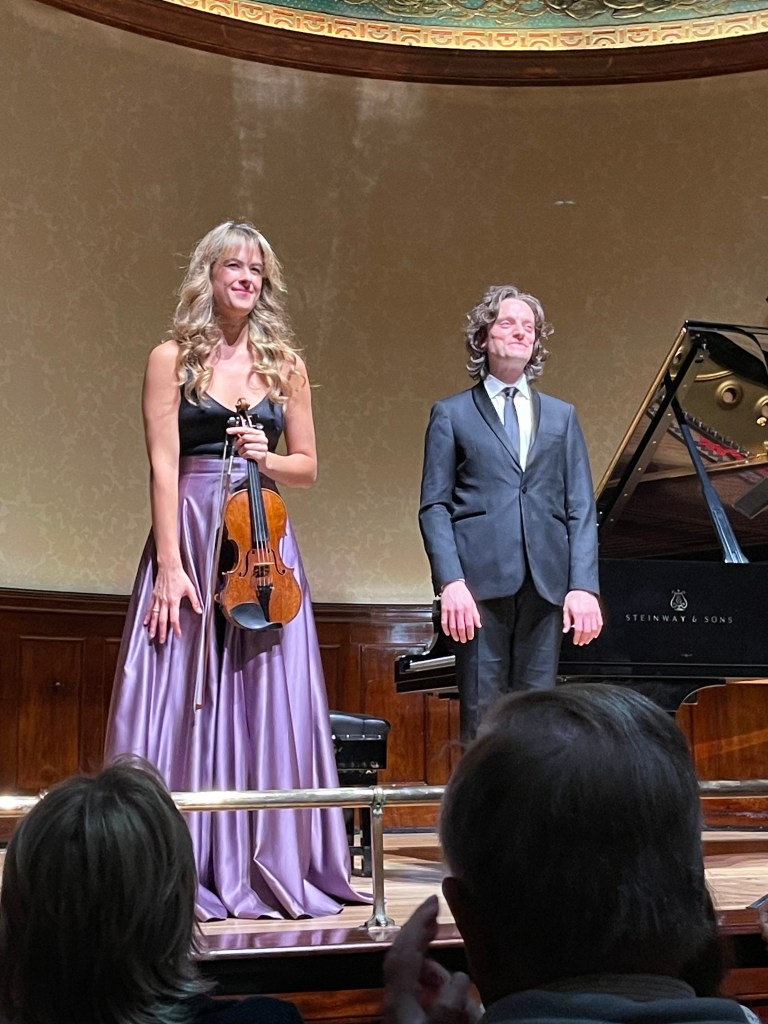
It was the same in the Schoenberg that opened the programme , written in the last years of his life but with a mastery that could weave such sounds from the solo violin and that the piano could add shape and colour to a dynamic range of rhythmic intricacy and intensity.
But the best was yet to come with a ‘Kreutzer’Sonata played by two masters . Breathtaking rhythmic energy and a dynamic range of kaleidoscopic colour. Has the final chord of the first movement ever sounded so final or the opening so noble ? Sumptuous full sound from the piano in the Andante only to be so teasingly and wondrously varied by these two remarkable artists.A question and answer of extraordinary characterisation before the call to arms of the Finale and the race was on. Breathtaking ensemble as they played as one at breakneck speed with never the slightest doubt that this was a relentless tarantella of devilish proportions .

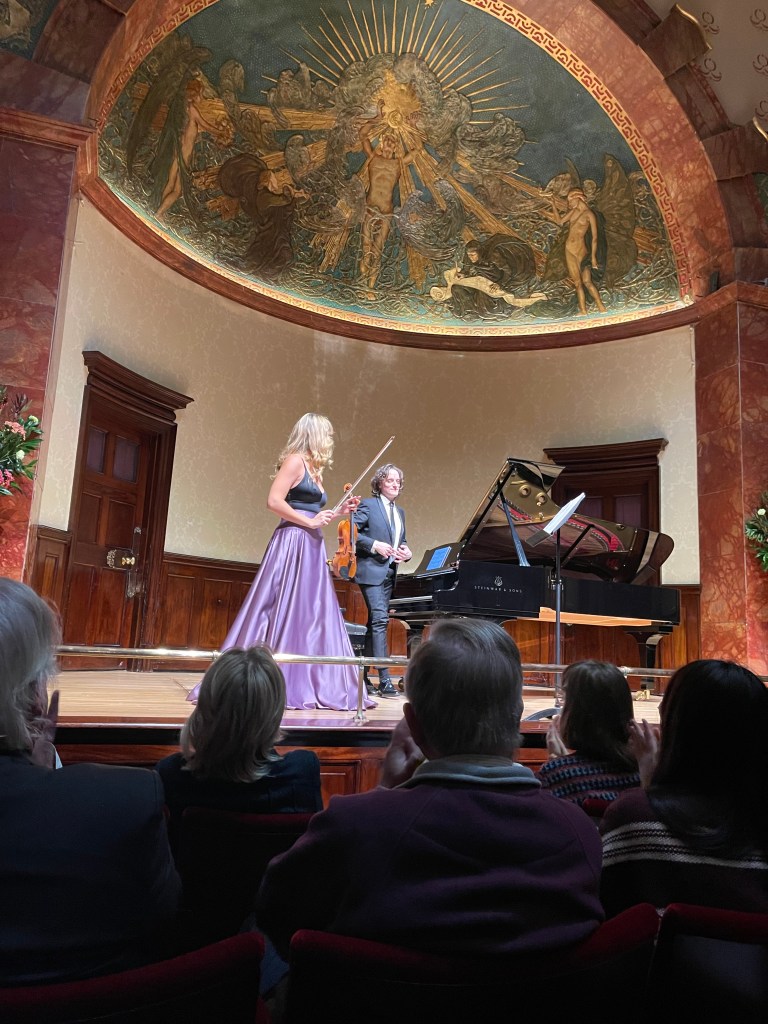
An even more passionate performance of the Brahms FAE Scherzo, played as an encore , with deep insinuating sounds from the piano that I have never been aware of before and a breathtaking drive from FD who swept all before her.
By great demand a slight morsel by Strauss the only other piece he wrote for violin and a fitting 150th anniversary tribute from two master musicians.
Arnold Schoenberg (1874-1951)
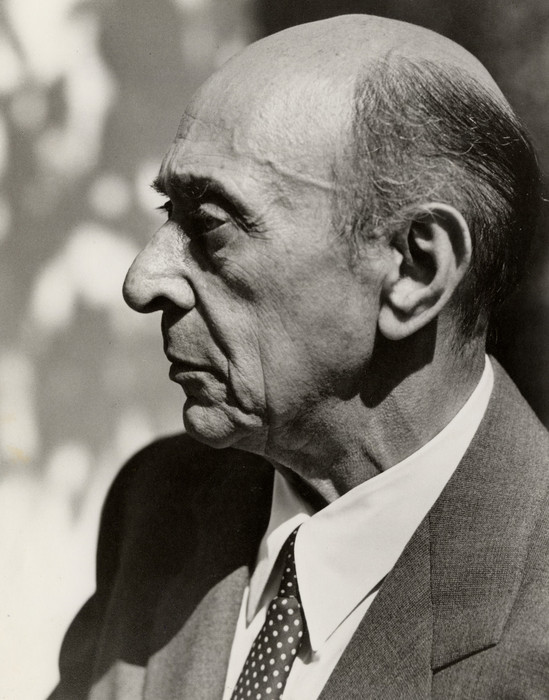
Phantasy Op. 47 (1949)
In Arnold Schoenberg’s last instrumental piece, the scale is tipped over to the violin side. Composed in 1949 and dedicated to the memory of violinist Adolph Koldofsky, the Phantasy “for Violin with Piano Accompaniment” is very precisely titled – the violin part was even written first, and the accompaniment added later.The Phantasy is an intense, virtuosic rhapsody in a single movement, but containing within it episodes that clearly recall archetypes of other traditional forms, including a complete little Scherzo and Trio crisply bouncing in 6/8 rhythmic games. Schoenberg is meticulous about dynamic and expressive indications, including romantic markings such as passionato, dolce, cantabile, grazioso, and furioso. Variation is a central principle in composing with 12-tone rows, and there is also a very clear sense of theme-and-variations here, including a tight, dramatic recapitulation.
Richard Strauss (1864-1949)
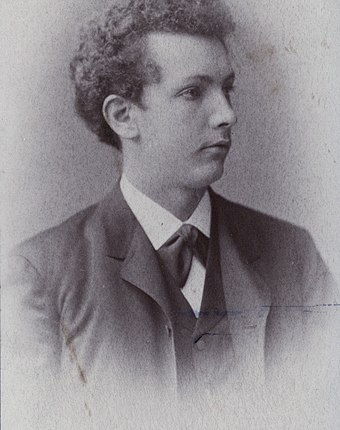
Violin Sonata in E flat Op. 18 (1887)
I. Allegro, ma non troppo • II. Improvisation. Andante cantabile • III. Finale. Andante – Allegro
The Violin Sonata op 18 was written by in 1887 and published in 1888. Although not considered a milestone in violin literature, it is frequently performed and recorded. It is noted for its lyrical beauty and its technical demands made on both violinist and pianist Following the completion of his cello sonata and piano sonata , Strauss composed his Violin Sonata in 1887. It was during this time that Strauss fell in love with Pauline de Ahna, the soprano whom he would later wed, and his amorous feelings can be heard throughout the piece. Like all of his chamber music, Strauss’ sonata follows standard classical form, though it is considered the last of his works to do so.
Interval
Ludwig van Beethoven (1770-1827)

Violin Sonata No. 9 in A Op. 47 ‘Kreutzer’ (1802-3)
I. Adagio sostenuto – Presto • II. Andante con variazioni • III. Finale. Presto
The Violin Sonata No. 9, in A major op.47 was written in 1803 and is notable for its technical difficulty , unusual length and emotional scope. It is commonly known as the Kreutzer Sonata after the violinist Rodolphe Kreutzer , to whom it was ultimately dedicated, but who thoroughly disliked the piece and refused to play it
In the composer’s 1803 sketchbook, the work was titled “Sonata per il Pianoforte ed uno violino obligato in uno stile molto concertante come d’un concerto” The final movement was originally written for the Sonata n.6 op 30 n.1 .

The sonata was originally dedicated to the violinist George Bridgetower (1778–1860) as “Sonata mulattica composta per il mulatto Brischdauer [Bridgetower], gran pazzo e compositore mulattico” (Mulatto Sonata composed for the mulatto Brischdauer, great madman mulatto composer).Though Beethoven had barely completed the sonata it received its first public performance at a concert in the Augarten on 24 May 1803 at 8:00 am,with Beethoven on piano and Bridgetower on violin. Bridgetower had to read the violin part of the second movement from Beethoven’s copy, over his shoulder.
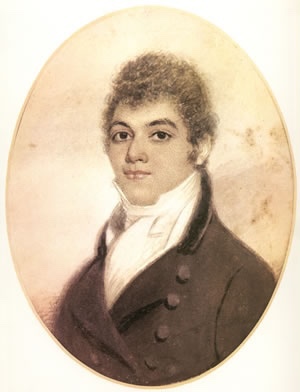
George Bridgetower a watercolour of 1800
He made a slight amendment to his part, which Beethoven gratefully accepted, jumping up to say “Noch einmal, mein lieber Bursch!” (“Once more, my dear fellow!”). George Bridgetower was born in Poland of a West Indian father described as an African Prince and German mother described as a Polish lady of quality.They were probably both in service!
George showed considerable talent while still a child and gave successful violin concerts in Paris,London,Bath and Bristol in 1789. In 1791, the Prince Regent , the future King George IV, took an interest in him and oversaw his musical education.He performed in the Philharmonic Society of London’s first season in 1813, leading the performance of Beethoven’s Quintet,and subsequently married Mary Leech Leeke in 1816. He later travelled abroad, particularly to Italy , where his daughter lived. He died in 1860 in Peckham , south London and is buried in Kensal Green Cemetery.After the premiere performance, Beethoven and Bridgetower fell out.While the two were drinking, Bridgetower apparently insulted the morals of a woman whom Beethoven cherished. Enraged, Beethoven removed the dedication of the piece, dedicating it instead to Rodolphe Kreutzer , who was considered the finest violinist of the day.After its successful premiere in 1803, the work was published in 1805 as Beethoven’s Op. 47, with its re-dedication to Rudolphe Kreutzer, which gave the composition its nickname. Kreutzer never performed the work, considering it “outrageously unintelligible”. He did not particularly care for any of Beethoven’s music, and they only ever met once, briefly.

Biografia
Figlia di Giuliano Dego, scrittore e giornalista italiano e di Margaret Straus, americana di origine ebraica[1], inizia lo studio del violino all’età di quattro anni sotto la guida del padre, violinista dilettante. Un anno dopo viene ammessa a studiare alla Fairbanks School of Performing Arts in California con Michael Tseitlin e a nove incontra il suo mentore Daniele Gay, che la seguirà fino al diploma al Conservatorio di Milano avvenuto nel 2006.[2][3]
Si perfeziona con Salvatore Accardo all’Accademia Chigiana di Siena e all’Accademia Stauffer di Cremona e nel 2010 ottiene un Master in performance al Royal College of Music di Londra sotto la guida di Itzhak Rashkovsky. Nel 2004 incontra Shlomo Mintz che apporta un profondo contributo al suo sviluppo artistico.
Il debutto da solista avviene all’età di sette anni a San Diego con un concerto di Bach, dando inizio a una carriera che la porterà a suonare alla Sala Verdi del Conservatorio di Milano a soli 15 anni e assieme a Shlomo Mintz al Teatro dell’Opera di Tel Aviv a 16.
In Italia si è esibita con le principali orchestre nazionali, tra cui la Filarmonica della Fenice, l’Orchestra Sinfonica Giuseppe Verdi di Milano, la Filarmonica Arturo Toscanini di Parma, l’Orchestra Haydn di Bolzano e Trento, l’Orchestra della Toscana e le orchestre di Genova, Bari, Bologna, Trieste e Verona. All’estero ha suonato con la City of Birmingham Symphony Orchestra, la Royal Philharmonic Orchestra, la Philharmonia Orchestra, l’Orchestra Sinfonica di Tokyo, l’Orchestra Sinfonica metropolitana di Tokyo, l’Orchestra sinfonica dei Paesi Bassi, l’Orchestra del Teatro Colon di Buenos Aires, l’Orchestra Classica do Sul, i Mannheimer Philharmoniker e l’Orchestre Philharmonique de Monte-Carlo.
Ha collaborato con direttori e cameristi come Salvatore Accardo, Roger Norrington, Christopher Hogwood, Donato Renzetti, Gabriele Ferro, Bruno Giuranna, Gianluigi Gelmetti, Wayne Marshall, Antonio Meneses, Domenico Nordio, Xian Zhang. Forma un duo stabile con la pianista Francesca Leonardi.
È sposata dal giugno 2015 con il direttore d’orchestra Daniele Rustioni[3]. Incide per Deutsche Grammophon.
In the words of Salvatore Accardo, ‘Francesca is one of the most extraordinary talents I have encountered. She possesses a brilliant and infallible technique and a beautiful, warm and appealing tone. Her musicality is full of imagination and at the same time very faithful to the score’. The Italian-American violinist now enjoys a busy international career founded on – as a Gramophone critic once put it – ‘playing that combines tonal purity, verve, and an evident delight in the unexpected’.

Alessandro Taverna established his international career by winning major prizes at Minnesota Piano-e-Competition, London International Piano Competition, Leeds International Piano Competition and Busoni Piano Competition in Bolzano. Since then he has gone to perform in some of the most important concert halls and seasons including Teatro alla Scala Milan, Teatro San Carlo Naples, Teatro Petruzzelli Bari, Teatro Comunale di Bologna, Teatro La Fenice Venice, Musikverein Vienna, Konzerthaus Berlin, Gasteig Munich, Wigmore Hall and Royal Festival Hall in London, Bridgewater Hall Manchester, Salle Cortot in Paris, Philharmonic Hall Liverpool, Musashino Hall in Tokyo, Auditorium Parco della Musica Rome.
His success has led to engagements with many prestigious orchestras including Filarmonica della Scala, Münchner Philharmoniker, Dallas Symphony Orchestra, Orchestra Sinfonica Nazionale RAI, Royal Philharmonic Orchestra, Minnesota Orchestra, Royal Liverpool Philharmonic, Bournemouth Symphony, Bucharest Philharmonic, Scottish Chamber, Orchestra of the Accademia Teatro alla Scala, working with conductors including Lorin Maazel, Riccardo Chailly, Fabio Luisi, Myung-Whun Chung, Daniel Harding, Michele Mariotti, Reinhard Goebel, Carlo Boccadoro, Thierry Fischer, Michael Guttman, Claus Peter Flor, Roland Böer, Joshua Weilerstein.
The London Keyboard Trust has presented him in recitals in Europe and the United States with Wigmore Hall debut in February 2012..
Born in Venice, Alessandro Taverna studied with Laura Candiago Ferrari at the Santa Cecilia Music Foundation in Portogruaro and with Franco Scala, Leonid Margarius, Boris Petrushansky and Louis Lortie at the Imola International Piano Academy. He later specialised at the Santa Cecilia National Music Academy in Rome with Sergio Perticaroli, at the Hochschule für Musik in Hannover with Arie Vardi, and at the Lake Como Piano Academy.
Taverna teaches at Imola International Piano Academy “Incontri col Maestro”, at the Conservatory of Music “Cesare Pollini” in Padova and at Santa Cecilia Music Academy in Portogruaro.
For his artistic achievements and his international career, he was awarded the Premio Presidente della Repubblica in 2012.


 ChristopherAxworthy-MusicCommentary