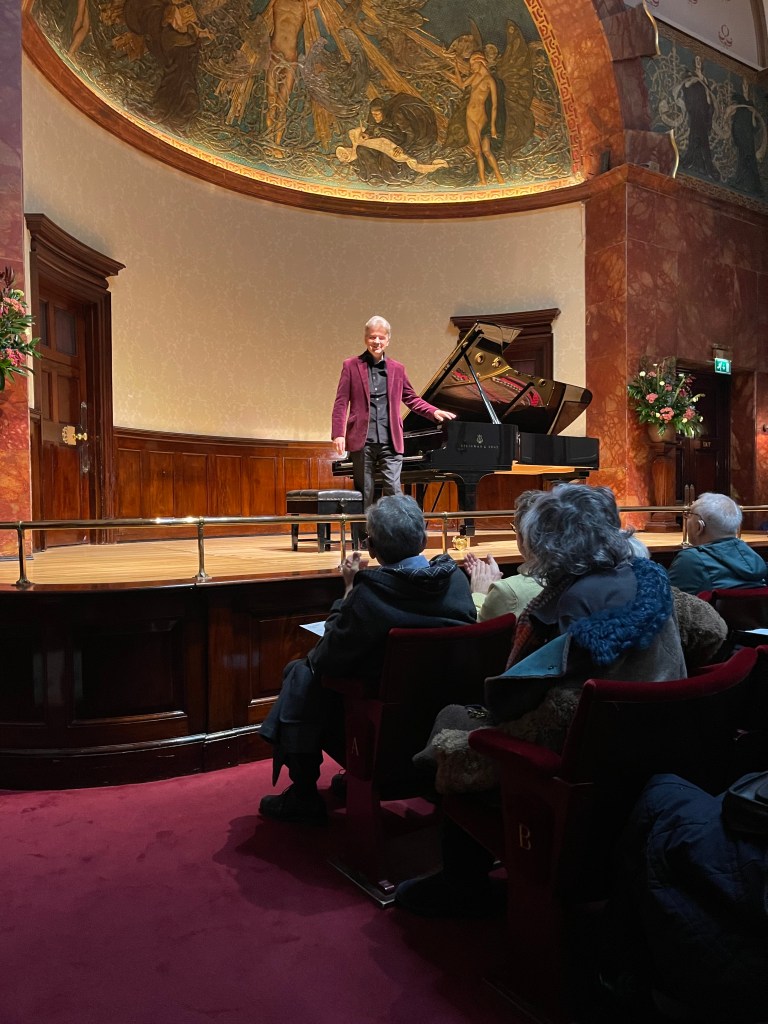
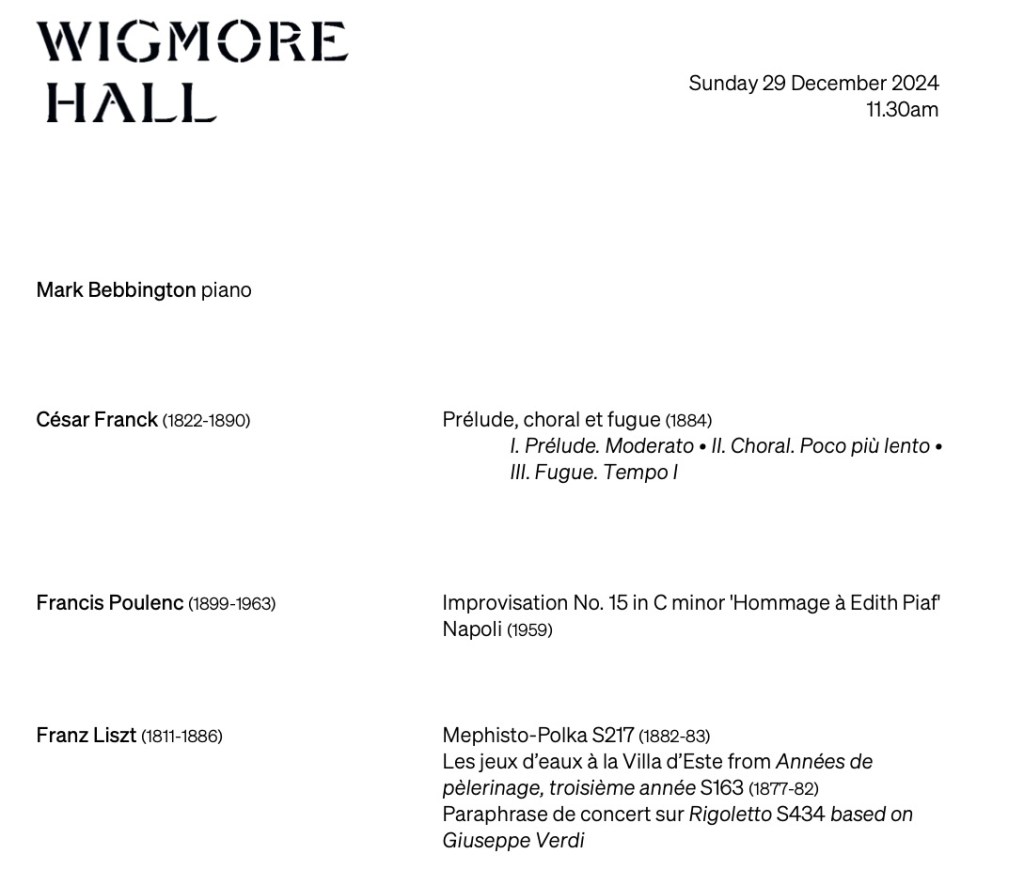


Mark Bebbington at the Wigmore Hall with a Hommage a Piaf that fast turned into the scintillating unmistakably French circus of Napoli , Poulenc Style.Mephisto Polka the last piece that Liszt was to pen with his energy obviously on the wane after admiring the scintillating fountains of the Villa d’Este or his transcendental paraphrase of Rigoletto all played with loving musicianship and daring.MB’s musicianship shone through all he played and nowhere more than in Cesar Franck’s much loved Prelude Chorale and Fugue
A simple Spanish dance by Granados was MB’s way of thanking his very enthusiastic audience before they could get to the sherry that awaited in the foyer on what must be the coldest day of the year beyond the comforting Wigmore doors
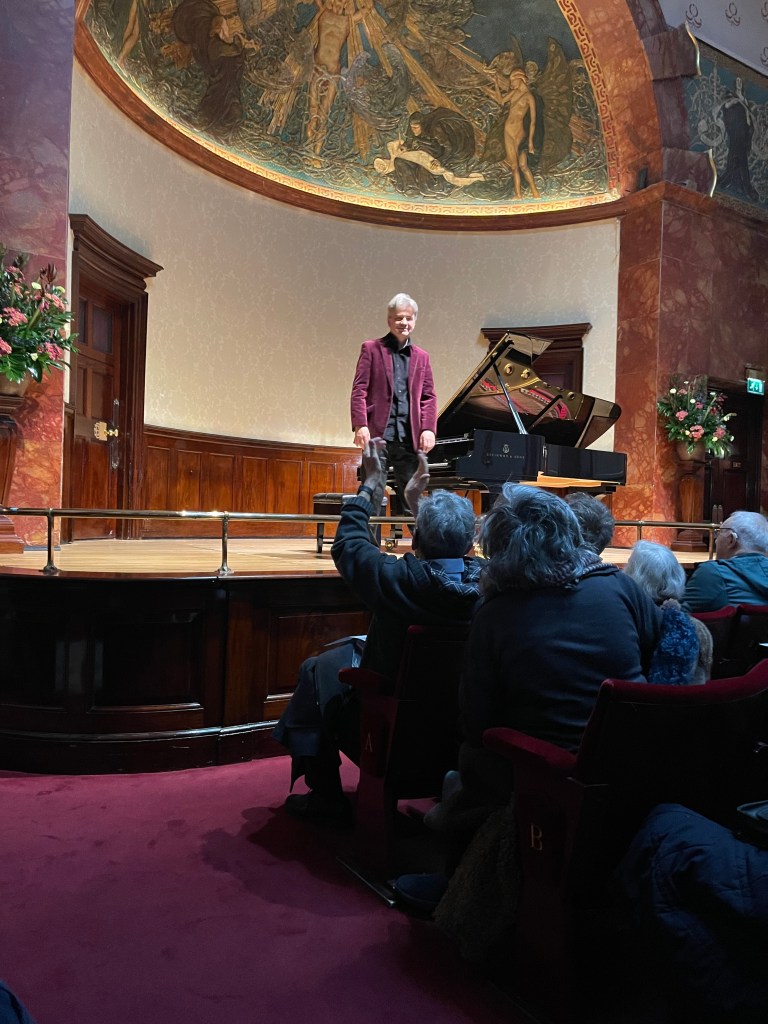
The critical plaudits that have greeted Mark Bebbington’s performances and recordings have singled him out as a British pianist of the rarest refinement and maturity. Internationally recognised as a champion of British music in particular, Mark has recorded extensively for the SOMM ‘New Horizons’ label to unanimous critical acclaim. His last seven releases have been awarded consecutive sets of five-star reviews in BBC Music Magazine and his most recent CD , ‘The Piano Music of Vaughan Williams’ reached No. 3 in the UK Classical Charts where it remained for eight weeks.

Mark’s premiere recordings include Bax’s Piano Concertino coupled with Ireland’s Piano Concerto and Legend, and premieres of Vaughan Williams’s Fantasia and Mathias’s first two Piano Concertos with the Ulster Orchestra.

In addition to concerto recordings, in 2017 Mark completed his Ireland and Bridge solo piano series and released a CD of Alwyn’s piano works. As well as his BBC Music Magazine success, he has won Gramophone magazine’s Editor’s Choice, International Record Review’s ‘Outstanding’ accolade and many others.
Over recent seasons Mark has toured throughout Europe and the USA (both as recitalist and as soloist with some of the world’s leading orchestras), as well as the Far East and North Africa. He recently gave the US premiere of Richard Strauss’s ‘Parergon’ for the Left Hand at Carnegie Hall with the American Symphony Orchestra and Leon Botstein and gave masterclasses and recitals of British music at Bard College. In the UK he has performed concertos with the Royal Philharmonic and Philharmonia orchestras, the London Mozart Players, the Orchestra of the Swan and the BBC Concert Orchestra. He has featured both as soloist and recitalist on BBC television and radio, and on major European television and radio networks.
Mark studied at the Royal College of Music, where he was a recipient of numerous international awards and prizes including a Leverhulme Scholarship, a Winston Churchill Fellowship and the Ivan Sutton Recording Prize – the latter awarded to the one outstanding graduate of the combined London music colleges. He later studied in Paris and Italy with the legendary Aldo Ciccolini.Mark’s programming demonstrates a commitment to the music of our time and he regularly includes contemporary composers as diverse as Toru Takemitsu, Julian Anderson, John McCabe, David Matthews, Pierre Boulez and Elliot Carter in his recital series.Forthcoming projects include continuing releases for the Somm label, appearances in major concert series and festivals both in the UK and throughout Europe and, closer to home, concerto performances with the London Philharmonic and Royal Philharmonic Orchestras. He recently completed a two-week tour with the Czech National Orchestra and Libor Pesek and returned to the USA for concerts with the Buffalo Philharmonic. In July 2017 Mark made his Israel debut tour with the Israel Camerata.

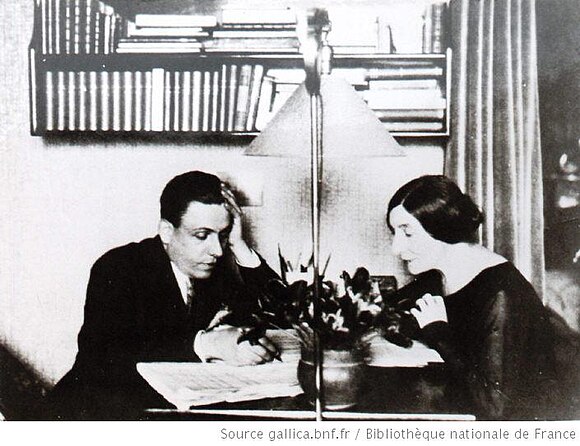
The vast majority of the piano works of Poulenc are, in the view of the writer Keith W Daniel, “what might be called ‘miniatures'”. Looking back at his piano music in the 1950s, the composer viewed it critically: “I tolerate the Mouvements perpétuels, my old Suite in C , and the Trois pieces. I like very much my two collections of Improvisations, an Intermezzo in A flat, and certain Nocturnes . I condemn Napoli and the Soirées de Nazelles without reprieve.”
Of the pieces cited with approval by Poulenc, the fifteen Improvisations were composed at intervals between 1932 and 1959. All are brief: the longest lasts a little more than three minutes. They vary from swift and balletic to tender lyricism, old-fashioned march,perpetuum mobile,waltz and a poignant musical portrait of the singer Edith Piaf. Poulenc’s favoured Intermezzo was the last of three. Numbers one and two were composed in August 1934; the A flat followed in March 1943. The commentators Marina and Victor Ledin describe the work as “the embodiment of the word ‘charming’. The music seems simply to roll off the pages, each sound following another in such an honest and natural way, with eloquence and unmistakable Frenchness https://youtu.be/JcQeZZzLpE0?si=1AafQtJ198Ky2DC8
.”The pieces Poulenc found merely tolerable were all early works: Trois mouvements perpétuels dates from 1919, the Suite in C from 1920 and the Trois pièces from 1928. All consist of short sections, the longest being the “Hymne”, the second of the three 1928 pieces, which lasts about four minutes. Of the two works their composer singled out for censure, Napoli (1925) is a three-movement portrait of Italy, and Les Soirées de Nazelles is described by the composer Geoffrey Bush as “the French equivalent of Elgar’s “Enigma Variations” – miniature character sketches of his friends. Despite Poulenc’s scorn for the work, Bush judges it ingenious and witty.
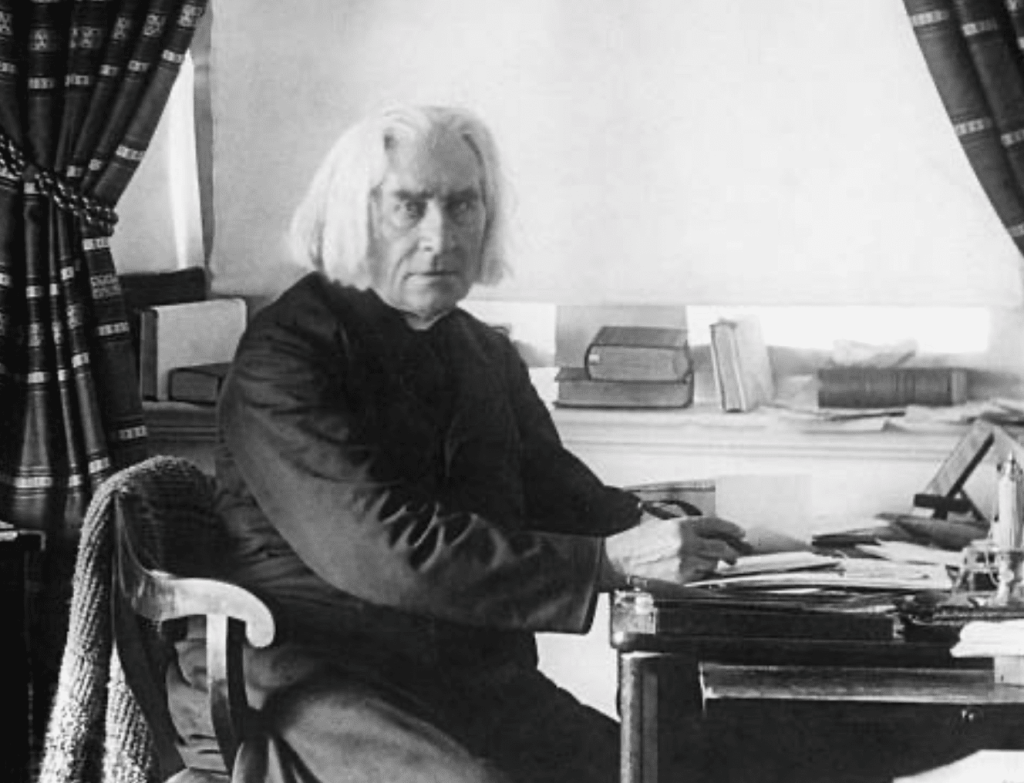
| Franz Liszt (1811 – 1886) in 1884 |
The Mephisto Polka (S. 217) was written in folk-dance style for solo piano by Franz Liszt in 1882–83. The work’s program is the same as that of the same composer’s four Mephistopheles Waltzes , written respectively in 1859–60, 1880–81, 1882 and 1885 and based on the legend of Faust, not by Goethe but by Nikolaus Lenau (1802–50). The following program note, which Liszt took from Lenau, appears in the printed score of the Mephisto Waltz No. 1:
There is a wedding feast in progress in the village inn, with music, dancing, carousing. Mephistopheles and Faust pass by, and Mephistopheles induces Faust to enter and take part in the festivities. Mephistopheles snatches the fiddle from the hands of a lethargic fiddler and draws from it indescribably seductive and intoxicating strains. The amorous Faust whirls about with a full-blooded village beauty in a wild dance; they waltz in mad abandon out of the room, into the open, away into the woods. The sounds of the fiddle grow softer and softer, and the nightingale warbles his love-laden song.
The Mephisto Polka was dedicated to Lina Schmalhausen, one of Liszt’s “inner-circle” piano students. However, she is remembered more as one among the closest and most ardently devoted of Liszt’s followers, frequently attending to and assisting in the many needs of the aged master whose health was in rapid decline.
Franz Liszt’s last work was probably an arrangement for Mozart’s Ave verum corpus -for organ- in the year he died in 1886, but let’s look at his last original composition. Actually, Liszt’s last original composition is not easy to pinpoint, he composed many small pieces in late 1885 and some of his compositions from 1885 were lost and some were undated. However, our information indicates that “En rêve” (“Dreaming”) was likely Liszt’s last original composition. The “Cambridge Companion to Liszt”, one of the most comprehensive books on Liszt, also points to this work as one of Liszt’s last works: “‘En Reve. Nocturne’ one of his last pieces, written in late 1885 for his student August Stradal.” Also, in the chronological listing of Liszt’s works made for Grove Music Online in 2010, En Reve appears as the last original piece.It can be said that this work, En rêve, stands in contrast to all the works of Liszt in his last period. Liszt’s last period is dark and experimental; The identified themes are death, depression, despair and sadness. Nuages gris (grey clouds), Unstern (sinister), Trauervorspiel und Trauermarsch (Funeral prelude and Funeral march), Abschied (farewell), Seven Hungarian Historical Portraits, La lugubre gondola (the lugubrious gondola)… Almost all works composed after 1880 are in similar dark tones. In the early 1880s he said: “I carry with me a deep sadness of the heart which must now and then break out in sound.” His compositions were much simpler than before, he used emptiness and silence like never before. The effective use of silence and simplicity also intensely reflects the “purposelessness” that Liszt felt. These works also pointed to the music of the future.It is quite interesting to compare these works composed in the same period as En Reve. For Liszt, worldly things were depressive and death-related. He composes elegies for important Hungarian figures; gray clouds and gondolas gave it dark connotations. But in En rêve (Dreaming) it’s the opposite, not “joyful” but a poetic and peaceful little nocturnal piece, there is an atmosphere where sweetness and sadness coexist, it is unrelated to all his other works of that period. In addition, it is a composition that does not use emptiness or silence like his other works, and ends in a snap. Liszt is just at peace in his sleep and that’s the only place where dark thoughts don’t surround him. His nightmare was when he awoke and was probably waiting for death, thinking there would be peace.
 ChristopherAxworthy-MusicCommentary