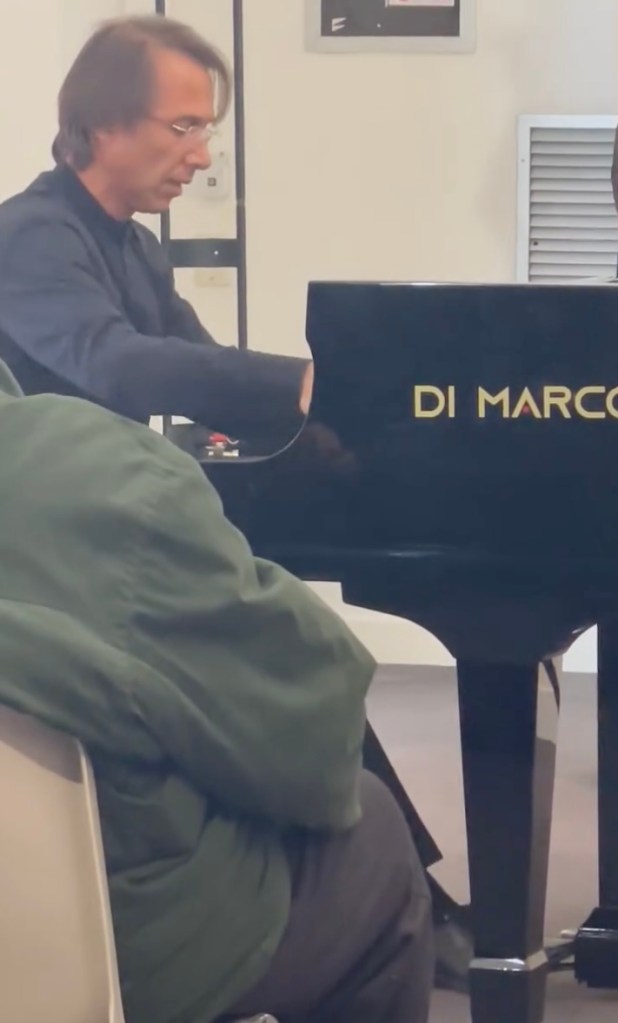
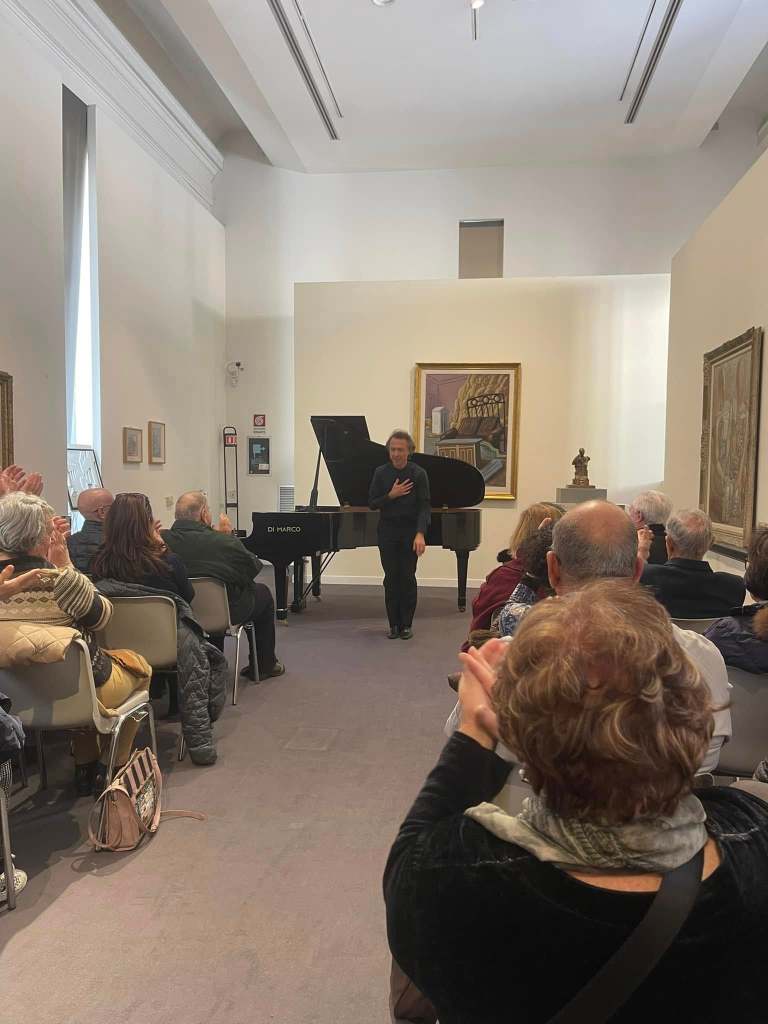
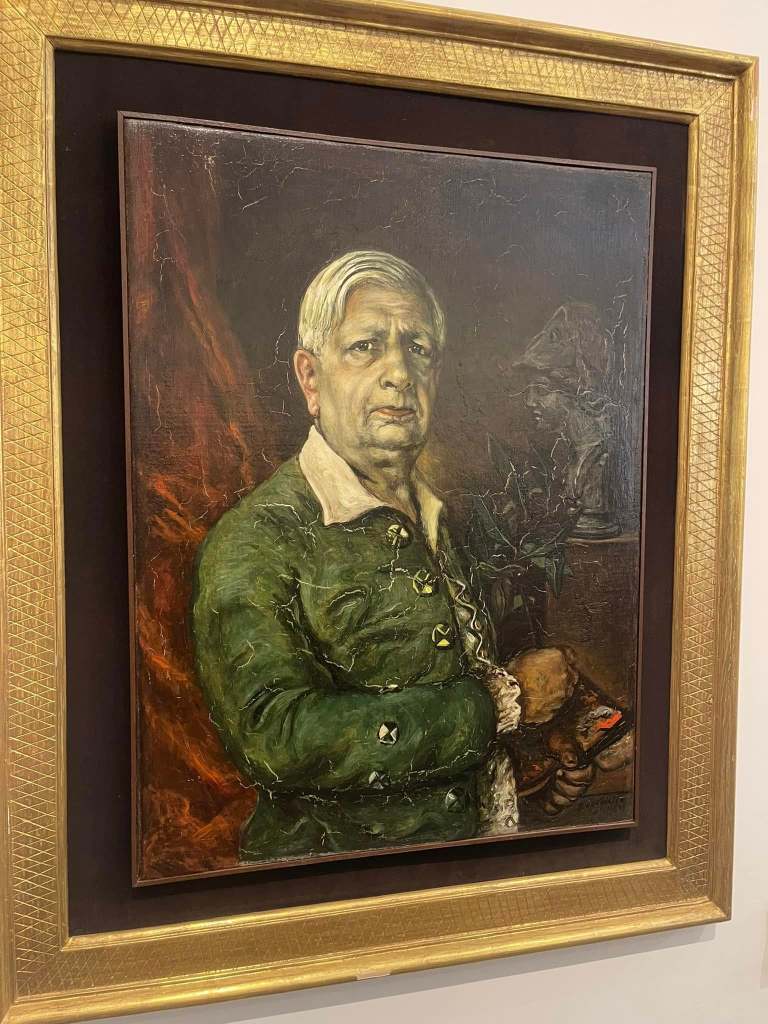
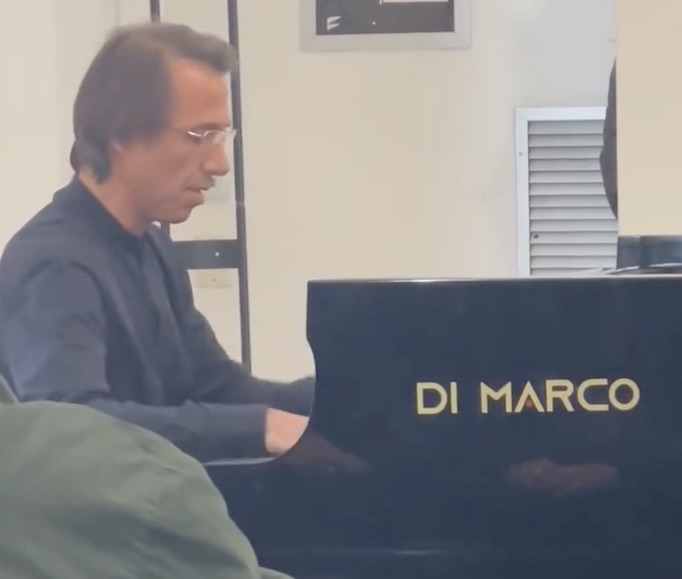
Surrounded by a collection of De Chirico paintings Maurizio Baglini shared with us the divine sounds that Liszt had captured in music during his Years of Travel in Italy.
The Raffaello ‘Sposalizio’ was played with the same radiance and kaleidoscope of colours that Genius could inspire.His masterly use of the pedal – the soul of the piano- allowed him to create etherial sounds of sublime poetic beauty .Here poetry and sumptuous regality were united in a tone poem of searing fluidity . The morbose sounds of pure marble as sculptured by Michelangelo were captured with the same deep intensity as his ‘Thinker.’ Deep moving bass notes were of overpowering potency. A jaunty interval with the countrified simplicity of the Canzonetta del Salvatore Rosa with its infectious lilting jig like dance was followed by subtle whispered confessions of the poetic inspirations of Petrarch. A very subtle sense of balance and architectural shape made these three tone poems into works of intimate confessions and searing emotions.And finally the call to arms of Dante with his demonic sonata of heroism and submission.A masterly control and aristocratic sense of style of timeless beauty with an extraordinary range of emotions. His understanding of the meaning behind the notes allowed him to play fearlessly with breathtaking power and technical mastery.Even the treacherous octaves at the end were thrown off with the ease of someone who had something important to say where problems simply dissolved in the face of the message he had to transmit.
Playing of aristocratic control and masterly poetic understanding with a range of colours on an old ‘casserole’ that had never been aware that it was capable of such cordon bleu mastery until it was placed in the inspired hands of Maurizio Baglini.
‘Widmung’ by Schumann transcribed by Liszt was an encore that summed up the artistry that we had been witness to in this short Sunday morning recital. A wonderful sense of balance that allowed the melodic line to sing with fluidity and beauty full of the same subtle inflections as the human voice. A technical mastery that allowed him to embellish Schumann’s outpouring of love for Clara with fearless abandon just as he was able to share with us Schumann’s whispered and most intimate thoughts.
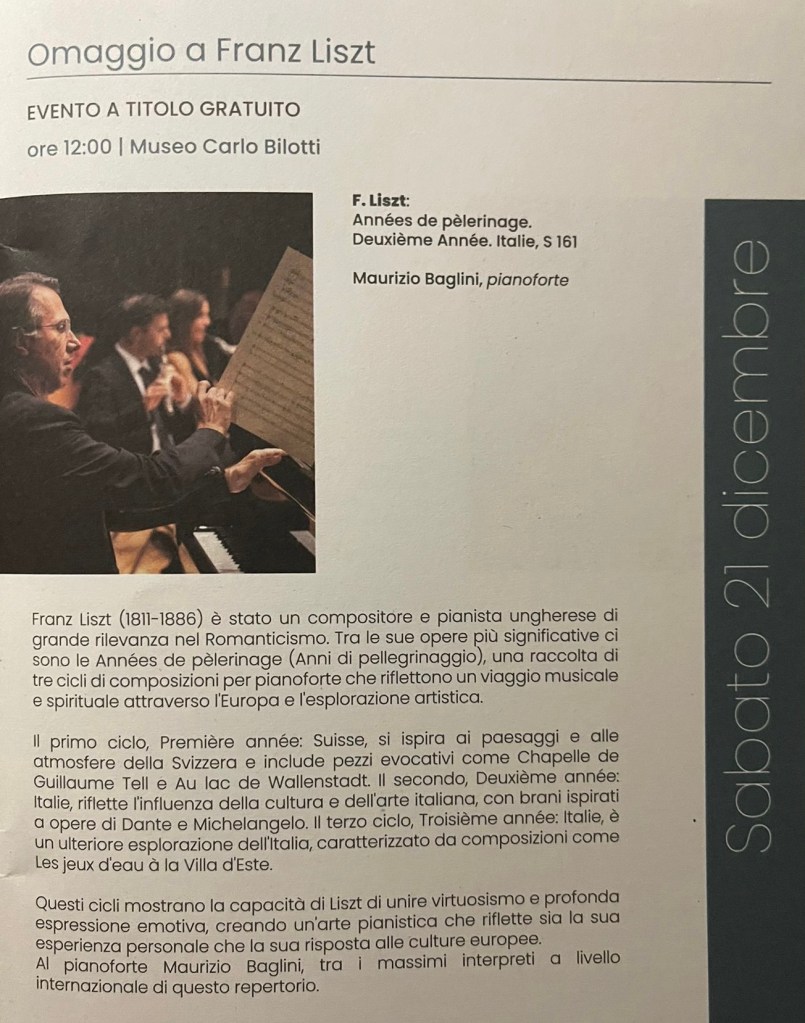
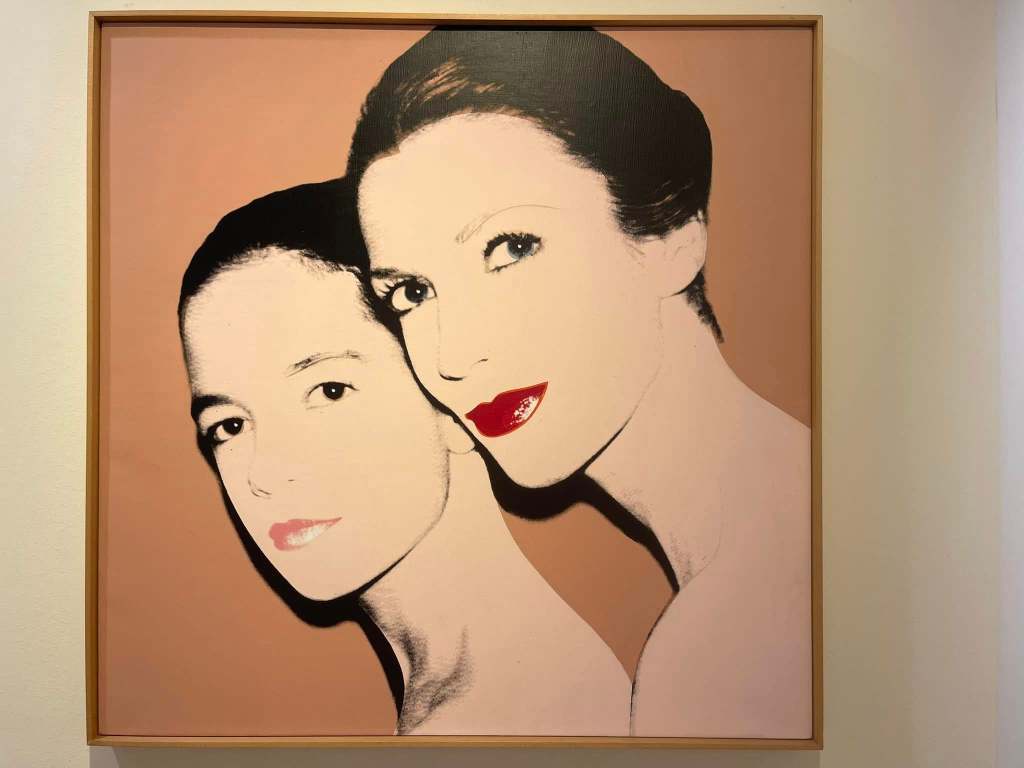
Années de pèlerinage (S.160,161,162,163) is a set of three suites for solo piano by Franz Liszt. Much of it derives from his earlier work, Album d’un voyageur, his first major published piano cycle, which was composed between 1835 and 1838 and published in 1842. Années de pèlerinage is widely considered as the masterwork and summation of Liszt’s musical style.Surrounded by beauty with an inspired and inspiring recital by Maurizio Baglini in the Bilotti museum in the sumptuous park of Villa Borghese.
Maurizio Baglini with Roberto Pujia, President of Roma Tre Orchestra
The title Années de pèlerinage refers to Goethe’s famous novel of self-realization, Wilhelm Meister’s Apprenticeship, and especially its sequel Wilhelm Meister’s journeyman Years (whose original title Wilhelm Meisters Wanderjahre meant Years of Wandering or Years of Pilgrimage, the latter being used for its first French translation). Liszt clearly places these compositions in line with the Romantic literature of his time, prefacing most pieces with a literary passage from writers such as Schiller,Byron or Senancour, and, in an introduction to the entire work, writing:
‘Having recently travelled to many new countries, through different settings and places consecrated by history and poetry; having felt that the phenomena of nature and their attendant sights did not pass before my eyes as pointless images but stirred deep emotions in my soul, and that between us a vague but immediate relationship had established itself, an undefined but real rapport, an inexplicable but undeniable communication, I have tried to portray in music a few of my strongest sensations and most lively impressions.’
Deuxième année: Italie
“Deuxième année: Italie” (“Second Year: Italy”), S.161, was composed between 1837 and 1849 and published in 1858 by Schott. Nos. 4 to 6 are revisions of Tre sonetti del Petrarca , which was composed around 1839–1846 and published in 1846.
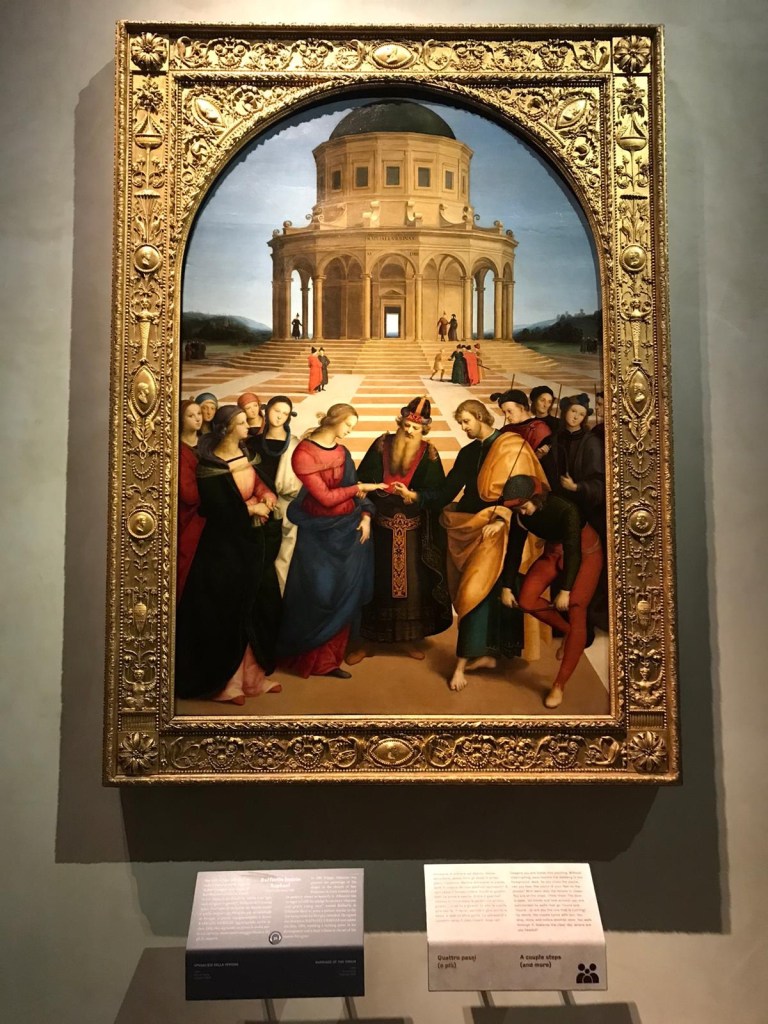
Sposalizio (Marriage of the Virgina by Raphael) in E major
Il penseroso (The Thinker, a statue by Michelangelo)
Canzonetta del Salvator Rosa ( this song “Vado ben spesso cangiando loco” was in fact written by Giovanni Bononcini )
Sonetto 47 del Petrarca
Sonetto 104 del Petrarca
Sonetto 123 del Petrarca (Petrarch’s Sonnet 123)
Après une lecture du Dante:Fantasia Quasi Sonata
Leslie Howard writes :’There are many similarities in the genesis of the first and second books of Liszt’s Années de Pèlerinage: most of the pieces in both books were conceived in the 1830s during his travels to and from Switzerland and Italy with Marie d’Agoult, a time which saw the birth of the couple’s three children, Blandine, Cosima and Daniel, and for Liszt a period of intense compositional activity, punctuated by a good many concerts. The two books were eventually prepared for publication in their final form by the early 1850s, in Liszt’s busiest period as a composer/conductor at the court of Weimar. Their story is also paralleled by that of the Transcendental Etudes and the Hungarian Rhapsodies, which achieved their final form at about the same time. In the case of the Swiss volume, Liszt had selected all but one of the pieces from the previously published Album d’un Voyageur; with the Italian set only three of the pieces had appeared in print in earlier versions—the Petrarch Sonnets—although all but one of the remaining pieces had been drafted in the late 1830s. The supplementary volume Venezia e Napoli had been ready for publication in about 1840, but was withdrawn by Liszt at the proof stage. The later set of pieces with the same title discarded two of the earlier set, revised two, and added a new piece between them. The important difference between the two books lies in the source of inspiration: although various literary references lie in the background to the Swiss volume, the principal imaginative spring is the landscape of Switzerland itself; the second Année draws entirely upon Italian art and literature.
The Marriage of the Virgin, also known as Lo Sposalizio, by Raphael was completed in 1504 for the San Francesco church in Città downtown Castello it depicts a marriage ceremony between Mary and Joseph and since 1806 it is housed in the Pinacoteca di Brera in Milan Sposalizio is the title of the first piece in Liszt’s Deuxième Annie de Pèlerinage :Italie (Second Year of Pilgrimage: Italy), published in 1858. The composition starts out with a simple pentatonic melody, described as a “bell-like motif”,turning into a complex musical architecture. The melody then changes to a type of wedding march, continually embellished leading to the grand climax before ending quietly.
Sposalizio was first written in 1838 or 1839, and the manuscript shows at least two levels of revision before the version finally published. Liszt composed the work in homage to Raphael’s eponymous painting of the betrothal of Our Lady and St Joseph (which may be seen in the Brera Chapel in Milan). We know from Liszt’s later use of the second theme (G major, Lento) in the work for voices and organ called Zur Trauung (‘At the betrothal’) and otherwise catalogued as Ave Maria III that this melody honours Mary, but Liszt offers no further clues to the musical characterization. The uncanny presentiment in the closing phrases of Debussy’s First Arabesque has often been noted.
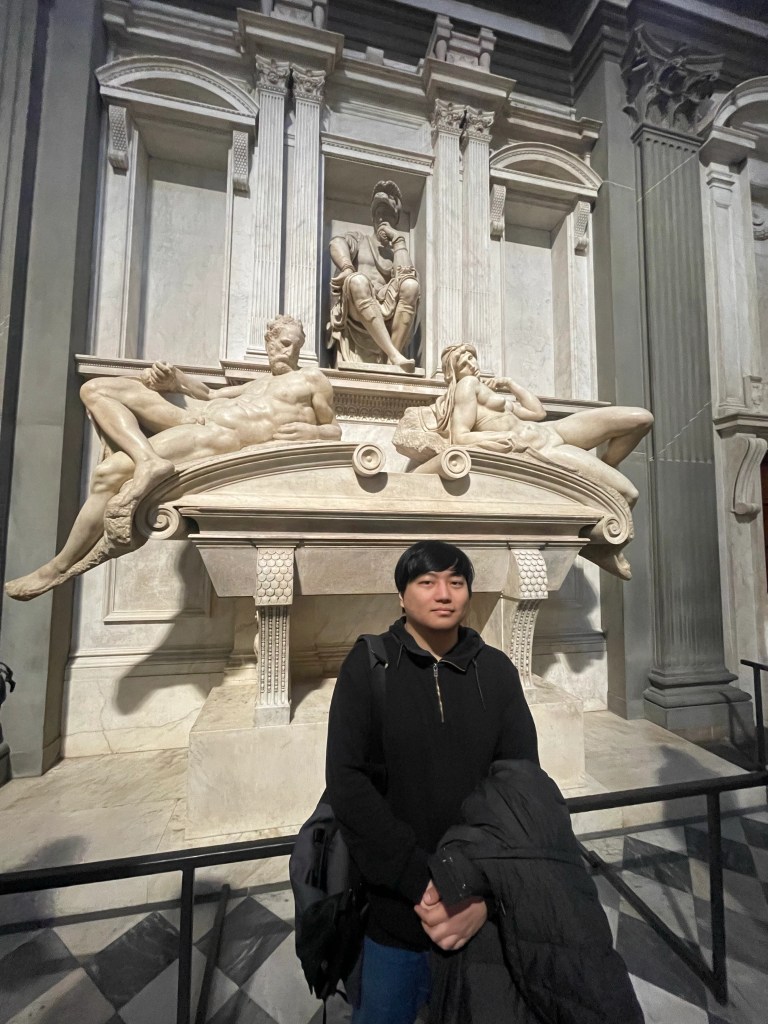
From the first edition of Liszt ‘Il Penseroso’ that was inspired by Michelangelo’s sculpture of the same name. There is also the poem by Michelangelo on the front page of the first edition The statue is actually part of a tombstone made for the Lorenzo de Medici, Duke of Urbino. Michelangelo shows Lorenzo as a man deep in thought. Liszt must have interpreted these thoughts as a dark place, as if he were receding into the shadows. Matching this depiction, Il penseroso is a very dark piece. There is not much movement, and it is confined to the the lower registers of the piano, with many slow chords.
Michelangelo’s sculpture Il penseroso may be seen on the tomb of Lorenzo de’ Medici in the church of San Lorenzo in Florence. The music is amongst the simplest and most stark of Liszt’s early mature works, and appears to have been incorporated as it was originally written in 1838/9. The work was later revised and extended to form the second of the Trois Odes funèbres: ‘La notte’ (in Volume 3), and both works bear Michelangelo’s quatrain:
Grato m’è il sonno, e più l’esser di sasso. Mentre che il danno e la vergogna dura. Non veder, non sentir m’è gran ventura Però non mi destar, deh’—parla basso!
Sleep, nay, being made of rock, makes me happy whilst harm and shame endure. It is a great adventure neither to see nor to hear. However, disturb me not, pray—lower your voice!
Of course, Salvator Rosa (1615–1673) was primarily a painter, but he was also an actor, a poet, a satirist and a musician. Nonetheless, the saucy little Canzonetta del Salvator Rosa is not his music, although the text may be by or about him. The work (originally for voice and basso continuo) is listed in The New Grove amongst the cantatas for solo voice of the once greatly celebrated Giovanni Battista Bononcini (1670–1747)—under the title of its opening line ‘Vado ben spesso’, and unaccountably described as unpublished. Liszt’s version, undated, but at any rate completed by 1849, ranks as one of his lightest and happiest numbers, and exemplifies a catholicity of taste which does not differentiate between wholly original music and music based upon existing source material. The original text is laid out above the music:
Vado ben spesso cangiando loco, Ma non so mai cangiar desio. Sempre l’istesso sarà il mio fuoco, E sarò sempre l’istesso anch’io.
I very often go about to various places, but I never know how to vary my desire. My fire shall always remain unchanged, and so (therefore) shall I.
In adapting the Tre Sonetti di Petrarca for their final piano versions Liszt changed the order from the first publication, reversing the first two, so that Sonetto 47 happily takes up the chord with which the Canzonetta finished. The long introduction to Sonetto 104 is replaced with a passage almost identical to that in the first published vocal setting. The three pieces are intense love-songs rich in passionate harmonies, and generous in their melodic flight, and they have long been amongst Liszt’s most beloved works.
‘Pace non trovo’ Sonetto n. 47
Pace non trovo, e non ho da far guerra,
E temo, e spero, ed ardo, e son un ghiaccio:
E volo sopra 'l cielo, e giaccio in terra;
E nulla stringo, e tutto 'l mondo abbraccio.

Tal m'ha in priggion, che non m'apre, nè serra,
Nè per suo mi ritien, nè scioglie il laccio
E non m'ancide Amor, e non mi sferra;
Nè mi vuol vivo, nè mi trahe d'impaccio.

Veggio senz'occhi; e non ho lingua e grido;
E bramo di perir, e cheggio aita;
Ed ho in odio me stesso, ed amo altrui.

Pascomi di dolor, piangendo rido,
Egualmente mi spiace morte e vita,
In questo stato son, Donna, per Voi.
I find no peace, and yet I make no war:
and fear, and hope: and burn, and I am ice:
and fly above the sky, and fall to earth,
and clutch at nothing, and embrace the world.

One imprisons me, who neither frees nor jails me,
nor keeps me to herself nor slips the noose:
and Love does not destroy me, and does not loose me,
wishes me not to live, but does not remove my bar.

I see without eyes, and have no tongue, but cry:
and long to perish, yet I beg for aid:
and hold myself in hate, and love another.

I feed on sadness, laughing weep:
death and life displease me equally:
and I am in this state, lady, because of you.
Sonetto n. 104 ‘Benedetto sia ‘l giorno’
Benedetto sia 'l giorno, e 'l mese, e l'anno,
E la stagione, e 'l tempo, e l'ora, e 'l punto
E 'l bel paese e 'l loco, ov'io fui giunto
Da'duo begli occhi che legato m'ànno;

E benedetto il primo dolce affanno
Ch'i' ebbi ad esser con Amor congiunto,
E l'arco e la saette ond' i' fui punto,
E le piaghe, ch'infino al cor mi vanno.

Benedette le voci tante, ch'io
Chiamando il nome di Laura ho sparte,
E i sospiri e le lagrime e 'l desio.

E benedette sian tutte le carte
Ov'io fama le acquisto, e il pensier mio,
Ch'è sol di lei, si ch'altra non v'ha parte.
Blessed be the day, and the month, and the year,
and the season, and the time, and the hour, and the moment,
and the beautiful country, and the place where I was joined
to the two beautiful eyes that have bound me:

and blessed be the first sweet suffering
that I felt in being conjoined with Love,
and the bow, and the shafts with which I was pierced,
and the wounds that run to the depths of my heart.

Blessed be all those verses I scattered
calling out the name of my lady,
and the sighs, and the tears, and the passion:

and blessed be all the sheets
where I acquire fame, and my thoughts,
that are only of her, that no one else has part of.
Sonetto n.123. ‘I’ vidi in terra angelici costumi’
I' vidi in terra angelici costumi,
E celesti bellezze al mondo sole;
Tal che di rimembrar mi giova, e dole:
Che quant'io miro, par sogni, ombre, e fumi.

E vidi lagrimar que' duo bei lumi,
Ch'han fatto mille volte invidia al sole;
Ed udì' sospirando dir parole
Che farian gir i monti, e stare i fiumi.

Amor! senno! valor, pietate, e doglia
Facean piangendo un più dolce concento
D'ogni altro, che nel mondo udir si soglia.

Ed era 'l cielo all'armonia s'intento
Che non si vedea in ramo mover foglia.
Tanta dolcezza avea pien l'aer e 'l vento.
I saw angelic virtue on earth
and heavenly beauty on terrestrial soil,
so I am sad and joyful at the memory,
and what I see seems dream, shadows, smoke:

and I saw two lovely eyes that wept,
that made the sun a thousand times jealous:
and I heard words emerge among sighs
that made the mountains move, and halted rivers.

Love, Judgement, Pity, Worth and Grief,
made a sweeter chorus of weeping
than any other heard beneath the moon:

and heaven so intent upon the harmony
no leaf was seen to move on the boughs,
so filled with sweetness were the wind and air.
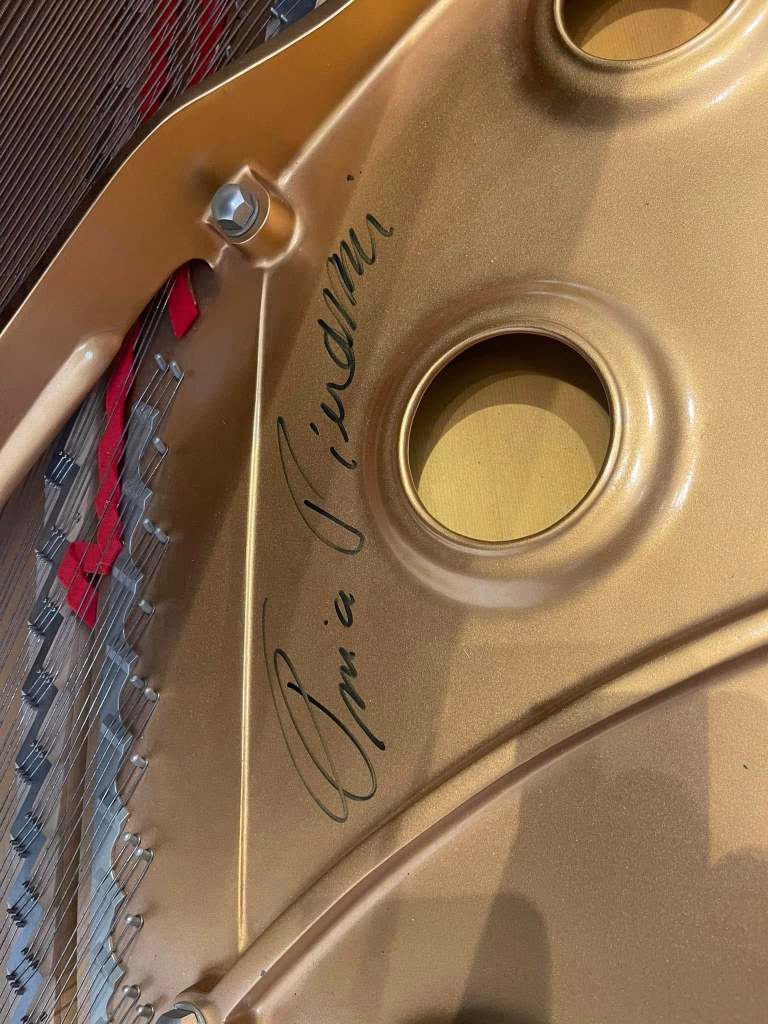
The casserole that Maurizio managed to seduce
Just as there is inconsistency between the title page and music head titles of the sonnets—in one place ‘di’ and the other ‘del’ Petrarca—the work commonly called the ‘Dante Sonata’ is described both as ‘une lecture de’ on the title page and ‘une lecture du’ at the head of the music and in the amended title on the manuscript. The original title of the piece was Paralipomènes à la Divina Commedia—Fantaisie symphonique pour piano, and the first version (which is in two parts) is probably what Liszt first played in 1839. A first layer of revision in the principal manuscript may well belong to the second projected title Prolégomènes (still in two parts), and Liszt seems to have performed a version of this work under the title Fantasia quasi sonata (Prolégomènes zu Dantes Göttlicher Comödie). A further, much more extensive layer of revision carries the final title and one-movement structure, but a good many final corrections and alterations were made at the proof stage to produce the present work.
The principal manuscript with its revisions in Liszt’s hand is actually in a copyist’s hand and contains several errors which went uncorrected by Liszt through the various stages of revision. Problem bars include: 65 (first left-hand group may be incorrect—the second left-hand chord should perhaps have a B flat instead of an A); 102 (second harmony should surely have E sharp—MS has a (redundant) natural sign); 255 (first left-hand chord should probably have an F sharp instead of an E); 262–3 (almost certainly B flats and hence E flat major—otherwise the augmented triad is the only such chord in the work in all versions, and it is a chord to which Liszt normally grants particular importance in a musical structure—furthermore, this theme is always extended elsewhere by common triads); and 297 (the right hand should certainly have G sharps on the third crotchet, as in the earlier version—the lack of them in the rewriting, which otherwise preserves exactly the same progression, is clearly a slip of the pen).
Many commentators have essayed a description of the particular reading of Dante which Liszt has chosen to represent, although he himself gave no specific clues. (The case of the Dante Symphony is quite another matter: each movement represents Liszt’s reaction to Inferno and Purgatorio, with a hint of Paradiso in the concluding Magnificat, and the musical text is laid out upon occasion to fit various quotations of Dante’s work.) Clearly, the diabolus in musica tritone—heard at the outset, and at all the important structural junctions—suggests Inferno, and suggestions have been made concerning the Francesca da Rimini episode. But calling the reprise of what amounts to the second subject (10 bars of ethereal tremolo at bar 290) a representation of Paradiso as some commentators have done is surely wide of the mark, and the piece as a whole is much less celestial or purgatorial than it is relentlessly infernal. Formally, the structure is a much tighter sonata-form than the epithet Fantasia might suggest, and the musical form outweighs any attempt there might have been to convey a poetic narrative rather than just a general reaction to Dante’s work. Leslie Howard Hyperion Complete Liszt recordings







 ChristopherAxworthy-MusicCommentary