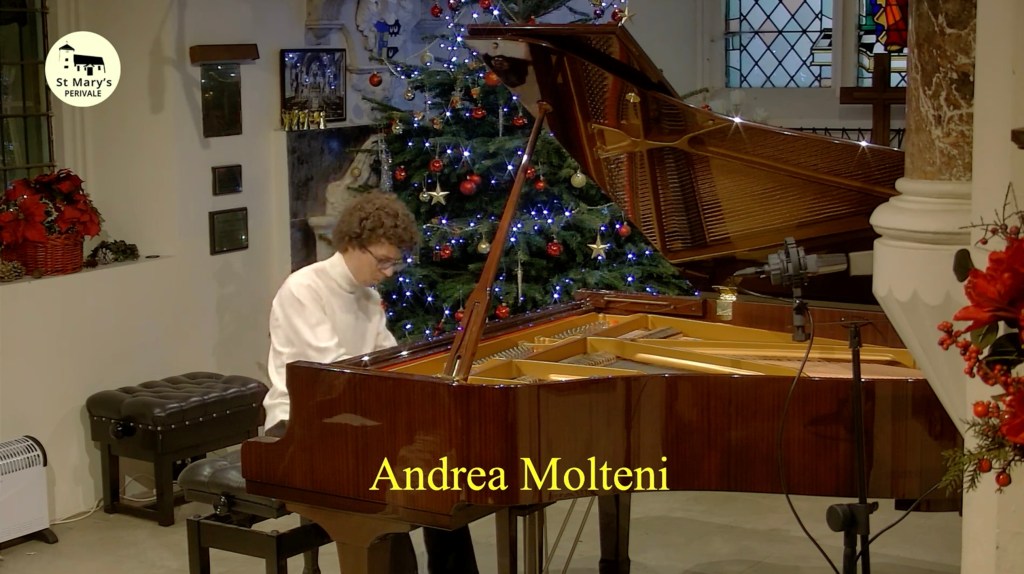

Some quite extraordinary playing of radiance and clarity. A technical command of such natural fluidity that makes all he plays sound so natural and effortless.A precision and brilliance that makes his playing in particular of the Sonatas by Scarlatti so scintillating and brilliant.It was indeed only as an encore that we could admire his quite extraordinary dexterity with ornaments that like tightly wound springs seemed to glisten and glow with an inner life of their own.
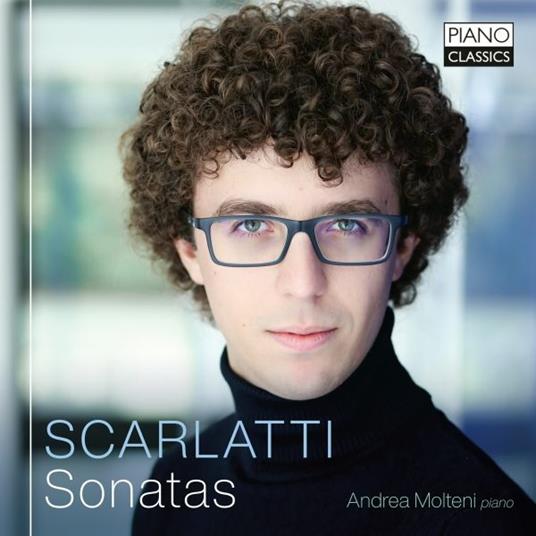
But it is not only Scarlatti that this young man excels in because the clarity and his superb simple musicianship illuminate all that he does.He has recently recorded an all Beethoven CD with the ‘Hammerklavier’ op 106 and as a fill up the ‘Grosse Fuga!’ greeted by the press with five star reviews.


An opening with grandiose flourishes but also where everything he played sang with such fluidity.A sense of style as you would expect from his mentor Willian Grant Naboré but allied to an architectural shape that gave a sense of grandeur to this opening ‘Allegro’ of regal importance.I found the left hand of the ‘Largo’ rather sparse where I have always thought of the deep bass notes as marcato not staccato but it did allow Bach’s bel canto to sing with extraordinary flexibility and glowing beauty.There was an infectious ‘joie de vivre’ of the final ‘Presto’ with a clarity to the part playing that I have rarely heard played with such conversant musicality.

Beethoven’s little F sharp Sonata op 78 often known as ‘A Therese’ because of its opening movement with it’s beautiful simple ‘Adagio’ opening up to a florid ‘Allegro’ with a continuous outpouring of song.The ‘Allegro’ second movement was played with dynamic drive and superb phrasing which gave it a continuous forward movement of bucolic drive.

There was radiance and fluidity in Debussy’s ‘Pagodes’ with subtle colouring building up to a climax that burst into streams of notes that Andrea spun with ease as the golden sounds he created filled the perfumed air. A whispered ‘Soirée dans Grenade’ of great atmosphere was followed by the sparkling clarity of ‘Jardins sous la Pluie’.
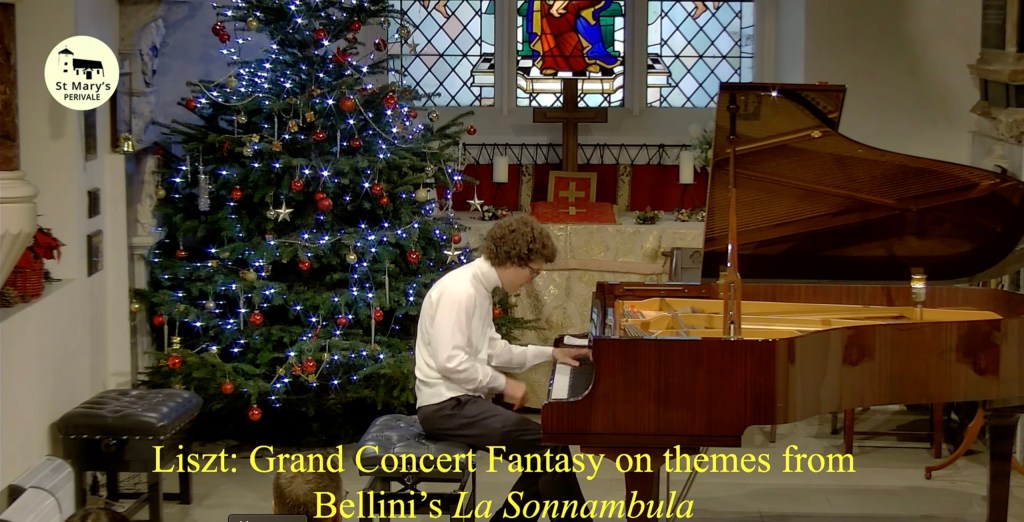
Leslie Howard had indicated to Andrea this work which he considers to be one of Liszt’s best but most neglected of all his paraphrases. A work that needs a fearless champion with a technical mastery that can allow Bellini’s bel canto to sing above the most transcendental pyrotechnics.Andrea could play with featherlight clarity as he could also play with orchestral fullness but never loosing sight off the melodic line that weaves it’s way in and out of such demonic pianistic elaborations. Missing a little of the sumptuous Philadelphian fullness of sound Andrea made up for it with a dynamic drive and clarity that was breathtaking in its fearless abandon. In Andrea’s hands,as those of his mentor Leslie Howard, it is obviously a work that deserves to be better known and put side by side with the much played Norma Fantasy.
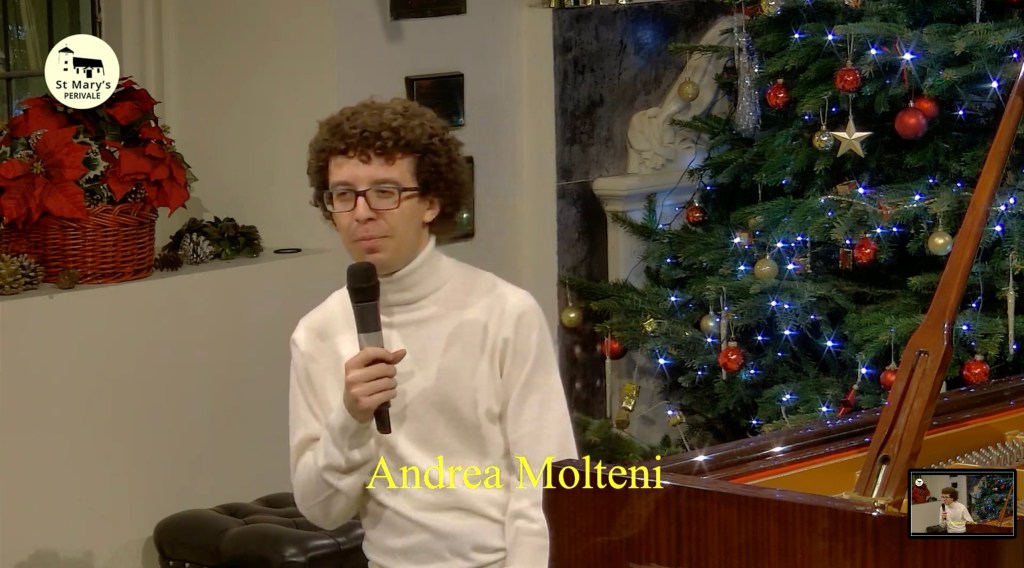
An exciting young Italian piano talent, the 26-year-old Andrea Molteni is building his international profile with performances in the US, Italy, France, Germany, Austria, Switzerland, Eastern Europe, and Asia. Three albums, recently released on Brilliant Classics and broadcast on France Musique, Germany’s MDR Kultur and Radio Classica in Italy, have received international praise: the complete piano works of Petrassi and Dallapiccola, a selection of Scarlatti sonatas, and Beethoven: Con alcune licenze, featuring Hammerklavier, Op. 110 and The Grosse Fuge, never before recorded in a piano solo version. Andrea Molteni enjoys the artistic guidance of William Grant Naboré and Stanislav Ioudenitch. He has also participated in master classes with Andras Schiff, Elisabeth Leonskaja, Pavel Gililov, Dang Thai Son, and Vladimir Feltsman.
Mr. Molteni began his career at the age of 15, when he participated at the Bayreuth Festival celebrating Wagner’s 200th anniversary and performed in France and Monte Carlo. Since then he has played at Mozarteum University in Salzburg, Scriabin Museum in Moscow, Esplanade in Singapore, Forbidden City Concert Hall in Beijing, Sydney Conservatorium of Music, National Opera Center and DiMenna Center in New York, Chopin Music University in Warsaw, Cincinnati Conservatory of Music, among other venues. The pianist regularly performs with orchestras, such as Orchestra Antonio Vivaldi, Orchestra Filarmonica Mihail Johra di Bacau in Romania, and Orchestra of the Costa Rica University. In the coming season he will give 25 concerts on three continents, including tours in China and Australia and recitals in Milan, Bergamo, Cremona and other Italian cities.

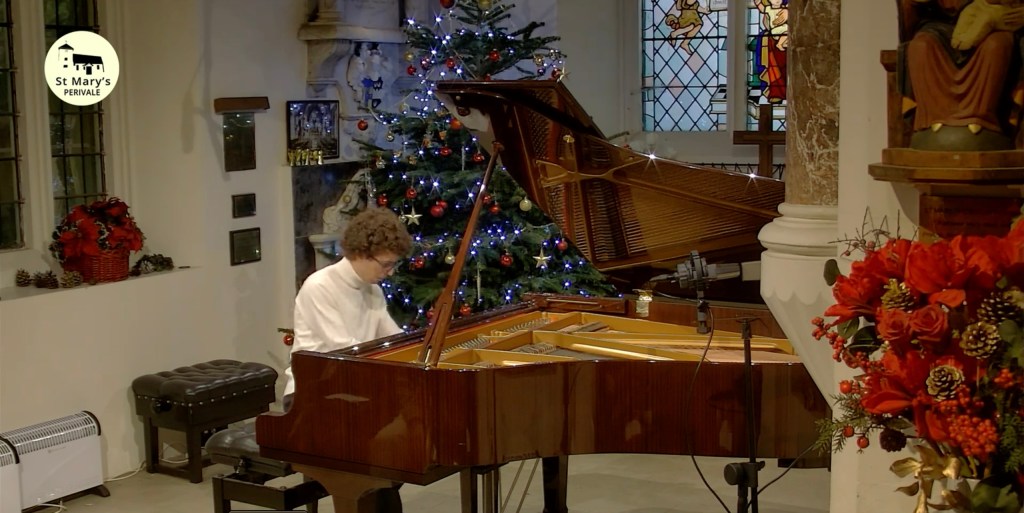
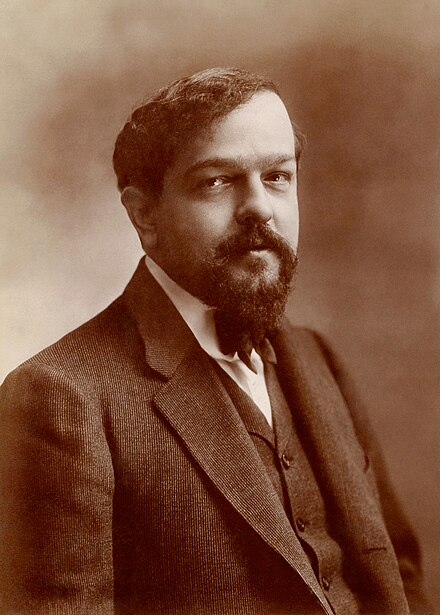
Estampes (Prints),L. 100, was finished in 1903 and the first performance of the work was given by Ricardo Viñes at the Salle Érard in Paris on 9 January 1904.
This suite with 3 movements is one of a number of piano works by Debussy which are often described as impressionistic , a term borrowed from painting. Pioneered by Ravel in Jeux d’eau written in 1901, was soon adopted by Debussy (for example in the earlier numbers of Images), but Debussy did not himself identify as an impressionist.The three movements Pagodes, La soirée dans Grenade (An evening in Granada) and Jardins sous la pluie (Gardens in the rain) create a poetic world of landscapes and distant lands. Written in the summer 1903 while he was staying in Bichain in the north of Burgundy. As he wrote in a letter at the time: “If one cannot afford to travel, one substitutes the imagination.”
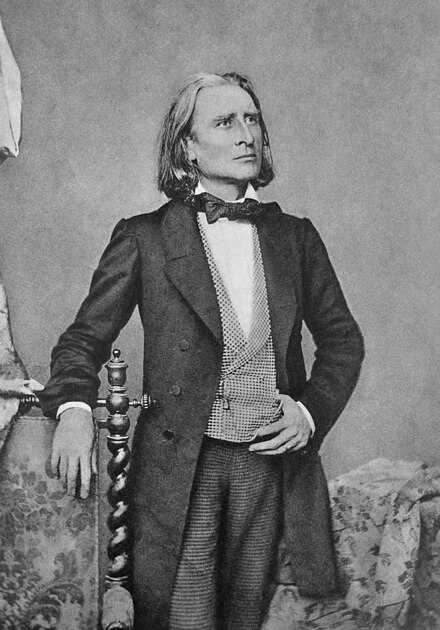
Leslie Howard writes: ‘Discounting the first publication of Liszt’s Sonnambula fantasy, which differs from the second by having virtually no dynamics or performance indications, there are three versions of the work, which first appeared in 1839, and then shortly afterwards with a few alterations, and finally in 1874, with a German rather than the original French title, ‘Grosse Concert Fantasie S 393.’ This last ignores the middle version and was clearly made by altering a copy of the 1839 version (all the errors missed in proof-reading are to be found in the passages which remain identical to both texts). Unusually in a late Liszt revision, the changes make the piece more rather than less difficult to perform. The work is constructed about five themes from Bellini’s opera, and really presents the drama in miniature by concentrating upon the principal story-line of the sleep-walking Amina who is presumed to be unfaithful to her betrothed Elvino, her rejection by him, her narrow escape from death by drowning whilst sleep-walking, her vindication, and the lovers’ reconciliation. Liszt captures the whole spirit of the piece in what amounts to a three-movements-in-one form whose last section, based on the triumphant ‘Ah! non giunge’, deftly draws all the elements together. It is altogether one of his best fantasies and long overdue for revival in the concert hall.’
‘A major revelation of nineteenth-century ideas and techniques. There is musical nourishment here as well as entertainment’ (Gramophone)


 ChristopherAxworthy-MusicCommentary