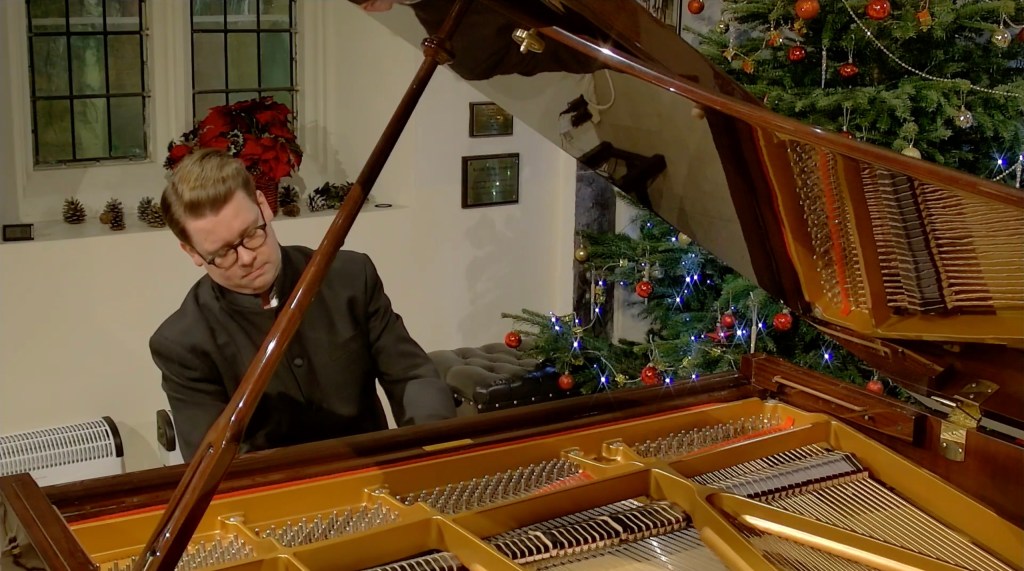

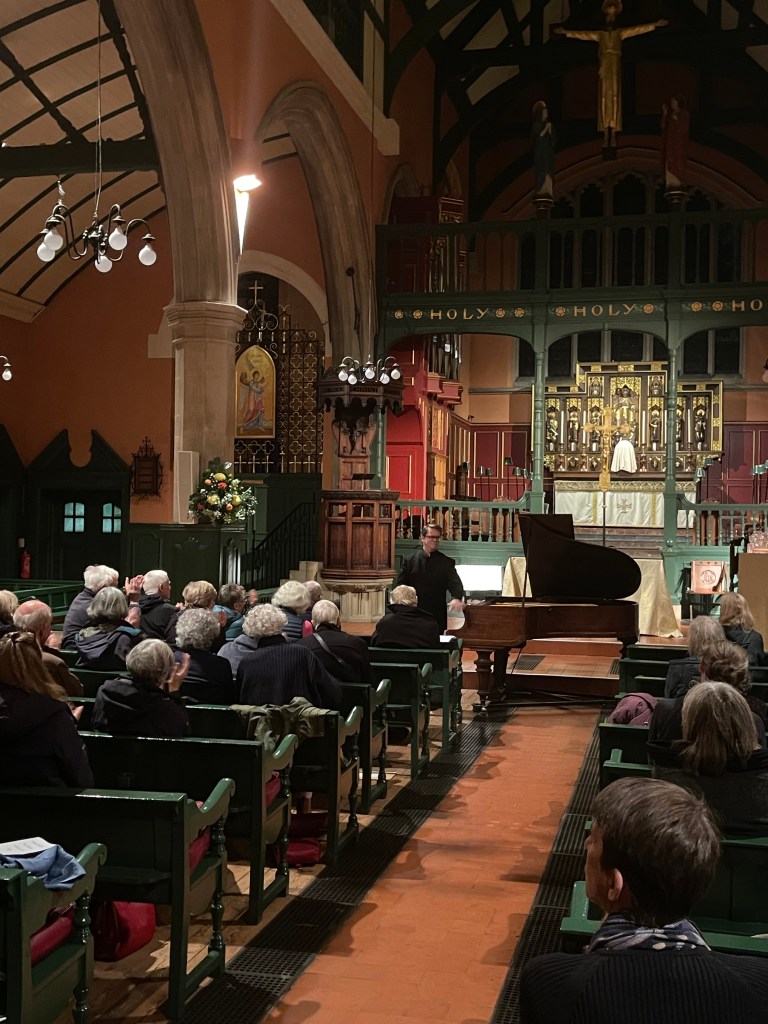
The extraordinary thing about a Mark Viner recital is his ability ,one might even say a mission or passion, to bring a fresh light to all he does. Whether delving deep into the archives for works too long kept in obscurity or looking at the most revered classics afresh with the same microscope and absolute fidelity to the composer that he uses to bring neglected masterpieces to the fore. And so it was today with two of the most played classics :Beethoven’s ‘Moonlight’ and Chopin’s G minor Ballade and relatively unknown works with a Christmas appeal. A transcription of two movements from Tchaikowsky’s ‘Nutcracker’ in the transcription of Taneyev which has long been overtaken by the genial much played one by Mikhail Pletnev. ‘A Christmas Tree Suite’ by Liszt that has long been in oblivion as are too many of his misunderstood later works. And the final triumphant March of the ‘Three Holy Kings’ from Liszt’s rarely heard oratorio ‘Christus’.

A programme decided only three days ago with Dr Hugh Mather to be able to substitute a sick colleague at St Mary’s Perivale. Luckily Mark has been playing this programme or similar in seven pre Christmas recitals in Oxford ,several in Germany for Moritz von Bredow.

Finally on Thursday in his beloved St Michael’s and All Angels where he and his partner officiate and feel at home as much in the Church as in the Tabard Inn opposite or their sumptuous home next door.
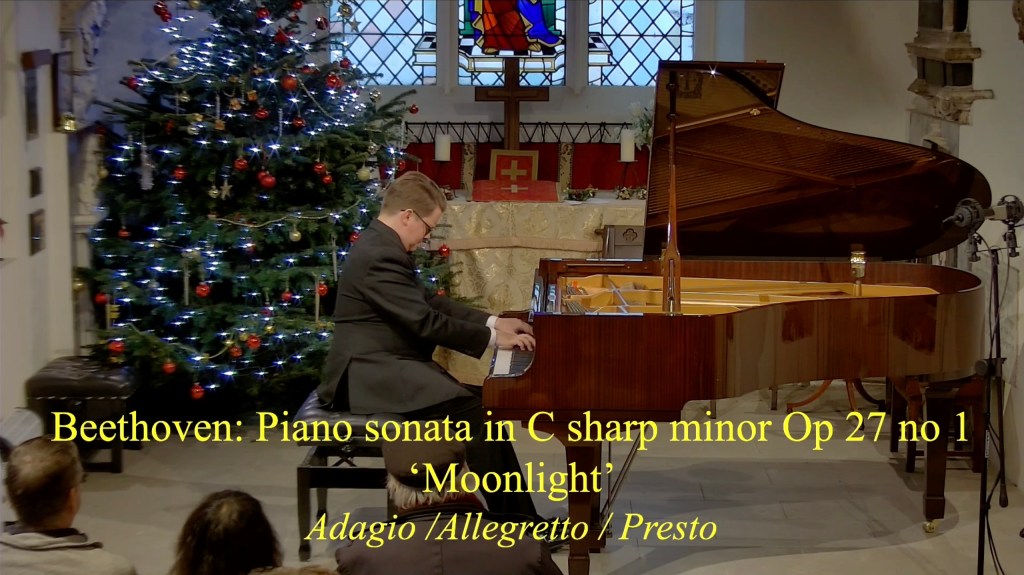
Beethoven’s miss-named ‘Moonlight’ Sonata had no sign of dreamy rays in Mark’s ‘illuminated’ reading. ‘Adagio sostenuto’ first movement in two not the tainted moonlit twelve! There was a fluidity and glowing beauty of Beethovenian strength and nobility. An authoritative performance that would come as a surprise to those that have struggled with a much maligned piece. Even Beethoven’s long pedal markings were intelligently noted and interpreted on an instrument very different from the one that Beethoven could actually still hear.The Minuet was played with unusual weight and seriousness which suited the sumptuous rich sounds of the Trio.The ‘Presto’ finale was played with extraordinary clarity and dynamic rhythmic drive where even the beautiful mellifluous episodes were on a burning cauldron of bubbling energy.

Chopin’s First Ballade was given an aristocratic reading of nobility and refreshing simplicity. Gone were all the layers of dirt that tradition has accumulated over the years and like Rubinstein Chopin’s vision of beauty was allowed to tell it’s own untarnished story.
https://youtu.be/Emzn1o_wOos?si=K-B8dRFSqLktntkR
Everything sang in Mark’s remarkable hands even the first great climax usually played like the 1812 overture,whereas in Mark’s hands the top notes of the sumptuous chords were allowed to glow with a radiance of architectural brilliance. The coda was taken at breakneck speed and might have enjoyed a more mellifluous ride but this was a vision of a man who had a story to tell and this was an integral part of his story of beauty and the beast!

Has the ‘ Sugar Plum Fairy ‘ ever sounded so radiant and glowing as she retraced her steps with infinite delicacy and stealth. There was a wonderful fluidity to the ‘Pas de deux ‘ which in Taneyev’s agile transcription should at least be rechristened ‘ de trois’ or ‘de quattro’. Not quite as pianistically daring as Pletnev it was nevertheless good to hear what was obviously the starting point for a pianistic genius of our times. Mark played it with sumptuous sounds and expansive melody of grandiose beauty with streams of notes just pouring from his well oiled fingers, just as ballet stars would be inspired to great heights by this magnificent score.
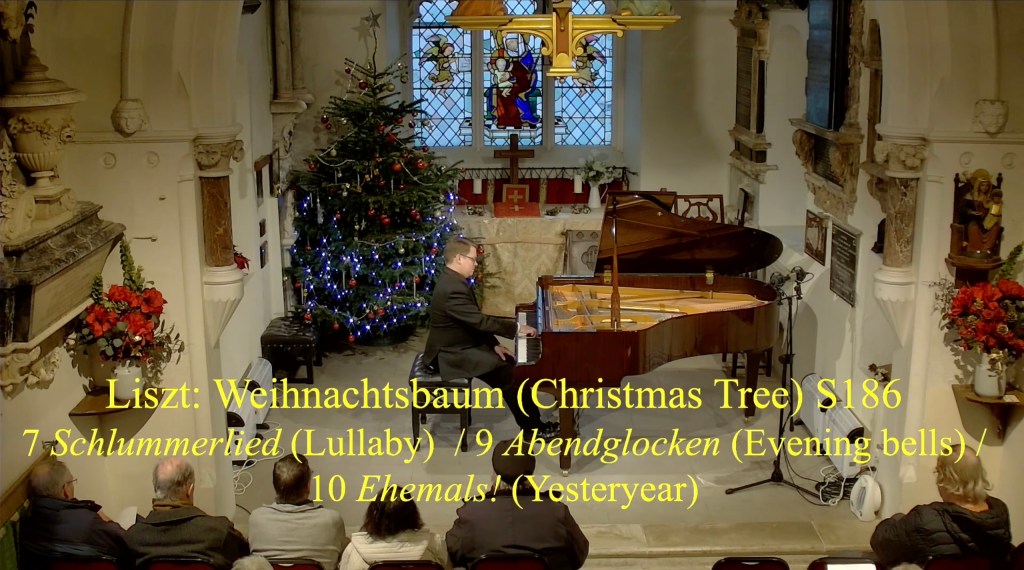
As a teenager I would frequent the music department of Chiswick Library and bring home scores to look at and try to play on my grandmother’s upright Broadwood. A piano that her husband had bought before going to the 1914 -18 war never to come back to enjoy the piano that stood in the parlour and would eventually be played by his two daughters. One of the pieces I brought back from the library was Liszt’s ‘Christmas’s Tree Suite’ . I remember the bright orange cover and my disappointment at what I found inside.Today Mark played three pieces from the suite the whole of which he has just recorded on one of his numerous CD’s. This is late Liszt where the composer was looking to the future with a sound world that was no longer necessarily with a tonal centre.This of course explains the strange inconclusive finish of the first piece and the resonant sounds in reply to the melodious recitativi of the second.The final piece was with a strident melody opening out to a full sumptuous outpouring. I must say I am still not completely convinced or maybe I am just mislead by the title.Mark played it with masterly conviction and burning authority and I look forward to listening to his recording of the whole work with that orange covered score at hand – I wonder if it is still languishing on the shelf sixty years on !!!

Liszt”s own transcription of the March from his ‘Christus’ Oratorio was played with astonishing mastery with an outpouring of great resonance expanding into a show piece of great effect .
Another wondrous voyage of discovery from one of the most important young artists before the public today
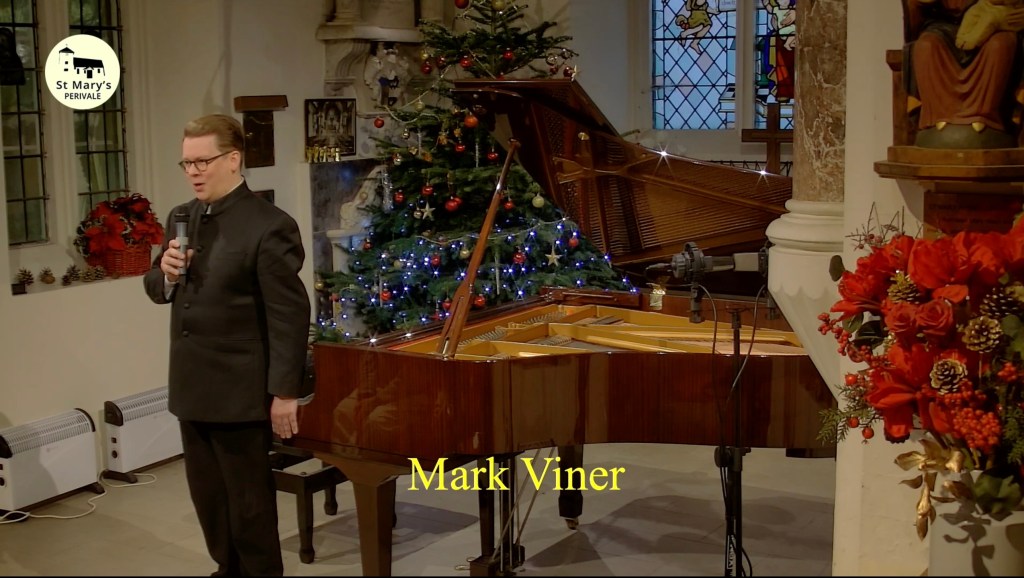
Described by International Piano Magazine as “one of the most gifted pianists of his generation”, Mark Viner is steadily gaining a reputation as one of Britain’s leading concert pianists; his unique blend of individual artistry combined with his bold exploration of the byways of the piano literature garnering international renown. He began playing at the age of 11 before being awarded a scholarship two years later to enter the Purcell School of Music where he studied with Tessa Nicholson for the next five years. Another scholarship took him to the Royal College of Music where he studied with the late Niel Immelman for the next six years, graduating with first class honours in a Bachelor of Music degree in 2011 and a distinction in Master of Performance 2013; the same year which afforded him the honour to perform before HM the King.

After winning 1st prize at the Alkan-Zimmerman International Piano Competition in Athens, Greece in 2012, his career has brought him across much of Europe as well as North and South America. While festival invitations include appearances the Raritäten der Klaviermusik, Husum in Germany, the Cheltenham Music Festival and Harrogate Music Festival in the United Kingdom and the Festival Chopiniana in Argentina, radio broadcasts include recitals and interviews aired on Deutschlandfunk together with frequent appearances on BBC Radio 3. His acclaimed Wigmore Hall début recital in 2018 confirmed his reputation as one of today’s indisputable torchbearers of the Romantic Revival. He is particularly renowned for his CD recordings on the Piano Classics label which include music by Alkan, Blumenfeld, Chaminade, Liszt and Thalberg, all of which have garnered exceptional international critical acclaim. His most important project to date is a survey of the complete piano music of Alkan: the first of its kind and which is expected to run to some 18 CDs in length. Aside from a busy schedule of concerts and teaching, he is also a published composer and writer and his advocacy for the music of Alkan led to his election as Chairman the Alkan Society 2014.

 ChristopherAxworthy-MusicCommentary
Una risposta a "Mark Viner at St Mary’s Nobility and radiance on a voyage of discovery"