
What an amazing place London is with a clash between giants in two different halls tonight
Gerstein at the Barbican and Yuja Wang and Vikingur Olafsson at the RFH.
https://inews.co.uk/culture/arts/yuja-wang-vikingur-olafsson-two-pianos-royal-festival-hall-review-stunning-display-3358136?ico=related_article_inline
A sold out Festival Hall and an amazingly full Barbican even if the programme was certainly not box office. Bacewicz Symphony and Busoni Piano concerto.

Chances to hear the monumental Busoni concerto are rare because of the forces that are required even in Busoni’s anniversary year. (1/4/1866 – 27/7 1924). A soloist who can weave his way through the intellectual and technical demands of 80 minutes of music ,a full Symphony orchestra and a male voice choir.
Benjamin Grosvenor brought it to the proms with great success as Emanuil Ivanov has been playing it to great acclaim in Birmingham and Sofia.
I had just heard the same team of Gerstein-Oramo with the Berlin Philharmonic ( Busoni’s original orchestra for the first performance in 1904) just ten days ago and I remember in that same Philharmonic Hall with Levit and Pappano with the Santa Cecilia orchestra on tour both were streamed live.

But tonight there was a dream team and magic in the air. Oramo with his BBC orchestra brought a masterly clarity to the Bacewicz Second Symphony which I had not heard before and found myself thinking why is this not heard more often.
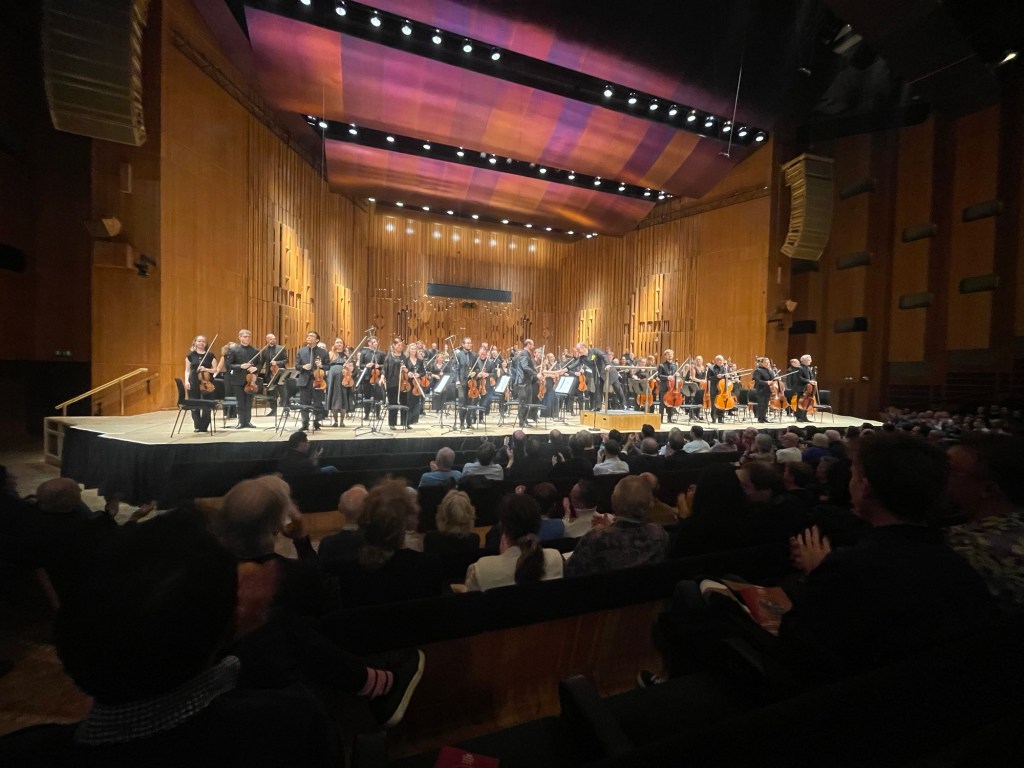
An orchestral masterpiece with an orchestra playing their hearts out as they followed every move of their genial much admired conductor.

The Busoni concerto more an orchestral piece with piano obligato according to Gerstein and he should know because of all the pianists playing today he is the one that has found the key to Busoni’s elusive sound world .
Kirill Gerstein – Busoni is alive and well and returned to the Wigmore Hall
His lecture recital on Busoni and Liszt a while back at the Wigmore Hall was a true revelation. Busoni the continuation of LIszt’s prophetic sound world of his later years when he could foresee the direction that music was taking.

I can now understand the enthusiasm of my old teacher Gordon Green forty years ago who had studied with Egon Petri a student of Busoni passing his passion on to all his disciples including notably Peter Donohoe and Stephen Hough.
It is a unique sound world and takes a genial interpreter to be able to find and share the path that makes sense of seemingly plotless sounds.
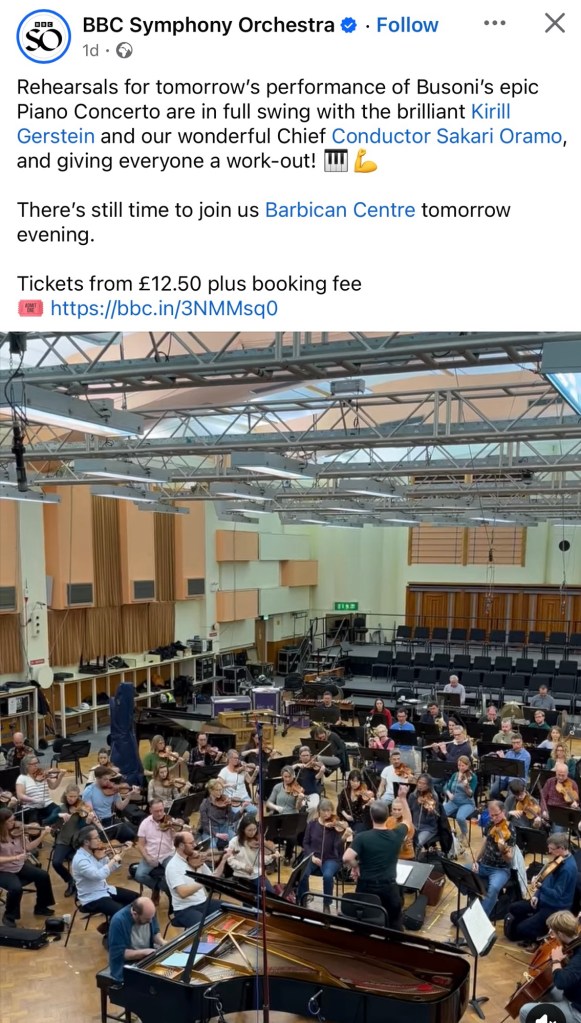
Gerstein tonight with Oramo revealed this monumental concerto to an audience on their feet cheering after 80 minutes of intense music making .
The male voice choir illuminating the final movement with a moving contemplation of the words of Oehlenschlager shown with subtitles discretely above the orchestra, the piano barely touching the keys as time stood still until the final outburst of red hot octaves brought the work to a triumphant close.



Ferruccio Dante Michelangiolo Benvenuto Busoni Empoli 1st April 1866 Vienna 27th July 1924
photo of the composer in 1905, soon after completing the concerto in C major BV 247
Based on Aladdin by Adam Oehlenschlager. Composed 1901–04
First performance November 10, 1904: Berlin
Published
1906 by Bretikopf & Hartel Duration 70 min
in 5 Movements for piano orchestra men’s chorus
The first performance took place in the Beethoven-Saal, Berlin, Germany, on November 10, 1904, at one of Busoni’s own concerts of modern music. Busoni was the soloist, with Karl Muck conducting the Berlin Philharmonic and the choir of the Kaiser Wilhelm Memorial Church .The reviews were mixed, some expressing hostility or derision.A year later, the work was played in Amsterdam by the Concertgebouw , conducted by Busoni, with Egon Petri as soloist. The century following has seen relatively few performances, owing to the large orchestration, complex texture, need for a male chorus, and the staggeringly demanding solo part.

Apart from the immense demands required of the soloist and the large forces needed, there is a further difficulty that can affect performances of this work: the role of the soloist.
As Busoni himself wrote, piano concertos tended to be modelled after either Mozart or Beethoven.In Mozart’s case, the concerto centres around the spotlit virtuoso composer-performer, who appears to spontaneously create the work before us, on-stage. The orchestra mostly provides a background accompaniment. But with Beethoven, the work is often conceived in symphonic terms; the piano takes the secondary role, reflecting on or responding to ideas that have already been introduced by the orchestra (excepting the fourth piano concerto)
Busoni combined both these precedents in the Piano Concerto, Op. 39, creating a huge work of symphonic proportions which was originally accused of having only a piano obbligato .The work presents exceptional challenges for the soloist, who is often nevertheless required to incorporate a glittering cascade of notes into the overall orchestral sound. This self-abasement of the familiar 19th-century heroic soloist’s role thus requires careful consideration of balance in performance. But as Edward Dent comments:
‘Despite the incredible difficulty of the solo part, Busoni’s concerto at no point offers a display of virtuosity. Even its cadenzas are subsidiary episodes. At the same time the pianoforte hardly ever presents a single theme in its most immediate and commanding shape. It is nearly always the orchestra which seems to be possessed of the composer’s most prophetic inspiration. Busoni sits at the pianoforte, listens, comments, decorates, and dreams.’

Adam Oehlenschlager’s verse drama Aladdin , or the Magic Lamp was first published in Danish in 1805.The play has a number of parallels with the works and ideas of Goethe such as the Faust figure of the wicked magician Noureddin who takes advantage of Aladdin’s youth and inexperience to get hold of the wonderful lamp;Goethe was also much preoccupied with Plato’s philosophy, including his theory of Forms and the allegory of the Cave
During his travels in Germany in 1805–6, Oehlenschläger spent several months in Weimar in the company of Goethe and his closest circle of friends. He used the opportunity of his daily visits to read out Aladdin to Goethe, freely translating from the Danish.At the time, Goethe was in the process of completing the final version of Faust Part 1.
Subsequently, Oehlenschläger prepared a German edition of Aladdin, translating and revising the work himself and adding an explanatory introduction for his intended German readers. This edition was published in 1808 in Amsterdam.The new version included a special dedicatory poem To Goethe and was split into two parts, intended to be given on two successive evenings. More especially, this version had a new finale differing considerably from the original Danish edition by having various magical scenic transformations.Busoni was quite taken with this early German version of Aladdin and planned to adapt it as a one-evening work. In a letter to his wife, dated London, February 10, 1902, Busoni wrote:
‘I have thought it out and decided not to use Oehlenschläger’s Aladdin for an opera, but to write a composition in which drama music, dancing and magic are combined – cut down for one evening’s performance if possible …………I have planned 6 works for the summer, the principal one being the pianoforte Concerto. How beautiful!’ Busoni never completed his adaptation of Aladdin,[22] although he did compose music for the final chorus in the magic cave; this soon made its way into the Piano Concerto.
Oehlenschläger’s stage direction “Deep and quiet, the pillars of rock begin to sound:” is printed above the score where the chorus enters. Busoni follows the text exactly, only omitting a few verses which were not appropriate.According to Dent:
‘The actual meaning of the words hardly matters. The chorus is directed to be invisible; it sings in plain chords, like a body of soft trombones added to the orchestra. The effect which Busoni desired was stated by him once in a letter to a friend who had mistakenly suggested to him that it might be better to re-write the chorus for mixed voices; he replied that he had no desire to convert his Concerto into an oratorio; he insisted that the chorus should be invisible, and said that its function was ‘to add a new register to the sonorities which precede it’.’
Deep and quiet, the pillars of rock begin to sound:
Lift up your hearts to the power eternal,
Feel Allah’s presence, behold all his works!
Joy and pain interweave in the light of the world;
The world’s [mighty] pillars stand peacefully here.
Thousands and thousands and once again thousands
Of years – serene in their power as now –
Flash by purely with glory and strength,
They display the indestructible.
Hearts glowed [so brightly], hearts became colder.
Playfully interchanged life and death.
But in a peaceful awaiting they stretch out,
Gorgeous, powerfully, early and late.
Lift up your hearts to the power eternal,
Feel Allah’s presence, behold all his works!
Thus the dead world comes completely to life.
Praising divinity, the poem falls quiet!

Grażyna Bacewicz before World War II
5 February 1909 Lodz,Poland – 17 January 1969 (aged 59) Warsaw
In 1928 she began studying at the Warsaw Conservatory where she studied violin with Józef Jarzębski and piano with Jozef Turczynski , and composition with Kazimierz Sikorski graduating in 1932 as a violinist and composer.She continued her education in Paris having been granted a stipend by Paderewski to attend the Ecole Normale and studied there in 1932–33 with Nadia Boulanger (composition) and André Touret (violin). She returned briefly to Poland to teach in Łódź, but returned to Paris in 1934 in order to study with the Hungarian violinist Carl Flesch.After completing her studies, Bacewicz took part in numerous events as a soloist, composer, and jury member. From 1936 to 1938 she was the principal violinist of the Polish National Radio Orchestra , directed by Grzegorz Fitelberg .This position gave her the chance to hear much of her own music. During World War II, Grażyna Bacewicz lived in Warsaw . She continued to compose and gave secret underground concerts, where she premiered her Suite for Two Violins.
Bacewicz also dedicated time to family life. She was married in 1936, and in 1942 gave birth to a daughter, Alina Biernacka who became a recognized painter.Following the Warsaw uprising they escaped the destroyed city and temporarily settled in Lublin.After the war, she took up the position of professor at the State Conservatoire in Łódź . At this time she was shifting her musical activity towards composition, drawn by her many awards and commissions. Composition finally became her only occupation from 1954, the year in which she suffered serious injuries in a car accident.She died of a heart attack in 1969 in Warsaw.
Her musical legacy includes 4 symphony’s ,5 violin concertos,2 cello concertos.a concerto for one and two pianos and much else besides .
 ChristopherAxworthy-MusicCommentary