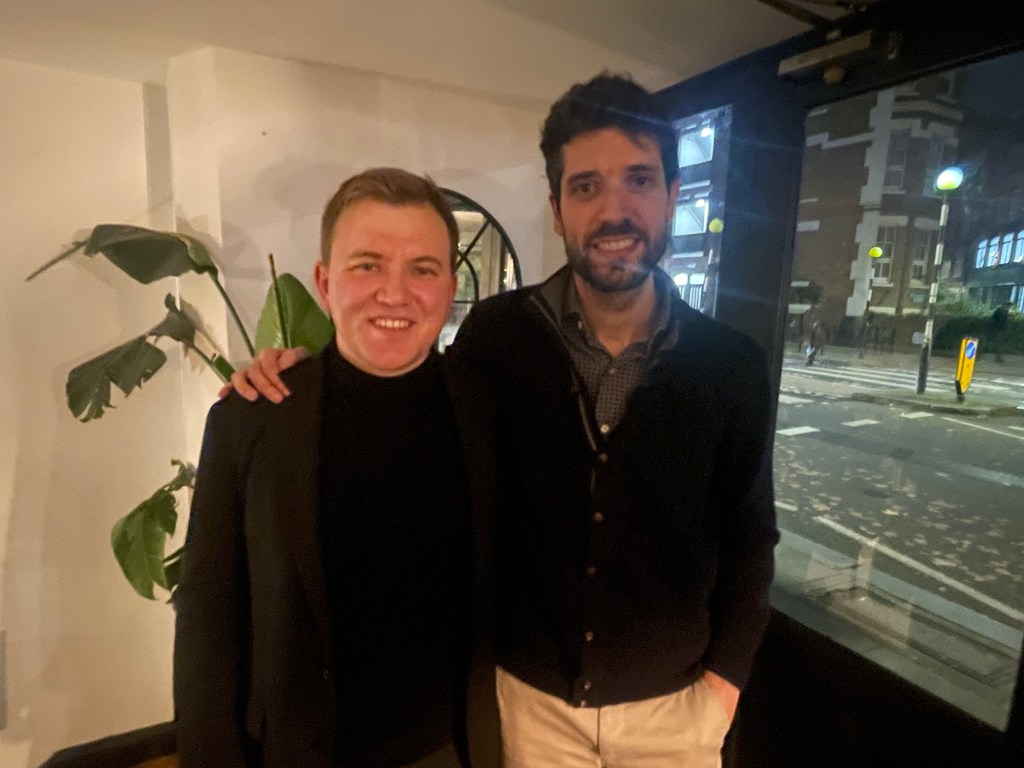
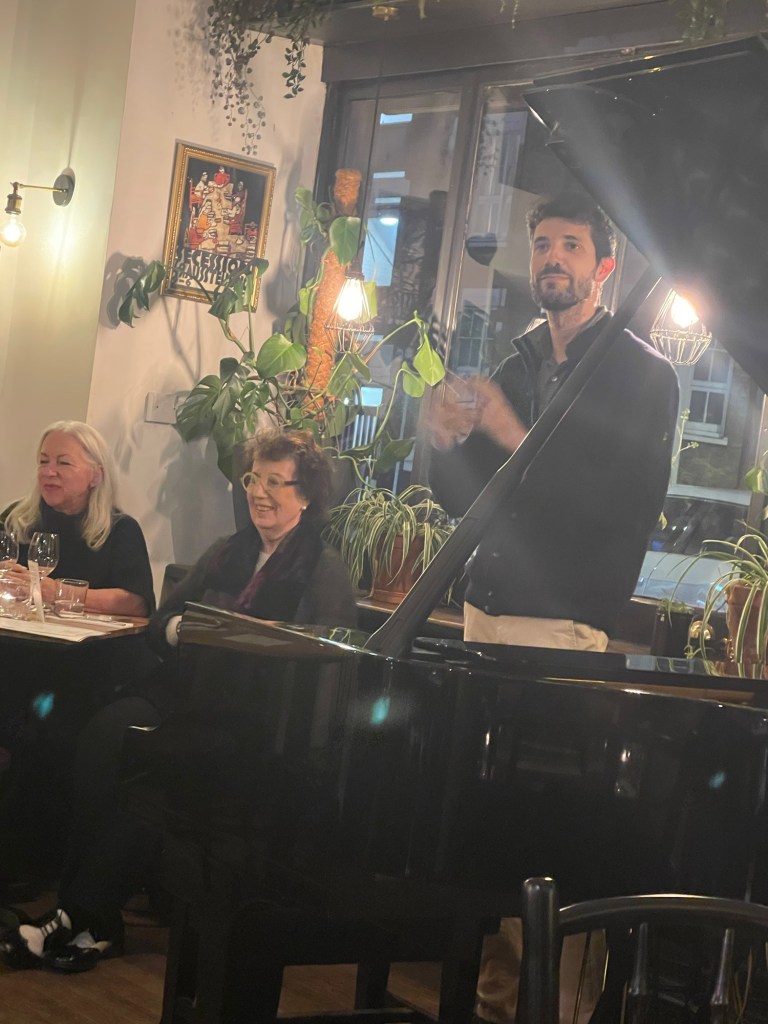
Words are not enough to describe a work of such universal genius as the Diabelli variations and it’s interpreter today,Filippo Gorini, touched by genius was able to guide us through this maze of emotions with selfless mastery visibly still moved by a work he has been playing and living with for well over a decade.

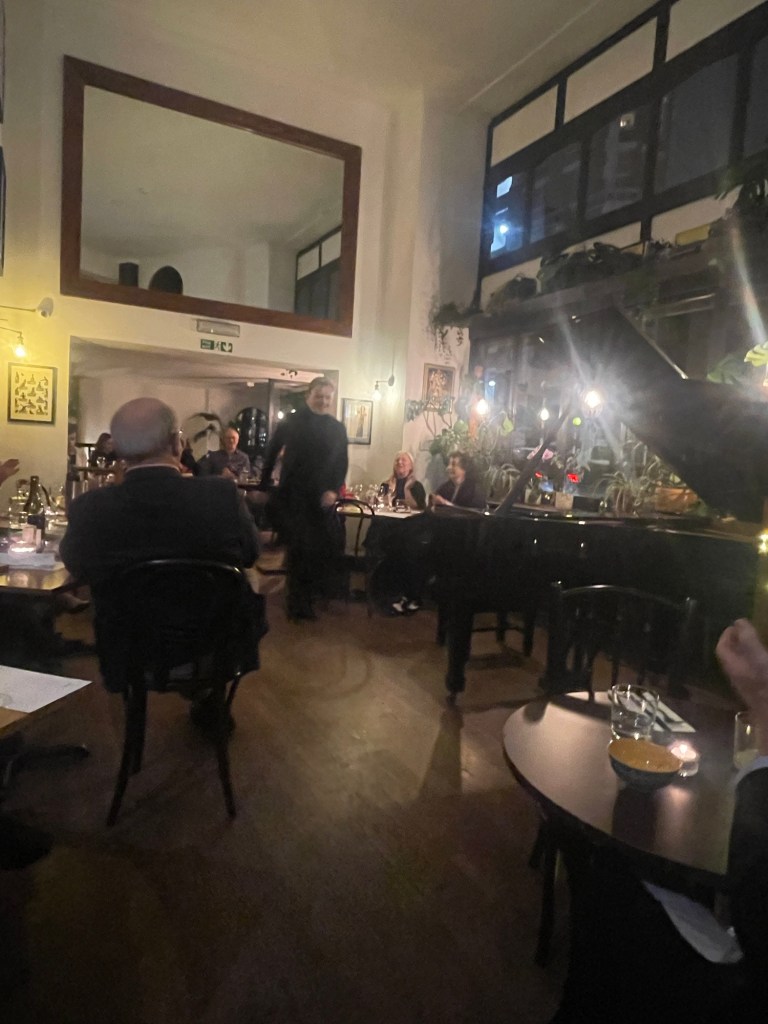
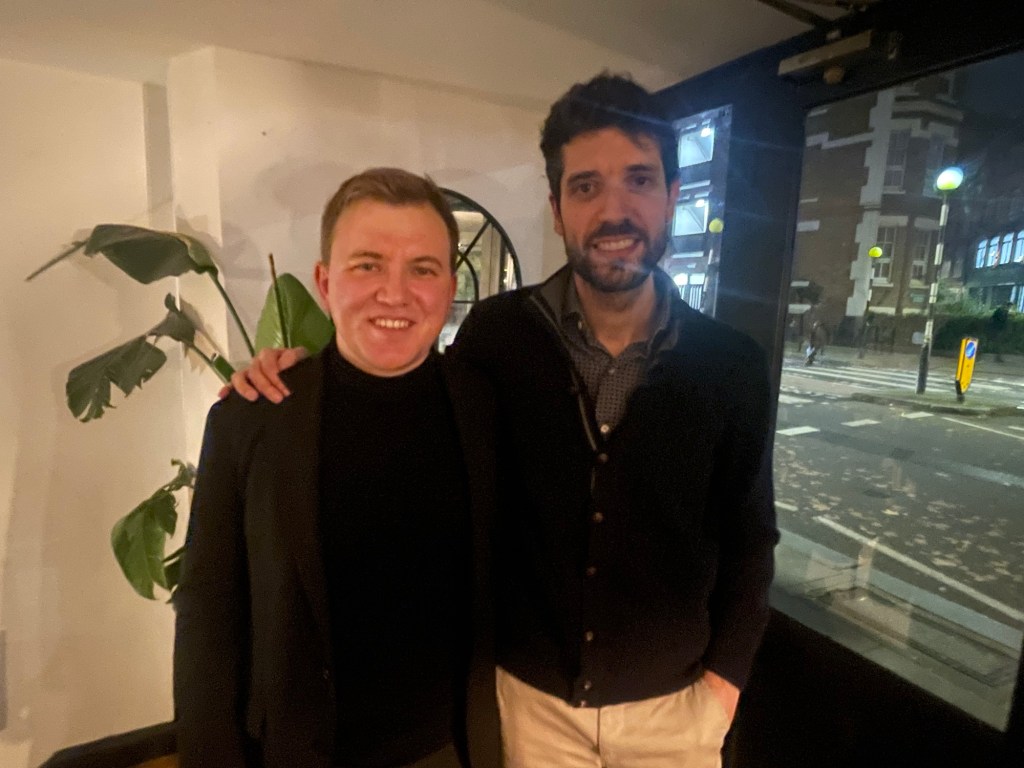
Raffaello Morales his friend from their early teen student days together,surely, is also touched by genius as he has created an oasis of culture in a metropolis where quantity rather than quality reigns.
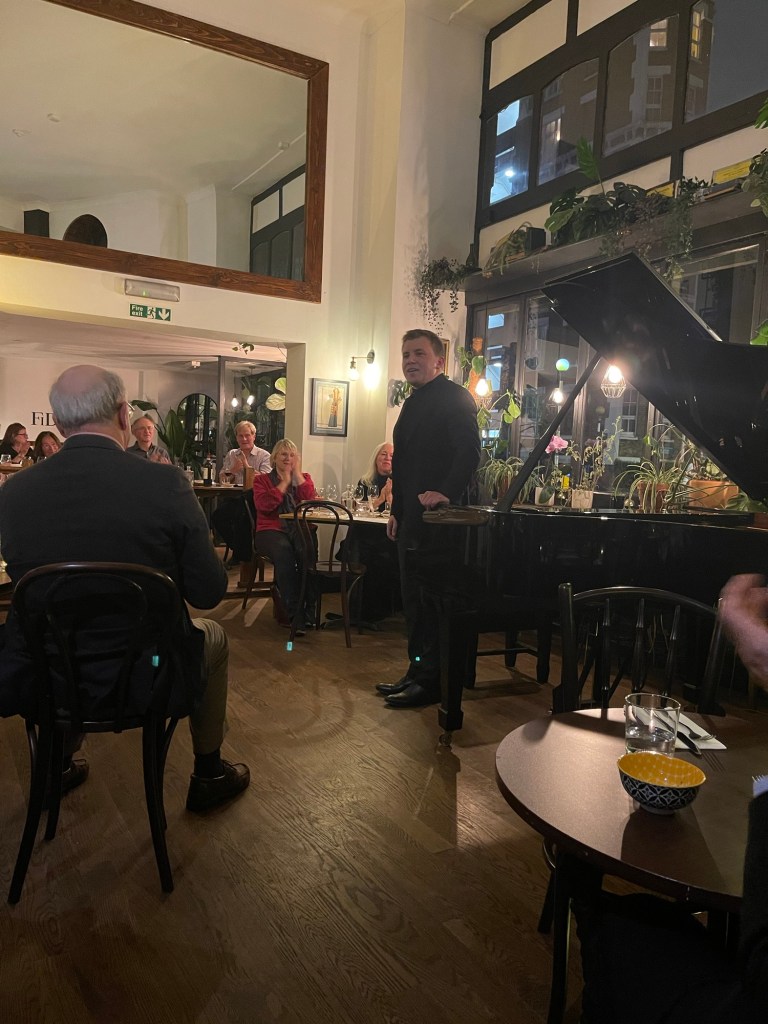
A distinguished audience including Dame Imogen Cooper whose performances of the Diabelli are legendary like her and Filippo’s mentor Alfred Brendel.

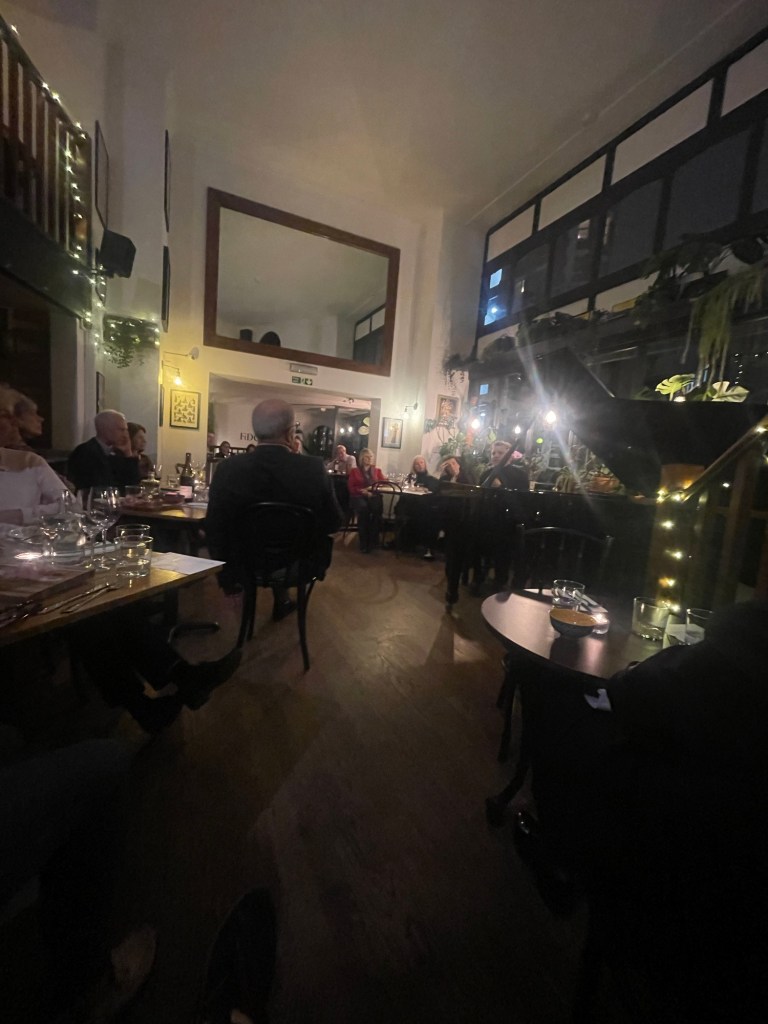
Wonderful cooking smells wafted around this very suggestive haven with a cordon bleu menu to follow Beethoven.
I personally after a performance like we heard today need to seek solice and silence to savour the earth shattering experience we had just been through together .
I really cannot imagine anyone able to digest anything after having digested Beethoven whole in his most dramatic and enigmatic mood and expect there might be many left overs tonight!
Filippo has played for his friend the Art of Fugue a while back. Now this Buitoni Bortolotti fellow plays Diabelli , what next ……..? https://christopheraxworthymusiccommentary.com/2020/11/30/filippo-gorini-the-art-of-fugue/
Goldberg ,Hammerklavier, Rzewski whatever it might be I certainly will not miss one of the most eclectic and masterly musicians of our day.
Filippo has a twinkle in his eye and is sure to come up trumps to have the joy of sharing his musical discoveries in such a magically intimate space.
As stimulating introduction playing extracts from the theme and variations ,without any sign of the score, that was securely fastened within him. Crucial parts of this seemingly insignificant theme that Beethoven uses to transform into a totally new world with the innocuous opening turn transformed into a beautiful waltz or a dynamic rhythmic puzzle of frantic force. Even the accompaniment of just repeated notes Beethoven transforms into a Fugue of incredible force and power.The 22nd variation where Diabelli’s little waltz is parodied with Mozart’s ‘Notte e giorno faticar’ which was a little nudge from Beethoven to his publisher who was impatient to see the finished work. As Filippo pointed out the German title ‘Veränderungen’ translates as change, alteration, modification, transformation, change, shift, variation. Showing us the deeply meditative Andante of the 20th variation transformed with its almost unrecognisable ponderous long chords.
This was Beethoven’s penultimate work for an instrument that had followed the compositional career of a Genius , only the ‘trifles’ of op 126 were to follow. And like in his late sonatas op 109 and op 111 Beethoven at the end of each of these masterworks reaches out to the paradise that only he can envisage in his private ear.The miracle is that even totally deaf he could write down these sounds for posterity. It is with the charm and beauty of a Tempo di Menuetto that closes this monumental work.But even here it is not just a minuet but a gradual unwinding of etherial sounds reaching on high and just a very insignificant final chord played without force or rhetoric. This was not just an ending of a journey but the start of a journey that was to take him from us at the age of only 57.
I was not expecting a complete performance as it was billed as a lecture recital but Filippo after showing us many of the key moments, at 7 o’clock he started his long journey of a theme and the thirty three transformations of the Genius of Bonn. A theme that was played as a waltz with Beethoven’s dynamic marks noted but not yet distorting the natural flow as is the case in so many performances. It was Serkin too who was literally to bounce on the seat as he played with the same infectious lilt as Filippo today. What wondrous full rich sounds Filippo brought immediately to the pomposity of the first variations or the music box clockwork perfection of the second.Beauty and freedom to the third with the startlingly whispered left hand just a poignant interruption to the flow. This pastoral episode exploding into the 6th ‘Allegro man non troppo e serioso’ firing off notes as Serkin would do with injections of startling drive and energy. Trills shrilly upward moving with one hand answered by the other and a real wake up call , typical of the duel personality of Beethoven where serenity is interrupted by irascible impatience. Filippo’s playing of the 7th I have never heard played with such overpowering bass notes and it was quite an overwhelming even exhilaratingly exhausting experience. What energy he brought to Diabelli’s innocent little turn punched out with demanding vigour as it burst into a ‘presto’ of unrelenting forward movement played with a drive where the energy not the notes were Filippo’s prime concern , but which he played with exemplary precision despite Beethoven’s impossible demands. Diabelli’s little turn was transformed into such beguiling beauty in Filippo’s sensitive hands with the ‘Allegretto’ of the 11th. I noticed Dame Imogen looking over his shoulder for the secret of his wonderful legato meanderings in the 12th! The 13th was remarkable for the rests that separated pompous outbursts with whispered impish answers. I have never heard the ‘Grave e maestoso’ played with such veiled majesty and it contrasted with the ‘presto scherzando’ that just shot from Filippo’s fingers with crystalline whispered sounds of clockwork precision.The drive of the 16th and 17th I never thought I would hear the like since Serkin’s performance, but Filippo was like a man possessed and took us and himself by storm with dynamic drive and transcendental virtuosity. The ‘poco moderato’ of the 18th was given all the time to breathe and was a ravishing pastoral oasis after experiencing such a battleground.The long drawn out chords that Filippo’s had demonstrated in his talk brought this first half to a deeply felt close ( as in the 15th of the Goldberg variations) where a second of meditative silence brought a moment of peace before the final 13 variations still to come in this monumental work.
Trills abounding from one end of the keyboard to another with extraordinary energy signalled the second half and took us to the quote from Mozart that Filippo had explained earlier was a wake up call for Beethoven’s impatient publisher. I was surprised that the gasps of the ‘Adagio ma non troppo’ of the 29th were not made more apparent as Beethoven had gone to the trouble to mark them meticulously. A small detail compared to the extraordinary character Filippo gave to these last variations.The very heart of this work is the 31st variation that Filippo played with weight delving deep into the notes where Beethoven’s ‘ bel canto’ was so much more intense and poignant than that of Bellini. Beethoven had taken these embellishments as inner palpitations of meaningful significance and not the egoistic enhancement of the popular operas of the day.The 32nd variation was a fugue every bit as breathtaking as Serkin with wild hysterical abandon that Filippo like Serkin kept under strict architectural control bursting into streams of notes and a final impatient cadenza. The following six bars are in my opinion the most startlingly original and poignantly significant in the whole work.This is real Genius where six bars can mean so much with so little.The final variation , a minuet, as I have already mentioned, reaching into the distance that Beethoven could already perceive and that he was to join in only a few years after the finish of this monumental work.

Samson Tsoy: Mastery and restless conviction reaching for the skies with Fidelian courage
Mihai Ritivoiu at Fidelio The Poet speaks in an oasis of elegance and eloquence.
Angela Hewitt plays Bach and Brahms with the Fidelio Orchestra of Raffaello Morales
DIABELLI ALLA FRANCESE TIBERGHIEN TRIUMPHS AT THE WIGMORE HALL
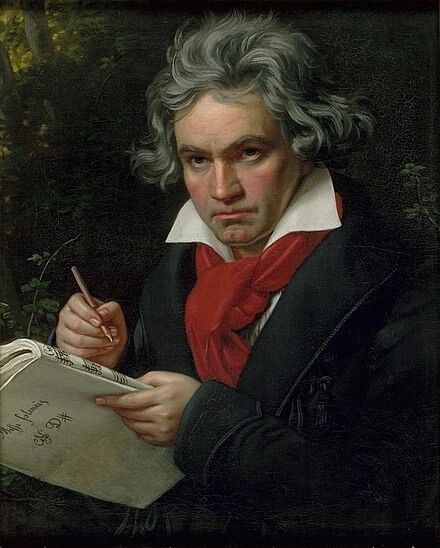
Ludwig van Beethoven
17 December 1770 Bonn 26 March 1827 (aged 56) Vienna
The 33 Variations on a waltz by Anton Diabelli, op 120, was written between 1819 and 1823 by Beethoven on a waltz by Anton Diabelli .It forms the first part of Diabelli’s publication Vaterlandischer Kunstlerverein , the second part consisting of 50 variations by 50 other composers including Carl Czerny,Franz Schubert ,Hummel,Moscheles,Kalkbrenner,a twelve year old Franz Liszt and a host of lesser-known names including Franz Xaver Mozart and others now largely forgotten.It is often considered to be one of the greatest sets of variations for keyboard along with Bach’s Goldberg Variations.Tovey called it “the greatest set of variations ever written”and pianist Alfred Brendel has described it as “the greatest of all piano works”.It also comprises, in the words of Hans von Bulow “a microcosm of Beethoven’s art”. Alfred Brendel wrote, “The theme has ceased to reign over its unruly offspring. Rather, the variations decide what the theme may have to offer them. Instead of being confirmed, adorned and glorified, it is improved, parodied, ridiculed, disclaimed, transfigured, mourned, stamped out and finally uplifted”.Maynard Solomon in The Late Beethoven: Music, Thought, Imagination expresses this idea symbolically, as a journey from the everyday world (“Diabelli’s theme conveys ideas, not only of the national, the commonplace, the humble, the rustic, the comic, but of the mother tongue, the earthly, the sensuous, and, ultimately, perhaps, of every waltzing couple under the sun”Of great significance, according to Kinderman, is the discovery that a few crucial variations were added in the final stage of composition, 1822–23 and inserted at important turning-points in the series. A careful study of these late additions reveals that they stand out from the others by having in common a return to, and special emphasis on, the melodic outline of Diabelli’s waltz, in the mode of parody.

change, alteration, modification, transformation, change, shift, variation,
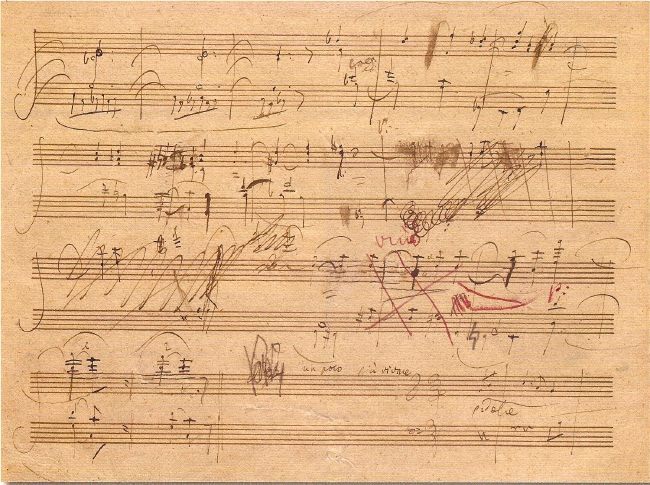
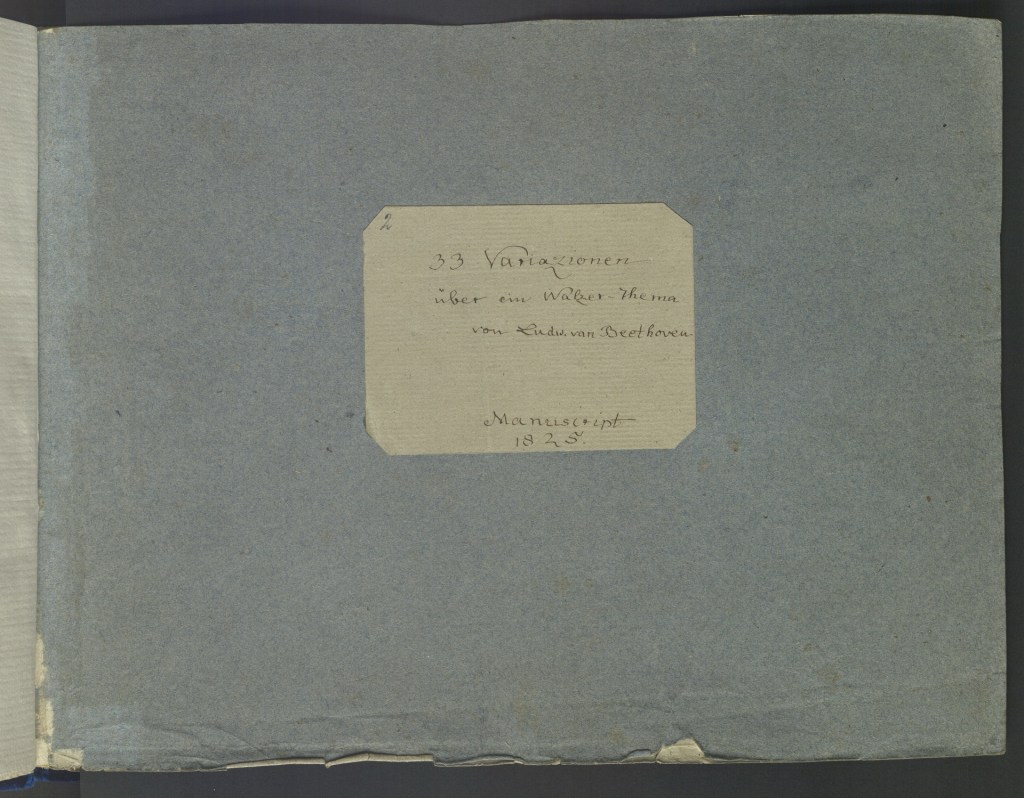
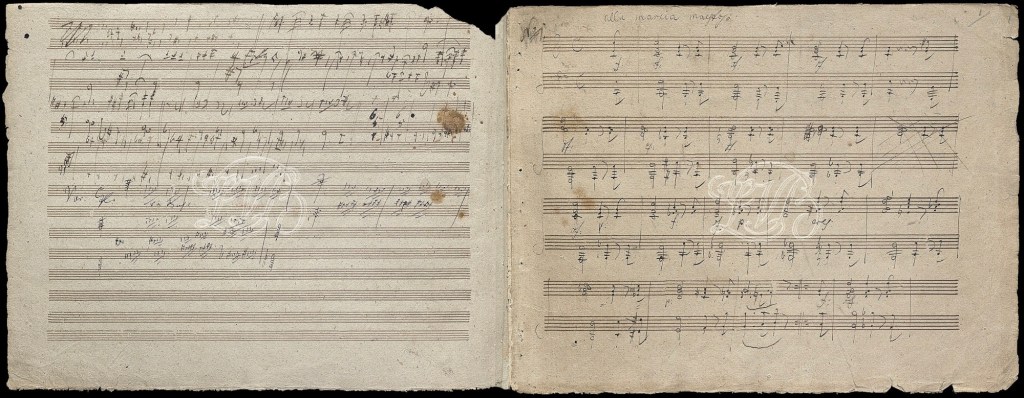
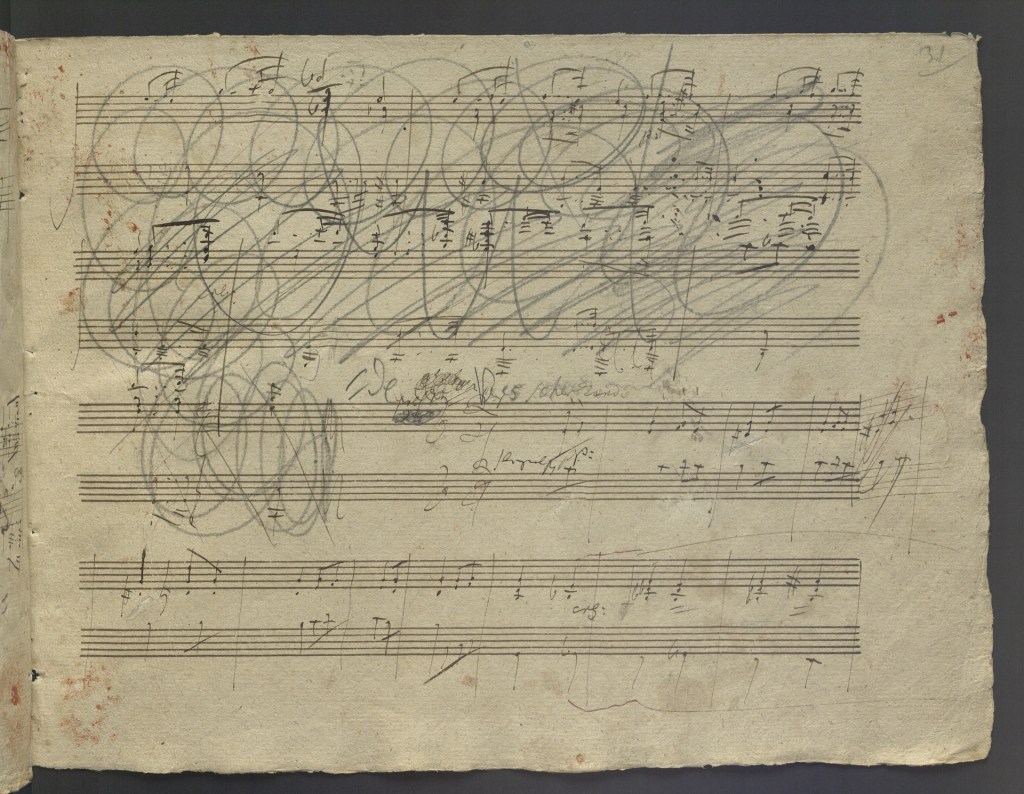

The autograph of the Diabelli variations gives a detailed insight into Beethoven’s working routine. It nicely illustrates how the composer worked, how he strove for a perfect final version by adding, crossing out and pasting over notes, by inserting sheets and so on. Beethoven’s handwriting gives evidence of the conflict between producing a well-readable copy and giving way to spontaneity and unrestrained expression. His way of writing says much about his musical intentions, and the manuscript also mirrors his complex personality.
His handwriting had always been quite attracting. Anton Diabelli, who ordered the variation cycle, wanted to own the autograph by all means and claimed that he as the publisher needed it as proof of ownership. And indeed, he managed to obtain it. Later, it came into the possession of two well-known autograph collectors: Heinrich Steger from Vienna and Louis Koch from Frankfurt. Thereafter, the manuscript remained in private possession for many years. Thanks to the contribution of many supporters, among them the public authorities, public and private foundations as well as music aficionados from all over the world, the manuscript could be acquired in 2009 and be added to the collection of the Beethoven-Haus. Last but not least this important achievement is owing to the efforts of outstanding Beethoven interpreters who gave charity concerts. Thanks to this common commitment artists and laymen can now enjoy this unusual master composition.

At only 29 years of age, Filippo Gorini’s musicianship has drawn unanimous acclaim in recitals in venues such as Milan’s Teatro alla Scala, Amsterdam Concertgebouw, Berlin Konzerthaus, Vienna Konzerthaus, Hamburg Elbphilharmonie, London Wigmore Hall, Louis Vuitton Foundation Paris, Zurich Tonhalle, Van Cliburn Foundation, Vancouver Recital Society, as well as with orchestras such as the Santa Cecilia Orchestra in Rome, the Salzburg Mozarteum Orchester, the Nagoya Philharmonic, the Flanders Symphony Orchestra, the Gyeonggi Philharmonic in Seoul, the Opera Nacional de Chile.Filippo’s highlights from 2023-24 include his recital debuts in Teatro alla Scala di Milano and at Cal Performances in Berkeley, and concertos with the Orchestra del Maggio Musicale Fiorentino conducted by Daniele Gatti, Shenzhen Phillharmonic and Musikalische Akademie Mannheim, as well as a chamber music tour in New York’s Carnegie Hall, Boston, Philadelphia, Washington DC for the Marlboro Music Festival.Filippo’s multi-year project “The Art of Fugue Explored” has shown his vision and creativity to go further than just his performing abilities: with the support of the Borletti-Buitoni Trust, he has released the work on Alpha Classics in 2021, performed it internationally over 30 times, and has released on RAI5 and RaiPlay a series of filmed conversations on Bach’s music involving personalities such as Peter Sellars, Frank Gehry, Sasha Waltz, Alexander Sokurov, Alexander Polzin, Alfred Brendel, George Benjamin, and many more. Produced by Unitel, they will soon be published internationally.His upcoming project “Sonata for 7 cities”, due for 2025-26, aims to show a new, responsible and ethical approach to concert life with monthly residencies in Vienna, Cape Town, Hong Kong, Tokyo, Portland, Milan and more, centred around performances, outreach, teaching, and philanthropy. During this project he will also perform seven newly commissioned piano pieces by composers such as Beat Furrer, Stefano Gervasoni, Yukiko Watanabe, Michelle Agnes Magalhaes, Federico Gardella, Oscar Jockel.Filippo has received the “Premio Abbiati”, the most prestigious musical recognition in Italy, in 2022, as well as the Borletti-Buitoni Trust Award 2020 and First Prize at the Telekom-Beethoven Competition 2015. His three albums featuring Beethoven and Bach late works, released on Alpha Classics, have garnered critical acclaim, including a Diapason d’Or Award and 5-star reviews on The Guardian, BBC Music Magazine, Le Monde.Alongside his solo career, Filippo has performed chamber music with musicians such as Marc Bouchkov, Itamar Zorman, Pablo Ferrandez, Brannon Cho and Erica Piccotti, in renowned festivals such as the Marlboro Music Festival, the Prussia Cove Chamber Music Seminars, as well as “Chamber Music Connects the World” in Kronberg with Steven Isserlis. He has taught masterclasses at the Liechtenstein Musikakademie, the University of British Columbia, the Royal Welsh College of Music, and the conservatories in Bergamo and Siena. He follows actively the world of contemporary composition, and has played works by composers such as Stockhausen, Kurtág, Boulez and Lachenmann as well as commissioning new pieces.After graduating with honours from the Donizetti Conservatory in Bergamo and the Mozarteum University in Salzburg, Filippo’s artistic development is now supported by the mentorship of Maria Grazia Bellocchio, Pavel Gililov, Alfred Brendel and Mitsuko Uchida.
“There is no doubt: a star has risen, perhaps of the brightest kind” ★★★★★, Diapason D’Or
Premier prix du concours Telekom-Beethoven à Bonn en 2015, soutenu par Alfred Brendel avec qui il étudie, Filippo Gorini débute sa carrière discographique à vingt-deux ans par un défi, les Variations Diabelli (1823). Les avoir souvent jouées au concert lui permet d’animer avec un timing impeccable le cycle gigantesque, conscient des continuités d’une variation à l’autre, des ruptures de surface et des ruptures profondes. Sans surjouer le caractère de chacune, il fait naître un tout véritable de la diversité arrogante que Beethoven a organisée et bousculée dans ce cahier. Gorini, en technicien déjà consommé, offre une vision limpide et tonique. Ses phrasés sont personnels et parfois immenses, la polyphonie richissime. Le jeune interprète dépasse le détail ciselé au bénéfice d’un discours plus ample, les pages d’intériorité abyssale ne l’effraient pas.
Comme chez son maître Brendel, le lyrisme de l’expression et la transparence de la sonorité semblent primordiaux, soutenus par un élan vigoureux. L’intelligence pianistique a de quoi impressionner : chaque trait est précisément pensé. L’exubérance frôle quelquefois la nervosité (Variations XXI, XXIII, XXVII, XXVIII, XXXII), mais n’y succombe jamais. La touche de parodie, si chère à Brendel quand il analyse ou joue cette oeuvre, et les regards moqueurs sur la valse banale de Diabelli font merveille. Le parcours exploratoire de la main gauche, le poids exquis de la main droite, la force légère d’accent captivent. Les phases abruptes ou fulgurantes (premier groupe de variations « telluriques » se refermant avec la Variation X), les inflexions plus hautaines (Variations XIV, XV, XXIV) ou quasi désespérées (XXIX, XXX et XXXI) se répondent avec une extrême intensité. Cela ne fait guère de doute : une étoile se lève, peut-être de première grandeur. L’art si individuel de Filippo Gorini, qui paraît réconcilier des éléments incompatibles, correspond à la souveraine liberté de pensée de Beethoven : les proportions sont distendues, mais les rapports restent justes.
— Patrick Sznersovicz, Diapason
 ChristopherAxworthy-MusicCommentary