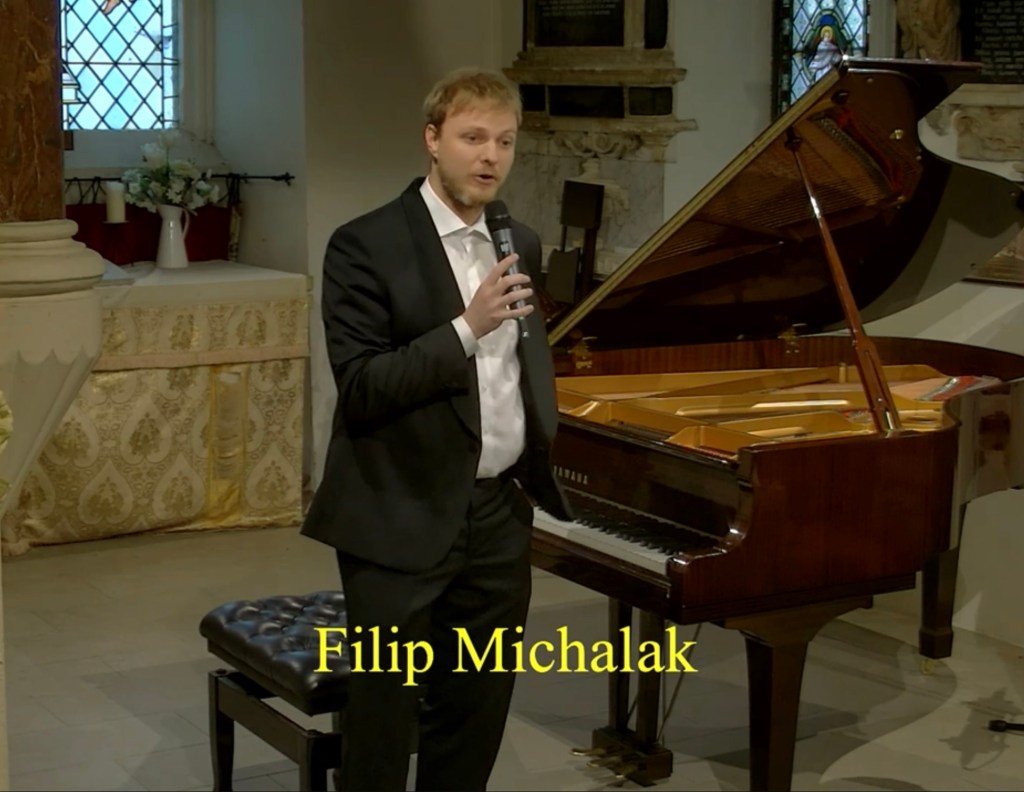
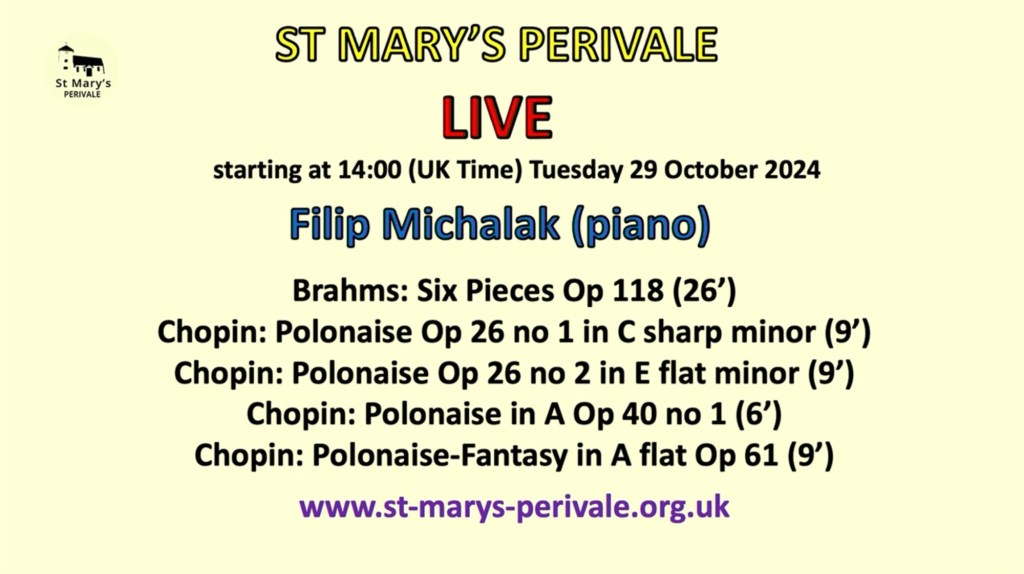
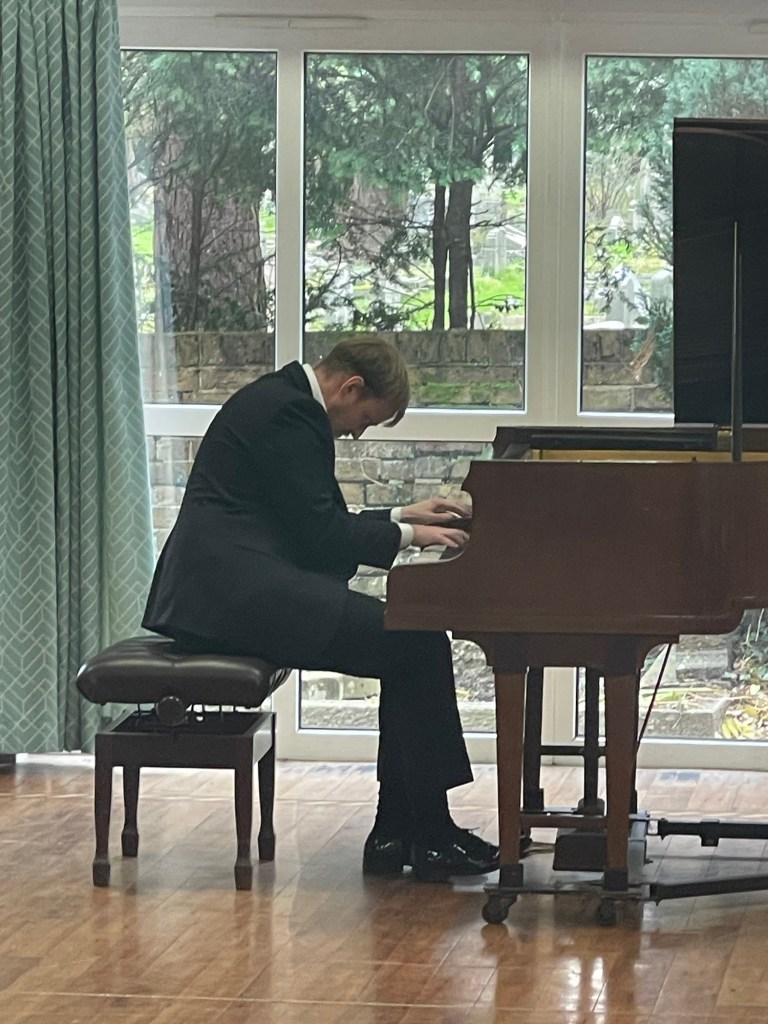
Some remarkable playing of aristocratic maturity and simple beauty. I cannot remember ever listening with such satisfaction to these six pieces op 118 as today .They were played with sumptuous rich sound and scrupulous attention to Brahms’ markings. I do not mean just attention to the dots and dashes on the page but the true meaning behind a notation which is the nearest a composer can get to describing the sounds in his head. A full rich sound ,never hard, but with a glowing luminosity that rarely I have heard on an instrument that I have listen to for many a year. It reminded me of the richness of sound of Bruno Leonardo Gelber who had acquired a rich sound through being bedridden as a child with poliomyelitis and only having a keyboard on his bed to practice on. No pedal of course so there was the chameleonic legato , like an organist, never leaving the keys , playing with weight in the horizontal not vertical sense. It is the school of Scaramuzza of course where so many great pianists were created in Argentina.I read that Filip had been mentored by Gabriela Montero and expect this has been a great influence allowing him to search out this wonderful golden sound that gave such body and strength to all he did today.
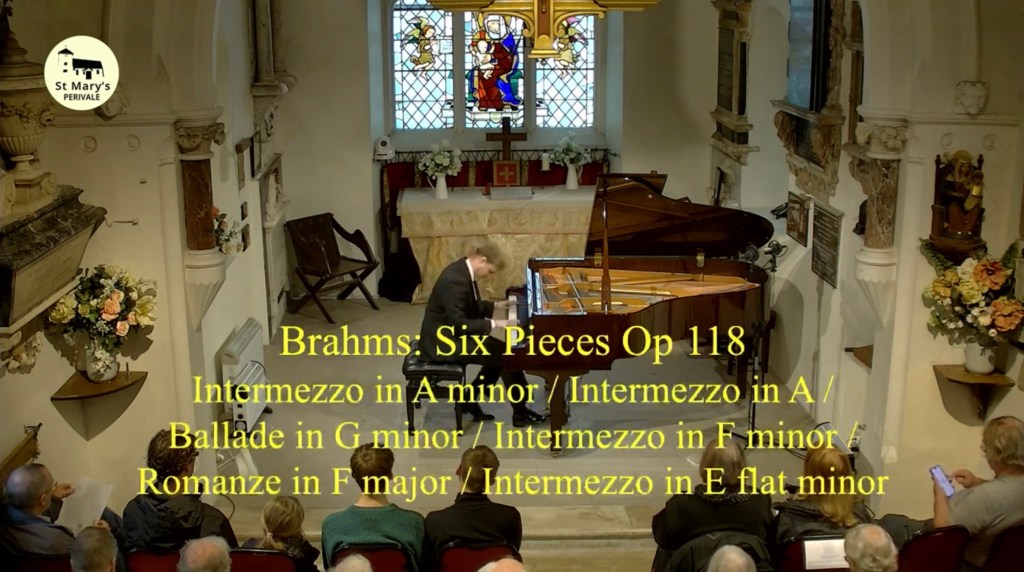
The six Klavierstucke op 118 are the penultimate works written by Brahms for piano and are miniature tone poems of poignant intimacy and passionate declarations. Filip broke straight in with the passionate sweep of the A minor Intermezzo with fingers like limpets sucking out the beauty of each note that was given it’s just weight and poignancy. Followed by the simple beauty of the Intermezzo in A of crystalline beauty of great significance with its duet between the voices of fluidity as each voice outdoing the other for succulence. Dynamic drive and passion of the Ballade in G minor was soon dispelled by the mellifluous outpouring of searing Brahmsian simplicity.The final notes are marked without pedal and the final note just a quaver barely whispered that had me searching for the score to find if this was indeed Brahms’s rarely noticed intention! Busy weaving of the Intermezzo in F minor unexpectedly interrupted by a long sustained chorale of clouded beauty which Filip shaped with masterly architectural musicianship.The final chords were again played with ravishing beauty of ever more diminishing wondrous sounds.The Romanze in F was a revelation as Filip gave precedence to the legato line in the treble ,that is indeed marked by Brahms. So often we hear the espressivo inner parts and loose the emotional strength of a work where it is so easy to get lost in Brahms’s wonderful meandering counterpoints. What refreshing pastoral beauty he brought to the ‘Allegretto grazioso’ that just flowed like a bubbling brook from his sensitive hands. The Intermezzo in E flat minor is an epic tone poem that Filip played with an echoing radiance as the story unfolded with the orchestral colours and contours that were independent but part of a sumptuous whole. Gradually springing to life as this was now an orchestra ringing out with passion and sumptuous full sounds.Dying away to a mere whisper with the left hand weaving a web of clarity as the right intoned the melodic line with a glowing fluidity to the final sumptuous lento of a chord spread out with such aristocratic grandeur at the end of an epic tale.

It is quite rare these days to hear these early Polonaises by Chopin in concert. We often hear the later one’s ,in particular the Polonaise Héroique of 53 , but rarely these days to we hear the equally heroic Polonaise op 40 n. 1 that used to be almost obligatory in recitals of pianist in the age of Paderewski.
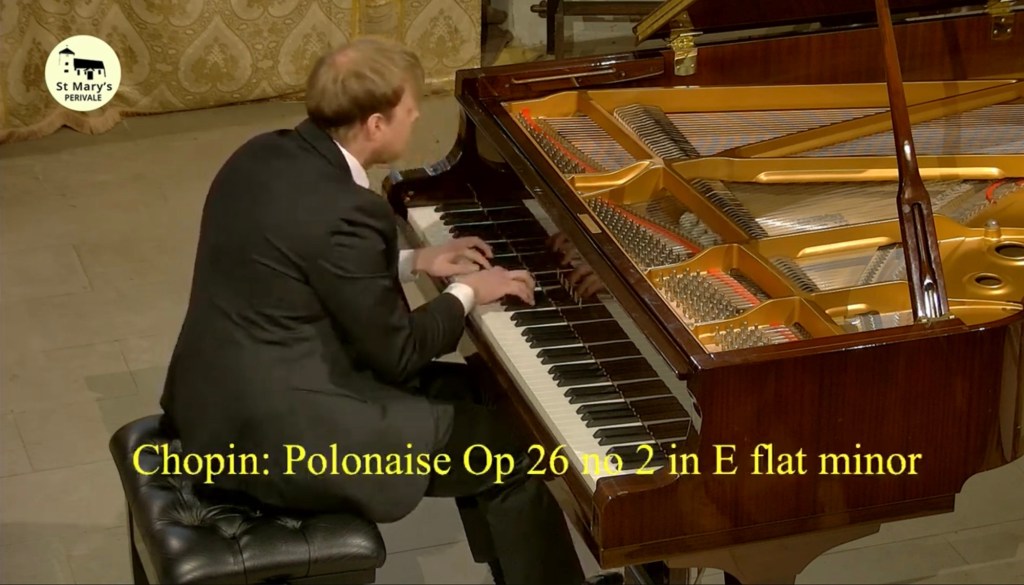
There was grandeur of the Polonaise in C sharp minor with the radiant beauty of the central episode always moving forward with a wonderful flowing lyrical cantabile.There was a sudden call to arms as the opening Polonaise returned. It’s twin in E flat minor opening with a deep brooding mystery bursting into life with its mazurka central episode contrasting with the Polonaise of driving intensity.
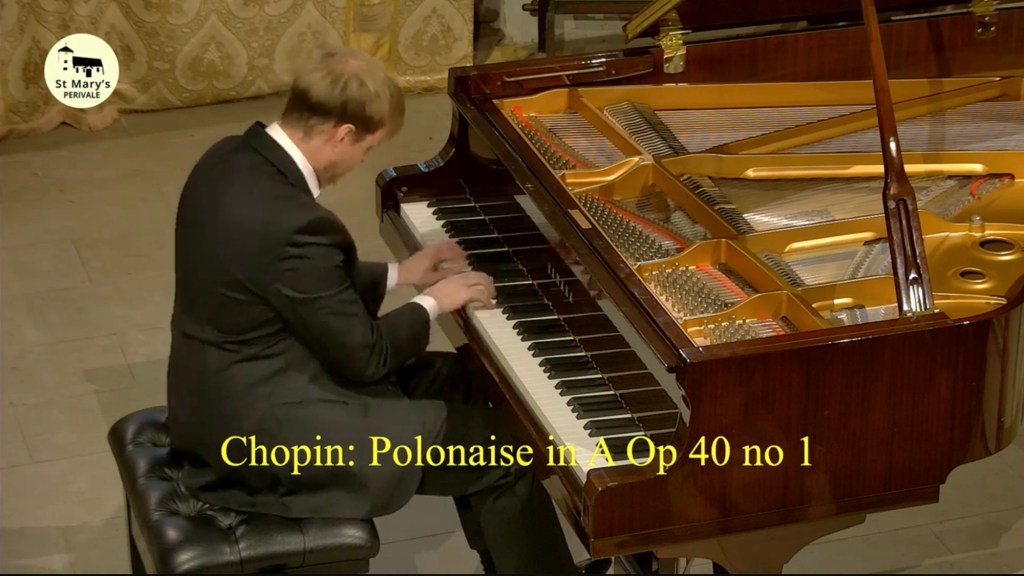
The Polonaise op 40 n.1 is, like Liszt’s second rhapsody one of the most instantly recognisable works for piano. Filip whose parents are both Polish,transferred to Denmark , has this music in his blood and it flowed with an aristocratic nobility and inevitability that was mesmerising Even gently placing a deep bass note to add just that extra sumptuous sound to such a noble outpouring.

The Polonaise Fantasie is one of the last works of Chopin where the composer is breaking away from traditional forms and like Liszt and Schubert using them as a basis for a form where themes could be transformed like characters in an opera. Chopin opens this masterpiece with fanfares of great declarations where the final reverberations are spread over the entire keyboard. From the very opening Filip’s masterly playing illuminated a work that can in lesser hands seem more a collection of episodes than the great monument that it really is.The whispered return of the opening melodic line followed a long drawn out central episode of languid beauty. Whispered because it was just like a memory of the past which was gradually to be caught up in a whirlwind of exhilaration and excitement and a climax that was allowed to fill the piano with sumptuous rich sounds before dying away on the rhythm of a polonaise to the simple gentle final chord of A flat.
What Chopin recital could it be without an encore of his most recognisable of waltzes .The Waltz op 64 n.2 in C sharp minor that Rubinstein would inevitably include in his memorable recitals. It was played with charm and delicacy with some unusual inner counterpoints of great beauty. A beguiling beauty and ravishing jeux perlé and a wonderful way to end such a masterly recital.
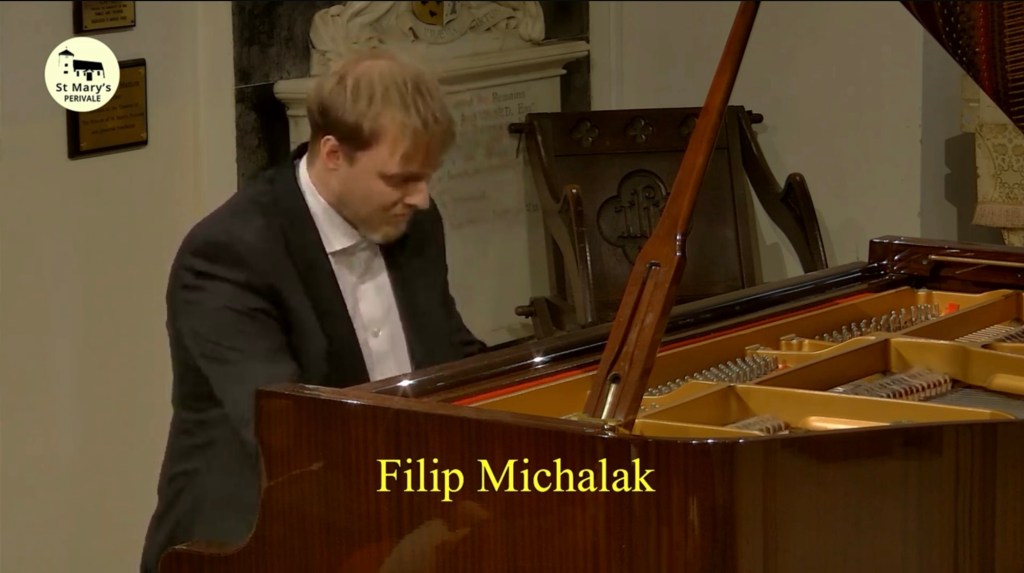
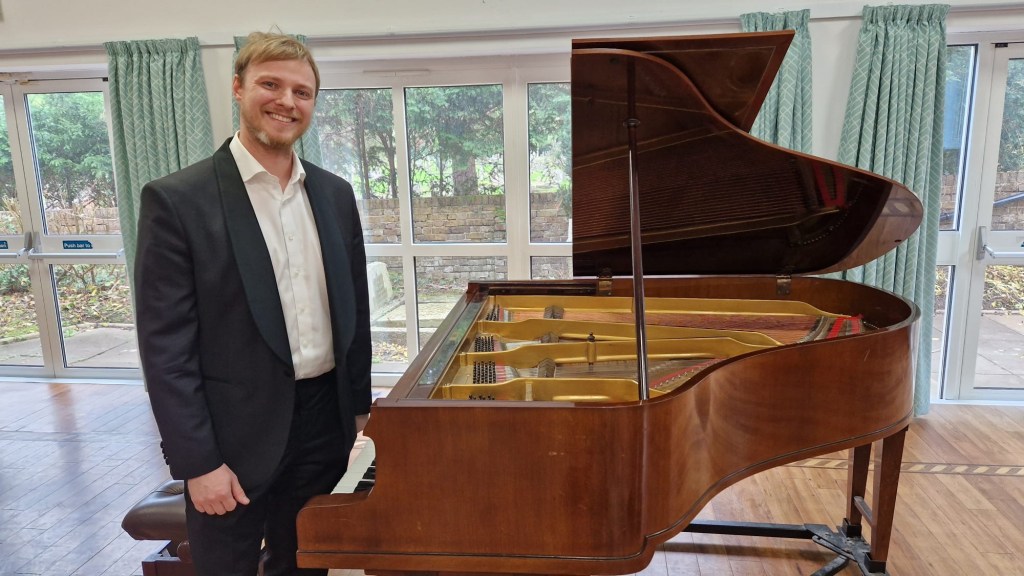
Filip Michalak, a distinguished Danish-Polish classical pianist, has become a prominent figure in the Scandinavian music scene, earning accolades across Europe, the United States, and the Middle East. He has garnered numerous prestigious awards, including the “Stars at Tenerife” competition in Spain and top prizes in Denmark’s “Nordjyllands Talentkonkurrence” and the “Steinway Festival.”
In 2017, Michalak’s talent shone brightly as a finalist in the “8th Nordic Piano Competition” and semi-finalist in France’s “St. Priest International Piano Competition.” He won the “Chopin Prize Competition” at the Royal Northern College of Music (RNCM), where he was also a finalist in the Gold Medal Competition. His international acclaim grew with his participation in the Leeds International Piano Competition and a 2021 nomination for the Vendome Prize in New York. Through The Keyboard Charitable Trust in London, Michalak has performed in renowned venues in London, Frankfurt, Florence, and Rome. As a soloist, he has captivated audiences with Beethoven’s 5th and Chopin’s 2nd Piano Concertos. His USA tour in March 2024 featured solo recitals and a performance of Brahms’ 1st Piano Concerto with the Manchester Symphony Orchestra. Michalak has enchanted festival audiences, including at the Duszniki International Chopin Festival in Poland and the Helsingborg Piano Festival in Sweden. Recent highlights included Mozart’s Piano Concerto No. 12 and Brahms’ Piano Quintet at the Elmore Chamber Music Festival in August 2024. As an Artistic Director, he has significantly influenced the Södertälje Chamber Music Festival and spearheaded the inaugural Aalborg Chamber Music Festival in September 2024. His education includes studies at The Royal Danish Academy of Music in Copenhagen, Ingesund Musikhögskolan in Sweden, and the Royal Northern College of Music in Manchester. Participation in the “Gabriela Montero Piano Lab” has further enriched his artistry. Now a thriving freelance artist, Michalak continues to mesmerize global audiences with his dynamic performances and unwavering passion for music.
Filip Michalak triumphs in Florence and so on to the live stream of Tuscia University in Viterbo with reviews of both performances
Filip Michalak at St Mary’s ‘something old but oh so new in a great artists hands’
 ChristopherAxworthy-MusicCommentary
Una risposta a "Filip Michalak at St Mary’s Perivale and St Martin’s Ruislip Radiance and beauty of great artistry"