

Some very accomplished playing from this young Polish pianist with a very poised and beautiful account of what Fou Ts’ong used to call 24 problems.An entire lunchtime recital dedicated to the complete 24 preludes and played with a great sense of style and consummate musicianship .

From the very first prelude we were obviously in the hands of a pianist who could play with poise and a timeless sense of style that could allow the music to breathe so naturally without ever loosing track of the overall shape and direction. There was the poignancy of the second prelude too with its brooding undercurrent accompanying the long drawn out melodic line. A fleeting lightness to the third which accompanied the gentle rubato of the upper melodic line. Never missing a note but with the sensibility of an accompanist who can listen and follow with such care. The agonising melodic line of the fourth was played with disarming simplicity as the left hand was the palpitating heartbeat of this cry in the dark.The fifth was played with a fleetness but also with a certain weight that allowed it to be shaped with emotional souplesse.A profound depth to the sixth that was played with the beauty and flexibility of a ‘cello with the gentle sighing drops in the right hand merely an onlooker.
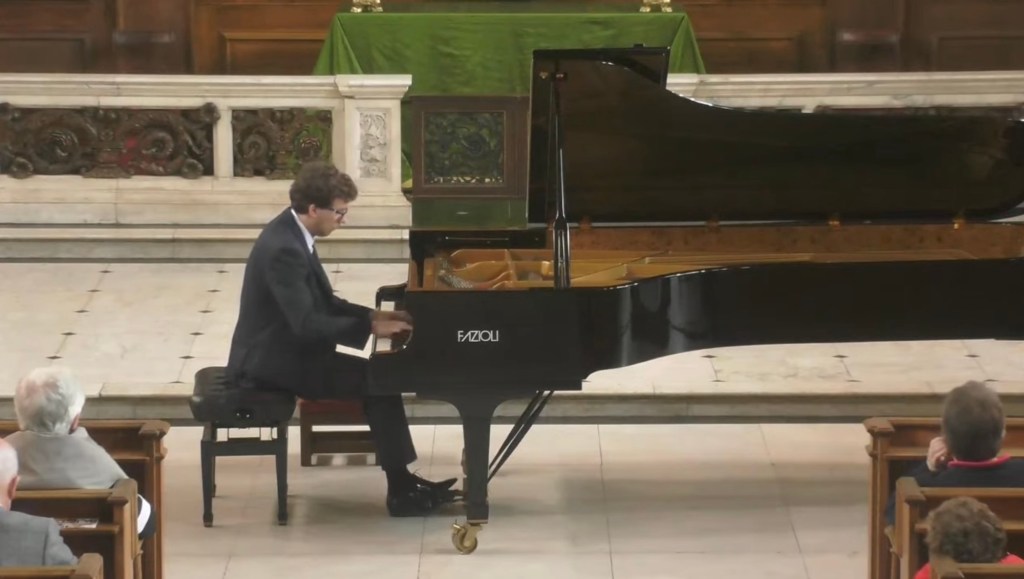
The 7th and shortest of all the preludes was played with the beauty and simplicity that it deserves before the passionate outpouring of the 8th with its searing passionate abandon that was almost too much emotion for this young man’s noble soul. Majesty and nobility accompanied the 9th even adding a deep bass note to give more depth without hardness to the sound at a crucial moment in it’s percorse.The capricious mazurka style of the 10th was beautifully shaped with playing of lightness but also of architectural shape. The ‘vivace’ of the 11th whilst beautifully sung could have been even simpler allowing Chopin to lead the way with mellifluous beauty.The 12th was played with remarkable control and technical finesse allowing the relentless forward movement to arrive at it’s final inevitable goal.The 13th is one of the most beautiful of all the preludes and was played with radiance and beauty the ‘più lento’ reaching moments of sublime beauty. A remarkable sense of balance that allowed the melodic line to sing as it was revealed without interruption from the continuous bass harmonies.The agitation of the 14th was played with clarity , simplicity and dryness allowing us to appreciate the radiant beauty of the first ‘raindrop’ that fell onto the keys with glowing beauty and aristocratic good taste.If the central episode could have flowed with more horizontal shape and movement it would have made even more impact before the poignant beauty of the return of subtle raindrops just dying to a whisper as a storm was about to break.

The 16th is a ‘tour de force’ of technical command and resiliance.It is one of those works that one must practice blindfold because there is no way that any pianist can look at the left hand leaps whilst the right hand is playing a non stop stream of notes. I remember Perlemuter demonstrating this very prelude in a master class at the Royal Academy in London during the Heath period of continual strikes.The great master was demonstrating this prelude when the lights suddenly went off ,but well into his 80’s he carried on fearlessly and spotlessly to the end! It was played today with great mastery but to see this young man’s head looking to the right and then to the left took away from the musical undulations that this prelude represents.There was beauty and simplicity in the 17th with its sweeping melodic line and continual forward movement and if Chopin does mark the deep A flats in the coda with a forzando, I feel that this is only like a long pedal of A flat on which floats as in a dream the memory of such beauty. In Schumann it can mean the striking of the midnight hour but here I feel it should be more etherial and less of this world. It contrasts with the cadenza type prelude that is very much of the real world with its passionate outpourings and dramatic Lisztian comments.The 19th like op 10 n 10 is the most technically difficult of all the preludes as it requires a continual swimming like movement to allow the melodic line to sing above a continuous stream of sounds.Today it was played remarkable beauty and with poetic shape of delicacy. The C minor prelude often used by composers as the theme for variations was played with nobility and dignity as it disappeared into the distance with a masterly control of sound. A beautifully mellifluous melodic line with a flowing accompaniment reached a poignant climax of sumptuous sounds in the 21st before two final chords heralded the entry of the bass tearing away ‘molto agitato ‘ with dynamic drive. Our pianist seemed more concerned with the right hand chords than the searing melodic line in the left that could have been much more sustained and legato.A simplicity like streams of water in the 23rd heralded the heroic opening of the 24th that was played with great command ,a remarkable sense of line and an architectural shape taking us to the three final D’s in the bass that were played with respectful solemnity of differing voices.

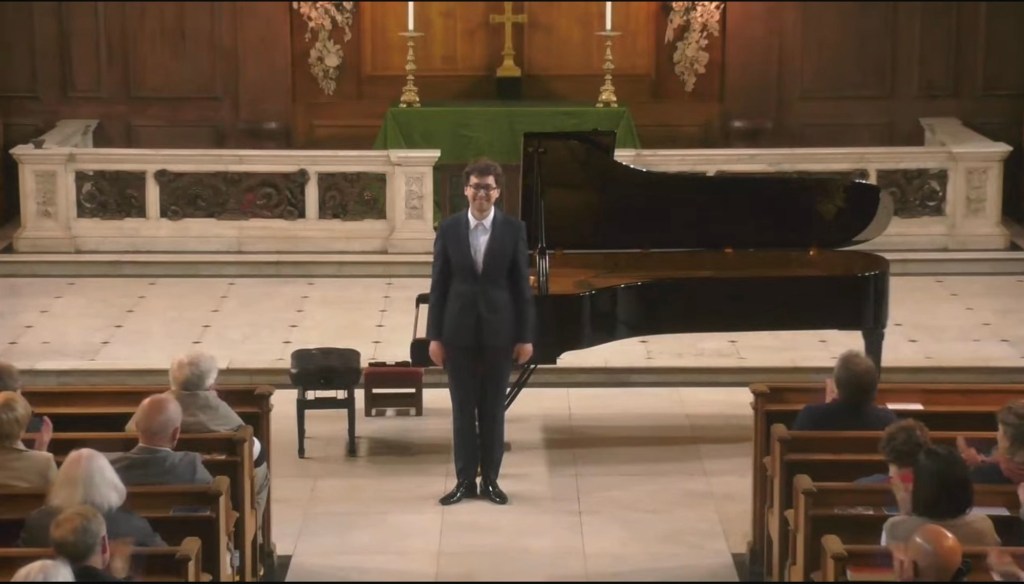
The beautiful C sharp minor notturne op posth was offered as an encore for a large and very appreciative audience.It was played with a glowing fluidity and subtle rubato and like all he did today superb musicianship and masterly control.
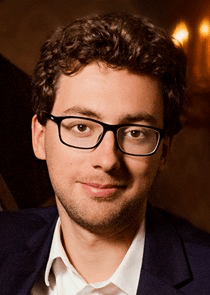
Equally passionate about solo and collaborative performance, Krzysztof has performed as a soloist and chamber musician at many prestigious venues including Barbican Hall, Wigmore Hall, St Martin-in-the-Fields, Milton Court Concert Hall, Birmingham Town Hall, Palacio de Festivales de Santander, Casa da Musica in Porto, Witold Lutosławski Concert Studio in Warsaw, as well as in Germany, France, The Netherlands, Japan and United States. He has appeared as soloist with the Opole Philharmonic Orchestra, Radom Chamber Orchestra, Frederic Chopin State School Symphony Orchestra, and the Hornton Chamber Orchestra. Krzysztof has been invited to many international music festivals and piano courses worldwide. In 2015 he attended the Aspen Music Festival and School in Colorado. He worked with Maestro Thomas Adès at the International Musicians Seminar in Prussia Cove and Christian Blackshaw at the Hellensmusic Festival. In 2017 he was invited to perform both solo and chamber music at the 17th Encuentro de Música y Academia de Santander. Recently, he appeared at the London Master Classes and The International Holland Music Sessions. Moreover he has received masterclasses from highly distinguished musicians including Richard Goode, Angela Hewitt, Robert Levin, Norma Fisher, Jonathan Biss, Kevin Kenner and Anne Queffélec; he also gained valuable insight from his work with Graham Johnson and Carole Presland. Krzysztof began learning piano at the age of seven with Renata Lasocka; during his musical studies in Poland, he won prizes in major national piano competitions and performed as a soloist, chamber musician, and with orchestra. In 2011, he completed with highest distinction the Frederic Chopin State School of Music in Warsaw, studying with Joanna Kurpiowska. His subsequent move to London allowed for further development of his pianism. In 2017, he completed his Master Degree in Piano Performance with first class honours at the Guildhall School of Music & Drama, studying with Ronan O’Hora. Subsequently, he was offered a prestigious Guildhall Artist Fellowship in 2017/2018. A prizewinner at several international piano competitions, including the International Brant Piano Competition in Birmingham, the Christopher Duke International Piano Recital Competition in London, and the Piano Competition of Ludwik Stefanski Plock in Poland, which led to a concert tour in Japan, In 2016 he became an artist of the Talent Unlimited Trust. Krzysztof was also awarded the Derek Butler Award from Countess of Munster Musical Trust and the James Gibb Scholarship Award. Moreover, Krzysztof had been graciously supported during his studies by the Guildhall School Trust and Sinfonia Varsovia Foundation.
Presented in association Talent Unlimited
 ChristopherAxworthy-MusicCommentary