

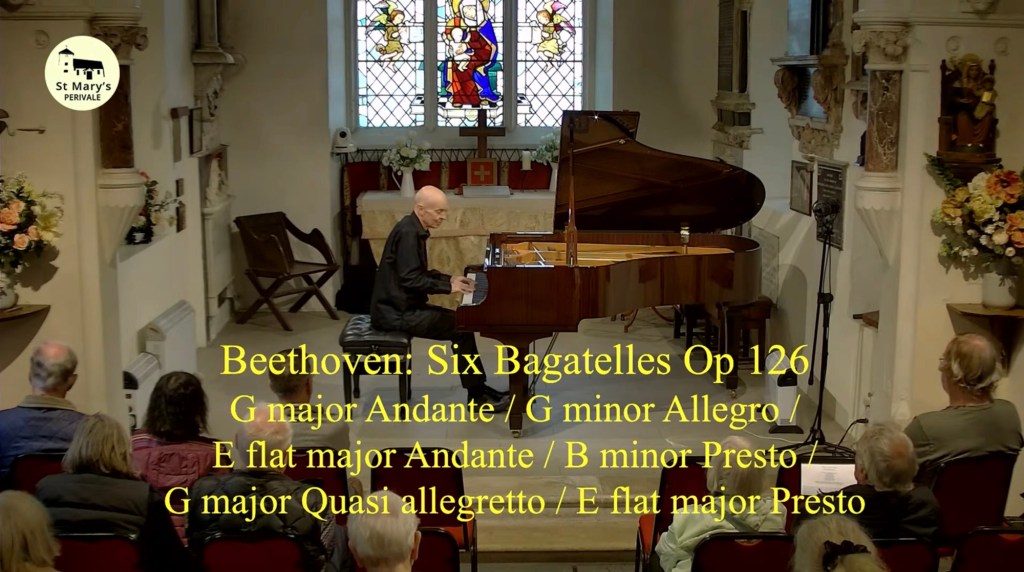
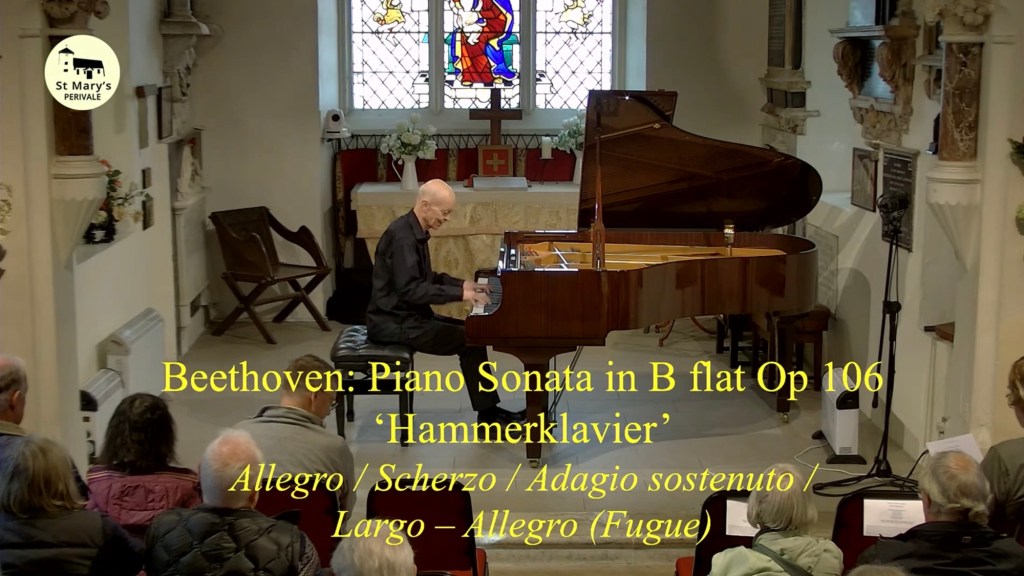
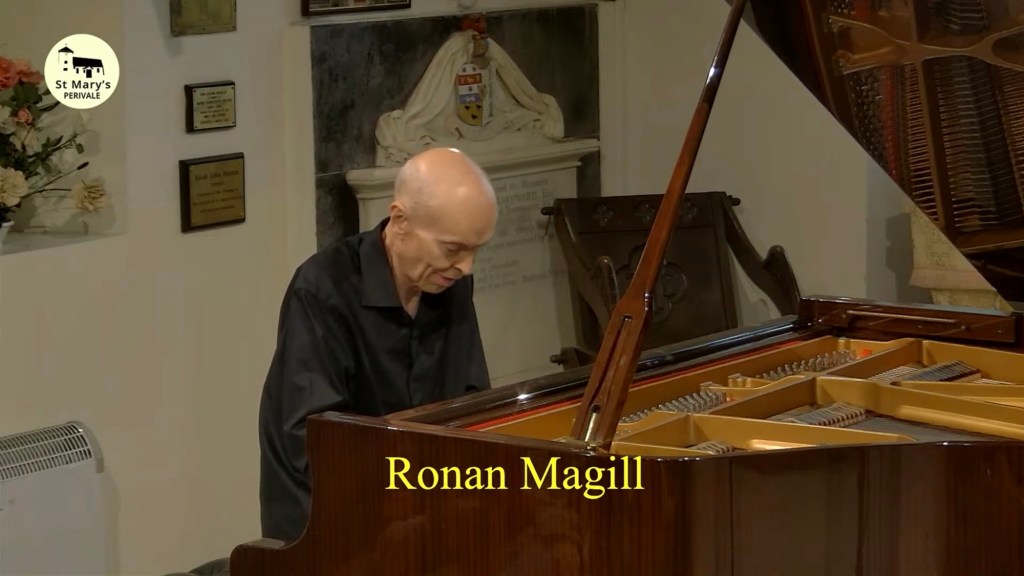
The enigmatic maestro Magill astonishes and informs us again, this time with simple grand Beethoven. The last thoughts on the piano with his six bagatelles op 126 and then the longest and most complex of all his 32 Sonatas ,the ‘Hammerklavier’ op 106. Beethoven of course from one extreme to another as his lifelong journey as depicted in 32 steps comes to an end and the paradise that awaits is in sight after a long and turbulent life .It is this contrast between turbulence and serenity that Ronan Magill brought out with astonishing clarity not only of playing but above all of thought.
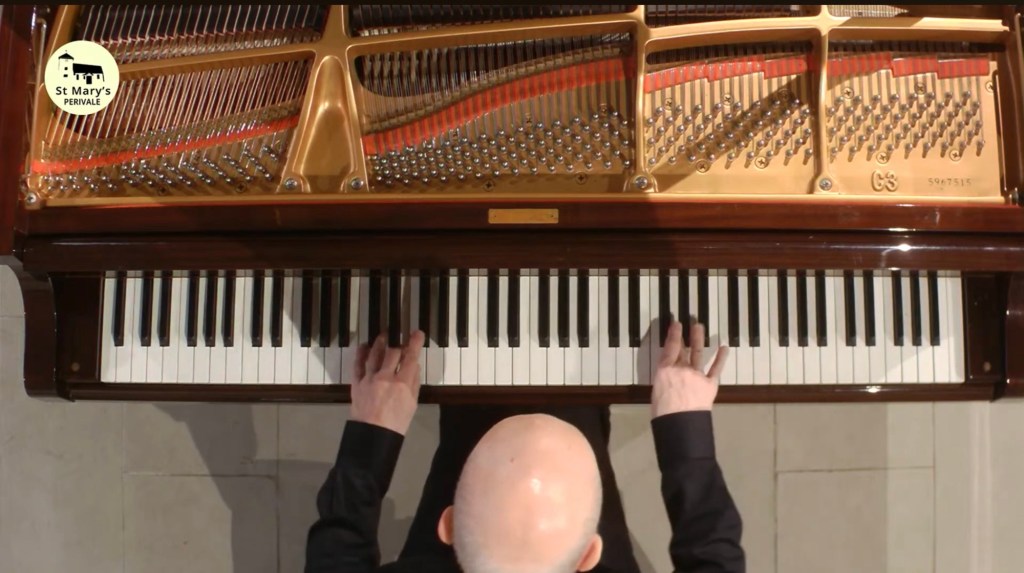
Six Bagatelles that were six tone poems where the few simple notes had such a significant and poignant meaning as the Andante unfolded with a ravishing sense of balance that gave a radiance to the serene calm that Beethoven was able to depict. Ronan built it gradually to a fleeting climax that gave great architectural shape before dissolving into the calm whispered ending.Ready to burst into a turbulent irascible outburst but this time with Beethoven bursting into a lyrical outpouring which rode on this turbulent undercurrent that was sure to explode again.Ronan was living every moment of these quasi theatrical scenes as you could see him throw his arms up in surprise as he waited for the calm to be so miraculously restored. In fact all through Ronan’s world of Beethoven there was a theatricality added of course to an intellect that made Beethoven’s surprises so actual as they took us all unawares.The beautifully etched Andante in E flat with long melodic lines of prayer like intensity was with a beautifully judged pedal effect at the end.The extraordinary thing is that Ronan had understood the intention of Beethoven but translated onto a modern instrument with intelligent sensibility. Great rhythmic drive to the fourth played with such clarity that even the drone bagpipe effect had a great architectural shape and the dramatic contrasts were even more overpowering.Ronan brought a simple pastoral beauty to the Allegretto before the explosion of the last Bagatelle that dissolves into just fragments floating in the visionary paradise that Beethoven could envisage and that awaited him before long.A great sense of drama ,surprise and poignant meaning all played with a simple mastery where it was enough to allow these last words to the genius of Beethoven.
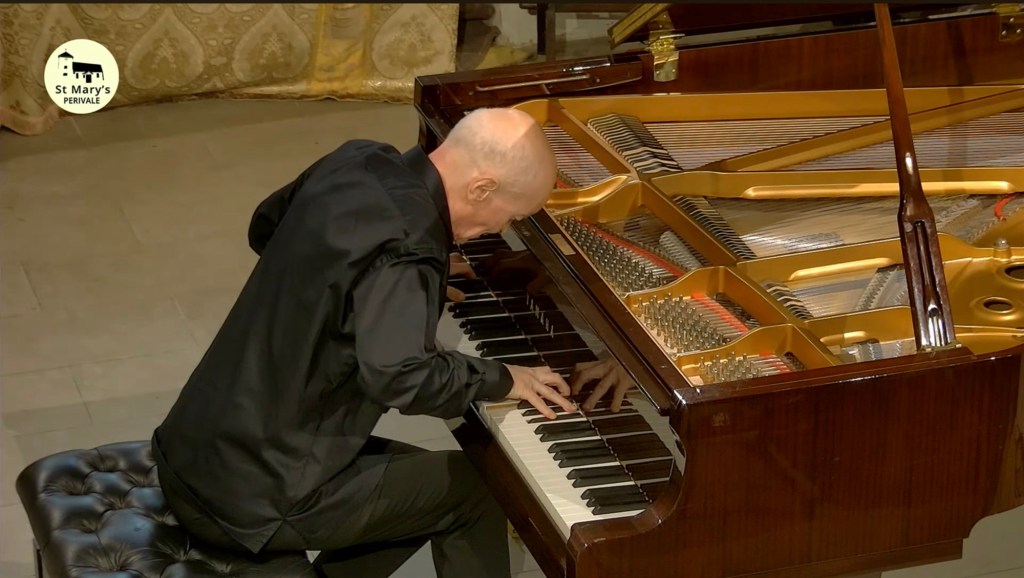
What to say of Ronan’s Hammerklavier with a performance of such clarity and overwhelming theatricality allied to moments of deeply moving intensity and poignant significance .Beethoven’s fantasy too was revealed rather than stated by a pianist who was truly living every moment of such a monumental statement. Even after the final mighty chord Ronan was an anxious to talk about his discoveries and thoughts .But time was against us and in the end anyone who had ears to listen carefully will have found that Ronan’s playing spoke far more clearly than any words ever could. There used to be an advertisement for Heineken beer in which it said Heineken refreshes parts you did not know you had!
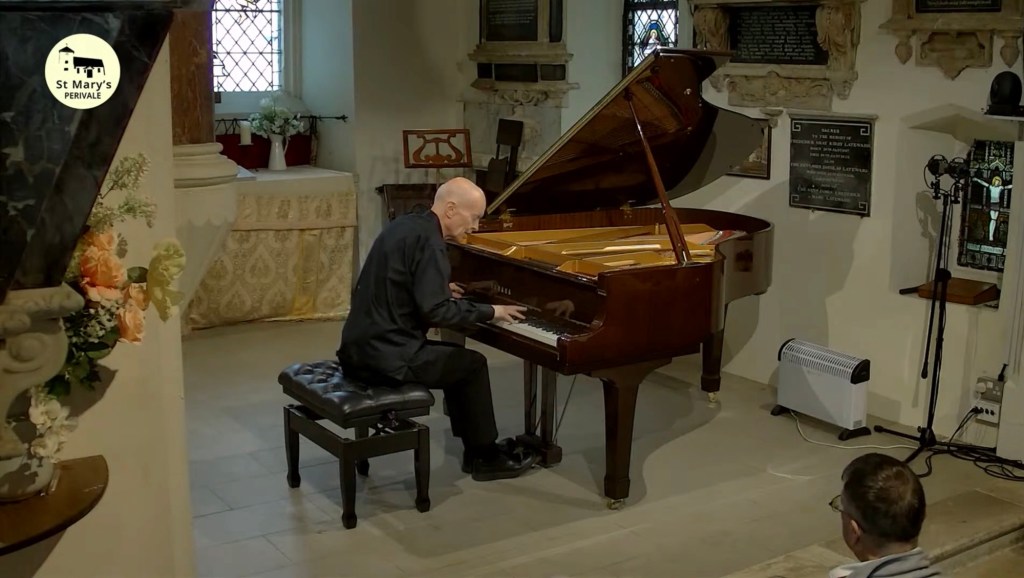
It may be sacrilege to talk about beer and Hammerklavier in the same breath but the effect of both is very similar! I will never forget Serkin playing it in the Royal Festival Hall and even holding the final chord having created such tension that he was literally shaking and in a hysterical state as we were too in the audience.

A famous critic once remarked that he had gone to hear a remarkable pianist play the Beethoven Trilogy at the end of a complete cycle of the 32 Sonatas .There was such a request for tickets that the concert was repeated live a couple of hours later.I had heard the broadcast of the first performance and had the score beside me and a glass of wine as I sat in my garden ready for the worst from the latest ‘wizz kid’. I was overwhelmed by the authority and fidelity as well as beauty and mastery .I asked the critic if the second performance was as good.’Oh yes’ said he ,’but you know Christopher when I went to hear Arrau play the same trilogy live ,not only he was completely drained and exhausted but so was the audience.He could never have just had a quick cup of tea and gone out to do it all over again!’ I think this is very significant for the meaning of live performance as recorded or as Gilels used to say the difference between fresh meat and canned !

I was completely won over ( after swearing I would never listen again to a pianist who could butcher Schumann op 2o) by Sokolov’s Hammerklavier as I was also by a reborn Kissin. Murray Perahia of course was monumental just as Beatrice Rana was recently at the Wigmore Hall. https://christopheraxworthymusiccommentary.com/2022/10/12/beatrice-rana-a-tornado-ignites-the-wigmore-hall/
It is interesting to note that she like Ronan approach the opening declaration in the same way. Great discussions always about playing with one hand or splitting with two or should it be A or A sharp later on in the bass.All details because it is the intention that is so important as Richter so often showed us ( his Hammerklavier was memorable but as he was not happy with the way he played the fugue knowing it was being recorded he played it all over again !) Annie Fischer has gone down in history as standing in at the last minute for Louis Kentner in the Festival Hall when she played the fugue as an encore !
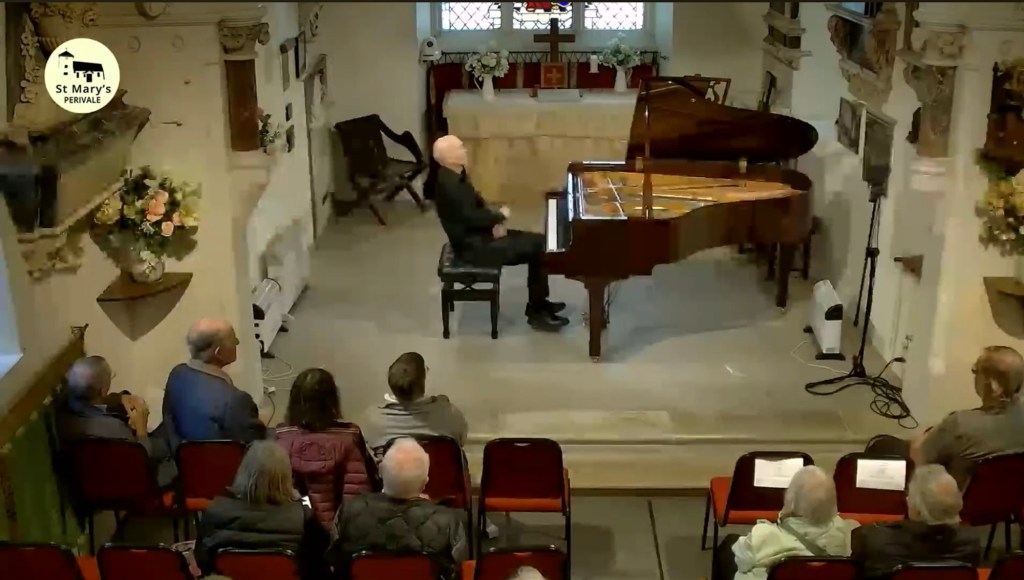
It was indeed the intention behind the notes in Ronan’s performance that was so arresting .For him and for us it was as though we were listening to a work where the ink was still wet on the page. The theatricality of the Allegro was followed by the fleeting precise rhythmic drive of the scherzo with its crazy hysterical interruption before going gently on it’s way .Taking us on a path and into a world that only in the last quartets was Beethoven able to express so much with so little. There was the improvised transition to the fugue that was quite remarkable for the way that Ronan seemed to be discovering the way, just as Beethoven surely would have improvised on the piano. Ronan played the impossible fugue with dynamic drive and fearless abandon just as Richter had done ….this is not play safe music but music brought to the limit and beyond of what is humanly possible on one instrument. This is in fact music to test human endurance and intellectual understanding whilst entering an inner territory that some call ‘soul’.
I t is for a chosen few and today we were privileged to hear such a performance.
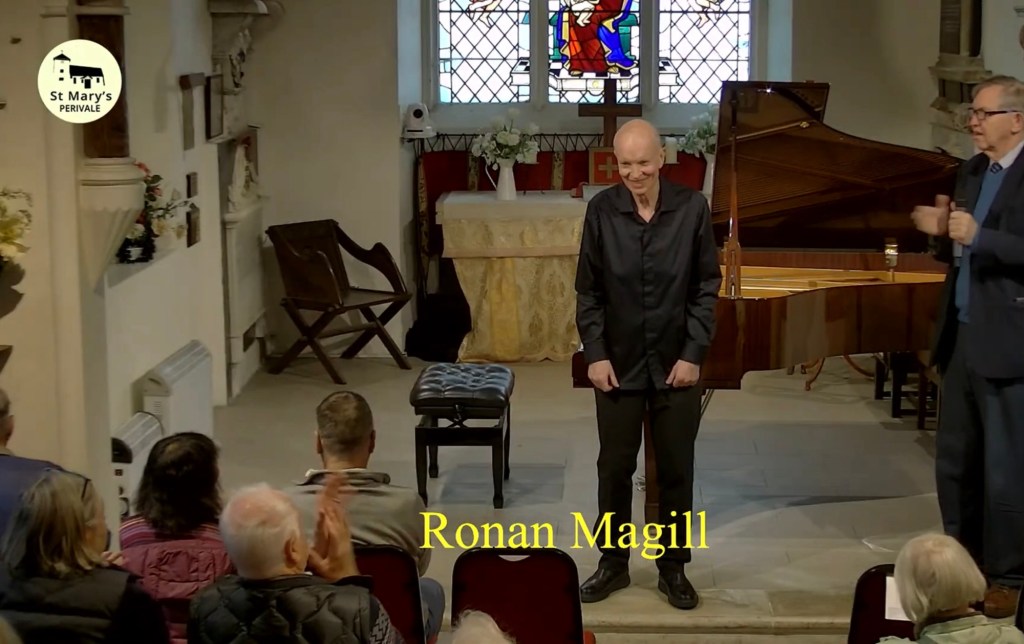
The pianist and composer RONAN MAGILL (born Sheffield 1954) was, as a nine year old, chosen to be one of the founder pupils of the Yehudi Menuhin School. Later after a period at Ampleforth College, and on the advice of Benjamin Britten, he went to the Royal College of Music working with David Parkhouse and later John Barstow, and winning all the major prizes for piano and composition. After his Wigmore and South Bank debuts (Brahms 2 nd Concerto) in 1974, and again on Britten’s advice, he moved to Paris to study with Yvonne Lefebure at the Conservatoire, and then remained in Paris for a number of years, performing regularly both in concert and on TV and radio, and also receiving advice from Pierre Sancan, and Nikita Magaloff and Arturo Benedetti Michelangeli in Switzerland. In 1985 Magill won ist Prize in the 1 st “Milosz Magin” International Competition for Polish Music, followed by a European tour, and then after returning to the UK , he won the 3rd British Contemporary Piano Competition which a UK tour and concerts on BBC Radio 3. In recent years Magill has been performing in the UK, USA (Rachmaninoff 3 rd Concerto) and most recently in Japan where he has been living since 2013 performing in many cities. He returned to the UK in April 2021 and has given three memorable recitals at St Mary’s Perival
The enigmatic Ronan Magill astonishes again at St Mary’s who are in celebratory mood with the Critic’s circle accolade
Ronan Magill Mature Mastery at St Mary’s
 ChristopherAxworthy-MusicCommentary