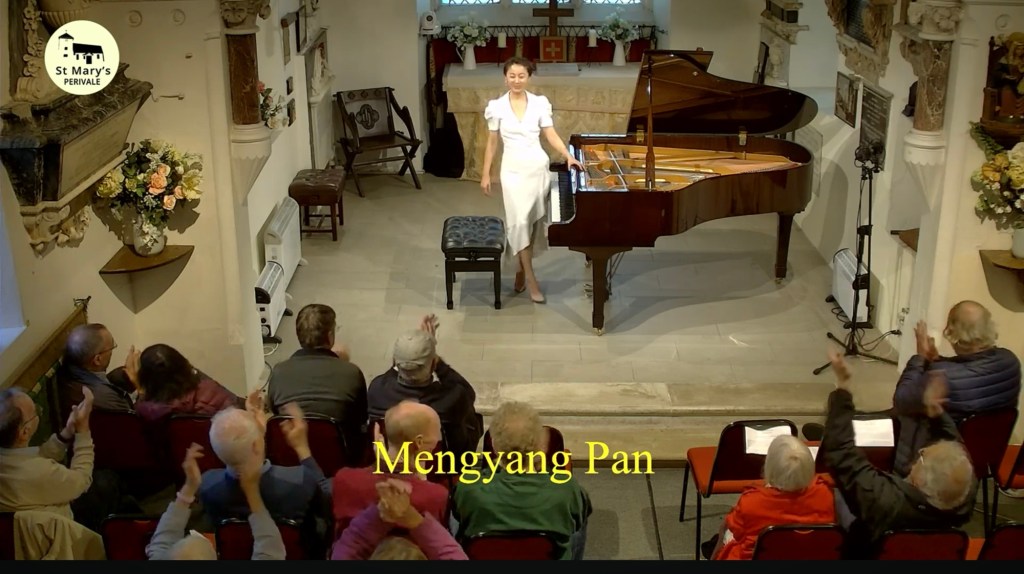
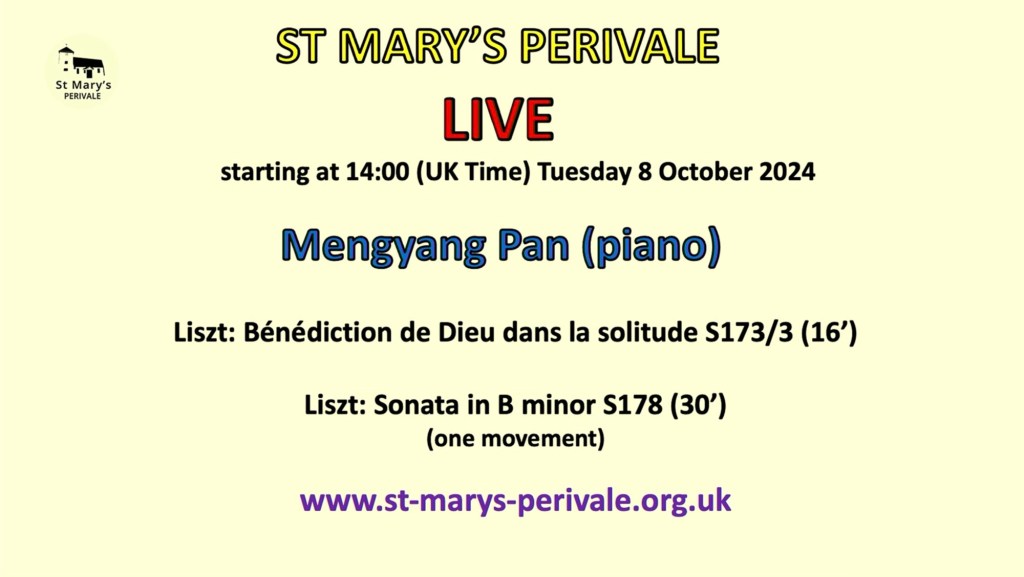
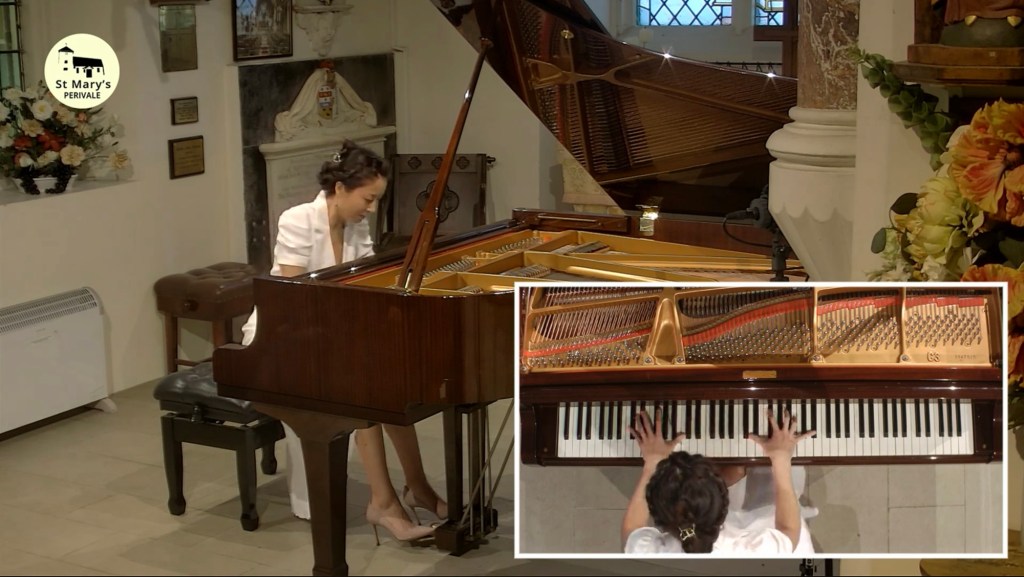
Some superb playing of great artistry and intelligence allied to an aristocratic grandeur and complete technical command. Infact these two masterworks were revealed in a new light where any of the rhetoric of tradition was substituted by a scrupulous attention to the composers detailed indications in the score.
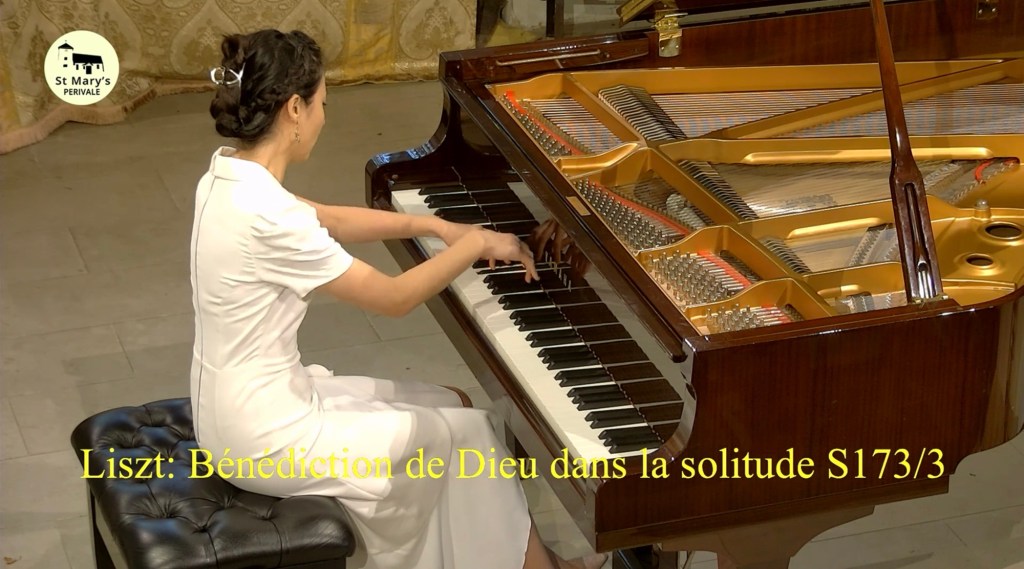
Bénediction I well remember from the early recordings of Liszt by Alfred Brendel that it was exactly his musicianship , technical mastery and respectful integrity that we heard for the first time with a composer too often represented as a barnstorming virtuoso and seducer of the senses. The leisurely opening of Mengyang’s performance created the atmosphere of reverence and dignified beauty with the bass melody allowed to unfold with the shimmering accompaniment above it , gradually building to a passionate outpouring of sumptuous sounds .’Cantando sempre’ as the melodic line moves so magically from the bass to the tenor with harp like chords just adding a golden sheen to such beauty. Mengyang judged superbly the gradual build up in intensity to a sumptuous climax that dissolved immediately to prepare for the chorale like ‘Andante’ that she played with simplicity and devout beauty. ‘Più sostenuto quasi preludio’ was played with aristocratic good taste as the melodic line was now reversed with the theme in the right hand and with shimmering left hand harmonies just adding to the radiant fluidity. Building this time to a climax that Liszt marks ‘rinforzando molto e sempre più appassionato’ and is the cry of Liszt the fervent believer with an almost unbearable intensity. Menyang calling on her wonderfully florid arms to add ever more sumptuous sounds without ever a trace of hardness. In fact the beauty and luminosity of sound was one of the most remarkable things of this performance and of the sonata that was to follow. Streams of harp like sounds were played with ravishing fluidity as the left hand melodic line sang it’s heart out with refined and respectful beauty. ‘Andante semplice espressivo’ was indeed the final prayer with Liszt on his knees calling on all the sublime beauty and radiance that he could offer to his maker. This was a remarkable performance and was the ideal accompaniment for the B minor Sonata. Two great works restored to their rightful place at the pinnacle of the pianistic repertoire.
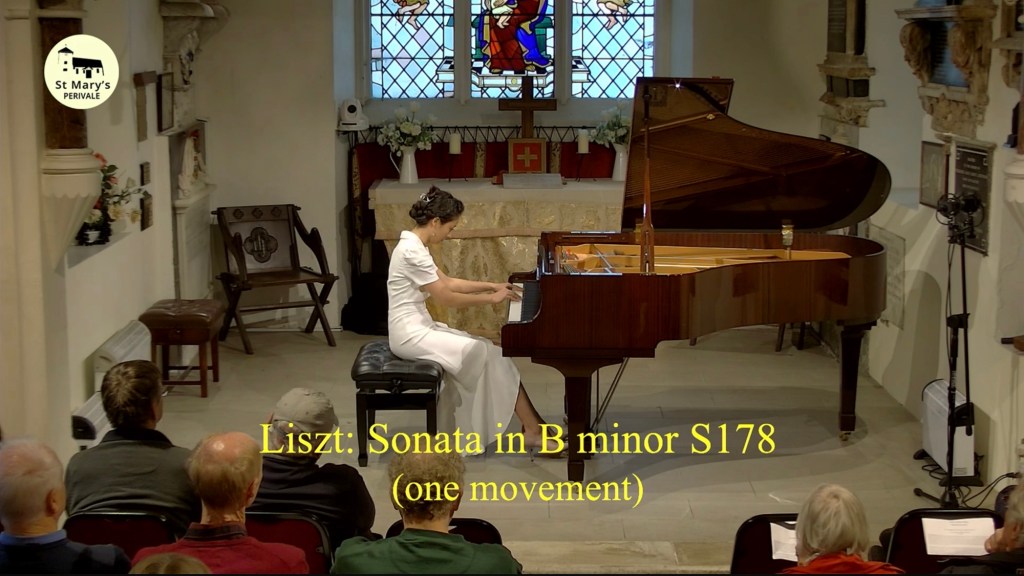
The Liszt Sonata saw Mengyang in demonic mood sometimes playing with a clenched fist as the drama unfolded.The three opening themes that are transformed throughout the Sonata were played with such characterisation from the mystery of the sombre deep bass to the call to arms of the ‘Allegro energico’ and the pummelled bass notes that Liszt indeed indicates ‘marcato’. This was a truly superb performance where her technical command was allied to a poetic understanding as she allowed this masterpiece to unfold with scintillating virtuosity and sumptuous beauty. The same quasi religious integrity of Benediction she brought to the ‘Andante sostenuto’ and was remarkable for the simplicity and beauty that unfolded from her delicate fingers .The ‘Quasi Adagio’ was breathtaking in it’s delicacy ‘dolcissimo con intimo sentimento’ as it lead to the nobility and majesty of the passionate climax before reaching for the infinite with scales that just wafted over the keys with featherlight whispered sounds.The Fugato that follows was played with fearless control and dynamic energy as she dispatched Liszt’s diabolical octaves with enviable mastery. The final prophetic pages were played with a radiance and beauty of two pages that demonstrate more than any other the genius of Liszt looking always into the future.
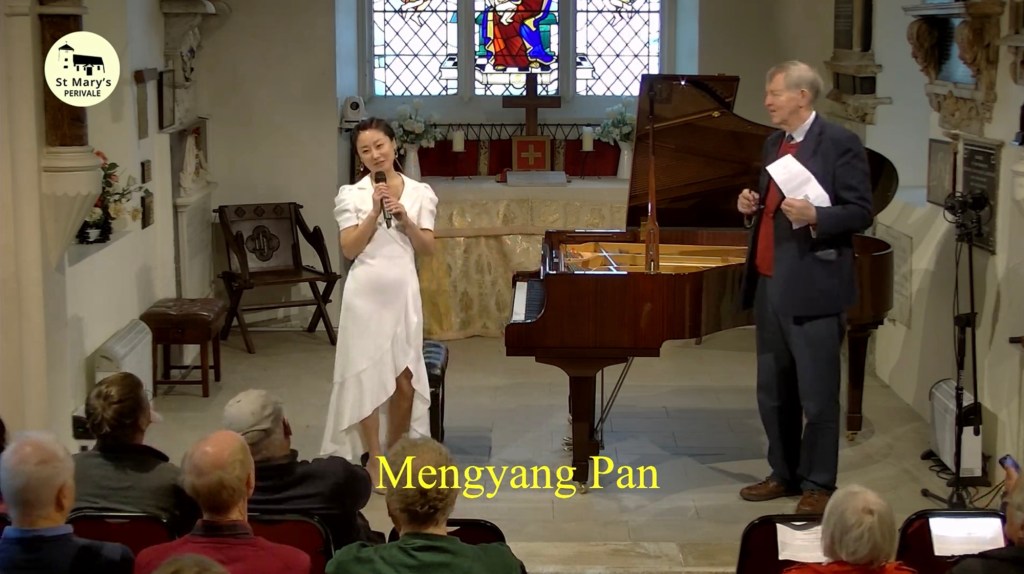
Pianist Mengyang Pan, known for her captivating performances, has graced prestigious stages worldwide, including the Royal Festival Hall, the Wigmore Hall, Bruckner Haus Austria, UNESCO Paris and many more. Born in China, she began her musical journey at the Central Conservatory of Music and later pursued her studies in the UK at the Purcell School and the Royal College of Music. Earning accolades at competitions such as the Ettlingen International Piano competition, Rina Sala Gallo International Piano Competition, Dudley International Piano Competition Birmingham International Piano Competition and many more, Mengyang’s mastery of both traditional and contemporary repertoire has earned her critical acclaim, with her delicate touch and tonal shades praised by critics. Collaborating with renowned conductors like Vladimir Ashkenazy and John Wilson, her electrifying performances have garnered high acclaim.
Beyond performance, Mengyang is a dedicated educator, serving as a piano professor at the Royal College of Music and actively participating in international competitions and music festivals as an adjudicator and masterclass instructor. Co-founding the Elisi-Pan Piano Duo, she continues to share her musical expertise through recitals worldwide. Additionally, Mengyang contributes significantly to piano pedagogy as a module leader and lecturer at the RCM and directs various music education programs, including the IPPA Conero International Piano Competition. Her passion for musical exploration is evident in her curation of festivals dedicated to reviving overlooked compositions and composers while embracing contemporary expressions.
Mengyang Pan in Texas Playing of sumptuous beauty and refined artistry
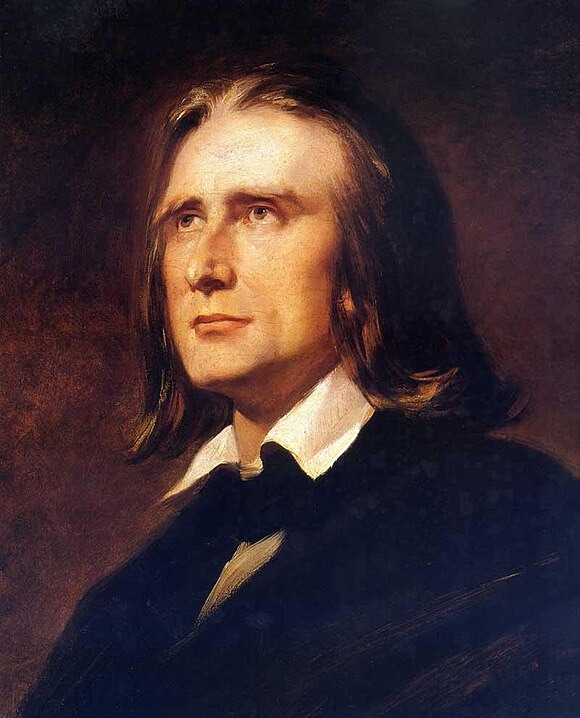
22 October 1811 Doborjan, Kingdom of Hungary, Austrian Empire
31 July 1886 (aged 74) Bayreuth Kingdom of Bavaria, German Empire
Harmonies poétiques et religieuses (Poetic and Religious Harmonies), S.173, is a cycle of piano pieces written by Franz Liszt at Woronince the Polish-Ukrainian country estate of Liszt’s mistress Princess Caroline von Sayn-Wittgenstein in 1847, and published in 1853. The pieces are inspired by the poetry of Alphonse de Lamartine as was Liszt’s symphonic poem Les Préludes.
The ten compositions which make up this cycle are:
- Invocation (completed at Woronińce);
- Ave Maria (transcription of choral piece written in 1846);
- Bénédiction de Dieu dans la solitude (‘The Blessing of God in Solitude,’ completed at Woronińce);
- Pensée des morts (‘In Memory of the Dead,’ reworked version of earlier individual composition, Harmonies poétiques et religieuses (1834));
- Pater Noster (transcription of choral piece written in 1846);
- Hymne de l’enfant à son réveil (‘The Awaking Child’s Hymn,’ transcription of choral piece written in 1846);
- Funérailles (October 1849) (‘Funeral’);
- Miserere, d’après Palestrina (after Palestrina);
- La lampe du temple (Andante lagrimoso);
- Cantique d’amour (‘Hymn of Love,’ completed at Woronińce).
Liszt’s Bénédiction de Dieu dans la solitude [“Benediction of God in solitude”] is the third work from his cycle Harmonies poétiques et religieuses [“Poetic and Religious Harmonies”] completed in 1853. This magnificent piece is the perfect marriage between Liszt’s abilities as a virtuoso pianist and his profound spirituality. The Benediction is prefaced by a poem of the French literary romantic Alphonse de Lamartine, and comes from a collection dating from 1830 also titled Harmonies poétiques et religieuses. Through several meetings, Lamartine’s socio-political, aesthetic, and religious views influenced Liszt greatly. Despite the popular belief that he only converted to Catholicism late in life in order to repent from his youthful transgressions, Liszt’s father took him to several churches as a young boy and instilled in him a curiosity and reverence which would persist through old age.
The piece can be divided into four large sections [ABCA’]. The A section features long, rich, fluid melodies while B is contrasting in its short gestures and pastoral peacefulness. Section C is rather improvisatory and guides the music emotionally from the tranquil B section to the glorious return of the A section. This time, the melody is further ornamented with elaborate accompanimental figures as the music climactically ascends to the heavens. An introspective, prayer-like postlude follows in which a fragment from the B section appears as a reminiscence, a cyclical feature present in many of Liszt’s larger late works. A professor of mine once remarked about the piece, “It doesn’t matter whether you are religious or not, when you listen to the Bénédiction you are convinced that there is a God.”
The Piano Sonata in B minor S.178 is in a single movement and was completed the work during his time in Weimar, Germany in 1853, a year before it was published in 1854 and performed in 1857. He dedicated the piece to Robert Schumann , in return for Schumann’s dedication to Liszt in his Fantasie in C major op 17. A copy of the work arrived at Schumann’s house in May 1854, after he had entered Endenich sanitorium . Pianist and composer Clara Schumann did not perform the Sonata despite her marriage to Robert Schumann; according to scholar Alan Walker she found it “merely a blind noise”.Already in 1851 Liszt experimented with a non-programmatic “four-movements-in-one” form in an extended work for piano solo called Grosses Concert – Solo which in 1865 was published as a two-piano version under the title Concerto Pathétique shows a thematic relationship to both the Sonata and the later Faust Symphony .Walker claims the quiet ending of the Sonata was an afterthought; the original manuscript contains a crossed-out ending section which would have ended the work in a loud flourish instead.[7]
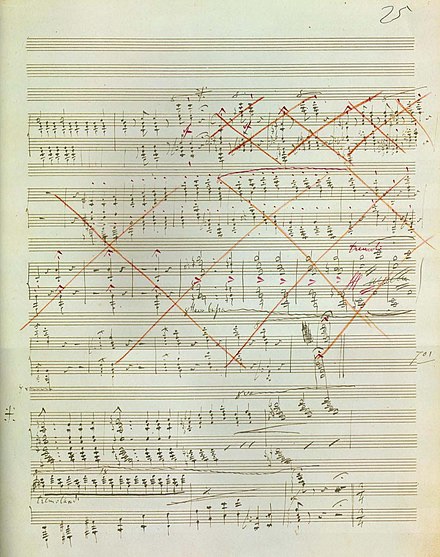
Page 25 of the manuscript. The large section crossed out in red contains the original loud ending
The Sonata was published by Breitkopf & Härtel in 1854 and first performed on 27 January 1857 in Berlin by Hans von Bulow. It was attacked by Eduard Hanslick who said “anyone who has heard it and finds it beautiful is beyond help”. Brahms reputedly fell asleep when Liszt performed the work in 1853. However, the Sonata drew enthusiasm from Richard Wagner following a private performance of the piece by Karl Klindworth on April 5, 1855.It took a long time for the Sonata to become commonplace in concert repertoire because of its technical difficulty and negative initial reception due to its status as “new” music. However by the early stages of the twentieth century, the piece had become established as a pinnacle of Liszt’s repertoire and has been a popularly performed and extensively analyzed piece ever since.
Camille Saint – Saens , a close friend of Liszt, made a two-piano arrangement of the Sonata in 1914, but it was never published in his lifetime because of rights issues. It was first published in 2004 by Durand in Paris, edited by Sabrina Teller Ratner. According to a letter from Saint-Saëns to Jacques Durand , dated 23 August 1914, the two-piano arrangement was something that Liszt had announced but never realized.
Liszt effectively composed a sonata within a sonata, which is part of the work’s uniqueness, and he was economical with his thematic material.The first page contains three motive ideas that provide the basis for nearly all that follows, with the ideas being transformed throughout. The complexity of the sonata means no analytical interpretation has been widely accepted.Some analyses suggest that the Sonata has four movements,although there is no gap between them. Superimposed upon the four movements is a large sonata form structure,although the precise beginnings and endings of the traditional development and recapitulation sections have long been a topic of debate. Others claim a three-movement form,an extended one-movement sonata form,and a rotational three-movement work with a double exposition and recapitulation .Inspired by the Wanderer Fantasie by Schubert that Liszt much admired which is a work where the transformation of the themes was incorporated into a more conventional form and was the basis of Liszt’s breaking away from the conventional forms of the day but having allowing themes to be transformed like character terms in a play.And has provoked a wide range of divergent theories from those of its admirers who feel compelled to search for hidden meanings. Possibilities include the following:
- The Sonata is a musical portrait of the Faust legend, with “Faust,” “Gretchen,” and “Mephistopheles” themes symbolizing the main characters.
- The Sonata is autobiographical; its musical contrasts spring from the conflicts within Liszt’s own personality.
- The Sonata is about the divine and the diabolical; it is based on the Bible and on John Milton’s Paradise Lost
- The Sonata is an allegory set in the Garden of Eden ; it deals with the Fall of Man and contains “God,” “Lucifer,” “Serpent,” “Adam,” and “Eve” themes.
- The Sonata has no programmatic allusions; it is a piece of “expressive form” with no meaning beyond itself.
 ChristopherAxworthy-MusicCommentary