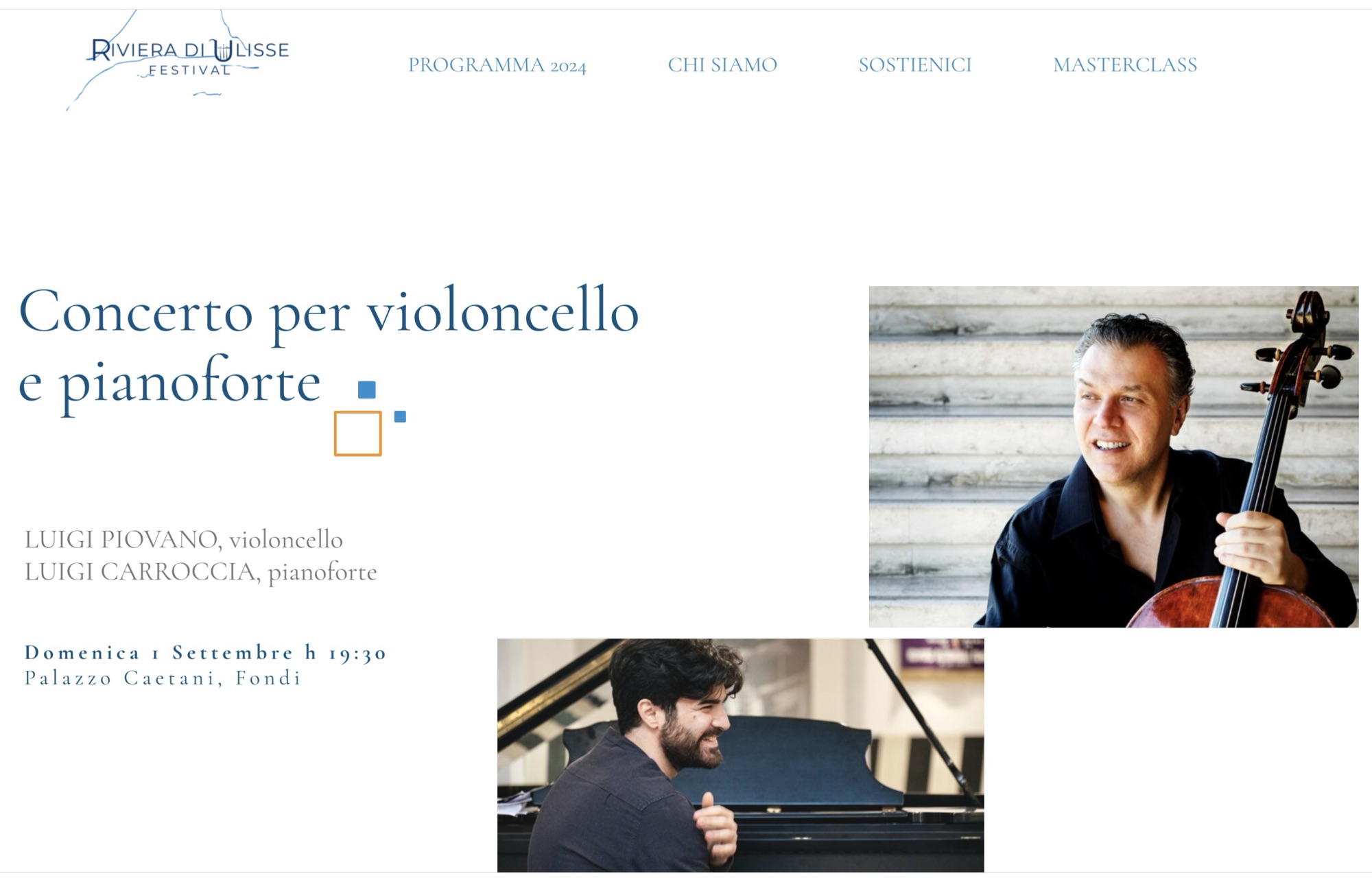

F. MENDELSSOHN Romanza in Re maggiore op 109
S. RACHMANINOV Vocalise op 34 n.1
R. SCHUMANN 3 Fantasiestücke op. 73
L. V. BEETHOVEN Sonata n. 3 in La maggiore op.69
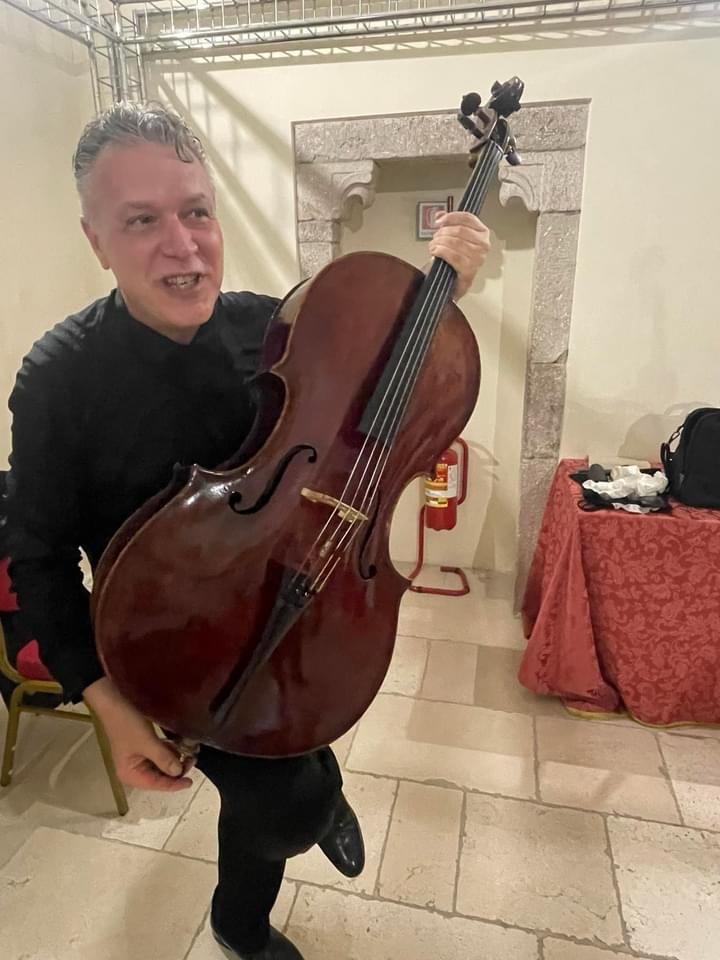
Miracles in Fondi -a wonderful Alessandro Gagliano of 1710 in the hands of a master.
Luigi Piovano and Luigi Carroccia united as one in a recital of refined musicianship end exquisite artistry .
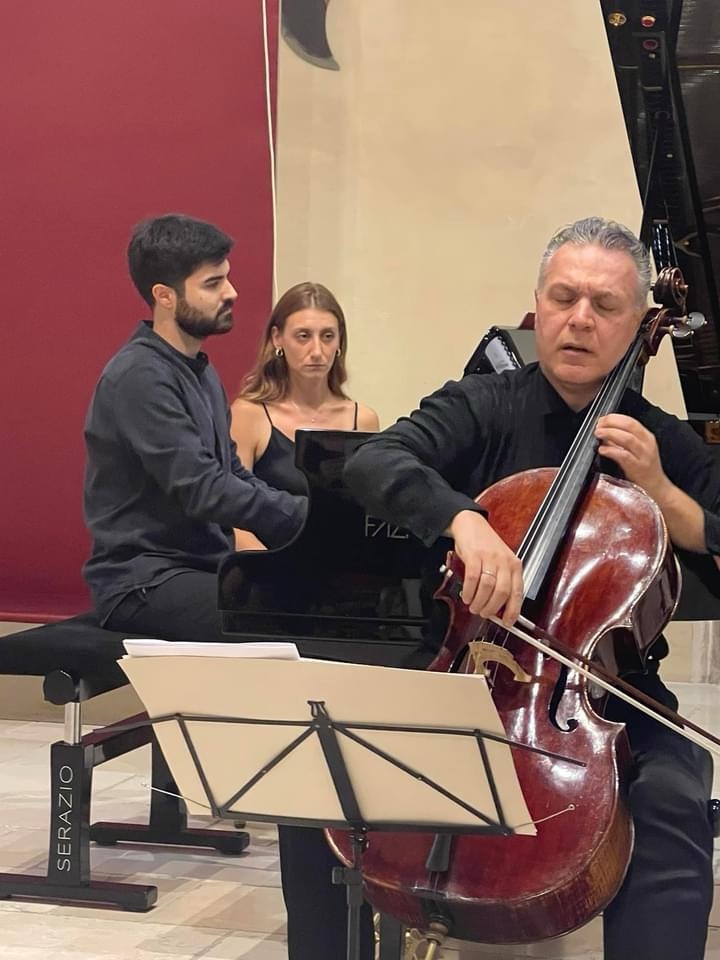
Allied to passion and mastery it was an intoxicating mix .Both playing with the weight which Tortelier once described to me as the fingers like limpets sucking the very lifeblood out of every note .

The barely audible whispers of Piovano were breathtaking after such nobility and authority. Just as the streams of scales from Carroccia were of pure gold, illuminating the trail in Beethoven taking us on a voyage of sublime inspiration .
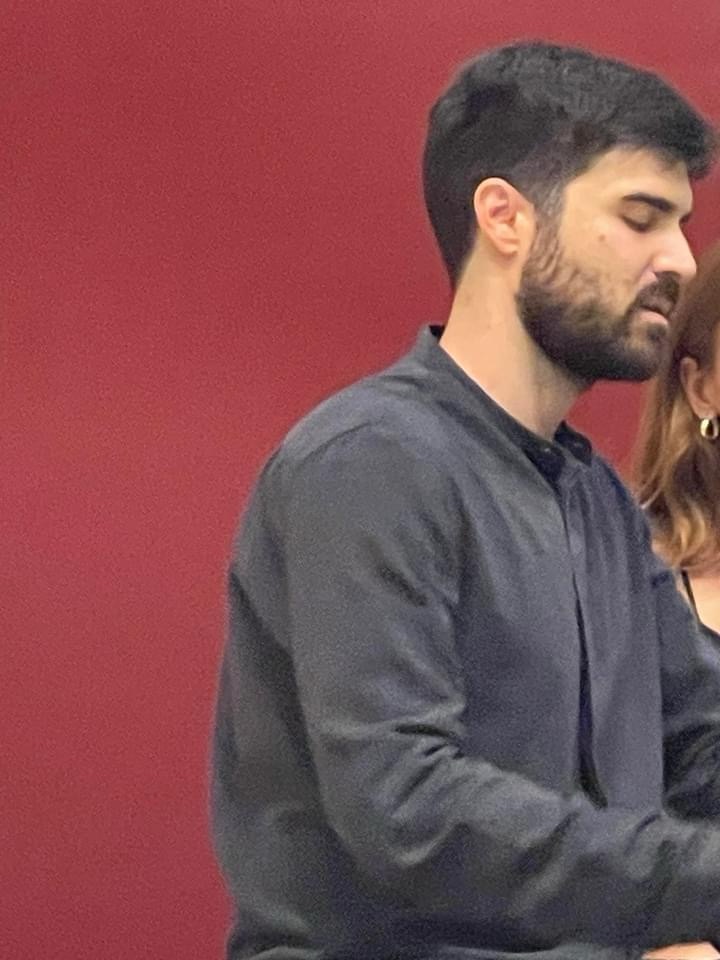
A Mendelssohn song without words that was truly a bel canto of rarified artistry where the daringly placed notes held us riveted from the very first sounds.Here was the same breathing and inflections of a Caballé and the whispered return of the melody was of heartrending beauty.Wonderfully supported by the piano with sumptuous rich sounds only illuminating the magic that was unfolding before our very eyes. A sumptuous duo with two great artists intertwined in their search for poetic beauty.

Carroccia an expert driver of a well powered Fazioli that with refined ears could tune up to fit so perfectly into a performance of Rachmaninov’s Vocalise that was nothing short of miraculous for the generous sensitivity of these two great artists .Here was refined passion and subtle rubato of a real duo where the penetrating glow from the piano was allowed to shine through a cloud of rich intensity as a light shone upon each artist in turn like a halo glowing on high.
Sublime inspiration in Schumann with the impetuous passion of Piovano but with Carroccia like a hawk always ready to swoop in to match the dynamism of his partner

The solo opening of Beethoven”s A major Sonata I have only heard the like from Tortelier and the architectural shape and generous give and take was of two great artists on the crest of a wave .Aristocratic authority from Piovano’s magnificent Gagliano with refined artistry of intelligence and beauty.There was a beautiful fluidity from the piano that I have not heard since Zecchi with Mainardi and with the theme that returns in octaves on the piano that are four separate voices.A real duo of two artists united as one to the glory of Beethoven.The positive statement of the Scherzo by Carroccia was followed by the whispered answer of Piovano.Ravishing beauty from this Fazioli piano in the hands of an artist who really listens to himself as the Adagio shone like stars in paradise only to be answered by the nobility of Piovano’s Gagliano.Bursting into a ‘joie de vivre’ of intoxicating brilliance where the streams of notes on the piano were merely the layers of gold on which Piovano could place his jeux perlé of astonishing finesse and beguiling quixotic character.

The Flight of the Bumble Bee as an encore was nothing short of miraculous as the Saint-Saens Swan that followed was sublime.

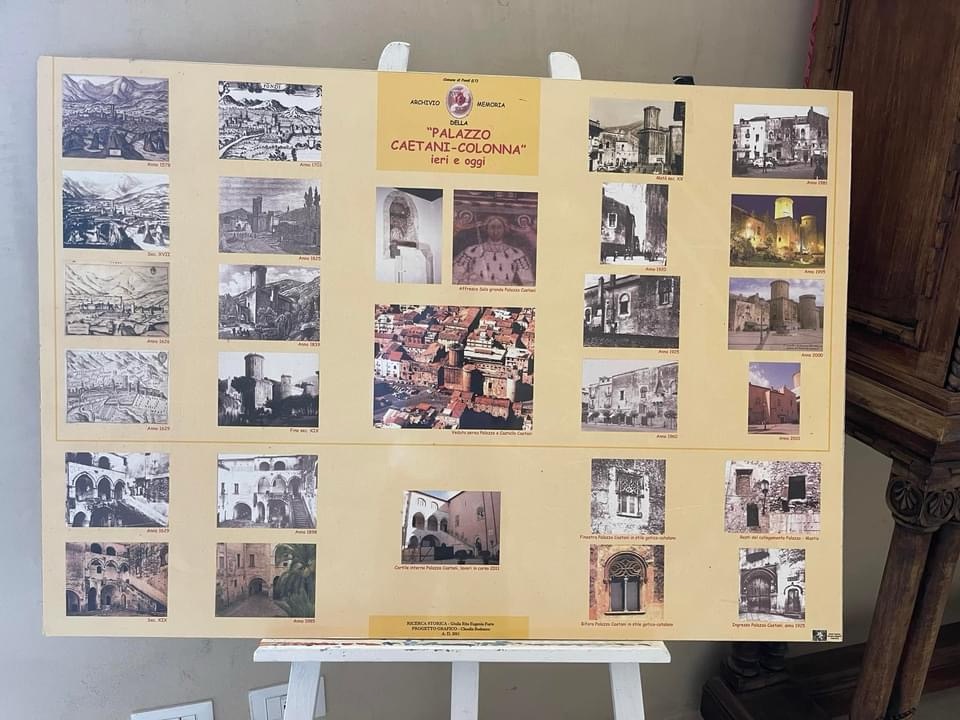
Fondi was in party mood outside the Caetani Palace that stands in its centre and I just wonder if the happy revellers realised what miracles were being performed tonight in their midst?


LUIGI PIOVANO
Da oltre vent’anni è primo violoncello solista dell’Orchestra dell’Accademia Nazionale di Santa Cecilia. Oltre a molti concerti nel doppio ruolo di solista e direttore, dal 2002 si dedica sempre più alla direzione d’orchestra. Ha collaborato con solisti come Avi Avital, Luis Bacalov, Stefano Bollani, Mario Brunello, Pietro De Maria, Benedetto Lupo, Sara Mingardo, Dmitry Sitkovetsky, Valeriy Sokolov e ha registrato per la Naxos tre Concerti per pianoforte di Paisiello (solista Francesco Nicolosi) e per la Eloquentia le Quattro Stagioni di Vivaldi (solista Grazia Raimondi), il Concerto per violino di Britten (solista Livia Sohn) e un CD con Sara Mingardo in cui dirige i Kindertotenlieder e i Lieder eines fahrenden Gesellen di Mahler, premiato in Francia nel 2012 come miglior CD di Lieder dell’anno.
Dal 2012 al 2022 è stato direttore musicale dell’Orchestra ICO della Magna Grecia di Taranto. Dopo il grande successo ottenuto a Roma nel 2013 dirigendo gli Archi dell’Orchestra di Santa Cecilia in un concerto di musiche di Schubert e la registrazione del medesimo programma per un CD Eloquentia, Piovano ha avviato una collaborazione stabile alla testa degli Archi di Santa Cecilia con i quali si è esibito nelle più importanti stagioni e Festival italiani e ha registrato già 6 CD.
Fra i suoi impegni come direttore in questi ultimi anni, concerti sul podio di molte delle principali orchestre italiane e, all’estero, il debutto con la New Japan Philharmonic Orchestra e, nel 2022, con l’Orchestra del Mozarteum di Salisburgo che lo ha immediatamente reinvitato per il marzo 2023 e il febbraio 2024.
Molto attivo nella musica da camera a fianco di artisti del calibro di Maurizio Pollini, Wolfgang Sawallisch, Myung-Whun Chung, Alexander Lonquich, Dmitry Sitkovetsky, Leonidas Kava- kos, Veronika Eberle, Katia e Marielle Labeque, Nikolay Lugansky, Malcolm Bilson, dal 2005 suona regolarmente in duo con Antonio Pappano e dal 2009 al 2019 ha fatto parte del Trio Latitude 41. Ha suonato come solista con prestigiose orchestre – Tokyo Philharmonic, New Japan Philharmonic, Accademia di Santa Cecilia, Seoul Philharmonic, Orchestre Symphonique de Montréal – sotto la direzione di direttori come Chung, Menuhin, Nagano, Pappano, Pletnev.

LUIGI CARROCCIA
Luigi Carroccia ha vinto prestigiosi premi tra i quali il “Premio Abbado” indetto dal MIUR in memoria di Claudio Abbado e il “Virtuoso Prize” del Vendome Piano Prize svolto nel Festival di Verbier 2019. Ha ricevuto a Kjustendil una medaglia per le sue esecuzioni di A. Scriabin e negli scorsi anni ha riscosso grande successo nei Concorsi “Van Cliburn” di Fort Worth, “Ferruccio Busoni” di Bolzano e “Fryderyk Chopin” di Varsavia.
La sua attività concertistica lo ha visto regolarmente impegnato in Italia e all’estero per Festival come il Duszniki International Chopin Piano Festival, il Miami International Piano Festival, il Dresdner Musikfestspiele, e in sale come l’Ishibashi Memorial Hall dell’Università di Tokyo, Flagey di Bruxelles, la Symphony Hall e la Town Hall di Birmingham, le sale Apollinee del Teatro La Fenice di Venezia, il Museo Teatrale alla Scala di Milano, il Teatro Casa d’Italia a Istanbul e la Salle Bourgie di Montreal.
Luigi ha intrapreso i suoi studi musicali sotto la guida del padre e del nonno. La sua maturazione artistica è poi proseguita presso il Conservatorio “C. Monteverdi” di Bolzano, dove ha ottenuto il Diploma Vecchio ordinamento con massimo dei voti e lode e il Diploma Accademico di II livello con massimo dei voti lode e menzione d’onore.
Successivamente ha ricevuto una Junior Fellowship dal Royal Birmingham Conservatoire (UK) e dal 2018 al 2022 è stato Artist in Residence presso la Queen Elisabeth Music Chapel di Waterloo in Belgio.
Luigi Carroccia ‘The poet of the piano’ Chopin Concerti op 11 and 21 in Rome Orchestra delle Cento Città directed by Luigi Piovano

Bonn 17 December 1770 Vienna 26 March 1827 (aged 56)
Over the course of his life, Beethoven composed five cello sonatas two of them early as his op 5 .These two sonatas, composed when Beethoven was age 25, were highly virtuoso concert pieces showing off the pianist, with a cello part of less weight. Beethoven performed them with cellist Jean- Pierre Duport in Berlin in 1796, and dedicated them to Frederick William 11 of Prussia who was an amateur cellist himself.
Beethoven composed his third cello sonata in A major in Vienna during his middle period , a productive time[when he also composed works such as the Piano Trios op 70, the Choral Fantasy, as well as his Fifth and Sixth Symphonies It was a time when Beethoven faced increasing deafness. He had to end his career as a pianist with the concert on 22 December 1808 in which he premiered the two symphonies, the Choral Fantasy and other vocal and choral music, as well as his Fourth PianoConcerto .First sketches for the sonata appeared alongside those for the Fifth Symphony and the Violin Concerto in a sketchbook dated September 1807 to early in 1808.Beethoven’s sketches show that he continuously revised passages, and further altered his first autograph manuscript while the finished composition sounds like the result of spontaneous inspiration. He completed the composition in 1808.
Beethoven dedicated the sonata to Freherr Ignaz von Gleichenstein his friend and an amateur cellist, who also assisted the composer in financial matters.The previous year he had arranged an annuity for Beethoven from a group of sponsors which included Archduke Rudolf of Austria, a pupil of Beethoven.The composer had planned to dedicate his Fourth Piano Concerto to Gleichenstein, but felt that he had to honour the Archduke with the dedication instead, because he had shown particular interest in the Concerto. Beethoven explained to Gleichenstein his regret but announced: “… another work is appearing in which you will be given what is due to your – and our friendship”.
The sonata was first performed on 5 March 1809 as part of a benefit concert for the cellist Nikolaus Kraft , who performed it with pianist Dorothea von Ermanno ,a student of Beethoven.Kraft, known for “technical mastery” and a “clear, rich tone”,was the cellist for whom Beethoven had written his Triple concerto published in 1804, and Beethoven’s first work to use advanced cello techniques.A performance of the cello sonata in 1816 was played by Joseph Linke , the cellist in the Razumovsky Quartet and Carl Czerny . The pianist wrote in metronome markings, regarded as approved by the composer, and noted that a slight rubato playing would increase interest and expressiveness.
- Allegro ma non tanto
- Scherzo . Allegro molto
- Adagio cantabile – Allegro vivace



 ChristopherAxworthy-MusicCommentary