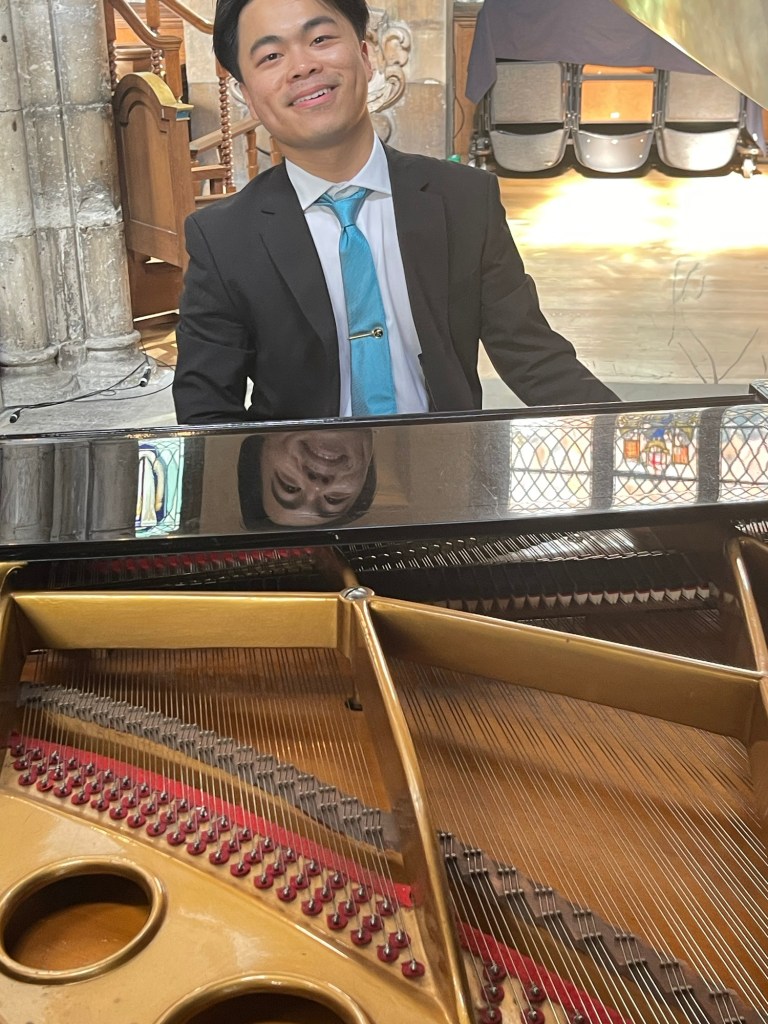
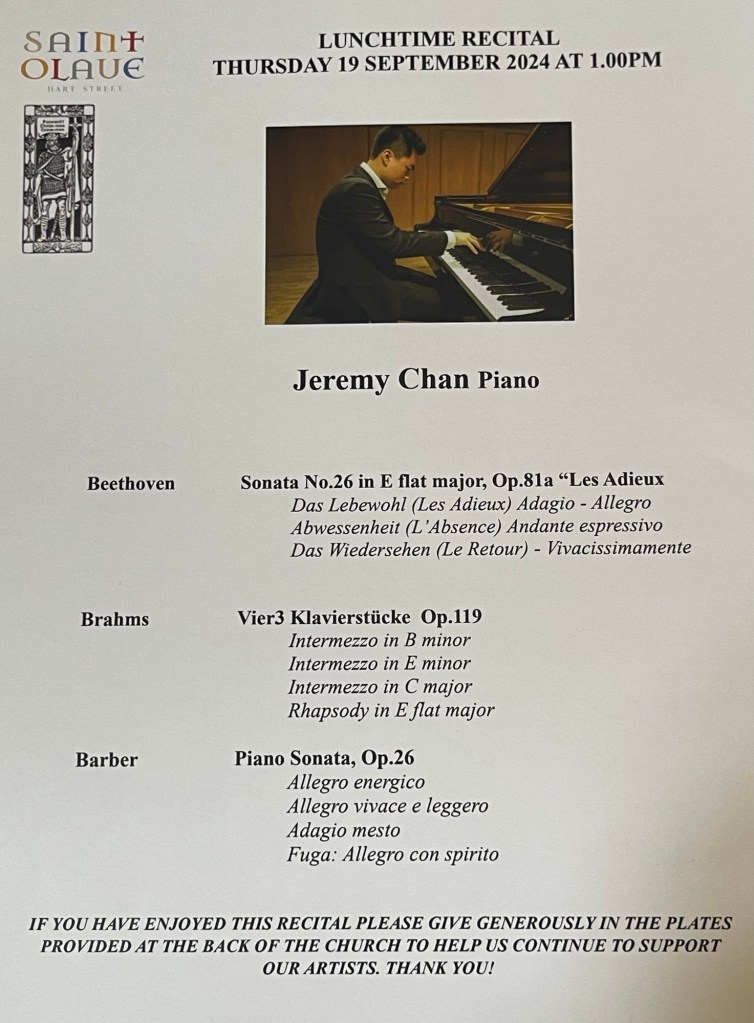
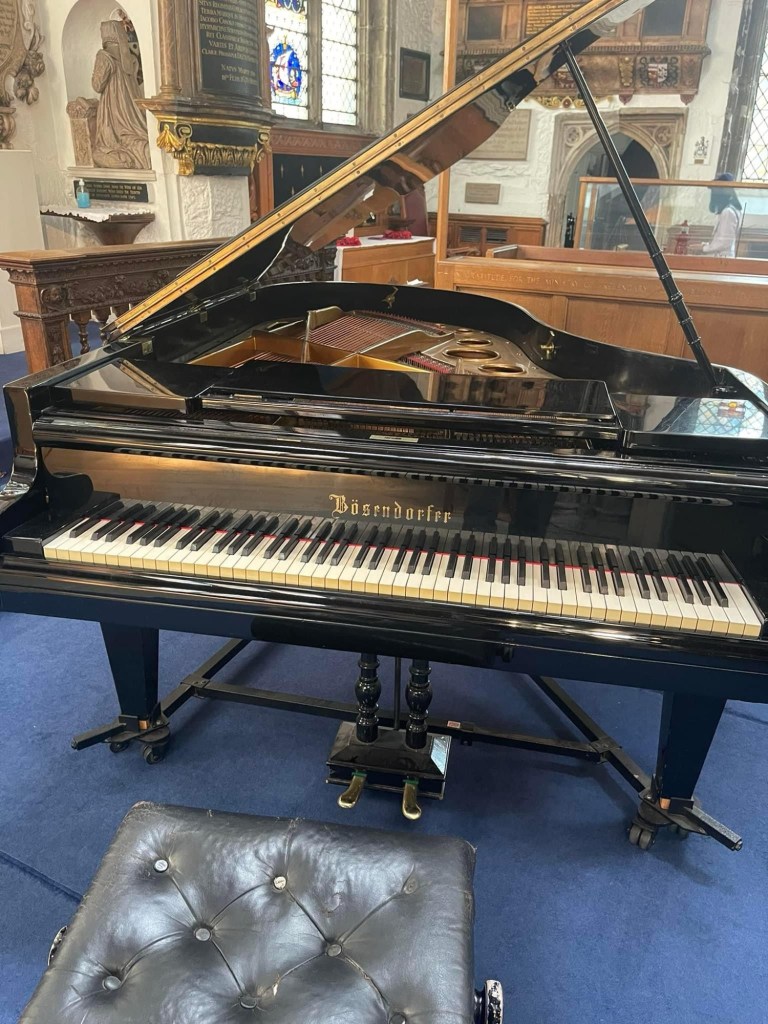
Playing of real authority on a not easy piano but nevertheless a Bosendorfer of pedigree that in the hands of a true musician can still reveal many secrets .A programme of the three B’s : Beethoven ,Brahms ……..and Barber eloquently introduced but even more eloquently played !
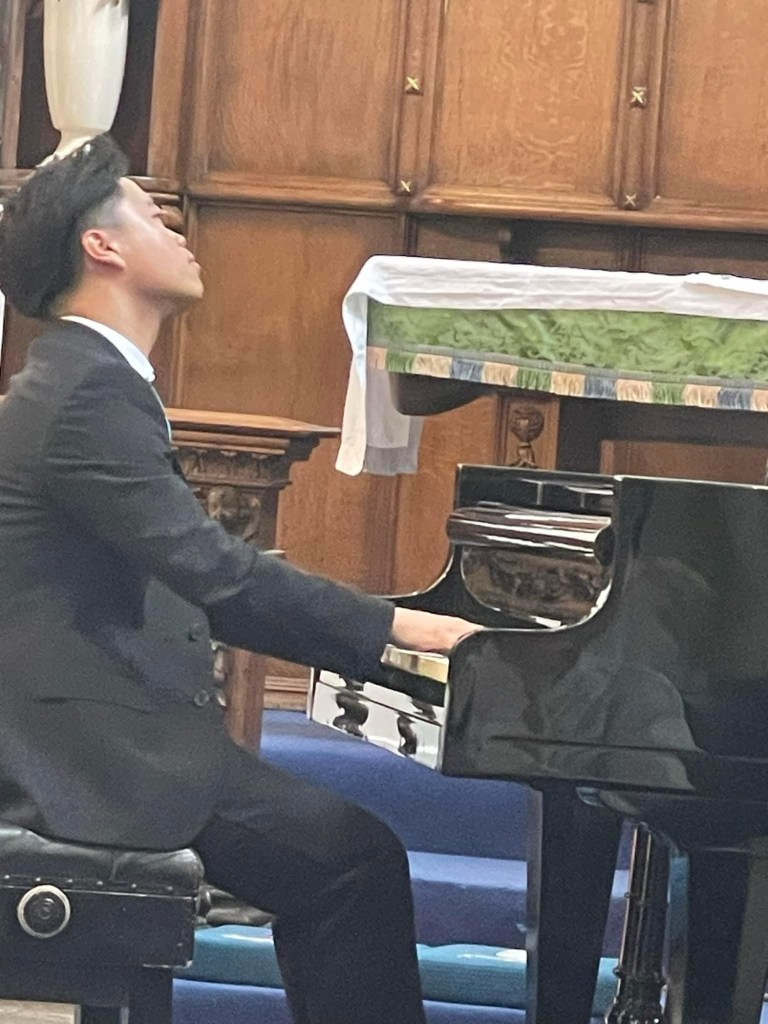
Beethoven’s ‘Les Adieux’ Sonata the only Sonata that Beethoven actually gave titles to opened with the luminosity and simplicity of a beautifully shaped ‘Adagio’ before exploding into the ‘Allegro’ that was played with great buoyancy and drive. Impeccable technical control as he played with scrupulous attention to Beethoven’s detailed indications with musicianship and poetic beauty.There was a beautiful sense of balance in the ‘Andante espressivo’ that allowed the melodic line to glow with poignant simplicity. An oasis of calm before the explosion of the ‘Vivacissimamente’ and an exhilarating pastoral ‘joie de vivre’ that was played with dynamic drive and scintillating exuberance.
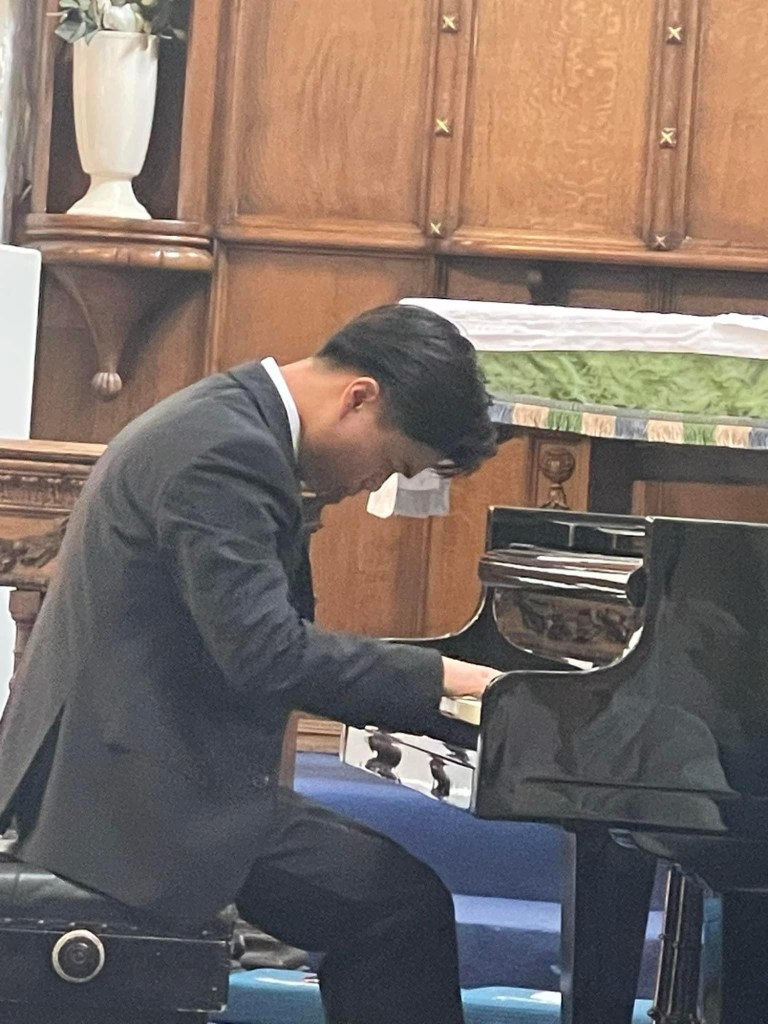
The four pieces that make up Brahms op 119 opened with the Intermezzo in B minor played with purity and poignant beauty as the music was allowed to unfold with heartrending beauty as Brahms said farewell to the piano with these last solo offerings. The Intermezzo in E minor was played with a whimsical whispered flight of beauty with playing of great fantasy and architectural line.In fact all through these four short pieces there was an overall sense of line and shape that united them into a whole which I have rarely heard played with such intelligent musicianship and sense of forward movement.Never allowing himself to wallow in these very intimate pieces but letting the music to speak for itself with a kaleidoscope of sounds of rare beauty.A beguilingly capricious Intermezzo in C major was thrown off with the same ease and charm that I still remember from the hands of Curzon.The final Rhapsody in E flat was full of majestic orchestral sounds with a central episode that was like a breath of fresh air of innocent purity before the final sumptuous finale played played with grandiose aristocratic control.
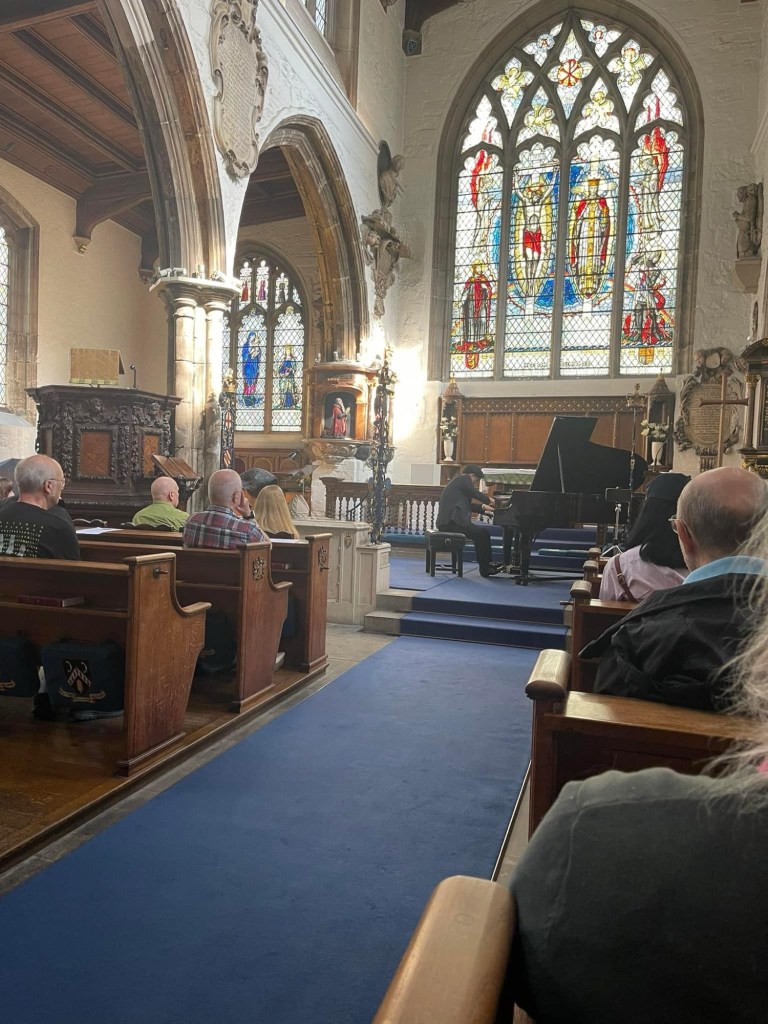
A performance of the Barber Sonata that was written for Horowitz and is indeed a ‘tour de force’ of intricate counterpoints and moving harmonies of relentless forward movement.The ‘Allegro energico’ was played with a kaleidoscope of colours it’s melancholic theme emerging through a mist of sounds.The ‘Allegro vivace e leggero’ was a mellifluous outpouring of continuous sounds and led to the languid beauty of mystery and haunting nostalgia of the ‘Adagio mesto’ that was played with passionate commitment and commanding authority. But it was the Fugal last movement notorious for its intricate knotty twine that Jeremy played with breathtaking ,fearless virtuosity but also with the sense of line and architectural shape of a remarkable musician.
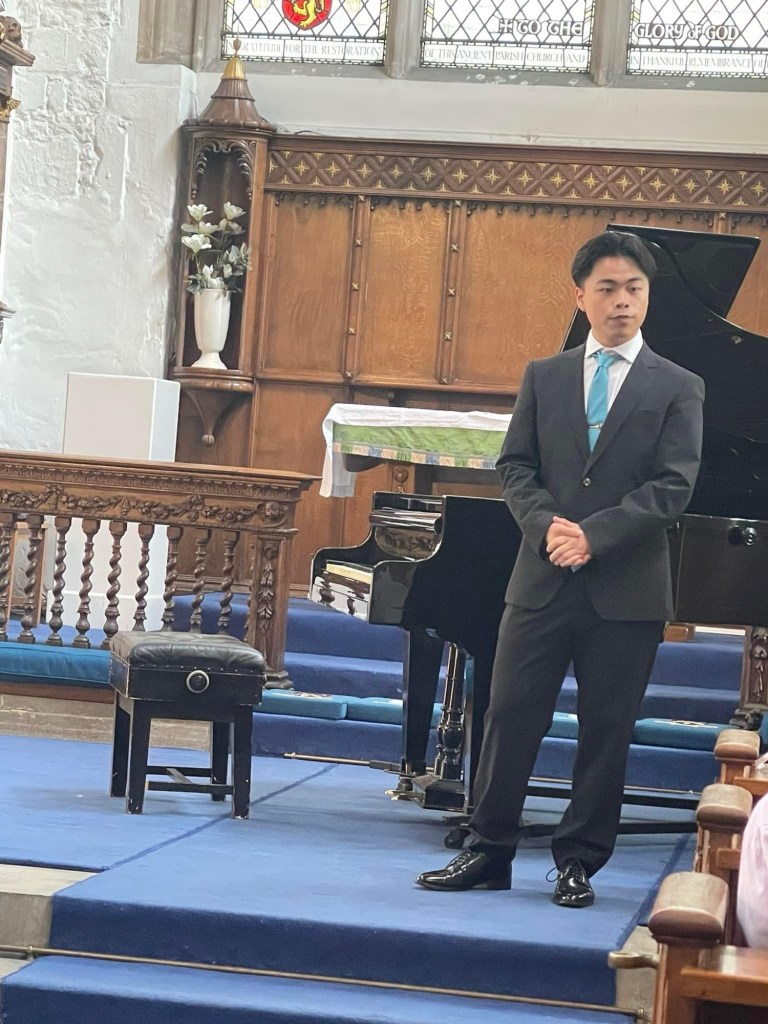
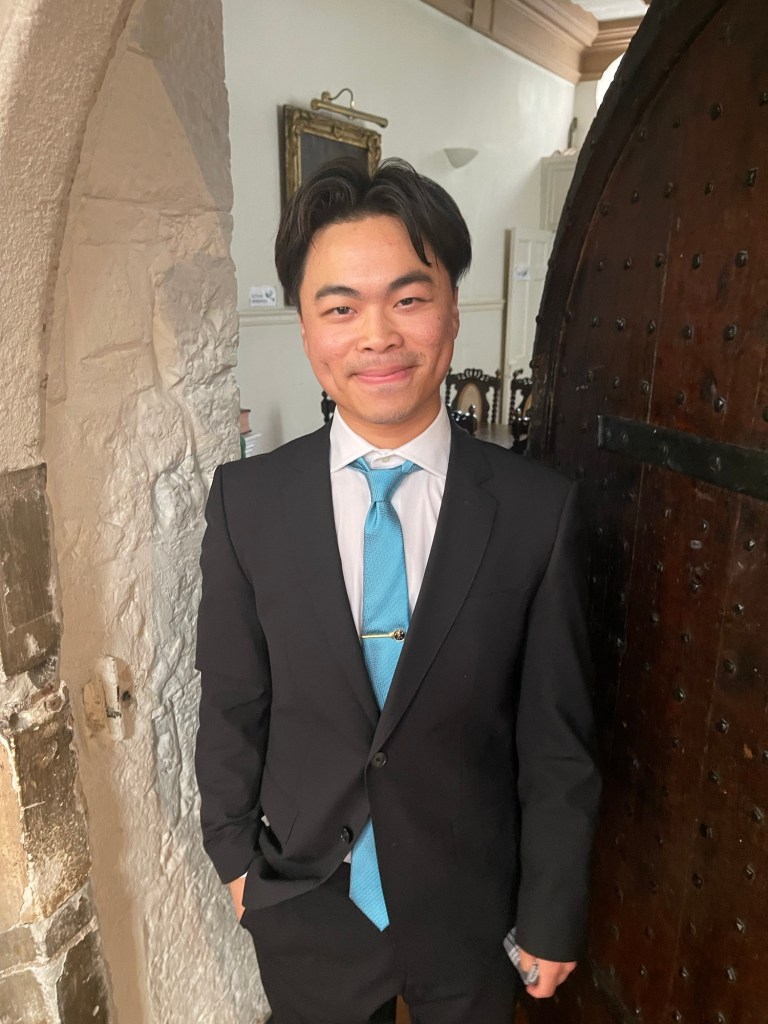
Angela’s generosity and infectious Song and dance inspires her illustrious students.
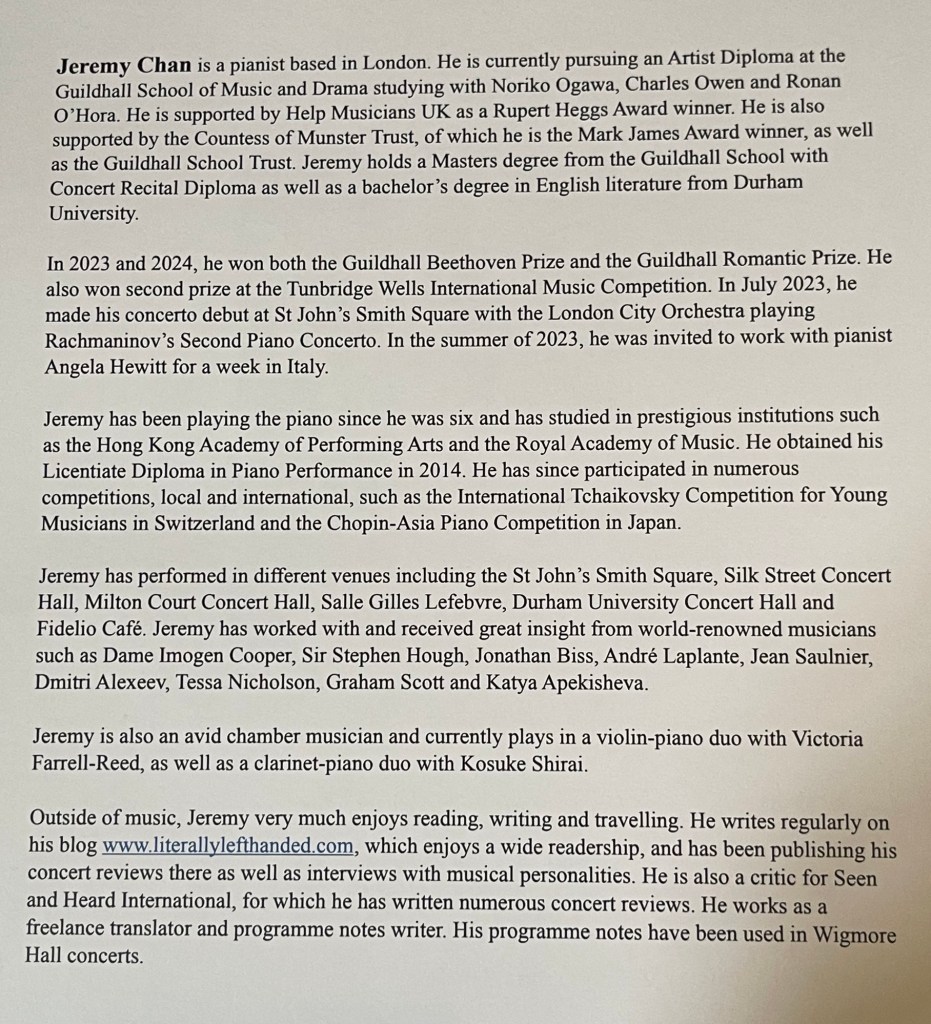
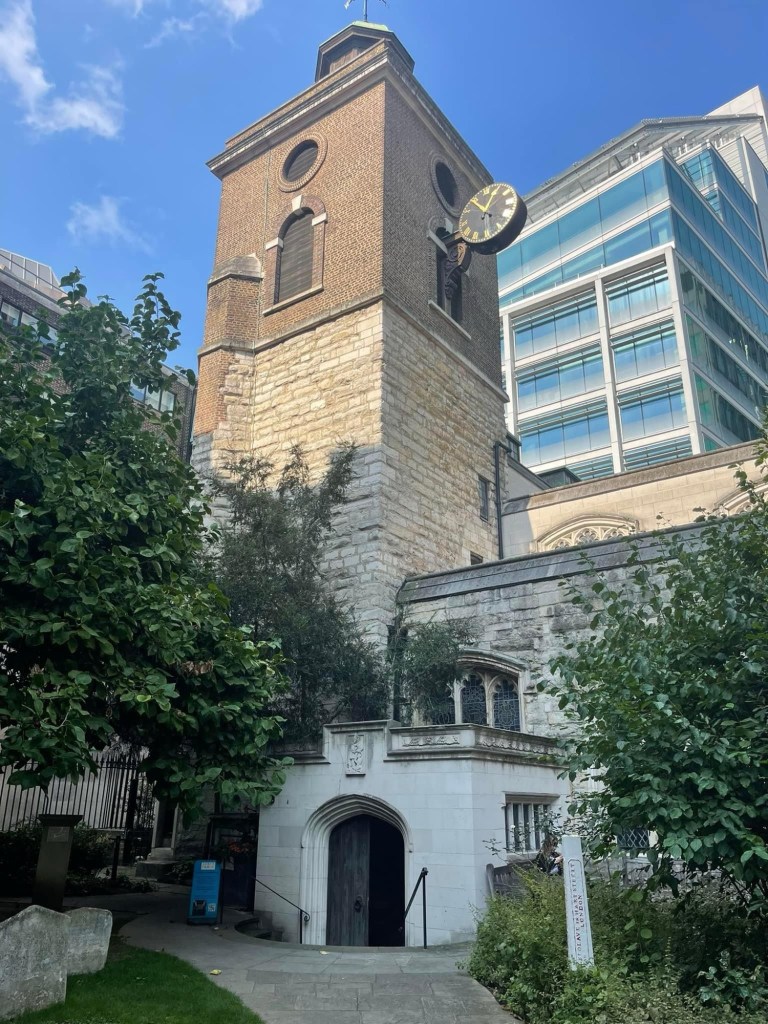
Jeremy Chan at St Olaves Tower Hill ‘Masterworks played with intelligence and sensitive artistry’
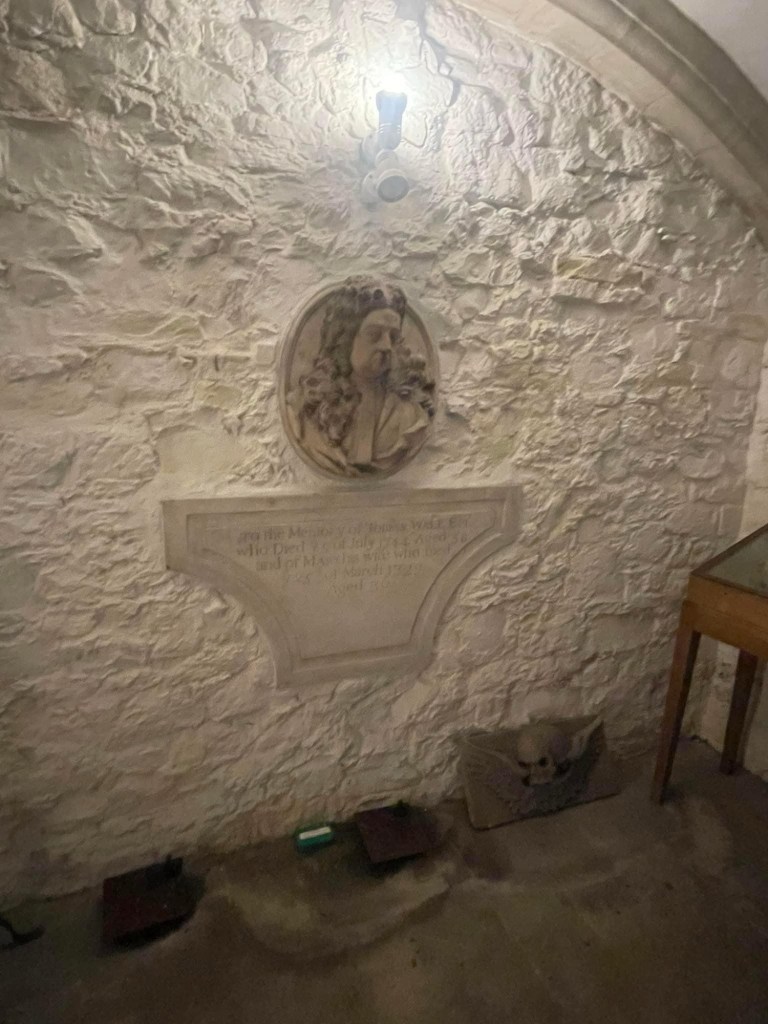
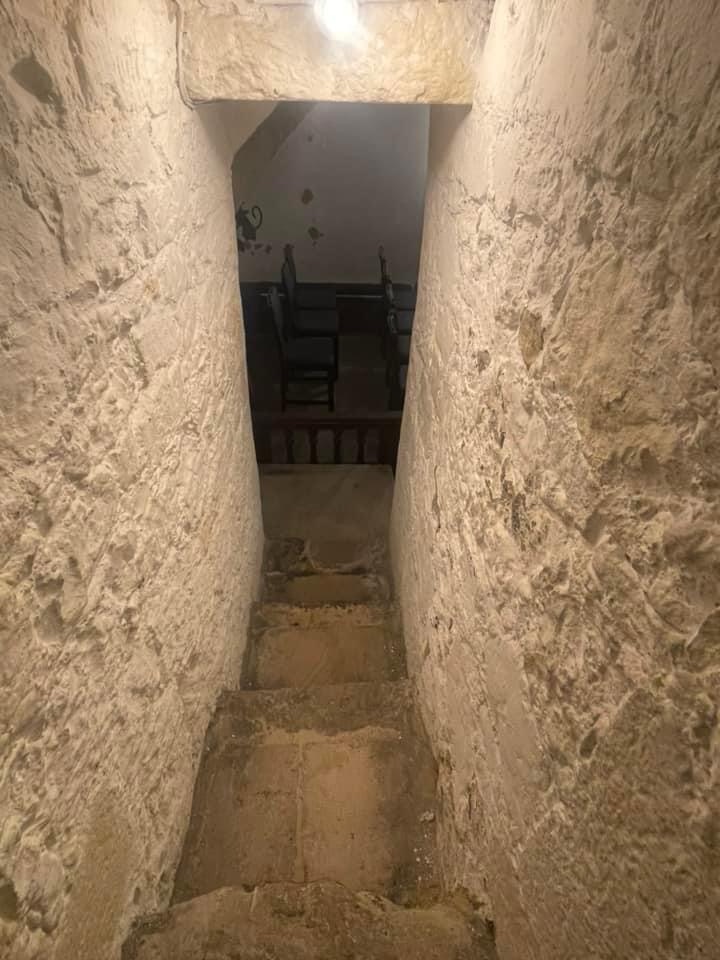
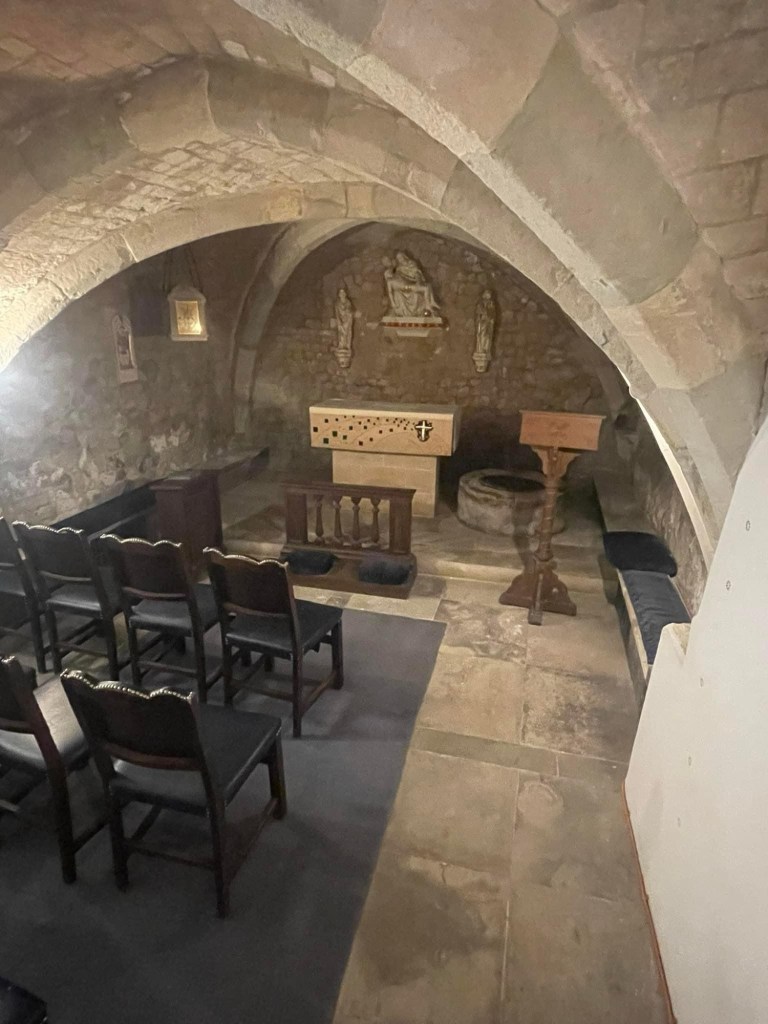
An inspiring visit to the crypt in this remarkable church so brutally abused during the war.
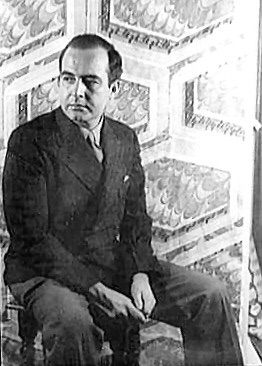
Samuel Osmond Barber II
March 9, 1910 West Chester Pennsylvania
January 23, 1981 Manhattan NY
The Piano Sonata in E-flat minor, op .26, was commissioned for the twenty-fifth anniversary of the League of Composers by American songwriters Irving Berlin and Richard Rodgers .It was written between 1947 to 1949, and was first performed by Vladimir Horowitz in December 1949 in Havana, Cuba, followed by performances in Washington D.C and New York City in January 1950. The sonata is regarded as a cornerstone of American piano literature and one of Barber’s most significant achievements. Critics hailed it as a defining moment in mid-20th-century music, with The New York Times describing it as the “first sonata truly to come of age by an American composer of this period.”
Upon completing the first two movements, Barber initially planned a concluding slow movement,and played the completed movements for Horowitz , who would later premiere the work, at Horowitz’s house.Horowitz then suggested Barber write a four-movement work with a “very flashy last movement, but with content”, a movement which would become a fugue.
The composer finished the sonata in June 1949, and Vladimir Horowitz began to prepare it for performance, spending five hours a day practicing it. Barber later commented that Horowitz had been playing it “with a surprising emotional rapprochement which I had not expected”.Horowitz premiered the Sonata in Havana, Cuba, on December 9, 1949. This was followed by a private performance in New York at the former G.Shirmer headquarters on January 4, 1950. Gian Carlo Menotti ,Virgil Thomson,William Schumann,Thomas Schippers,Aaron Copland,Lukas Foss Myra Hess and Samuel Chotzinoff all attended.The official U.S. premiere was in Washington, DC,on January 11, 1950, at Constitution Hall ; Horowitz then publicly played the work in New York on January 23, 1950 at Carnegie Hall to ubiquitous praise from music critics.By April 1950, plans were in place for Horowitz to record the sonata for a Christmas release that year; Horowitz made the recording in May, for RCA Victor . This recording remained Barber’s preferred version for at least a decade.
The sonata is in four movements:
- Allegro energico
- Allegro vivace e leggero
- Adagio mesto
- Fuga : Allegro con spirito
 ChristopherAxworthy-MusicCommentary