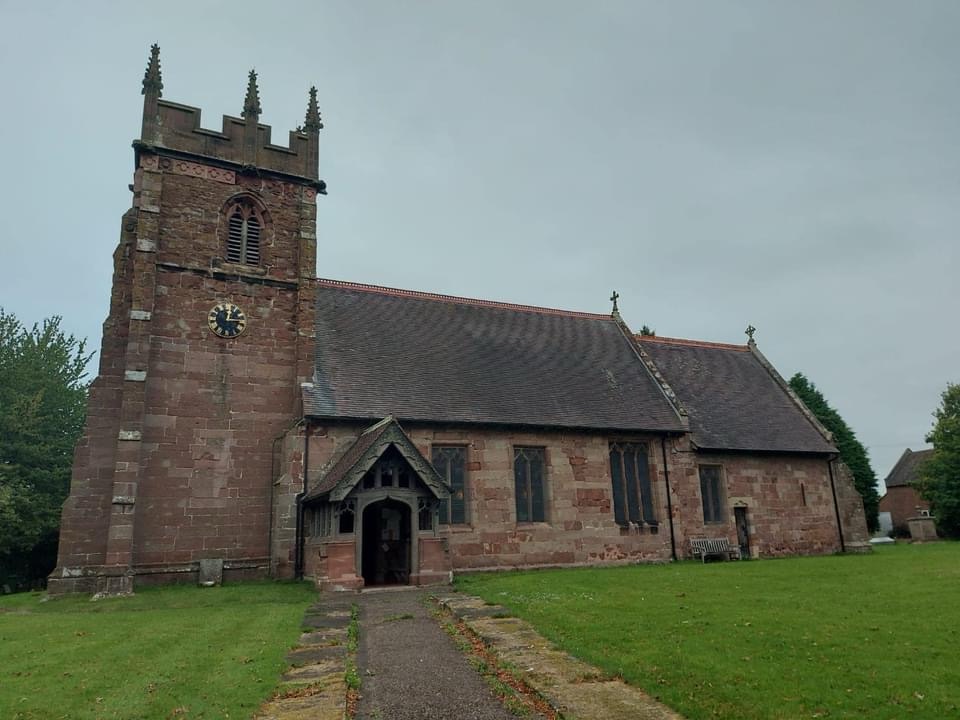
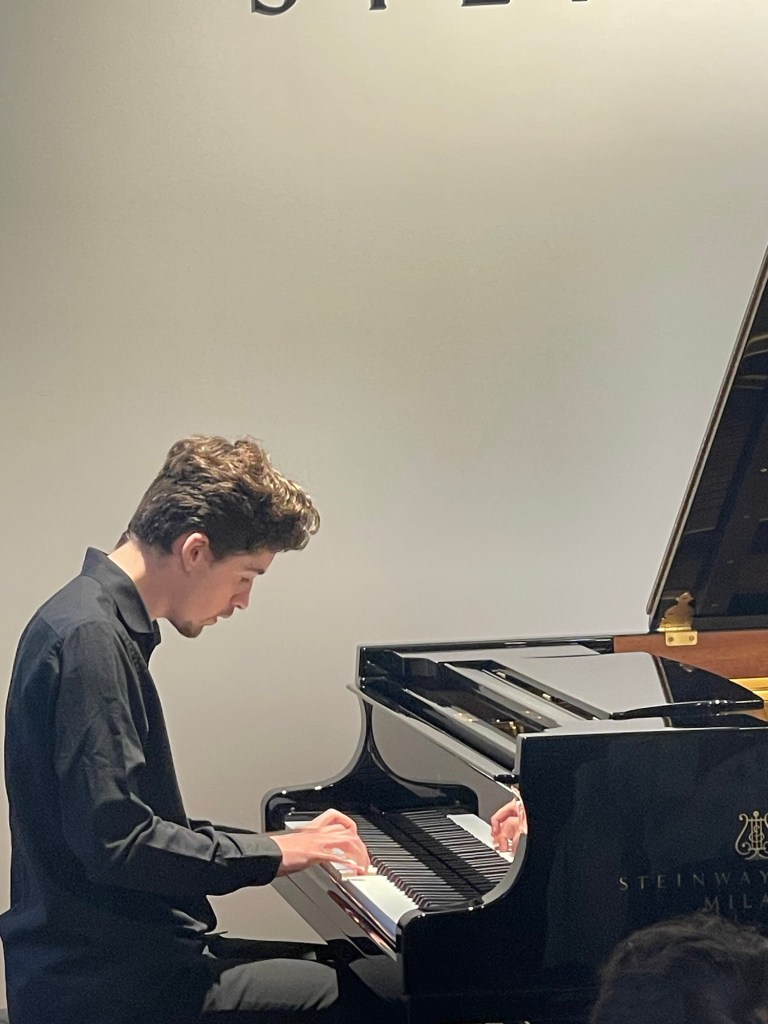
“Mozart and Schubert make up most of my repertoire . They are two supreme vocal composers. Everything in life and the human condition is there in their music and everything is imbued with that singing line. They make perfect partners, I believe. The C minor Sonata is a very turbulent work, and the Adagio is, in my opinion, one of Mozart’s most profound slow movements. It is not often heard together with its twin, the C minor Fantasia . Schubert’s Moments Musicaux are also heavenly. All of life is there in a thirty-minute work . As for the Franck/Bauer, there is darkness, anguish, a sweet melancholy, and deep spirituality to his music” – Kyle Hutchings
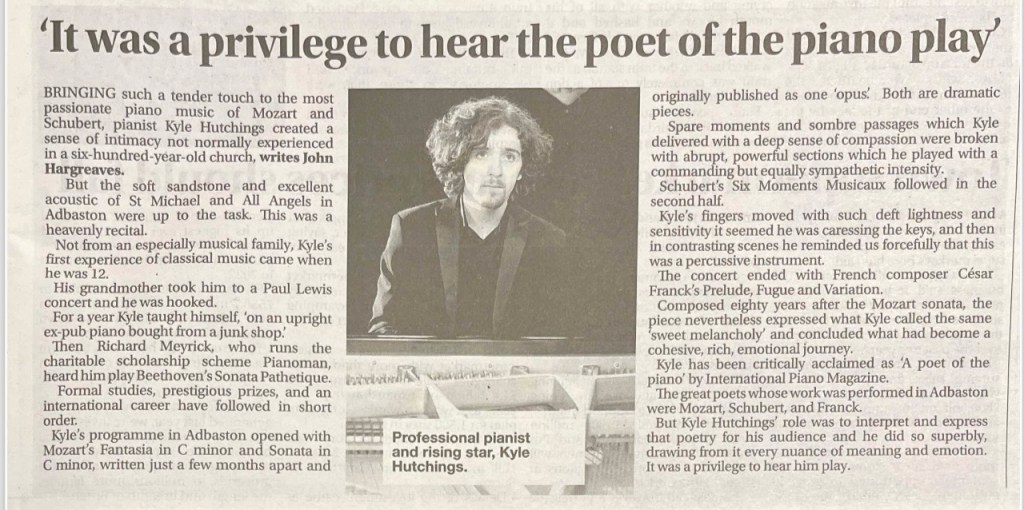
REVIEW BY THE DISTINGUISHED MUSICIAN JOHN HARGREAVES https://johnhargreaves.com/index.php/kyle-hutchings/

It was indeed the simplicity that he brought to all he did that allowed the music to speak with a voice that reveals “ life and the human condition “. There was dynamic drive in the Mozart where operatic brilliance is tinged with a deeply felt poignancy.The searing drama of the opening of the C minor Sonata was followed by an Adagio which is one of Mozart’s most poignant compositions and even leaves a dark shadow looming over the seemingly capricious Allegro assai.The dramatic contrasts and delicate recitativi of the Fantasia opened a world that was pure opera and showed us the turbulence that was deep within the genial soul of Mozart. It was played with an unadorned simplicity of music that Schnabel is quoted as exclaiming is “too difficult for adults and too easy for children”. An astonishing simplicity and delicacy with a palette of sounds that like the human voice can reveal so much with so little.
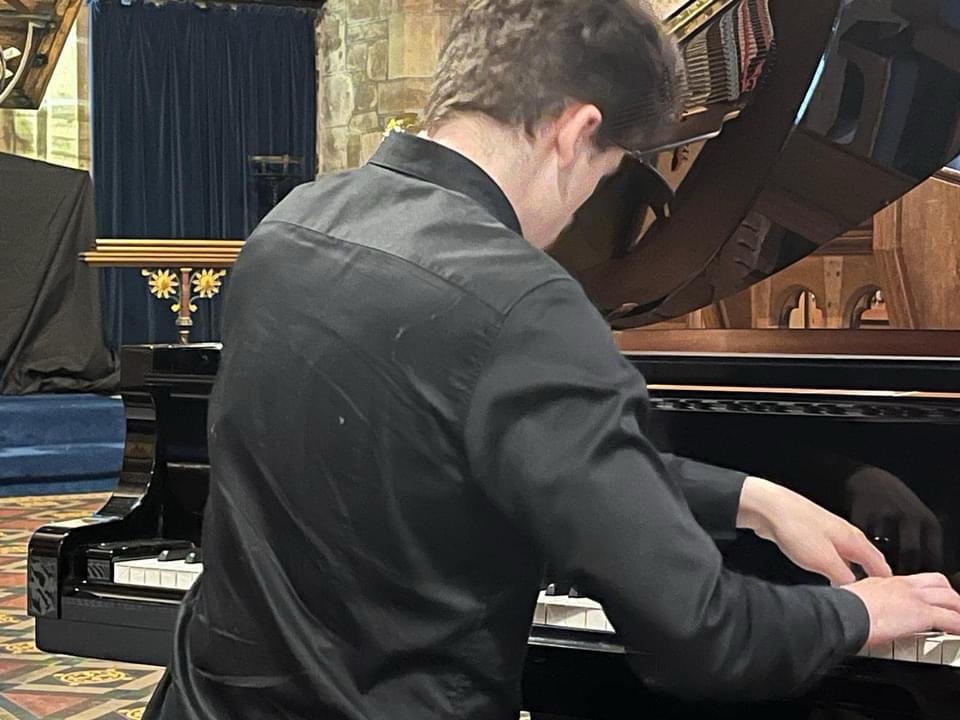
The six little Moments Musicaux by Schubert seem deceptively simple but in the hands of a true poet they become six miniature tone poems showing every facet of the human character. Beguiling ,quixotic,hypnotic or commanding the beautiful final Allegretto reveals the world that awaited Schubert just a few months later. They were played with insinuating character and charm but above all delicacy and ravishing beauty.

It was the same haunting beauty that Franck was to imbue his Prelude,Fugue and Variation with , in the transcription for piano from the organ by Harold Bauer. It was played with an architectural shape and sense of line that made the reappearance of the haunting opening even more touching when played with great sentiment but never sentimentality.There was an aristocratic musicianship to all Kyle did that gave real strength to his playing and brought us to the heart of the composer.
Kyle Hutchings the poetic troubadour of the piano ravishes and seduces at St Johns


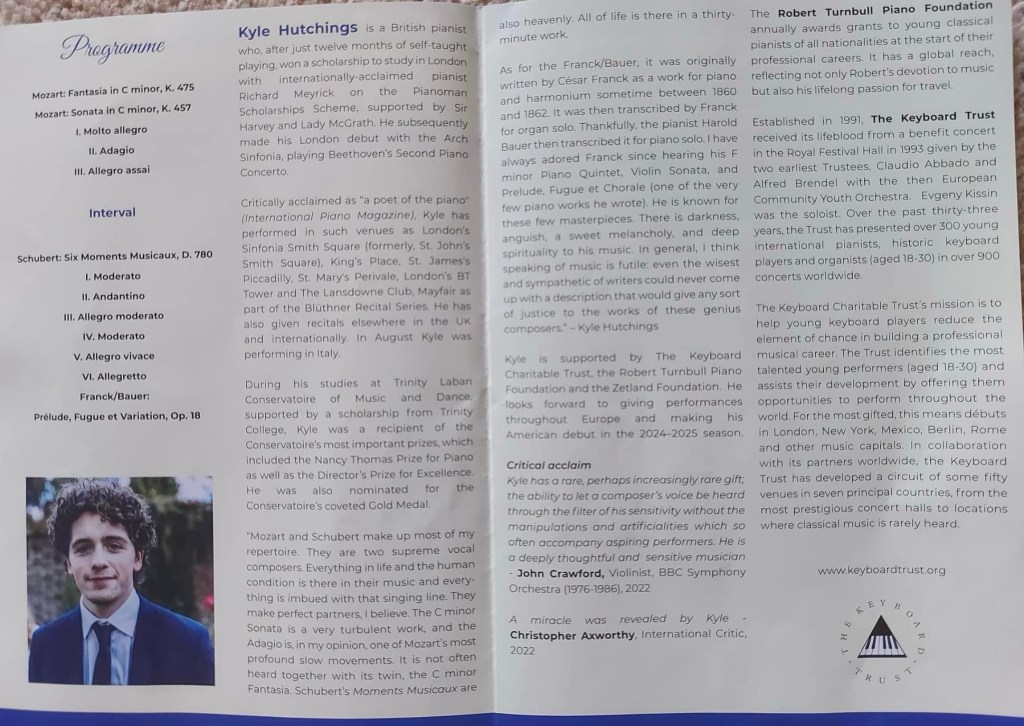
Kyle Hutchings the poetic troubadour of the piano ravishes and seduces at St Johns
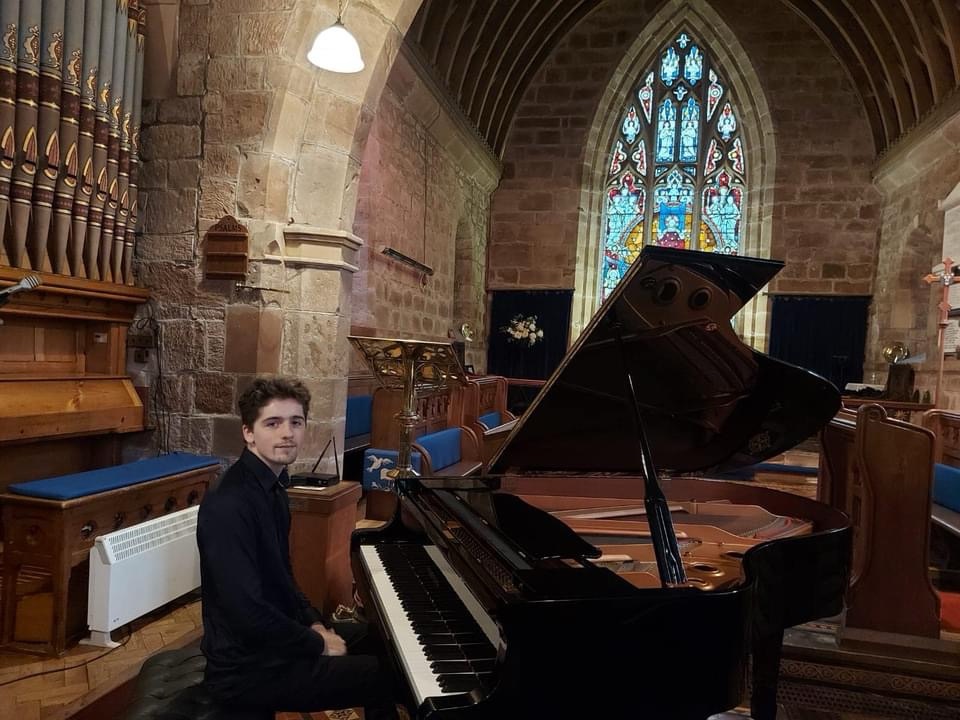
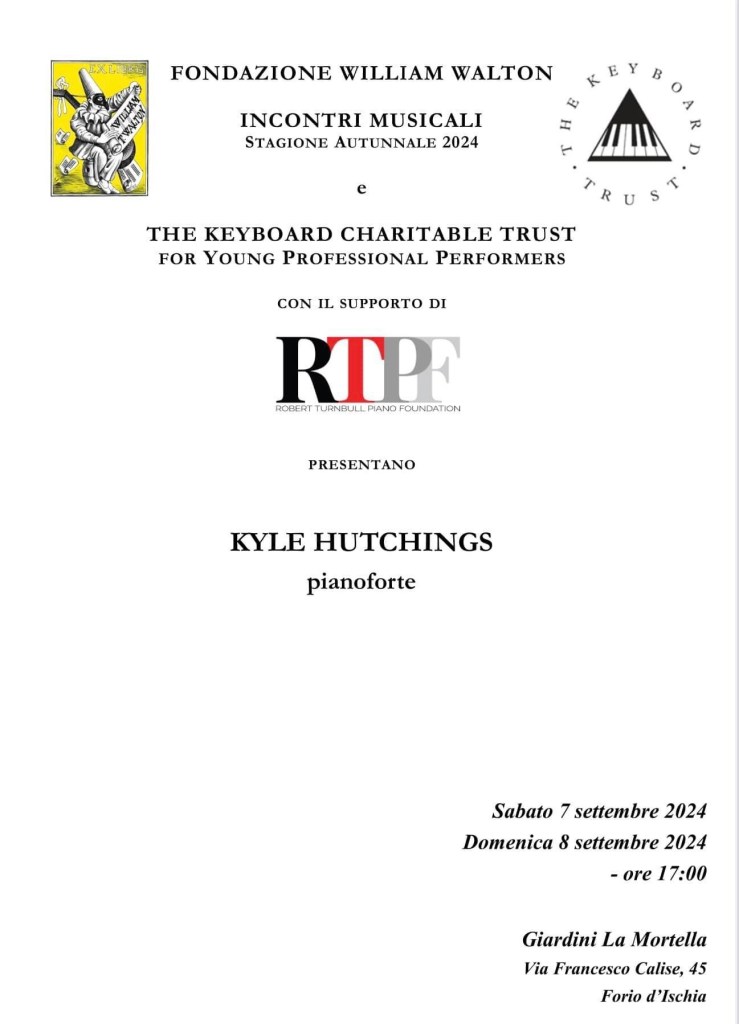
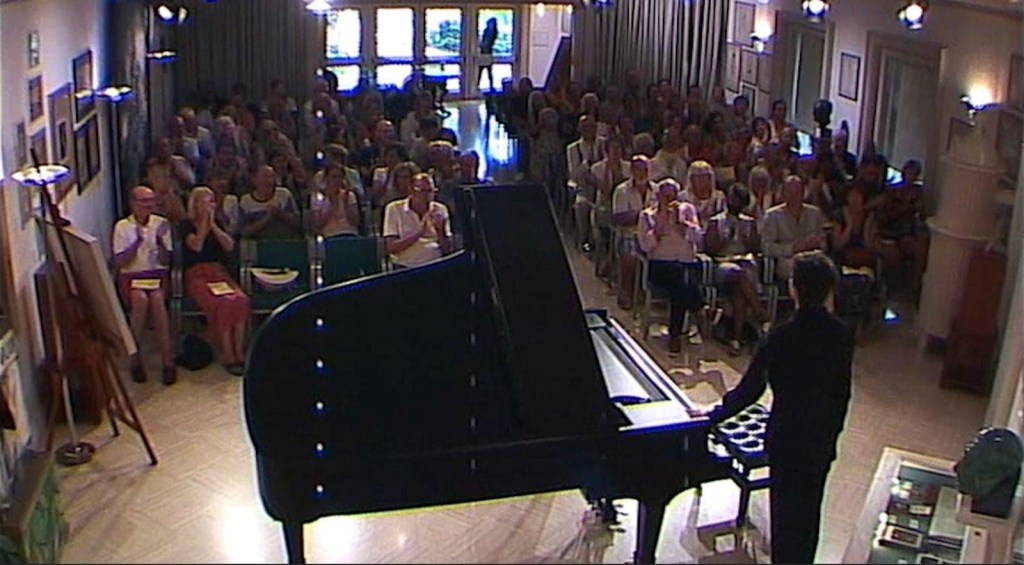
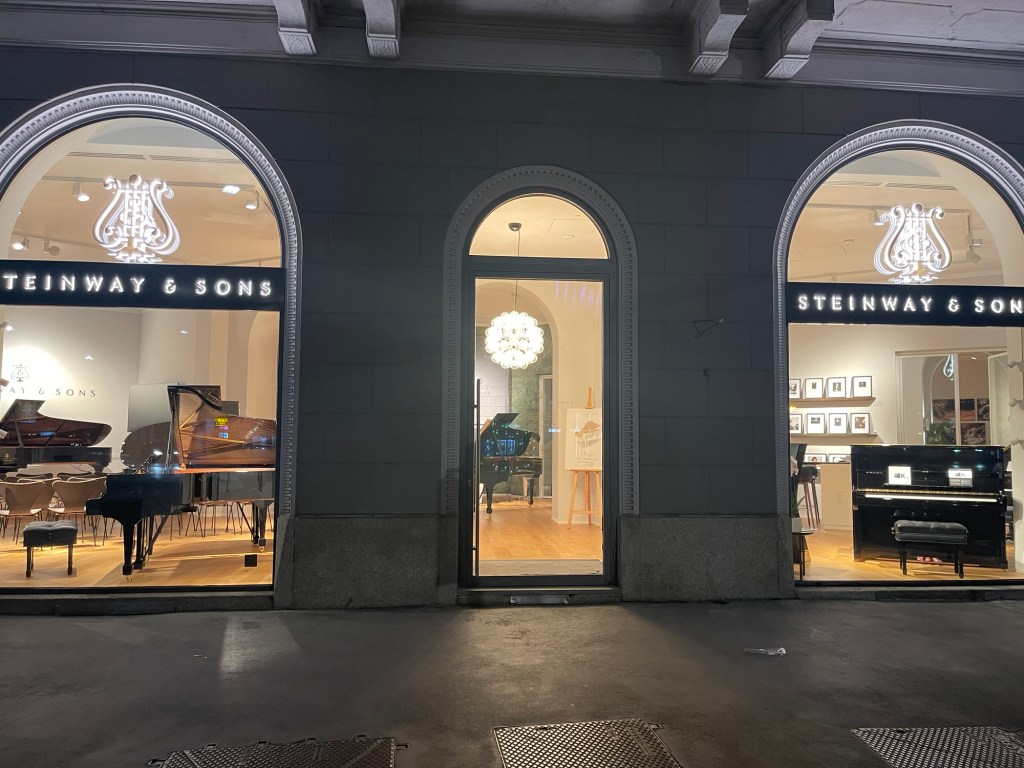
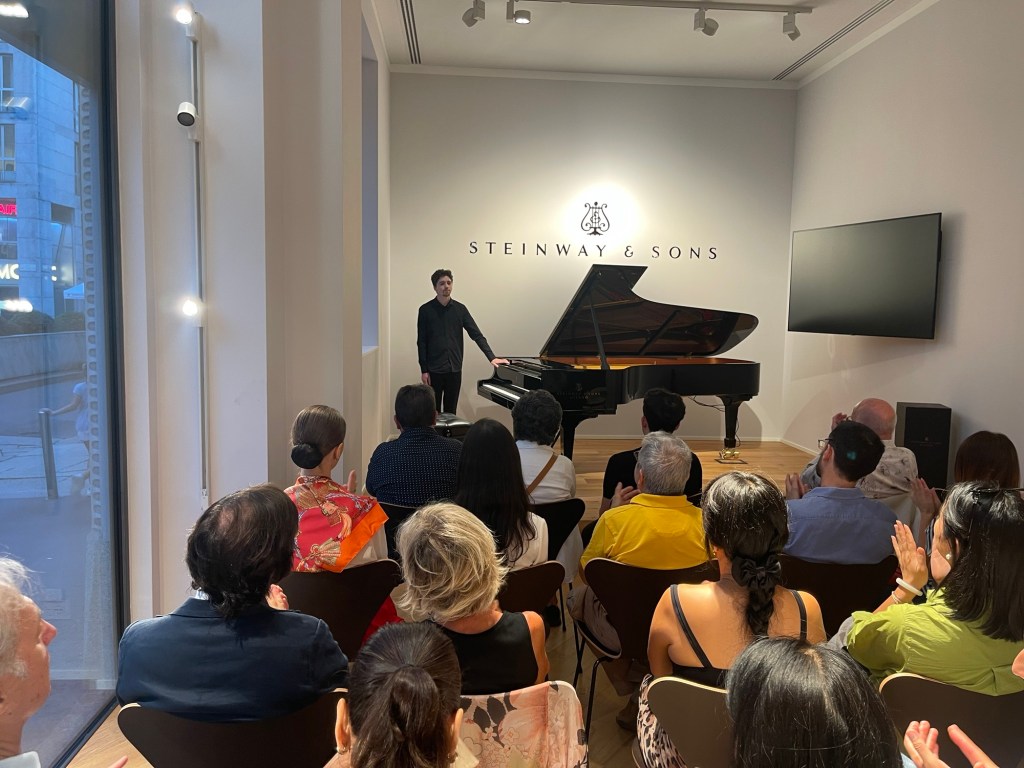
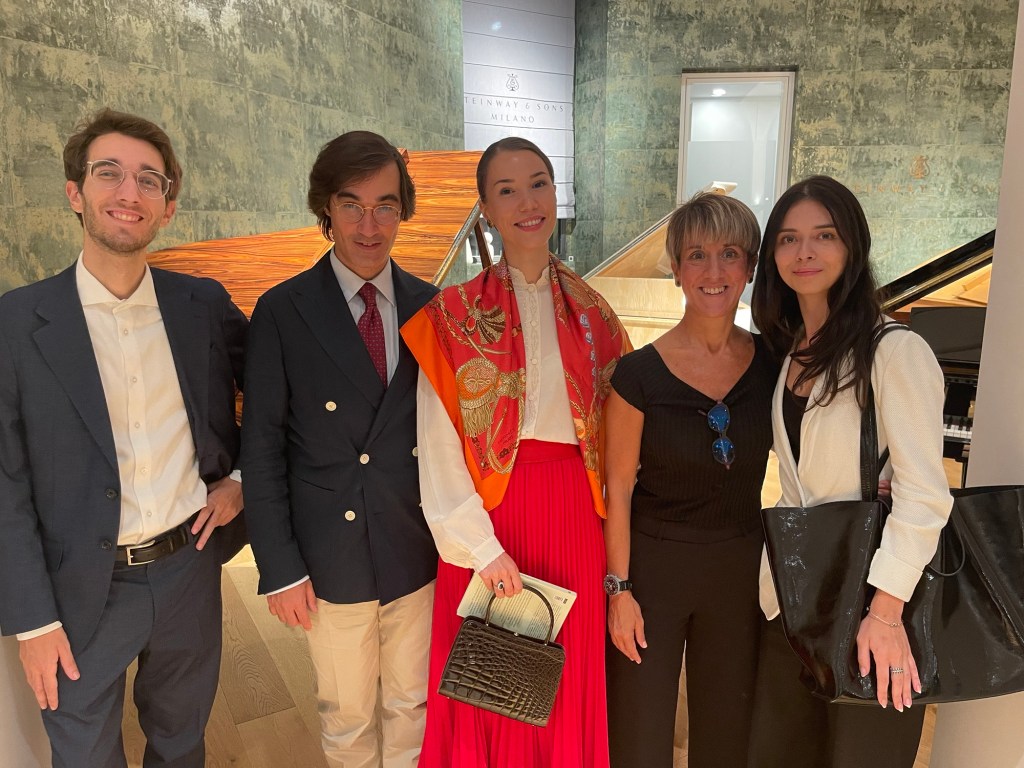
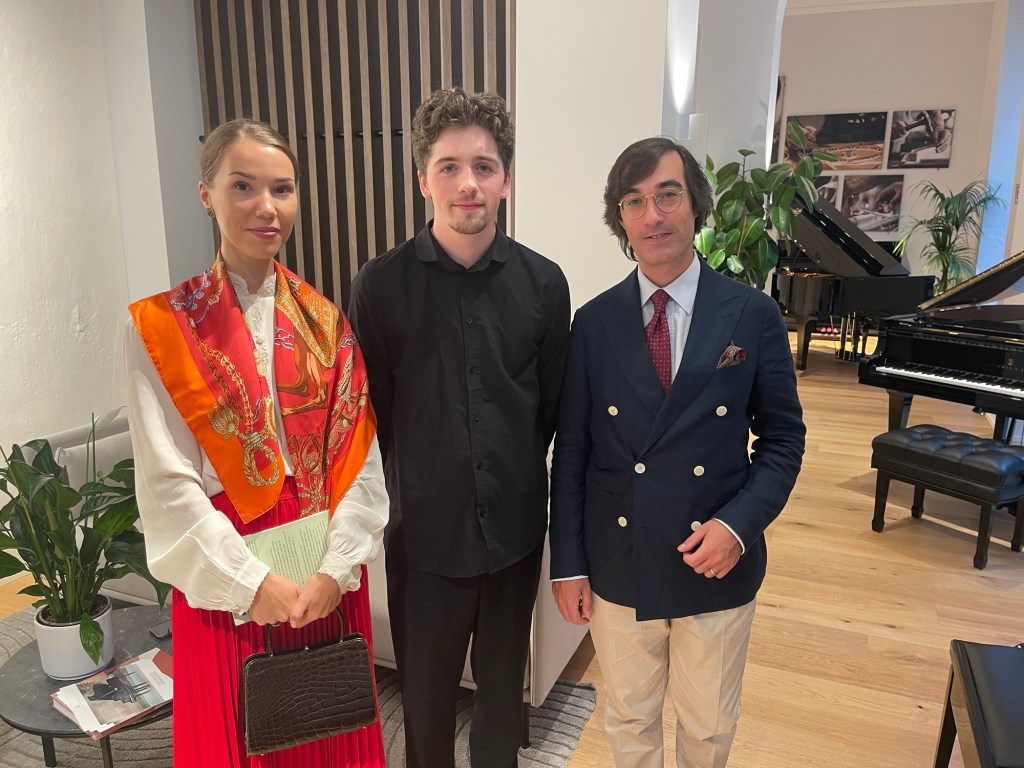
A concert tour of Italy from the 7th to the 11th September follow this concert in Adbaston .It will include The Walton Foundation on Ischia 7/8 th ; Florence British at the Harold Acton Library 10th and Steinway Flagship Milan on the 11th. Organised by the Keyboard Trust in collaboration with the Robert Turnbull Piano Foundation



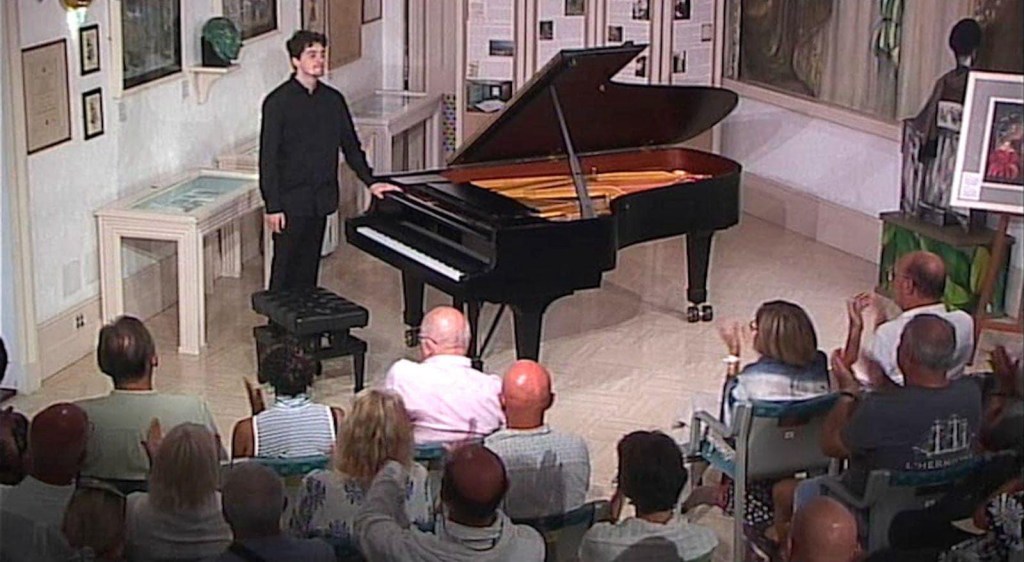


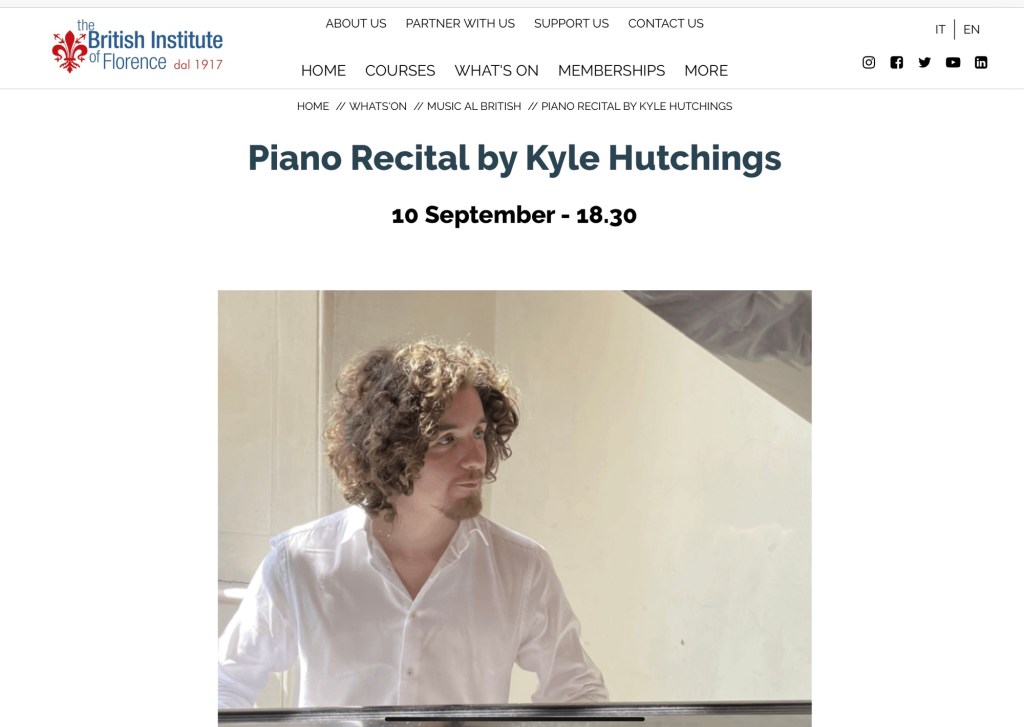
We are thrilled to inaugurate our new season of events in the Library with this piano recital by the brilliant British pianist Kyle Hutchings.
After just twelve months of self-taught playing, Kyle won a scholarship to study in London. He has gone on to perform in prestigious London venues such as Kings Place, St John’s Smith Square, and St James’s Piccadilly.
For his concert in the Library he will play Mozart and Schubert.
Here is a sneak preview of Kyle playing in London recently: Lunchtime Recital by Kyle Hutchings (piano)
This concert is promoted by the Keyboard Trustwith support from the Robert Turnbull Piano Foundation.

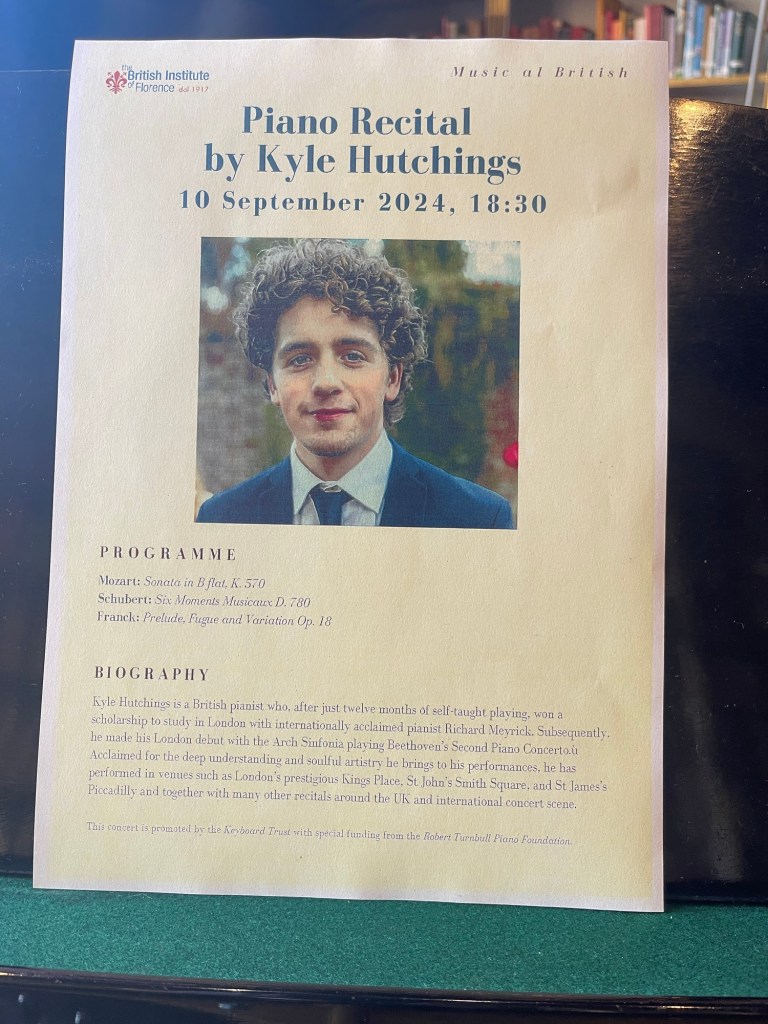
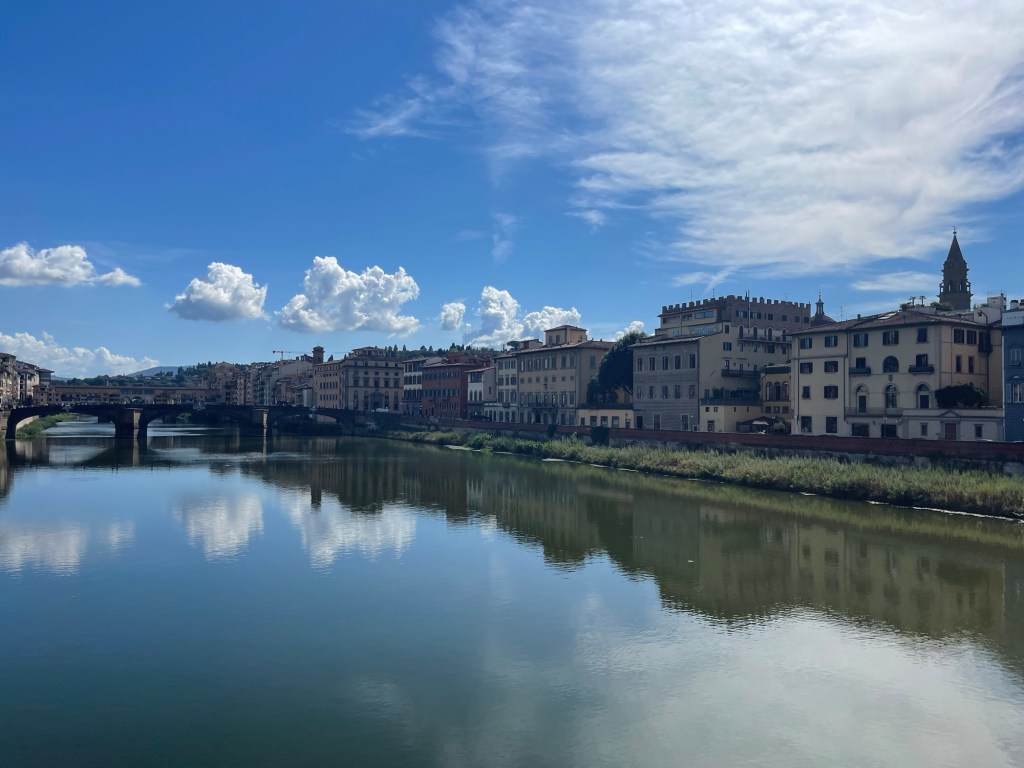
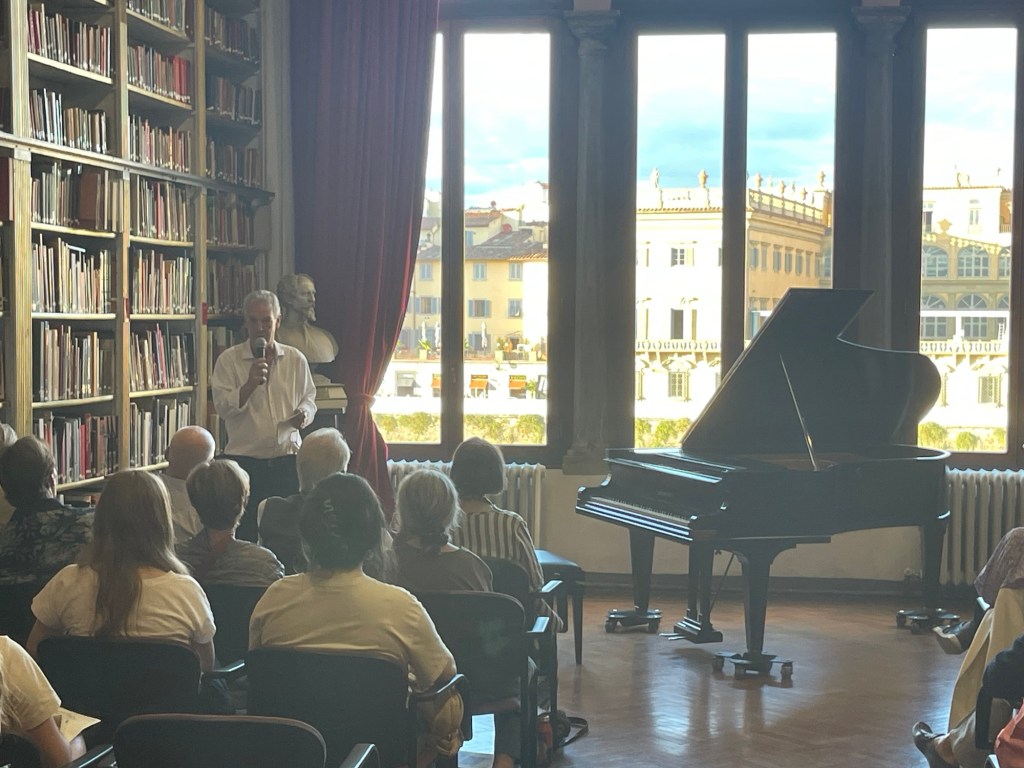
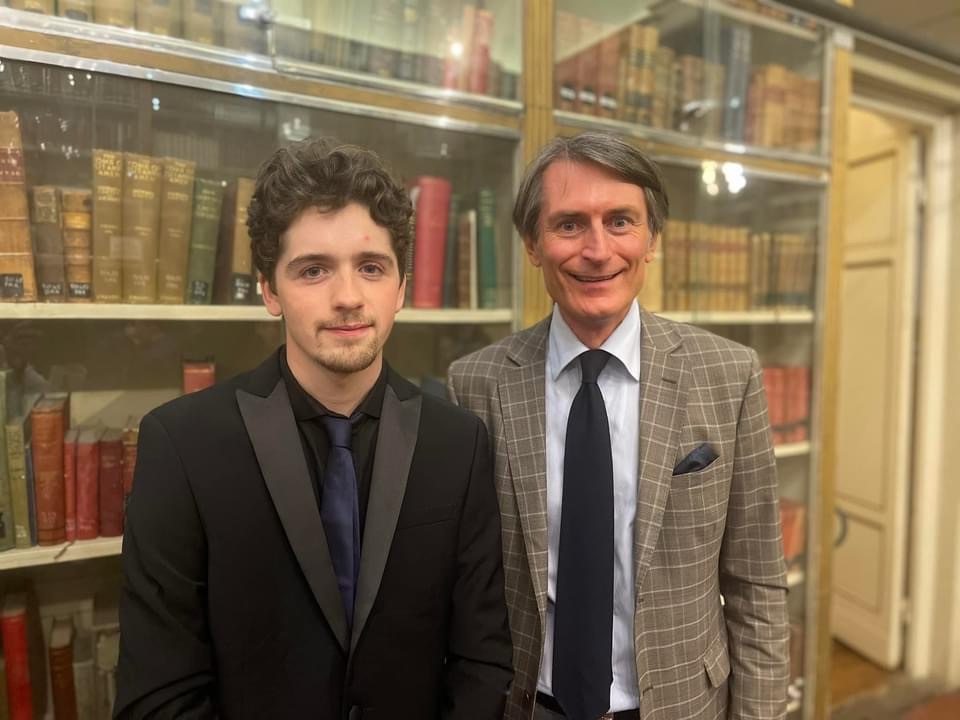
A room with a view ……not only …..as the refined sounds of a troubadour of the piano held the select audience in the Harold Acton Library spellbound.
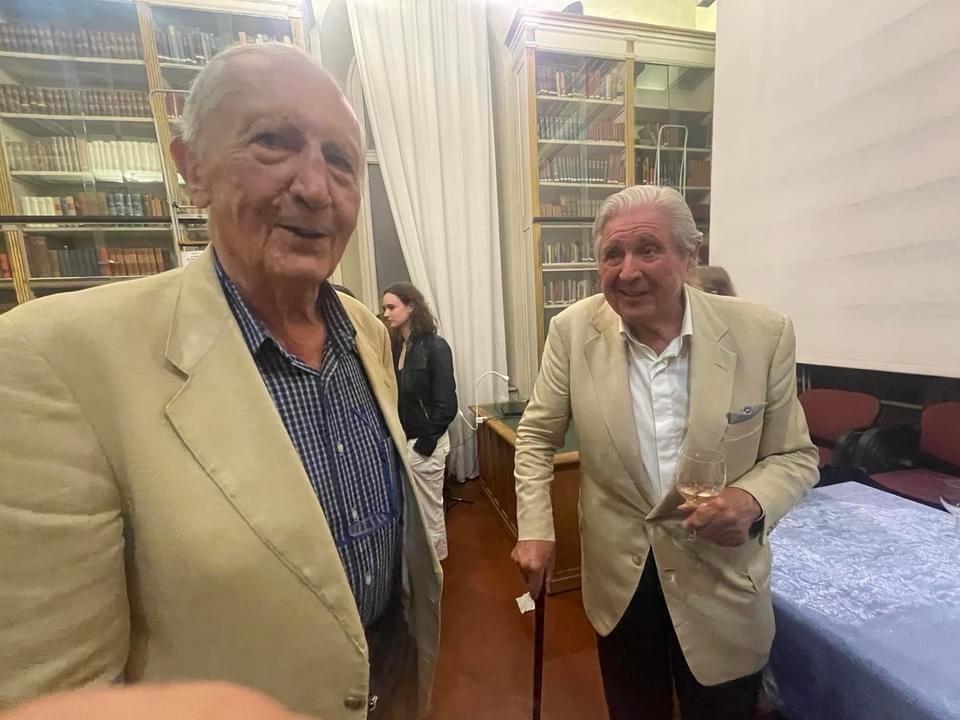
As Sir David Scholey moved by such music making declared :’every note has such a poignant significance.’
Whispered refined finesse of a young man inspired as a 12 year old schoolboy by Paul Lewis.
He had been bewitched by sounds that could comunicate from soul to soul a message that for a timid schoolboy could open up a magic world of beauty and imagination.
His dream that inspired his late start at the piano was to be able to bring to life the profound utterings of Mozart and Schubert as he had experienced from Paul Lewis .
Florence is a place where dreams become reality and this was never more true than listening on a piano that Perlemuter would have called a ‘casserole’ but which was capable in Kyles magic hands of speaking with a voice that reached deeply to all those present.

The penultimate Mozart Sonata that anyone who has studied the piano knows too well was given new life with a restrained brilliance , refine delicacy and good taste.Exquisite finesse that denied the ‘sturm und drang’ that was to come but had an innocence of whispered confessions and the restrained brilliance of its age.
Schubert’s Six Moments Musicaux written in the last year of the composers all too short life on this earth were played as exquisite tone poems of poignancy contrasted with charm and veiled beauty. Exhilaration too but only a glimpse as this was a world of mystery and revelation .
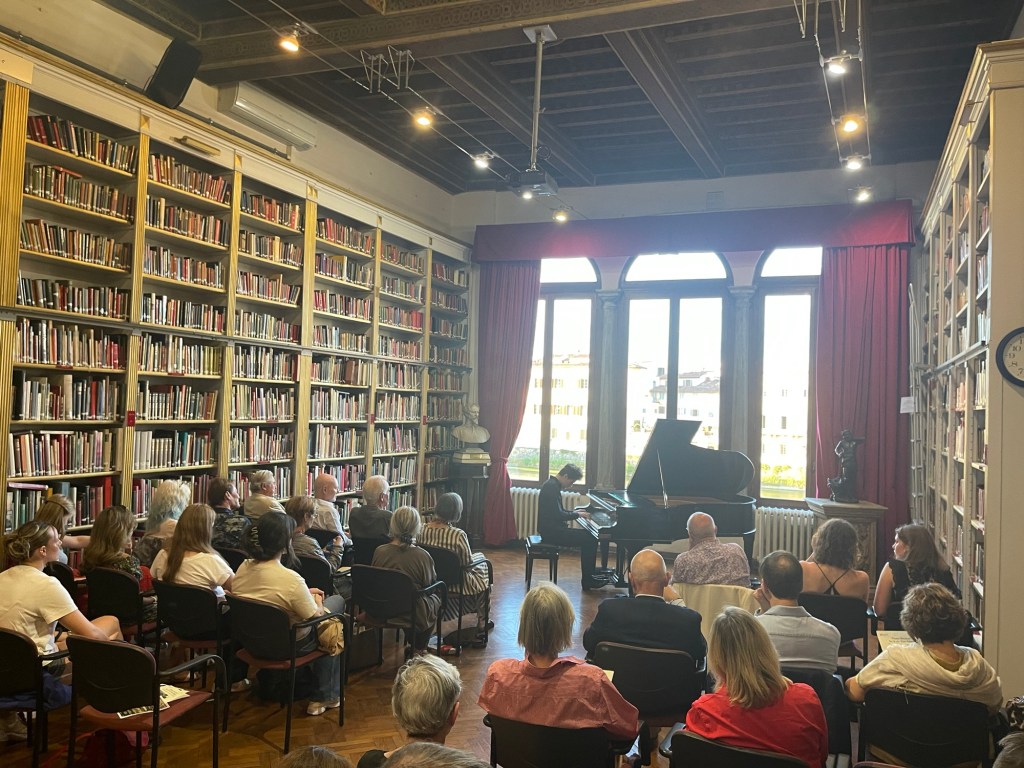
Franck’s Prelude Fugue and Variation in the Bauer transcription, was played with an ethereal beauty ,the opening melody pervading the score with breathtaking hypnotic beauty. A Fugue that was played almost without pedal as it brought a ray of clarity and reason to a magic world that Franck would have improvised on the organ at St Clotilde in Paris. Harold Bauer, a pianist originally from near to where Kyle was born in the Home counties was equally inspired to become a pianist on meeting with Paderewski when as a violinist he arrived in Paris. He was to give the first performance in America of Brahms First Concerto and Debussy even dedicated his ‘Children’s Corner Suite’ to him .It was he who made this magical transcription of one of six improvisations that Franck had dedicated to Saint Saens.

An encore of Schumann’s ‘Warum’ had Sir David wishing we could have had at least a glimpse of Florestan too after being bewitched all evening by Eusebius.
But this is a poet of the piano a real aesthete like Harold Acton whose books surrounded us and whose presence could surely be felt by all those present tonight.
https://en.wikipedia.org/wiki/Harold_Acton



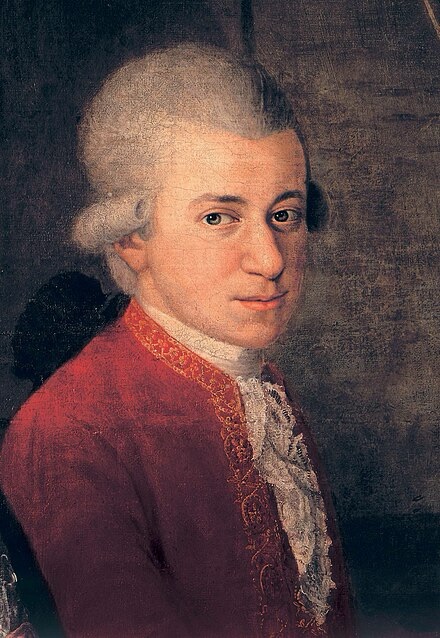
Wolfgang Amadeus Mozart
27 January 1756 Salzburg 5 December 1791 (aged 35) Vienna
The Piano Sonata No. 14 K 457, was composed and completed in 1784, with the official date of completion recorded as 14 October 1784 in Mozart’s own catalogue of works.
1. Molto Allegro
2. Adagio
3.Allegro assai
It was published in December 1785 together with the Fantasy K.475 as op 11 by the publishing firm Artaria. Mozart’s main Viennese publisher.C minor is traditionally the key of drama, passion, pathos, and pain, which also applies here in Mozart’s famous C minor sonata K. 457. He wrote it in October 1784, though what might have triggered this incredible outpouring of a “romantic” world of feeling is unknown. Half a year later, Mozart composed his C minor fantasy K. 475, an extraordinary work in every regard. Both of these C minor works were published together in one edition in 1785, meaning that they were intentionally linked together by their author, counter to convention.
In 1785 Mozart’s Sonata in C minor was published together with the composer’s Fantasia in C minor as a single opus, with the Fantasia forming a kind of introductory ‘prelude’ to the sonata. Scholars are divided as to whether or not this was Mozart’s intention. Certainly, the common key of C minor and a shared fondness for heightened musical drama link the two works. Not to mention how the practice of combining an improvisatory movement with a more formally rigorous one has traditional roots in the Baroque pairing of fantasy and fugue.
And yet this three-movement sonata is entirely capable of standing on its own. It is a small sonata with big ideas: operatic in its wide range of emotions, orchestral in many of its effects (especially its imitation of alternating orchestral ‘choirs’ of instruments), and pianistic in its unabashed display of quasi-virtuosic keyboard techniques, all of which have been cited as possible influences on – and perhaps even models for – some of the early sonatas of Beethoven in a minor key.
Piano Sonata No. 17 in B flat , K. 570, dated February 1789,The penultimate sonata of 18 written two years before his death.
- Allegro
- Adagio
- Allegretto

Franz Schubert
31 January 1797 Vienna 19 November 1828 (aged 31)
Vienna
Six moments musicaux, D.780 ( op. 94) is a collection of six short pieces for piano It has been said that Schubert was deeply influenced in writing these pieces by the Impromptus, Op. 7, of Jan Vaclav Vorisek (1791 1825) .These pieces have been described as “akin to Beethovens Bagatelles in their brevity and quixotic character.”
They were published by Leidesdorf in Vienna in 1828, under the title “Six Momens musicals “ The sixth number was published in 1824 in a Christmas album under the title Les plaintes d’un troubadour.
- Moderato
- Andantino
- Allegro moderato
- Moderato
- Allegro vivace
- Allegretto in A♭ major (ends on an open octave in an A♭minor context)
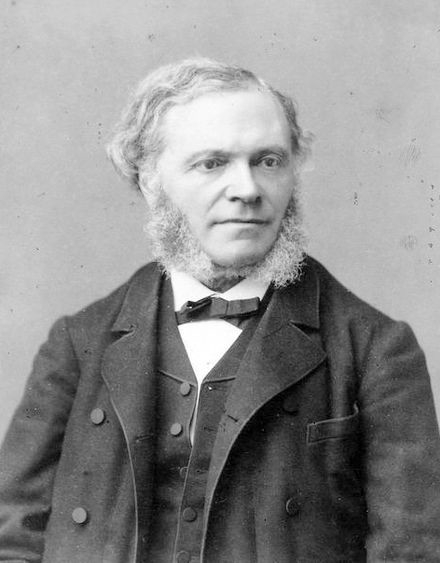
César-Auguste-Jean-Guillaume-Hubert Franck
10 December 1822 Liège. 8 November 1890 (aged 67) Paris, France
Prelude ,Fugue and Variation op 18 Franck/Bauer
Franck was the organist at several churches with early Cavaillé-Coll organs, served the company as an artistic representative, and in 1858 was appointed organist at the new basilica of St. Clotilde in Paris, where he inaugurated one of Cavaillé-Coll’s best instruments. Franck’s improvisations after church services were major public attractions, and he set some of them down in the Six Pieces he completed between 1859 and 1862. These exploited the power and colors of the Cavaillé-Coll organs to the fullest and did much to establish the distinctively French school of symphonic organ music.The Prelude, Fugue, and Variation, Op. 18, which was dedicated to Camille Saint-Saëns, himself an organist of considerable skill. Franck’s dedications do not imply portraits, but the balance and clarity of the Prelude, Fugue, and Variation do suggest the classical orientation of Saint-Saëns. The flowing B-minor Prelude has a gentle melancholy, opening almost like Bach’s “Liebster Jesu” prelude with three repetitions of an asymmetrical five-bar phrase. The Fugue has its own little prelude and clean textures, the polyphony by no means hard to follow. Rounding the three-part work is the Variation, basically a repeat of the Prelude with a more active accompaniment, fading to the light of B major.
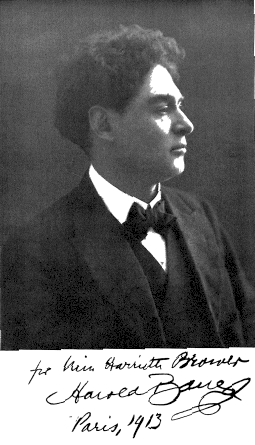
Harold Victor Bauer (28 April 1873 – 12 March 1951) was an English-born pianist of Jewish heritage who began his musical career as a violinist .Born in Kingston upon Thames ; his father was a German violinist and his mother was English. He made his debut as a violinist in London in 1883, and for nine years toured England. In 1892, however, he went to Paris and studied the piano under Paderewski for a year, though still maintaining his interest in the violin.In 1900, Harold Bauer made his debut in America with the Boston Symphony Orchestra, performing the U.S. premiere of Brahms’ Piano Concerto No.1 in D minor. On 18 December 1908, he gave the world premiere performance of Debussy’s piano suite Children’s Corner in Paris.

 ChristopherAxworthy-MusicCommentary
4 risposte a "Kyle Hutchings A poetic troubadour of the piano reveals the heart of Mozart,Schubert and Franck the Keyboard Trust Concert Tour of Adbaston ,Ischia,Florence and Milan"