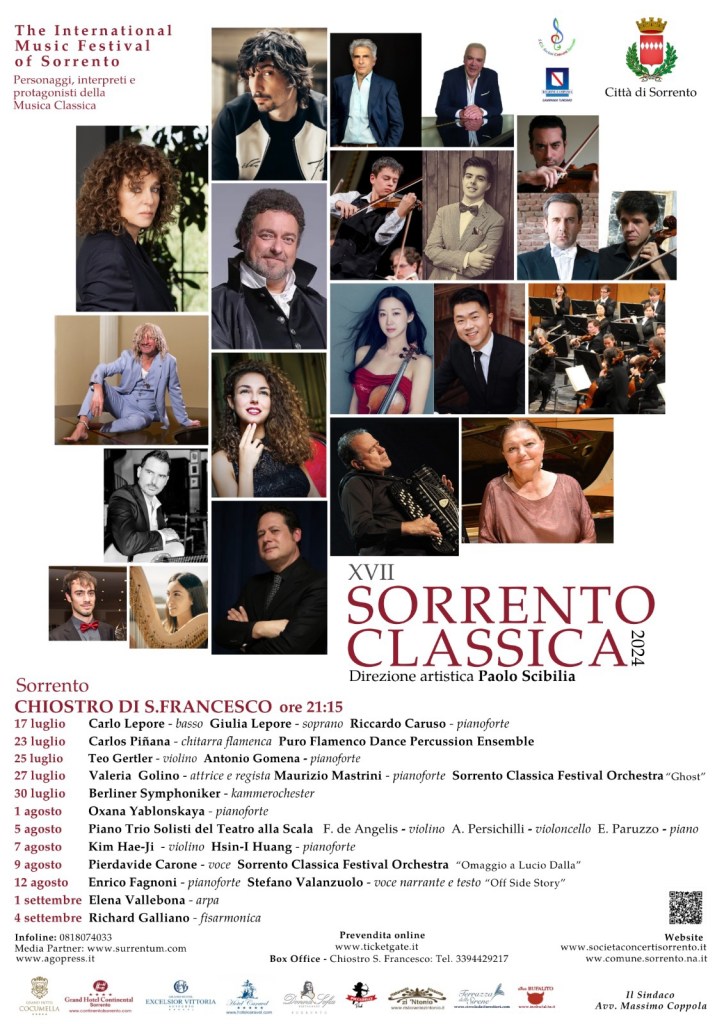
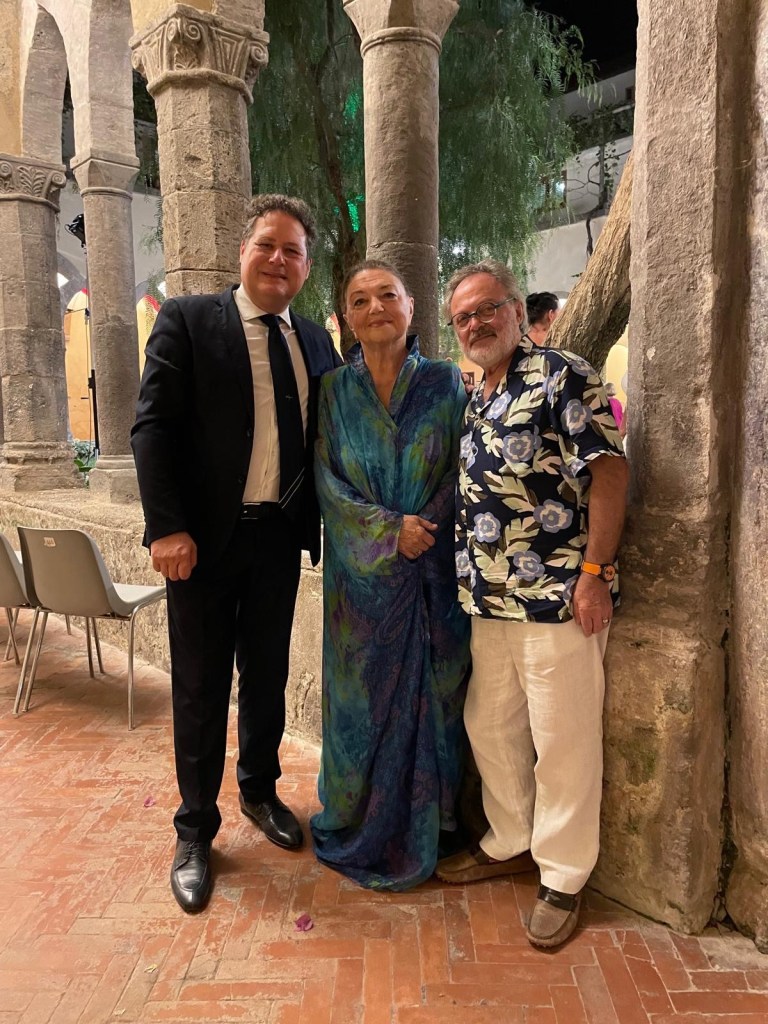
Wonderful to see the ‘Soviet Union’s best kept secret‘ being celebrated world wide while she dedicates her life selflessly to music and to helping young musicians. Oxana had played in Rome in1985 invited by Bruno Nicolai to play in the Ghione Theatre and those that heard her play Prokofiev’s Third Sonata have never forgotten it .I recently had the fortune to spend a week together with this remarkable lady in Trapani where she was chairwoman of the jury of the second edition of the International Piano competition.
Trapani the jewel of Sicily where dreams can become reality – The International Piano Competition – Domenico Scarlatti
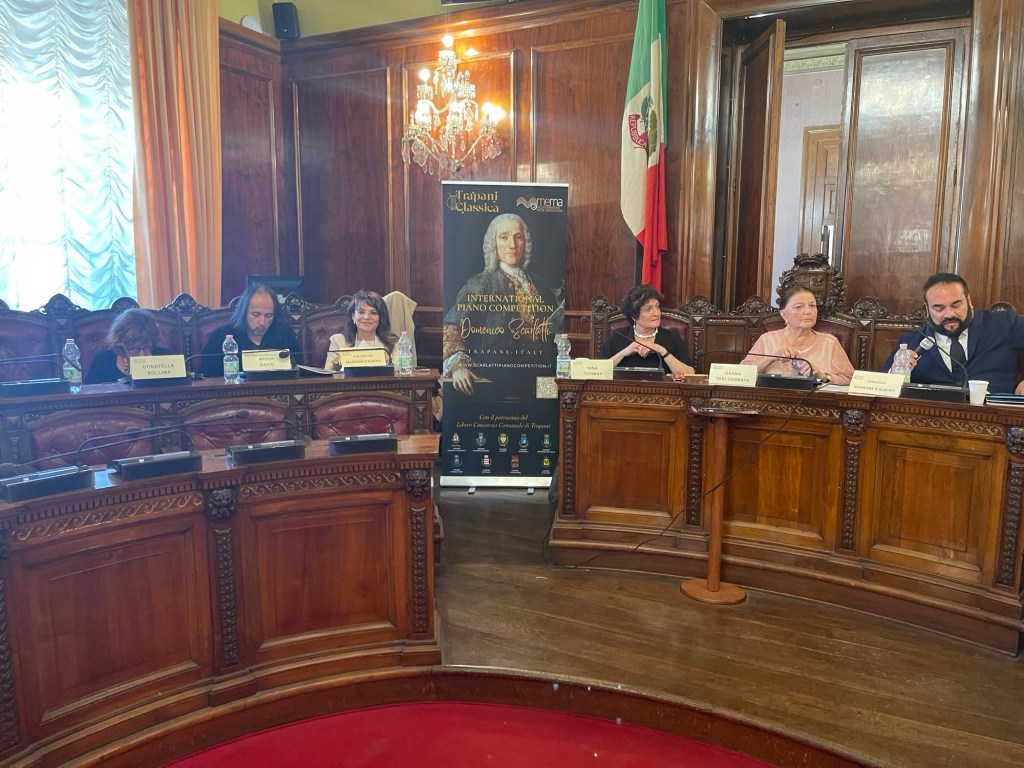
A new competition that aims to bring culture to the jewel in Sicily that is Trapani .It was a privilege to see how she listened to all the young contestants and was happy to discuss music and career with them.
A young Russian pianist ,he too an emigré in Weimar,won the first prize together with a more mature South Korean pianist ,Jeongro Park.
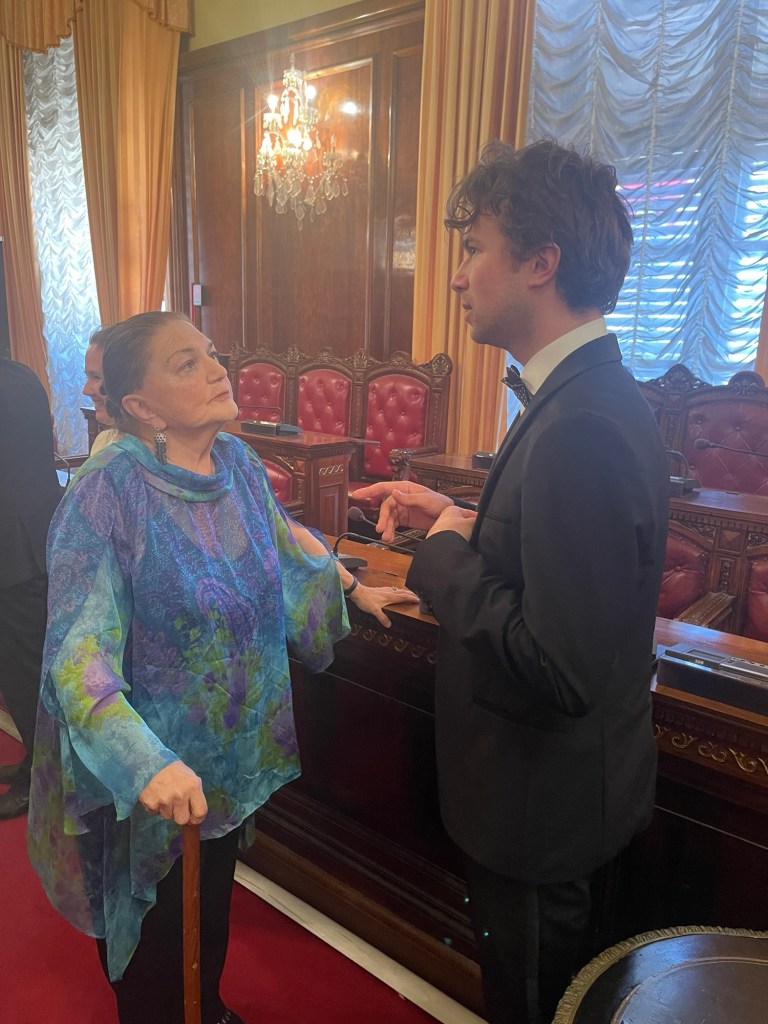

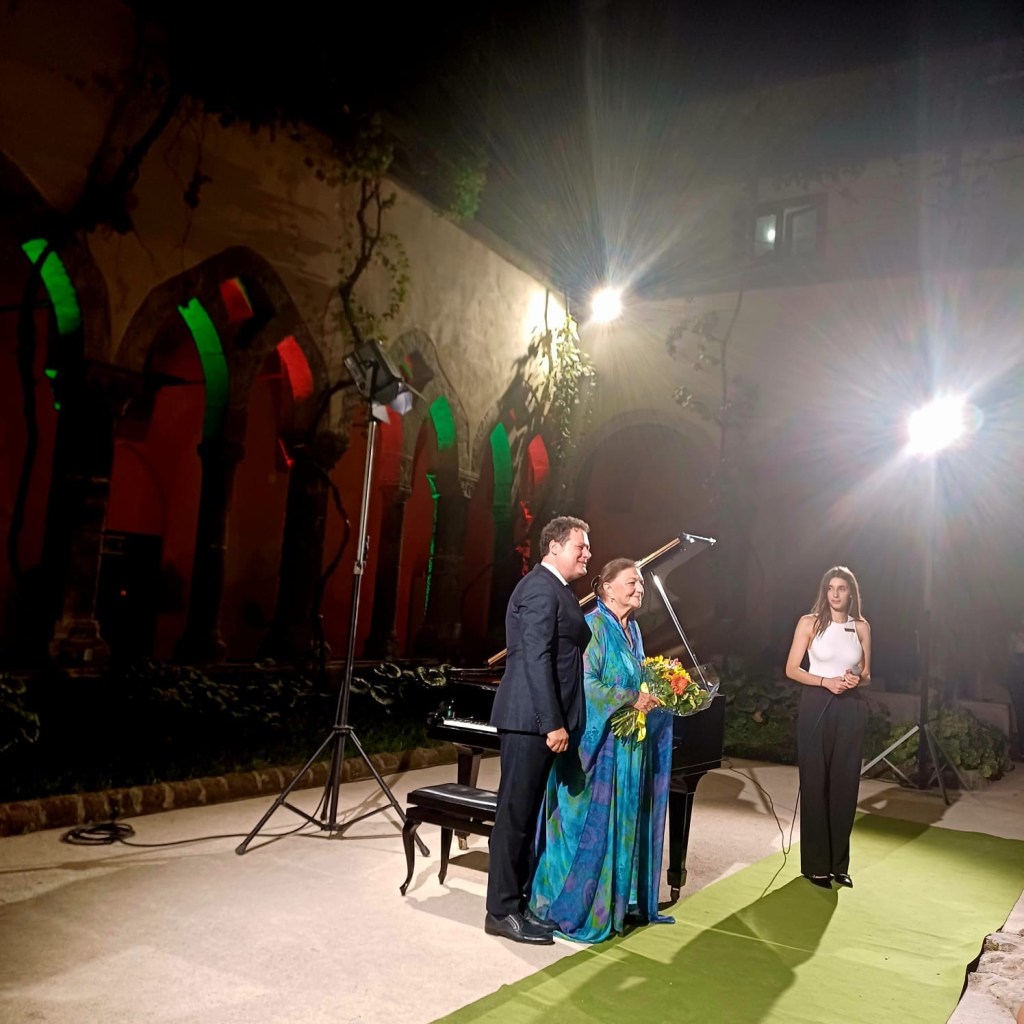
It was the attention she showed towards all the young pianists that was remarkable as was her willingness to enjoy the company of her colleagues with a ‘joie de vivre’ that was infectious.When she saw me arrive she very spiritedly said ‘Well now I will have to practice!’.There was no time to practice so after a gruelling last session on the jury she put on a beautiful gown with no wish to rest before she climbed onto the platform to give a recital that will remain in the memory of all those that were present. My poor words can never do justice to such artistry or mastery but I did my best’- she did even better!
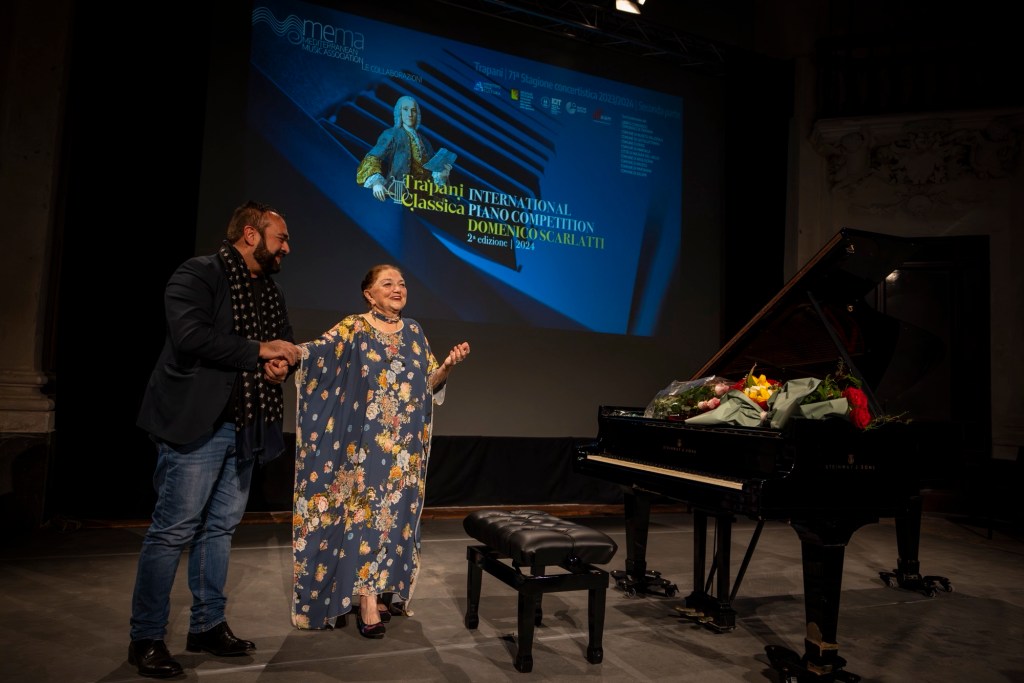
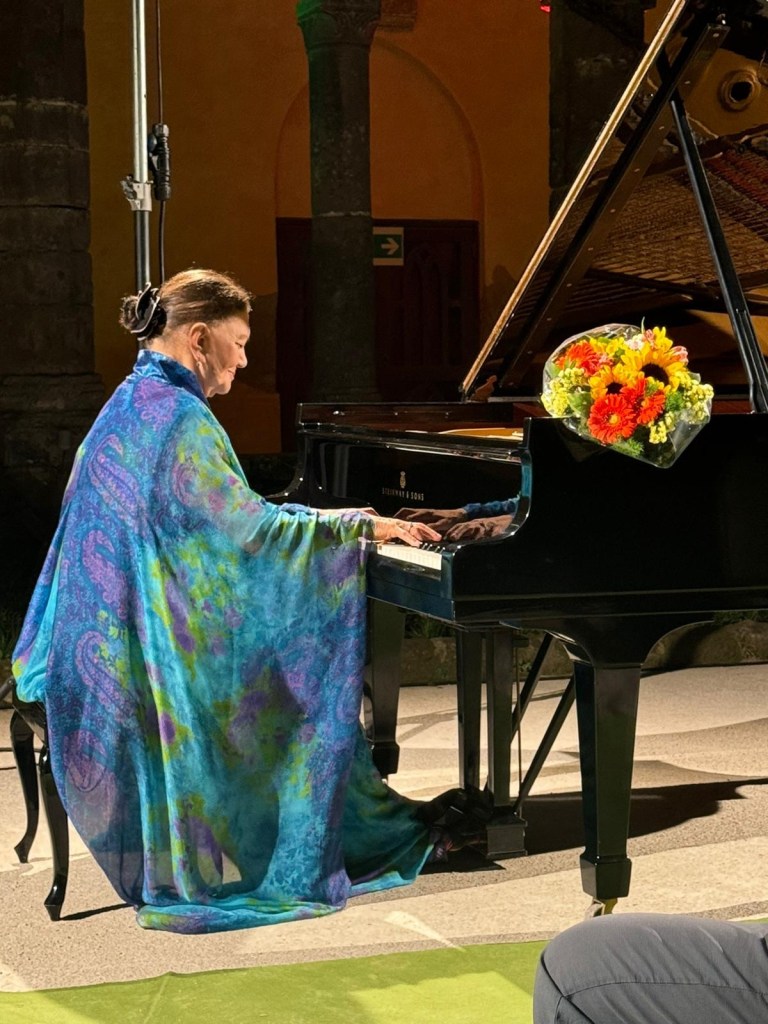
‘Today the moment she sat at the piano she became another person as the serenity and simplicity she unfolded in C.P.E Bach’s Rondo espressivo from his B minor Sonata H.245 seemed to give her the vigour and stamina to contemplate a programme that included a major Sonata by Beethoven.
The rondo was played with a delicacy and a ravishing sense of colour but above all a simplicity that allowed the music to speak for itself with disarming beauty.It is the same simplicity that Rubinstein was to share with his public when he too had reached Oxana’s age.It is a simplicity born of total mastery not only as a musician but also being able to play with such natural movements that it is like a great sage seated before us ready to recount the most wondrous stories.’
‘Relaxation in tension because to play the piano is also a physical exercise and Oxana’s technical mastery allows her to place her hands on the keys like a swimmer floating in water.The physical effort is reduced to a minimum with no superfluous crowd pleasing gestures .She like Rubinstein is there at the service of the music with the disarming simplicity of Art that disguises Art.’
‘The Beethoven she had chosen to play is one of the first major sonatas of the 32 that were to span the composers entire life.Breaking away from the model of his illustrious mentor Haydn it is in the Sonatas op 2 n 3 , op 7 and this op 10 n 3 that the composer reveals his revolutionary spirit in opening new paths into the future.It is in all three of these early sonatas that the slow movements become of great poignancy and beauty and show the depth of feeling and orchestral thinking of Beethoven.From the very first notes Oxana took us into a world of dynamic drive and suprising contrasts with the opening octaves shaped with her great artistry into a wind that blew in from a far to arrive at a light where the beautiful second subject could flourish with greater beauty but without ever sacrificing the drive that was to guide us from the first to the last note of this remarkable sonata .The dark sombre string quartet texture of the extraordinarily poignant Largo and mesto was followed by the wonderful way Oxana just allowed the minuet to float in like a ray of sunlight after such sombre brooding .The wonderful expression on this great artist’s face as Beethoven’s question and answer in the Rondo became ever more insistent .There was an ethereal ending with jeux perlé scales accompanying the still questioning left hand as it disappeared so peacefully into the depths of the keyboard .
A remarkable performance of mastery and musicianship that will long be remembered.’
She burst into the second of Brahms Rhapsodies with a kaleidoscope of colour and sumptuous richness.A breath of fresh air blew over the keys as she brought simplicity and purity to the contrasting central episode.
‘Three Chopin Mazurkas were indeed ‘canons covered in flowers’ and became miniature tone poems in Oxana’s poetic hands.There was searing beauty full of nostalgia in the barely whispered A minor op 17 which was the bridge between two boisterous folk dances of Chopin’s native homeland.’

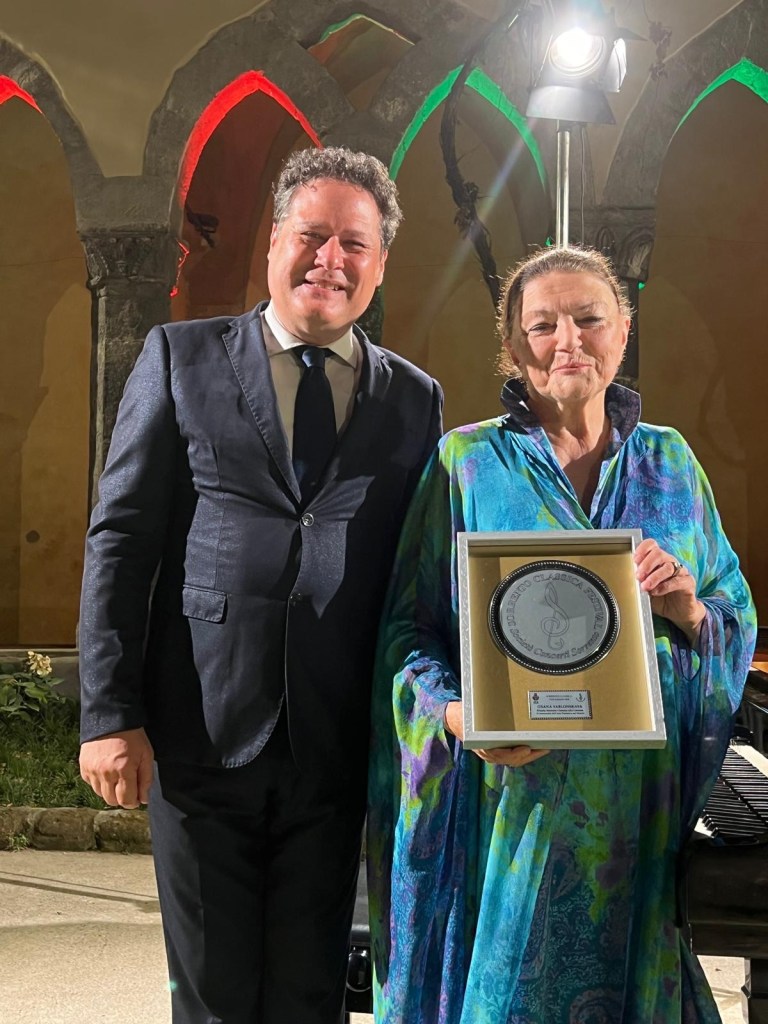
It was almost the same programme that she presented in Sorrento ,with Schubert- Liszt and Gluck instead of Mozart . She was just happy to receive such a prestigious award especially in one of the world’s most beautiful places. I was sorry not to be in Sorrento to hear such artistry again but happy that she played in a place where I had heard artists such as Shura Cherkassky,Rosalyn Tureck,Byron Janis and even her mentor Tatiana Nikolaeva .A great tradition of celebrating great artists in a unique setting.Last year the great Liszt expert Leslie Howard was awarded the Sorrento Classica award as was another great lady Marcella Crudeli the year before ( who,by coincidence,had been chairwoman of the first Trapani Competition) :
Sorrento crowns Marcella Crudeli -A lifetime in music

https://www.unita.it/2024/07/30/oxana-yablonskaya-a-sorrento-in-concerto-la-zarina-del-pianoforte/
Sorrento Classica“, in occasione della kermesse musicale in scena nella località costiera in provincia di Napoli, il primo agosto si esibirà Oxana Yablonskaya la “Zarina” del pianismo russo, che riceverà il premio alla carriera. Il festival musicale internazionale è diretto artisticamente dal Maestro Paolo Scibilia, ed organizzato dalla S.C.S. Società dei Concerti di Sorrento e dalla Città di Sorrento all’interno del programma ufficiale degli eventi della Città di Sorrento. Il 1 agosto si esibirà la grande “Zarina” del pianismo russo, Oxana Yablonskaya, mirabile esempio di senilità pianistica (classe 1938), oggi al culmine della sua settantennale e prestigiosa carriera internazionale. Per l’occasione le sarà conferito il “Premio Sorrento Classica alla Carriera”.
Oxana Yablonskaya al “Sorrento Classica”
Il programma del suo concerto, dal titolo “Grand Tsarina of Piano”, prevede C.P.E BACH Rondo Espressivo (dalla Sonata in Si min. H. 245), L. van BEETHOVEN Sonata nr. 7 in Re magg., Op. 10 n. 3 Presto – Largo e mesto (re minore) – . Minuetto. Allegro – Rondò. Allegro, J. BRAHMS Rapsodia Op. 79 nr. 2, C.W. GLUCK – O. YABLONSKAYA – Melodia (dall’Opera “Orfeo ed Euridice”), F. SCHUBERT – F. LISZT. Standchen;Auf dem Wasser zu singen ;Gretchen am Spinnrade, F. CHOPIN Cinque Mazurche.
Oxana Yablonskaya, di origine Russa e naturalizzata statunitense dal 1977, è definita dalla critica internazionale “il segreto meglio custodito dell’Unione Sovietica”.
Chi è Oxana Yablonskaya e il premio alla carriera
Insignita col prestigioso titolo di “Solista della Filarmonica di Mosca” e di “Artista Emerita Melodya” (la principale casa discografica statale dell’Ex – Unione Sovietica), è annoverata a pieno titolo tra gli artisti d’élite russi, del calibro di Gilels, Richter, Rostropovich, Oistrakh e Kogan. Formatasi al Conservatorio di Mosca con i leggendari maestri Aleksandre Goldenweiser and Tatiana Nikolayeva, è stata vincitrice dei primi premi al concorso “Jacques Long-Thibaud” (Parigi 1963), “Rio de Janeiro” (1965) e “Beethoven” (Vienna 1969). Nota soprattutto quale una delle migliori interpreti di Rachmaninoff e Tchaikovsky, è stata anche la prima interprete assoluta del “Basso Ostinato” di Rodion Shchedrin, che è diventato il suo pezzo distintivo.
La zarina del pianismo russo
Oltre al suo enorme successo come pianista concertista e artista discografica, Yablonskaya ha ricoperto la carica di Professore di pianoforte alla Julliard School di New York Per l’occasione le sarà conferito il “Premio Sorrento classica alla carriera”. Di origine Russa e naturalizzata statunitense dal 1977, Oxana Yablonskaya è definita dalla critica internazionale “il segreto meglio custodito dell’Unione Sovietica“. Nota soprattutto quale una delle migliori interpreti di Rachmaninoff e Tchaikovsky, è stata anche la prima interprete assoluta del “Basso Ostinato” di Rodion Shchedrin, che è diventato il suo pezzo distintivo. Oltre al suo enorme successo come pianista concertista e artista discografica, Yablonskaya ha ricoperto la carica di professore di pianoforte alla Julliard School di New York.

Martha Noguera in Rome and Sorrento ‘The authority and passionate conviction of a great artist.’

Born in Moscow to a Jewish family, Yablonskaya was a pupil of pianist Anaida Sumbatyan at the Moscow Central School for the Gifted where she studied from the ages of six through sixteen. She then pursued further studies in her native city with Alexander Goldenweiser upon entering the Moscow Conservatory as well as Goldenweiser’s Assistant Dmitry Bashkirov. She was a student of Tatiana Nikolaeva in her Doctorate program. After graduating from the conservatory in 1965, she joined the school’s piano faculty. She went on to win top prizes in the Long-Thibaud – Crespin Competition in 1963, Rio de Janeiro Piano Competition in 1965 and the Vienna Beethoven Competition in 1969.
Yablonskaya was invited to perform with orchestras and in concert halls in the West during the 1960s and 1970s, but was never allowed to accept the engagements by the Soviet government. She also performed throughout the USSR and made numerous recordings on the Melodya label. She was named a “Soloist of the Moscow Philharmonic” and was also highly active as a soloist with the Bolshoi Orchestra
In 1975 Yablonskaya, along with her father and son, applied for a visa to emigrate to the United States, a move which caused her to be fired from her post at the Moscow Conservatory and which blacklisted her from all concert venues in the USSR. She waited for over two years to obtain a visa which was approved largely due to a petition which had been organized by American composers, conductors, musicians, movie actors, writers and senators such as Elie Wiesel, Isaac Bashevis Singer, Leonard Bernstein, Stephen Sondheim, Katharine Hepburn, Shelley Winters, Norman Mailer, Henry F. Miller and many others. The family came to New York City in 1977 and later that year Yablonskaya gave a critically acclaimed recital at Carnegie Hall. This launched her career in the west, and she went on to appear with many of the world’s finest symphony orchestras. As recording artist, Oxana Yablonskaya recorded for labels such as Melodiya, Connoisseur Society, Naxos, Bel Air, Pro Piano. Mme. Yablonskaya is the Winner of Grand Prix du Disque from the Liszt Society in Budapest for her recording of music by Schubert-Liszt and Liszt. She is an Honorary Academician of the International Academy of the Arts at the United Nations, International Academy of the Arts in San Francisco and Independent Academy of Liberal Arts at the Russian Academy of Sciences. She is recipient of the Einstein Medal for Outstanding Achievements in the Arts.
Yablonskaya is Online Master Teacher at Classical Academy with whom she has recorded several online Masterclasses.
Yablonskaya’s son, Dmitry Yablonsky, has become a noted cellist. Educated at Juilliard, he has become principal cellist of the Bergen Symphony Orchestra in Norway,[and they have given mother and son recitals to critical acclaim.
In 2016 Prof. Yablonskaya immigrated to Israel, where she now teaches at the Jerusalem Academy of Music and Dance and continues to dazzle audiences throughout Israel and abroad.



 ChristopherAxworthy-MusicCommentary