

On the eve of his 30th birthday, Tyler Hay offers a surprise present to his audience – a hand-picked selection of the most virtuosic, dramatic, expressive, melodic and deliciously charming studies ever written for the piano. It will be a unique recital
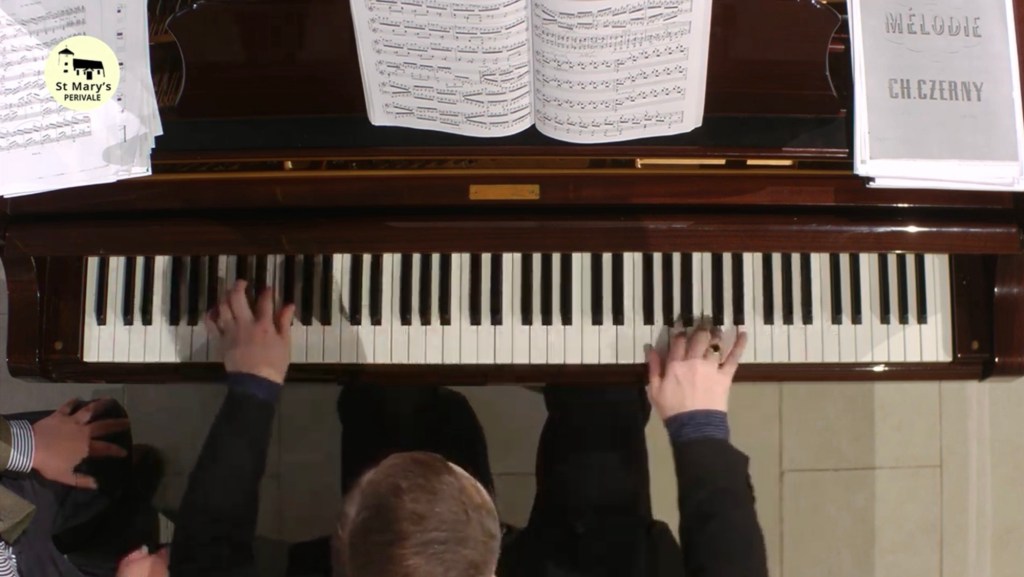
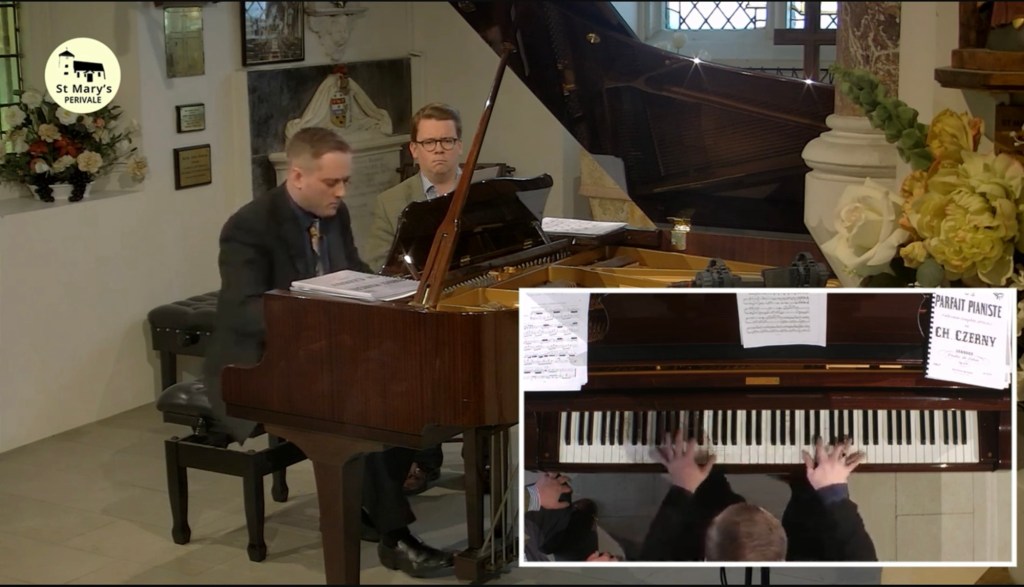
Happy Birthday Tyler together on stage with Mark Viner who celebrated his birthday just a few days ago .Two of the finest most eclectic young virtuosi both from the class of Tessa Nicholson.And with what humility and simplicity they both share their extraordinary talent bringing to life music that we have only read about in encyclopaedias.And bringing to life Tyler certainly did with 24 studies by Czerny of Gradus ad Parnassum fame whose opus numbers reach out to op 861 and beyond!

What jewels they are with a choice of 24 that show a range of styles from Mendelssohnian charm to virtuosistic Liszt opera paraphrases of Rossinian ‘joie de vivre’.There were studies of impish quixotic good humour and coquettish charm with the same freshness and innocence that we associate with the salon works of the Victorian period.Never too serious even though attempting a fugato in n. 46 from op 822.
But there was such character to each of these miniature gems that sparkled and shone as they spun from Tyler’s masterly fingers with an ease and a jeux perlé of quite extraordinary subtlety.What was so remarkable was the clarity and beauty of sound that Tyler brought not only to the mellifluous song without words studies but also to the more energetic transcendentally difficulty ones.

A remarkable ‘tour de force’ as this youngster on the last day in his twenties becomes a mature master ready to take the world by storm just as his page turner has been doing since he too passed the same starting point a few years ago.
Mark Viner at St Mary’s ‘Mastery and mystery of a unique artist and thinking musician.’




Tyler Hay was born in 1994 and first showed a prodigious talent for the piano when he won the Dennis Loveland award in Kent for his performance of Liszt’s Mephisto Waltz no 1 at the age of 11. He gained a place to study at the Purcell School in 2007 where he studied under Tessa Nicholson. He continued his studies with Graham Scott and Frank Wibaut at the Royal Northern College of Music and with Niel Immelman and Gordon Fergus-Thompson for a Masters degree at the Royal College of Music. Tyler has performed programmes at Wigmore Hall, Cadogan Hall and the Purcell Room and has played Ravel’s Concerto for Left Hand Alone at the Queen Elizabeth Hall and Saint-Saëns’ Piano Concerto no 2 at Symphony Hall with the City of Birmingham Symphony Orchestra. In 2016, Tyler won first prize in the keyboard section of the Royal Overseas League Competition and as well as winning the RNCM’s Gold medal competition, also won first prize in the Liszt Society International Competition. Tyler won 1st prize in the Dudley International Piano Competition in November, 2022. CDs of Liszt, John Ogdon, Kalkbrenner and Field are available on Brilliant Classics and an album of virtuoso piano music by contemporary British composer Simon Proctor is also available on Navona Records.
Tyler Hay reaching for the stars.’From candlelight to starlight’.A masterly display of artistry and showmanship at St Martin in the Fields
Tyler Hay and David Zucchi celebrate the work of Radamés Gnattali at the Sala Brasil

21 February 1791 Vienna – 15 July 1857 Vienna
Carl Czerny was an Austrian composer, teacher, and pianist of Czech origin .His vast musical production amounted to over a thousand works and his books of studies for the piano are still widely used in piano teaching. He was one of Beethoven’s best-known pupils and would later on be one of the main teachers of Liszt.As a child prodigy, Czerny began playing piano at age three and composing at age seven. His first piano teacher was his father, who taught him mainly Bach,Haydn and Mozart . He began performing piano recitals in his parents’ home. Czerny made his first public performance in 1800 playing Mozart’s Concert in C minor K.491.
At the age of fifteen, Czerny began a very successful teaching career. Basing his method on the teaching of Beethoven, Clementi and Hummel teaching up to twelve lessons a day in the homes of Viennese nobility.In 1819, the father of Franz Liszt brought his son to Czerny, who recalled:
‘He was a pale, sickly-looking child, who, while playing, swayed about on the stool as if drunk…His playing was… irregular, untidy, confused, and…he threw his fingers quite arbitrarily all over the keyboard. But that notwithstanding, I was astonished at the talent Nature had bestowed upon him.’
Liszt became Czerny’s most famous pupil. He trained the child with the works of Beethoven, Clementi, Moscheles and Bach . The Liszt family lived in the same street in Vienna as Czerny, who was so impressed by the boy that he taught him free of charge. Liszt was later to repay this confidence by introducing the music of Czerny at many of his Paris recitals.Shortly before Liszt’s Vienna concert of 13 April 1823 (his final concert of that season), Czerny arranged, with some difficulty (as Beethoven increasingly disliked child prodigies) the introduction of Liszt to Beethoven. Beethoven was sufficiently impressed with the young Liszt to give him a kiss on the forehead.[16] Liszt remained close to Czerny, and in 1852 his Transcendental Studies were published with a dedication to Czerny.
Czerny left Vienna only to make trips to Italy, France (in 1837, when he was assisted by Liszt) and England. After 1840, Czerny devoted himself exclusively to composition. He wrote a large number of piano solo exercises for the development of the pianistic technique, designed to cover from the first lessons for children up to the needs of the most advanced virtuoso. Czerny died in Vienna at the age of 66. He never married and had no near relatives. His large fortune he willed to charities (including an institution for the deaf), his housekeeper and the Society of Friends of Music in Vienna, after making provision for the performance of a Requiem mass in his memory.
Czerny composed a very large number of pieces (more than one thousand and up to op. 861).
Czerny’s works include not only piano music (études, nocturnes, sonatas, opera theme arrangements and variations) but also masses and choral music, symphonies, concertos, songs, string quartets and other chamber music. The better known part of Czerny’s repertoire is the large number of didactic piano pieces he wrote, such as The School of Velocity and The Art of Finger Dexterity. He was one of the first composers to use étude (“study”) for a title. Czerny’s body of works also include arrangements of many popular opera themes.
The majority of the pieces called by Czerny “serious music” (masses, choral music, quartets, orchestral and chamber music) remain in unpublished manuscript form and are held by Vienna’s Society from the Friends of Music , to which Czerny (a childless bachelor) willed his estate.

 ChristopherAxworthy-MusicCommentary
Una risposta a "Tyler Hay at St Mary’s Perivale ‘The Perfect Pianist comes of age ‘"