

Ravel: Miroirs
Noctuelles (‘Moths’)
Oiseaux tristes (‘Sad birds’)
Une barque sur l’océan (‘A boat on the ocean’)
Alborada del gracioso (‘The jester’s aubade’)
La vallée des cloches (‘The valley of bells’)

Rachmaninov : 6 Morceaux for piano duet Op 11
Barcarolle, Scherzo, Chanson Russe, Valse, Romance and Slava.
Ravel’s evocative Miroirs were played with ravishing colours and technical brilliance .
From the fleeting moths calmed for a moment by the solemn tolling of a languid chant before flitting off with featherlight ease and grace.Roman created just the sultry atmosphere in which the saddest of birds could sing their lament with glowing fluidity.Cascades of notes swept from his fingers as the waves enveloped the boat on the ocean before being calmed and with a miraculous song of thanks giving being floated with whispered magic on the now calmest of seas. Rhythmic energy and recitativi with the pulsating Spanish throbbing of passionate cries in Alborada that only a French composer could truly describe .A technical mastery that could cope with Ravel’s insinuating double notes and triple glissandi as only few could do.And finally a calm and desolate landscape where bells are heard in the distance with sounds without beginning or ending only proving that as T.S. Eliot says in the beginning is our end as infinite sounds reverberate in the distance.
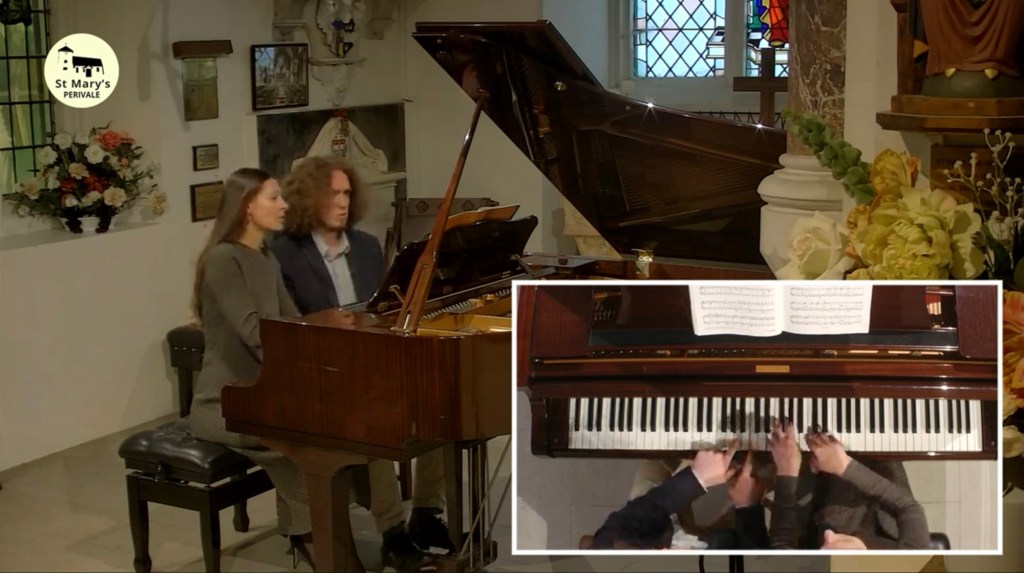
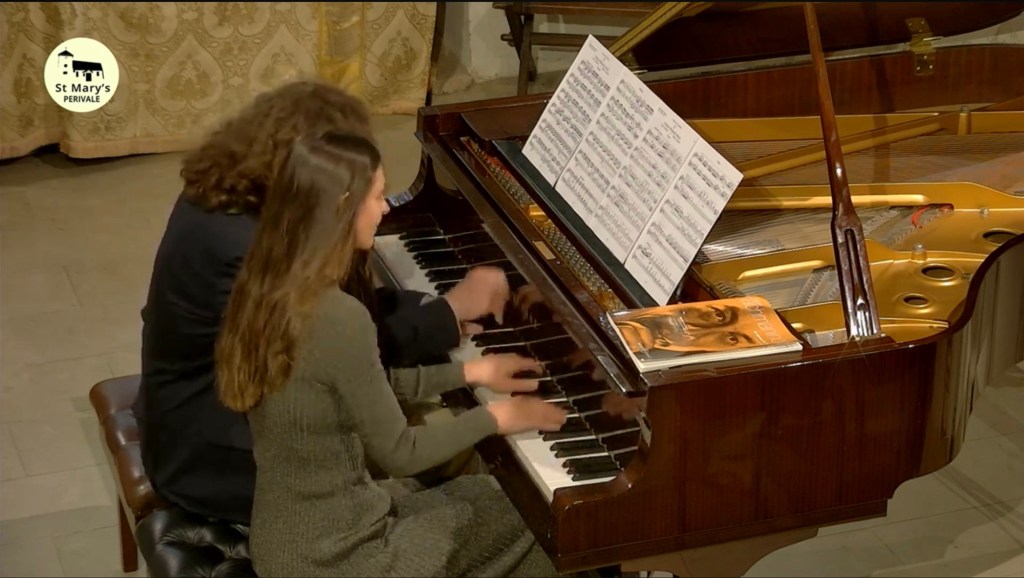
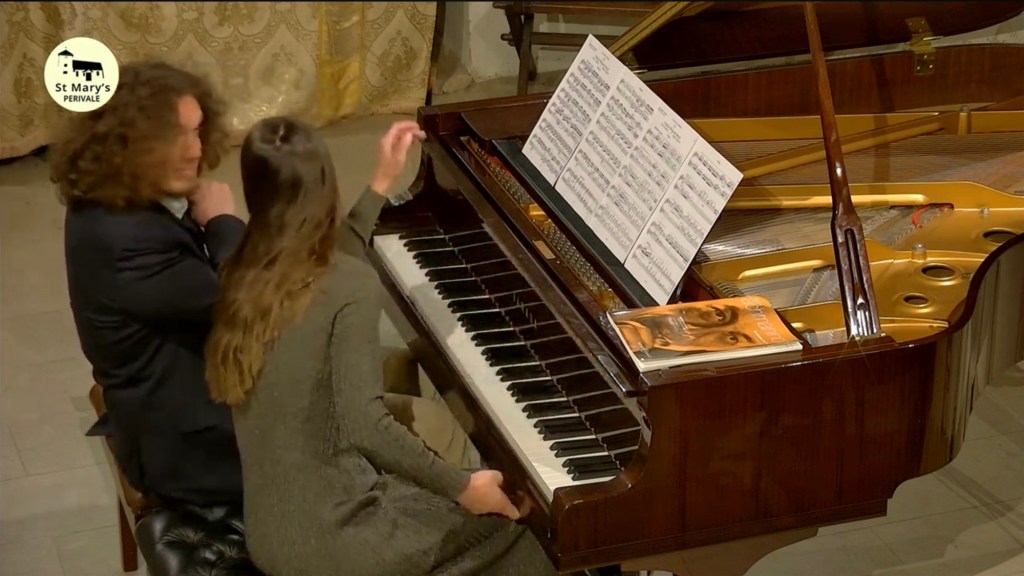
This was the landscape that Roman so nobly depicted in sound today and it was wonderful to meet his wife who is certainly his peer pianistically but had also discovered during the pandemic a talent to paint the sea in pastels as she and her husband were guests in Hastings where Roman had been winner and is now ambassador of their International Piano Competition.Rachmaninov’s beguiling early suite for piano duet op 11 was played by husband and wife with charm,style and not a little Russian nostalgia.And charm there was too in the little encore by Respighi apparently based on Christmas which had Tanya leaping down to the bass to have the last word over her husband.
A truly joyous occasion of wonderful music making ‘en famille’
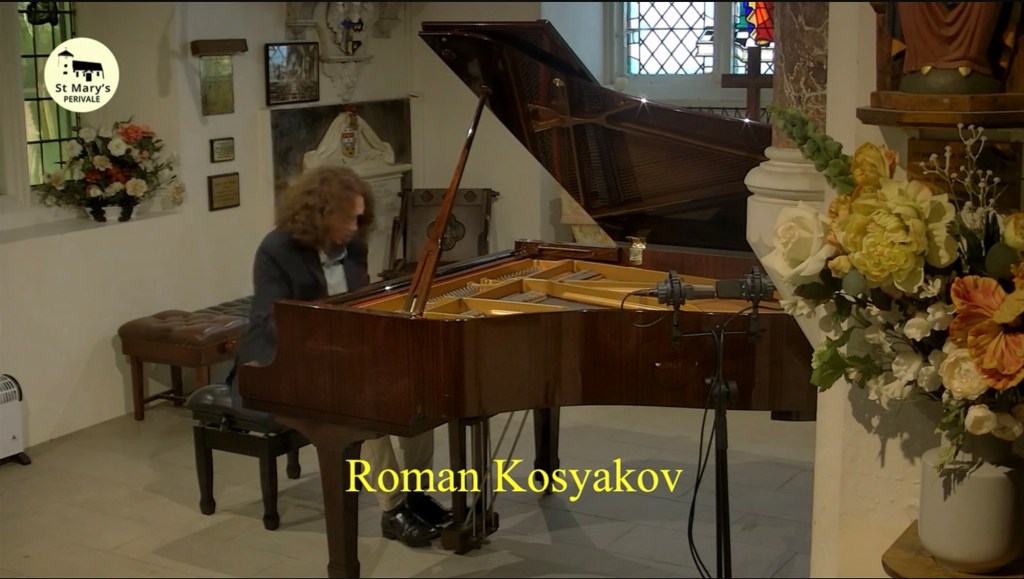
Roman Kosyakov is a Russian pianist, Ambassador for the Hastings International Piano Concerto Competition . He is a laureate of many international competitions : most recently he won the Third Prize and The Bridget Doolan Prize for the best performance of a piece by Mozart of The 12th Dublin International Piano Competition (Ireland, 2022); First Prize, Orchestra Prize and an Audience Prize of the XV Campillos International Piano Competition (Spain, 2021); a s part of “Fitzroy Piano Quartet” Roman won the Royal Over-Seas League Annual Music Competition string ensembles section (UK, 2020 ); Second Prize of the UK Piano Open International Piano Competition (UK, 2020); First Prize and the Orchestra Prize of the 14th Hastings International Piano Concerto Competition (UK, 2018) .Roman’s performance career includes engagements in the most important venues and festivals across the UK, US and Europe such as Kings Place, St James Piccadilly, St Mary’s Perivale and Cadogan Hall in London, Sursa Performance Hall in Ball State University, Lemington Festival, Battle Festival, Furness Classical, North Norfolk Festival, West Meon Festival and European Chamber Academy Leipzig. In 2019 recorded a debut CD for “Naxos” with works by Liszt.
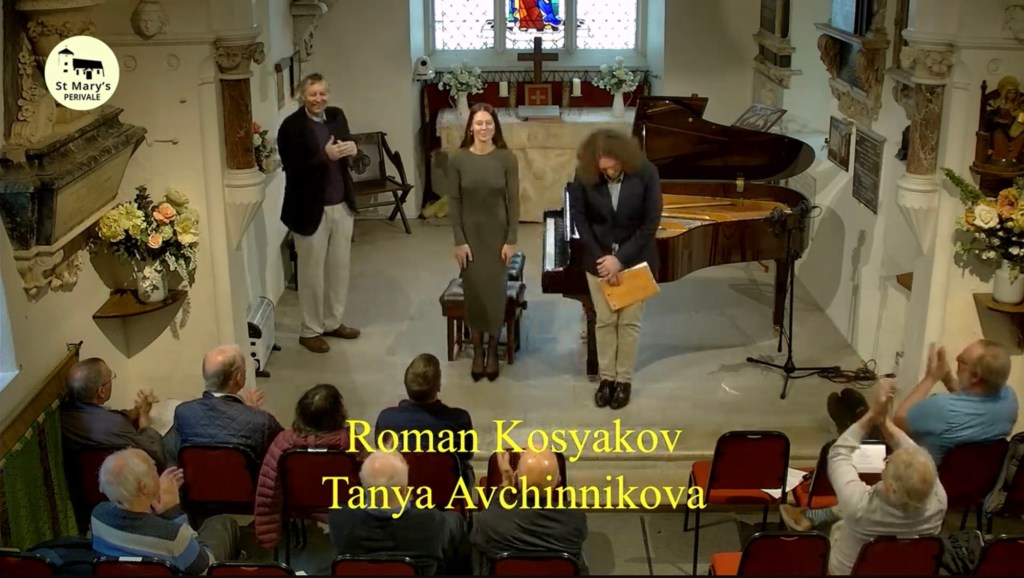
Tanya Avchinnikova is a pianist and an award winning soft pastel artist. After graduating from Belorussian Academy of Music and The Royal Birmingham Conservatoire she started her artists career. Recently she received the Unison Colour young artist award 2022; Enduring Brilliance, NY – President’s Award, 2023 and the Pastel Society West Design Faber Castell Award , 2023. Tanya is also a Member of Pastel Society UK and a Signature Artist of Pastel society of America.
Roman Kosyakov a Masterly light shining brightly at St Marys
Roman Kosyakov Hastings prize winners’ concert with the RPO at Cadogan Hall under Kevin John Edusei

Joseph Maurice Ravel 7 March 1875 – 28 December 1937
“Miroirs” – Ravel dedicated each of these five piano pieces to a member of the Parisian artistic circle “Les Apaches”. Ravel also belonged to this circle of poets, painters and musicians, giving first performances of many of his works at gatherings of this illustrious group.
In “Miroirs” he went a step further than in “Jeux d’eau”. The music was to sound as if it came from a sketchbook. The bold harmony irritated his contemporaries at first but pointed the way ahead for Ravel’s subsequent works. Around 1900, Maurice Ravel joined a group of innovative young artists, poets, critics, and musicians referred to as Les Apaches or “hooligans”, a term coined by Ricardo Vines to refer to his band of “artistic outcasts”.To pay tribute to his fellow artists, Ravel began composing Miroirs in 1904 and finished it the following year. It was first published in 1906 and first performed by ricardo Vines inn that year. The third and fourth movements were subsequently orchestrated by Ravel, while the fifth was orchestrated by Percy Grainger among others.
Noctuelles” (“Night Moths”) is dedicated to Léon – Paul Fargue and is a highly chromatic work, maintaining a dark, nocturnal mood throughout. The middle section is calm with rich, chordal melodies, and the recapitulation takes place a fifth below the first entry.
Oiseaux tristes” (“Sad Birds”) is dedicated to Ricardo Vines this movement represents a lone bird whistling a sad tune, after which others join in.
“Une barque sur l’océan” (in English “A Boat on the Ocean”). Is dedicated to Paul Sordes , the piece recounts a boat as it sails upon the waves of the ocean. Arpeggiated sections and sweeping melodies imitate the flow of ocean currents and is the longest piece of the set.”Alborada del gracioso” (Spanish: “The Jester’s Aubade / Morning Song of the Jester”) is dedicated to Michel-Dmitri Calvocoressi , Alborada is a technically challenging piece that incorporates Spanish musical themes into its complicated melodies.
La vallée des cloches” (“The Valley of Bells”) is dedicated to Maurice Delage and evokes the sounds of various bells through its use of sonorous harmonies.

Sergei Rachmaninov
1 April 1873, Novgorod Russia – 28 March 1943 Beverly Hills , California, U.S.
Composed in 1894, the Six Morceaux, op. 11 for piano four-hands is among the finer compositions of Rachmaninoff’s youthful period following his studies at the Moscow Conservatory. The opening Barcarolle in G minor is dark and mysterious, its gently rocking rhythms depicting a gondolier navigating the Venetian canals beneath a moonlit sky. The piece builds to a dazzling climax with rapid figurations atop the rich and powerful chords so typical of Rachmaninoff’s piano music. These same figurations return to close the piece in a much brighter mood than it began. The following Scherzo in D major is a sprightly and brilliant composition with a relentless rhythmic drive. There is no actual Trio section, but instead a coquettish secondary theme that momentarily hold the Scherzo’s impetuosity at bay.
Occupying the third position in the set is the Chanson Russe, a set of variations on an unknown folk song. The piece begins quietly but builds quickly into a majestic variation in which the theme is heard against a rushing counterpoint of sixteenth notes. From this climax, the music recedes through a quiet variation only to be roused again at the final cadence. Next, the Valse is reminiscent of Chopin in its amalgamation of different waltz tunes. However, the style is certainly that of Rachmaninoff and possesses a power that is at odds with both the graceful Viennese dance and the ruminations of Chopin. Yet, the Valse is not wholly without elegance.
Fifth in the set is the Romance. In C minor, it is a passionate piece with a particularly poignant principal theme that seems to anguish over some grief. Brief moments of light shine across the otherwise dismal canvas of the Romance, but never break the otherwise gloomy air. Lastly, Slava! (Glory) closes the set. A set of variations based on the Russian chant used by Mussorgsky in Boris Godunov, it provides the opus 11 with a majestic and towering conclusion. The Six Morceaux are among the earliest of Rachmaninoff’s mature works. Rachmaninoff had graduated from the Moscow Conservatory in 1892, and-only two years later-had already made a reputation for himself as a pianist and as a composer. These little pieces reflect themes of yearning and display some of Rachmaninoff’s famous intricate passagework. The Morceaux are often considered as the forerunners of his later 13 Preludes, Op. 32, from 1910.
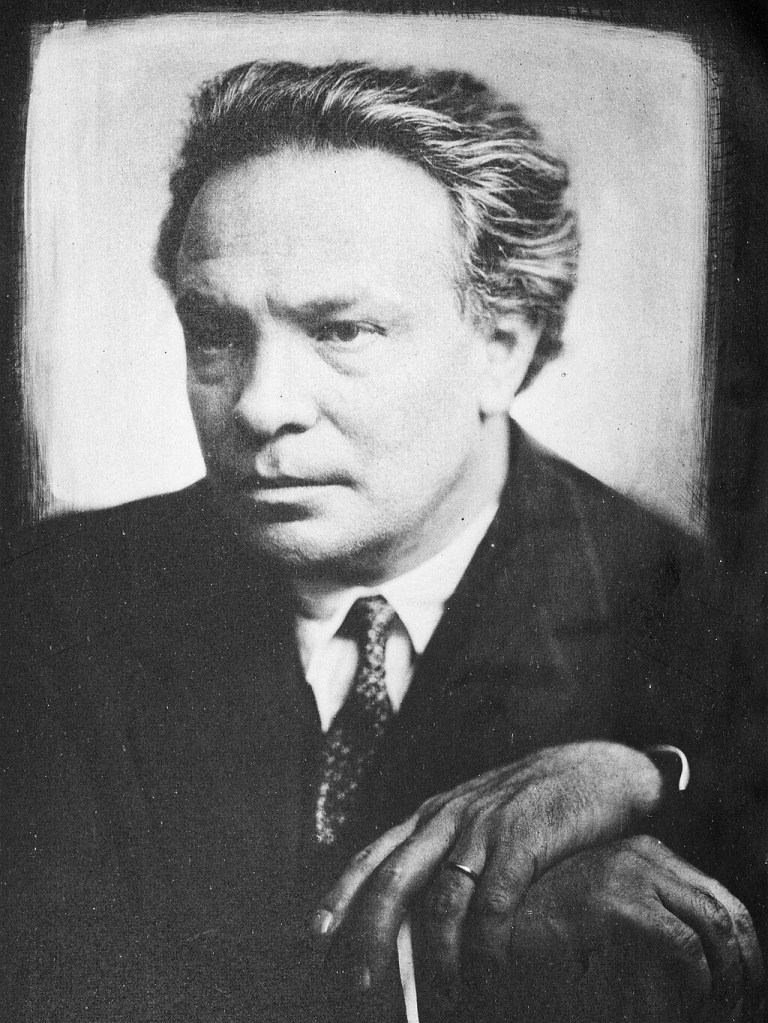
9 July 1879 Bologna 18 April 1936 Rome, Italy
If there is a neglected area of Italian music, it is piano music, and in particular that for four-hands .Ottorino Respighi was a member of Italian classical music’s ‘golden generation’ for whom the opera was not the be-all and end-all. Yes, he composed operas, twelve to be exact, but his fame firmly rests on his orchestral output, which included the interesting and well worth investigating Sinfonia Drammaticaas well as concertos. People usually know his music through his Roman Triptych but he also composed some very engaging works on a smaller scale, including string quartets, works for violin and piano and piano works, of which the Sonata in F minor is very good. He was also to arrange some of his orchestral music for piano four-hands.Six Pieces which are quite short and remarkable.
Respighi: Six little pieces for piano duet of which Roman and Tanya chose the fourth as an encore
- Romanze
- Sizilanisches Jagdlied
- Armenisches Lied
- Weihnacht, Weihnacht!
- Schottische Weise
- Die kleinen Hochländer
The six pieces open with a Romanza which would be quite at home played by a musical box; the spritely tinkering fingers produces a pleasant melody. There is a more boisterous Canto di caccia siciliano, which has the air of a Neapolitan song, followed by a Canzone armena which is more lilting. This is followed by a jolly Christmas tune which was played today as an encore : Natale, Natale! But it is the final two pieces of the set which come as the main surprise here. The Cantilena scozzese and the Piccoli highlanders offer the listener music of a distinct Scottish lilt, charming.
 ChristopherAxworthy-MusicCommentary