
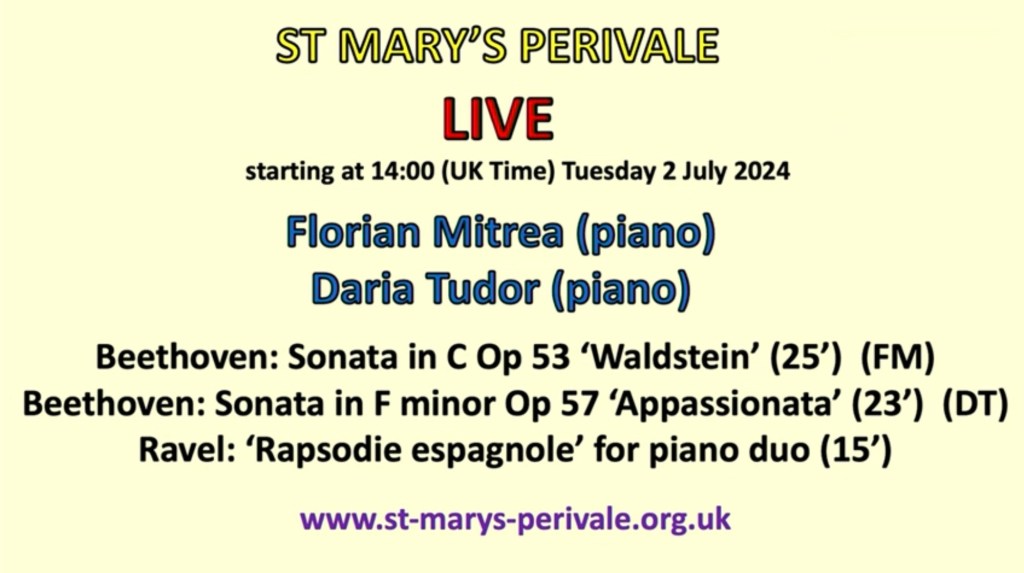
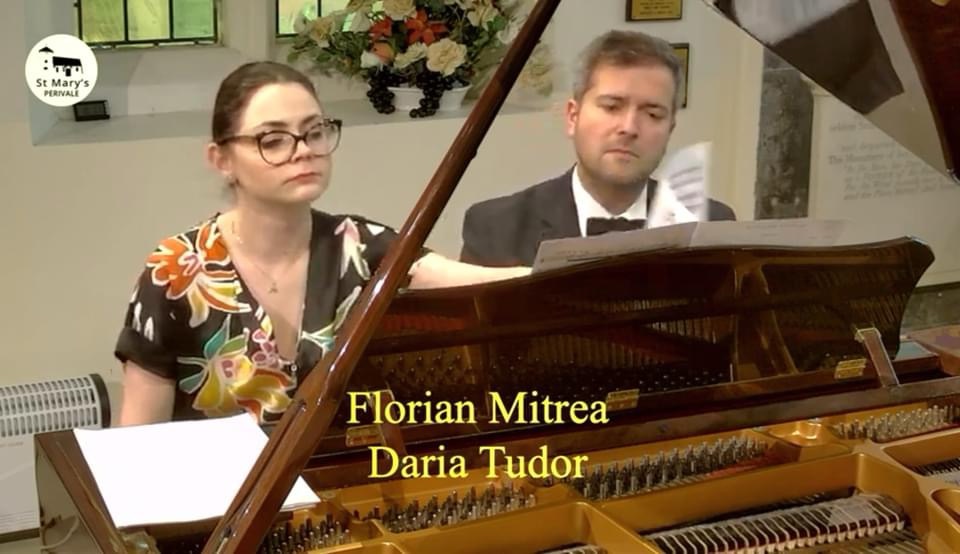
Party time in Perivale but not before two very serious interpretations of Beethoven’s ‘Waldstein’ and ‘Appassionata’ Sonatas.
Playing from both pianists of great integrity where Beethoven’s precise indications were scrupulously noted .Daria with impeccable playing of intelligence and clarity , a luminosity of sound and no rearranging of Beethoven’s irascible cascades of notes also following his pedal indications with impeccable musicianship and technical prowess.
Florian too with his limpet like fingers that seem to belong to the keys and with his personal vision of the more pastoral ‘Waldstein’ compared to the ‘Appassionata’s’ ‘ river of energy and anger’ . Equally scrupulous in their respect for Beethoven and both with a technical mastery that allowed them to interpret the composers precise indications without being tainted by tradition.It was this scrupulous attention to detail that brought a ravishing sense of colour and animal excitement to their interpretation of Ravel’s early Spanish Rhapsody.

Daria beginning with the ‘Appassionata’ that Florian thought was a more suitable start being ‘ a river of energy and anger’ before his image of a more pastoral ‘Waldstein’.I think too it was the impeccable gentleman who wanted to allow his colleague to play for the first time on a stage that he knows already well. It was a performance of great intelligence and integrity with the opening kept tightly under control, the trills with spring like precision and the rests scrupulously observed.There was menace too in the four note motive that is to pervade much of Beethoven’s work in this period ,played with great precision.As was the opening cascade of notes that she played as written by Beethoven with one continual movement (many ‘pianists’ rearrange the distribution between the hands like in op 111 to avoid any risk ) where she was not afraid to accept the challenge of the composer from the very first notes.There was also a luminosity of sound and rhythmic drive behind the notes allied to absolute precision and clarity.Some beautiful shading in the mellifluous second subject before the explosion of the irascible Beethoven of this period. No nicely pointed top notes on these outbursts but just torrents of notes played with dynamic rhythmic drive.A coda that almost came unstuck but was called immediately to arms with the ‘sang froid’ of a great professional keeping the tempo right to its final resting place with a relentless forward movement.Some beautiful playing in the ‘Andante con moto’ that has been likened to a funeral procession such is its sombre string quartet quality.Here we missed the limpet fingers of her colleague who would have delved much deeper into the keys than Daria who slightly missed the solidity of one of the themes that Beethoven uses in many of his sonatas as a basis for a series of variations (Op.109 and 111) .The variations unwound beautifully from Daria’s sensitive fingers taking us to Beethoven’s alarm call before the perpetuum mobile of the ‘Allegro ma non troppo’.Here one could really perceive Florian’s description of ‘a flood of energy and anger’ and Daria played with impeccable precision and style with a coda of breathtaking dynamic drive.
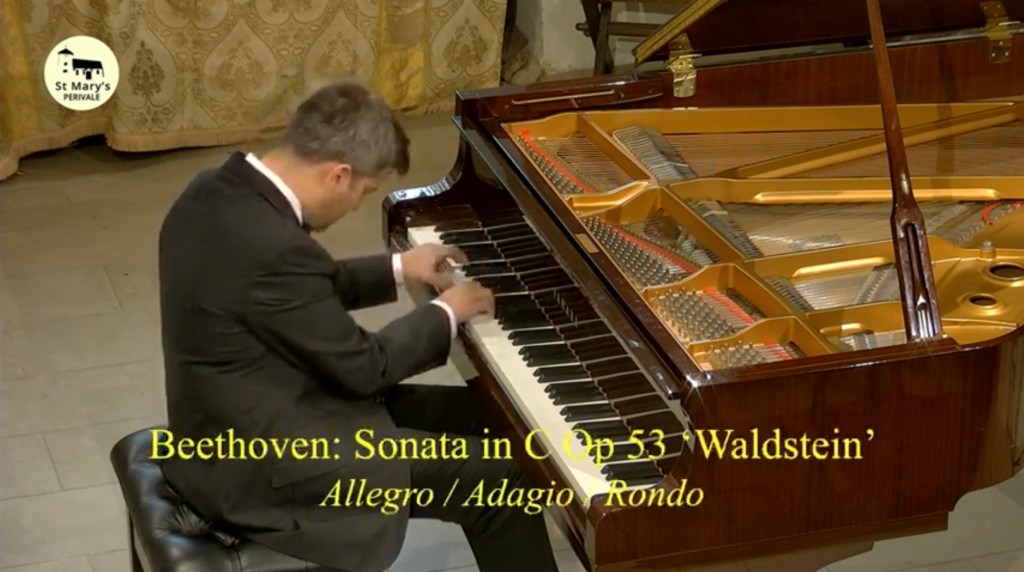
Florian perceives the ‘Waldstein’ as more pastoral but it actually fits Delius’s flippant description of Beethoven as being all scales and arpeggios ( Bach he also dismissed as knotty twine!).Florian is a stylist with his limpet like fingers that seem to belong to the keys.A perfect tempo was set that allowed the second subject to be part of an architectural whole and was played with impeccable musicianship but sometimes turning corners too beautifully for Beethoven in this sonata where he leaves lots of ragged edges on purpose.There was a beautiful depth of sound to the ‘Adagio molto’ which Beethoven describes as an ‘introduzione’ as the original slow movement he discarded ( later published as the Andante Favori) .Beethoven obviously wanted the second and third movements to be joined in an atmosphere of pastoral simplicity but Florian in my opinion chose a tempo in six instead of two which divorced the two elements one from the other instead of linking them.Beautifully played with real feeling but surely the staccato is more portamento especially at the tempo he chose.However it lead beautifully into the Rondo even if the final ‘g’ sounded like a call to arms instead of a gentle link to the same note that floats on a sea of undulating sounds at the beginning of the Rondo. Beauty, dynamic control and technical mastery united in a movement that is really a great technical trial for pianists.Following Beethoven’s instructions with impeccable musicianship and style he even managed to play the treacherous glissandi on a modern piano .It is no mean feat on a piano with a weight that Beethoven’s pianos would not have had.(Serkin used to lick his fingers before attempting the glissandi others tend to slow the pace to be able to play the octave glissandi surreptitiously with two hands).Perfectly placed trills were played with great clarity and brought this very stylish performance to a brilliant end.
I could not help thinking what perfection there would be if Daria shared her impeccable precision with Florian and he shared his supreme stylism with her.

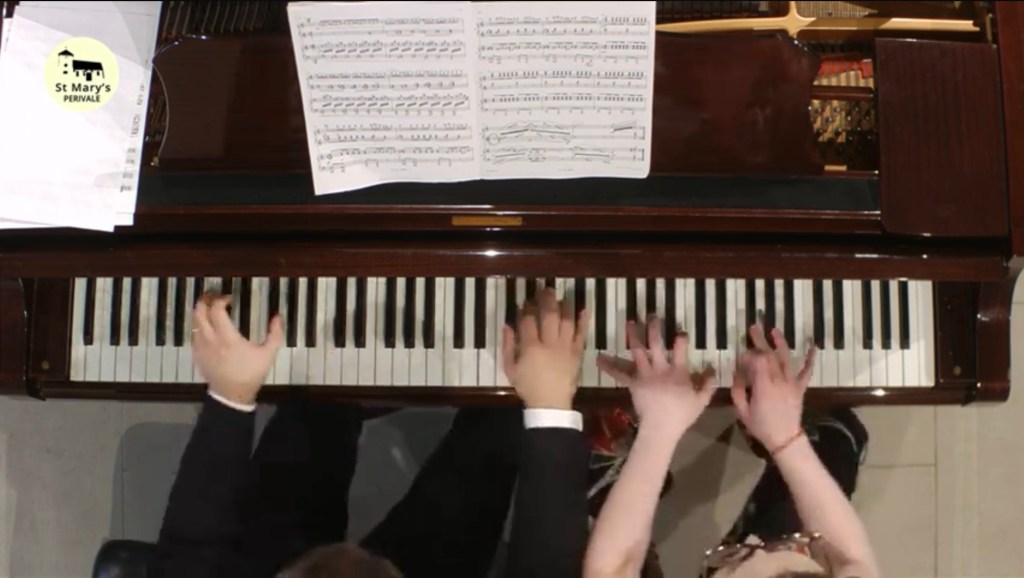
My wish was granted ,or course,as they joined forces for a performance of Ravel for four hands at one piano.Florian in the bass with the pedals and Daria in the treble leading the way.Their combined mastery and complimentary musicianship gave a performance of dynamic drive especially in the final exhilarating pages of the ‘Feria’.But there was also great beauty as in the ‘Habanera ‘ that Ravel was very wary to point out was written long before other of his French colleagues had strayed into the Spanish territory.


Winner of the Best Young Artist of the Year Award at the 2019 Cincinnati Art of the Piano International Festival, Pianist Daria Tudor debuted at the age of 9 with the Romanian Radio Chamber Orchestra. She rapidly went from being a child prodigy, appearing in concert halls across her native Romania, to performing in programmes of institutions such as the Berliner Philharmoniker and Deustchlandfunk Kultur, in international festivals including the Mozartfest in Würzburg and the Encuentro de Musica in Santander, and as soloist with orchestras in Belgium and Italy. She has partnered Patricia Kopantschinskaja, Andrei Ioni?a, and Zakhar Bron, and her concerts portfolio stretches from the Werner Hall, USA and St Martin-in-the-fields, London, to Akishino Hall – Kyoto. Currently a scholarship student at the UdK in Berlin, Daria has been recommended by eminent pianist Elisabeth Leonskaja and has studied with Maria João Pires at the Queen Elisabeth Music Chapel, Belgium.

Described by Martha Argerich as ‘an outstanding young pianist’, British-Romanian pianist Florian Mitrea was a double-laureate at the Glasgow, Hamamatsu, and Munich-ARD International Piano Competitions. He won the piano section of the Royal Overseas League Music Competition and was a major prize winner at the Harbin – China, St Priest, and James Mottram-Manchester International Piano Competitions. His prize at the 2018 New York International Piano Festival led to his debut performance at Carnegie Hall. Florian has performed as a soloist with the Royal Scottish National Orchestra, the Philharmonia in London, Elbland Philharmonie in Dresden, Collegium Musicum in Basel, the Romanian National Radio Symphony Orchestra, and the George Enescu Philharmonic. A recitalist and concerto soloist at festivals such as Lucerne and Enescu – Bucharest, Florian has also performed at the Bozar Centre in Brussels, the Bunka Kaikan Hall in Tokyo and the Sonic Concert Hall in Oomiya City, the Seoul Arts Centre, the Harbin Concert Hall, and in the UK at the Usher Hall – Edinburgh, Royal Concert Hall – Glasgow, Bridgewater Hall – Manchester, King’s Place and St Martin in the Fields in London.
Florian Mitrea – born free at St Mary’s
Piano Sonata No. 21 in C major Op. 53, known as the Waldstein, is one of the three most notable sonatas of Beethoven’s middle period ( the other two being the Appassionata op 57 and Les Adieux op 81) Completed in summer 1804 and surpassing Beethoven’s previous piano sonatas in its scope, the Waldstein is a key early work of Beethoven’s “Heroic” decade (1803–1812) and set a standard for piano composition in the grand manner.
The sonata’s name derives from Beethoven’s dedication to his close friend and patron Count Ferdinand Ernst Gabriel von Waldstein member of Bohemian noble Waldstein family (Valdštejn) and is the only work that Beethoven dedicated to him.It is also known as L’Aurora (The Dawn) in Italian, for the sonority of the opening chords of the third movement, thought to conjure an image of daybreak.
Piano Sonata No. 23 in F minor, op.57 Appassionata,was composed during 1804 and 1805, and perhaps 1806, and was dedicated to Count Franz von Brunswick.
Appassionata was not named during the composer’s lifetime, but was labelled in 1838 by the publisher of a four =- hand arrangement of the work. Instead, Beethoven’s autograph manuscript of the sonata has “La Pasionata” written on the cover, in Beethoven’s hand.
One of his greatest and most technically challenging sonatas , the Appassionata was considered by Beethoven to be his most tempestuous piano sonata until the 29th known as the Hammerklavier op 106 .1803 was the year Beethoven came to grips with the irreversibility of his progressive hearing loss.
Composed between 1907 and 1908, the Rapsodie is one of Ravel’s first major works for orchestra. It was first performed in Paris in 1908 and quickly entered the international repertoire. The piece draws on the composer’s Spanish heritage and is one of several of his works set in or reflecting Spain.The genesis of the Rapsodie was a Habanera, for two pianos, which Ravel wrote in 1895. It was not published as a separate piece, and in 1907 he composed three companion pieces. A two-piano version was completed by October of that year, and the suite was fully orchestrated the following February.At about this time there was a distinctly Spanish tone to Ravel’s output, perhaps reflecting his own Spanish ancestry.To counter any accusations of plagiarism, Ravel made certain that the date 1895 was clearly printed for his Habanera in the published score of the Rapsodie.
The Rapsodie has four movements; Prélude à la nuit ;Malagueña ;Habanera;Feria
 ChristopherAxworthy-MusicCommentary