
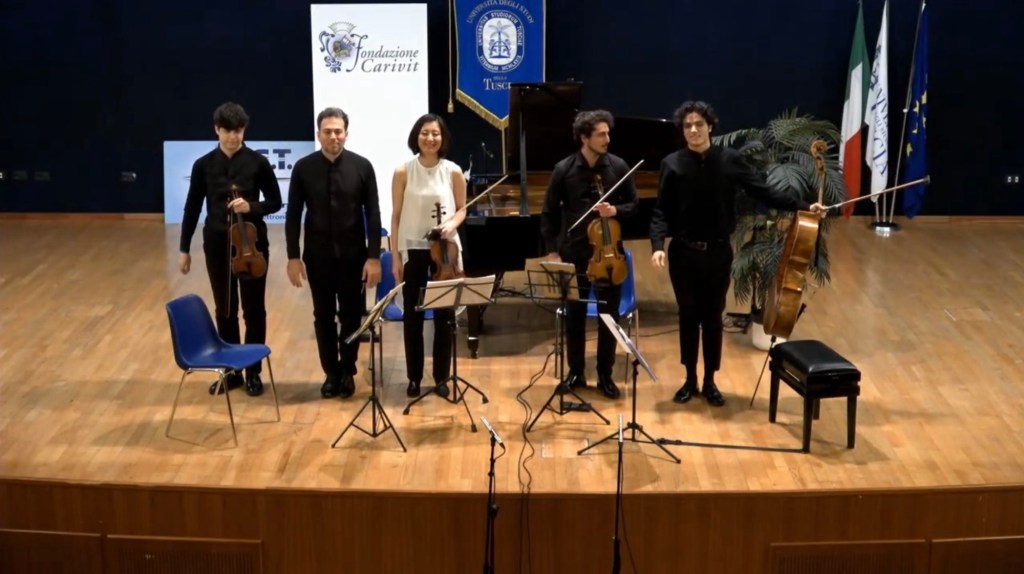
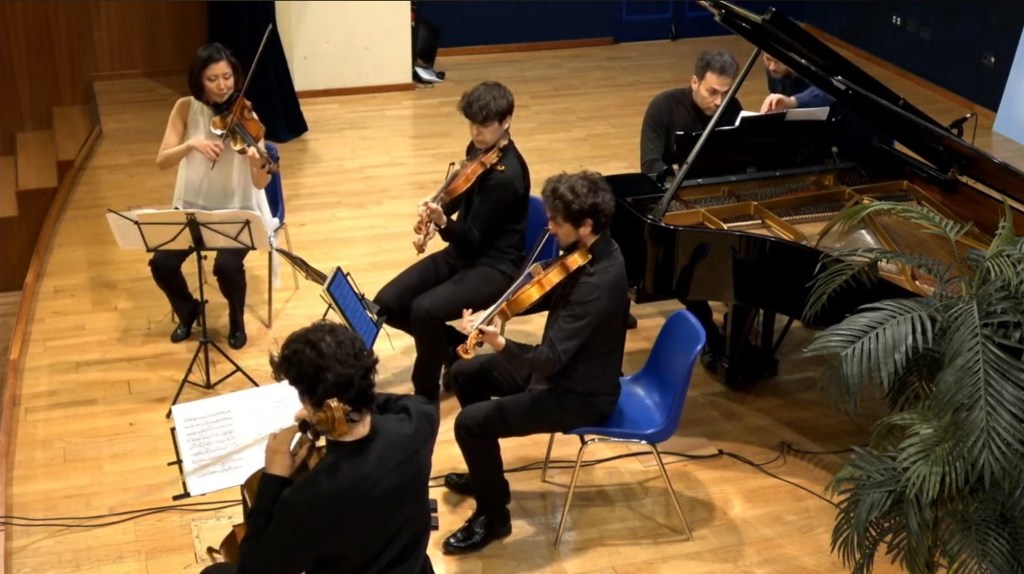
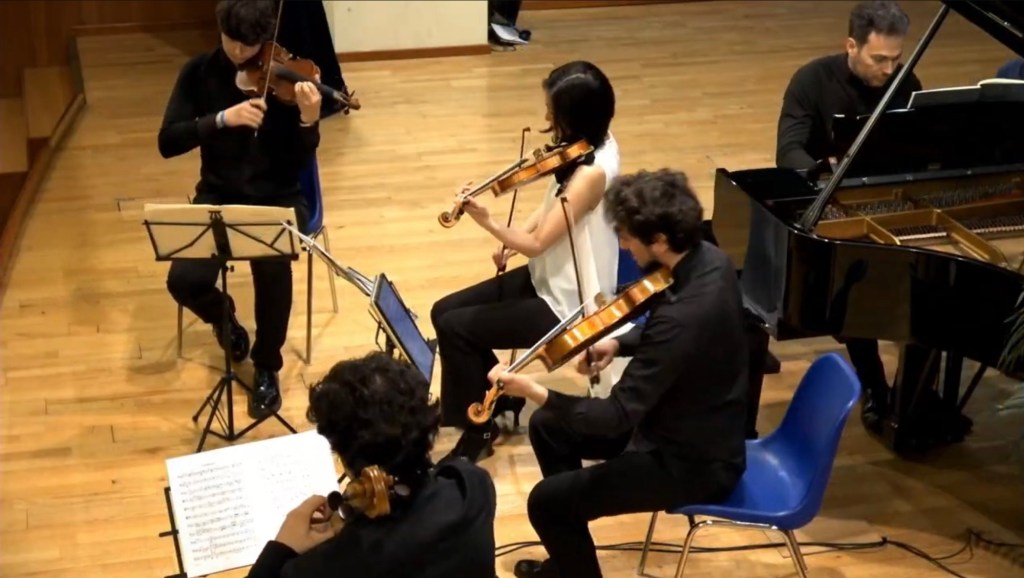
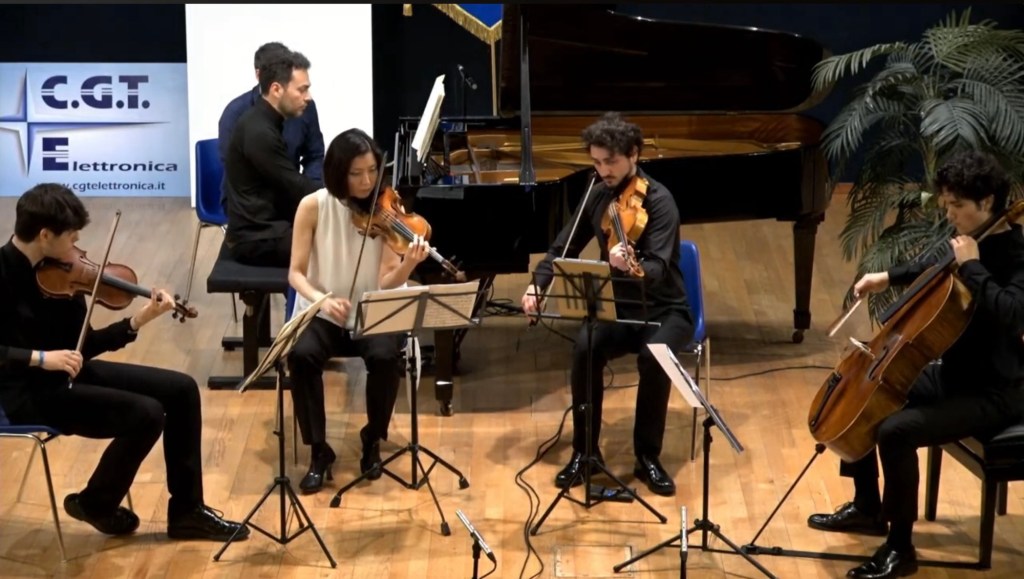
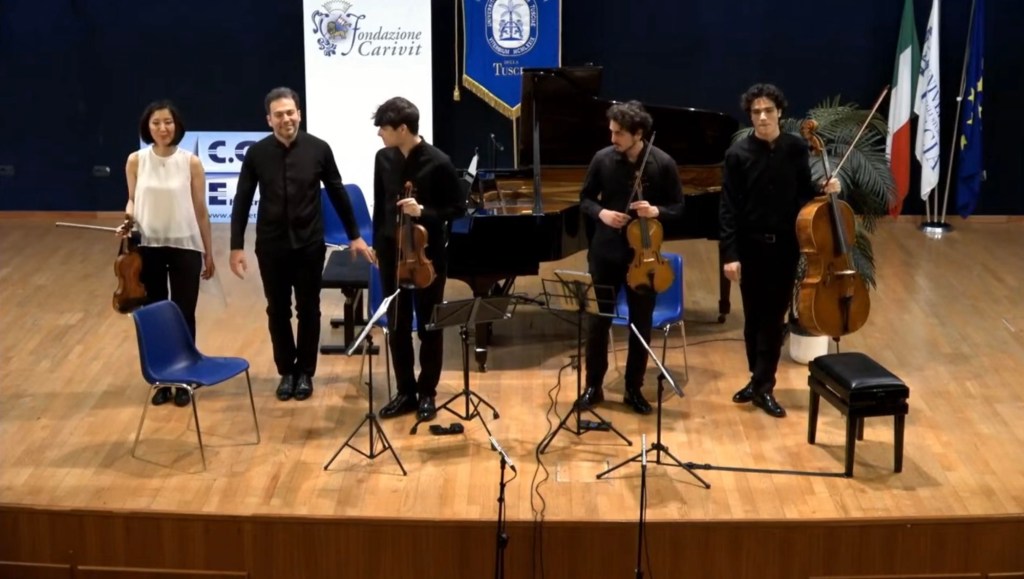
A quintet of players of refined good taste and musicianship.With the piano lid fully opened but never overpowering the quartet of strings as they created together an amalgam of rich beautiful sounds .Massimo Spada was at the helm with some ravishing sounds of delicacy and passion.Glissandi that were streams of colour that just illuminated and added an extra colour to the strings.

Mirei Yamada and Matteo Morbidelli on the violins swapping places for the two quintets. Matteo Introna and Alessandro Sacchetti,viola and cello,having a special voice in the Korngold where they produced a radiance of sound of Philadelphian proportions.This rarely played Quintet by Korngold started with an explosion of sounds with glissandi on the piano and many other effects of Hollywoodian style but always of expert craftsmanship.The slow movement was a meditative outpouring on the viola and cello joined by the violins in a ravishingly beautiful dialogue with gently throbbing unearthly sounds from the piano.There was a dramatic opening to the last movement leaving just a solo violin soon to be joined by her colleagues for a very exciting and quixotic ending.

The Franck Quintet is one of the most notoriously difficult scores for the piano and is a passionate outpouring of ravishing sounds .There were some featherlight sounds from the piano too but it was the ravishing flights of fantasy and passionate abandon of this youthful quintet that showed the difference between the highly crafted quintet of Korngold and the genial invention of this masterpiece by Franck.
Rana and Spada – The crossing of swords with sublime music making in Viterbo

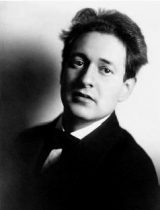
May 29, 1897 Brno,Moravia,Austria – Hungary.
November 29, 1957 (aged 60)Los Angeles, California
Rarely if ever has the world encountered a more precocious musical talent than that of Erich Wolfgang Korngold. Compared in his youth to Mozart and Mendelssohn, he enjoyed immensely successful and well-publicized premieres of his work while still in his early teens, being championed by musicians such as Artur Nikisch, Felix von Weingartner, Artur Schnabel, and Richard Strauss.
At age 11, he composed his ballet Der Schneemann (The Snowman), which became a sensation when performed at the Vienna Court Opera in 1910, including a command performance for Emperor Franz Josef. He continued composing with great success throughout his teens.At the age of 12, he composed a piano trio and his Piano Sonata No. 2 in E major, which followed, was played throughout Europe by Artur Schnabel.He wrote his first orchestral score, the Schauspiel-Ouvertüre, when he was 14. His Sinfonietta appeared the following year, and his first two operas, Der Ring des Polykrates and Violanta, in 1914.In 1916, he wrote songs, chamber works, and incidental music, including to Much Ado About Nothing , which ran for some 80 performances in Vienna.
Success followed success, and in 1920, at the age of 23, his masterpiece Die Tote Stadt was premiered in Hamburg and Cologne. The Piano Quintet Op. 15 (SCMS performance July 7) was written a year later.He completed a Concerto for the left Hand for pianist Paul Wittgenstein in 1923 and his fourth opera, Das Wunder der Heliane four years later.
Korngold had his first taste of career disappointment in 1927 with the premiere of his opera Das Wunder der Heliane, at which point the Viennese public showed the first signs of having moved on from his late-romantic musical language. As music became more tonally progressive and experimental, Korngold stayed true to himself, writing music that seemed more from the past than of the present.
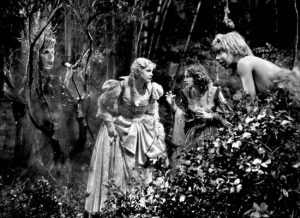
In 1934, Korngold wrote his first film score for Max Reinhardt’s film adaptation of A Midsummer Night’s Dream. Shortly thereafter, he signed an exclusive contract with Warner Brothers, eventually winning two Oscars for his film scores. As a Jew, Korngold’s world was crumbling around him, and in 1938 Korngold and his family moved to the United States. He vowed to write no more concert music until Hitler was removed from power.Korngold was a master film composer and his wonderful melodies, orchestrated in the most gorgeous Richard Strauss-oriented manner, are a joy to hear, even when the films are forgettable. Robin Hood, The Sea Hawk, and Elizabeth and Essex all display Korngold’s musical extravertism, and for some reason, his unmistakable Viennese kind of sentiment helped Errol Flynn be a convincing English hero.
The American Film Institute ranked Korngold’s score for The Adventures of Robin Hood as number 11 on their list of the greatest film scores . His scores for the following films were also nominated for the list:
- The Private Lives of Elizabeth and Essex (1939)
- The Sea Hawk (1940)
- Kings Row (1942)
- Deception (1946)
When Korngold returned to Europe in 1949, musical tastes had changed. Despite an initial success with his Symphonic Serenade Op. 39, critics were unmoved and subsequent performances were poorly attended. In his absence, the European musical community had moved on.When he died in Hollywood in 1957 at the age of 60, he believed himself forgotten and for the next 40 years, he was little more than a musical footnote, occasionally remembered through his film scores, a few arias, and the violin concerto.
Erich Wolfgang Korngold’s Piano Quintet in E major dates from the period following perhaps the composer’s greatest work, the opera Die tote Stadt, which had received simultaneous premieres in Hamburg and Cologne in December 1920. The following year, as he shepherded his opera to worldwide success, conducting performances in Dresden, Frankfurt and Vienna, Korngold began work on a pair of chamber-music works: the first of his three string quartets, and this piano quintet. Though the quartet did not receive its premiere until January 1924, the quintet was first performed in Hamburg on 16 February 1923 and in Vienna on 1 March, with Korngold at the piano alongside the Mairecker-Buxbaum Quartet. Perhaps unsurprisingly, the Viennese music critics gave the new work considerable attention, and in a feuilleton in the Neue Freie Presse (the newspaper of which Korngold’s father, Julius, was chief music critic), Josef Reitler waxed lyrical, noting, ‘as soon as the bold main theme begins with enthusiastic gestures, one has the unmistakable feeling: Korngold!’. Reitler made the point that the composer, whose Opus 1 was a piano trio, always returned to chamber music following his dramatic works—pointing to the string sextet that followed his two single-act operas, Violanta and Der Ring des Polykrates—and his fellow critic Heinrich Kralik, in the Neues Wiener Tagblatt, likewise saw the composer’s devotion to instrumental forms as a taking of breath or gathering of forces before the effort of creating new stage characters. As such, Kralik found in the piano quintet the legacy of Die tote Stadt, pointing to that same dramatic theme that had struck Reitler so forcefully and finding in it a ‘spirit akin to that of Marietta’, the main female character of the opera.
Kralik, however, also made his readers aware of the close connection between the quintet and Korngold’s Vier Abschiedslieder of a few years previously. These ‘songs of farewell’ provide the material for a set of free variations that form the quintet’s central movement, in the same way that Korngold used his song ‘Schneeglöckchen’ as the basis for a movement of the Violin Sonata, Op 6. Kralik thus suggested that this was a ‘quintet of farewell … that once more the composer draws to the heart the dear and familiar figures of his past before devoting himself entirely to the new future’. Undoubtedly though, the reference to the Abschiedslieder was about more than a farewell to the past. For Korngold, these songs—and thus the quintet—are intimately tied to his burgeoning romance with Luise von Sonnenthal, or Luzi as she was known. Their long courtship, which Korngold’s parents did everything to frustrate, featured long periods of separation, and Luzi maintained that one of the Abschiedslieder even included a secret message to her that imitated the sound of her voice. The pair finally married on 30 April 1924, a year after the quintet was first performed. Their first summer together was spent at Altaussee—with Korngold’s parents in tow—and it was during this period that Luzi helped correct the score and parts of the quintet for publication, whereupon it was dedicated to the composer’s friend, the sculptor Gustinus Ambrosi.
The three-movement Piano Quintet is a highly charged, virtuosic, and overwhelmingly positive piece.
- Mäßiges Zeitmaß, mit schwungvoll blühendem Ausdruck
- Adagio. Mit größter Ruhe, stets äußerst gebunden und aus drucksvoll
- Finale. Gemessen beinahe pathetisch
The optimistic first movement alternates between extroverted romanticism and the introspective beauty, and revels in its instrumental complexity. The 2nd movement is a glorious set of nine variations on themes from his song cycle of 1920, Songs of Farewell, with the third song, Moon, thou riseth again, being the main inspiration. The finale opens with severe, declamatory cadenza material, before giving way to a jocular rondo theme. The coda brings back material from the beginning of the piece and brings the work to a rousing conclusion.
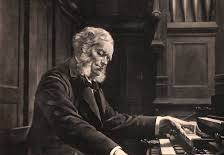
César-Auguste-Jean-Guillaume-Hubert Franck
10 December 1822 Liège,Belgium
8 November 1890 (aged 67) Paris, France
Franck’s Piano Quintet in F minor for 2 violins,viola and cello was composed in 1879 and has been described as one of Franck’s chief achievements alongside his other late works such as Symphony in D minor,the Symphonic Variations,the string Quartet and the Violin Sonata

It was premiered by the Marsick Quartet , with Camille Saint-Saens playing the piano part, which Franck had written out for him with an appended note: “To my good friend Camille Saint-Saëns”. In three movements
- Molto moderato quasi lento – Allegro
- Lento con molto sentimento
- Allegro non troppo ma con fuoco
The music has a cyclical character whereby a motto theme of two four-bar phrases, used 18 times in the first movement, recurs at strategic point later in the work.The work has been described as having a “torrid emotional power”, and Edouard Lalo characterised it as an “explosion”

 ChristopherAxworthy-MusicCommentary