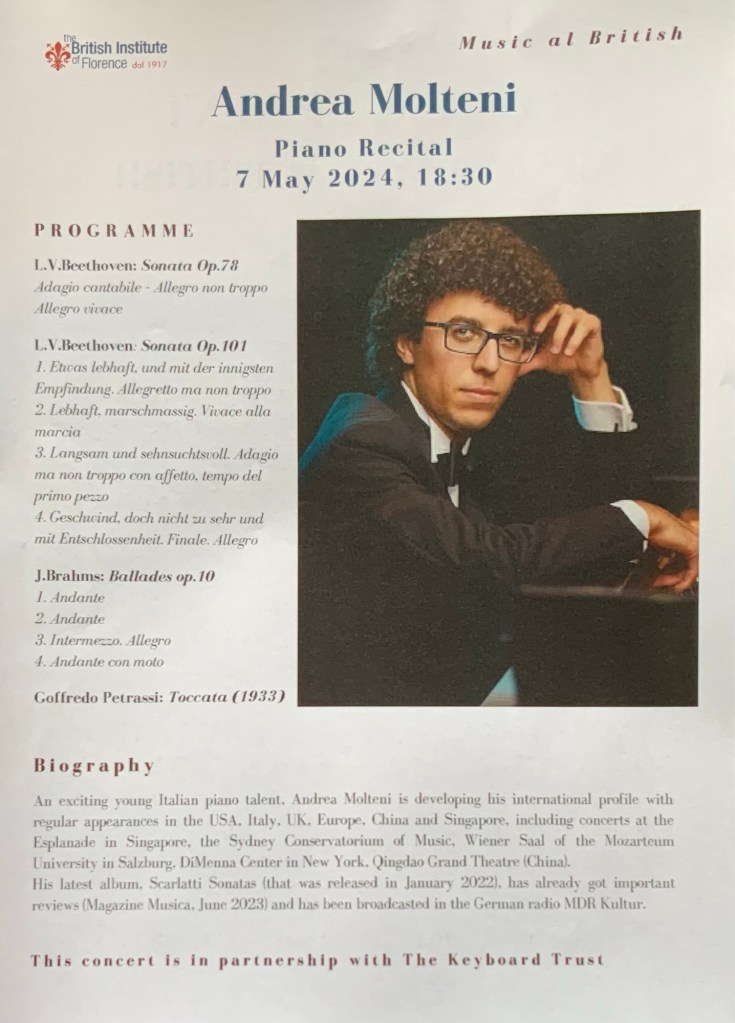
An exciting young Italian piano talent, Andrea Molteni is developing his international profile with regular appearances in the USA, Italy, UK, Europe, China and Singapore, including concerts at the Esplanade in Singapore, the Sydney Conservatorium of Music, Wiener Saal of the Mozarteum University in Salzburg, DiMenna Center in New York, Qingdao Grand Theatre (China).
His latest album, Scarlatti Sonatas (that was released in January 2022), has already got important reviews (Magazine Musica, June 2023) and has been broadcasted in the German radio MDR Kultur.
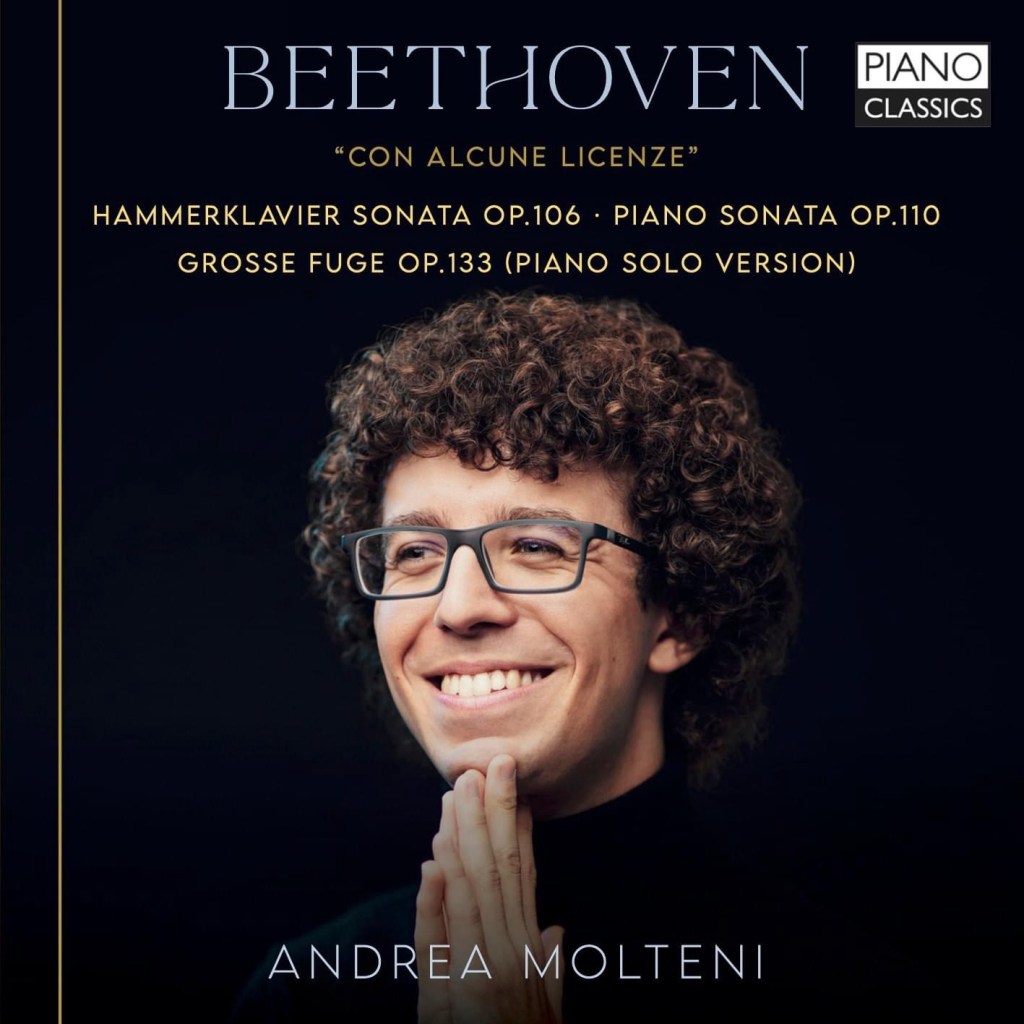
Andrea Molteni arrived in Florence with his latest CD issued just a few days ago. Quite a colossal undertaking for a young musician to present an all Beethoven programme that includes the Sonata ‘Hammerklavier’ op 106 ,the Sonata op 110 and with a fill up of the solo piano version of the mighty Grosse Fuge op 133!
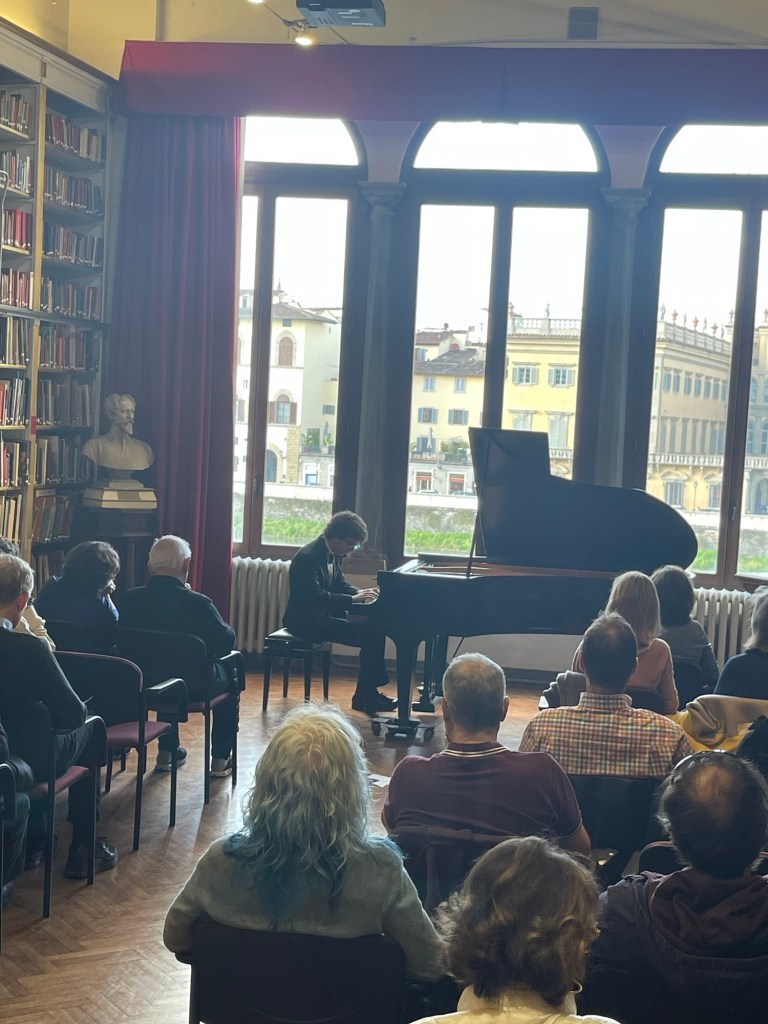
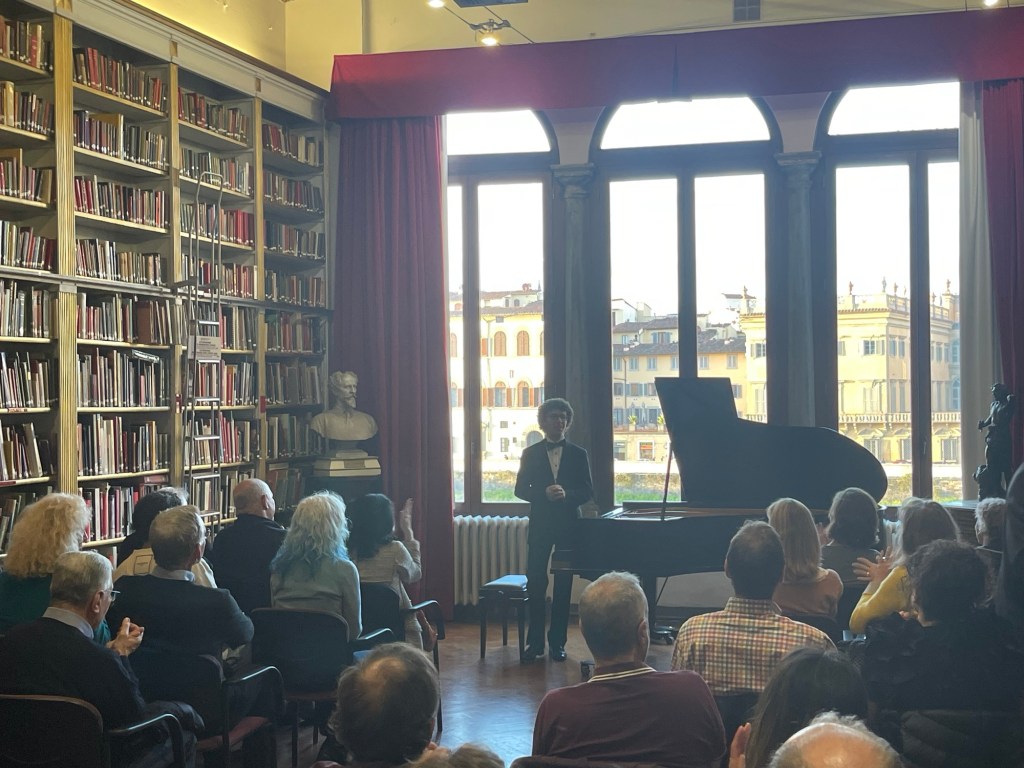
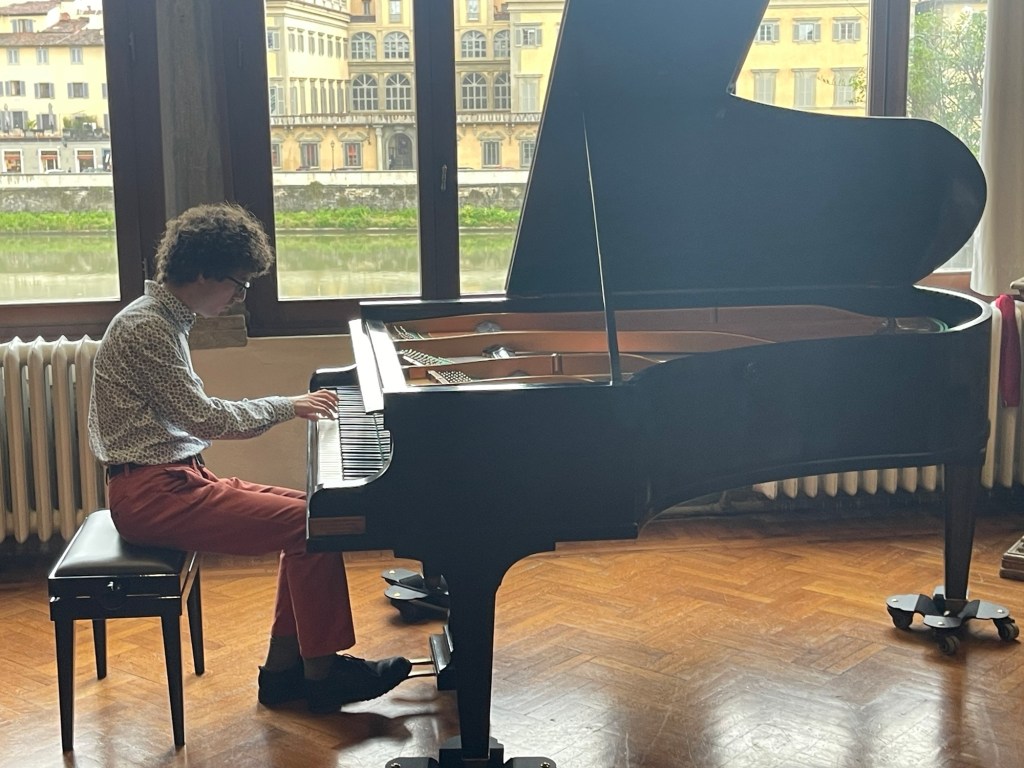
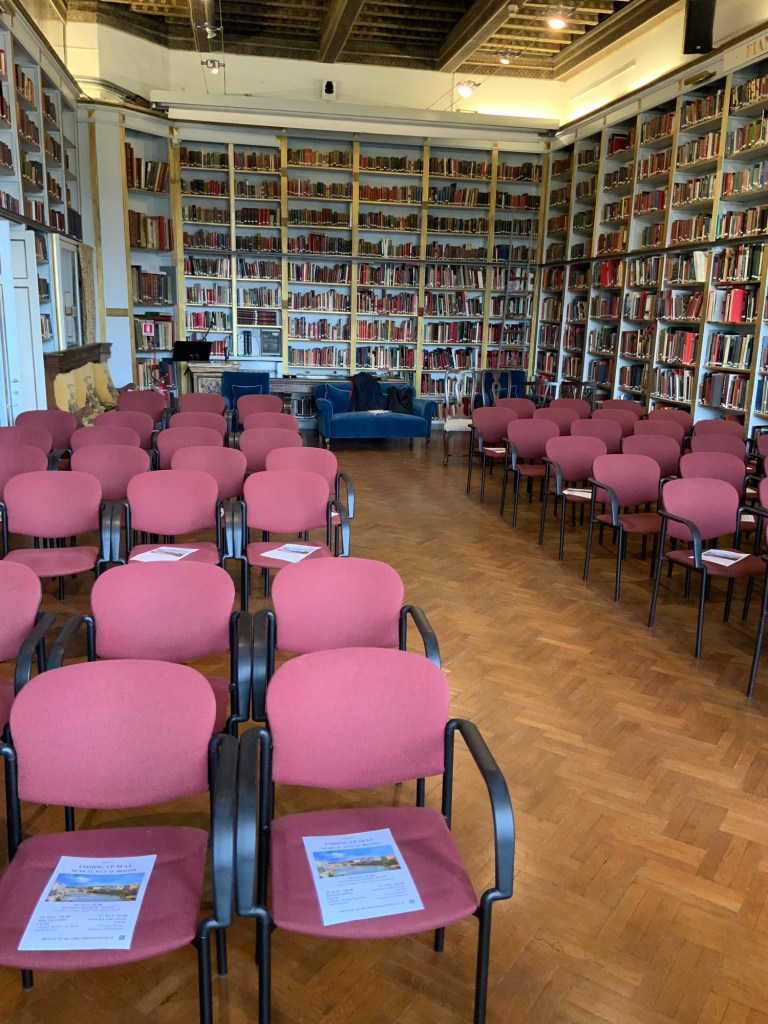
It was even more remarkable that his programme in Florence did not include any of these works but instead the Sonata op 101 which is the first of the five last Sonatas that a totally deaf Beethoven was to pen with visionary precision. He prefaced this with one of Beethoven’s own favourite Sonatas ‘a Thérèse’ op 78. The little two movement sonata ,dedicated to a pupil ,where beauty and simplicity combine with clarity and luminosity in a mellifluous outpouring worthy of Schubert. Andrea played it with aristocratic simplicity allowing the music to unfold on this mellow sounding Bechstein of 1898 that sits so proudly and justly in ‘a room with a view.’ Surrounded by books in the Harold Acton Library that is the seat of the British Institute in Florence, Andrea immediately created a warmth and intimacy with playing of subtle delicacy and refined good taste.
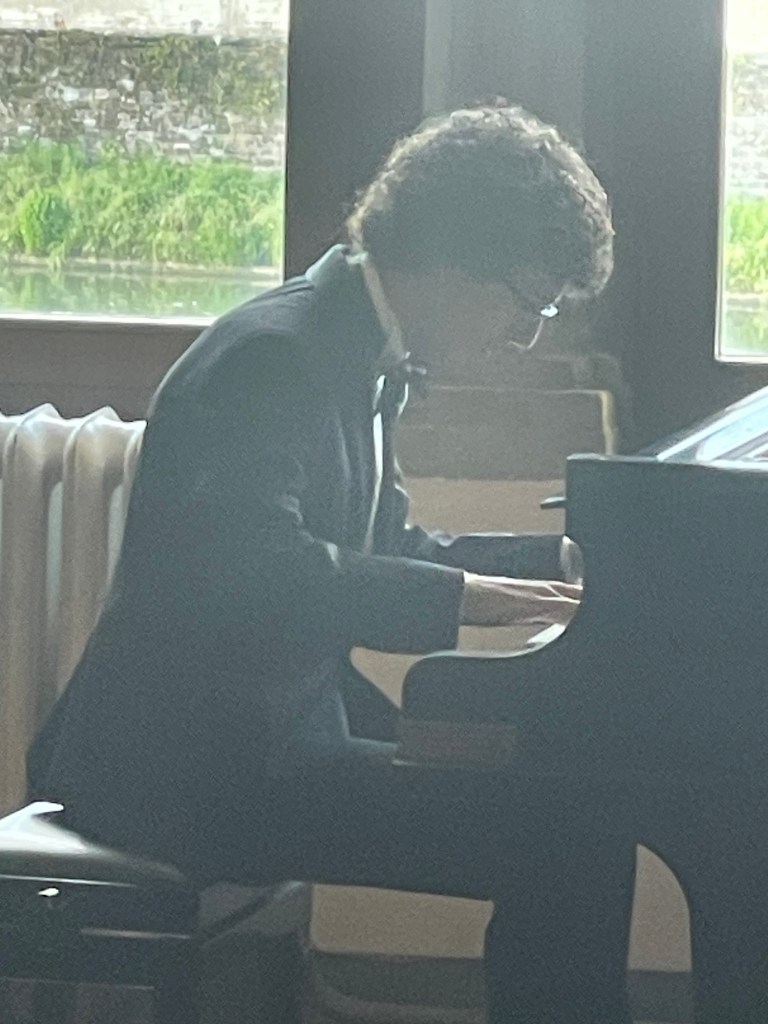
Andrea is quite a live wire as those that encounter him are immediately aware. Eyes that light up with a brilliance and sparkle but that hide the depths that his music making can reveal. It was in the ‘Allegro vivace’ second movement that he suddenly changed the mood from the slow and contemplative to the highly strung brilliance of notes that just spun from his fingers with oiled ease.There is a great intellectual depth too to this musician and in the rehearsal he was keen to show me the discoveries of phrasing and tempi that he had found in the depths of the score which was a new work in his repertoire and a great addition to his voyage of discovery into the world of Beethoven.
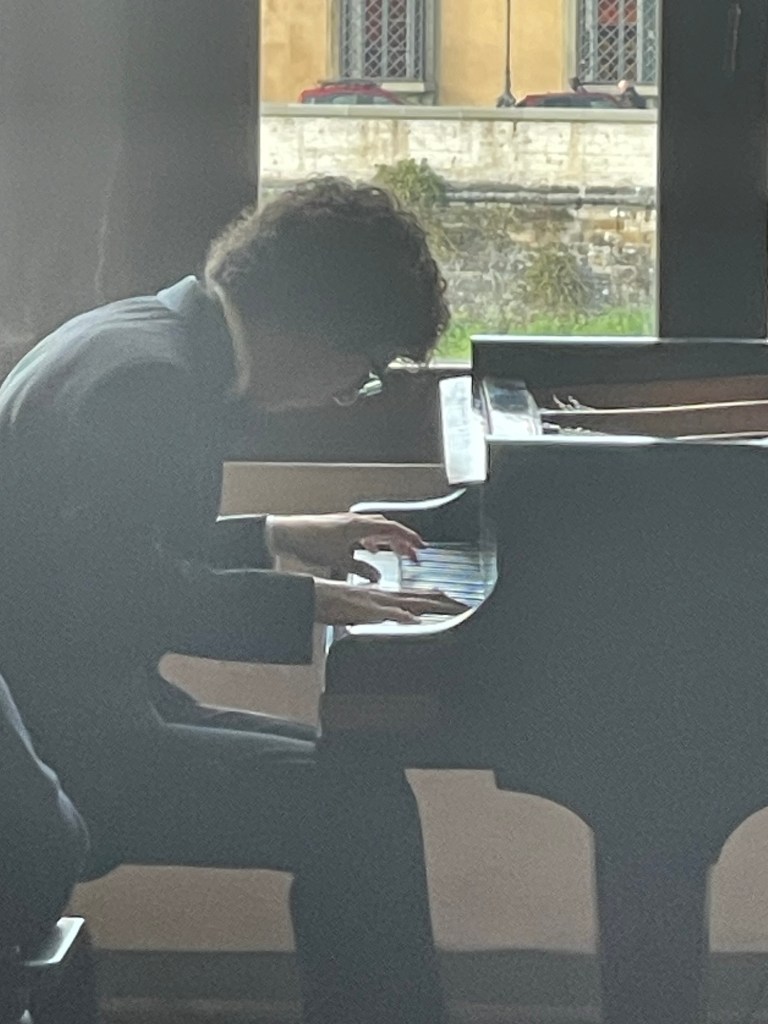
It was in fact in the second sonata that his intelligence and musicianship were allied to pianistic mastery and poetic vision. Op 101 after the ‘Hammerklavier’ is considered by many to be an equal technical challenge as the intricacies and rhythmic drive of the second and fourth movement need an architectural understanding that belies the seemingly gentle pastoral opening. It was the same beauty as op 78 that Andrea brought to the seemingly improvised first movement but with an expansiveness creating an atmosphere of pastoral peace and well being. Short lived because this is the world of Beethoven where sudden contrasts and tumultuous outpourings are part of the high’s and lows’ of his rumbustuous life style and character. There was a dynamic drive to the ‘Lebhaft Vivace alla marcia’ of the second movement but Andrea managed to keep it under control and with a technical mastery that was able to transform this march into a lyrical rather than military procession. Following Beethoven’s long pedal indications with poetic understanding he brought a clarity to the central episode before the return of the ‘alla marcia’. The long improvised ‘Adagio ma non troppo’ that Beethoven himself marks to be played ‘con affetto’ was given a poignant sense of fantasy as Beethoven searches for a way through the momentary apparition of the first movement to the irascible entry into the Finale. Knotty twine indeed but with Andrea’s precision and clarity the inconclusive trills and dynamic strands of melody were allowed to erupt with sparkling brilliance and masterly control.
What better way to celebrate Brahms’s birthday ( 7 May 1833) than with his Four Ballades op 10. This was an early Brahms from a passionate and deeply introverted 21 year old. He was already under the spell of his mentor Clara Schumann who was to play such a significant part in his life as the Schumann /Brahms triangle played itself out with selfless passion and genius.The shimmering beauty and passionate pulsating of the heart in these four tone poems are evidence enough of the inspiration for such sublime outpourings. Andrea just a few years older that Brahms when he wrote these magical pieces could understand the intensity and burning message of youthful serenity and hope.It was the glowing fluidity that he brought to the sound as well as a driving military insistence to the contrasting central episode that built to a sumptuous climax of Philadelphian proportions with glorious full golden sounds played with aristocratic nobility. It was the same fluidity and glowing beauty that’s he brought to the second with its ominous rhythmic central episode.There was a youthful call to arms with a dynamic rhythmic drive of the third Ballade which dissolved with such poetic artistry into the beautifully suggestive whispered ending. Opening the gate for a vision of paradise with the searing whispered intensity of the ‘Andante con moto’. Andrea visibly transformed as we were all moved by the throbbing heart beat of sumptuous whispered sounds on which emerges an enigmatic melody of heart rending beauty. It was Michelangeli who made this piece his own and I remember the atmosphere that he created in the Festival Hall in London with his own piano specially prepared with loving care by his great friend Fabbrini, who would follow him on his tours to ensure that the nearest thing to perfection was possible. Andrea today produced sounds on a piano that has a voice of mellow beauty like a faded photograph where beauty is suggested and becomes much more poignant than a sharply defined modern print.He was able to share with us the extraordinarily intense vision of the twenty year old Genius of Brahms with as much intimacy as Michelangeli in a hall of two thousand.
Andrea chose a piece of brilliance and subtle colouring to finish his recital.The Toccata by Goffredo Petrassi was written in 1933 and is not only of brilliance but also of a subtle tone palette and sound world that reminds one of the haunting beauty and fantasy of a very particular moment between the wars when composer were searching for a new means of expression but still using the traditional polyphonic sound world of the past. A Toccata that is also a tone poem as it’s hauntingly whispered opening erupts into a true toccata of technical exhilarance and dynamic drive only to dissolve into the opening mystery with which it had begun. Masterly playing and one of the works that this young musician has recorded on his recent CD of the piano works of Petrassi and Dallapiccola.

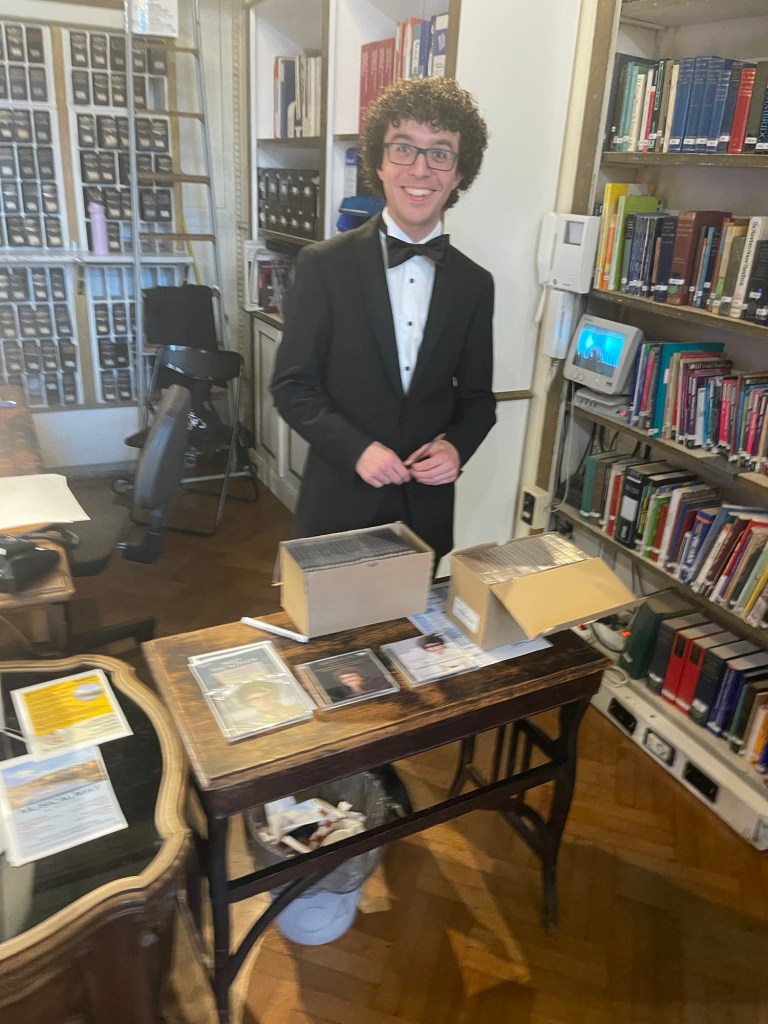
A sparkling Scarlatti Sonata just spun from his well oiled fingers with delicacy and style and is one of the nine that he has recorded on yet another CD for piano Classics. His second encore of Chopin’s Study op 10 n.4 had the audience on its feet and ready to buy his CD’s to take back home with them to prolong the enjoyment and ‘joie de vivre’ that this young man had brought into their lives.
The Piano Sonata No. 24 in F sharp, Op. 78.
- Adagio cantabile — Allegro ma non troppo
- Allegro vivace
Nicknamed ‘à Thérèse’ because it was written for his pupil Countess Thérèse von Brunswick who.with her sister Josephine was his pupil. According to her diary Beethoven had stronger feelings than just for her intellect and sisterly tenderness .For sometime it has been thought that the famous letters from Beethoven to his ‘distant beloved’ were indeed to her.Composed in 1809 and consisting of two movements:According to Czerny,Beethoven himself singled out this sonata and the ‘Appassionata’as favourites together later with the ‘Hammerklavier’Wagner found it ‘profoundly personal’ but D’Indy said :’What sort of artist or man could admit that the only work dedicated to the Countess of Brunswick is the insipid Sonata in F sharp,the same recipient of the passionate letters that all the world has read’
The Piano Sonata No. 28 in A major, op 101, was composed in 1816 and published in 1817 and dedicated to the pianist Baroness Dorothea Ertmann née Graumen and is considered the first of the composer’s late piano sonatas
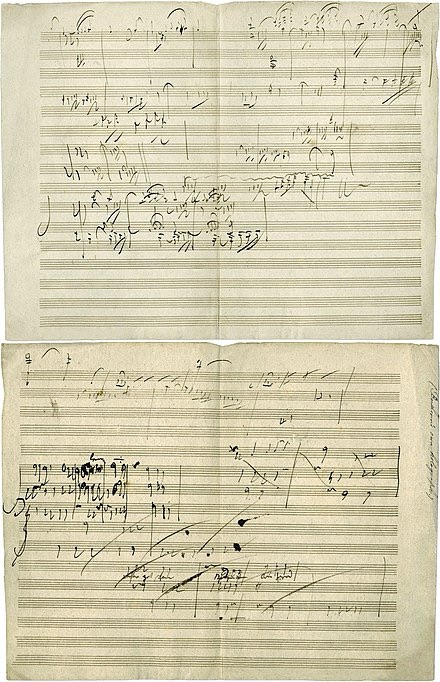
This sonata marks the beginning of what is generally regarded as Beethoven’s final period, where the forms are more complex, ideas more wide-ranging, textures more polyphonic, and the treatment of the themes and motifs even more sophisticated than before. Op. 101 well exemplified this new style, and Beethoven exploits the newly expanded keyboard compass of the day.As with the previous sonata op 90 it is unclear why Beethoven wrote Op. 101. The earliest known sketches are on leaves that once formed the parts of the Scheide Sketchbook of 1815–16. It shows the first movement already well developed and notated as an extended draft in score, and there are also a few preliminary ideas for the final Allegro Beethoven himself described this sonata, composed in the town of Baden, just south of Vienna during the summer of 1816, as “a series of impressions and reveries.” The more intimate nature of the late sonatas probably has some connection with his deafness, which by this stage was almost total, isolating him from society so completely that his only means of communicating with friends and visitors was via notebooks.
The Sonata Op. 101 is the first of the series of Beethoven’s “Late Period” (although sometimes op.90 is considered the first), when his music moved in a new direction toward a more personal, intimate, sometimes even introspective, realm of freedom and fantasy. In this period he had achieved a complete mastery of form, texture and tonality and was subverting the very conventions he had mastered to create works of remarkable profundity and beauty.It is also characteristic of these late works to incorporate contrapuntal techniques (e.g. canon and fugue)into the sonata form.
This was the only one of his 32 sonatas that Beethoven ever saw played publicly; this was in 1816, and the performer was a bank official and amateur musician.

Brahms in 1889
7 May 1833 Hamburg -3 April 1897 Vienna
The Ballades, Op. 10, were written by Brahms in his youth. They were dated 1854 and were dedicated to his friend Julius Otto Grimm. Their composition coincided with the beginning of the composer’s lifelong affection for the pianist and composer Clara Schumann, who was helping Brahms launch his career. The Scottish ballad “Edward” from J. G. Herders anthology of folk songs “Stimmen der Völker in Liedern” made such a deep impression on Brahms that, as he told a friend, the melodies came to him effortlessly.
Dein Schwert, wie ist’s von Blut so rot? Edward, Edward!
Dein Schwert wie ist’s von Blut so rot, und gehst so traurig her? – O!
O, ich hab’ geschlagen meinen Geier todt, Mutter, Mutter!
O, ich hab’ geschlagen meinen Geier todt, und keinen hab’ ich wie er – O!
Why does your Brand sae drop wi’ blude, Edward, Edward,
Why does your Brand sae drop wie blude, and why sae sad gang ye, O?
O, I hae kill’d my hawk, sae gude, mither, mither,
O, I hae kill’d my hawk, sae gude, and I had nae mehr but he, O
“Edward” provided the motif for the first of four ballade compositions, musical tales of a dramatic romantic nature that were linked with memories of Clara Schumann for Brahms. Julius Grimm, to whom the pieces were dedicated, also said that “the Ballades are really for her”. Robert Schumann was very enthusiastic about his young colleague’s composition. Chopin had written the last of his four Ballades only 12 years earlier, but Brahms approached the genre differently from Chopin, choosing to take its origin in narrative poetry more literally.
They are arranged in two pairs of two, the members of each pair being in parallel keys . The first ballade is one of the best examples of Brahms’s bardic or Ossianic style; its open fifths, octaves, and simple triadic harmonies are supposed to evoke the sense of a mythological past.
- D minor. Andante
- D major. Andante
- B minor. Intermezzo. Allegro
- B major. Andante con moto
The tonal center of each ballade conveys an interconnectedness between the four pieces: the first three each include the key signature of the ballade that follows it somewhere as a tonal center, and the fourth ends in the key signature of D major/B minor despite cadencing in B major.
Brahms returned to the wordless ballade form in writing the third of the Six pieces for piano op 118 . His Op. 75 vocal duets titled “Ballads and Romances” include a setting of the poem “Edward”—the same that inspired Op. 10, No. 1.
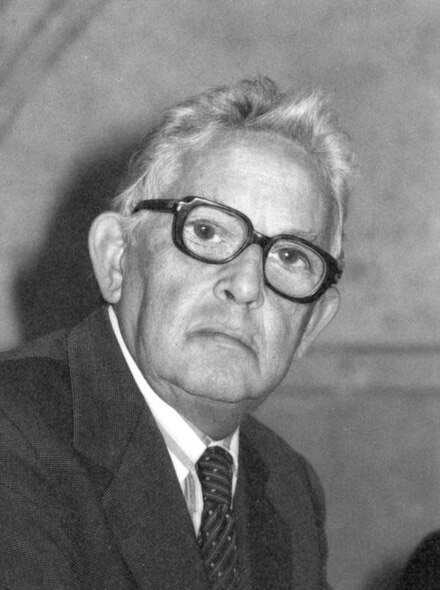
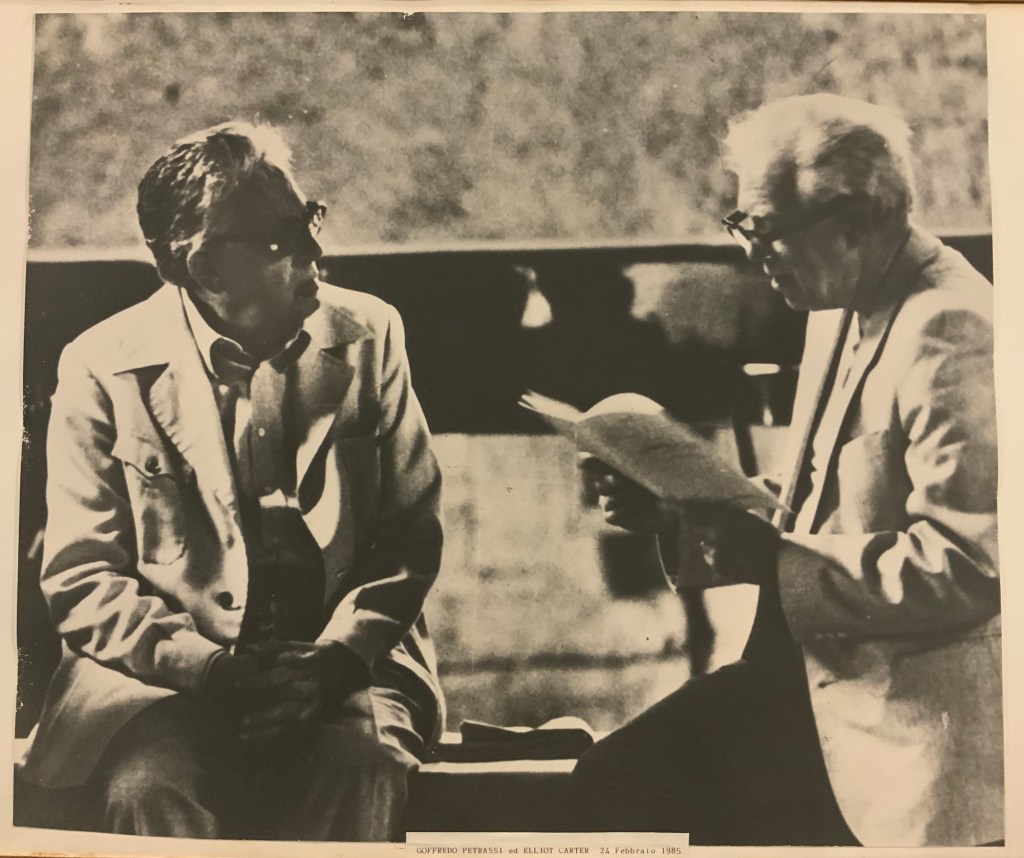
Goffredo Petrassi 16 July 1904 – 2 March 2003 and is considered one of the most influential Italian composers of the twentieth century.
Born at Zagarolo, near Rome at the age of 15 he began to work at a music shop to supply his family’s financial needs, and became fascinated by music. In 1928, he entered the Santa Cecilia Conservatory in Rome to study organ and composition . In 1933, composer Alfredo Casella conducted Petrassi’s Partita for orchestra at the ISCM festival in Amsterdam From 1940 to 1960 Petrassi was professor of composition at Santa Cecilia Conservatory and later, he also became musical director of the opera house La Fenice and from 1960 to 1978 he taught in the master courses in composition at the Accademia di S.Cecilia was also a teacher at the Salzburg Mozarteum. Petrassi had many famous students, including Franco Donatoni,Aldo Clementi,Cornelius Cardew,Ennio Morricone,Peter Maxwell Davis .Kenneth Leighton ,Boris Porena etc etc.
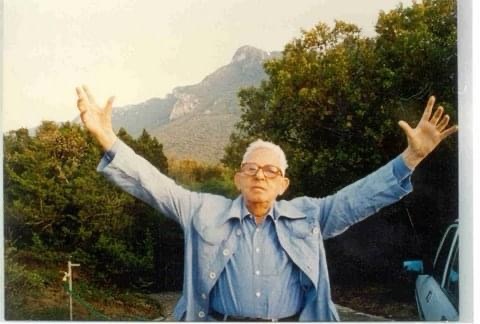
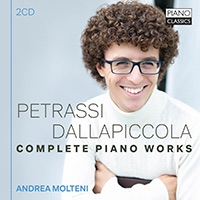
The strident conviction of Goffredo Petrassi (1904-2003) his seven postwar Concertos for Orchestra could hardly be anticipated from the fluent pastiche of his piano Partita, composed in 1926. The Baroque titles of the four movements introduce a disarming simplicity of expression, whose dominant strains are the Classicism of Mozart and Beethoven. Even the more exploratory harmonies of the Toccata (1933) are couched in an idiom of gentle introspection – a far cry from the contemporary toccatas of Bartok and Prokofiev, for example – and an escapist, playful spirit courses through the seven Inventions of 1944.
Extant surveys of Petrassi’s piano music end there, whereas Andrea Molteni adds three further, attractive miniatures: a mischievous Petit Piece of 1950 and then the two movements of Oh Les Beaux Jours! (1976), which rework material from the early 1940s including an unfinished Divertimento Scarlattiano. Unexpected this may be, for all but the most devoted student of Petrassi, but Andrea Molteni brings out the most attractive and witty features of his piano writing.
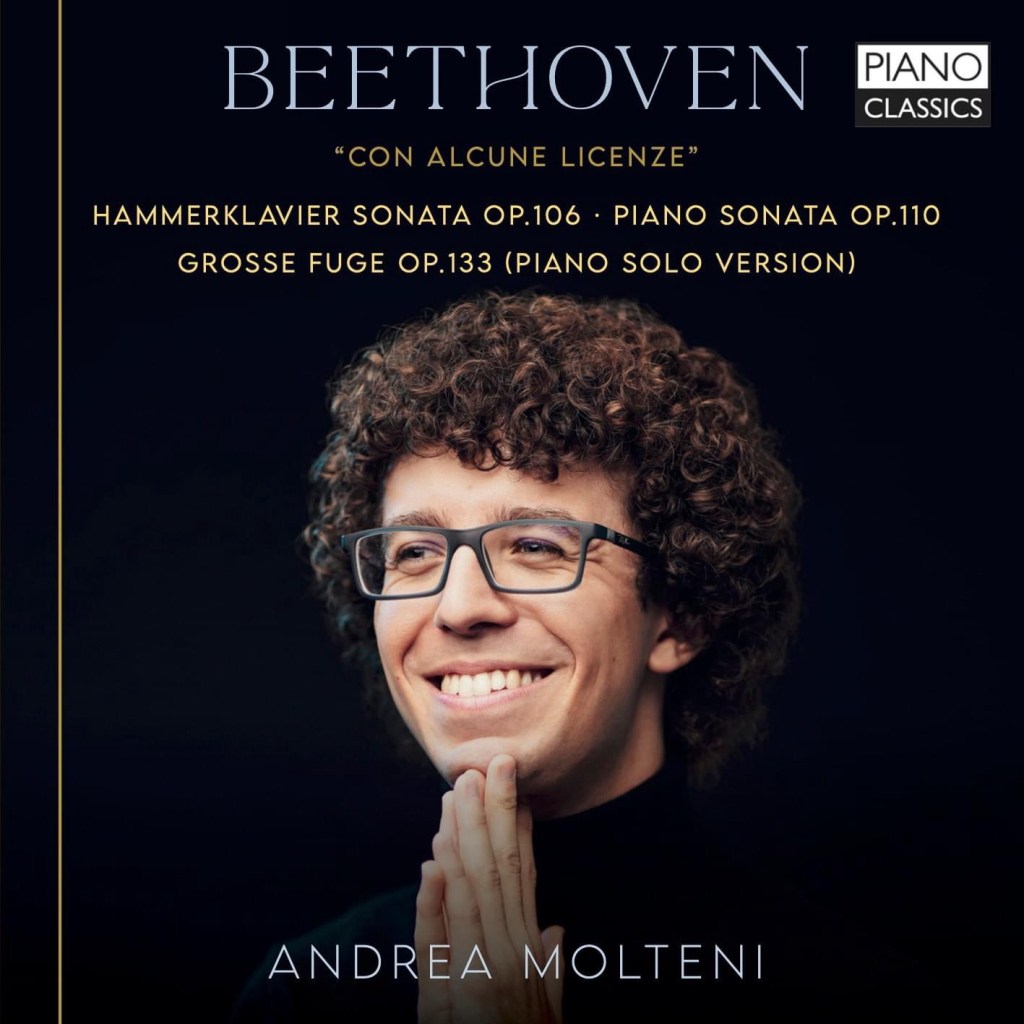
Really happy to tell you that my new album 𝗕𝗲𝗲𝘁𝗵𝗼𝘃𝗲𝗻: 𝗖𝗼𝗻 𝗮𝗹𝗰𝘂𝗻𝗲 𝗹𝗶𝗰𝗲𝗻𝘇𝗲 is now out (Piano Classics | Brilliant Classics)!
Sonata op.106 Hammerklavier
Piano Sonata op.110
Grosse Fuge op.133 (piano solo version)
Hope you’ll like the album, please tell me which piece is you favourite!
💿 𝗢𝗥𝗗𝗘𝗥 🎧 𝗗𝗢𝗪𝗡𝗟𝗢𝗔𝗗 ➡ https://www.piano-classics.com/articles/b/beethoven-con-alcune-licenze
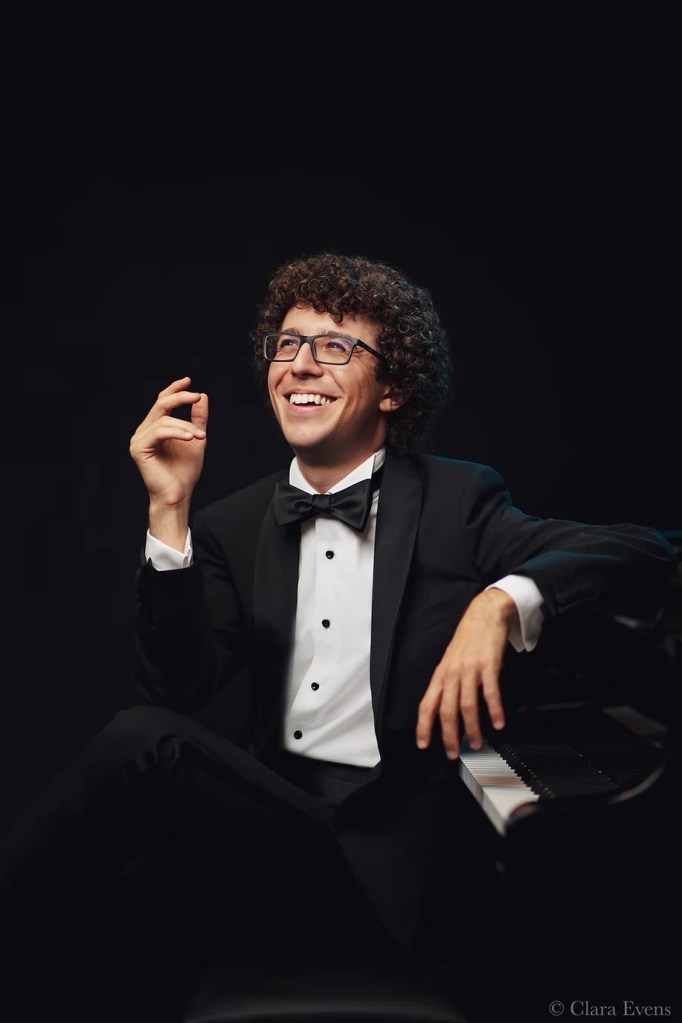
Mr. Molteni enjoys the artistic guidance of William Grant Naboré and Stanislav Ioudenitch under the auspices of the prestigious International Lake Como Piano Academy. In 2020, he was awarded a master’s degree Magna cum Laude in Advanced Performance Studies by the Conservatorio della Svizzera Italiana in Lugano. After he graduated with top marks, honors and honorable mention with Mario Patuzzi at the Conservatorio G.Verdi in Como, Andrea studied in Milan with Vincenzo Balzani. He also took part in various masterclass with Sir. Andras Schiff, Elisabeth Leonskaja, Arie Vardi, Pavel Gililov, Dang Thai Son, Piotr Paleczny, Vladimir Feltsman, Christopher O’Riley, Aquiles Delle Vigne.
At the age of 15, Mr. Molteni formed a youth orchestra, “L’Orchestra del Lago”, which he conducted and played with. His earliest orchestral collaborations also include Orchestra Antonio Vivaldi, Orchestra Filarmonica Mihail Johra di Bacau in Romania, and Orchestra of the Costa Rica University. The special scholarship of Cercle Wagner Association in France allowed Mr. Molteni to participate at the Bayreuth Festival celebrating the 200th anniversary of Richard Wagner, as well as to perform a series of concerts in Nice, Menton, Cannes, and Monte Carlo. An exciting young Italian piano talent, Andrea Molteni is developing his international profile with regular appearances in the USA, Italy, UK, Europe, China and Singapore. He has played at the Esplanade in Singapore, Verbrugghen Hall of the Sydney Conservatorium of Music in Sydney, Wiener Saal of the Mozarteum University in Salzburg, Scriabin Museum in Moscow, DiMenna Center in New York, Qingdao Grand Theatre in Qingdao (China) and other prestigious venues around the world.His latest album, Scarlatti Sonatas (that was released in January 2022), has already got important reviews (Magazine Musica, June 2023) and has been broadcasted in the German radio MDR Kultur. The album “Petrassi and Dallapiccola Complete Piano Works” (May 2021) has been appreciated by distinct pianistic personalities such as V.Ashkenazy and L.Howard. It received reviews on significant music magazines (Magazine Musica, December 2021; Opus Klassiek, May 2021) and it has been broadcasted on radio programmes (in cuffia, Radio Classica, July 2021 and November 2021; France Musique, September 2021).

https://christopheraxworthymusiccommentary.com/2022/03/24/andrea-molteni-at-steinway-hall/
 ChristopherAxworthy-MusicCommentary
Una risposta a "Andrea Molteni in Florence – A live wire of Mastery and Poetic sensibility."