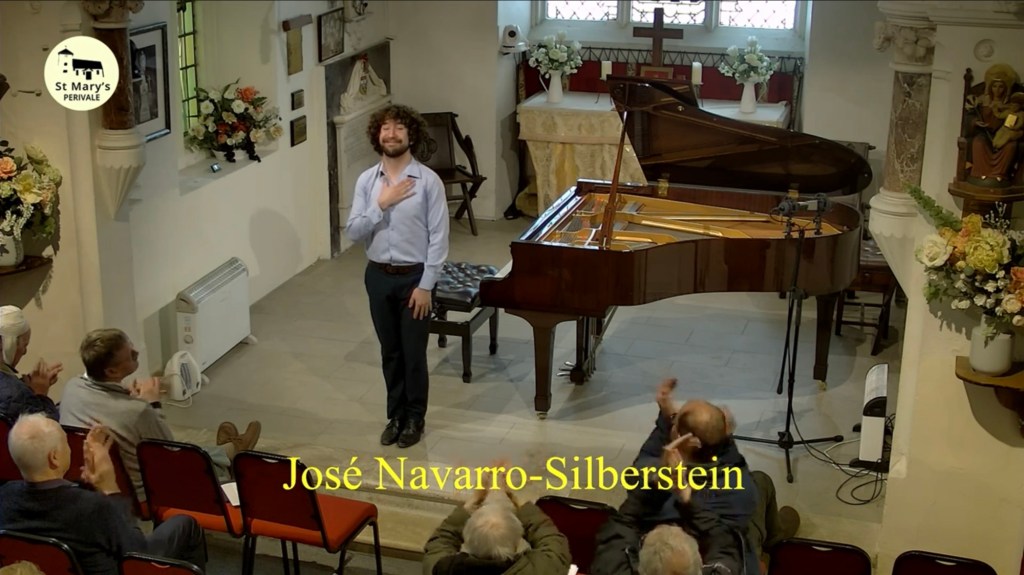

It was the music of his native South America played as an encore that ignited this young musicians imagination with playing of haunting beauty and a kaleidoscope of colours and sounds of radiance and fluidity. His total authority and hypnotic sense of communication in a very atmospheric work by Villa Lobos created an atmosphere of the scintillating colours and the native rhythms of his homeland bringing a recital full of radiance and beauty to a breathtaking end.
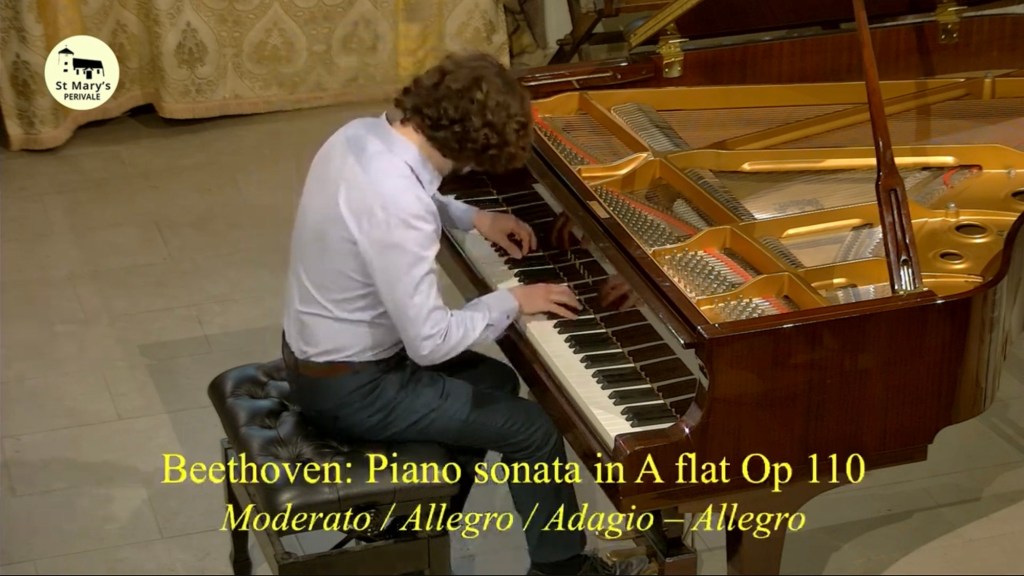
José is a master musician as his playing of Beethoven demonstrated .A scrupulous attention to the composers very precise indications were allied to a technical command with sounds of clarity and beauty.The dialogue between the bass and the soprano in the development was played with simplicity where Beethovens careful shaping of the left hand was beautifully played without disturbing the mellifluous beauty of the right hand. Sometimes his Latin temperament took over and embellishments could have unwound with more ease and the deep left hand throbbing in the recapitulation could have been less passionate.But it was his love and respect for Beethoven’s most mellifluous of his last sonatas that shone through all he did. The Allegro molto – Scherzo was shaped with real style and sense of proportion.A dynamic drive but never overpowering but beautifully shaped.Beethoven’s irascible character had been tamed as the coda gently flowed into the ‘Adagio’ that was played with poignant dignity and beauty.Beethoven’s long pedal and vibrating notes created a haunting atmosphere on which could float one of Beethoven’s most beautiful melodies.The gentle left hand heartbeat was beautifully controlled as the melodic line was allowed to float unimpeded with flowing luminosity. The Fugue was masterly controlled and allowed to unfold naturally as it built to the long E flat that miraculously dissolves down to D for the return of the ‘Arioso’ ‘perdendo le forze – dolente’. Beethoven fills this most poignant of melodies with a series of rests that are like breaths for a singer but that José took a little too literally and his Latin temperament disturbed the simplicity that he had kept so aristocratically under control.The inversion of the fugue was gently whispered as it gradually built to the glorious outpouring with which this Sonata finishes.Again José’s temperament and passionate love of the music almost made him loose control and his arrangement of the hands for the final great triumph of A flat lost the noble impact it surely should have. José is indeed a intelligent young artist with a passionate heart of gold!

It was refreshing to hear the Holberg Suite in concert as I have not heard it since my own school days when it was standard fare for advanced piano students.It is a beautiful piece that José played with nobility and poignant beauty.The prelude has a haunting beauty that pervades it and José’s sumptuous sound palette was very touching.He brought delicacy and simplicity to the ‘Sarabande’ and charm and grace of orchestral nobility to the ‘Gavotte’.The ‘Air’ he played with weight and intensity as the long drawn out melodic line was allowed to sing with simple beauty.There was a beauty to the tenor melody as it was gently accompanied by whispered embellishments.I found the ‘Rigaudon’ a little too fast for comfort as it lost a little of it’s rhythmic precision. It created,though, the excitement and exhilaration needed to round off the simple innocence of this delightful suite of dances and if the ending was a little too thrown away it was because the pianist was obviously enjoying every minute of it as we were too.

The three Chopin Mazukas were played with great style and colour but were sometimes rather too fast and breathless .One felt that José was playing more in the style of Chopin that actually what was written on the printed page and infact he left out a big chunk of the first one too! There were ,of course, many beautiful moments as José is a true artist and there was the haunting beauty of the opening of op 50 n.2 and the beauty of Chopin’s knotty twine in op 50 n.3.

It was the Liszt Hungarian Rhapsody that suddenly unleashed the showman in José as the ‘Pesther Karneval’ took to the stage opening with dynamism and grandiose nobility .With chameleonic changes of colour and character and scintillating virtuosity he swept across the keys as Liszt must have done with this,the longest of his 19 Rhapsodies.A glorious outpouring of sumptuous sounds of dynamic drive and passionate conviction brought this very varied programme to a brilliant close.

The young Bolivian pianist has performed in different countries in venues and festivals in Europe, South America and USA. Halls include Teatro Municipal “Alberto Saavedra Pérez” in his hometown La Paz to the Musikverein in Vienna. He is a Talent Unlimited Artist in London. As a soloist, he has performed with the Jena Philharmonic Orchestra, Norddeutsche Philharmonie Rostock, Georgian Philarmonic Orchestra, La Paz Symphony Orchestra, Orquesta de Jóvenes Musicos Bolivianos, Orquesta Sinfónica Juvenil de Santa Cruz de la Sierra among others. He is a prize winner at the Anton Rubinstein Piano Competition in Düsseldorf, Tbilisi International Piano Competition in Georgia, International Competition Young Academy Award in Rome, Claudio Arrau International Piano Competition in Chile among many others. He was a finalist at the Eppan Piano Academy and at the 63r d Ferruccio Busoni International Piano Competition. In Bolivia he gave masterclasses in La Paz Conservatory, Sucre Conservatory Santa Cruz Fine Arts College and Laredo School in Cochabamba. He served as a jury member in national music competitions. He was mentored by Paul Badura Skoda. He studied with Balasz Szokolay at the Franz Liszt University in Weimar and with Claudio Martínez Mehner at the University of Music and Dance in Cologne. At the moment he is at the Artist Diploma programme at the Royal College of Music in London under the guidance of Norma Fisher and Ian Jones.He holds scholarships from Royal College of Music, Herrmann Foundaiton Liechtenstein- Bolivia, Theo and Petra Lieven Foundation of Hamburg, Clavarte Foundation in Bern and Elfrun Gabriel Foundation for Young Pianists.


Beethoven’s A flat major Sonata, Op 110, was his penultimate sonata, written in 1821, The outward gentleness of the opening movement belies its tautness of form, and the contrast with the brief second, a scherzo marked Allegro molto – capricious, gruffly humorous, even violent – is extreme. Beethoven subversively sneaks in references to two street songs popular at the time: Unsa Kätz häd Katzln ghabt (‘Our cat has had kittens’) and Ich bin lüderlich, du bist lüderlich (‘I’m dissolute, you’re dissolute’)!
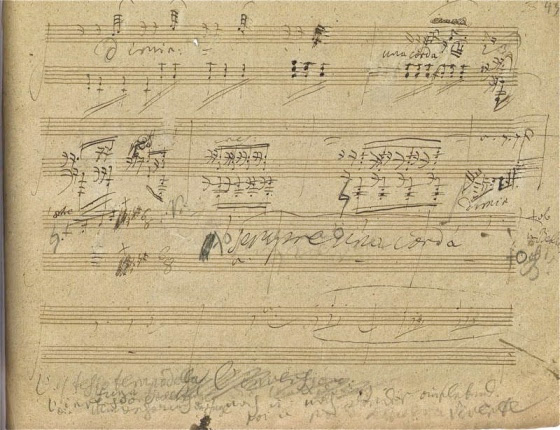
Facsimile of last movement p.43
But it’s in the finale that the weight of the sonata lies, and it begins with a declamatory, recitative-like passage that starts in the minor, moving to an emotionally pained aria-like section.Beethoven introduces a quietly authoritative fugue, based on a theme reminiscent of the one that opened the sonata. Its progress interrupted by the aria once more, its line now disjunct and almost sobbing for breath. The way in which the composer moves into the major via a sequence of G major chords is a passage of pure radiance, that Edwin Fischer described as ‘like a reawakening heartbeat’. This leads to a second appearance of the fugue in inversion culminating in a magnificently triumphant conclusion.

The legendary Guido Agosti held summer masterclasses in Siena for over thirty years.All the major pianists and musicians of the time would flock to learn from a master,a student of Busoni,where sounds heard in that studio have never been forgotten.He was persuaded by us in 1983 to give a public performance of the last two Beethoven Sonatas.The recording of op 110 from this concert is a testament,and one of the very few CD’s ever made,of this great master.
This is a recently made master of op 111 https://drive.google.com/file/d/1zdb2qjgWnA3HyPph_6FxnxjLHy7APc_f/view?usp=drive_web

https://christopheraxworthymusiccommentary.com/2024/01/03/forli-pays-homage-to-guido-agosti/The facsimile of the manuscript were given to the Ghione theatre by Maestro Agosti.They still adorn the walls of this beautiful theatre ,created by Ileana Ghione and her husband,that became a cultural centre of excellence in the 80’s and 90’s.
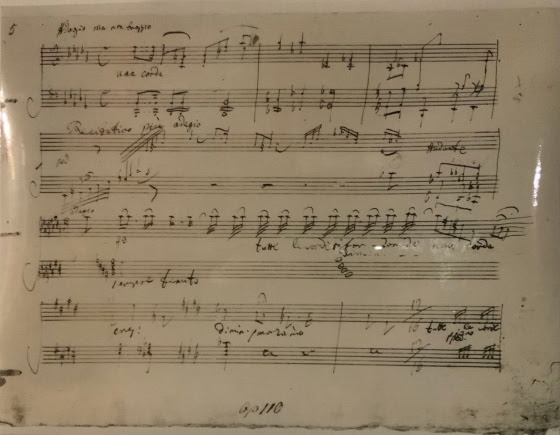
Beethoven’s own markings with the ‘bebung‘ or vibrated notes in the Adagio of op.110
In the summer of 1819, Adolf Martin Schlesinger from the Schlesinger firm of music publishers based in Berlin sent his son Maurice to meet Beethoven to form business relations with the composer.The two met in Modling,where Maurice left a favourable impression on the composer.After some negotiation by letter, the elder Schlesinger offered to purchase three piano sonatas for 90 ducats in April 1820, though Beethoven had originally asked for 120 ducats. In May 1820, Beethoven agreed, and he undertook to deliver the sonatas within three months. These three sonatas are the ones now known as Op. 109,110, and 111 the last of Beethoven’s piano
The composer was prevented from completing the promised sonatas on schedule by several factors, including his work on the Missa solemnis (Op. 123),rheumatic attacks in the winter of 1820, and a bout of jaundice in the summer of 1821.Op. 110 “did not begin to take shape” until the latter half of 1821.Although Op. 109 was published by Schlesinger in November 1821, correspondence shows that Op. 110 was still not ready by the middle of December 1821. The sonata’s completed autograph score bears the date 25 December 1821, but Beethoven continued to revise the last movement and did not finish until early 1822.The copyist’s score was presumably delivered to Schlesinger around this time, since Beethoven received a payment of 30 ducats for the sonata in January 1822.

https://youtube.com/watch?v=Lfnq7ZuDuGQ&feature=shared

Edvard Hagerup Grieg 15 June 1843 – 4 September 1907 Bergen Norway
The Holberg Suite was originally composed for the piano, but a year later was adapted by Grieg himself for string orchestra .The suite consists of an introduction and a set of dances. It is an early essay in neoclassicism an attempt to echo as much as was known in Grieg’s time of the music of Holberg’s era.The Holberg Suite, op 40, more properly From Holberg’s Time (Norwegian: Fra Holbergs tid), subtitled “Suite in olden style” (Norwegian: Suite i gammel stil), is a suite of five movements based on eighteenth-century dance forms, written in 1884 to celebrate the 200th anniversary of the birth of Dano-Norwegian humanist playwright Ludvig Holberg (1684–1754).
- Prelude – Allegro vivace
- Sarabande – Andante
- Gavotte – Allegretto
- Aria – Andante religioso
- Rigaudon – Allegro con brio

Franz Liszt 22 October 1811 – 31 July 1886
Hungarian Rhapsody No. 9, S.244/9 is nicknamed the “Carnival in Pest” or “Pesther Carneval” and was composed in 1847.Liszt used five themes in this rhapsody. The first of these, possibly Italian in origin, can be found in one Liszt’s manuscript notebooks. The second theme is a csardas by an unknown composer. After the third theme, which is an unidentified folk tune, Liszt quotes an authentic Hungarian folk song, A kertmegi káposzta. The final theme quoted is a third folk tune, Mikor én még legény voltam.Liszt wrote a set of 19 piano pieces based on Hungarian Folk Themes during 1846–1853, and later in 1882 and 1885. Liszt incorporated many themes he had heard in his native western Hungary and which he believed to be folk music, though many were in fact tunes written by members of the Hungarian upper middle class, or by composers such as Jozsef Kossovits ,often played by Gypsy bands. The large scale structure of each was influenced by the verbunkos a Hungarian dance in several parts, each with a different tempo.Within this structure, Liszt preserved the two main structural elements of typical Gypsy improvisation—the lassan (“slow”) and the friska (“fast”). At the same time, Liszt incorporated a number of effects unique to the sound of Gypsy bands, especially the pianistic equivalent of the cimbalom.He also makes much use of the Hungarian gypsy scale.

Fryderyk Franciszek Chopin;1 March 1810 – 17 October 1849
Over the years 1825–1849, Chopin wrote at least 59 compositions for piano called Mazurkas referring to one of the traditional Polish dances
- 58 have been published
- 45 during Chopin’s lifetime, of which 41 have opus numbers (with the remaining four works being two early mazurkas from 1826 and the famous “Notre Temps” and “Émile Gaillard” mazurkas that were published individually in 1841)
- 13 posthumously, of which 8 have posthumous opus numbers (specifically, Opp. 67 & 68)
- 11 further mazurkas are known whose manuscripts are either in private hands (2) or untraced (at least 9).
The serial numbering of the 58 published mazurkas normally goes only up to 51. The remaining 7 are referred to by their key or catalogue number.
Chopin while he used the traditional mazurka as his model, he was able to transform his mazurkas into an entirely new genre, one that became known as a “Chopin genre”.
In 1852, three years after Chopin’s death, Liszt published a piece about Chopin’s mazurkas, saying that Chopin had been directly influenced by Polish national music to compose his mazurkas. Liszt also provided descriptions of specific dance scenes, which were not completely accurate, but were “a way to raise the status of these works [mazurkas].”While Liszt’s claim was inaccurate, the actions of scholars who read his writing proved to be more disastrous. When reading Liszt’s work, scholars interpreted the word “national” as “folk,” creating the “longest standing myth in Chopin criticism—the myth that Chopin’s mazurkas are national works rooted in an authentic Polish-folk music tradition.”In fact, the most likely explanation for Chopin’s influence is the national music he was hearing as a young man in urban areas of Poland, such as Warsaw.
After scholars created this myth, they furthered it through their own writings in different ways. Some picked specific mazurkas that they could apply to a point they were trying to make in support of Chopin’s direct connection with folk music. Others simply made generalizations so that their claims of this connection would make sense. In all cases, since these writers were well-respected and carried weight in the scholarly community, people accepted their suggestions as truth, which allowed the myth to grow. However, in 1921, Béla Bartok published an essay in which he said that Chopin “had not known authentic Polish folk music.”By the time of his death in 1945, Bartók was a very well known and respected composer, as well as a prominent expert on folk music, so his opinion and his writing carried a great deal of weight. Bartók suggested that Chopin instead had been influenced by national, and not folk music.Schumann described Chopin Mazurkas as ‘Canons covered in flowers’.The op .50 mazurkas are a set of three written and published in 1842.
 ChristopherAxworthy-MusicCommentary