

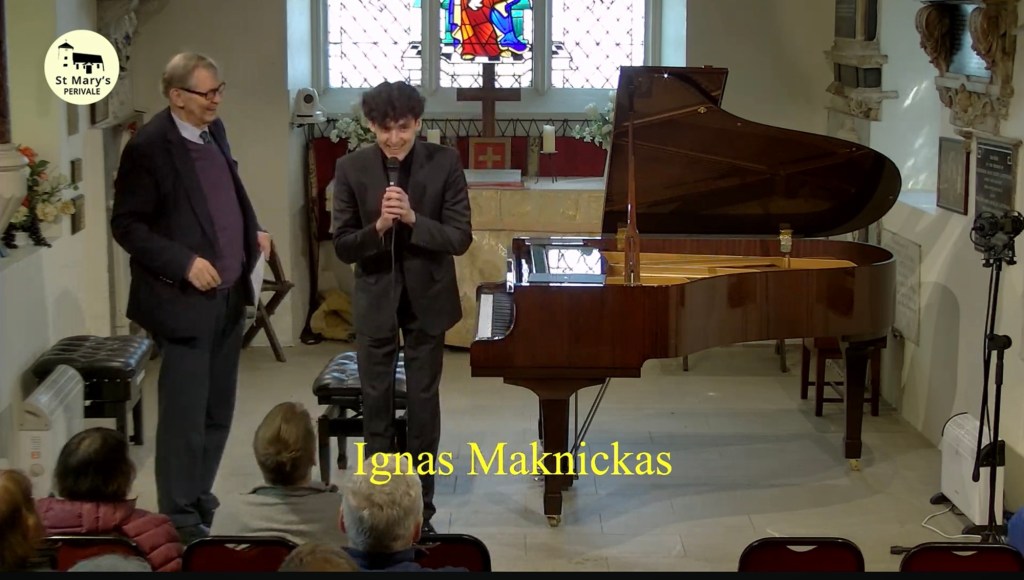
I have known Ignas for many years now since I was invited by Alim Baesembayev’s teacher ,Tessa Nicholson,to listen to two first years students,Alim and Ignas playing the Mozart Double Concerto in the RAM Annual Piano Festival. Alim has gone on to win the Leeds International Piano Competition but Ignas has been slower to allow his extraordinary talent to mature.There are many temptations for young students when they leave their homeland to study in the great metropolis and the discipline and working attitude they were brought up with can take time to find its place as life and music must grow up side by side in a voyage of discovery which is never easy.Teenagers that are prepared to dedicate their youth to art require an enormous dedication and discipline.Ignas is proving in the past few years to have found that discipline and is having the just rewards that his remarkable talent has always demanded.It sounds foolish to talk about the fluidity of Lithuanian pianists and the relaxed way they seem to caress the keys like strokes of a swimmer in the water.It is a fact ,though, that all the Lithuanian pianist I know have this fluidity of sound that used to belong primarily to the great Hungarian School of Dohnyani : Geza Anda and Annie Fischer are two such examples. The Lithuanian pianists in London that I know well are Gabrielé Sutkuté,Milda Daunoraité,Rokas Valuntonis and Kasparas Mikuzis and are all strangely ‘birds of a feather’!
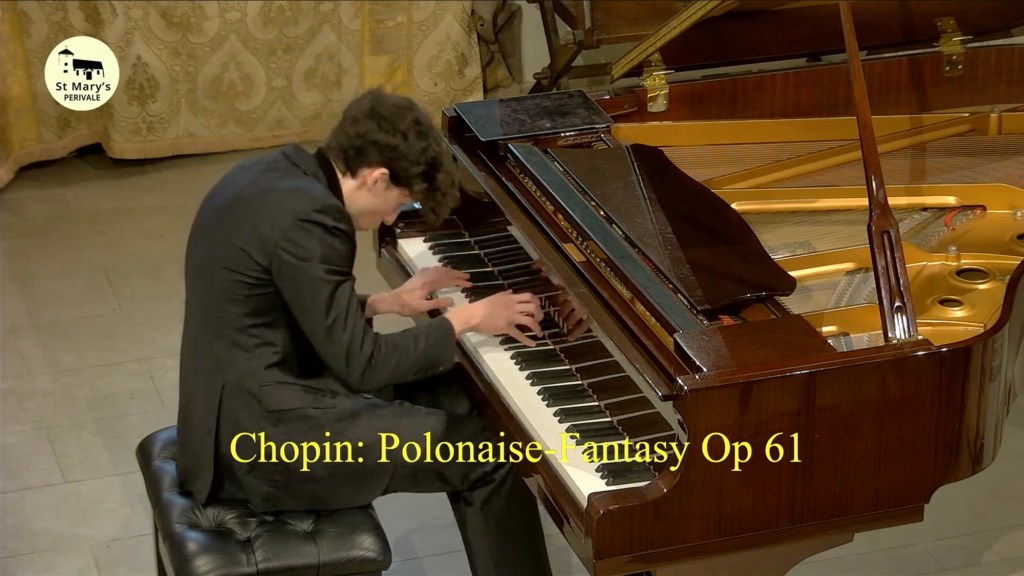
It was in the last work of the programme that Ignas revealed his great artistry and magnetic personality as rays of light glistened as he spread Chopin’s great web of sounds over the entire keyboard .I have heard him play this work many time before and it has now become part of his being as it was with Rubinstein .In fact there were moments when details were not quite focused and were blurred as rests were ignored and notes sometimes not quite as precise as in the score but there was an overall conviction allied to a quite extraordinary sound world that recreated this masterpiece before our very eyes.There was an architectural shape and an urgency that was compelling.I found the opening Polonaise ‘a tempo giusto’ a fraction too fast but what did it matter as we were drawn hypnotically into a magic world of this dashing young romantic – Rubinstein springs to mind even in his eternally youthful Indian Summer.There was a sumptuous beauty to the ‘Poco piu lento’ where the harmonic progression was as important as the melodic line.The final dynamic drive to the great climax was breathtaking and at the same time full of nobility and aristocratic control.

The concert had begun with Schumann’s Kinderscenen that must be a new work in Ignas’s repertoire.It was played with disarming simplicity and an overall architectural shape but missed the ravishing colour and sense of fantasy that he was to reserve for later in the programme.A beautiful fluidity and sense of balance as the tale of distant lands unfolded with simplicity leading to a curious story of beautifully interwoven sounds.A dynamic drive to the Blind man’s buff also given an overall shape as the counterpoints in the pleading child were so delicately described.If perfect happiness was rather breathless it was only because he could not wait to show us the grandeur and nobility of a Great Adventure.Traumerei had a flowing beauty but missed the magic that was to come later in the programme.His beautiful liquid sound though allowed this most beautiful of Reverie’s to be expressed with disarming simplicity.There was a flowing beauty by the Fireside before the simple drive of the Rocking Horse.Almost too serious flowed directly into the Hobgoblins schizophrenic antics and the gentle slumbers of the child sleeping.But it was the Poet speaks that suddenly ignited Ignas’s imagination and was indeed a poet who had found a voice that illuminated the piano ready for the sumptuous sounds of Vine and Bortkiewicz.This is obviously a work in progress just as I had watched his Schumann Fantasy and Schubert B flat Sonata gradually be transformed from a pianist who had learnt his lesson and was now being recreated with great artistry as he had delved deep and found the gems that lay hidden to all but the very few.I await the next performance of Schumann when he has surely found the key to this chest of jewels.https://youtu.be/UroWVTDb8Oo
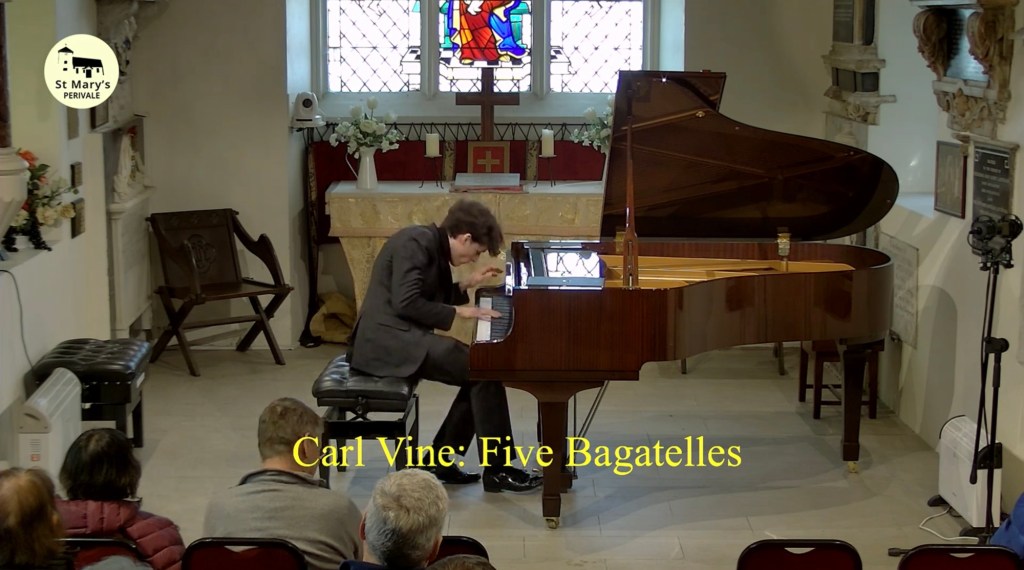
The works by Vine and Bortkiewicz obviously stimulated his imagination and with the beauty of his physical movements at the piano he was able to find a kaleidoscope of sounds and a use of the pedal that Anton Rubinstein so rightly said is its very soul. There was clarity and rhythmic drive in the second prelude and clusters of cloudy sounds in the third.His self identification with the Jazz sounds of the fourth saw him crouched low over the keyboard with shoulders moving first right then left as he relived the music with fantasy and brilliance.A slow lazy atmosphere in the last where he spread magic sounds over the entire keyboard.

Carl Edward Vine, 8 October 1954
Vine was born in Perth,Western Australia. He played the cornet from the age of 5, and took up the piano when he was 10. A teenage fascination with the music of Stockhausen inspired a period of Modernism, which he explored until the mid-1980s.He studied physics , then composition at the University of Western Australia (now the before moving to Sydney in 1975, where he worked as a freelance pianist and composer with a variety of theatre and dance companies, and ensembles.
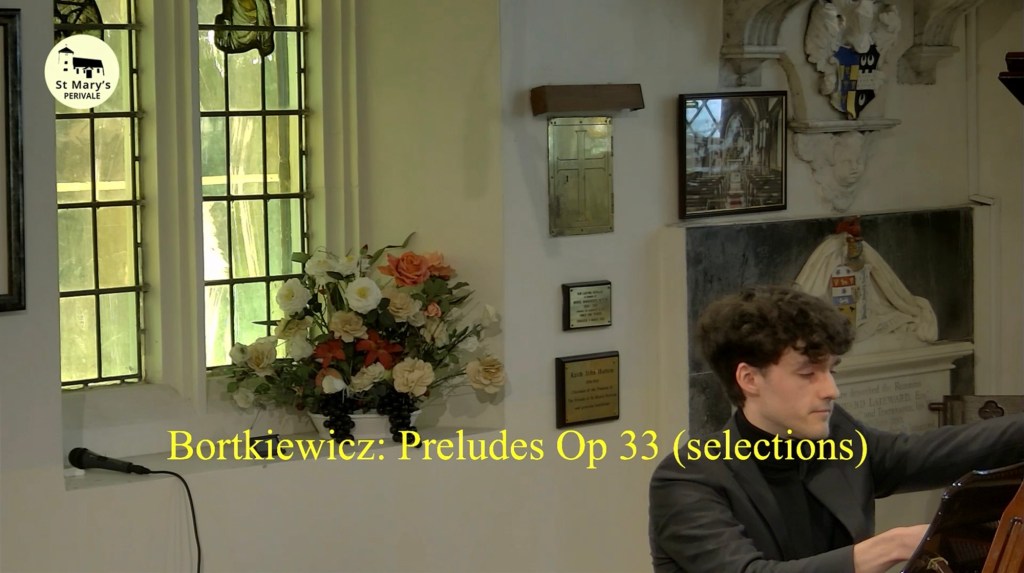
Bortkiewicz opened with Rachmaninovian grandiosity contrasting with the ravishing beauty of the second prelude. Sombre and passionate sounds of great intensity of the third built to a tumultuous sumptuous climax dying away to a very suggestive ending.There was a wonderful fluidity to the quasi Chopiniana fourth prelude.This was a fascinating short survey of a Ukrainian composer rarely heard in the concert hall and hats off to Ignas for showing us with such artistry what wonders there still are to be discovered.
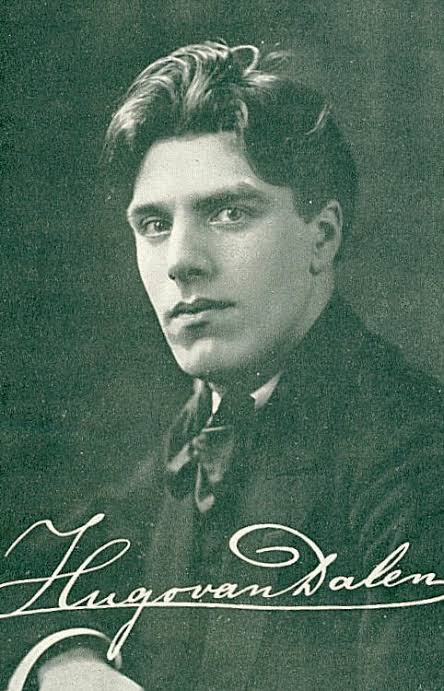
Sergei Bortkiewicz; 28 February 1877 – 25 October 1952
was born in Kharkov Ukraine He moved to Vienna in 1922 and became a naturalized Austrian citizen in 1926
Bortkiewicz’s piano style was influenced by Liszt,Chopin,Tchaikowsky,Scriabin,Wagner and Ukrainian folklore and thus never saw himself as a modernist.
‘His craftsmanship was meticulous, his imagination colourful and sensitive, his piano writing idiomatic; a lush instrumentation underlines the essential sentimentality of his melodic invention … Bortkiewicz mastered the skills of the past without adding anything distinctly personal or original’

In July 2021 Ignas Maknickas received “The Queen’s Award for Excellence” as the highest-scoring graduate of the Royal Academy of Music. In 2023 Ignas became the winner of Young Classical Artists Trust (YCAT) International Auditions, had his debut recital at the Wigmore Hall and in January 2024 had his debut at the BBC Radio 3 programme “In Tune” with Sean Rafferty. Ignas has taken First Prize at the XIX Fryderyk Chopin Piano Competition for Youth in Szafarnia, First Prize at the XX Piano Competition “Young Virtuoso” in Zagreb, Third Prize at the Aarhus Piano Competition and, in 2021, was the semi-finalist of the Vendome Prize. 2024-25 highlights include solo recitals at the Wigmore Hall in London, Konzerthaus Berlin, Brighton Dome, King’s Lynn, Fidelio Cafe and others.
Born in California in 1998, Ignas was raised in Lithuania. In 2017, graduating from the National M.K. Ciurlionis School of Art in Vilnius, he was honoured by the President of Lithuania, H.E. Dalia Grybauskaite. With his sister and three brothers the talented Maknickas Family Ensemble has represented Lithuania on National Television and at State Occasions. Ignas completed his Bachelor and Master of Arts programmes at the Royal Academy of Music on full scholarship under Professor Joanna MacGregor. In September 2023 he commenced the Advanced Diploma Programme with Professor MacGregor, also on full scholarship. He is a Leverhulme Arts Scholar, a recipient of the ABRSM Scholarship Award, the Imogen Cooper Music Trust Scholarship, Munster Trust Mark James Award, Robert Turnbull Piano Foundation Award, Tillett Trust and Colin Keer Trust Award and Hattori Foundation Award. He is an Artist of the Munster Trust Recital Scheme. As a soloist he has appeared at the Steinway Hall in London, Auditorium du Louvre in Paris, Charlottenborg Festival Hall in Copenhagen, Ed Landreth Hall in Fort Worth, Lithuanian National Philharmonic in Vilnius and Kinross House in Scotland.

 ChristopherAxworthy-MusicCommentary