

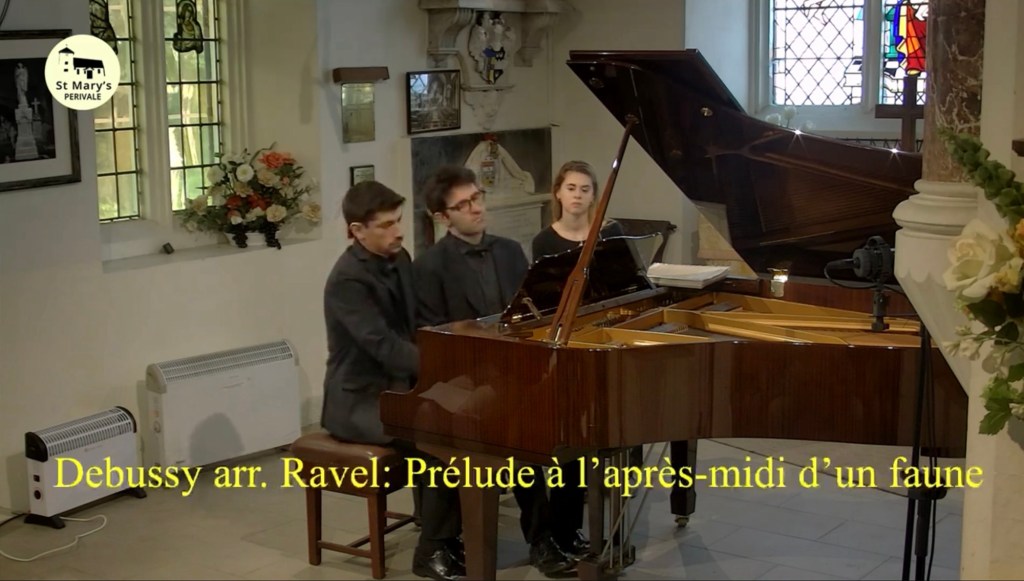
Some exciting playing from four hands and four feet but more importantly one mind and one heart …………..Ravishing colours of Debussy and refined brilliance of Ravel were but just an inspired preparation for the savagery of Stravinsky with his mixture of innocence and brutality depicted magnificently by a team that played as one.An ovation from a full house in Perivale was rewarded with an even more dynamic Danse Russe from this young Italian duo who had come especially to make their first appearance in the UK before embarking on an American tour.


Today 111 years on it was greeted by an ovation rarely seen by the usually undemonstrative audience at St Mary’s Perivale!
The dynamic changes of character and driving rhythms from this piano duo created a hypnotic atmosphere from the beauty of the introduction similar in many ways to the Debussy Faune,but erupting into savagery with the pungent rhythms from Alessandro of the ‘Dances of the young girls’.It is interesting to note that it was Debussy who first played this original version for four hands with the composer.
A remarkable precision that allowed Francesco to show us the parade of ‘Young Girls’ in all their naive innocence floating above this undercurrent of menace.Erupting in a ‘Ritual of Abduction ’ and a display of transcendental piano playing from Francesco before the insinuating pulsating sostenuto e pesante of the ‘Spring Rounds’.All the time the rhythmic drive was remarkably constant despite all the enormous rhythmic intricacies involved. There was beauty too as ‘Le Sacrifice’ opened the second part of the ‘Rite’. Gradually leading to the eruption and the ‘Glorification of the Chosen One ’.A remarkable sense of control and colour in the ‘Ritual action of the Ancestors ’ in which Alessandro kept the pulsating driving rhythm as an undercurrent to the insinuating melody from Francesco.
Knotty twine indeed but nothing could prepare us for the remarkable playing of the ‘ Sacrificial Dance’ where the precision and continual changes of colour were like shots being fired with their piercing lightening strikes.
A tour de force of piano playing but above all of united musicianship that could reveal this extraordinary work in all its naked brilliance.

Italian pianists Francesco Bravi and Adriano Leonardo Scapicchi regularly perform in duo since 2018. In 2019 they performed Stravinsky’s original version for piano four-hands of The Rite of the Spring at Teatro Palladium, for Roma Tre Orchestra Young Artist Piano Solo Series. The success following their performance, described by Christopher Axworthy as “a formidable knotty twine of great precision and rhythmic pulse”, brought them to be invited to many international music festivals, such as Villa Pennisi in Musica, I Tramonti di Tinia, Villa Borghese Piano Day. In 2023 they were awarded the Outstanding Musicians Prize at the International Classical Music Competition Ibla Grand Prize, where they also received a special mention for their interpretation of Debussy’s Prélude à l’après-midi d’un faune. As winners of the competition, in 2024 they will take part in a tour in the USA, performing in many important venues including the Weill Recital Hall of the Carnegie Hall. In 2022 they were invited to play Stravinsky’s Petrouchka at the Accademia Filarmonica Romana for the presentation of a new edition of Roman Vlad’s biography of Stravinsky. The following year they have been invited again for the presentation of the new book written by Francesco Maria Colombo. They performed at several venues, including Università Roma Tre, Reale Circolo Canottieri Tevere Remo, and Pontificio Istituto di Musica Sacra. In 2024 they have been invited to perform in the chamber music concert series Suoni Oltre Confine and at the Pauline Chapel of the Quirinal Palace for the series The Concerts at the Quirinale, live streamed by Radio 3. They took part in masterclasses led by renowned pianists who regularly perform in piano duos, such as Massimo Spada and Alessio Bax. They attend the Chamber Music Course at the International School of Music Avos Project in Rome.

Stravinsky’s sketchbooks show that after returning to his home at Ustilug in Ukraine in September 1911, he worked on two movements, the “Augurs of Spring” and the “Spring Rounds”.In October he left Ustilug for Clarens in Switzerland, where in a tiny and sparsely-furnished room—an 8-by-8-foot (2.4 by 2.4 m) closet, with only a muted upright piano, a table and two chairs – he worked throughout the 1911–12 winter on the score.By March 1912, according to the sketchbook chronology, Stravinsky had completed Part I and had drafted much of Part II.He also prepared a two-hand piano version, subsequently lost,which he may have used to demonstrate the work to Diaghilev and the Ballets Russes conductor Pierre Monteux in April 1912.He also made a four-hand piano arrangement which became the first published version of Le Sacre; he and the composer Claude Debussy played the first half of this together, in June 1912.The conductor Pierre Monteux had worked with Diaghilev since 1911 and had been in charge of the orchestra at the premiere of Petrushka.

The Rite of Spring – Le Sacre du printemps is a ballet and orchestral concert work written for the 1913 Paris season of Sergei Diaghilev’s Ballets Russes ; the original choreography was by Vaslav Nijinsky and the first performance at the Theatre des Champs- Elysées on 29 May 1913, caused a sensation and many have called the first-night reaction a “riot” or “near-riot”.Monteux’s first reaction to The Rite, after hearing Stravinsky play a piano version, was to leave the room and find a quiet corner. He drew Diaghilev aside and said he would never conduct music like that; Diaghilev managed to change his mind.Although he would perform his duties with conscientious professionalism, he never came to enjoy the work; nearly fifty years after the premiere he told enquirers that he detested it.In old age he said to Sir Thomas Beecham’s biographer Charles Reid: “I did not like Le Sacre then and I have conducted it fifty times since. I do not like it now”.On 30 March Monteux informed Stravinsky of modifications he thought were necessary to the score, all of which the composer implemented.The orchestra, drawn mainly from the Concerts Colonne in Paris, comprised 99 players, much larger than normally employed at the theatre, and had difficulty fitting into the orchestra pit.
Stravinsky was a young, virtually unknown composer when Diaghilev recruited him to create works for the Ballets Russes. Le Sacre du printemps was the third such major project, after the acclaimed Firebird (1910) and Petrushka ( 1911 ).The concept behind The Rite of Spring, developed by Roerich from Stravinsky’s outline idea, is suggested by its subtitle, “Pictures of Pagan Russia in Two Parts”; the scenario depicts various primitive rituals celebrating the advent of spring, after which a young girl is chosen as a sacrificial victim and dances herself to death. In his autobiography, Stravinsky writes that the derisive laughter that greeted the first bars of the Introduction disgusted him, and that he left the auditorium to watch the rest of the performance from the stage wings. The demonstrations, he says, grew into “a terrific uproar” which, along with the on-stage noises, drowned out the voice of Nijinsky who was shouting the step numbers to the dancers.Monteux believed that the trouble began when the two factions began attacking each other, but their mutual anger was soon diverted towards the orchestra: “Everything available was tossed in our direction, but we continued to play on”. Around forty of the worst offenders were ejected—possibly with the intervention of the police, although this is uncorroborated. Through all the disturbances the performance continued without interruption.

Prélude à l’après-midi d’un faune (L. 86), is a symphonic poem ,composed in 1894 and first performed in Paris on 22 December 1894. It was inspired by the poem by Stephane Mallarmé and is one of Debussy’s most famous works and is considered a turning point in the history of Western art music . Pierre Boulez considered the score to be the beginning of modern music, observing that “the flute of the faun brought new breath to the art of music.”
Debussy’s work later provided the basis for the ballet choreographed by Vaslav Nijinsky.
Debussy wrote :’The music of this prelude is a very free illustration of Mallarmé’s beautiful poem. By no means does it claim to be a synthesis of it. Rather there is a succession of scenes through which pass the desires and dreams of the faun in the heat of the afternoon. Then, tired of pursuing the timorous flight of nymphs and naiads , he succumbs to intoxicating sleep, in which he can finally realize his dreams of possession in universal Nature.
Mallarmé himself was unhappy with his poem being used as the basis for music: He believed that his own music was sufficient, and that even with the best intentions in the world, it was a veritable crime as far as poetry was concerned to juxtapose poetry and music, even if it were the finest music there is.However, after attending the premiere performance at Debussy’s invitation, Mallarmé wrote to Debussy: “I have just come out of the concert, deeply moved. The marvel! Your illustration of the Afternoon of a Faun, which presents no dissonance with my text, but goes much further, really, into nostalgia and into light, with finesse, with sensuality, with richness. I shake your hand admiringly, Debussy. Yours, Mallarmé.”

Rapsodie espagnole was composed between 1907 and 1908, the Rapsodie is one of Ravel’s first major works for orchestra. It was first performed in Paris in 1908 and quickly entered the international repertoire. The piece draws on the composer’s Spanish heritage and is one of several of his works set in or reflecting Spain.
The genesis of the Rapsodie was a Habanera, for two pianos, which Ravel wrote in 1895. It was not published as a separate piece, and in 1907 he composed three companion pieces. A two-piano version was completed by October of that year, and the suite was fully orchestrated the following February.At about this time there was a distinctly Spanish tone to Ravel’s output, perhaps reflecting his own Spanish ancestry.His opera L’heure espagnole was completed in 1907,as was the song “Vocalise-Etude en forme de habanera”.
In the interval between the composition of the original Habanera and the completion of the four-movement Rapsodie, Debussy had published a piano suite, Estampes (1903), of which the middle section, “Soirée dans Grenade”, had a Spanish theme.To counter any accusations of plagiarism, Ravel made certain that the date 1895 was clearly printed for his Habanera in the published score of the Rapsodie.
 ChristopherAxworthy-MusicCommentary
Una risposta a "Bravi – Scapicchi at St Mary’s A Piano Duo playing with one mind and one heart with ravishing colour,refined brilliance and savagery."