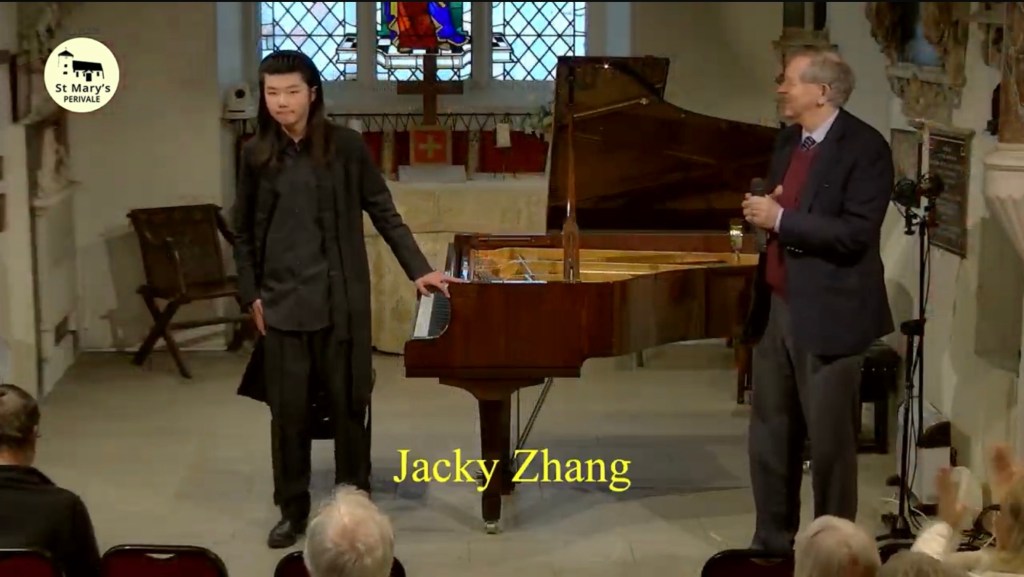
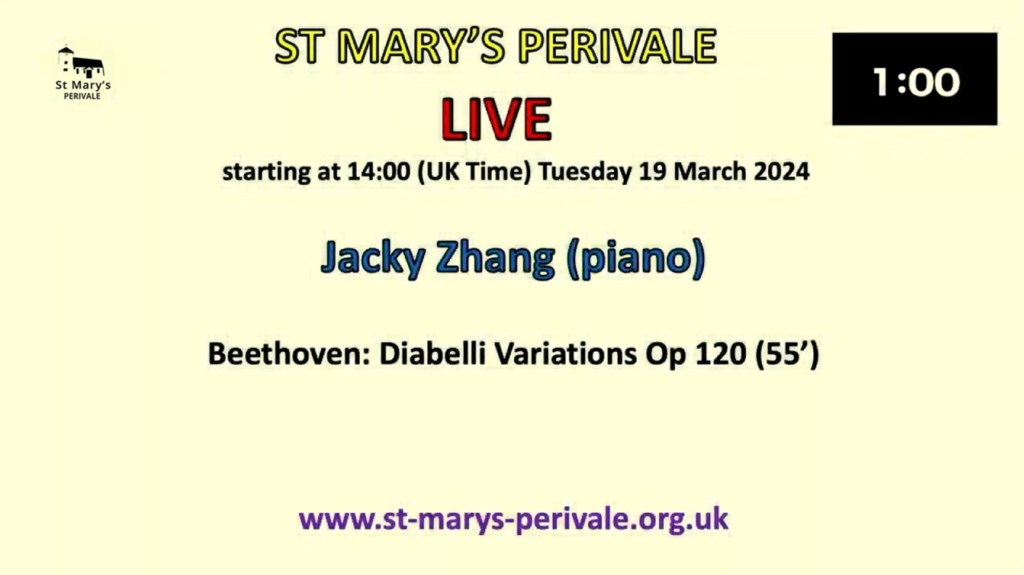
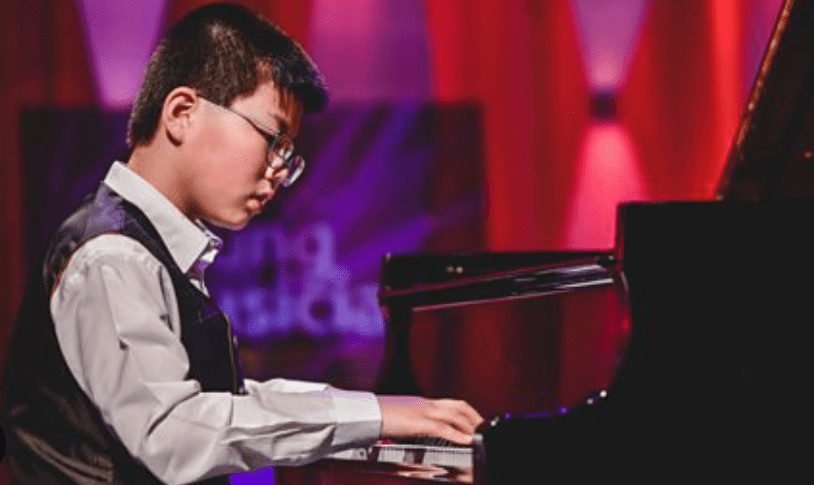
To see Jacky Zhang just a few months ago and see him now one can see the transformation from child prodigy to young artist.A young boy at the BBC young artists competition and now a young man with long hair and frock coat.This transition from choir boy to choir master is not easy and one must thank the Alexeev’s for taking this young boy under their protective wing and allowing his talent to bloom and flourish in a most natural way.

A year or so ago I heard him play the Goldberg Variations and now the Diabelli. Two of the greatest sets of variations ever written for keyboard and both works of endurance ,stamina and intellectual understanding quite apart from a technical mastery of the instrument . Jacky today gave an impeccable performance of the Diabelli Variations which in itself is something of a feat but it was his encore of Chopin ‘s B flat minor Sonata that convinced much more.
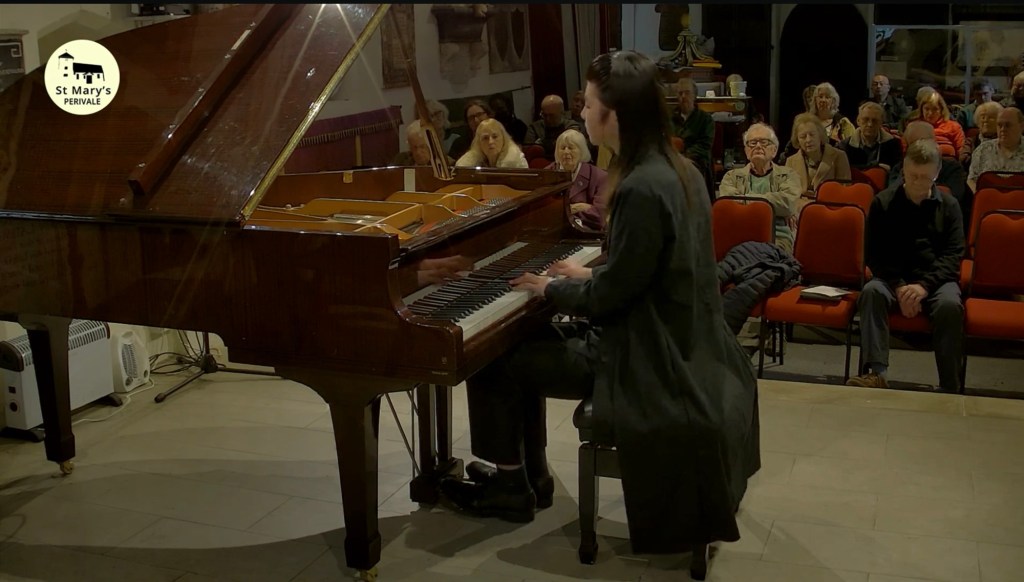
The Chopin had sweep,passion ,colour allied to a remarkable technical mastery and architectural understanding.Chopin’s indications had mostly been scrupulously noted and incorporated into an interpretation that was totally convincing .Above all there was the passionate commitment of a young man whose heart was beating with the same intensity as Chopin’s.I am not sure I like his pianistic rearrangement of the hands at the opening that makes me wonder whether he is thinking as a pianist or a musician but the clarity and precision of the last movement was truly remarkable.The scherzo too I have rarely heard played with such technical and musical assurance .Even the beautiful trio was played with individual personality but always with the greatest respect for the score.The final two bass notes were played with just the right orchestral length that made the entry of the Funeral March even more poignant.The Trio of the Funeral March was played with flowing lyricism with more restrained passion than the usual cold respect.The architectural shape of the first movement too was quite remarkably sustained and the final few bars played with aristocratic control.All through the performance there had been a wonderful sense of colour due to a remarkable sense of balance that gave a sumptuous glow to all he did no matter what the technical hurdles might have been.
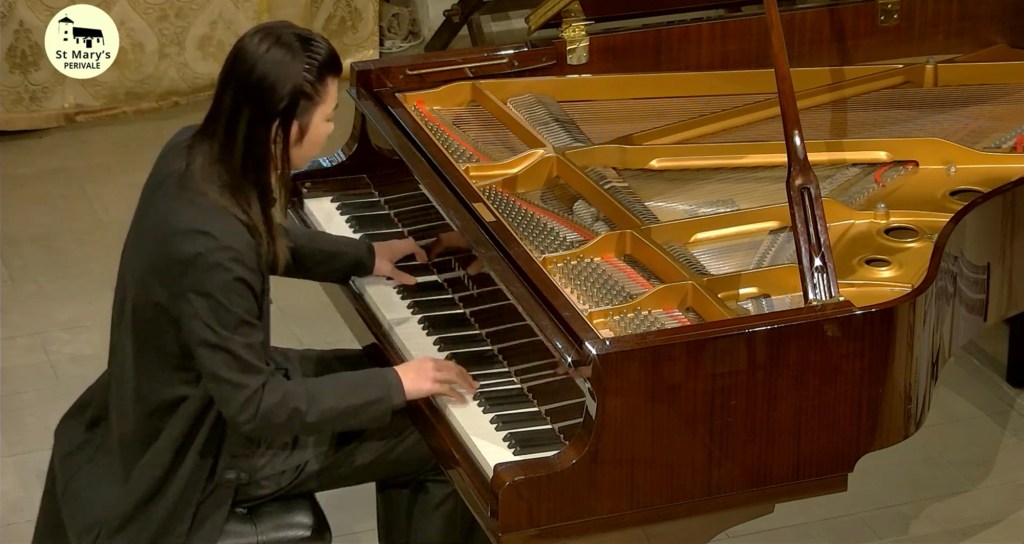
The Diabelli Variations are one of the greatest works for piano and I have heard them over the years played by many remarkable players.Rudolf Serkin and Alfred Brendel are the two that have remained with me ever since their performances in the Royal Festival Hall many years ago.How could I ever forget the electricity as Serkin attacked the Fugue of variation n 32 or the intensity and buoyancy that Brendel gave to the innocuous little opening theme.Stephen Bishop ( as he was then known) gave a performance of them in the Wigmore Hall that has gone down in history. I was not there but he told me that his mentor Myra Hess had never played them herself but she sat down and worked in detail with him and was there at the Wigmore Hall to cheer her young American prodigy.
All this to say that it was a remarkable feat for a 15 year old artist to be able to give not only a note perfect performance of a work that lasts almost an hour but to play it with a technical mastery and a sense of architectural shape that could hold this vast edifice into one complete whole.
But why then did it not have the same impact as a Serkin or a Brendel when with youth on his side it should have been even more exciting?
The point is that Beethoven may have been totally deaf when he wrote this penultimate work for piano but he was able to indicate in the minutest detail exactly what only he could actually hear and envisage .All the markings are there as indeed Brendel and Serkin had realised.
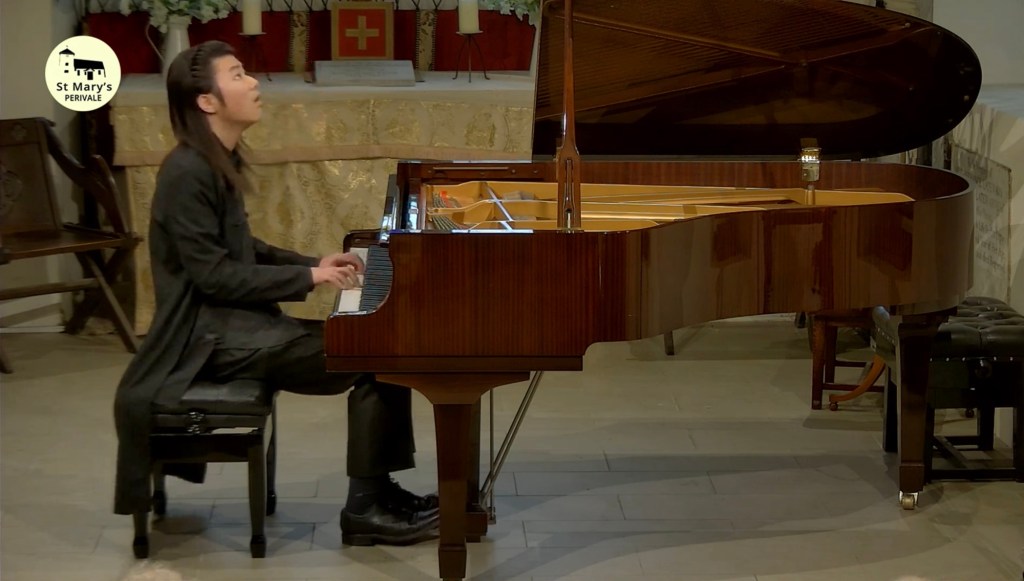
One of the most important things in Beethoven are the rests, sudden contrasts without forewarning of forte and piano.Sforzandi that should be like electric shocks and a difference between legato and staccato that is orchestral not pianistic.In the 29th Variation it was André Tchaikowsky who I remember more than others for the ‘Adagio’ that was not all uniformly legato but the rests were like a gasp between each droplet of the phrase.Jacky had played the 2nd variation with a legato melody too where the number of rests written must be a Guinness record! The Allegro of the 6th variation was more joyous than Beethoven’s indication of ‘serioso’.But there were many beautiful things of course, like the ‘Grave e maestoso’ of the 14th variation that flowed so beautifully but then surely the 15th should be more fun as it is after all marked ‘scherzando’ !The sudden forte and piano and legato left hand in the 17th was not noted as he spent more time on the transcendental difficulty of the right hand which is basically the accompaniment .The Allegro of the 21st was played with just the right amount of brio but the last note of ‘Notte e giorno faticar’ quoted from Mozart is not staccato like the previous four.And although the 23rd was remarkably played the simple ‘Andante Fughetta’ was missing the weight of world weariness that would have given it even more significance .His remarkable playing of the 25th was marred by a non legato left hand that is marked leggiermente and implies the sound of a legato bassoon rather than single bowed cellos? Why play the 26th so slowly when it is evolving like the miraculous unfolding of the fourth variation of op 109? Surely the ‘Menuetto’ of the last variation too should be slower .It is the calm after the storm where even Beethoven marks ‘grazioso e dolce’ as it floats into the stratosphere that the composer could already envisage in his final years .Floating into the paradise that was awaiting but which even he thinks is too soon as he slams the door shut with an almighty bang which resonates around the room ( hence the original pedal mark).
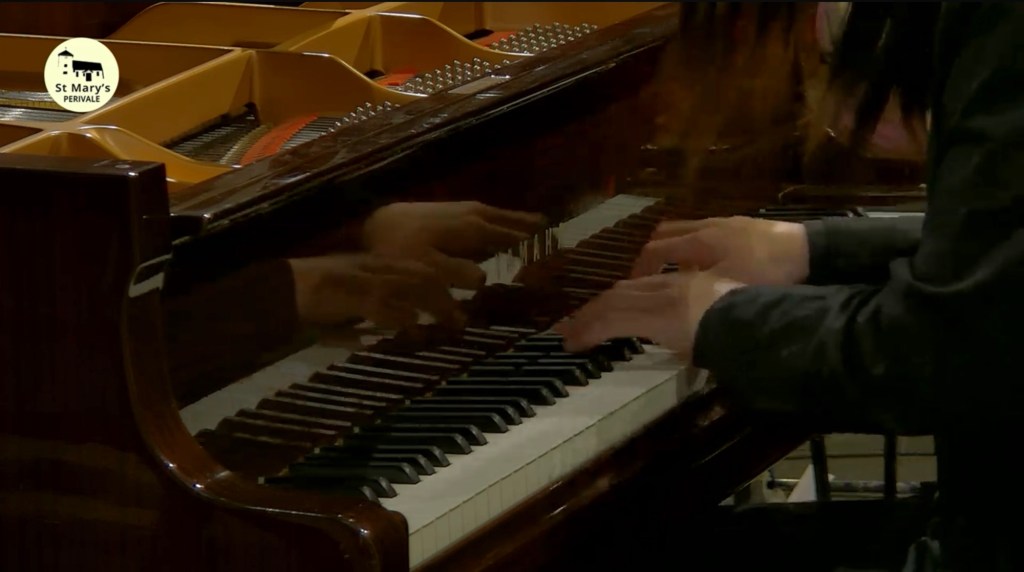
Of course Jacky is a remarkable young artist headed for the heights but these heights are not easily earned .When you touch such masterpieces there are so many things that only with maturity you will be able to understand.I remember Sidney Harrison judging a youthful Glenn Gould in a Canadian Music Festival and being told by his teacher that the boy would spend the entire lesson just playing the first chord of Beethoven’s Fourth Concerto and would not leave it until he was as satisfied as much was possible!
Genius is a multifaceted prism which moves in every direction as it becomes more and more aware of the problems of searching for perfection and looking to find the true meaning behind the notes of a score.The search is on for Jacky and it will be a voyage of discovery with many wonderful things awaiting as his talent will see the wonders that lie ahead of him ready for his golden fingers to entwine.
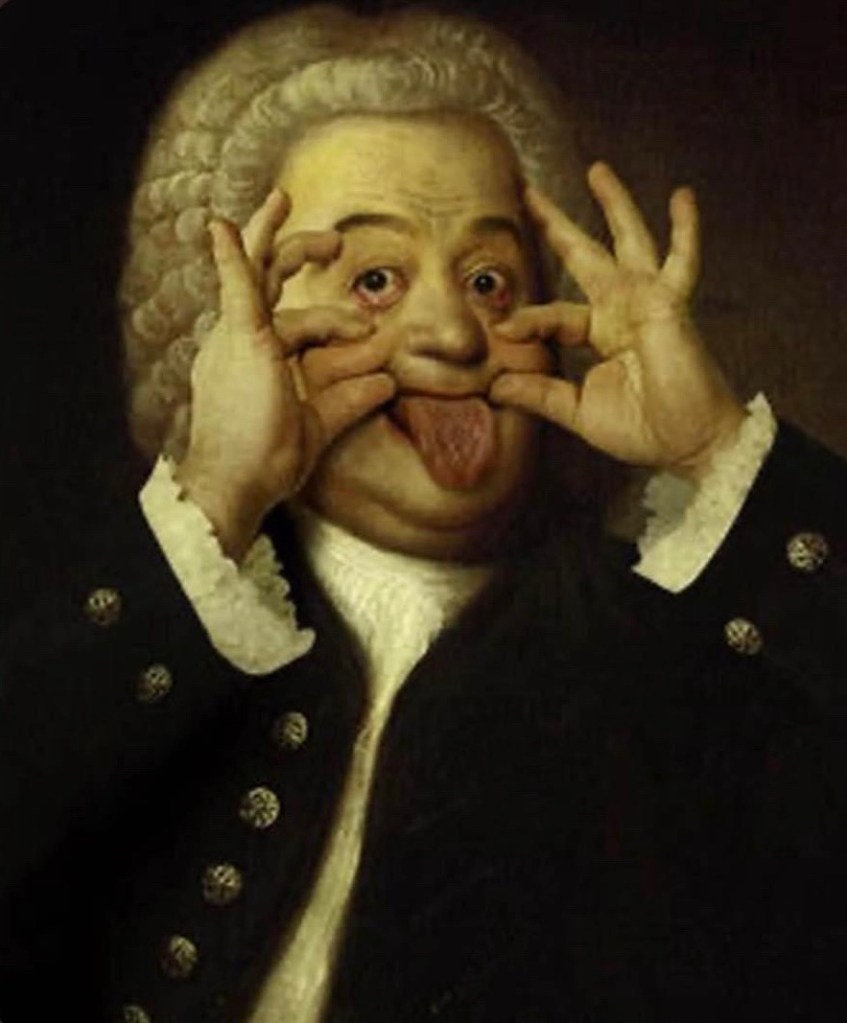
Of course one demands how can a mere performer be a Genius.
Bach,Beethoven and Mozart were Universal Genius’s with an astonishing amount of compositions that were masterpieces and one just wonders how that is possible in one lifetime. Da Vinci and Michelangelo too of course.But they all have one thing in common that defines them as Genius because it is a gift or God given talent that is unique and the reason for it unexplained by any normal reasoning.They are people who stand out because they have a unique gift and I use the term obviously in this context of performance meaning exceptionally talented.But it is more than exceptional it is unique and Genius or this sort of exceptional talent is neither easy to live with nor always pleasant .Trifonov is a case in point with a super human capacity to devour music and also to produce it himself.I remember Gilels when he came to the West and astonished us all simply saying ‘Wait and see who follows me’ – of course it was Richter! Bernstein was exceptionally talented -a Genius you might say.People with such extraordinary gifts and talent that are unexplained and so cannot be cloned but continue to surprise and astonish us mortals.
As Maude Tortelier once wrote to me so poetically saying that they are Angels just lent to us on this Earth for a certain period to fill our lives with joy and wonder.

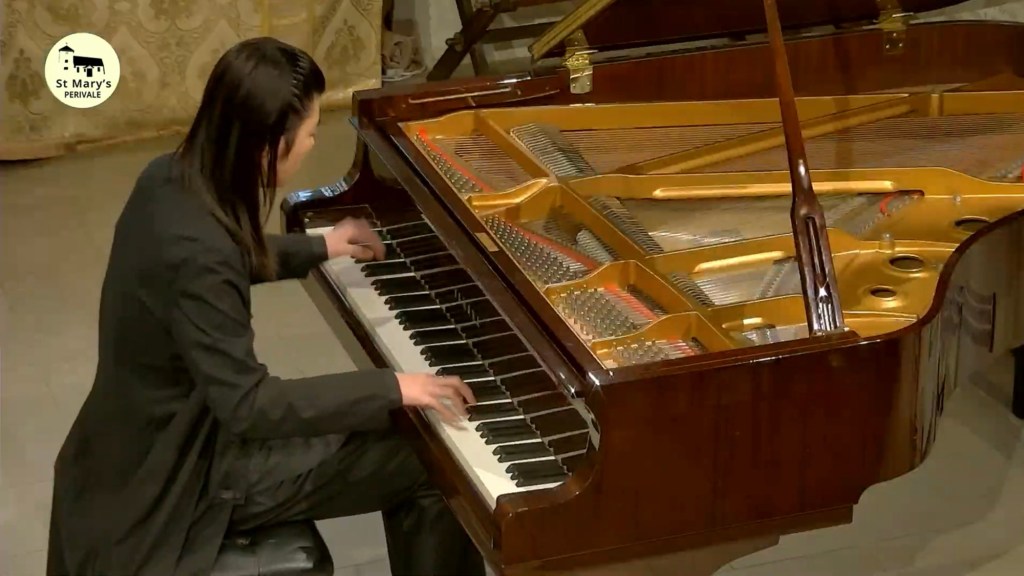
Jacky Zhang is a 15-year-old composer, pianist, songwriter, and producer. He is currently Year 3 undergraduate student of Royal College of Music, studying piano with Prof. Dmitri Alexeev and Prof. Jianing Kong, and composition with Prof. Kenneth Hesketh. Jacky won the first prize of the III Vladimir Krainev Moscow International Piano Competition 2019, the UK Piano Open International Piano Competition 2021, Premio Alkan International Piano Competition 2022, and both Classical and Romantic sections at the Città di Cantù International Piano and Orchestra Competition in 2023. Jacky has performed at many festivals and venues and has played concertos by Saint-Saëns, Mozart, Beethoven, and Rachmaninoff with well-known world-class conductors.
Jacky Zhang at St Mary’s the birth of a great artist and the start of a long voyage of discovery
The back of beyond -Bright future for the class of Dmitri Alexeev -Jacky Zhang-Alexander Doronin-Nikita Burzanitsa-Thomas Kelly -JunLin Wu
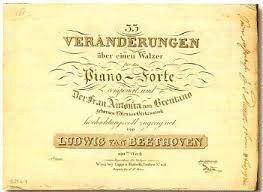
Donald Tovey called it “the greatest set of variations ever written” and Alfred Brendel has described it as “the greatest of all piano works”.It also comprises, in the words of Hans von Bulow “ a microcosm of Beethoven’s art”.Martin Cooper ,father of Imogen , writes, “The variety of treatment is almost without parallel, so that the work represents a book of advanced studies in Beethoven’s manner of expression and his use of the keyboard, as well as a monumental work in its own right”And Schoenberg “in respect of its harmony, the Diabelli deserves to be called the most adventurous work by Beethoven”.
The 33 Variations on a waltz by Anton Diabelli, Op. 120, commonly known as the Diabelli Variations, was written between 1819 and 1823 by Beethoven on a waltz composed by Anton Diabelli . Beethoven had had a connection with Diabelli for a number of years. Diabelli, born near Salzburg in 1781, had now been for some years one of the more prolific composers of light and pleasing music, and one of the best and most popular teachers in Vienna. He was much employed by Steiner and Co., as copyist and corrector, and in this capacity enjoyed much of Beethoven’s confidence, who also heartily liked him as a man.At the time of his project for variations on a theme of his own by various composers, Diabelli had advanced to become a partner in the publishing firm of Cappi and Diabelli. Beethoven at first refused categorically to participate in Diabelli’s project, dismissing the theme as banal, a Schusterfleck or ‘cobbler’s patch,’unworthy of his time. Not long afterwards, according to the story, upon learning that Diabelli would pay a handsome price for a full set of variations from him, Beethoven changed his mind and decided to show how much could be done with such slim materials. In another version of the legend, Beethoven was so insulted at being asked to work with material he considered beneath him that he wrote 33 variations to demonstrate his prowess.Beethoven’s approach to the theme is to take some of its smallest elements – the opening turn, the descending fourth and fifth ,the repeated notes – and build upon them pieces of great imagination, power and subtlety. Alfred Brendel wrote, “The theme has ceased to reign over its unruly offspring. Rather, the variations decide what the theme may have to offer them. Instead of being confirmed, adorned and glorified, it is improved, parodied, ridiculed, disclaimed, transfigured, mourned, stamped out and finally uplifted”.In early 1819 Diabelli, sent a waltz of his creation to all the important composers of the Austrian Empire , including Schubert,Czerny,Hummel and the Archduke Rudolph, asking each of them to write a variation on it. His plan was to publish all the variations in a patriotic volume called Vaterlandischer Kunstlerverein and to use the profits to benefit orphans and widows of the Napoleonic Wars.Liszt was not included, but it seems his teacher Czerny arranged for him to also provide a variation which he composed at the age of 11!
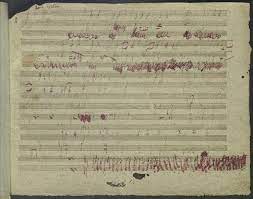
Diabelli published the work quickly as Op. 120 in June of the same year, adding the following introductory note:
“We present here to the world Variations of no ordinary type, but a great and important masterpiece worthy to be ranked with the imperishable creations of the old Classics—such a work as only Beethoven, the greatest living representative of true art—only Beethoven, and no other, can produce. The most original structures and ideas, the boldest musical idioms and harmonies are here exhausted; every pianoforte effect based on a solid technique is employed, and this work is the more interesting from the fact that it is elicited from a theme which no one would otherwise have supposed capable of a working-out of that character in which our exalted Master stands alone among his contemporaries. The splendid Fugues, Nos. 24 and 32, will astonish all friends and connoisseurs of serious style, as will Nos. 2, 6, 16, 17, 23, &c. the brilliant pianists; indeed all these variations, through the novelty of their ideas, care in working-out, and beauty in the most artful of their transitions, will entitle the work to a place beside Sebastian Bach’s famous masterpiece in the same form. We are proud to have given occasion for this composition, and have, moreover, taken all possible pains with regard to the printing to combine elegance with the utmost accuracy.”
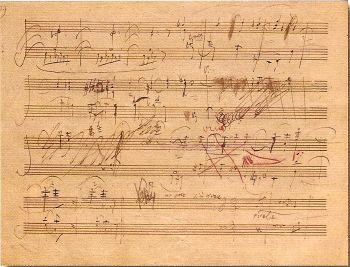
In the following year, 1824, it was republished as Volume 1 of the two-volume set Vaterlandischer Kunstlerverein , the second volume comprising the 50 variations by 50 other composers.Subsequent editions no longer mentioned Vaterländischer Künstlerverein.
 ChristopherAxworthy-MusicCommentary