
Jean-Efflam Bavouzet piano
Claude Debussy (1862-1918) Suite bergamasque (c.1890, rev. 1905)
I. Prélude • II. Menuet • III. Clair de lune • IV. Passepied
Franz Liszt (1811-1886) Hymne de la nuit S173a/1 (1840, rev. 1847)
Schlaflos! Frage und Antwort S203 (1883)
En rêve S207 (1885)
Claude Debussy La plus que lente (1910)
Franz Liszt Valse-impromptu S213 (1850-2)
Jules Massenet (1842-1912) Valse folle (1898)
Interval
Claude Debussy Masques (1903-4)
Erik Satie (1866-1925) Gymnopédie No. 1 (1888)
Jules Massenet Papillons blancs (pub. 1907)
Claude Debussy D’un cahier d’esquisses (1904)
Franz Liszt Toccata S197a (?1879)
Jules Massenet Toccata (pub. 1892)
Claude Debussy Pour le piano (1894-1901)
I. Prélude • II. Sarabande • III. Toccata

A sold out Wigmore Hall for Bavouzet ‘s fascinating survey of some extraordinary eccentricities by Liszt, Massenet and Debussy which of course could not have excluded the openly declared eccentricity of Satie .A musical sandwich between the beauty of Debussy’s early ‘Suite Bergamasque’ and ‘Pour le Piano’.But the surprise was still to come with an extraordinarily vivid performance of ‘L’isle joyeuse’ that had the normally sedate audience on their feet cheering a musician who could communicate his love and passion for music with warmth and charm.

Jersey has never had it so good! A range of sounds of astonishing Boulezian clarity and a musical understanding of the architectural shape of all he played .The grandiose opening of the ‘Prelude’ of the ‘Suite bergamasque’ was answered by the radiance and simplicity which he brought to ‘Clair de lune’. A mellifluous outpouring of magic sounds in Liszt’s ‘Hymne de la Nuit’ was mirrored by the dramatic entrance of ‘Schlaflos!Frage und Antwort ‘. ‘En reve’, surely the sweetest and certainly the shortest of Liszt’s late works was played with ravishing sound and an ethereal ending of whispered beauty as it reached out to the beguilingly impish ‘Valse Impromptu.’ There was the deep nostalgia of ‘La plus que lente’ unwinding with beguiling lazyness as the busy meanderings of Massenet’s ‘Valse folle’ were played with brilliant insistence.
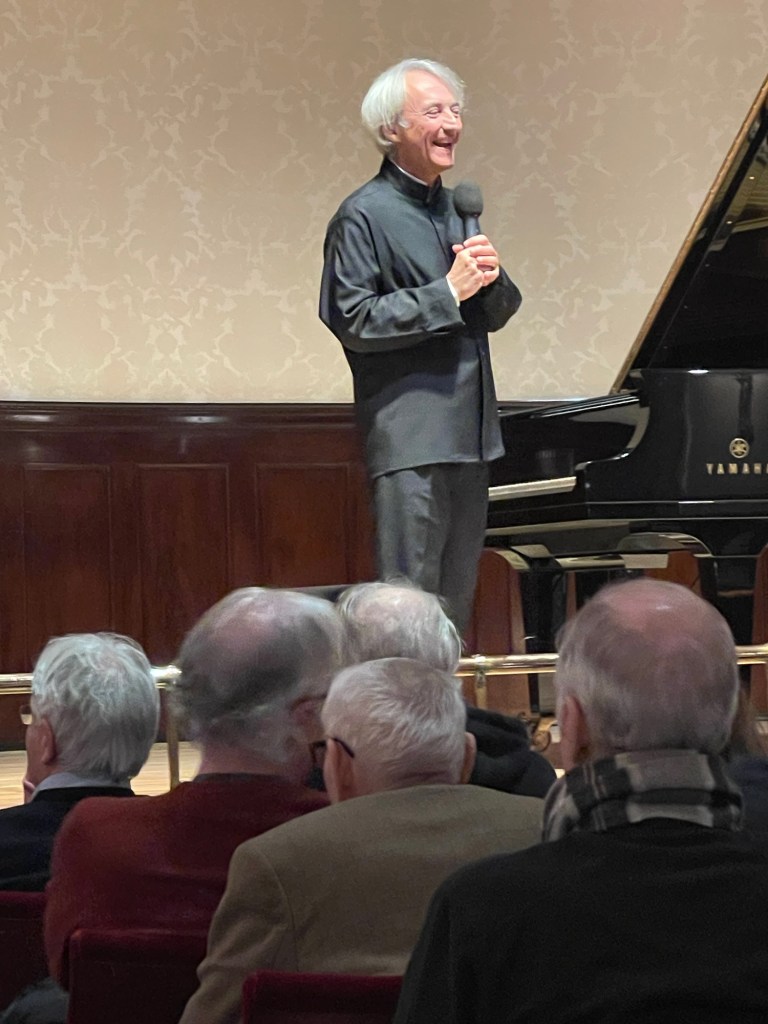
After the interval there was the frenzied dance of ‘Masques’ followed by the languid opening of Satie and the delicately etched purity of the melodic line – ‘douloureux’ – not easy on this rather ungrateful Yamaha that had been imported specially for the occasion!
It was a sign of the genius of Bavouzet that despite the rather black and white sounds of this piano he could reveal so many marvels that only a true thinking musician could do. Satie,you see was right as there is safety under the ‘umbrella’.
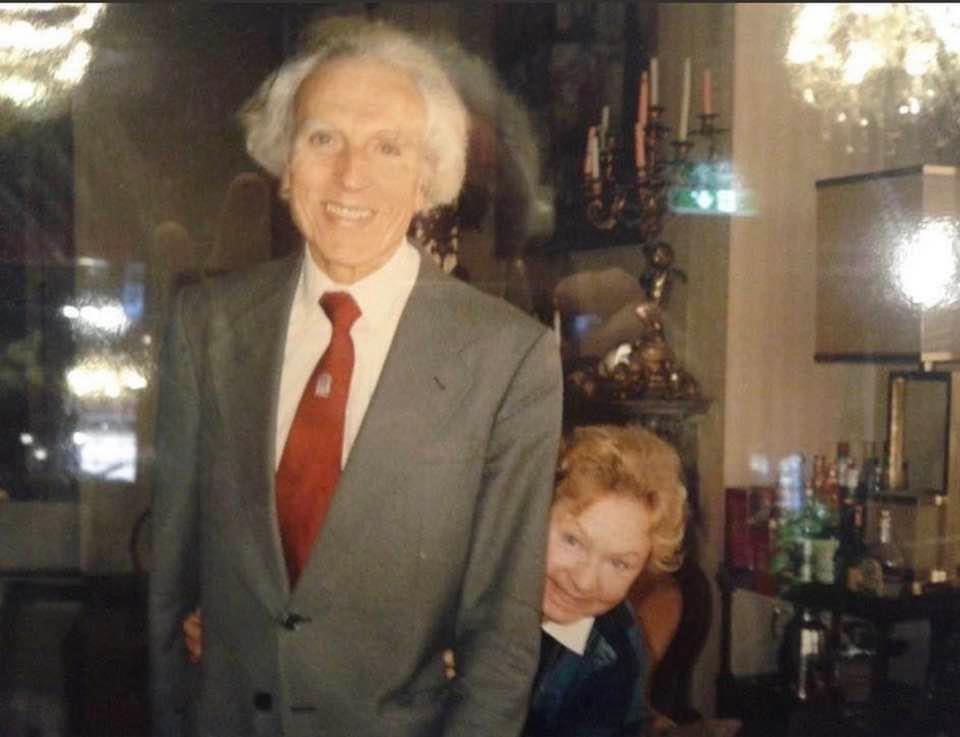
An enthusiasm that I have only ever experienced with Paul Tortelier who like Jean-Efflam Bavouzet would relish the contact with his public drawing them even closer into this wonderful world of sound.A musician who thinks in layers and who has always the orchestra in mind and like Boulez pointing to the marvels on a long inspired journey of discovery.

Massenet’s busy butterflies fluttered above the keys with shadowed haunting beauty contrasted with the solemnity of Debussy’s ‘Esquisses’ in an extreme resonant atmosphere.Liszt’s ‘Toccata’ ,that if we batted our eyelids we would have missed,but instead we watched astonished as Bavouzet allowed his fingers to flow with oiled perfection with this continuous stream of notes rudely interrupted only by the occasional call to arms.
Contrasting with Massenet’s ‘Toccata’ which was a much more sumptuously luxuriant escapade.
After all these fascinating morsels it was nice to be reminded of the greatness of Debussy as the meanderings of the ‘ Prélude’ of ‘Pour Le Piano’ filled the air with rarified flexibility and elegance .A favourite of Rubinstein who brought to it the same beauty as Bavouzet with its delicately moving melodic line opening up to monumental sounds of grandeur and showmanship.The delicate Sarabande was played with simplicity and disarming beauty more on the surface than Perlemuter who would dig deeper with weight and extract the essence of the beseeching cry of the appoggiaturas.But Bavouzet revealed a more subtle beauty and having got used to this black beast was able to reach deep into its soul and find exquisite delicate colours.The Toccata like that of Ravel is a masterpiece of ‘canons covered in flowers! The continuous stream of sounds that miraculously just fluttered above the ravishingly understated melodic invention that both Ravel and Debussy were masters of.

A monumental ending where the showman Bavouzet like Tortelier could bring their audience spontaneously to their feet.A true ovation that was filled with love and admiration for this genial master and brought us the greatest gift of the evening with Debussy’s rose coloured view of Jersey as seen from Eastbourne! A joyous island indeed!
Jean- Efflem Bavouzet had performed yet another miracle turning a bauble into a gem and tempering this great black beast with inspired intelligence and total mastery.
How could anyone resist?
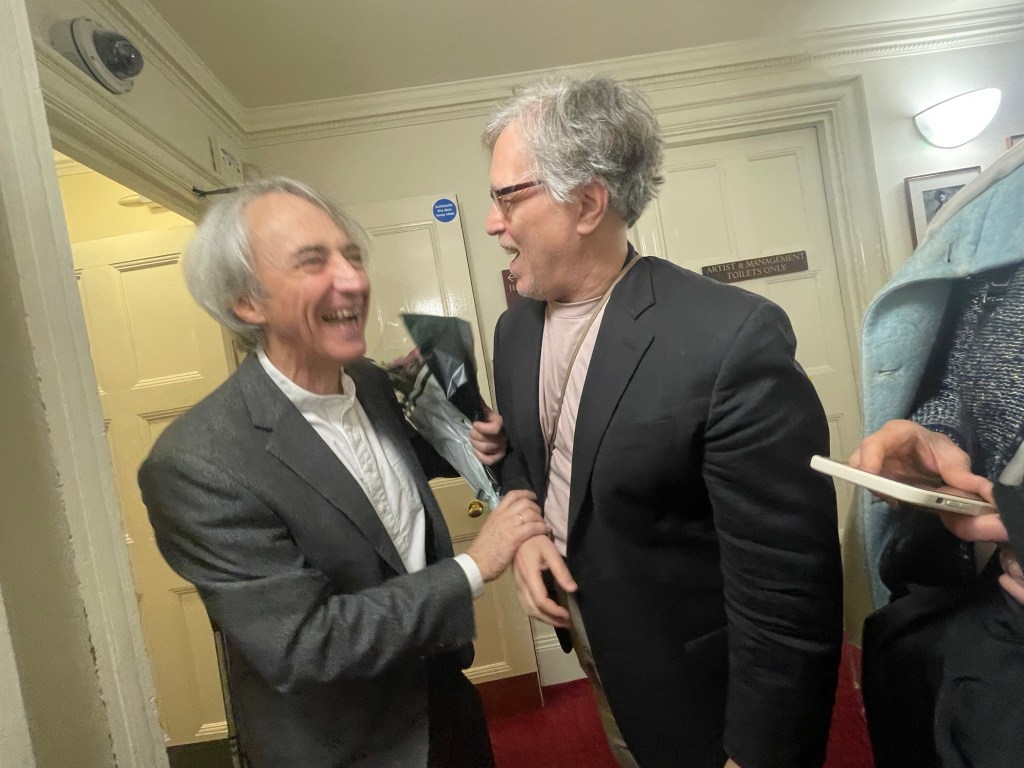
Party time in the Green room with the New York critic and commentator Jed Distler in town by chance to meet a master.A first physical meeting although Bavouzet knew and had read Jed’s writings – even the bad reviews because it comes from someone who is also an artist and really knows !
Jed of course charmed as we all had been all evening.

And the young up and coming star Giovanni Bertolazzi flown in especially from La Chapelle to pay homage to his mentor.

William Bracken too another young rising star greeted with that irresistible French warmth by the remarkable Bavouzets.

https://www.nytimes.com/1981/02/01/arts/andrea-nemecz-pianist-presents-schumann.html.
With Joelle and Davide Sagliocca and Giovanni Bertolazzi
Tonight was the living reply to ‘Is live music dead?’
Quality and communication as opposed to quantity and isolation !
Viva la France !

Jules Massenet (12 May 1842 – 13 August 1912) was a French composer best known for his operas, of which he wrote more than thirty, made him the leading composer of opera in France in the late 19th and early 20th centuries.. He also composed oratorios, ballets, orchestral works, incidental music, piano pieces, songs and other music. Massenet taught composition at the Paris Conservatoire from 1878 until 1896. Among his students were Gustave Charpentier, Ernest Chausson, Reynaldo Hahn and Gabriel Pierné. Massenet’s his operas are widely accepted as well-crafted and intelligent products of the Belle Époque.
Valse Folle was composed in 1898 (by which time Massenet had become wildly wealthy and famous from his success as an opera composer), the ‘Mad Waltz’ was dedicated to his friend Raoul Pugno (1852–1914). Pugno himself, one of the first internationally acclaimed lions of the keyboard to commit his art to disc, recorded the work in April 1903 for the Gramophone and Typewriter label.
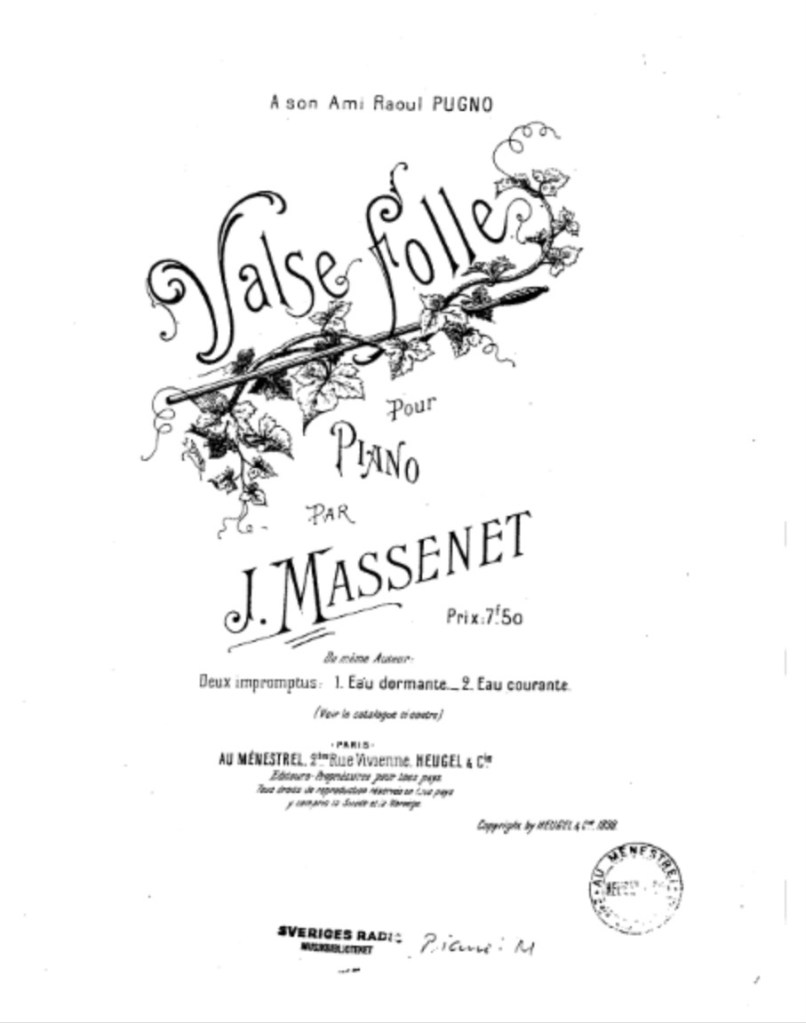
Its innocent main theme contrasts with abrupt changes of tempo and (for Massenet) unexpected discords and harmonies, to say nothing of the violent ending, providing a brief glimpse of an unexpected side to the elegant, urbane Massenet.
In 1907, Massenet’s publisher Heugel
issued his 2 pièces pour piano with a striking pictorial
cover depicting large black and white butterflies
against a yellowish-green background. The second of
these pieces, Papillons blancs (‘White butterflies’) is
an elegant character piece, beautifully crafted, with
some attractive digressions into unexpected keys; as
the piece nears its close, these particular butterflies
become surprisingly animated. Jules Massenet was a very good pianist and he composed for his instrument from an early age (Dix Pièces de genre, 1866) before turning body and soul to orchestral and vocal forms. However, he returned to piano composition at the end of the century: after the death of Ambroise Thomas and his subsequent resignation from the Paris Conservatoire, he turned once again to the Parisian salons with his Deux impromptus (1896) and Deux Pièces pour piano (1907). These evocative pieces were presented on those occasions with the early piano works of his students, from Portraits de peintres by Reynaldo Hahn (1894) to Rêverie by Paul Hillemacher (1908), and including Xavier Leroux’sRomance and Gabriel Pierné’s Étude symphonique (1903).The Toccata was first
published in 1892, with a dedication to Marie-Aimée
Roger-Niclos, the piano virtuoso to whom Saint-
Saëns had dedicated his fantasia Africa the year
before.

Liszt’s Hymne de la nuit was originally composed
in 1840 and revised in 1847. The score is prefaced by
the first verse of the poem by Alphonse
de Lamartine from his 1830 collection Harmonies
poétiques et réligieuses , which was such a rich
source of inspiration for Liszt. The Hymne da la nuit is
a kind of pendant to the Harmonies poétiques cycle
and is a musical evocation of the sunset and starry
heavens of Tuscany as described by Lamartine. The
Valse-impromptu S213 dates from about the same
period and was first published in 1852.The other Liszt
pieces are all late works. Schlaflos! Frage und Antwort
was written in 1883 and carries the rather misleading
subtitle ‘Nocturne … after a poem by Toni Raab’. We
don’t expect nocturnes to be about insomnia, but that
is what Liszt gives us. En rêve is
another ‘night’ piece, from very late in Liszt’s career,
composed in 1885 for August Stradal (a pupil of both
Liszt and Bruckner). The Toccata dates from about 1879. Marked
prestissimo , its energy is incessant until fading away
into delicate and inconclusive chords.
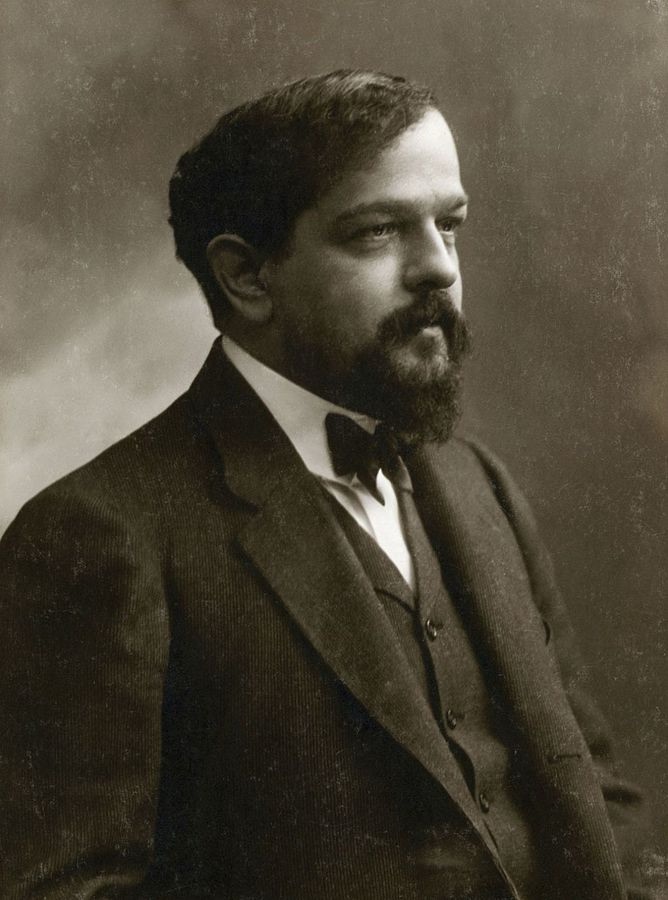
Despite its title, La plus que lente was not meant to be played slowly; “lente,” in this context, refers to the valse lente genre that Debussy attempted to emulate.Typical of Debussy’s caustic approach to naming his compositions, it represented his reaction to the vast influence of the slow waltz in France’s social atmospheres.The piece was first heard at the New Carlton Hotel in Paris, where it was transcribed for strings and performed by the popular ‘gipsy’ violinist, Léoni, for whom Debussy wrote it (and who was given the manuscript by the composer).The work is marked “Molto rubato con morbidezza,” indicating Debussy’s encouragement of a flexible tempo.During the same year of its composition, an orchestration of the work was conceived, but Debussy opposed the score’s heavy use of percussion and proposed a new one, writing to his publisher:
‘Examining the brassy score of La plus que lente, it appears to me to be uselessly ornamented with trombones,kettle drums,triangles etc and thus it addresses itself to a sort of de luxe saloon that I am accustomed to ignore!—there are certain clumsinesses that one can easily avoid! So I permitted myself to try another kind of arrangement which seems more practical. And it is impossible to begin the same way in a saloon as in a salon. There absolutely must be a few preparatory measures. But let’s not limit ourselves to beer parlors. Let’s think of the numberless five-o’-clock teas where assemble the beautiful audiences I’ve dreamed of ‘Claude Debussy, 25 August 1910
Masques“, L. 105, was composed July 1904, it was premiered on 18 February 1905 by Ricardo Vines at the Salle Pleyel in Paris. Its sombre character reflects Debussy’s difficult separation from Lilly Texier, his first wife. The title refers to the commedia dell’arte although Debussy confided to Marguerite Long that the piece was “not Italian comedy, but an expression of the tragedy of existence” (French: ce n’est pas la comédie italienne, mais l’expression tragique de l’existence.)

Maurice Ravel during the inaugural concert of the Independent Music Society
on April 20 1910 .
One of the least known and most unfairly neglected pages of Debussy.The score inaugurates the writing on three staves in Debussy’s piano work and evokes the first part of La Mer From dawn to noon on the sea , which dates from 1903 , and because of its melodic quality, the richness of the harmonies and the instrumental writing ,it could be considered as a preparatory study for ‘Images’
Debussy Celebrations Jean- Efflam Bavouzet at the Barbican
Vive la France …Brocal and Bavouzet in London
Miracles at the Wigmore Hall Bavouzet / Shishkin side by side as one
 ChristopherAxworthy-MusicCommentary