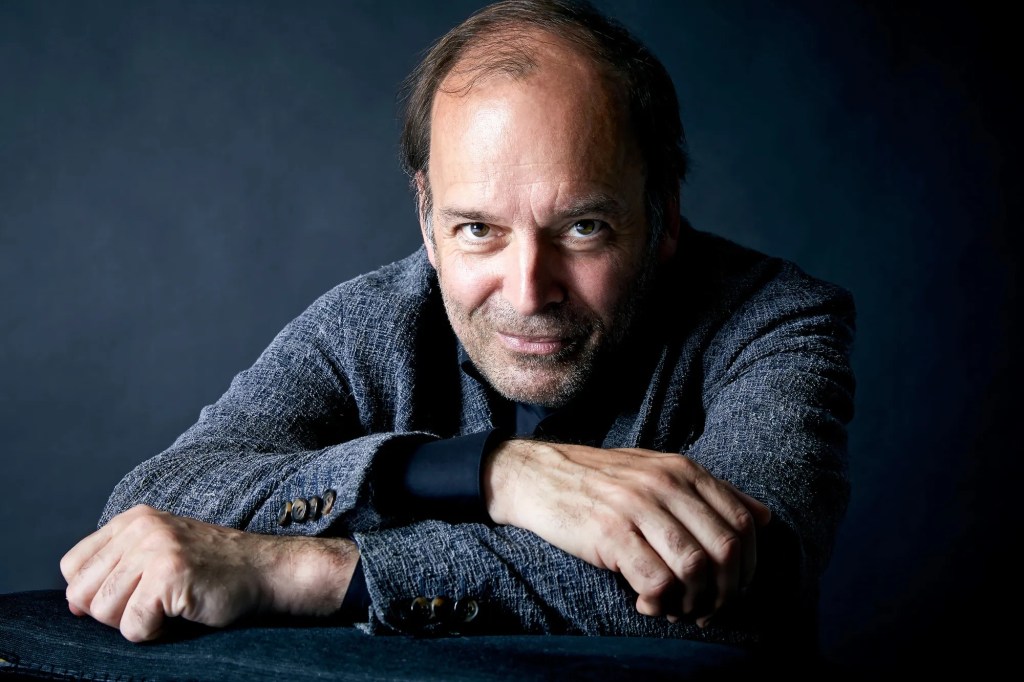
Louis Lortie made his debut with the Montreal Symphony Orchestra at the age of thirteen, and in 1984 won the first prize of the Busoni competition and the fourth prize of the Leeds Competition. He studied with Yvonne Hubert (herself a student of the legendary Alfred Cortot ) and with Dieter Weber in Vienna, and then with Leon Fleisher. He was honoured with the title of “Officer of the Order of Canada” in 1992, and “Chevalier Ordre national du Québec” in 1997, and received an honorary doctorate from the University of Laval the same year.

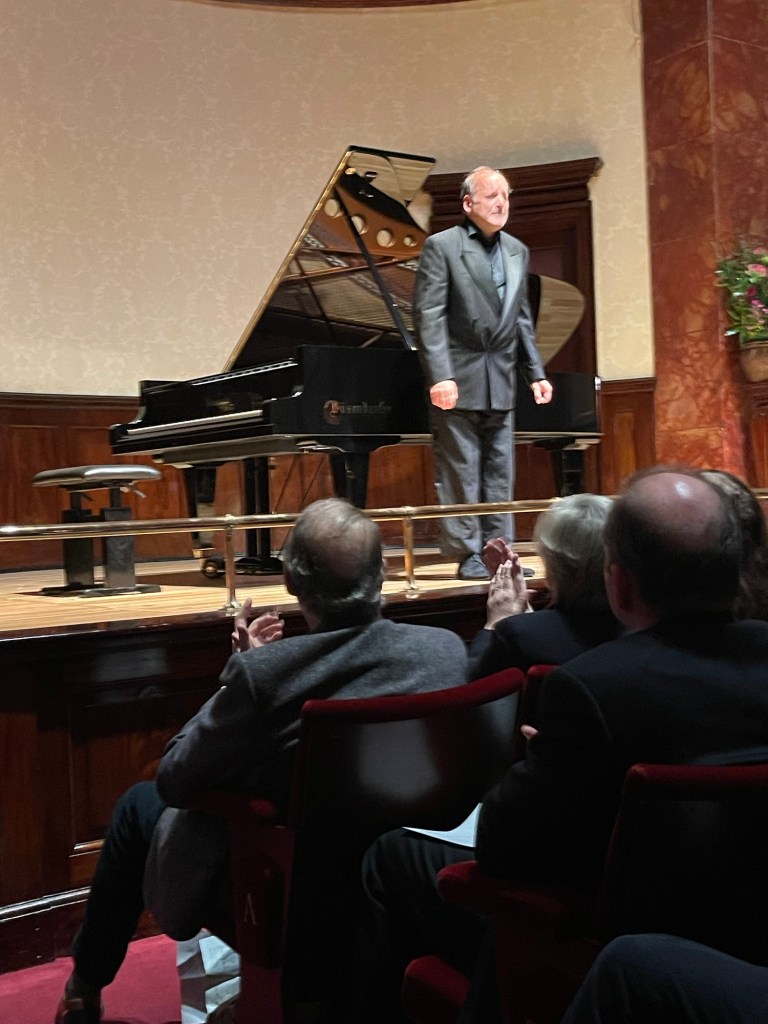
Louis Lortie’s very personal Hommage à Fauré on the 100th anniversary of his death .
A Bosendorfer proudly standing where once stood Bechstein and nowadays Steinway or Fazioli .Bechstein reborn will soon be the Wigmore’s next door neighbour! Home from home indeed.
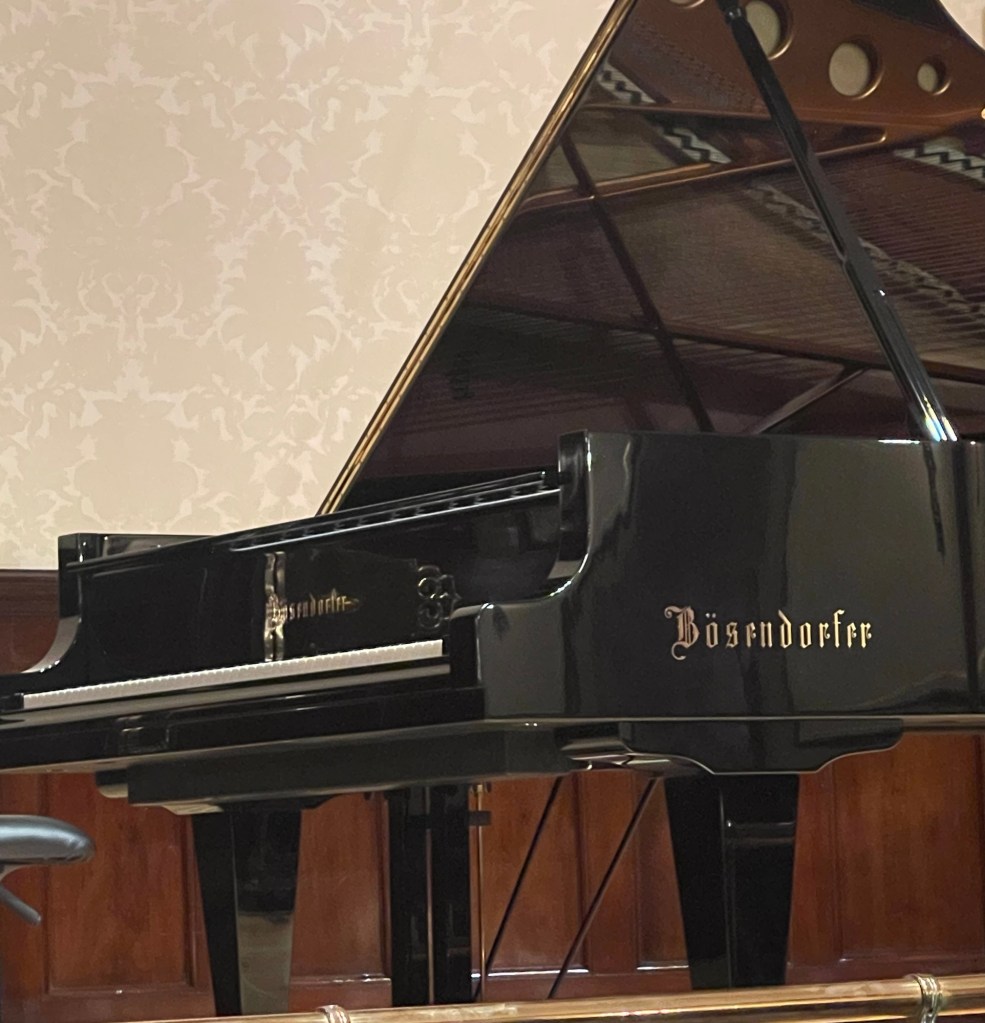
It was the very resonant fluidity of this magnificent instrument that immediately found in Louis Lortie the ideal interpreter where notes just disappeared as clouds of harmony and streams of golden sounds glistened and gleamed in a way we so rarely hear these days. Fauré’ s illusive late preludes were immediately luminous and radiant with every so often the clouds of sound parting to reveal jewels gleaming in a sultry luxuriant atmosphere .Pungent gently dissonant harmonies that must have been so revolutionary to Faure’s contemporaries.
Louis very interestingly allowed us to hear what six of the seven composers had penned with their own short homage to their genial master who had opened an important gate for them to walk through and pursue new paths.

The Preludes immediately set the scene once our ears had got attuned to a very resonant piano that gave opulant radiance and luminosity.There was the aristocratic French nasal sound – that was so typical of Perlemuter when he would often play with great projection but with the ‘soft ‘pedal down that gave this very particular colour to the sound.Perlemuter was brought up also to never leave the keys and infact my scores are covered in fingerings sometimes on the same note so as never to loose the ‘weight’ that is such an essential part of sucking the sound out of the keys .The very opposite of the so called ‘Russian’ percussive school.Louis is master of this creation of sound and it gave a very particular sheen to the sound that pervaded the whole recital.It was as though we were in a bubble of sound within which everything was so clear and precise but we were not aware of single notes .A jeux perlé that had me thinking of De Pachmann or Moiseiwitch both artists whose shadow looms large in this very intimate of halls.There was the prelude that was a a weaving web of magical spider like tracery gradually transformed into a sumptuous outpouring of almost Spanish idiom.The simplicity of the long seemingly inconclusive melodic lines that only Fauré can weave were with a contrapuntal harmonic complicity reminding us that Fauré was above all an organist.There were virtuosistic outbursts too but always with the streams of notes shaped into moving harmonic blocks of sound.Suddenly in the final prelude there was a disarming clarity like a ray of sunlight with a melodic line etched in gold with refined simplicity and intensity.It was also the final variation of the Theme and Variations later in the programme where Louis had played with the searing burning inner intensity of a man possessed .Louis Lortie is an artist who has delved deeply into the soul of this seemingly elusive composer.There is an inner message of a very deep introverted man that can be very elusive but that Louis Lortie seemed to have found the key to in this long overdue homage.
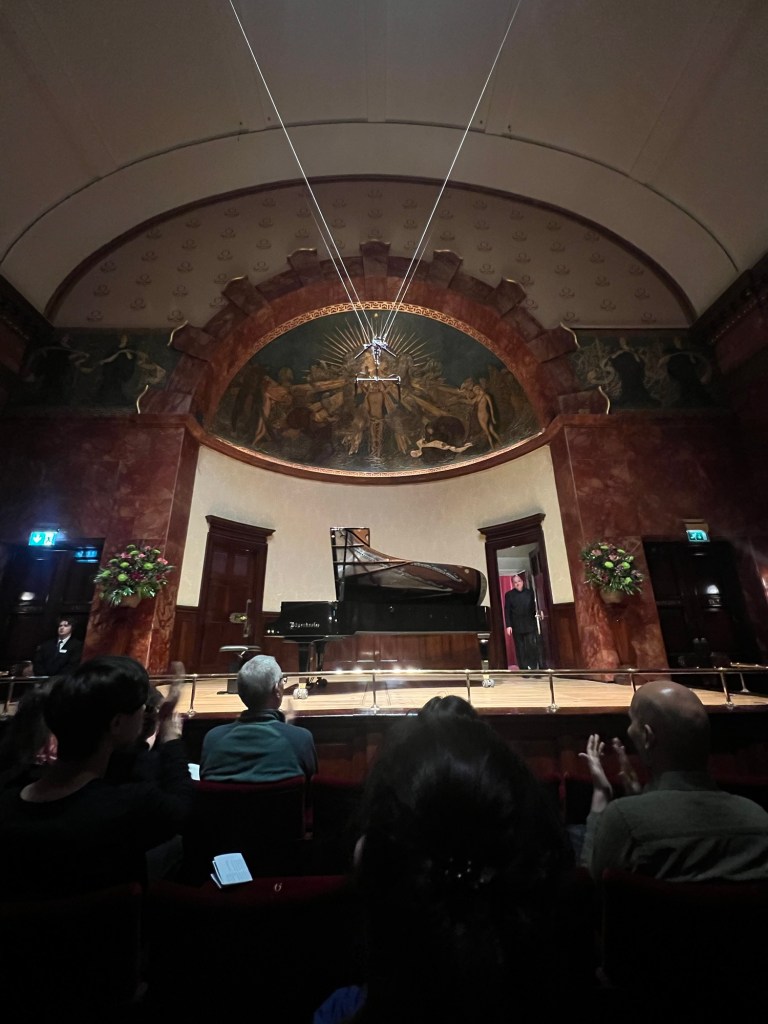
The six short pieces dedicated to Fauré by his students were a fascinating interlude in this homage to a composer who seemed always to be avoiding a conclusive perfect cadence.
Only six out of seven because the piece by Roger- Ducasse is for two pianos.There was the unmistakable sound world of Ravel with a melodic line etched with typical clarity .Enescu was with Scriabinesque sounds of sumptuous colour.A passionate outpouring of radiance from Aubert contrasted with Schmitt’s dramatic outpouring with swirl of notes in the longest and most complex of these short pieces.A reflective chorale of great beauty was Koechlin’s contribution and Ladmirault’s bucolic dance brought this short homage to a brilliant end.
The second half was dedicated to just three very substantial and unjustly neglected masterpieces .
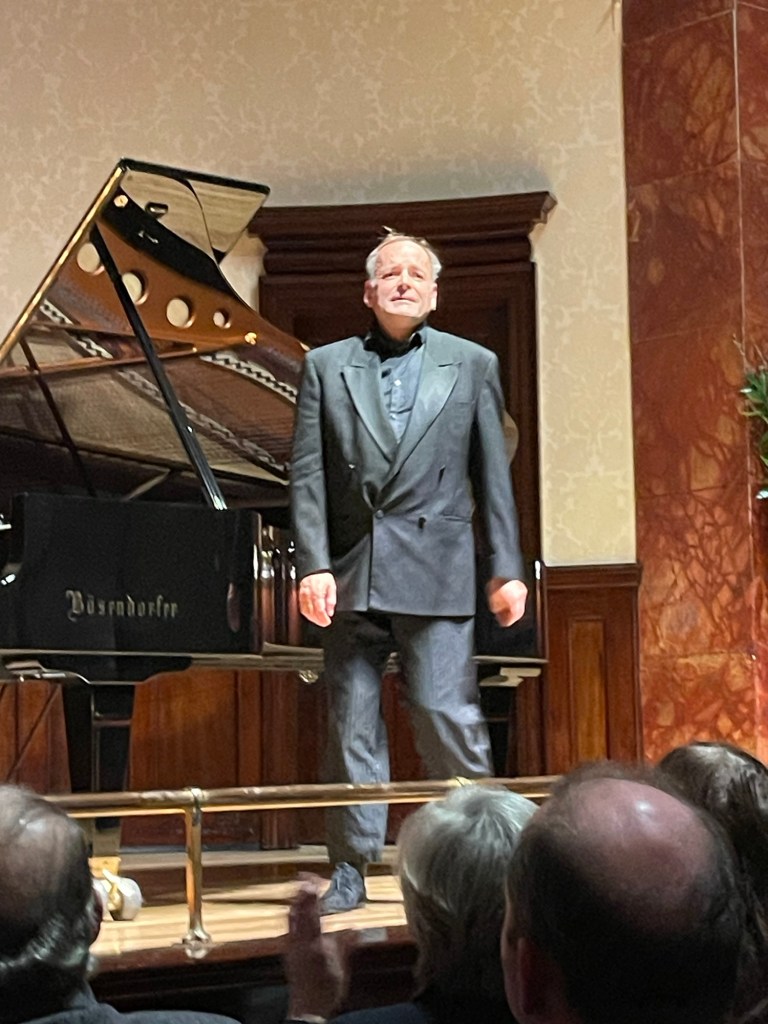
The Pavane we often hear in it’s orchestral guise but this is the first time I have heard it in the recital hall.Louis brought to it a subtle grace with some magical colouring .It was above all the legato that was of another age where Louis like Kempff or Lupu in their final years were able to find a legato which belies the very fact that a piano is made of hammers that hit strings.It is a very subtle illusion that a rare breed of pianist are searching for. Bar lines and sharp edges disappear as the piano is made to sing and breathe every bit as magically as a Schwarzkopf or Lehmann.Of course a masterly and courageous use of the pedals is demanded and it was Anton Rubinstein who had declared that the pedal was the soul of the piano! Never more so than tonight!
There was magic in the air as without a break the ravishing beauty of the Ballade could be heard in the distance.I fell in love with this piece when I heard the recording of Casadesus with Bernstein .My first teacher Sidney Harrison ( piano daddy of Norma Fisher too) had played it with our local orchestra as it is for a relatively small orchestra of 2 flutes, 2 oboes, 2 clarinets, 2 bassoons, 2 horns, strings
Jean Marie Darré’s historic performance was also recorded :

https://christopheraxworthymusiccommentary.com/2017/12/19/in-praise-of-joan-2/
Strangely enough Perlemuter never played it to my knowledge and certainly did not record it .When he played Fauré in my Euromusica series in Rome ( Nocturnes and Theme and Variations) he wanted me to tell the audience before he played that the works were written by Fauré and given to the young student Perlemuter to try out whilst the ink was still wet on the page .I have his copy of the first nocturne where the notes can hardly be seen for the fingering – He and Curzon had much in common !

Louis tonight showed us what great works the Ballade and the Theme and Variations are.The same luminosity and fluidity of sound in the Ballade ,drawing us into his sound world rather than projecting to a lazy audience.Magical duets between soprano and mezzo with the gentle pulsating wave of undulating sounds that sustained the whole piece.Pianississimo chords that were Messianic in their broken glass like transparency just interrupted the etherial beauty of the innocent melodic line.Radiance like rays of sun on the keys and notes that spun from Louis hands like a web of legatissimo sounds and showed an astonishing mastery of the keyboard but above all a masterly musical mind.

An almost religious solemnity to the great opening Theme was played with the same aristocratic authority that I remember from Perlemuter.Using much more pedal though Louis managed to show us the subtle colouring of the theme in the left hand in the first variation with the delicate accompaniment of a continuously flowing right hand weaving its way wondrously above.The second variation – piu mosso was played with great elan and quite considerable command leading to the impishly capricious declamations of the third.I will never forget the 80 year old Perlemuter throwing himself into the fourth variations as notes covered the entire keyboard with terrifying impetus .Louis of course played it with enormous mastery and control as he did all the following variations.But it was the final variation that Louis played with intensity and passion that was quite overwhelming as this great work was brought to rest with such disarming simple beauty and poignancy.
Last but not least was the finest performance of the evening : the Fourth Nocturne in E flat offered as an encore.The subtle elusive world of Fauré that Louis had so generously shared with us all evening was suddenly united into one architectural whole of refined beauty,passion and simplicity. A great artist and above all an interpreter at the height of his powers.

Louis Lortie has earned an international reputation as a versatile musician critically acclaimed for the fresh perspective and individuality he brings to the grand masters of the piano repertoire. In demand on five continents for more than thirty years, Louis Lortie performs with the most prestigious orchestras and in major concert halls around the world. A prolific artist, he has produced more than 45 recordings for Chandos Records featuring the pillars of piano literature. He is followed by more than 300,000 listeners monthly on streaming platforms and generated more than 6 million streams in 2022.
In Great Britain, his long-standing relationship with the BBC, the BBC Symphony and BBC Philharmonic orchestras have resulted in numerous recordings and concerts as well than more than ten invitations at the BBC Proms. In his native Canada, for half a century, he has regularly played with all the major orchestras: Montreal, Toronto, Vancouver, Ottawa and Calgary. Close collaborator of Kurt Masur, he was a regular soloist with the Orchestre National de France and the Gewandhaus orchestra during his tenure as Music Director. He has also collaborated with the Deutsche Sinfonieorchester Berlin, the Dresden Philharmonic Orchestra, the Leipzig MDR Orchestra in Germany and the United States, the Philadelphia Orchestra, the Dallas Symphony , San Diego Symphony, St. Louis Symphony, and New Jersey Symphony. Further afield, his collaborations include the Shanghai Symphony Orchestra where he was Artist in Residence, the Hong Kong Philharmonic Orchestra and the National Symphony Orchestra of Taiwan, as well as the Adelaide and Sydney Symphony Orchestras and the Orquestra Sinfônica do Estado de São Paulo in Brazil. Regular partnerships with conductors include, among others, Yannick Nézet-Séguin, Edward Gardner, Sir Andrew Davis, Jaap Van Zweden, Simone Young, Antoni Wit and Thierry Fischer.
In recital and in chamber music, Louis Lortie regularly performs at Wigmore Hall in London, the Philharmonie de Paris, the Concertgebouw in Amsterdam, Carnegie Hall, the Chicago Symphony Hall, the Beethovenfest Bonn and the Liszt Festival Raiding. He is particularly sought after for his integral of the Years of Pilgrimage of Liszt in one evening, the Etudes of Chopins (complete) in one evening, or his cycles of Beethoven sonatas; the latest one was filmed at the Salle Bourgie in Montreal and broadcast on Medici TV in 2021. For more than twenty years, with Hélène Mercier, the Lortie-Mercier duo has brought new perspectives on the repertoire for four hands and two pianos in concert as well as their numerous recordings.
His discography, exclusively for Chandos records, includes, in the solo piano repertoire, 7 volumes of works by Chopin, Beethoven’s 32 sonatas, the complete works of Ravel, Liszt’s Years of Pilgrimage and two volumes of works by Faure. With Edward Gardner he recorded Lutoslawksi’s Concerto and Variations on a Theme of Paganini with the BBC Symphony Orchestra, particularly praised by critics, as well as the complete concertos of Saint-Saens with the BBC Philharmonic or the Vaughan Williams concerto with the Toronto Symphony Orchestra and Peter Oundjian.
Louis Lortie is co-founder and Artistic Director of the LacMus Festival, which has been held yearly since 2017 on Lake Como. He was master in residence at the Queen Elisabeth Music Chapel in Brussels from 2017 to 2022; he continues to mentor pianists of exceptional talent by introducing the new generation through concert cycles, recently a cycle of Beethoven/Liszt symphonies at Wigmore Hall and the Dresden International Festival as well as the Scriabin Marathon at the LacMus and Bolzano Bozen Festivals .
Louis Lortie takes Wimbledon by storm Exultation of the prelude ‘cradling the soul in golden dreams’
Beethoven La Chapelle offers an Ode to Joy

In the rigid official musical establishment of Paris in the second half of the 19th century Gabriel Fauré won acceptance with difficulty. He was a pupil of Camille Saint-Saëns at the École Niedermeyer and served as organist at various Paris churches, including finally the Madeleine, but had no teaching position until 1897, at the Conservatoire, where his pupils included Ravel and Enescu. In 1905 he became director of the Conservatoire in the aftermath of the scandal of the Prix de Rome being refused to Ravel, and he introduced a number of necessary reforms. He retired in 1920, after which he was able to devote himself more fully again to composition, producing notably two final chamber works: a Piano Trio and a String Quartet. He died in Paris in 1924.
He grew up, a rather quiet well-behaved child, in an area of great beauty. … But the only thing he remembered really clearly is the harmonium in that little chapel. Every time he could get away I ran there :’and I regaled myself. … I played atrociously … no method at all, quite without technique, but I do remember that I was happy; and if that is what it means to have a vocation, then it is a very pleasant thing.’ An old blind woman, who came to listen and give the boy advice, told his father of Fauré’s gift for music.He sent him to the École Niedermeyer de Paris which Louis Niedermeyer was setting up in Paris.When Niedermeyer died in March 1861, Camille Saint Saens took charge of piano studies and introduced contemporary music, including .Fauré recalled in old age, “After allowing the lessons to run over, he would go to the piano and reveal to us those works of the masters from which the rigorous classical nature of our programme of study kept us at a distance and who, moreover, in those far-off years, were scarcely known. … At the time I was 15 or 16, and from this time dates the almost filial attachment … the immense admiration, the unceasing gratitude I [have] had for him, throughout my life.”The close friendship between them lasted until Saint-Saëns died sixty years later.Roger Ducasse wrote ‘More profound than Saint-Saëns, more varied than Lalo, more spontaneous than d’Indy, more classic than Debussy, Gabriel Fauré is the master par excellence of French music, the perfect mirror of our musical genius’
The nine Préludes are among the least known of Fauré’s major piano compositions. They were written while the composer was struggling to come to terms with the onset of deafness in his mid-sixties. By Fauré’s standards this was a time of unusually prolific output. The préludes were composed in 1909 and 1910, in the middle of the period in which he wrote the opera Pénélope, the barcarolles nos. 8–11 and nocturnes nos. 9–11. In Koechlin’s view, “Apart from the Préludes of Chopin, it is hard to think of a collection of similar pieces that are so important”. The critic Michael Oliver wrote, “Fauré’s Préludes are among the subtlest and most elusive piano pieces in existence; they express deep but mingled emotions, sometimes with intense directness … more often with the utmost economy and restraint and with mysteriously complex simplicity.” Jessica Duchen calls them “unusual slivers of magical inventiveness.” The complete set takes between 20 and 25 minutes to play. The shortest of the set, No 8, lasts barely more than a minute; the longest, No 3, takes between four and five minutes.

Hommage à Gabriel Fauré is a collective work to which seven students of Fauré at the Paris Conservatore contributed : Maurice Ravel,Georges Enescu ,Louis Aubert,Florent Schmitt ,Charles Koechlin,Paul Ladmirault and Jean Roger-Ducasse.
From his arrival in Fauré’s class until that composer’s death in 1924, Ravel remained on friendly terms with his teacher, even though his music shows barely any Fauréan influence other than a distaste for loquacity. When the journalist Henry Prunières was planning a Fauré number of his Revue musicale in October 1922, Ravel joined six other pupils in providing a musical homage. Fauré had been let in on the idea and had suggested a theme drawn from his music to Prométhée, but in the end his pupils chose a musical transliteration of the name Gabriel Fauré: GABDBEE FAGDE. Ravel’s Berceuse has an unassuming grace worthy of its dedicatee, and its contrasts, as in the early Sonata movement, are largely between modal and chromatic harmonies. The score is marked semplice and the violin is muted throughout.the piano reduction is by Lucien Garban.
The seven pieces were created together on December 13th 1922 the 88th SMI concert with Hélène Jourdan- Morhange on violin for the Berceuse by Ravel , and Madeleine Grovlez for the piano pieces, with the assistance of Daniel Éricourt for the piece for two pianos by Roger- Ducasse.
La Berceuse by Ravel was created, alone, in Milan on October 18th 1922 and played by Ravel with Remy Principe on violin.
Enesco’s contribution, Hommage , is a short piano piece in , molto moderato e cantabile , composed from the five notes given on Fauré’s name: fa – a – sol – d – mi a score that is ‘impalpable, indecisive, with the fog of its arpeggio accompaniment (“harmonious and veiled”) and the vagueness of its perpetual modulation recalls the style of Scriabin’.
Louis Aubert’s piece, Esquisse sur le nom de Fauré , is the composer’s last work for solo piano. It consists of two pages of music moderato , which according to Guy Sacre are strange, “both melancholic and serene, detached from their very subject”
Schmitt’s piano homage is Sur le nom de Gabriel Fauré , op. 72 In the score, the composer dissociates the notes corresponding to “Gabriel” from those associated with “Fauré” . The master’s name provides a scherzo theme as well as a waltz theme while the first name gives a “caressing, whispered phrase, bathed in arpeggios” a bit like Fauré, “bringing to the effervescence of the first subject an unexpected expressive contrast”, in the words of Alfred Cortot , who underlines the “living dialogue [which] is established between these two themes”
Koechlin’s contribution is the Chorale sur le nom de Fauré , op.73 .

Ladmirault ‘s Hommage à Fauré is based on the notes corresponding to Fauré’s name ( fa – la – sol – ré – mi ), first in the form of a kind of popular song, , allegro moderato , “with melancholic inflections, with modal cadences , which could have been born on the bagpipe of a Breton shepherd” , then in a more elaborate form, a Trio , espressivo e poco rubato , “with supple lines, with undulating arpeggios , with refined modulations”.
Pavane, Op. 50
Originally conceived for orchestra, it is heard tonight as Fauré himself often performed it, for solo piano: it evokes a
bygone age, in the early 18th-century tradition of the
fête galante (the courtly festivities depicted in the
paintings of Antoine Watteau). The Pavane (1887) was conceived and originally written as an orchestral piece but Fauré published the version for piano in 1889.In the form of an ancient dance, the piece was written to be played more briskly than it has generally come to be performed in its familiar orchestral guise. The conductor Sir Adrian Boult heard Fauré play the piano version several times and noted that he took it at a tempo no slower than crochet = 100 and commented that the composer’s sprightly tempo emphasised that the Pavane was not a piece of German romanticism.
Ballade in F♯ major, Op. 19
The Ballade, dedicated to Camille Saint – Saens dates from 1877, and is considered one of the three masterpieces of his youth, along with the first violin sonata and the first piano quartet .It is one of Fauré’s most substantial works for solo piano, but is better known in a version for piano and orchestra that he made in 1881 at Liszt’s suggestion.Playing for a little over 14 minutes, it is second in length only to the Thème et variations.Fauré first conceived the music as a set of individual pieces, but then decided to make them into a single work by carrying the main theme of each section over into the following section as a secondary theme.The work opens with the F♯ major theme, an andante cantabile, which is followed by a faster section, marked allegro moderato, in E♭ minor. The third section is an andante introducing a third theme. In the last section, an allegro, a return of the second theme brings the work to a conclusion where the treble sings with particular delicacy.
Fauré appears to have first conceived his Ballade in
the late 1870s as a series of related short pieces, rather
in the tradition of Schumann. But in a letter of
September 1879, he explained that the central B-major
allegro had become ‘a kind of alliance between [piano
pieces] nos. 2 and 3. That is to say, by using new but
old methods I have found a way of developing the
phrase of no. 2 [the E-flat minor allegro moderato] into
a sort of interlude, and at the same time stating the
premises of no. 3 [the concluding allegro moderato,
with its bird-call trills] in such a way that the three
pieces become one. It has thus turned into a Fantasy
rather out of the usual way.’
Marcel Proust knew Fauré, and the Ballade is thought to have been the inspiration for the sonata by Proust’s character Vinteuil that haunts Swann in In Search of Lost Time .Debussy reviewing an early performance of the Ballade, compared the music with the attractive soloist, straightening her shoulder-straps during the performance: “I don’t know why, but I somehow associated the charm of these gestures with the music of Fauré himself. The play of fleeting curves that is its essence can be compared to the movements of a beautiful woman without either suffering from the comparison.” Bryce Morrison describes the Ballade as “a reminder of halcyon, half-remembered summer days and bird-haunted forests”.
Fauré was a chronic doodler, and many of his
manuscripts show patterns and even portraits
scribbled in margins. The coda of the Pavane suggests
the same sort of creative impulse: the arching melody
contracts to oscillating F sharps and G sharps, above a quasi-improvisatory sequence of chromatic harmonies.
Curiously, that same ‘doodling’ motif can be heard in
the Ballade Fauré composed a decade earlier, where it
assumes a structural importance that far outweighs its
seeming simplicity.
Thème et variations in C♯ minor, Op. 73
Fauré’s Thème et variations Cortot deemed his ‘most
significant’ work for piano, ‘thanks not just to its
proportions, but to its character and beauty.’ Fauré’s
stately but energetic theme is followed by 11 variations
that span the gamut of 19th-century pianism, the
increasingly virtuoso figurations culminating in the
flying scherzo of the tenth variation. The serenely
passionate eleventh suggests a closing homage to
Schumann (whose Etudes symphoniques, in the same
key of C-sharp minor, surely served as one of Fauré’s
models). ‘I don’t know if the piece is good but I’m sure
I’m not surprising you by saying it’s very difficult!’ wrote
Fauré to a friend in September 1895.
Written in 1895, when he was 50, this is among Fauré’s most extended compositions for piano. Although it has many passages that reflect the influence of Schumann’s Symphonic etudes. As in the earlier Romances sans paroles, Op. 17, Fauré does not follow the conventional course of ending with the loudest and most extrovert variation; the variation nearest to that description is placed next to last, and is followed by a gentle conclusion, “a typically Faurean understated finish.”Copland wrote of the work:Certainly it is one of Fauré’s most approachable works. Even at first hearing it leaves an indelible impression. The “Theme” itself has the same fateful, march-like tread, the same atmosphere of tragedy and heroism, that we find in the introduction of Brahms’s First Symphony . And the variety and spontaneity of the eleven variations which follow bring to mind nothing less than the Symphonic Etudes . Fauré disdained the easy triumph of closing on the brilliant, dashing tenth variation and turned the page and play that last, enigmatic (and most beautiful) .
The first time and maybe the only time I have heard this work until tonight was in the inimitable performances of my teacher Vlado Perlemuter.Vlado was 81 when I invited him to play in my Euromusica concert series in Rome and he wanted me to tell the public that many of the works of Fauré that were on the various programmes that he played every year until his 90th year were sent down to the young student to try out when the ink was still wet on the page .He was proud to tell us that he had lived in the same house as Fauré when he was a teenage prodigy of Alfred Cortot at the Paris Conservatoire ( Fauré had become director).Here is Vlado in a recording for Nimbus that he made in the ballroom of Wyanston Keys in Wales .https://youtube.com/watch?v=GDvKP0tuoHM&feature=shared

P.S.
It was the 80th Birthday of Ruggiero Ricci who was being feted a few years ago by Jack and Linn Rothstein .After having met Ruggiero in my house in Rome decided to give an after concert party for Ruggiero with all the major violinist present to salute their idol.
Ruggiero and Julia had gone out to his favorite Chinese restaurant the night before and poor Ruggiero got food poisoning .He could not cancel such a heartfelt celebration but he could play his solo violin recital at the Wigmore hall seated.’I may be ill but the Bach Chaconne I refuse to play seated’.
After the concert instead of going to the party organised by Jack and Linn I took Ruggiero to the nearby London clinic where he stayed over night on a diet of liver sausage sandwiches.
One and a half thousand pounds was the cost of that night – ‘You know Chris’ Ruggiero said in his inimitable American accent with his dry sense of humour ( or should I say humor) ;’That was the most expensive Chinese meal I have ever had’ .
It reminded me yesterday as I flew in for Louis’ Fauré homage at the Wigmore Hall.A Eurowings flight to Heathrow from Rome – an expensive flight but time was of essence – and I did not want to miss such an extraordinary event or to see Louis again.
Stop over in Düsseldorf assured that the flights were guaranteed by E dreams to connect.It turned out that there was not enough time allowed for the connecting flight.Slight delays and security which in the German airports is very thorough and oh so slow .A flight that arrives late at two and the next one that leaves on time at two thirty was an impossibility and Eurowings refused to wait even though I had booked in at the airport .
What to do ?- I was sent to the ticket counter and there was only one flight to London in time to get to the concert.
British Airways – 460 euros please……you will be reimbursed with compensation by Eurowings if you send them an E mail ………..well the money flew out of my bank account and I am very doubtful that it will fly back in again without a lot of discussion even if Euro has wings.
So this was the most expensive concert I have ever been to which includes flying over from Rome to hear Horowitz in London many years ago!
Some things cannot be measured in money and although compensation would please my bank manager I was more than compensated by the magic that Louis spun last night …………some things are priceless and last night was one of them …..so rare these days where quantity takes precedence over quality .Where communication is done with fists and arms rather than with poetry and artistry ………….thank you Louis money well spent may you always fly higher and higher

 ChristopherAxworthy-MusicCommentary