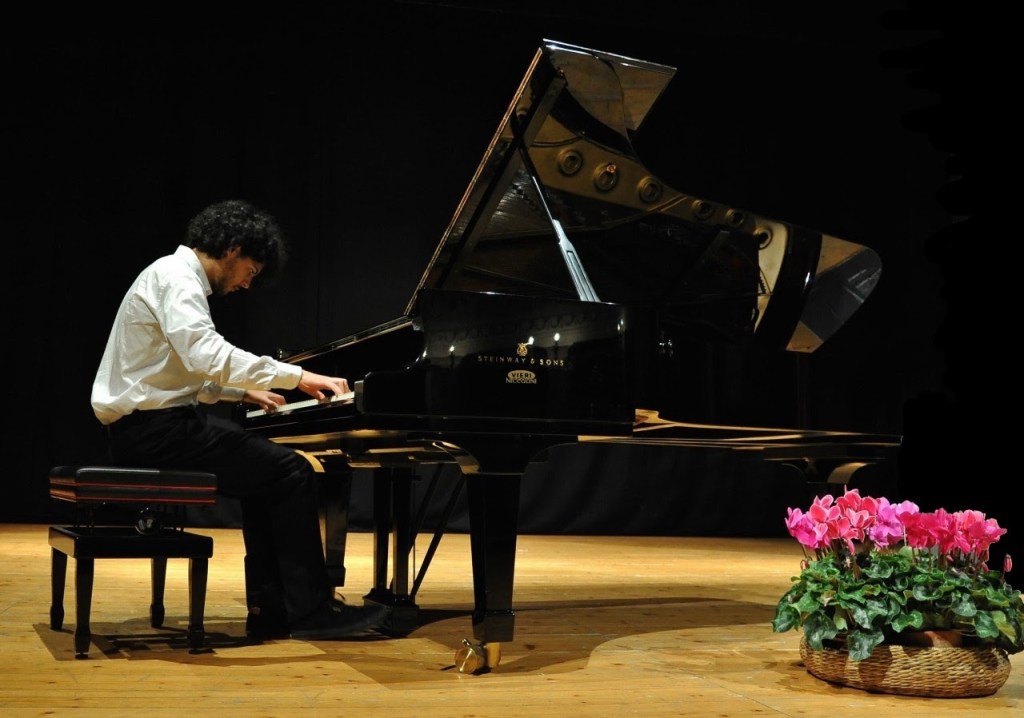
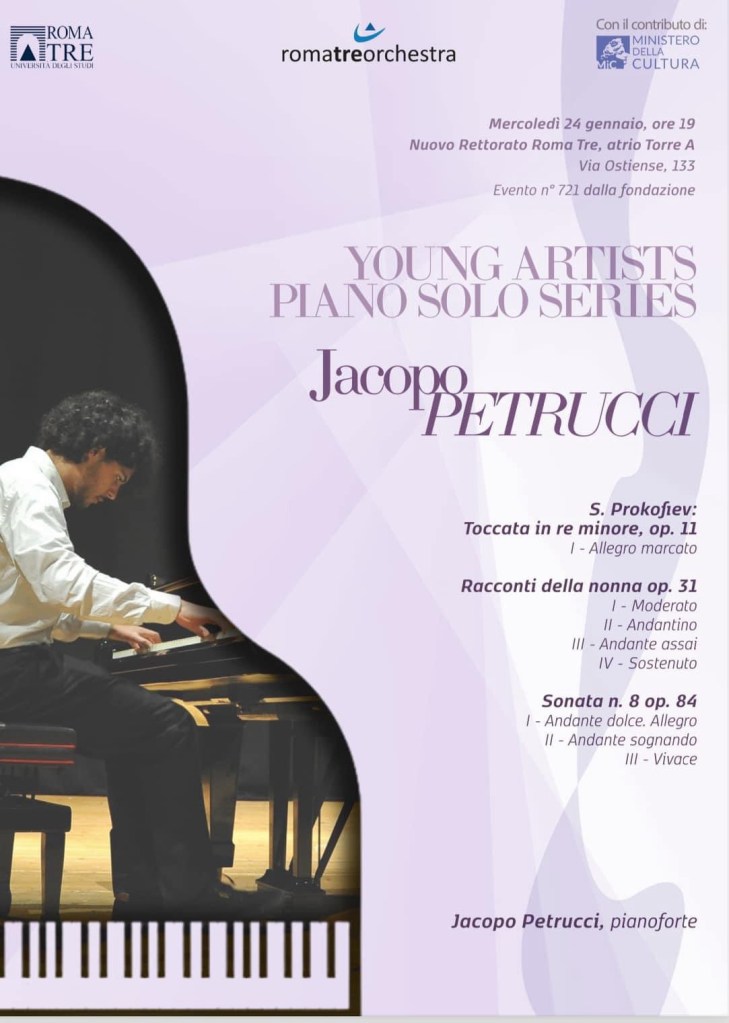
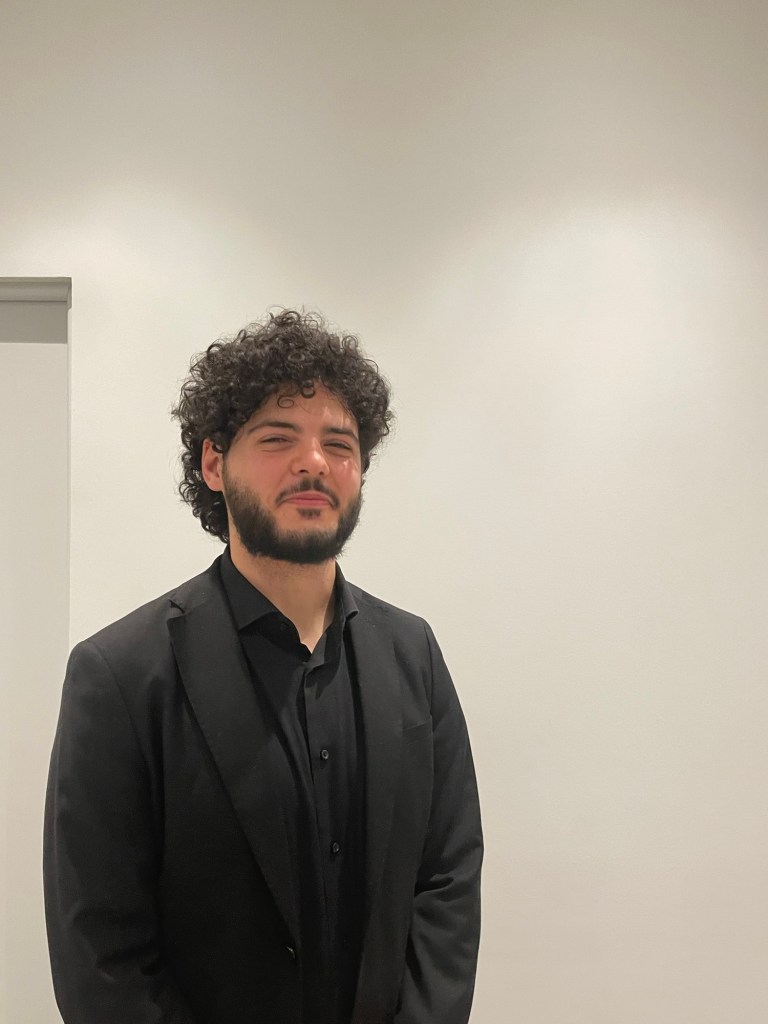
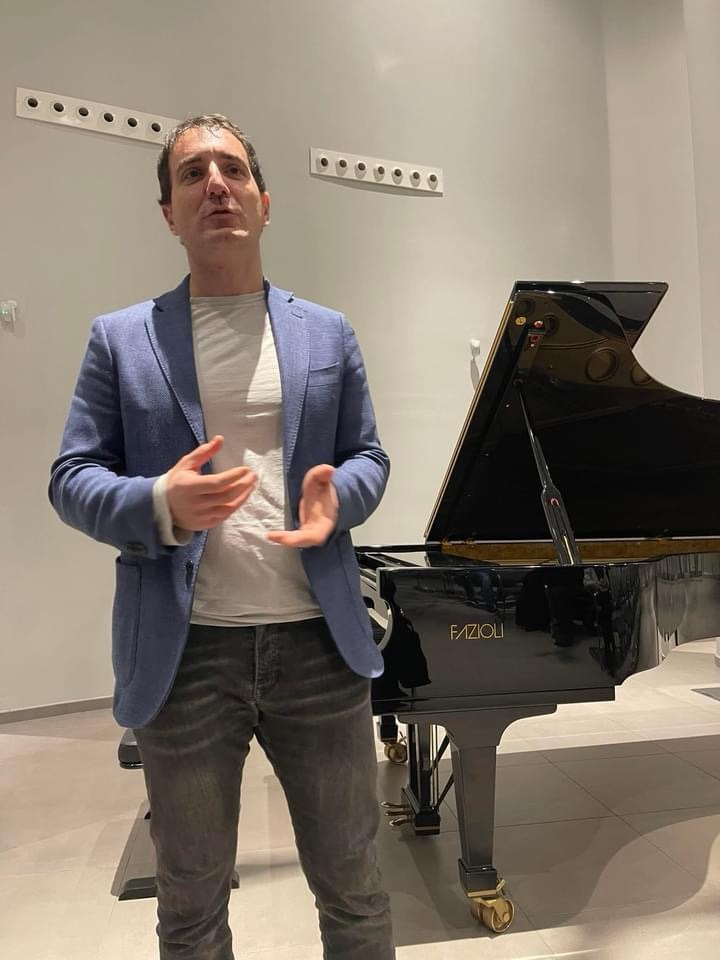
Nato a L’Aquila nel 1999, consegue nel 2017 il diploma di Pianoforte con il massimo dei voti e menzione d’onore presso il Conservatorio “A. Casella”, con i Maestri Mara Morelli e Orazio Maione. Si perfeziona successivamente presso la Scuola di Musica di Fiesole con Andrea Lucchesini e presso l’Accademia Nazionale di Santa Cecilia con Benedetto Lupo. Particolarmente interessato al panorama musicale del Novecento e della Contemporanea, collabora con importanti realtà come il PMCE, l’Ensemble Novecento e il “Cantiere Internazionale d’Arte” di Montepulciano. Sia come solista che come componente di formazioni da camera, ha tenuto concerti per l’Accademia Filarmonica Romana, la stagione dei Giardini “La Mortella” di Ischia, la Società Aquilana dei Concerti “B. Barattelli”. Frequenta attualmente il biennio specialistico di Composizione e nel 2023 è risultato vincitore del “Premio Casella”.
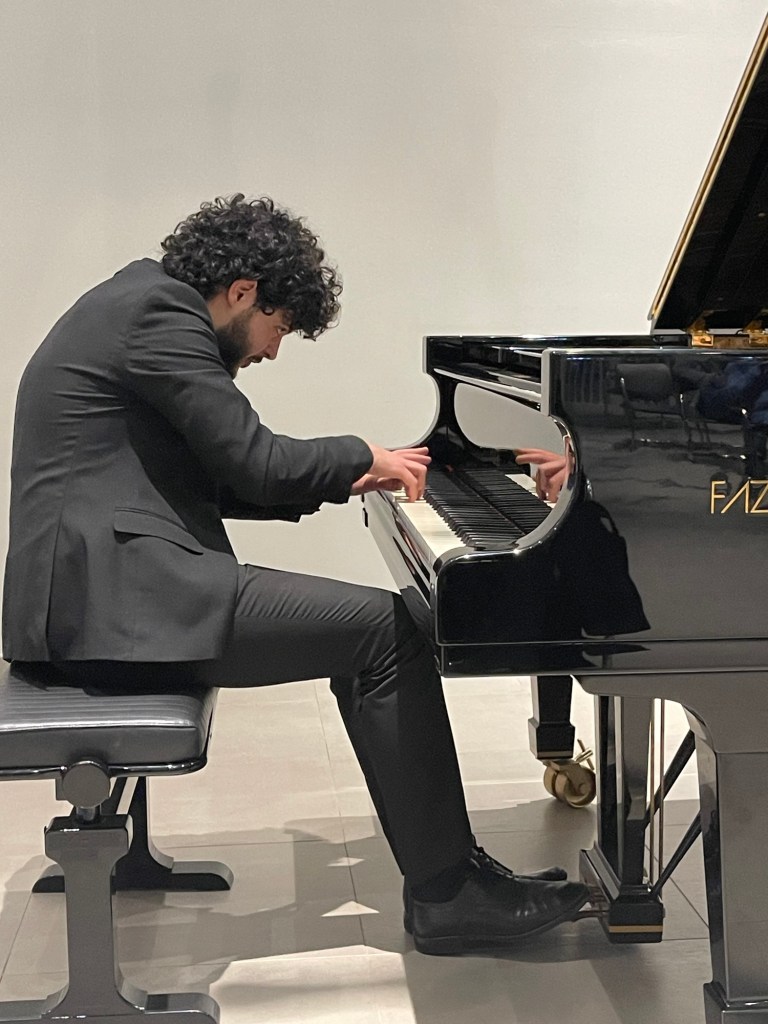
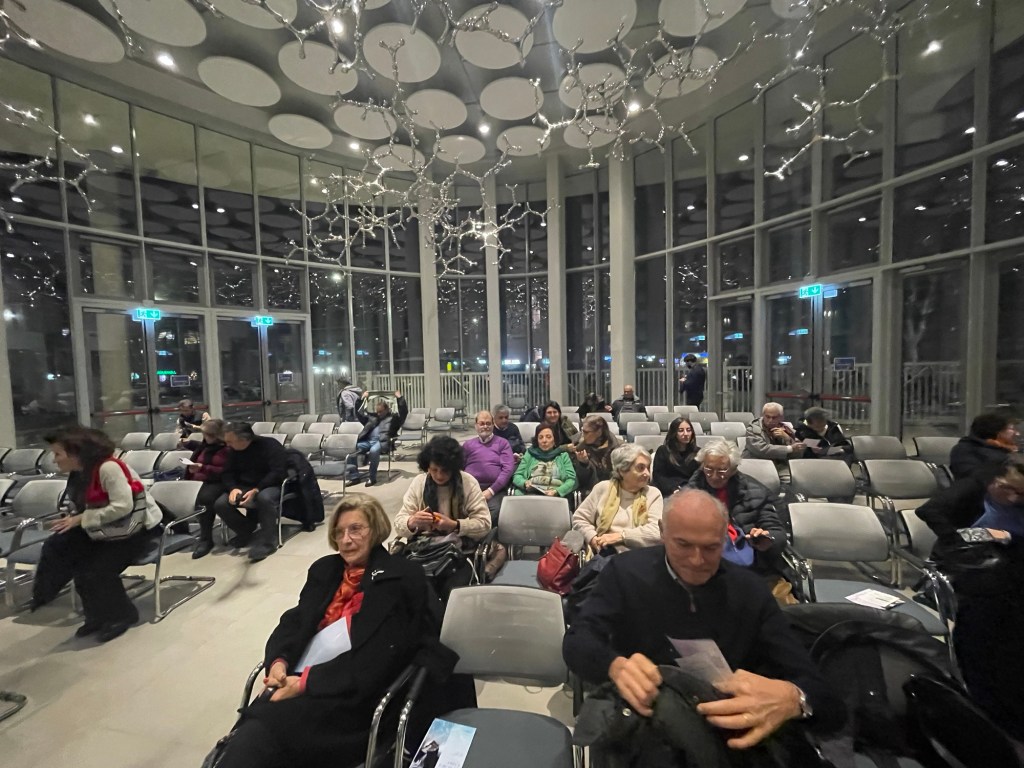
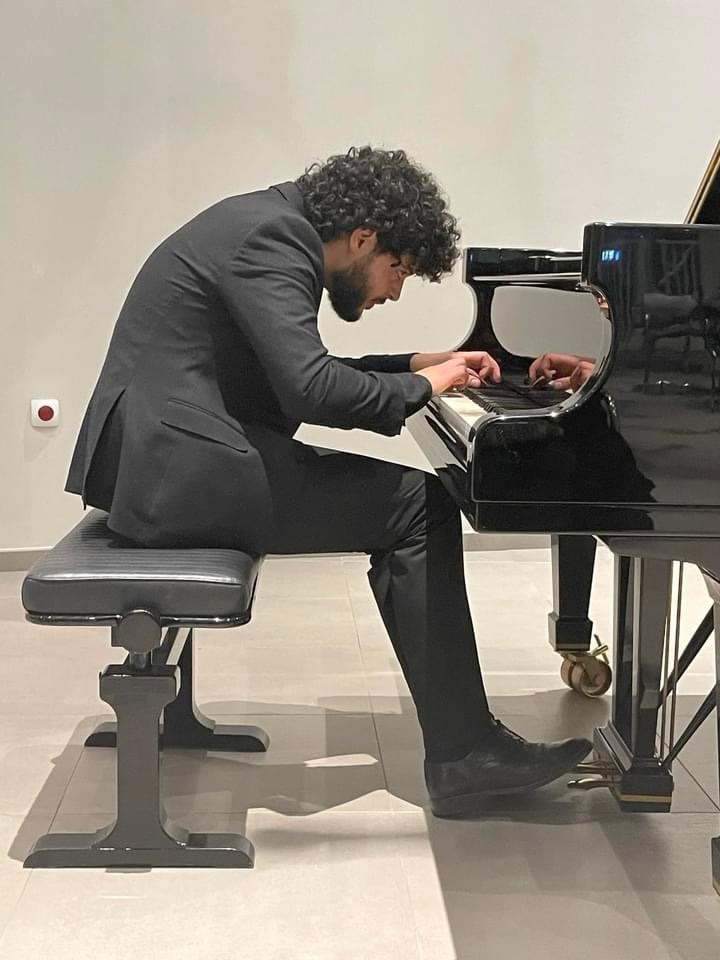
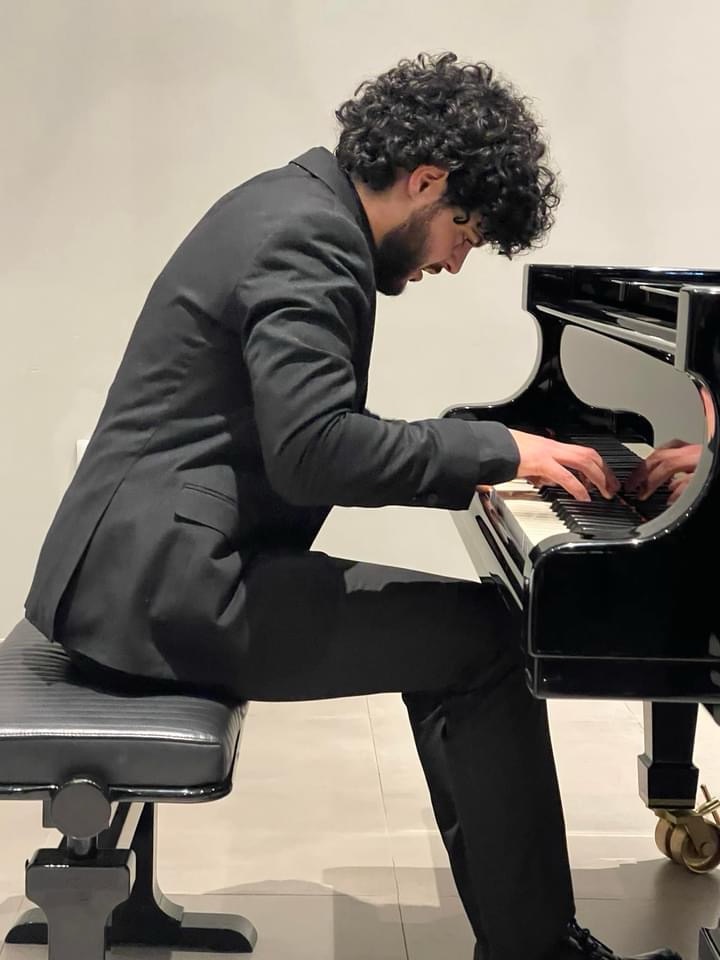
Some quite extraordinary playing from this young pianist who I remember hearing at the S.Cecilia Academy in the final examination recital of the class of Benedetto Lupo..I remember being impressed by his playing but nothing like today listening to him in concert with no one to judge him but the audience. I was completely overwhelmed by his authority and technical mastery but above all by his artistry and musical integrity. Having left ‘school’ and embarking on a career he has freed his wings and allowed his remarkable talent to take flight.Lucky us who have discovered this wonderful series at Roma 3 where they are able to give a platform to such star performers at the beginning of their career. I am not a great fan of Prokofiev as I find his percussive use of the piano and march like rhythms too overwhelming as his music is too often used as a vehicle for displays of virtuosity,strength and stamina. But there is another side to Prokofiev,the lyrical and melodic ,as Jacobo very eloquently pointed out.This is especially true with the earlier pieces like the Visions Fugitives op 22 or the first movement of the second piano concerto op 16.
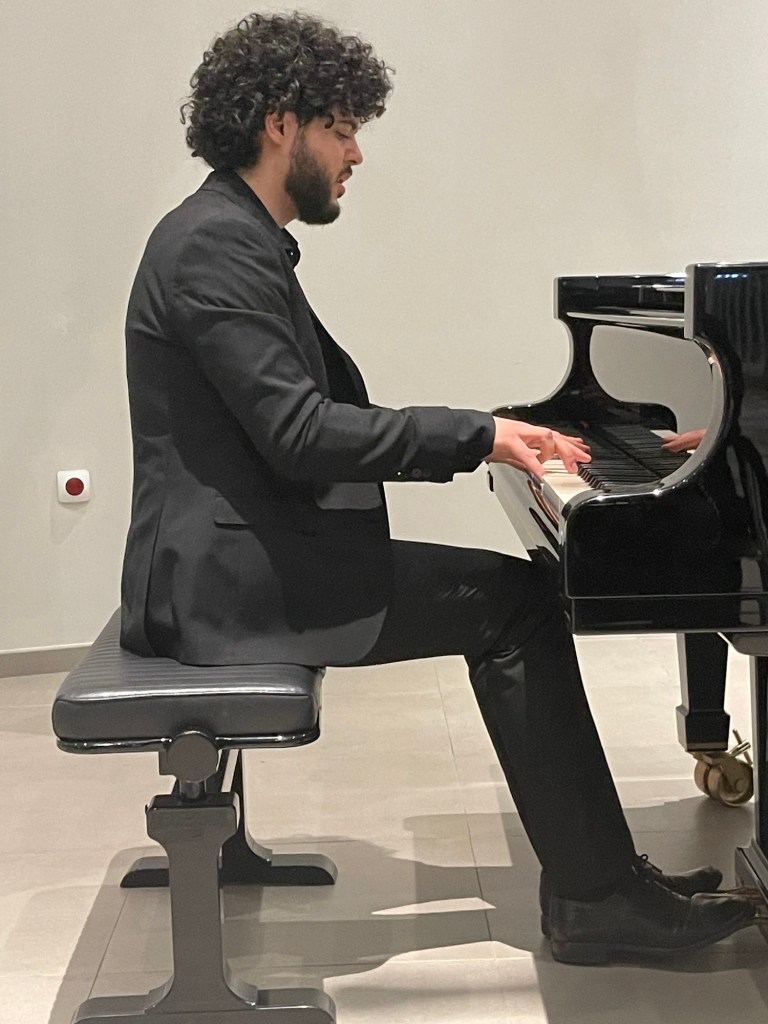
Even in his tour de force of the ‘Toccata’ there was a quite considerable range of sounds and colours.There was ,of course,the insistent mesmerising drive of the opening played with great clarity where every strand of this intricate web of sounds was of extraordinary simplicity.There was drama too with enormous sonorities that rode on this continual living rhythmic drive that was always technically impeccable. It took courage and was quite a feat to open a concert with such a notoriously tricky piece. His musicianship allowed the architectural shape to be so clear amid all the challenges and hurdles that were strewn in his path.
Jacobo chose to show us the fantasy and beauty of the ‘Tales of an Old Grandmother’ with its four movements full of changing character and imagination.The kaleidoscopic colours that Jacopo was able to find showed a quite refined technical mastery able to create continually changing landscapes.The capricious suggestive sounds of the ‘Moderato’ with its very atmospheric melody bathed in long held pedals contrasted with the impish opening and ending and was immediately followed by the ‘Andantino’ of beauty and fluidity.The insistent impish bass of the ‘Andante assai’ on which floated a tenor melodic line opened up to a beautiful mellifluous outpouring of searing intensity which was matched by the magical sounds that Jacopo was able to find in the ‘Sostenuto’ with his kaleidoscopic range of sounds and colours.
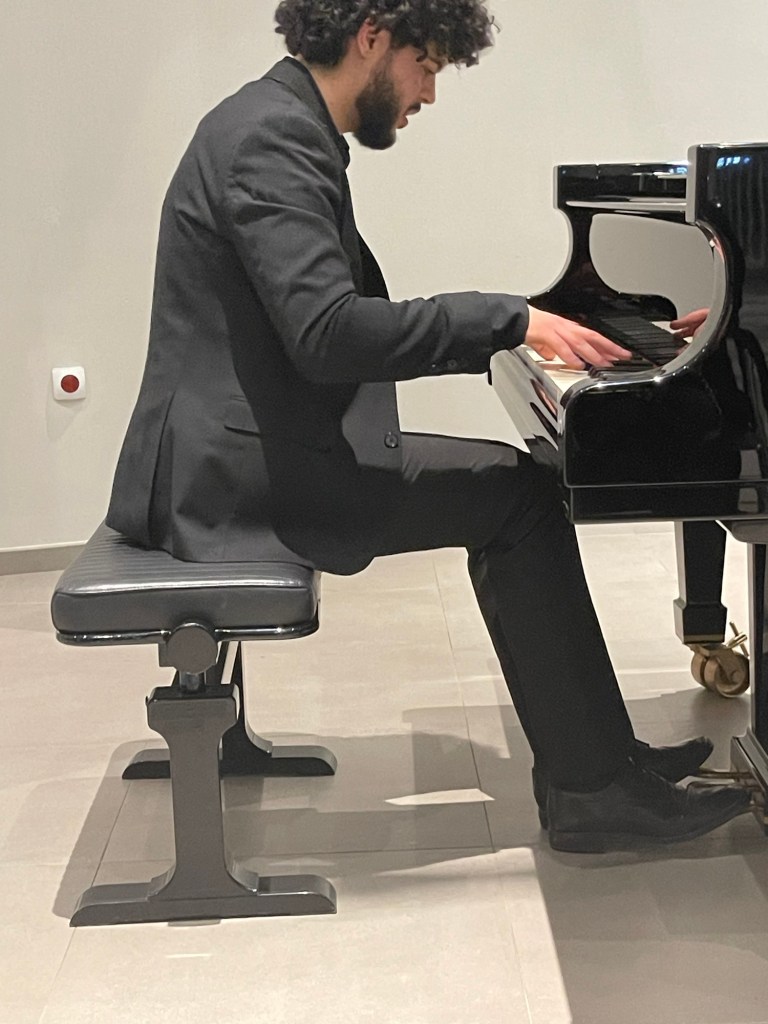
The 8th Sonata unlike it’s companions of the ‘War Trilogy’ is more lyrical than percussive and is the work above all others where the two worlds of violence and peace can live together with moments of searing beauty contrasting with devilish virtuosity.Jacopo was able, with his superb musicianship,to shape the four movements into one architectural whole.From the long haunting and even daunting first movement to the beguiling laziness of the long drawn out waltz of the ‘Andante sognando’ to the spiky energy ,virtuosity and orchestral colours of the ‘Vivace’.This was an extraordinarily convincing performance of a very elusive masterpiece that Jacopo was able to transmit with quite remarkable authority.His spoken eloquence and intelligence was only matched by playing that underlined what he had said but also added much more where words are just not enough.Action speaks louder that words.And music takes over where words are just not enough.Q.E.D.
The Toccata op 11
The Toccata in D minor, Op. 11 was written in 1912 and played by the composer on December 10, 1916, in Petrograd.It is an extremely difficult showpiece and according to the biography of the composer by David Gutman,Prokofiev himself had trouble playing it because his technique, while good, was not quite enough to master the piece. This fact is not universally accepted, however, and his performance as reproduced in 1997 for the Nimbus Records series The Composer Plays is certainly virtuosic.
The toccata genre has undergone great change since Bach’s time. Originally denoting works of recitative or improvisatory character, since the 19th century the emphasis has been on a continuous pulsating rhythm. In Prokofiev’s masterpiece, composed in 1912, this rhythm grows into a hammering motoric drive that dispenses with developed themes or motifs. That which seems fascinating and enthralling to us today came as a shock to the critics of that time. But there were also proponents such as Prokofiev’s friend Nikolai Myaskovsky, who wrote of the Toccata: “It is a fiendishly clever thing, edgy, energetic and full of personality”.
Tales of an Old Grandmother op 31 is a set of four piano pieces and was composed in 1918 and premiered by the composer himself on January 7 the following year in New York City, probably at Aeolian Hall.It has an approximate duration of ten minutes and it was first published by Gutheil in Moscow in 1922.It was composed during Prokofiev’s exile in the United States after the outbreak of the Russian Revolution. An arrangement for orchestra also exists.Prokofiev’s pianistic output of this period is scarce since he put all his efforts into composing his opera The Love for Three oranges . He also composed, around that time, Four Pieces, Op. 32. Both were written in order to mitigate his economic situation because of the delay of the opera’s premiere;however, he did not obtain the money in royalties he expected for them.
The set of works describes an old grandmother narrating tales to her young grandson who listens carefully in her lap. It is full of nostalgia, with all the movements written in minor keys.
The work comprises four untitled movements:
- Moderato (D minor)
- Andantino (F-sharp minor)
- Andante assai (E minor)
- Sostenuto (B minor)
Sergei Prokofiev’s Piano Sonata No. 8 in B♭ major, op .84 is the third and longest of the three ‘war sonatas’ it was completed it in 1944 and dedicated it to his partner Mira Mendelson , who later became his second wife.The sonata was first performed on 30 December 1944, in Moscow by Emil Gilels

In March 1939, Prokofiev began working seriously on a cycle of three piano sonatas, the Sixth, Seventh, and Eighth, to be known later in the West as the “War Sonatas.” The circumstances of their composition were summed up by Mira Mendelson, Prokofiev’s partner for the last twelve years of his life, “In 1939 Prokofiev began to write three piano sonatas… working on all ten move- ments at once, and only later did he lay aside the Seventh and Eighth and con- centrated on the Sixth.” It took Prokofiev five years to complete the cycle, from 1939 through 1944.
During the summer of 1944, in a state of great optimism, Prokofiev worked on both his Fifth Symphony and the Eighth Sonata. These two works represent not only the distillation and perhaps culmination of Prokofiev’s creative life, they might also be deemed metaphors for his country’s past history, the hopelessness of the early war years, and finally, victory. Indeed, both works embody what he called “an expres- sion of the greatness of the human spirit.” The first theme group of the opening movement, derived from melodies from his music for the film The Queen of Spades (Op. 70), consists of three different melodic profiles. Following a bridge section, a new theme in G minor flows into the allegro of the development. The recapitulation restates the first theme slightly modified.
Much of the thematic material of the second movement was taken from the ball scene in his incidental music for Eugene Onegin (Op. 71). Its dream-like quality is ex- pressed in its marking: Andante sognando, “slow and dreamy.”
The third movement, Vivace, is a bril- liant, fast sonata-rondo form, forging ahead with an extensive middle section and coda.
 ChristopherAxworthy-MusicCommentary