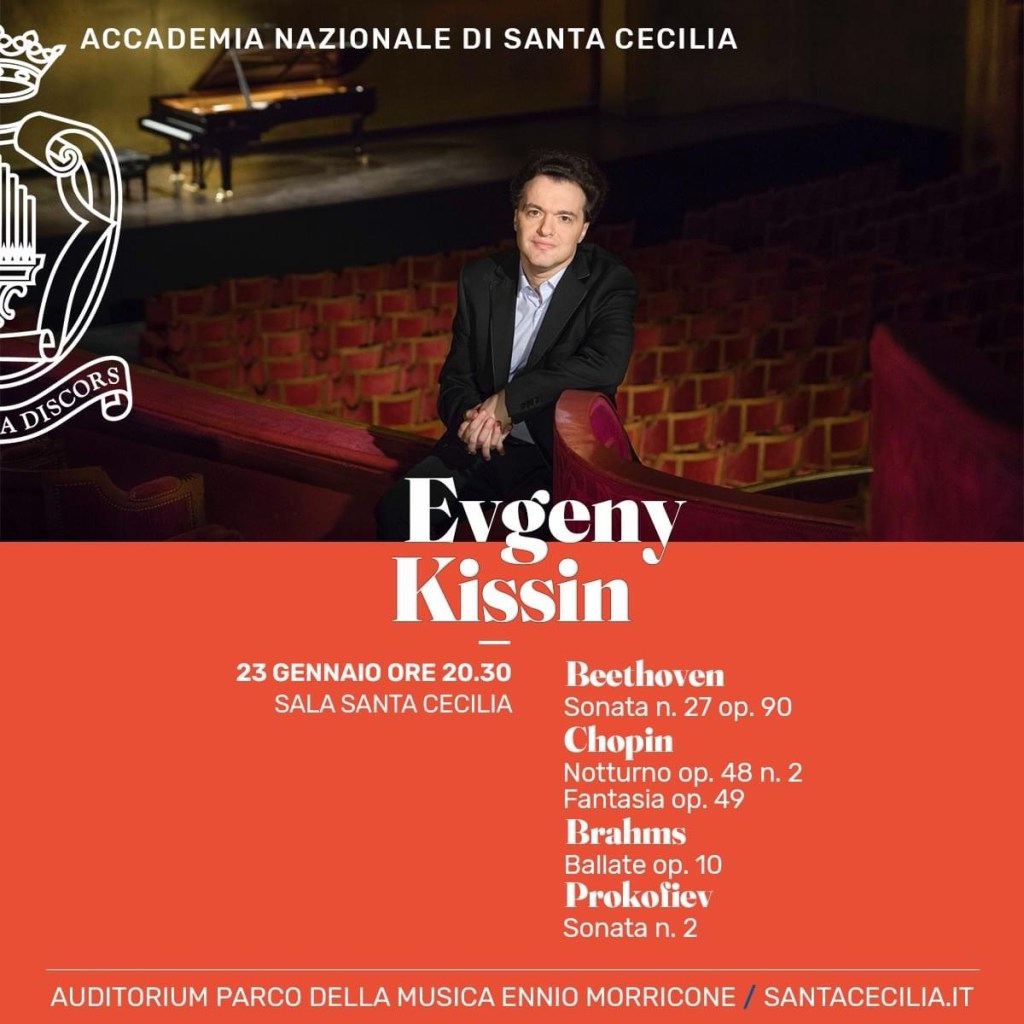
Words cannot do justice to the three monumental performances we heard today from Evgeny Kissin.Who would have thought that Beethoven op 90 and Chopin Nocturne op 48 n 2 and the F minor Fantasie would appear like new as they were recreated before our incredulous eyes by a pianist who from a leggendary child prodigy passing through sometimes questionable interpretations has now in his first half century become one of the greatest artists I have ever heard.
This is a man in love above all with the sound of the piano but also with his evident joy to be able to share his voyage of discovery with an audience. Only from Sokolov have I heard such pianistic and musical perfection.If sometimes the tempi were slow and the music was not allowed to take wing it was because every note and every rest was pregnant with meaning.’Tempo di Marcia’ the Fantasie it was not ……but it was by a strange paradox that it was mesmerising in the way that in convincing himself he drew us in to this recreation and we too were hypnotised ravished and following with baited breath the conversation between interpreter and composer.The central episode of the nocturne became monumental instead of incidental but as Curzon said on hearing Radu Lupu in Leeds :thank God I lived to hear that!
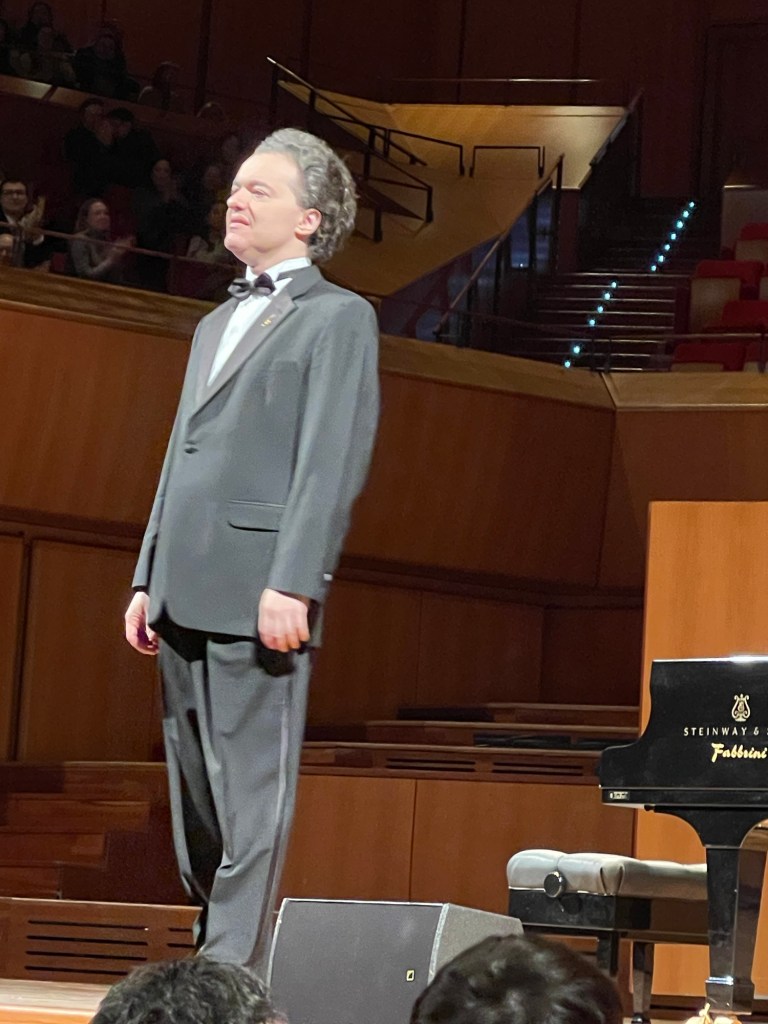
Beethoven op 90 where the punctuation was so precise but orchestral in its precision and contrapuntal clarity.There were remarkable contrasts between the military and the liquid purity of the melodic.Beethoven’s search for a way back became a hide and seek of suspense. The second movement flowed so mellifluously with a truly wondrous sense of balance as the melodic line floated indeed on magic wings of song.The left hand rests too became so important and infact every detail was noted like a Toscanini or Boulez at the helm of the Philharmonic.
The lights dim and this voyage of discovery continues ……..
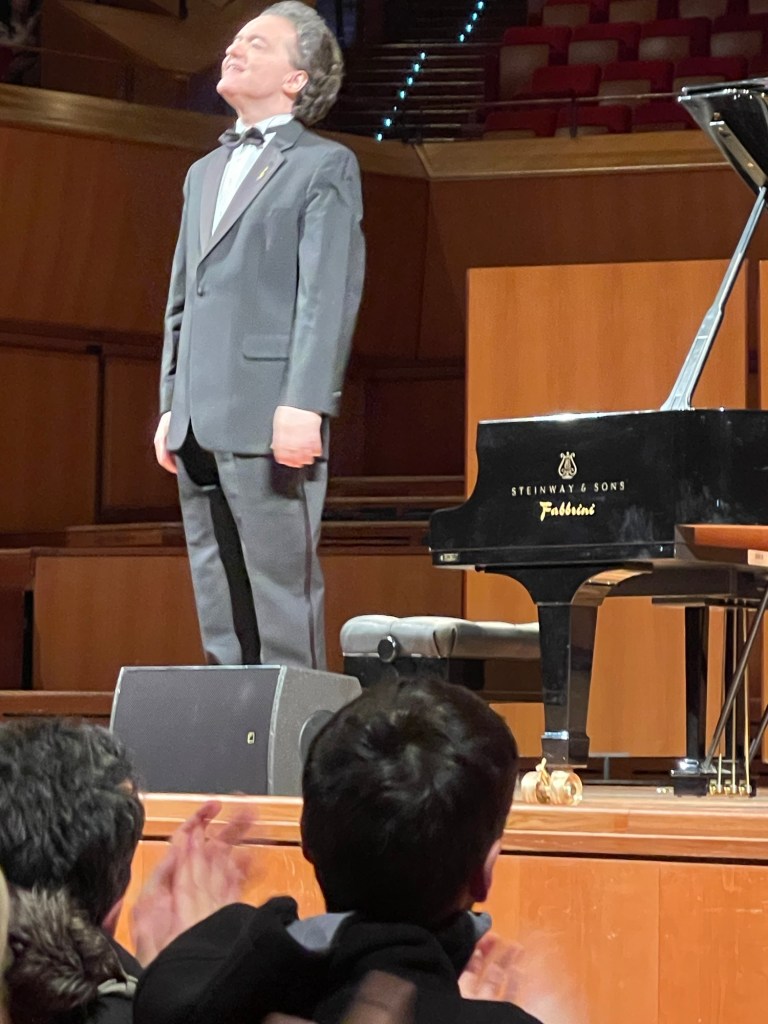
I thought nothing could have ever compared to my memory of Michelangeli playing Brahms Ballades until tonight where there was obviously magic in the air.The sublime heights Kissin reached will remain with me for a long time as Michelangeli had over fifty years ago.The fourth Ballade, ‘Andante con moto’ it was not but what does that matter when he could delve into the very soul of this sublime creation.Reverberations appeared as if the whole piano was vibrating out of which emerged a melodic line that was truly breathtaking .The Ballades had opened with such delicacy and beauty with the bass sustaining and adding another dimension to the wonderful legato that defied the fact that this black box was merely hammers hitting the strings.How was it possible that in Kissin’s hands tonight it became a wondrous box of jewels that glittered and sang with the same expressiveness of a Schwarzkopf.This is the illusion that a great artist after years at the helm can arrive at :Nirvana finding a wondrous world that others can never reach.A gradual rise in tension was suddenly released with the return of the opening theme even more legato with staccato left hand like pizzicato strings of an orchestra that suddenly took on a sinister appearance .Yes, Kissin with just ten fingers could find the sounds that only Walter could find with a full Symohony orchestra.In the second Ballade the clouds parted and the rising sun illuminated a beautiful pastoral scene and there was a ravishing beauty of poignant purity.It contrasted with the orchestral central episode only to have an even more wondrous appearance of the opening melodic line but with calm and reconciliation after the storm.The third Ballade opened with a startling reawakening of rhythmic precision and insistence but also with kaleidoscopic sounds.Purity and luminosity of religious intensity was of disarming simplicity in the central episode.
Prokofiev’s Second Sonata immediately followed after rapturous applause for Brahms but Kissin deciding to stay on stage this time.A completely different sound world opened up of the fantasy of a true world of dreams.A melodic line of amazing clarity appeared amongst the multicoloured sound world that had suddenly been unleashed.Rhythmic drive of the second movement with its spiky notes pointed with deadly precision was followed by the restless driving meanderings of great intensity of the Andante.The final movement brought this great gust of wind to an exciting end.
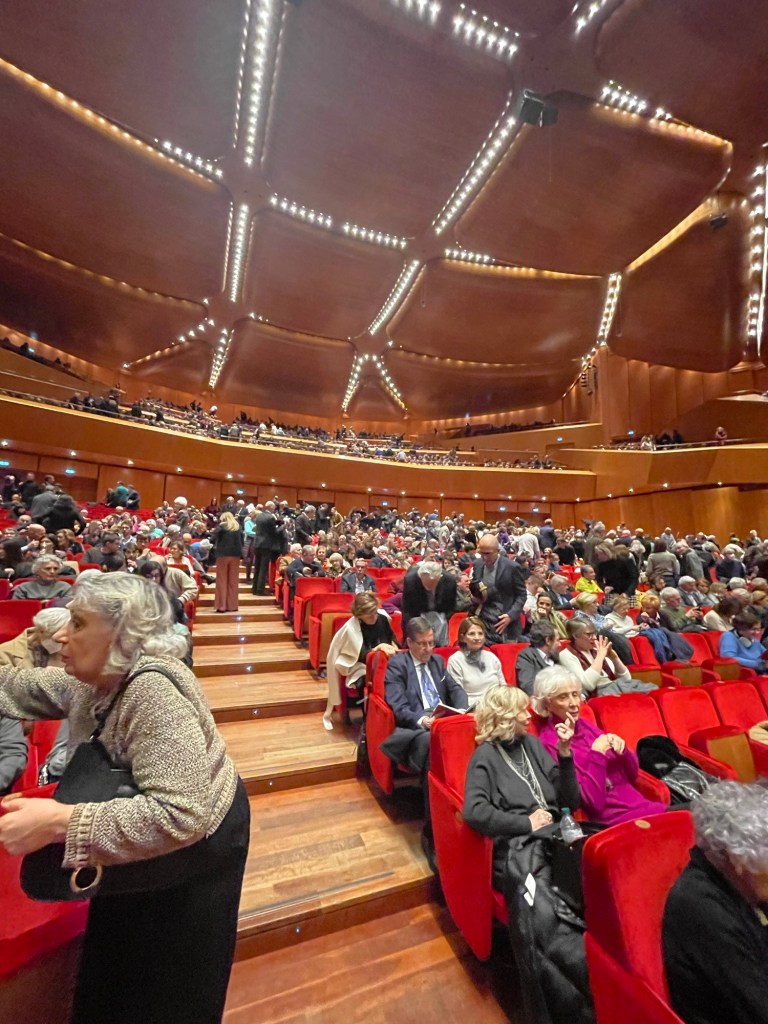
An ovation from a hall that I have rarely seen so full even for other pianistic giants like Sokolov or Volodos.Kissin who indeed had been ‘kissed’ by the Gods tonight played a Chopin Mazurka op 67 n.4 in A minor of refined purity and ravishing beauty that you could feel two thousand people united in following every subtle move that the melodic line was allowed to take with an almost improvised freedom and elasticity that I have not heard since Rubinstein.
Prokofiev’s March from ‘The Love for Three Oranges’ of course was a staggering tour de force of control and of dynamic range but it was the Brahms Waltz in A flat op 39 n.15 ,that Kissin wanted to send us away with,that was of such sublime beauty that I never expect to hear the like again ………until this masters next appearance!
Like Richter he can take a melodic line at such slow tempi because he can find so many different sounds within each note .It may mean some unorthodox changes of tempi that are hardly noticeable or of importance because the voyage is so beautiful that to stop and stare like with his Rachmaninov 3rd just a month ago is such a refreshing change from the usual speed mongers that occupy too often our concert halls.A thing of beauty is indeed a joy forever applies here stronger than ever.
The first time I heard Richter in London it was not his demonic energy or unorthodox technical genius that surprised so much as how quietly he could play and what control of sound never loosing the overall architectural shape of the music.
Kissin has arrived at a maturity now that for me marks him out as the only reason why live performance of well worn masterpieces can still be one of the most stimulating artistic experiences.
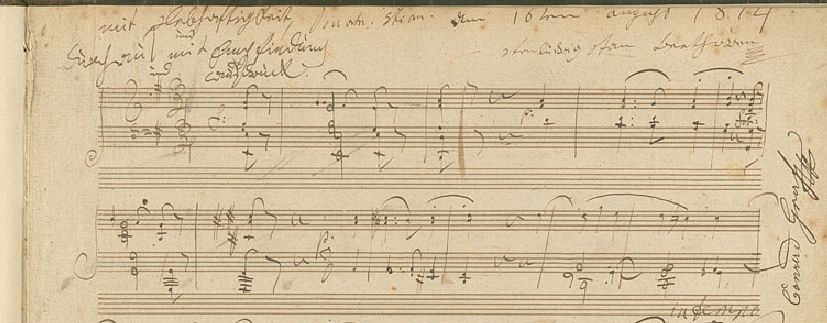
‘I had a delightful walk yesterday with a friend in the Brühl, and in the course of our friendly chat you were particularly mentioned, and lo! and behold! on my return I found your kind letter. I see you are resolved to continue to load me with benefits. As I am unwilling you should suppose that a step I have already taken is prompted by your recent favors, or by any motive of the sort, I must tell you that a sonata of mine is about to appear, dedicated to you. I wished to give you a surprise, as this dedication has been long designed for you, but your letter of yesterday induces me to name the fact. I required no new motive thus publicly to testify my sense of your friendship and kindness.’
Beethoven’s friend and biographer Anton Schindler reported that the sonata’s two movements were to be titled Kampf zwischen Kopf und Herz (“A Contest Between Head and Heart”) and Conversation mit der Geliebten (“Conversation with the Beloved”), respectively, and that the sonata as a whole referred to Moritz’s romance with a woman he was thinking of marrying.Schindler’s explanation first appeared in his 1842 book Beethoven in Paris and has been repeated in several other books. Later studies showed that the story was almost certainly invented by Schindler, at least in part, and that he went so far as to forge an entry in one of Beethoven’s conversation books to validate the anecdote.
Most of Beethoven’s piano sonatas are in three or four movements, but this one has only two. Both are provided with performance instructions in German. A few of Beethoven’s works of this period carried similar instructions in place of the traditional Italian tempo markings.
- Mit Lebhaftigkeit und durchaus mit Empfindung und Ausdruck (“With liveliness and with feeling and expression throughout”)
- Nicht zu geschwind und sehr singbar vorgetragen (“Not too swiftly and conveyed in a singing manner”)
The restless character of the first movement has been described by Tovey as “full of passionate and lonely energy “ and Charles Rosen , wrote of its “despairing and impassioned” mood.Andras Schiff hears Bach’s influence in the “beautiful counterpoint ” that unfolds in the development.
The second movement is a gentle sonata – rondo movement in E major
where its Romantic character, foreshadows Schubert as has long been noted by numerous musicians.
According to Wilfred Mellers , “Opus 90 belongs neither to [Beethoven’s] middle nor to his late phase and Denis Matthews sees it as having “more claim to kinship with the great sonatas of the last period than to the previous ones.” Hans von Bulow declared that this is the work “with which the series of pianoforte works of the Master’s so-called ‘last period’ begins.”Schiff has drawn attention to the apparent connection between the ending of this sonata, which closes in the key of E and the E major chord that opens the Sonata in A major, Op. 101, composed in 1816n declaring that : “If I go into the next sonata it sounds like a continuation of the previous one.”
The Ballades, Op. 10, were written by Brahms in his youth. They were dated 1854 and were dedicated to his friend Julius Otto Grimm. Their composition coincided with the beginning of the composer’s lifelong affection for the pianist and composer Clara Schumann, who was helping Brahms launch his career. The Scottish ballad “Edward” from J. G. Herders anthology of folk songs “Stimmen der Völker in Liedern” made such a deep impression on Brahms that, as he told a friend, the melodies came to him effortlessly.
Dein Schwert, wie ist’s von Blut so rot? Edward, Edward!
Dein Schwert wie ist’s von Blut so rot, und gehst so traurig her? – O!
O, ich hab’ geschlagen meinen Geier todt, Mutter, Mutter!
O, ich hab’ geschlagen meinen Geier todt, und keinen hab’ ich wie er – O!
Why does your Brand sae drop wi’ blude, Edward, Edward,
Why does your Brand sae drop wie blude, and why sae sad gang ye, O?
O, I hae kill’d my hawk, sae gude, mither, mither,
O, I hae kill’d my hawk, sae gude, and I had nae mehr but he, O
“Edward” provided the motif for the first of four ballade compositions, musical tales of a dramatic romantic nature that were linked with memories of Clara Schumann for Brahms. Julius Grimm, to whom the pieces were dedicated, also said that “the Ballades are really for her”. Robert Schumann was very enthusiastic about his young colleague’s composition. Chopin had written the last of his four Ballades only 12 years earlier, but Brahms approached the genre differently from Chopin, choosing to take its origin in narrative poetry more literally.
They are arranged in two pairs of two, the members of each pair being in parallel keys . The first ballade is one of the best examples of Brahms’s bardic or Ossianic style; its open fifths, octaves, and simple triadic harmonies are supposed to evoke the sense of a mythological past.
- D minor. Andante
- D major. Andante
- B minor. Intermezzo. Allegro
- B major. Andante con moto
The tonal center of each ballade conveys an interconnectedness between the four pieces: the first three each include the key signature of the ballade that follows it somewhere as a tonal center, and the fourth ends in the key signature of D major/B minor despite cadencing in B major.
Brahms returned to the wordless ballade form in writing the third of the Six pieces for piano op 118 . His Op. 75 vocal duets titled “Ballads and Romances” include a setting of the poem “Edward”—the same that inspired Op. 10, No. 1.
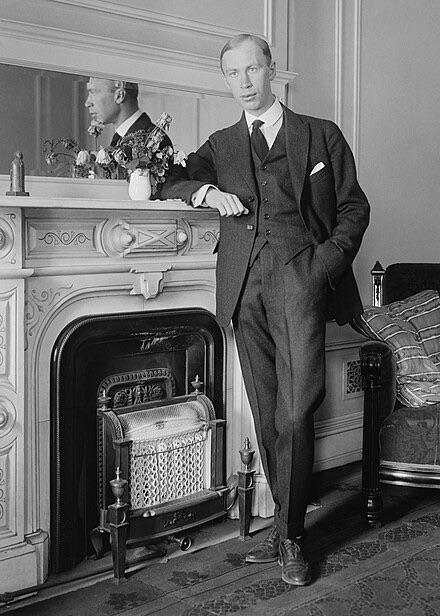
Sergei Prokofiev’s Piano Sonata No. 2 in D Minor, Op. 14, was written in 1912 and published 1913, it was premiered on 5 February 1914 in Moscow with the composer performing.Prokofiev dedicated the work to his friend and fellow student at the St Petersburg Conservatory, Maximilian Schmidthof, who committed suicide in 1913. It covers a huge emotional range: from Romantic lyricism to aggressive brutality’.
- Allegro ma non troppo – Più mosso-Tempo Primo
- Scherzo.Allegro marcato
- Andante
- Vivace – Moderato – Vivace
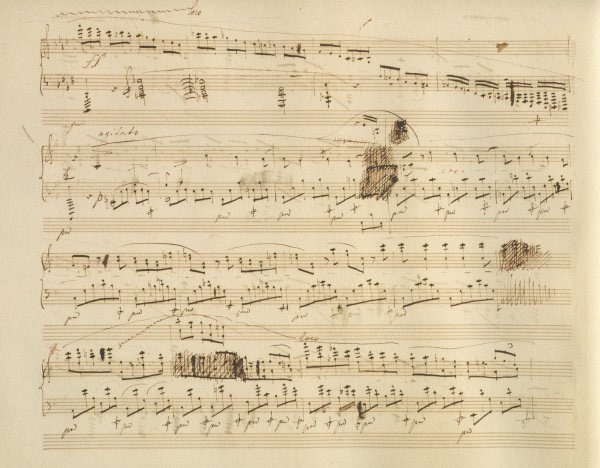
The Fantaisie in F minor, Op. 49, by Chopin was composed in 1841, when he was 31 years old and the most harmonious year in his stormy relationship with the author George Sand (the pen name of Amandine-Aurore-Lucile Dupin, Baroness Dudevant) From Chopin’s letters it is known that he used the name “fantasy” to show some sort of freedom from rules and give a Romantic expression.Frédéric Chopin continued the tradition of a self-contained movement in his Fantaisie.This Fantaisie is considered one of his greatest works.Scholars have long been trying to figure out the mystery of Chopin’s one and only solo Fantasie. The highly individual form is a puzzle to all who prefer more traditional genre concepts. Is it a sonata movement, a rondo, or even a free combination of character movements such as march, recitative or chorale? Chopin lovers have no need of such considerations, seeing that nobody would ever dare to doubt that this Fantasie is one of the greatest works from his pen. After completing the composition, Chopin wrote “The sky is bright, but my heart is afflicted by sorrow”. This gloomy contrast pervades the Fantasie. It is an exceptional work from every point of view
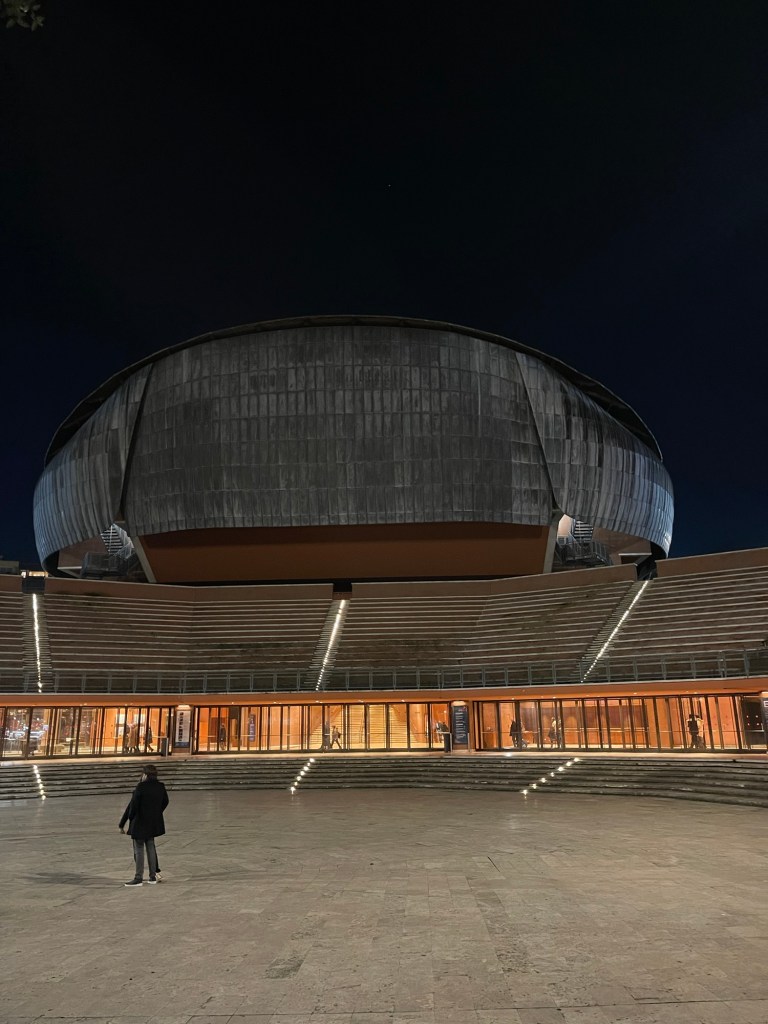
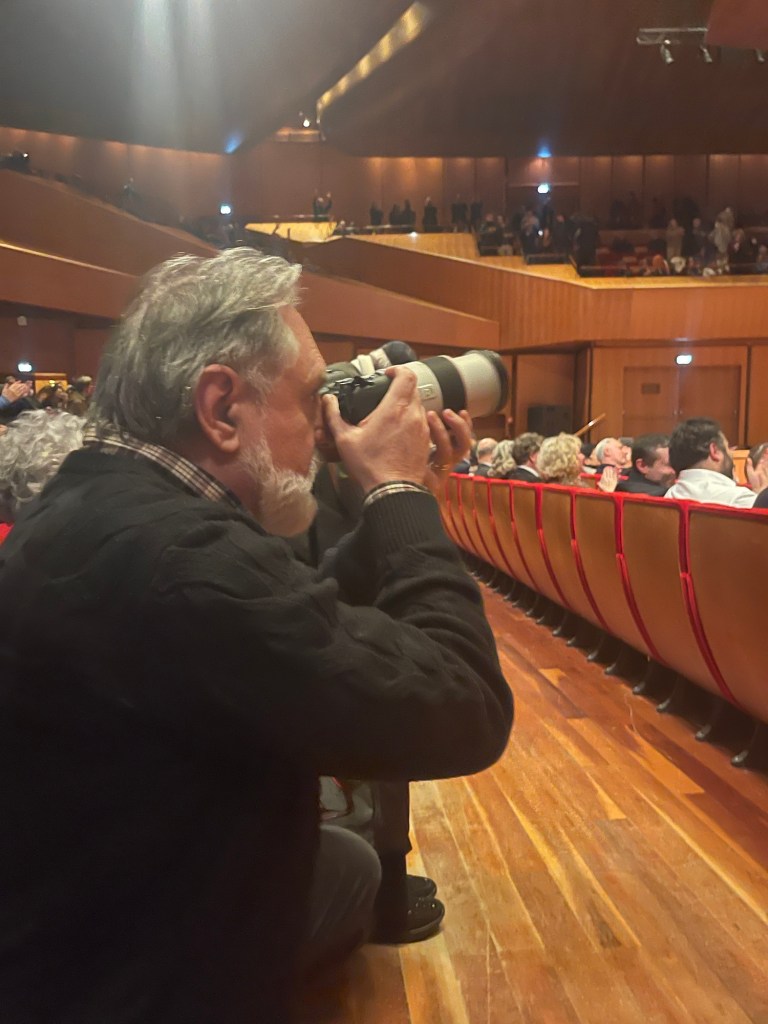
(Riccardo Musacchio was born in Rome in 1964. He started working for the principal theatres and auditoriums of the Capital. Official photographer for the Santa Cecilia National Academy, for the Auditorium Music Park of Rome, the Sistina Theatre, Courtial International and many other collaborations. His contributions to national and international magazines and newspapers have consented him an approach outside of the theatre world. His archives, already rich of photographs of conductors, prose actors, sopranos, tenors, dancers etc, also include portraits of writers, scientists, geographic reporter).
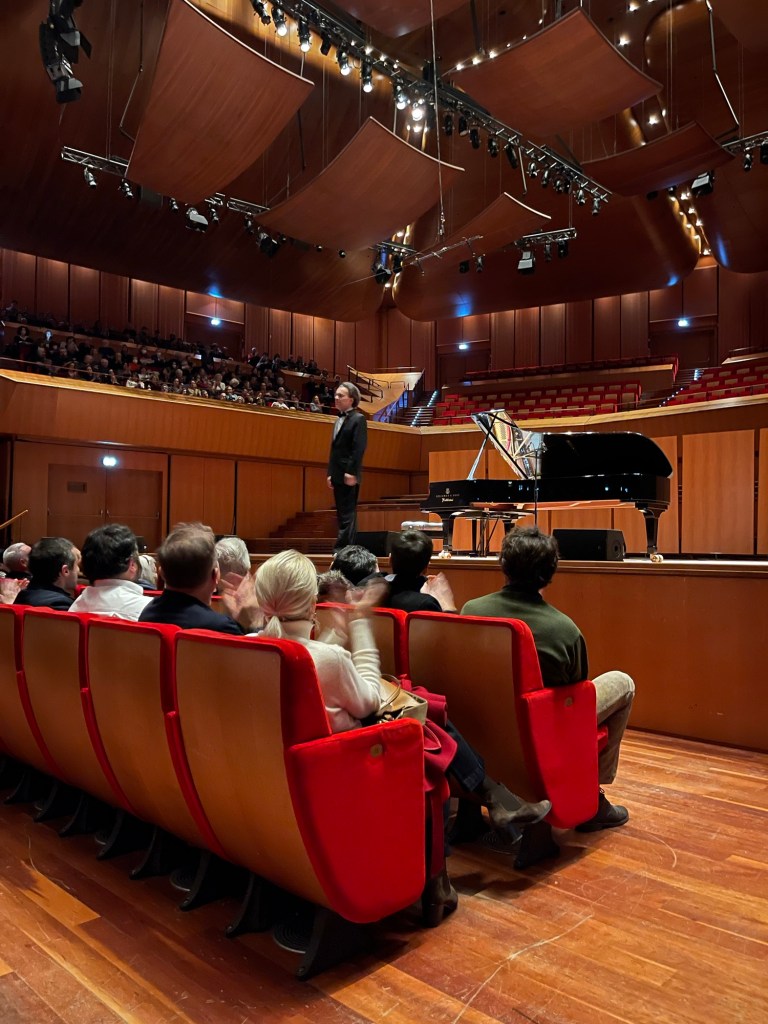
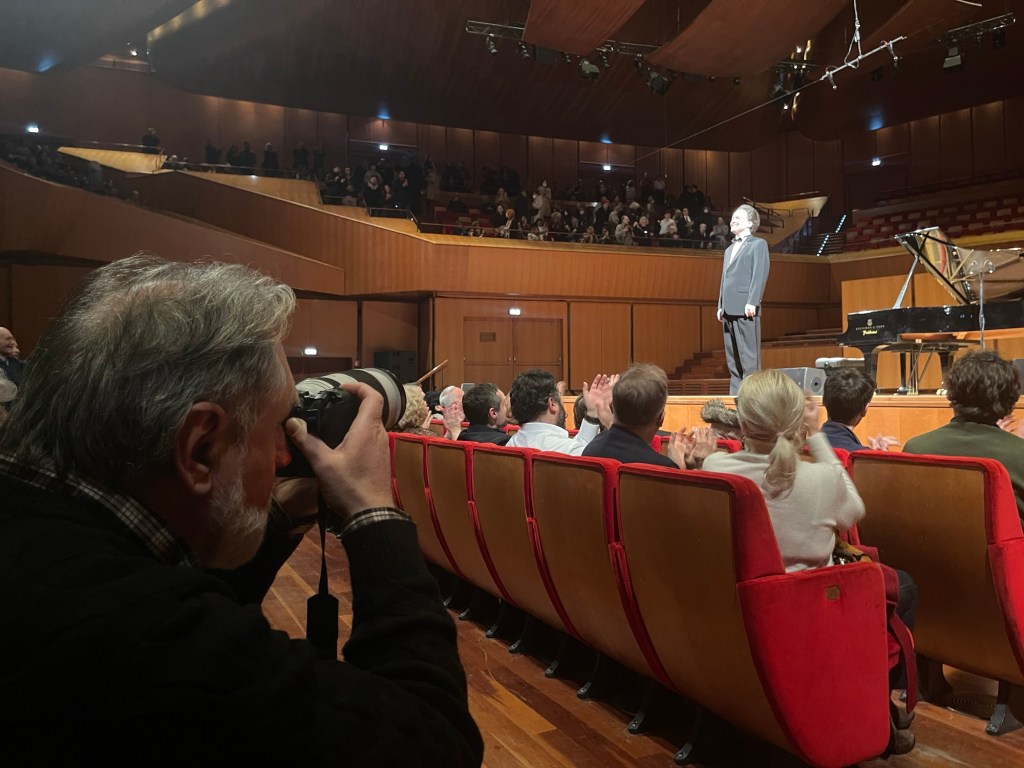
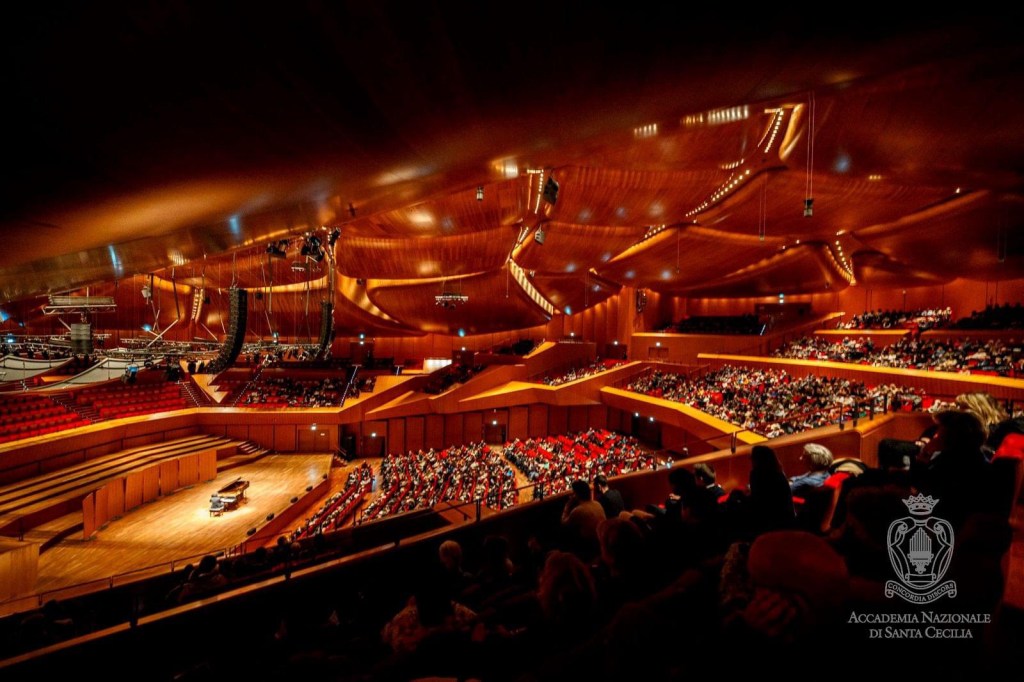
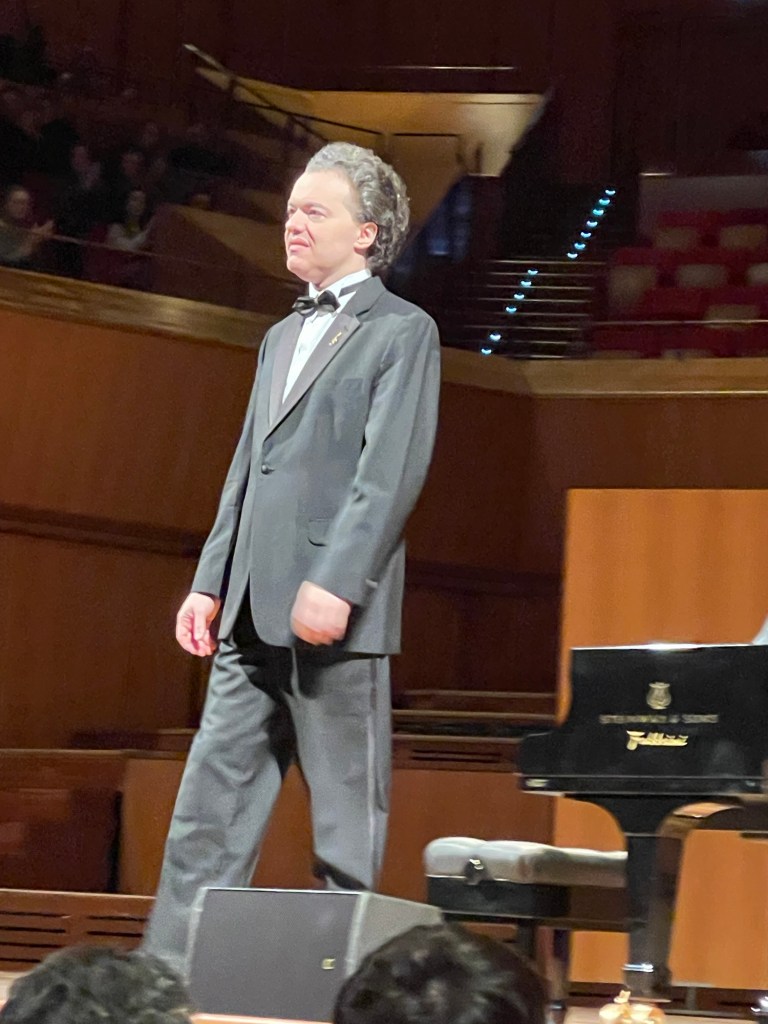
Kissin the Conqueror
Kissin- The Conqueror
 ChristopherAxworthy-MusicCommentary